length NISSAN NOTE 2016 Service Owner's Manual
[x] Cancel search | Manufacturer: NISSAN, Model Year: 2016, Model line: NOTE, Model: NISSAN NOTE 2016Pages: 3641, PDF Size: 28.72 MB
Page 2331 of 3641
MA-16
< PERIODIC MAINTENANCE >
ENGINE MAINTENANCE
ENGINE COOLANT : Draining Engine Coolant
INFOID:0000000012432253
WARNING:
Do not remove the radiator cap when the engine is hot. Serious burns could occur from high-pressure
engine coolant escaping from the radiator. Wrap a th ick cloth around the cap. Slowly push down and
turn it a quarter turn to allow built-up pressure to escape. Carefully remove the cap by pushing it down
and turning it all the way.
1. Remove front under cover. Refer to EXT-39, "
FRONT UNDER COVER : Removal and Installation".
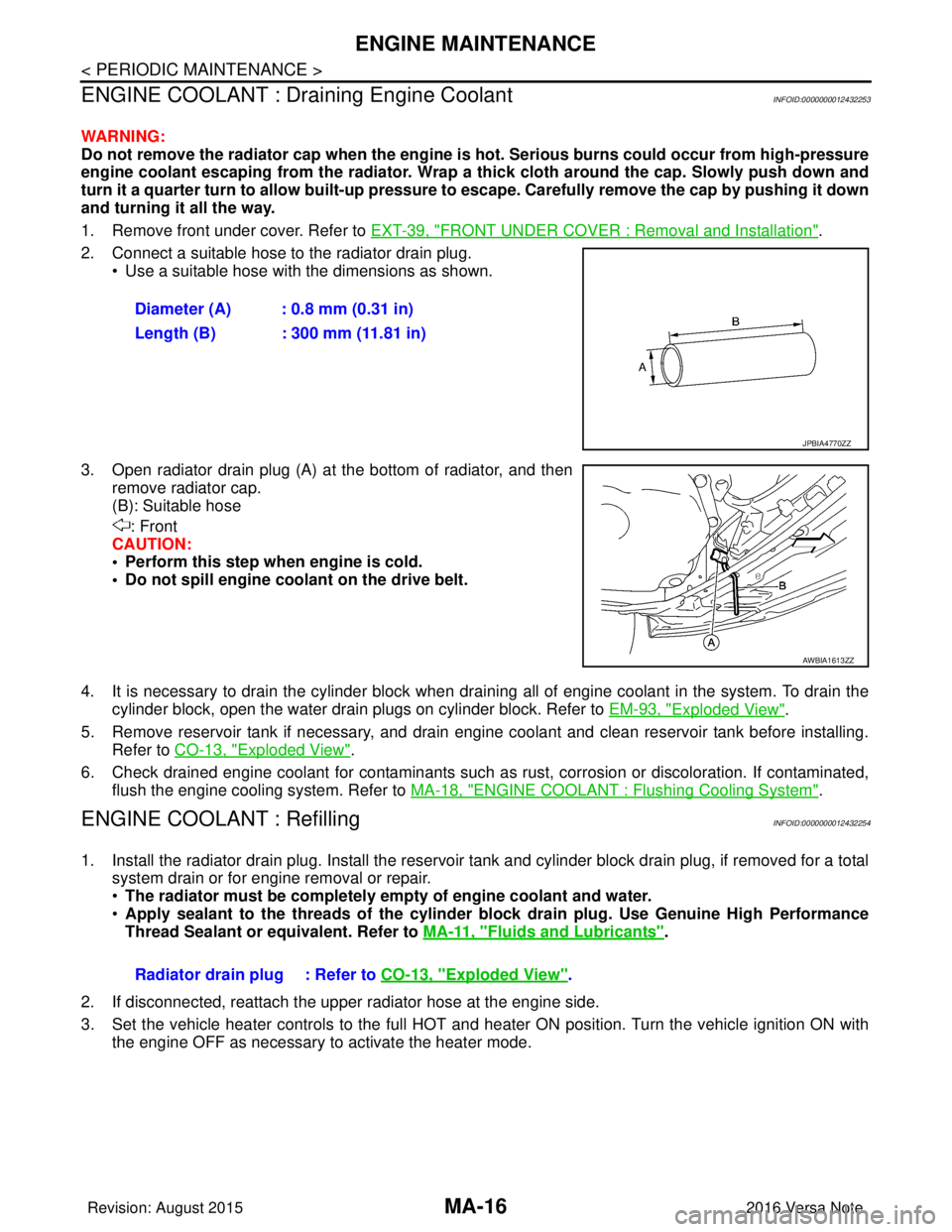
2. Connect a suitable hose to the radiator drain plug. • Use a suitable hose with the dimensions as shown.
3. Open radiator drain plug (A) at the bottom of radiator, and then remove radiator cap.
(B): Suitable hose
: Front
CAUTION:
• Perform this step when engine is cold.
• Do not spill engine coolant on the drive belt.
4. It is necessary to drain the cylinder block when drai ning all of engine coolant in the system. To drain the
cylinder block, open the water drain plugs on cylinder block. Refer to EM-93, "
Exploded View".
5. Remove reservoir tank if necessary, and drain engine coolant and clean reservoir tank before installing. Refer to CO-13, "
Exploded View".
6. Check drained engine coolant for contaminants such as rust, corrosion or discoloration. If contaminated, flush the engine cooling system. Refer to MA-18, "
ENGINE COOLANT : Flushing Cooling System".
ENGINE COOLANT : RefillingINFOID:0000000012432254
1. Install the radiator drain plug. Install the reservoir tank and cylinder block drain plug, if removed for a total
system drain or for engine removal or repair.
• The radiator must be completely empty of engine coolant and water.
• Apply sealant to the threads of the cylinder block drain plug. Use Genuine High Performance
Thread Sealant or equivalent. Refer to MA-11, "
Fluids and Lubricants".
2. If disconnected, reattach the upper radiator hose at the engine side.
3. Set the vehicle heater controls to the full HOT and heat er ON position. Turn the vehicle ignition ON with
the engine OFF as necessary to activate the heater mode. Diameter (A) : 0.8 mm (0.31 in)
Length (B) : 300 mm (11.81 in)
JPBIA4770ZZ
AWBIA1613ZZ
Radiator drain plug : Refer to
CO-13, "Exploded View".
Revision: August 2015 2016 Versa Note
cardiagn.com
Page 2802 of 3641
COMPONENT INSPECTIONSB-5
< BASIC INSPECTION >
C
DE
F
G
I
J
K L
M A
B
SB
N
O P
BASIC INSPECTION
COMPONENT INSPECTION
InspectionINFOID:0000000012430699
AFTER A COLLISION
WARNING:
Inspect all seat belt assemblies in cluding retractors and attaching hardware after any collision.
NISSAN/INFINITI recommends that all seat belt assemblies in use during a collision be replaced
unless the collision was minor and th e belts show no damage and continue to operate properly. Fail-
ure to do so could result in serious personal inju ry in an accident. Seat belt assemblies not in use dur-
ing a collision should also be replaced if either damage or improper operation is noted. Seat belt pre-
tensioners should be replaced even if the seat belts are not in use during a frontal collision in which
the air bags are deployed.
Replace any seat belt assembly (including anchor bolts) if:
• The seat belt was in use at the time of a collision (except for minor collisions and the belts, retractors and buckles show no damage and continue to operate properly).
• The seat belt was damaged in an accident (i.e. torn webbing, bent retractor or guide, etc.).
• The seat belt attaching point is damaged in an accident. Inspect the seat belt attaching area for damage or
distortion and repair if necessary before installing a new seat belt assembly.
• Anchor bolts are deformed or worn out.
• The seat belt pre-tensioner should be replaced even if t he seat belts are not in use during the collision in
which the air bags are deployed.
PRELIMINARY CHECKS
1. Check the seat belt warning lamp for proper operation per the following:
a. Turn ignition switch ON. The seat belt warning lamp should illuminate.
b. Fasten driver seat belt. The seat belt warning lamp should turn OFF.
2. If the air bag warning lamp is blinking, perform self-diagnosis with CONSULT and air bag warning lamp. Refer to SRC-14, "
Description".
3. Check that the seat belt retractor, seat belt anchor and buckle bolts are tightened firmly.
4. Check the shoulder seat belt guide and shoulder belt height adjuster for front seats. Check that guide
swivels freely and that webbing lays flat and does not bind in guide. Check that height adjuster operates
properly and holds securely.
5. Check retractor operation:
a. Fully extend the seat belt webbing and check for twists, tears or other damage.
b. Allow the seat belt to retract. Check that webbing retu rns smoothly and completely into the retractor. If the
seat belt does not return smoothly, wipe the inside of the loops with a clean paper cloth. Dirt build-up in the
loops of the upper anchors can cause the seat belts to retract slowly.
c. Fasten the seat belt. Check that seat belt returns smoothly and completely to the retractor. If the webbing does not return smoothly, the cause may be an accu mulation of dust or dirt. Use the “SEAT BELT TAPE
SET” and perform the following steps.
d. Inspect the front seat belt D-ring anchor 1. Pull the seat belt out to a length of 500 mm (19.69 in) or more.
2. Hold the seat belt at the center pillar webbing opening with a clip or other device.
3. Pass a thin wire through the D-ring anchor webbing opening. Hold both ends of the wire and pull it tightly while moving it up and down several times along the webbing opening surface to remove dirt
stuck there.
4. Any dirt that cannot be removed with the wire can be removed by cleaning the opening with a clean
cloth.
5. Apply tape at the point where the webbing contacts the D-ring anchor webbing opening. NOTE:
Apply the tape so that there is no slack or wrinkling.
6. Remove the clip holding the seat belt and check that the webbing returns smoothly.
6. Repeat steps above if necessary to check the other seat belts.
Revision: August 2015 2016 Versa Note
cardiagn.com
Page 2803 of 3641
SB-6
< BASIC INSPECTION >
COMPONENT INSPECTION
SEAT BELT RETRACTOR ON-VEHICLE CHECK
Emergency Locking Retractors (ELR) and Automatic Locking Retractors (ALR)
NOTE:
All seat belt retractors are Emergency Locking Retractors (ELR) type. In an emergency (sudden stop) the
retractor will lock and prevent the webbing from extendi ng any further. All 3-point type seat belt retractors
except the driver seat belt also have an Automati c Locking Retractors (ALR) mode. The ALR mode (also
called child restraint mode) is used when installing child seats. The ALR mode is activated when the seat belt
is fully extended. When the webbing is then retracted part ially, the ALR mode automatically locks the seat belt
in a specific position so the webbing cannot be extended any further. To cancel the ALR mode, allow the seat
belt to fully wind back into the retractor.
Check the seat belt retractors with the following test(s ) to determine if a retractor assembly is operating prop-
erly.
ELR Function Stationary Check
Grasp the shoulder webbing and pull forward quickly. T he retractor should lock and prevent the belt from
extending further.
ALR Function Stationary Check
1. Pull out the entire length of seat belt from retractor until a click is heard.
2. Retract the webbing partially. A clicking noise shoul d be heard as the webbing retracts, indicating that the
retractor is in the Automatic Locking Retractors (ALR) mode.
3. Grasp the seat belt and try to pull out the retractor. The webbing must lock and not extend any further. If it
does not operate normally, replace the retractor assembly.
4. Allow the entire length of the webbing to re tract to cancel the automatic locking mode.
ELR Function Moving Check
WARNING:
Perform the following test in a safe, open area clear of other vehicles and obstructions (for example, a
large, empty parking lot). Road surface must be p aved and dry. Never perform the following test on
wet or gravel roads or on public streets and highw ays. This could result in an accident and serious
personal injury. The driver and passenger must be prepared to brace themselves in the event that the
retractor does not lock.
1. Fasten driver seat belt. Buckle a passenger into the seat for the belt that is to be tested.
2. Proceed to the designated safe area.
3. Drive the vehicle at approximately 16 km/h ( 10 mph). Notify any passengers of a pending sudden stop
and the driver and passenger must be prepared to brace themselves in the event that the retractor does
not lock. Apply brakes firmly and make a very hard stop.
During stopping, seat belts should lock and not be extended. If the seat belt retractor assembly does not lock,
perform the retractor off-vehicle check.
FRONT SEAT BELT RETRACTOR OFF-VEHICLE CHECK
1. Remove the front seat belt retractor. Refer to SB-9, "SEAT BELT RETRACTOR : Removal and Installa-
tion".
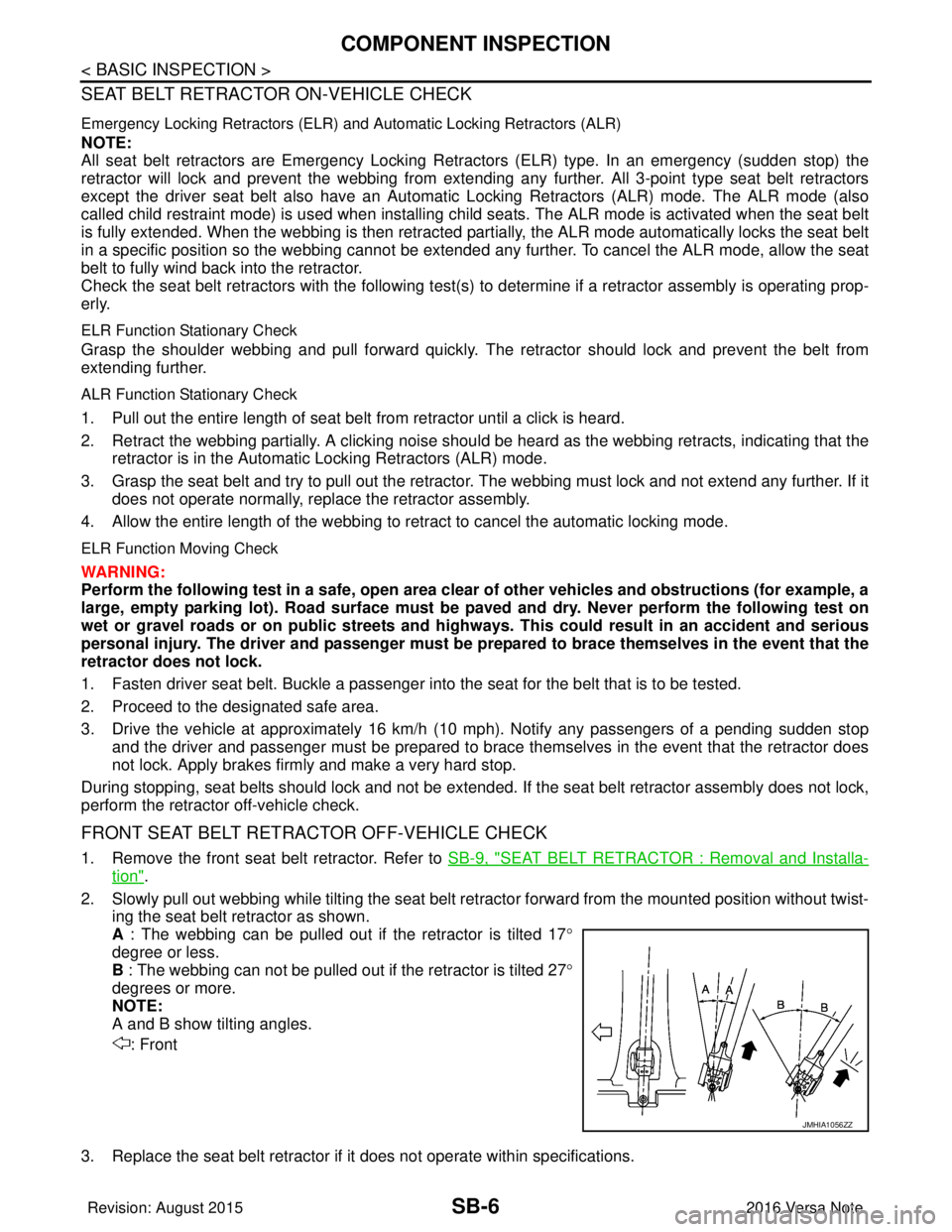
2. Slowly pull out webbing while tilting the seat belt re tractor forward from the mounted position without twist-
ing the seat belt retractor as shown.
A : The webbing can be pulled out if the retractor is tilted 17 °
degree or less.
B : The webbing can not be pulled out if the retractor is tilted 27°
degrees or more.
NOTE:
A and B show tilting angles.
: Front
3. Replace the seat belt retractor if it does not operate within specifications.
JMHIA1056ZZ
Revision: August 2015 2016 Versa Note
cardiagn.com
Page 3039 of 3641
SRC-22
< ECU DIAGNOSIS INFORMATION >
DIAGNOSIS SENSOR UNIT
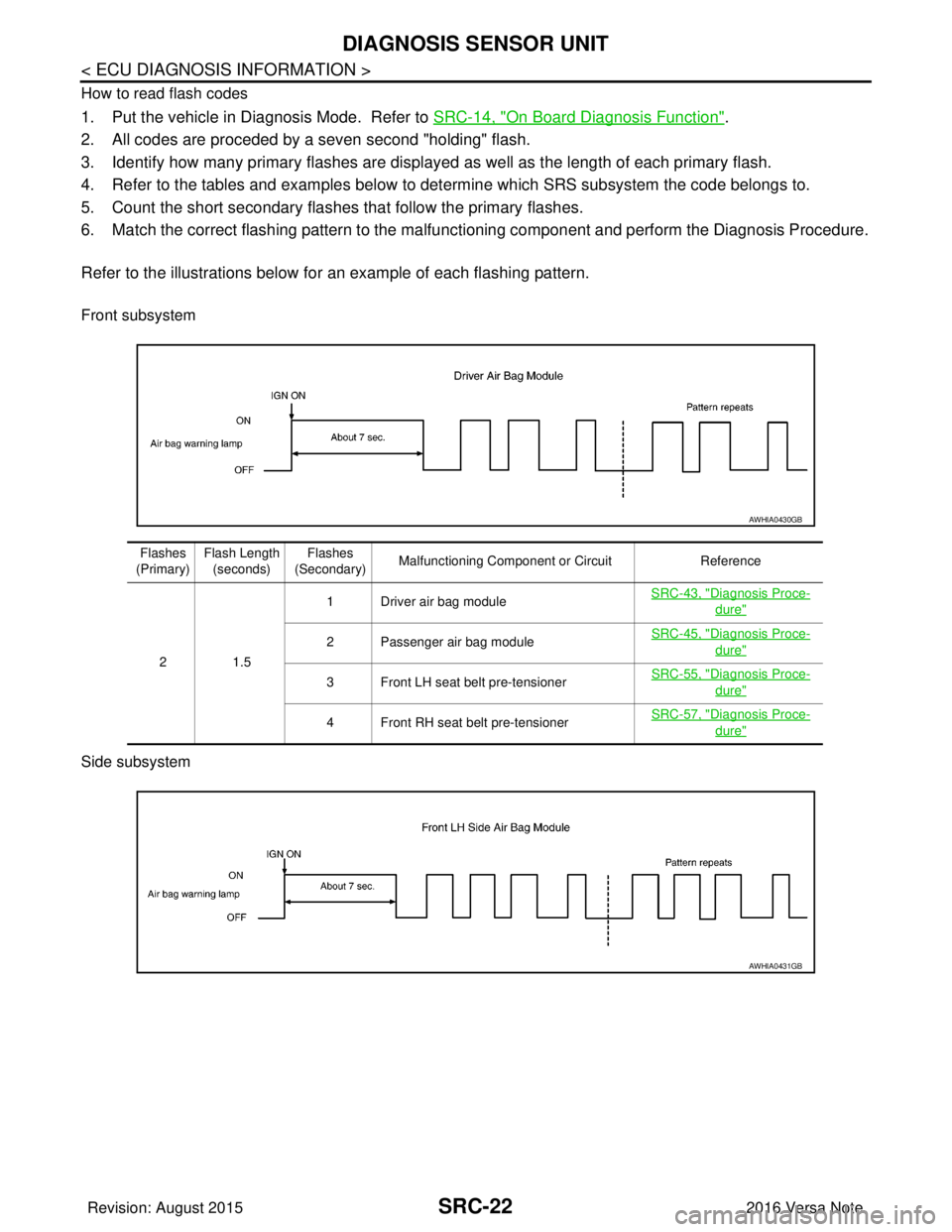
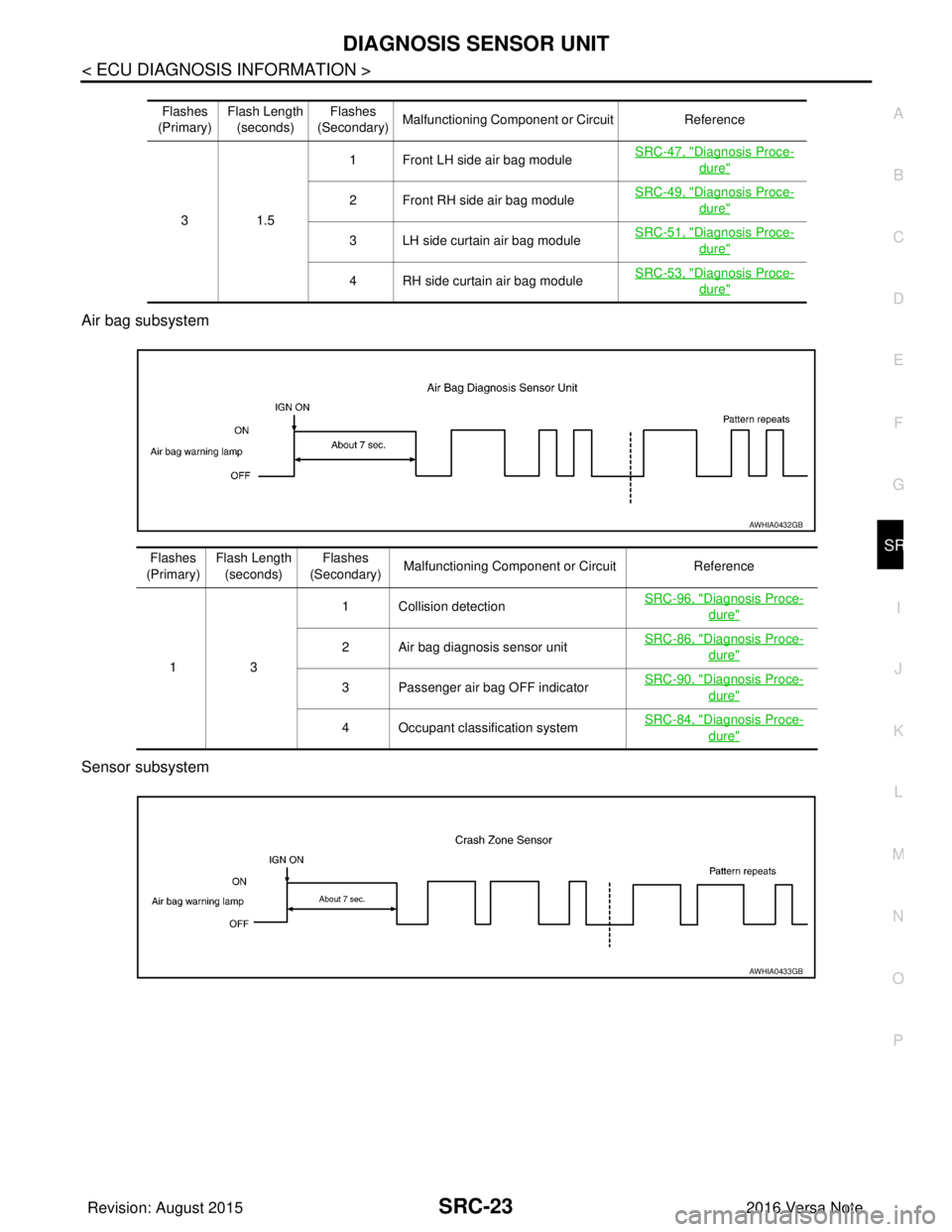
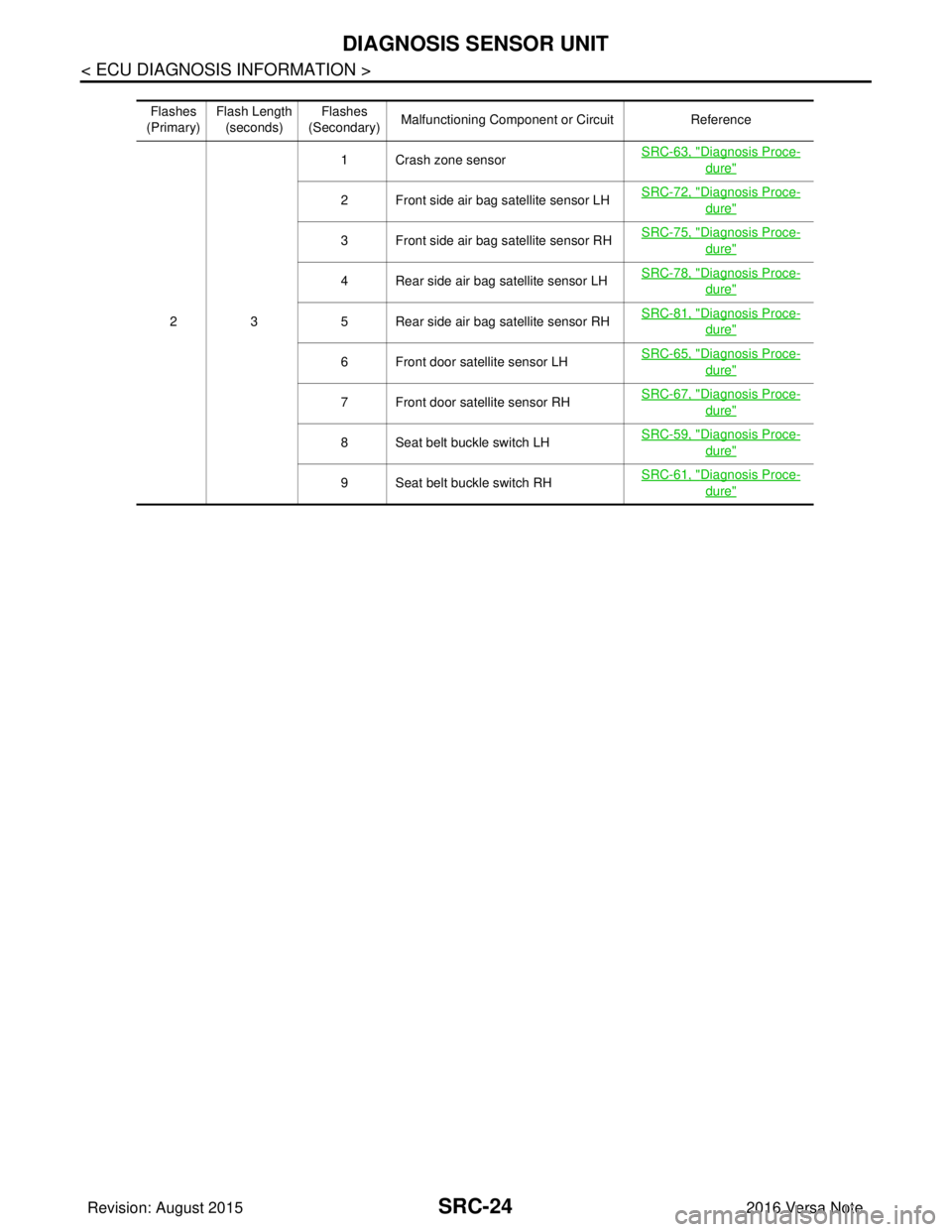
How to read flash codes
1. Put the vehicle in Diagnosis Mode. Refer to SRC-14, "On Board Diagnosis Function".
2. All codes are proceded by a seven second "holding" flash.
3. Identify how many primary flashes are display ed as well as the length of each primary flash.
4. Refer to the tables and examples below to determine which SRS subsystem the code belongs to.
5. Count the short secondary flashes that follow the primary flashes.
6. Match the correct flashing pattern to the malfunctioning component and perform the Diagnosis Procedure.
Refer to the illustrations below fo r an example of each flashing pattern.
Front subsystem
Side subsystem
AWHIA0430GB
Flashes
(Primary) Flash Length
(seconds) Flashes
(Secondary) Malfunctioning Component or Circuit
Reference
21 .5 1 Driver air bag module
SRC-43, "
Diagnosis Proce-
dure"
2 Passenger air bag moduleSRC-45, "Diagnosis Proce-
dure"
3 Front LH seat belt pre-tensioner
SRC-55, "Diagnosis Proce-
dure"
4 Front RH seat belt pre-tensionerSRC-57, "Diagnosis Proce-
dure"
AWHIA0431GB
Revision: August 2015
2016 Versa Note
cardiagn.com
Page 3040 of 3641
DIAGNOSIS SENSOR UNITSRC-23
< ECU DIAGNOSIS INFORMATION >
C
DE
F
G
I
J
K L
M A
B
SRC
N
O P
Air bag subsystem
Sensor subsystem
Flashes
(Primary) Flash Length
(seconds) Flashes
(Secondary) Malfunctioning Component or Circuit
Reference
31 .5 1 Front LH side air bag module
SRC-47, "
Diagnosis Proce-
dure"
2 Front RH side air bag moduleSRC-49, "Diagnosis Proce-
dure"
3 LH side curtain air bag module
SRC-51, "Diagnosis Proce-
dure"
4 RH side curtain air bag moduleSRC-53, "Diagnosis Proce-
dure"
AWHIA0432GB
Flashes
(Primary) Flash Length
(seconds) Flashes
(Secondary) Malfunctioning Component or Circuit
Reference
13 1 Collision detection
SRC-96, "
Diagnosis Proce-
dure"
2 Air bag diagnosis sensor unitSRC-86, "Diagnosis Proce-
dure"
3 Passenger air bag OFF indicator
SRC-90, "Diagnosis Proce-
dure"
4 Occupant classification systemSRC-84, "Diagnosis Proce-
dure"
AWHIA0433GB
Revision: August 2015
2016 Versa Note
cardiagn.com
Page 3041 of 3641
SRC-24
< ECU DIAGNOSIS INFORMATION >
DIAGNOSIS SENSOR UNIT
Flashes
(Primary) Flash Length
(seconds) Flashes
(Secondary) Malfunctioning Component or Circuit
Reference
23 1 Crash zone sensor
SRC-63, "
Diagnosis Proce-
dure"
2 Front side air bag satellite sensor LHSRC-72, "Diagnosis Proce-
dure"
3 Front side air bag satellite sensor RH
SRC-75, "Diagnosis Proce-
dure"
4 Rear side air bag satellite sensor LHSRC-78, "Diagnosis Proce-
dure"
5 Rear side air bag satellite sensor RHSRC-81, "Diagnosis Proce-
dure"
6 Front door satellite sensor LH
SRC-65, "Diagnosis Proce-
dure"
7 Front door satellite sensor RHSRC-67, "Diagnosis Proce-
dure"
8 Seat belt buckle switch LHSRC-59, "Diagnosis Proce-
dure"
9 Seat belt buckle switch RH
SRC-61, "Diagnosis Proce-
dure"
Revision: August 2015
2016 Versa Note
cardiagn.com
Page 3222 of 3641

ST-1
STEERING
C
DE
F
H I
J
K L
M
SECTION ST
A
B
ST
N
O P
CONTENTS
STEERING SYSTEM
PRECAUTION ....... ........................................2
PRECAUTIONS .............................................. .....2
Precaution for Supplemental Restraint System
(SRS) "AIR BAG" and "SEAT BELT PRE-TEN-
SIONER" ............................................................. ......
2
Service Notice or Precautions for Steering System
......
2
PREPARATION ............................................3
PREPARATION .............................................. .....3
Special Service Tool ........................................... ......3
Commercial Service Tool ..........................................3
BASIC INSPECTION ....................................5
STEERING WHEEL ........................................ .....5
Inspection ............................................................ ......5
SYMPTOM DIAGNOSIS ...............................7
NOISE, VIBRATION AND HARSHNESS
(NVH) TROUBLESHOOTING ........................ .....
7
NVH Troubleshooting Chart ................................ ......7
REMOVAL AND INSTALLATION ................8
STEERING WHEEL ........................................ .....8
Exploded View .................................................... ......8
Removal and Installation ...........................................8
STEERING COLUMN ..................................... .....9
Exploded View .................................................... ......9
Removal and Installation ...........................................9
Inspection ............................................................ ....10
STEERING SHAFT ...........................................12
Exploded View .........................................................12
Removal and Installation .........................................12
Inspection ................................................................13
STEERING GEAR AND LINKAGE ...................14
Exploded View .........................................................14
Removal and Installation .........................................14
Inspection ................................................................14
UNIT DISASSEMBLY AND ASSEMBLY ....16
STEERING GEAR AND LINKAGE ...................16
Exploded View ..................................................... ....16
Disassembly and Assembly .....................................16
Inspection ................................................................18
SERVICE DATA AND SPECIFICATIONS
(SDS) ............... .......................................... ...
19
SERVICE DATA AND SPECIFICATIONS
(SDS) .................................................................
19
General Specifications ......................................... ....19
Steering Wheel Axial End Play and Play .................19
Steering Wheel Turning Force .................................19
Steering Angle ..................................................... ....19
Steering Column Operating Range .........................19
Rack Stroke ......................................................... ....20
Ball Joint Swing Force .............................................20
Ball Joint Axial End Play ..........................................20
Inner Socket Length ................................................20
Revision: August 2015 2016 Versa Note
cardiagn.com
Page 3232 of 3641
STEERING COLUMNST-11
< REMOVAL AND INSTALLATION >
C
DE
F
H I
J
K L
M A
B
ST
N
O P
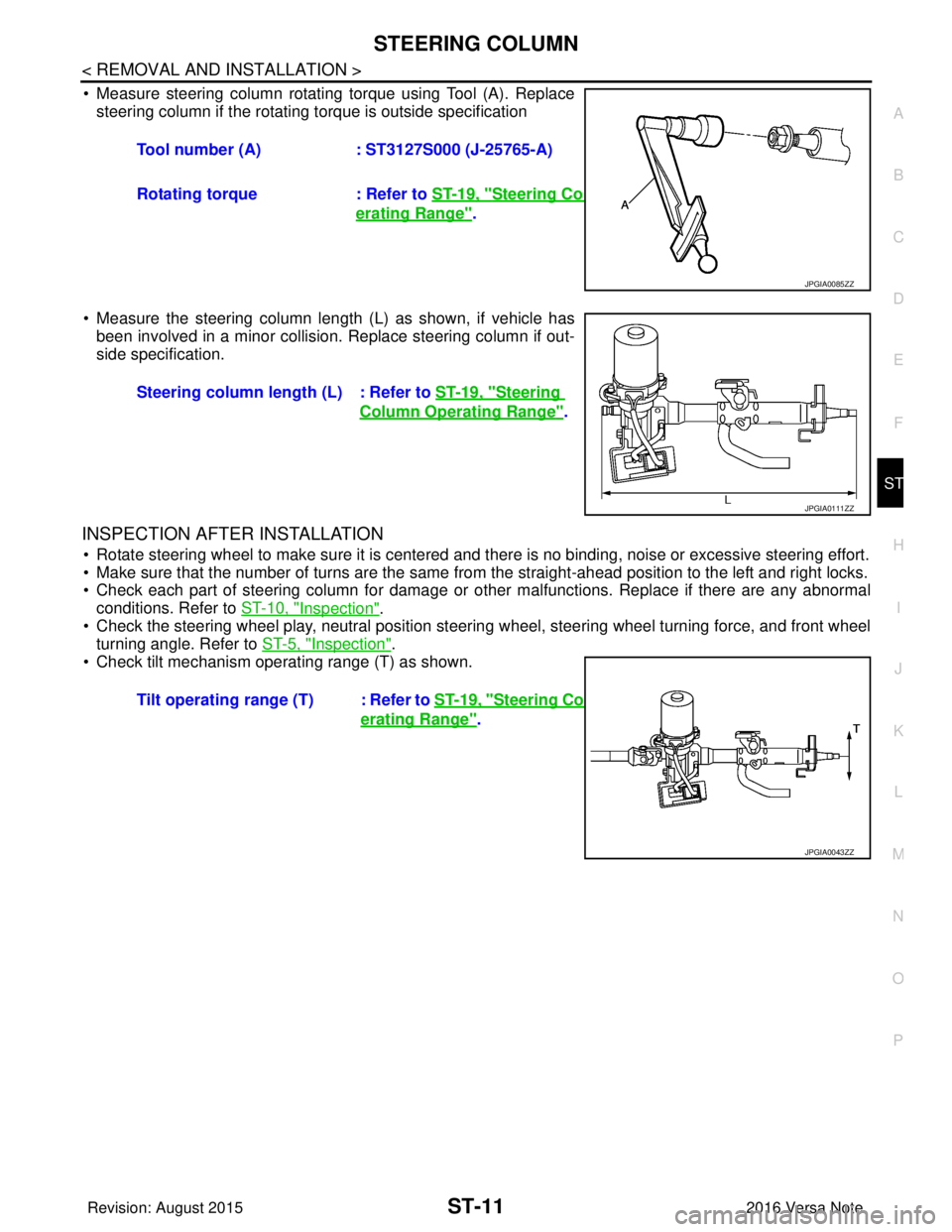
• Measure steering column rotating torque using Tool (A). Replace steering column if the rotating torque is outside specification
• Measure the steering column length (L) as shown, if vehicle has been involved in a minor collision. Replace steering column if out-
side specification.
INSPECTION AFTER INSTALLATION
• Rotate steering wheel to make sure it is centered and there is no binding, noise or excessive steering effort.
• Make sure that the number of turns are the same from the straight-ahead position to the left and right locks.
• Check each part of steering column for damage or other malfunctions. Replace if there are any abnormal
conditions. Refer to ST-10, "
Inspection".
• Check the steering wheel play, neutral position steering wheel, steering wheel turning force, and front wheel turning angle. Refer to ST-5, "
Inspection".
• Check tilt mechanism operating range (T) as shown. Tool number (A)
: ST3127S000 (J-25765-A)
Rotating torque : Refer to ST-19, "
Steering Column Op-
erating Range".
JPGIA0085ZZ
Steering column length (L) : Refer to ST-19, "Steering
Column Operating Range".
JPGIA0111ZZ
Tilt operating range (T) : Refer to ST-19, "Steering Column Op-
erating Range".
JPGIA0043ZZ
Revision: August 2015 2016 Versa Note
cardiagn.com
Page 3238 of 3641
STEERING GEAR AND LINKAGEST-17
< UNIT DISASSEMBLY AND ASSEMBLY >
C
DE
F
H I
J
K L
M A
B
ST
N
O P
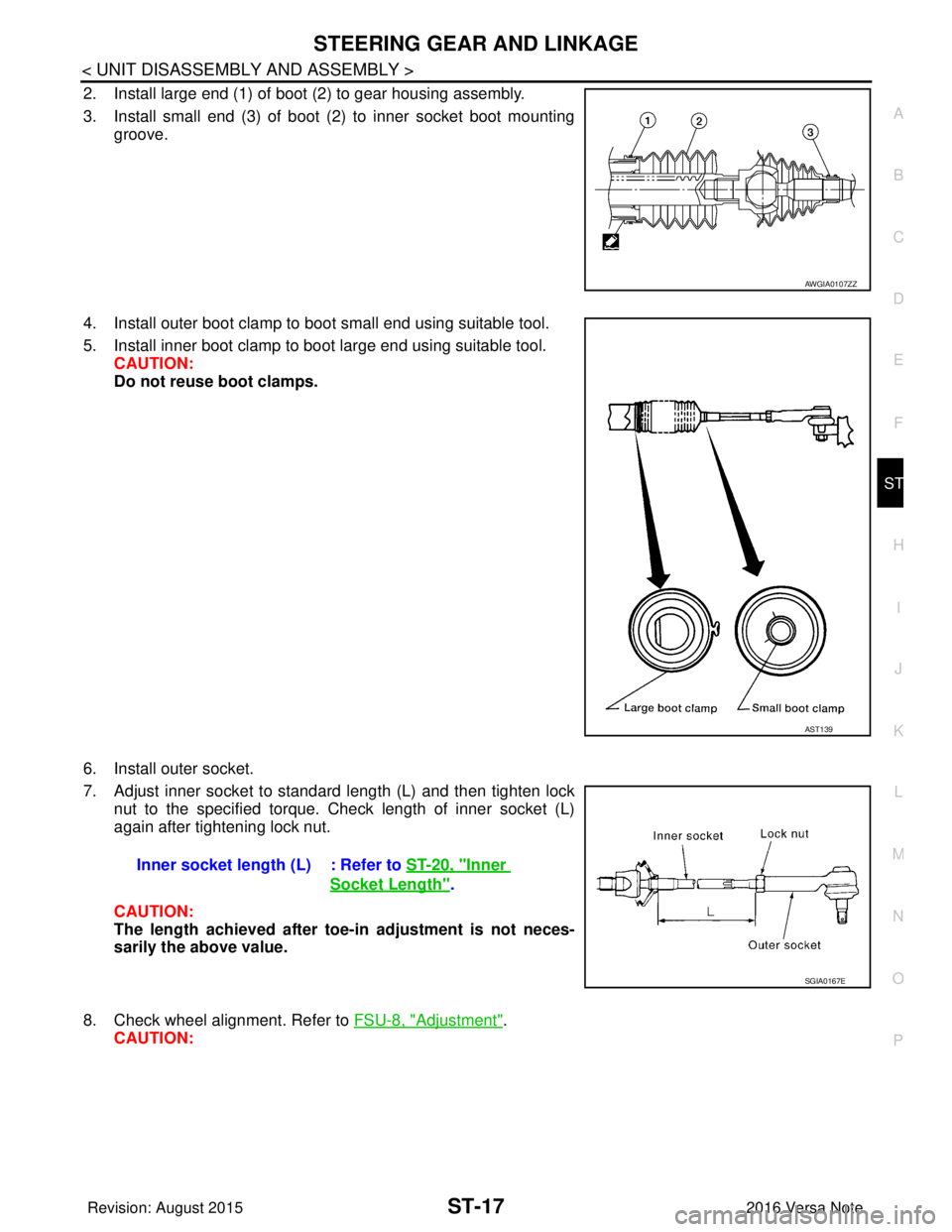
2. Install large end (1) of boot (2) to gear housing assembly.
3. Install small end (3) of boot (2) to inner socket boot mounting groove.
4. Install outer boot clamp to boot small end using suitable tool.
5. Install inner boot clamp to boot large end using suitable tool. CAUTION:
Do not reuse boot clamps.
6. Install outer socket.
7. Adjust inner socket to standard length (L) and then tighten lock nut to the specified torque. Check length of inner socket (L)
again after tightening lock nut.
CAUTION:
The length achieved after toe-in adjustment is not neces-
sarily the above value.
8. Check wheel alignment. Refer to FSU-8, "
Adjustment".
CAUTION:
AWGIA0107ZZ
AST139
Inner socket length (L) : Refer to ST-20, "Inner
Socket Length".
SGIA0167E
Revision: August 2015 2016 Versa Note
cardiagn.com
Page 3240 of 3641
SERVICE DATA AND SPECIFICATIONS (SDS)ST-19
< SERVICE DATA AND SPECIFICATIONS (SDS)
C
DE
F
H I
J
K L
M A
B
ST
N
O P
SERVICE DATA AND SPECIFICATIONS (SDS)
SERVICE DATA AND SPECIFICATIONS (SDS)
General SpecificationsINFOID:0000000012430513
Steering Wheel Axial End Play and PlayINFOID:0000000012430514
Unit: mm (in)
Steering Wheel Turning ForceINFOID:0000000012430515
Unit: N (kg-f, lb-f)
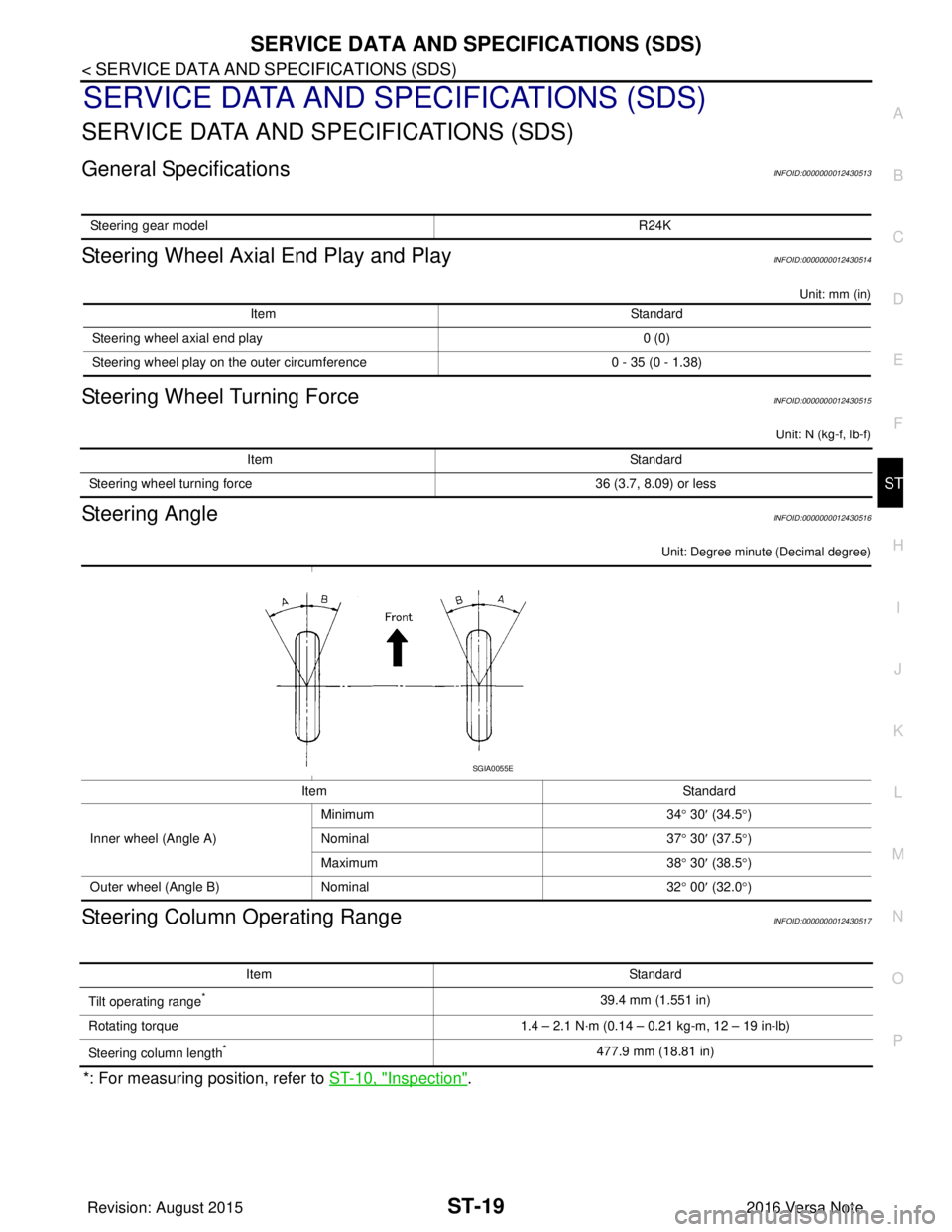
Steering AngleINFOID:0000000012430516
Unit: Degree minute (Decimal degree)
Steering Column Operating RangeINFOID:0000000012430517
*: For measuring position, refer to ST-10, "Inspection".
Steering gear model R24K
ItemStandard
Steering wheel axial end play 0 (0)
Steering wheel play on the outer circumference 0 - 35 (0 - 1.38)
ItemStandard
Steering wheel turning force 36 (3.7, 8.09) or less
ItemStandard
Inner wheel (Angle A) Minimum
34° 30 ′ (34.5° )
Nominal 37° 30 ′ (37.5° )
Maximum 38° 30 ′ (38.5° )
Outer wheel (Angle B) Nominal 32° 00 ′ (32.0° )
SGIA0055E
Item Standard
Tilt operating range
*39.4 mm (1.551 in)
Rotating torque 1.4 – 2.1 N·m (0.14 – 0.21 kg-m, 12 – 19 in-lb)
Steering column length
*477.9 mm (18.81 in)
Revision: August 2015 2016 Versa Note
cardiagn.com