charging NISSAN NOTE 2016 Service Workshop Manual
[x] Cancel search | Manufacturer: NISSAN, Model Year: 2016, Model line: NOTE, Model: NISSAN NOTE 2016Pages: 3641, PDF Size: 28.72 MB
Page 2343 of 3641
MA-28
< PERIODIC MAINTENANCE >
CHASSIS AND BODY MAINTENANCE
29. When the flow of CVT fluid slows to a drip, tighten the drain plug to the specified torque. TM-242,
"Removal and Installation".
CAUTION:
Never reuse drain plug gasket.
30. Lift down the vehicle.
31. Select “Work Support” in “TRANSMISSION” using CONSULT.
32. Select “CONFORM CVTF DETERIORTN”.
33. Select “Erase”.
34. Stop the engine.
CVT FLUID : AdjustmentINFOID:0000000012432269
CAUTION:
• Use only Genuine NISSAN CVT Fluid NS-3. Using transmission fluid other than Genuine NISSAN
CVT Fluid NS-3 will damage the CVT, which is not covered by the (NISSAN new vehicle limited) war-
ranty.
• During adjustment of the CVT fluid level, check CO NSULT so that the oil temperature may be main-
tained from 35 to 45 °C (95 to 113 °F).
• Use caution when looking into the drain hole as th ere is a risk of dripping fluid entering the eye.
1. Check that the selector lever is in the “P ” position, then completely engage the parking brake.
2. Start the engine.
3. Adjust the CVT fluid temperature to be approximately 40 °C (104° F).
NOTE:
The CVT fluid is largely affected by temperature. Therefore be sure to use CONSULT and check the
“FLUID TEMP” under “TRANSMISSION” in “Data Monitor” while adjusting.
4. While depressing the brake pedal, shift the selector lever to the entire position from “P” to “L”, and shift it to the “P” position.
NOTE:
Hold the lever at each position for 5 seconds.
5. Lift up the vehicle.
6. Check that there is no CVT fluid leakage.
7. Remove the drain plug. Refer to TM-242, "
Removal and Installation".
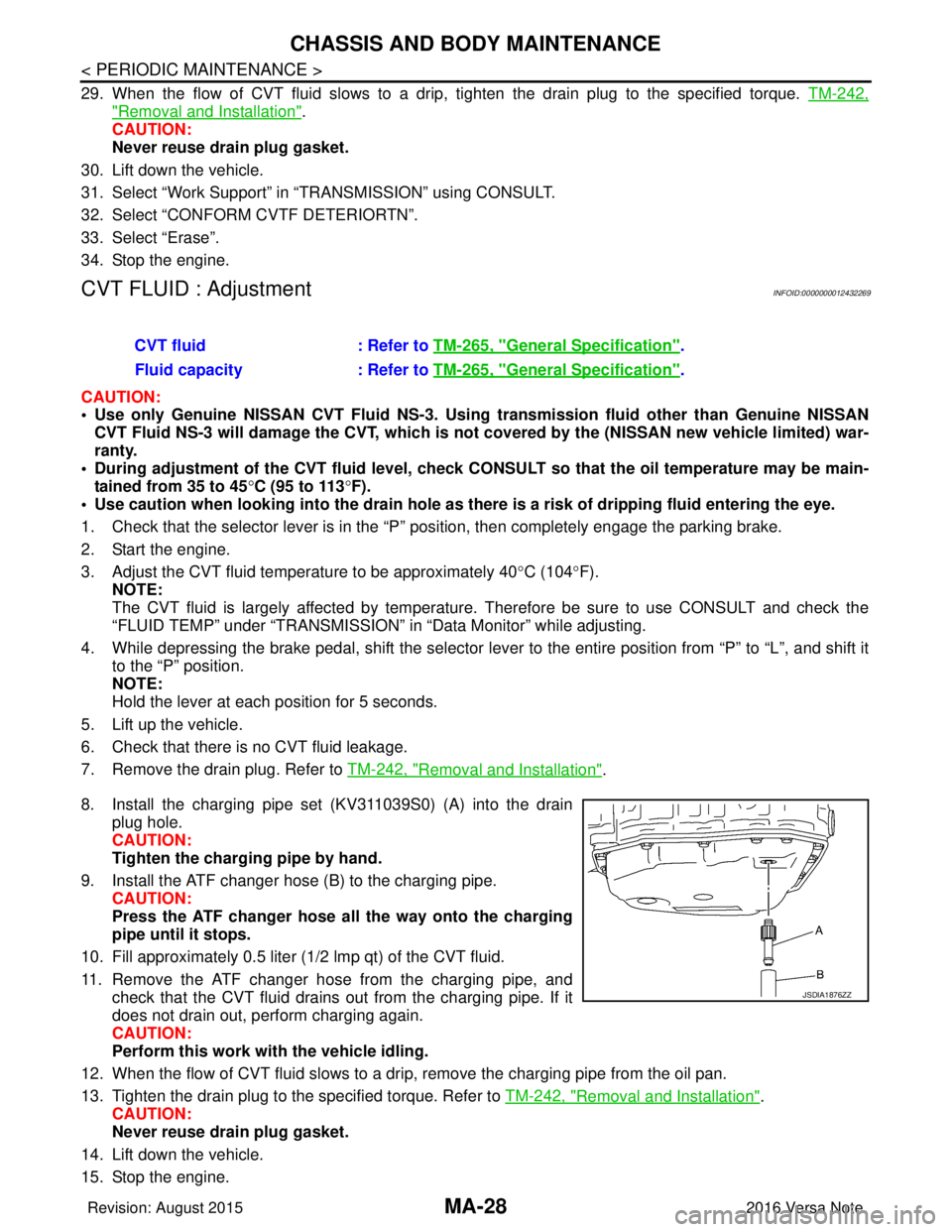
8. Install the charging pipe set (KV311039S0) (A) into the drain plug hole.
CAUTION:
Tighten the charging pipe by hand.
9. Install the ATF changer hose (B) to the charging pipe. CAUTION:
Press the ATF changer hose all the way onto the charging
pipe until it stops.
10. Fill approximately 0.5 liter (1/2 lmp qt) of the CVT fluid.
11. Remove the ATF changer hose from the charging pipe, and check that the CVT fluid drains out from the charging pipe. If it
does not drain out, perform charging again.
CAUTION:
Perform this work with the vehicle idling.
12. When the flow of CVT fluid slows to a drip, remove the charging pipe from the oil pan.
13. Tighten the drain plug to the specified torque. Refer to TM-242, "
Removal and Installation".
CAUTION:
Never reuse drain plug gasket.
14. Lift down the vehicle.
15. Stop the engine. CVT fluid
: Refer to TM-265, "
General Specification".
Fluid capacity : Refer to TM-265, "
General Specification".
JSDIA1876ZZ
Revision: August 2015 2016 Versa Note
cardiagn.com
Page 2590 of 3641
PG
PRECAUTIONSPG-3
< PRECAUTION >
C
DE
F
G H
I
J
K L
B A
O P
N
PRECAUTION
PRECAUTIONS
Precaution for Supplemental
Restraint System (SRS) "AIR BAG" and "SEAT BELT
PRE-TENSIONER"
INFOID:0000000012433111
The Supplemental Restraint System such as “AIR BAG” and “SEAT BELT PRE-TENSIONER”, used along
with a front seat belt, helps to reduce the risk or severi ty of injury to the driver and front passenger for certain
types of collision. Information necessary to service the system safely is included in the SR and SB section of
this Service Manual.
WARNING:
• To avoid rendering the SRS inoper ative, which could increase the risk of personal injury or death in
the event of a collision which would result in air bag inflation, all maintenance must be performed by
an authorized NISSAN/INFINITI dealer.
• Improper maintenance, including in correct removal and installation of the SRS, can lead to personal
injury caused by unintentional act ivation of the system. For removal of Spiral Cable and Air Bag
Module, see the SR section.
• Do not use electrical test equipm ent on any circuit related to the SRS unless instructed to in this
Service Manual. SRS wiring harnesses can be identi fied by yellow and/or orange harnesses or har-
ness connectors.
PRECAUTIONS WHEN USING POWER TOOLS (AIR OR ELECTRIC) AND HAMMERS
WARNING:
• When working near the Airbag Diagnosis Sensor Un it or other Airbag System sensors with the Igni-
tion ON or engine running, DO NOT use air or el ectric power tools or strike near the sensor(s) with a
hammer. Heavy vibration could activate the sensor( s) and deploy the air bag(s), possibly causing
serious injury.
• When using air or electric power tools or hammers, always switch the Ignition OFF, disconnect the
battery and wait at least three mi nutes before performing any service.
Precaution for Power Generation Voltage Variable Control SystemINFOID:0000000012433112
CAUTION:
For this model, the battery current sensor that is in stalled to the battery cable at the negative terminal
measures the charging/discharging current of the battery, and performs various controls. If the electri-
cal component or the ground wire is connected direct ly to the battery terminal, the current other than
that being measured with the battery current sensor is charging to or discharging from the battery.
This condition causes the malfunction of the control, and then the battery discharge may occur. Do
not connect the electrical component or the gr ound wire directly to the battery terminal.
Revision: August 2015 2016 Versa Note
cardiagn.com
Page 2591 of 3641
PG-4
< PREPARATION >
PREPARATION
PREPARATION
PREPARATION
Special Service ToolsINFOID:0000000012433113
The actual shape of the tools may differ from those illustrated here.
Commercial Service ToolINFOID:0000000012433114
Tool number
(TechMate No.)
Tool nameDescription
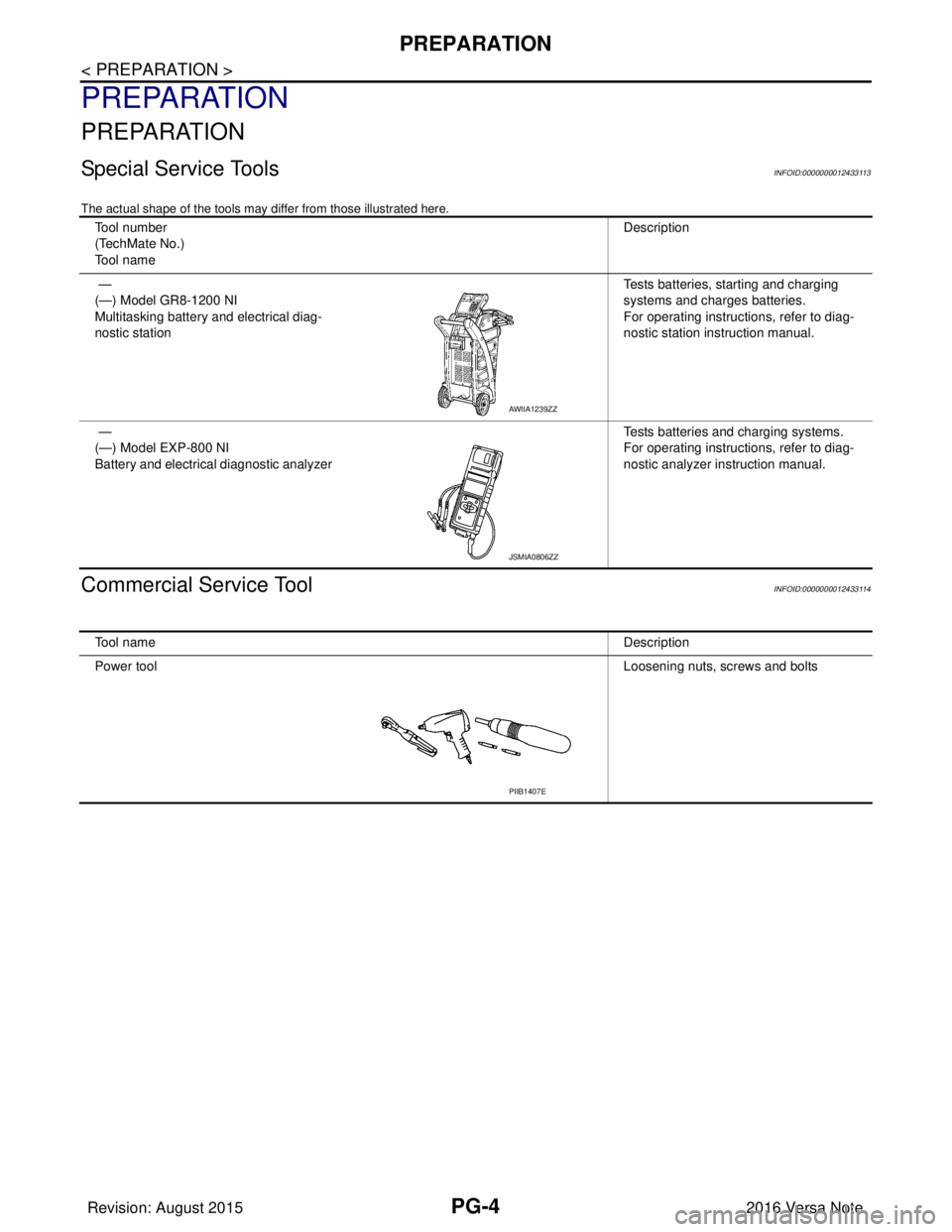
—
(—) Model GR8-1200 NI
Multitasking battery and electrical diag-
nostic station Tests batteries, starting and charging
systems and charges batteries.
For operating instructions, refer to diag-
nostic station instruction manual.
—
(—) Model EXP-800 NI
Battery and electrical diagnostic analyzer Tests batteries and charging systems.
For operating instructions, refer to diag-
nostic analyzer instruction manual.
AWIIA1239ZZ
JSMIA0806ZZ
Tool name
Description
Power tool Loosening nuts, screws and bolts
PIIB1407E
Revision: August 2015 2016 Versa Note
cardiagn.com
Page 2648 of 3641
PG
BATTERYPG-61
< BASIC INSPECTION >
C
DE
F
G H
I
J
K L
B A
O P
N
BASIC INSPECTION
BATTERY
How to Handle BatteryINFOID:0000000012433127
CAUTION:
• If it becomes necessary to start the engine with
a booster battery and jumper cables, use a 12-volt
booster battery.
• After connecting battery cables, ensure that they are tightly clamped to battery terminals for good
contact.
• Never add distilled water through the hole used to check specific gravity.
METHODS OF PREVENTING OVER-DISCHARGE
The following precautions must be taken to prevent over-discharging a battery.
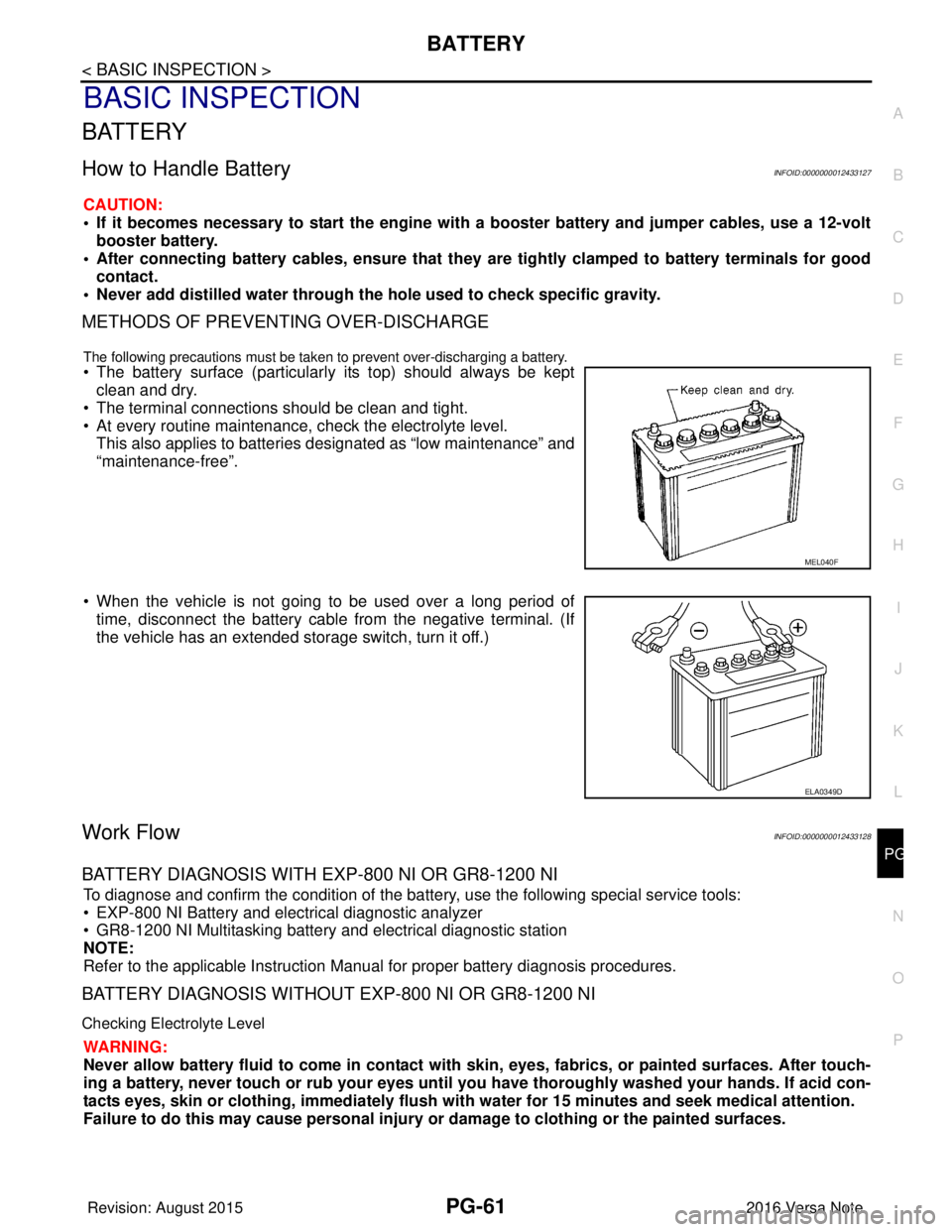
• The battery surface (particularly its top) should always be kept
clean and dry.
• The terminal connections should be clean and tight.
• At every routine maintenance, check the electrolyte level. This also applies to batteries designated as “low maintenance” and
“maintenance-free”.
• When the vehicle is not going to be used over a long period of time, disconnect the battery cable from the negative terminal. (If
the vehicle has an extended storage switch, turn it off.)
Work FlowINFOID:0000000012433128
BATTERY DIAGNOSIS WITH EXP-800 NI OR GR8-1200 NI
To diagnose and confirm the condition of the batte ry, use the following special service tools:
• EXP-800 NI Battery and electrical diagnostic analyzer
• GR8-1200 NI Multitasking battery and electrical diagnostic station
NOTE:
Refer to the applicable Instruction Manual for proper battery diagnosis procedures.
BATTERY DIAGNOSIS WITHOUT EXP-800 NI OR GR8-1200 NI
Checking Electrolyte Level
WARNING:
Never allow battery fluid to come in contact with skin, eyes, fabrics, or painted surfaces. After touch-
ing a battery, never touch or rub your eyes until you have thoroughly washed your hands. If acid con-
tacts eyes, skin or clothing, imme diately flush with water for 15 minutes and seek medical attention.
Failure to do this may cause personal injury or damage to clothing or the painted surfaces.
MEL040F
ELA0349D
Revision: August 2015 2016 Versa Note
cardiagn.com
Page 2649 of 3641
PG-62
< BASIC INSPECTION >
BATTERY
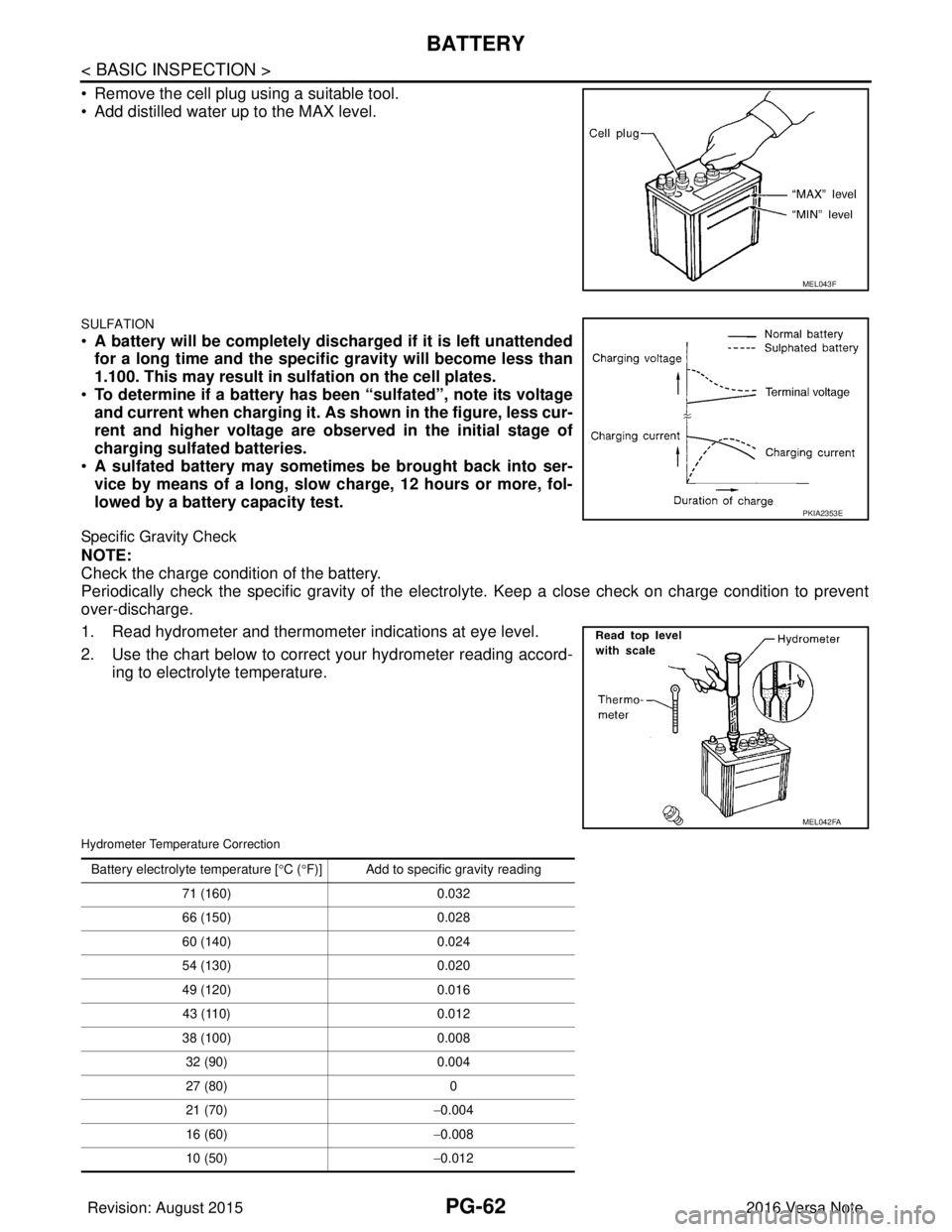
• Remove the cell plug using a suitable tool.
• Add distilled water up to the MAX level.
SULFATION
•A battery will be completely discharged if it is left unattended
for a long time and the specific gravity will become less than
1.100. This may result in su lfation on the cell plates.
• To determine if a battery has been “sulfated”, note its voltage
and current when charging it. As shown in the figure, less cur-
rent and higher voltage are ob served in the initial stage of
charging sulfated batteries.
• A sulfated battery may someti mes be brought back into ser-
vice by means of a long, slow charge, 12 hours or more, fol-
lowed by a battery capacity test.
Specific Gravity Check
NOTE:
Check the charge condition of the battery.
Periodically check the specific gravity of the electr olyte. Keep a close check on charge condition to prevent
over-discharge.
1. Read hydrometer and thermometer indications at eye level.
2. Use the chart below to correct your hydrometer reading accord- ing to electrolyte temperature.
Hydrometer Temperature Correction
MEL043F
PKIA2353E
MEL042FA
Battery electrolyte temperature [° C (°F)] Add to specific gravity reading
71 (160) 0.032
66 (150) 0.028
60 (140) 0.024
54 (130) 0.020
49 (120) 0.016
43 (110) 0.012
38 (100) 0.008
32 (90) 0.004
27 (80) 0
21 (70) −0.004
16 (60) −0.008
10 (50) −0.012
Revision: August 2015 2016 Versa Note
cardiagn.com
Page 2650 of 3641
PG
BATTERYPG-63
< BASIC INSPECTION >
C
DE
F
G H
I
J
K L
B A
O P
N
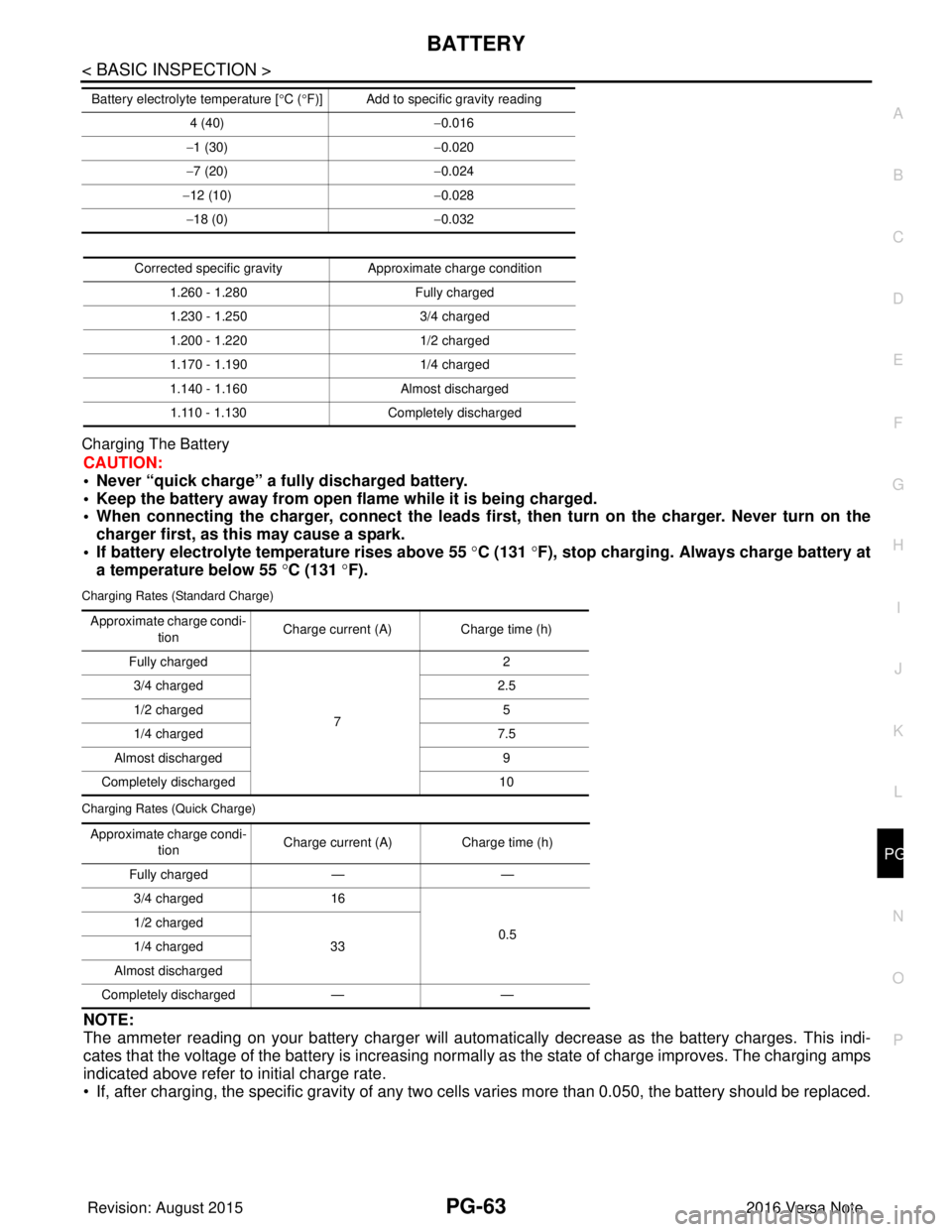
Charging The Battery
CAUTION:
• Never “quick charge” a fully discharged battery.
• Keep the battery away from open flame while it is being charged.
• When connecting the charger, connect
the leads first, then turn on the charger. Never turn on the
charger first, as this may cause a spark.
• If battery electrolyte temperature rises above 55 °C (131 °F), stop charging. Always charge battery at
a temperature below 55 °C (131 °F).
Charging Rates (Standard Charge)
Charging Rates (Quick Charge)
NOTE:
The ammeter reading on your battery charger will automatically decrease as the battery charges. This indi-
cates that the voltage of the battery is increasing norma lly as the state of charge improves. The charging amps
indicated above refer to initial charge rate.
• If, after charging, the specific gravity of any two cells varies more than 0.050, the battery should be replaced.
4 (40) −0.016
− 1 (30) −0.020
− 7 (20) −0.024
− 12 (10) −0.028
− 18 (0) −0.032
Battery electrolyte temperature [
°C ( °F)] Add to specific gravity reading
Corrected specific gravity Approximate charge condition
1.260 - 1.280 Fully charged
1.230 - 1.250 3/4 charged
1.200 - 1.220 1/2 charged
1.170 - 1.190 1/4 charged
1.140 - 1.160 Almost discharged
1.110 - 1.130 Completely discharged
Approximate charge condi-
tion Charge current (A)
Charge time (h)
Fully charged
72
3/4 charged 2.5
1/2 charged 5
1/4 charged 7.5
Almost discharged 9
Completely discharged 10
Approximate charge condi- tion Charge current (A)
Charge time (h)
Fully charged ——
3/4 charged 16
0.5
1/2 charged
33
1/4 charged
Almost discharged
Completely discharged ——
Revision: August 2015 2016 Versa Note
cardiagn.com
Page 3155 of 3641
PREPARATIONSTR-3
< PREPARATION >
C
DE
F
G H
I
J
K L
M A
STR
NP
O
PREPARATION
PREPARATION
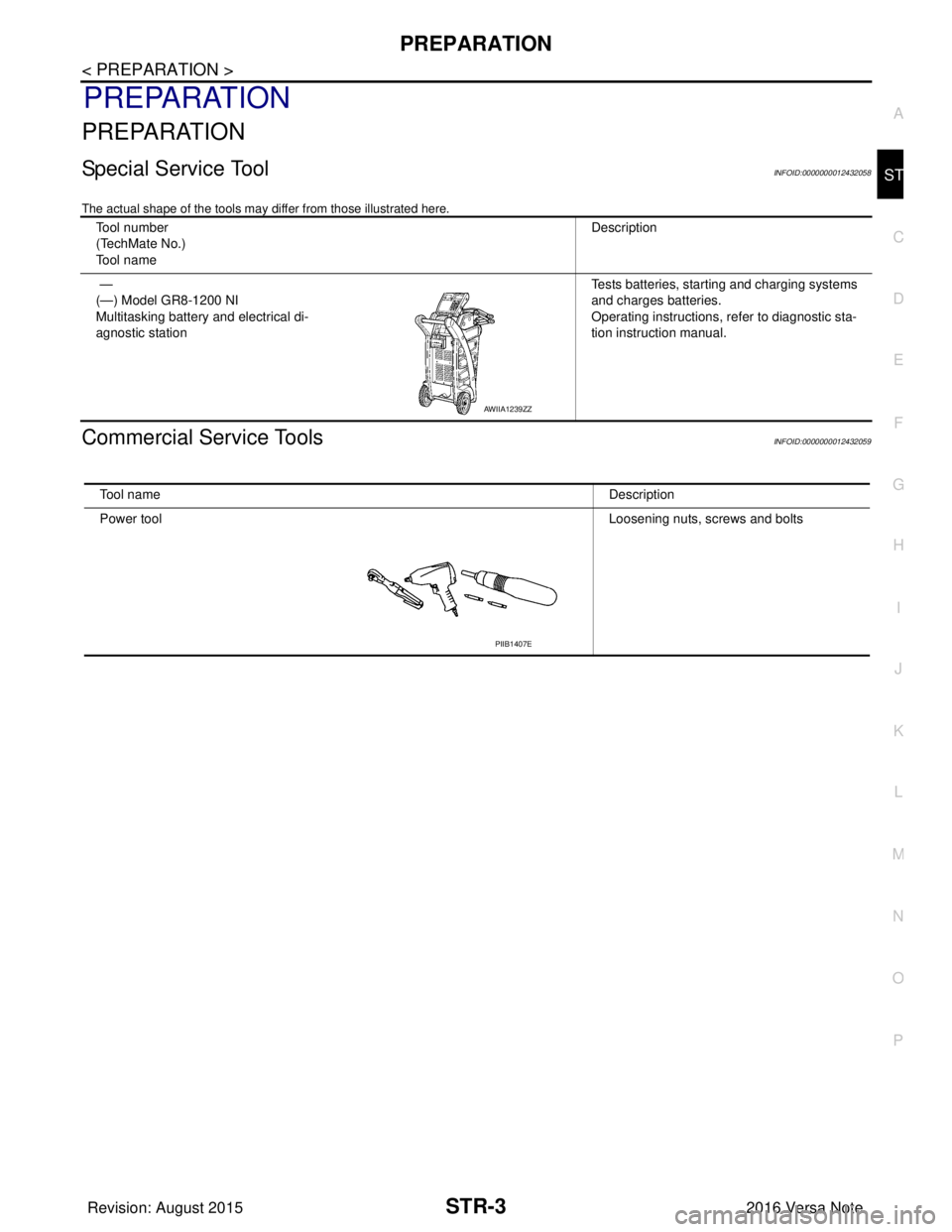
Special Service ToolINFOID:0000000012432058
The actual shape of the tools may di
ffer from those illustrated here.
Commercial Service ToolsINFOID:0000000012432059
Tool number
(TechMate No.)
Tool name Description
—
(—) Model GR8-1200 NI
Multitasking battery and electrical di-
agnostic station Tests batteries, starting and charging systems
and charges batteries.
Operating instructions, refer to diagnostic sta-
tion instruction manual.
AWIIA1239ZZ
Tool name
Description
Power tool Loosening nuts, screws and bolts
PIIB1407E
Revision: August 2015 2016 Versa Note
cardiagn.com
Page 3175 of 3641
DIAGNOSIS AND REPAIR WORKFLOWSTR-23
< BASIC INSPECTION >
C
DE
F
G H
I
J
K L
M A
STR
NP
O
Perform the starting system test with Multitasking bat
tery and electrical diagnostic station GR8-1200 NI. For
details and operating instructions, refer to diagnostic station Instruction Manual.
Test result
CRANKING NORMAL>>GO TO 2.
LOW VOLTAGE>>GO TO 5.
CHARGE BATTERY>>Perform the slow battery charging procedure. (Initial rate of charge is 10A for 12
hours.) Perform battery test again. Refer to diagnostic station instruction manual.
REPLACE BATTERY>>Before replacing battery, clean the battery cable clamps and battery posts. Perform battery test again. Refer to diagnostic station instruction manual. If second test result is
“REPLACE BATTERY”, then do so. Perform battery test again to confirm repair.
2.CRANKING CHECK
Check that the starter motor operates properly.
Does the engine crank normally?
YES >> GO TO 3.
NO >> GO TO 4.
3.ENGINE START CHECK
Check that the engine starts.
Does the engine start?
YES >> Inspection End.
NO >> Perform further diagnosis of engine mechanical or engine control system.\
Refer to EM and EC sections. Once resolved, perform battery test again.
4.STARTER MOTOR ACTIVATION
Check that the starter motor operates.
Does the starter motor turn?
YES >> Check ring gear and starter motor drive pinion. Once resolved, perform battery test again.
NO >> GO TO 7.
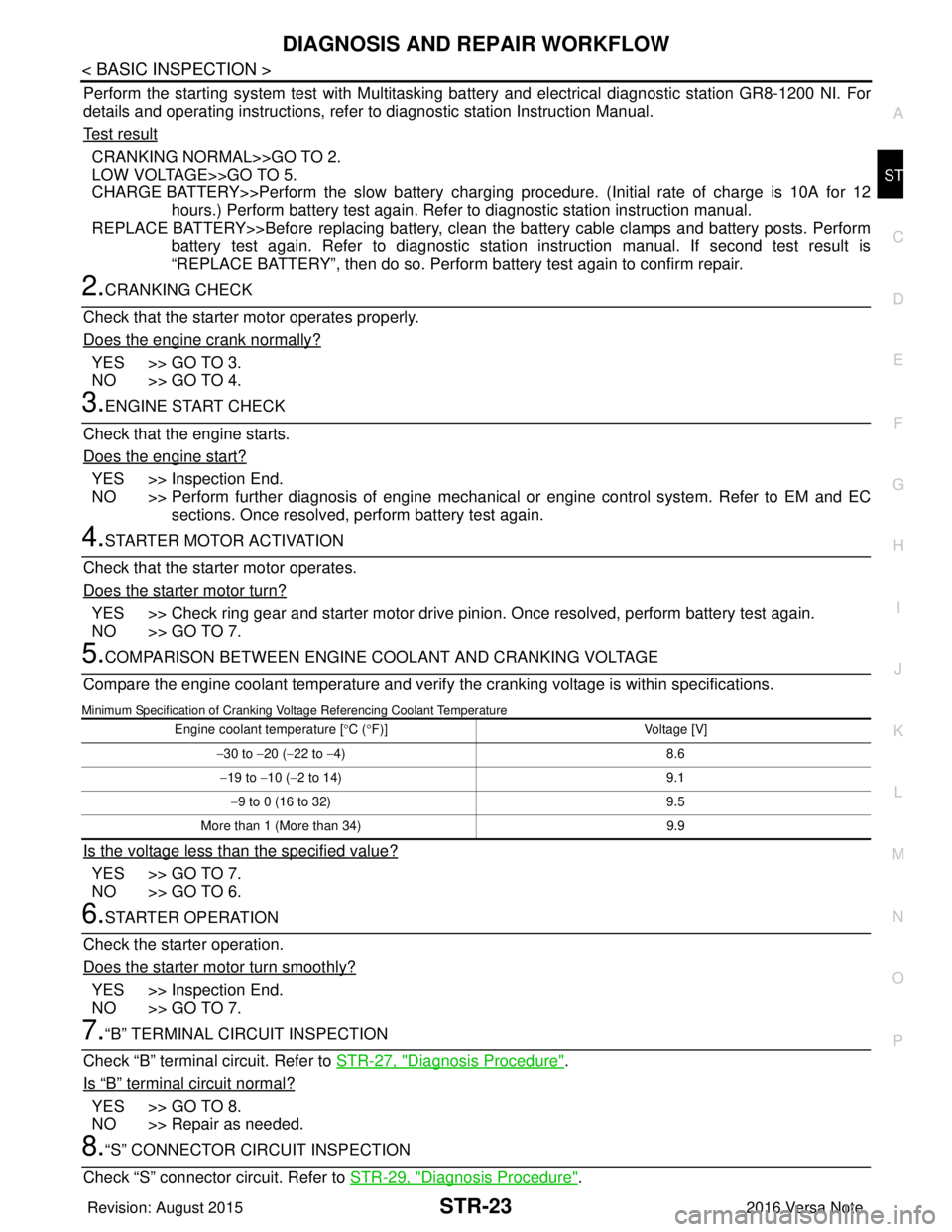
5.COMPARISON BETWEEN ENGINE C OOLANT AND CRANKING VOLTAGE
Compare the engine coolant temperature and verify the cranking voltage is within specifications.
Minimum Specification of Cranking Voltage Referencing Coolant Temperature
Is the voltage less than the specified value?
YES >> GO TO 7.
NO >> GO TO 6.
6.STARTER OPERATION
Check the starter operation.
Does the starter motor turn smoothly?
YES >> Inspection End.
NO >> GO TO 7.
7.“B” TERMINAL CIRCUIT INSPECTION
Check “B” terminal circuit. Refer to STR-27, "
Diagnosis Procedure".
Is
“B” terminal circuit normal?
YES >> GO TO 8.
NO >> Repair as needed.
8.“S” CONNECTOR CIRCUIT INSPECTION
Check “S” connector circuit. Refer to STR-29, "
Diagnosis Procedure".
Engine coolant temperature [°C ( °F)] Voltage [V]
− 30 to −20 ( −22 to − 4) 8.6
− 19 to − 10 (−2 to 14) 9.1
− 9 to 0 (16 to 32) 9.5
More than 1 (More than 34) 9.9
Revision: August 2015 2016 Versa Note
cardiagn.com
Page 3300 of 3641
![NISSAN NOTE 2016 Service Workshop Manual PREPARATIONTM-59
< PREPARATION > [CVT: RE0F11A]
C
EF
G H
I
J
K L
M A
B
TM
N
O P
PREPARATION
PREPARATION
Special Service ToolsINFOID:0000000012430988
The actual shape of the tools may differ from those](/img/5/57363/w960_57363-3299.png "NISSAN NOTE 2016 Service Workshop Manual PREPARATIONTM-59
< PREPARATION > [CVT: RE0F11A]
C
EF
G H
I
J
K L
M A
B
TM
N
O P
PREPARATION
PREPARATION
Special Service ToolsINFOID:0000000012430988
The actual shape of the tools may differ from those")
PREPARATIONTM-59
< PREPARATION > [CVT: RE0F11A]
C
EF
G H
I
J
K L
M A
B
TM
N
O P
PREPARATION
PREPARATION
Special Service ToolsINFOID:0000000012430988
The actual shape of the tools may differ from those illustrated here.
*: The O-ring as an unit part is set as a SST.
Commercial Service ToolsINFOID:0000000012430989
Tool number
(TechMate No.)
Tool name Description
1. KV311039S0 (—)
Charging pipe set
2. KV31103920* (—)
O-ring CVT fluid changing and adjustment
KV38107900
(—)
Protector
a: 32 mm (1.26 in) dia. Installing drive shaft
JSDIA1844ZZ
PDIA1183J
Tool number
Tool name
Description
Power tool Loosening nuts, screws and
bolts
31197EU50A
Drive plate location guide
a: 25 mm (0.98 in) dia. Installing transaxle assembly
PIIB1407E
JPDIA0676ZZ
Revision: August 2015
2016 Versa Note
cardiagn.com
Page 3469 of 3641
![NISSAN NOTE 2016 Service Workshop Manual TM-228
< PERIODIC MAINTENANCE >[CVT: RE0F11A]
CVT FLUID
PERIODIC MAINTENANCE
CVT FLUID
InspectionINFOID:0000000012431172
FLUID LEAKAGE
• Check transaxle surrounding area (oil seal and plug etc.)for](/img/5/57363/w960_57363-3468.png "NISSAN NOTE 2016 Service Workshop Manual TM-228
< PERIODIC MAINTENANCE >[CVT: RE0F11A]
CVT FLUID
PERIODIC MAINTENANCE
CVT FLUID
InspectionINFOID:0000000012431172
FLUID LEAKAGE
• Check transaxle surrounding area (oil seal and plug etc.)for")
TM-228
< PERIODIC MAINTENANCE >[CVT: RE0F11A]
CVT FLUID
PERIODIC MAINTENANCE
CVT FLUID
InspectionINFOID:0000000012431172
FLUID LEAKAGE
• Check transaxle surrounding area (oil seal and plug etc.)for fluid
leakage.
• If anything is found, repair or replace damaged parts and adjust
CVT fluid level. Refer to TM-229, "
Adjustment".
ReplacementINFOID:0000000012431173
CAUTION:
• Use only Genuine NISSAN CVT Fluid NS-3. Using transmission fluid other than Genuine NISSAN
CVT Fluid NS-3 will damage the CVT, which is not covered by the (NISSAN new vehicle limited) war-
ranty.
• Always use shop paper. Never use shop cloth.
• Replace a drain plug gasket with new ones at the final stage of the operation when installing.
• Use caution when looking into the drain hole as th ere is a risk of dripping fluid entering the eye.
• After replacement, always perform CVT fluid leakage check.
1. Select “Data Monitor” in “T RANSMISSION” using CONSULT.
2. Select “FLUID TEMP” and confirm t hat the CVT fluid temperature is 40°C (104° F) or less.
3. Check that the selector lever is in the “P ” position, then completely engage the parking brake.
4. Lift up the vehicle.
5. Remove the drain plug and overflow tube and drain the CVT fluid from the oil pan. TM-242, "
Removal and
Installation".
6. Install the charging pipe set (KV311039S0) (A) into the drain hole.
CAUTION:
Tighten the charging pipe by hand.
7. Install the ATF changer hose (B) to the charging pipe. CAUTION:
Press the ATF changer hose all the way onto the charging
pipe until it stops.
8. Fill approximately 3 liter (2-5/8 lmp qt) of the CVT fluid.
9. Remove the ATF changer hose and charging pipe, then install the drain plug.
NOTE:
Perform this work quickly because CVT fluid leaks.
10. Lift down the vehicle.
11. Start the engine.
12. While depressing the brake pedal, shift the selector lever to the entire position from “P” to “L”, and shift it to the “P” position.
NOTE:
SMA146B
CVT fluid : Refer to TM-265, "General Specification".
Fluid capacity : Refer to TM-265, "
General Specification".
JSDIA1876ZZ
Revision: August 2015 2016 Versa Note
cardiagn.com