control NISSAN PRIMERA 1999 Electronic Manual Online
[x] Cancel search | Manufacturer: NISSAN, Model Year: 1999, Model line: PRIMERA, Model: NISSAN PRIMERA 1999Pages: 2267, PDF Size: 35.74 MB
Page 226 of 2267
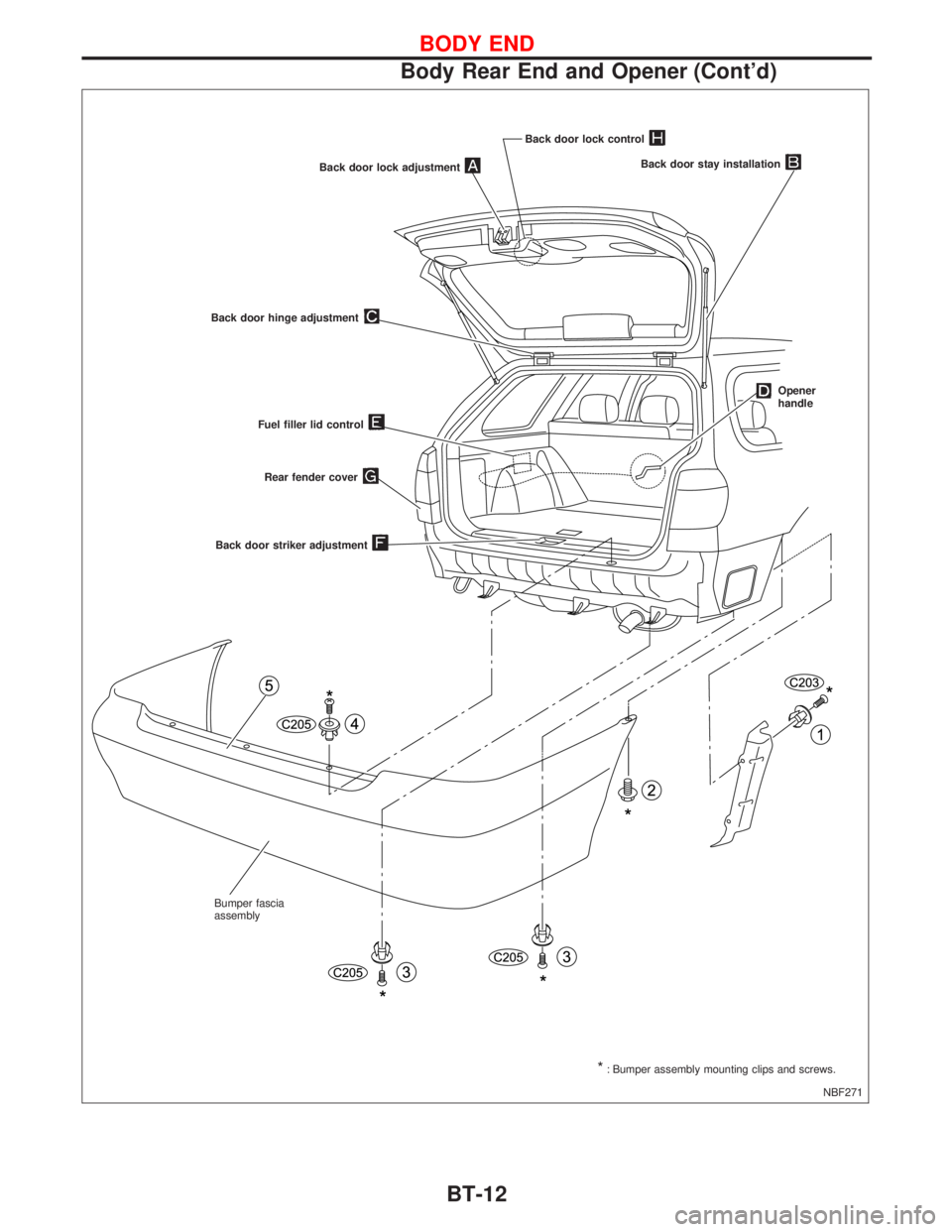
NBF271 Back door lock adjustment
Back door hinge adjustment
Back door stay installation
Opener
handle
Fuel filler lid control
Back door striker adjustment
*: Bumper assembly mounting clips and screws. Bumper fascia
assemblyRear fender cover
Back door lock control
BODY END
Body Rear End and Opener (Cont'd)
BT-12
Page 229 of 2267
CAUTION:
lDisconnect both battery cables in advance.
lDisconnect air bag system line in advance.
lNever tamper with or force air bag lid open, as this may adversely affect air bag performance.
lBe careful not to scratch pad and other parts.
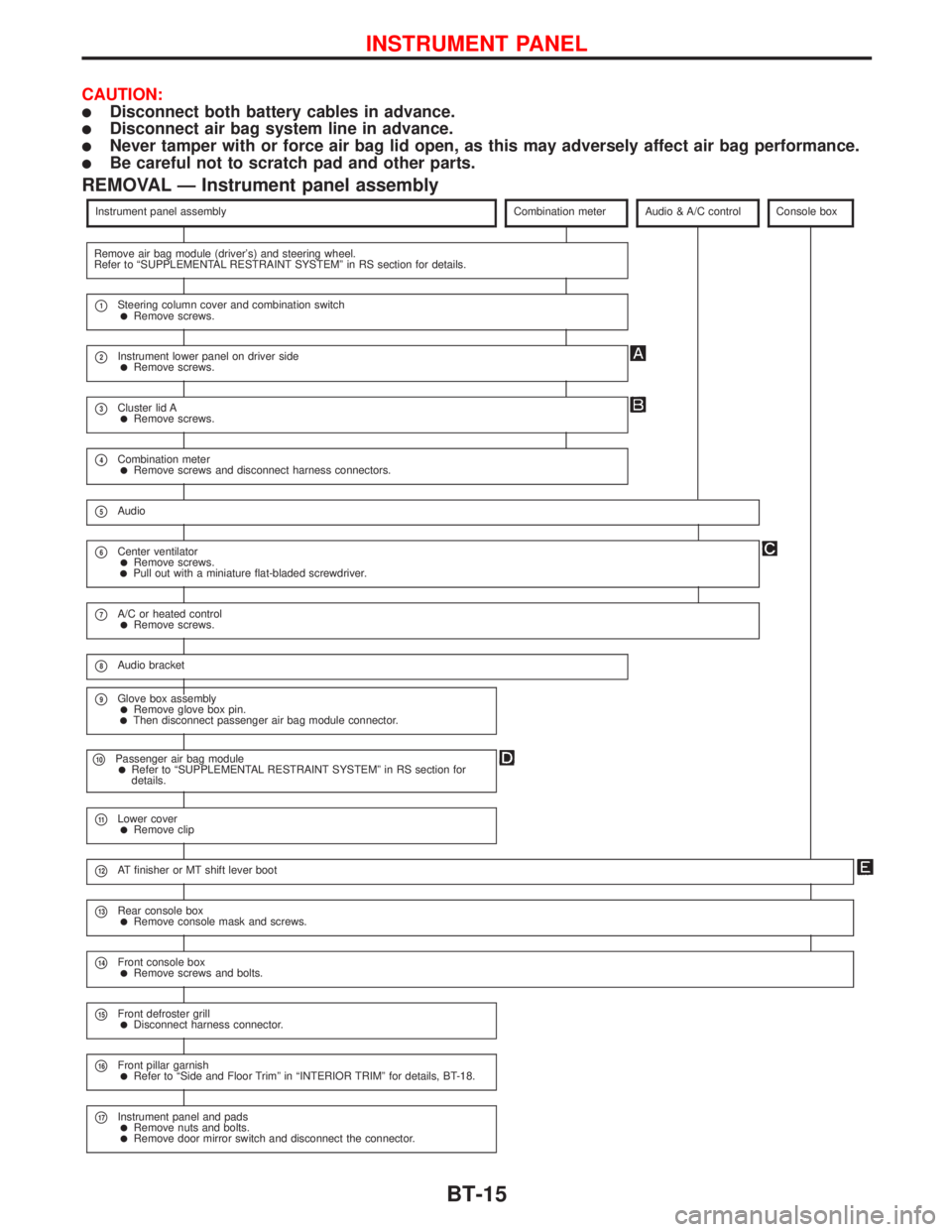
REMOVAL Ð Instrument panel assembly
Instrument panel assemblyCombination meterAudio & A/C controlConsole box
Remove air bag module (driver's) and steering wheel.
Refer to ªSUPPLEMENTAL RESTRAINT SYSTEMº in RS section for details.
p1Steering column cover and combination switchlRemove screws.
p2Instrument lower panel on driver sidelRemove screws.
p3Cluster lid AlRemove screws.
p4Combination meterlRemove screws and disconnect harness connectors.
p5Audio
p6Center ventilatorlRemove screws.lPull out with a miniature flat-bladed screwdriver.
p7A/C or heated controllRemove screws.
p8Audio bracket
p9Glove box assemblylRemove glove box pin.lThen disconnect passenger air bag module connector.
p10Passenger air bag modulelRefer to ªSUPPLEMENTAL RESTRAINT SYSTEMº in RS section for
details.
p11Lower coverlRemove clip
p12AT finisher or MT shift lever boot
p13Rear console boxlRemove console mask and screws.
p14Front console boxlRemove screws and bolts.
p15Front defroster grilllDisconnect harness connector.
p16Front pillar garnishlRefer to ªSide and Floor Trimº in ªINTERIOR TRIMº for details, BT-18.
p17Instrument panel and padslRemove nuts and bolts.lRemove door mirror switch and disconnect the connector.
INSTRUMENT PANEL
BT-15
Page 279 of 2267
CLUTCH
SECTION
CL
CONTENTS
PRECAUTIONS AND PREPARATION.......................... 2
Precautions ................................................................ 2
Preparation ................................................................ 2
NOISE, VIBRATION AND HARSHNESS (NVH)
TROUBLESHOOTING................................................... 3
NVH Troubleshooting Chart....................................... 3
CLUTCH SYSTEM......................................................... 4
INSPECTION AND ADJUSTMENT............................... 5
Inspecting and Adjusting Clutch Pedal ...................... 5
Bleeding Procedure ................................................... 7HYDRAULIC CLUTCH CONTROL............................... 8
Clutch Master Cylinder .............................................. 8
Clutch Operating Cylinder ......................................... 9
Clutch Damper ......................................................... 10
CLUTCH RELEASE MECHANISM.............................. 11
CLUTCH DISC AND CLUTCH COVER...................... 13
Clutch Disc............................................................... 13
Clutch Cover and Flywheel ..................................... 14
SERVICE DATA AND SPECIFICATIONS (SDS)........ 15
General Specifications ............................................. 15
Inspection and Adjustment ...................................... 16
CL
Page 286 of 2267
Clutch Master Cylinder
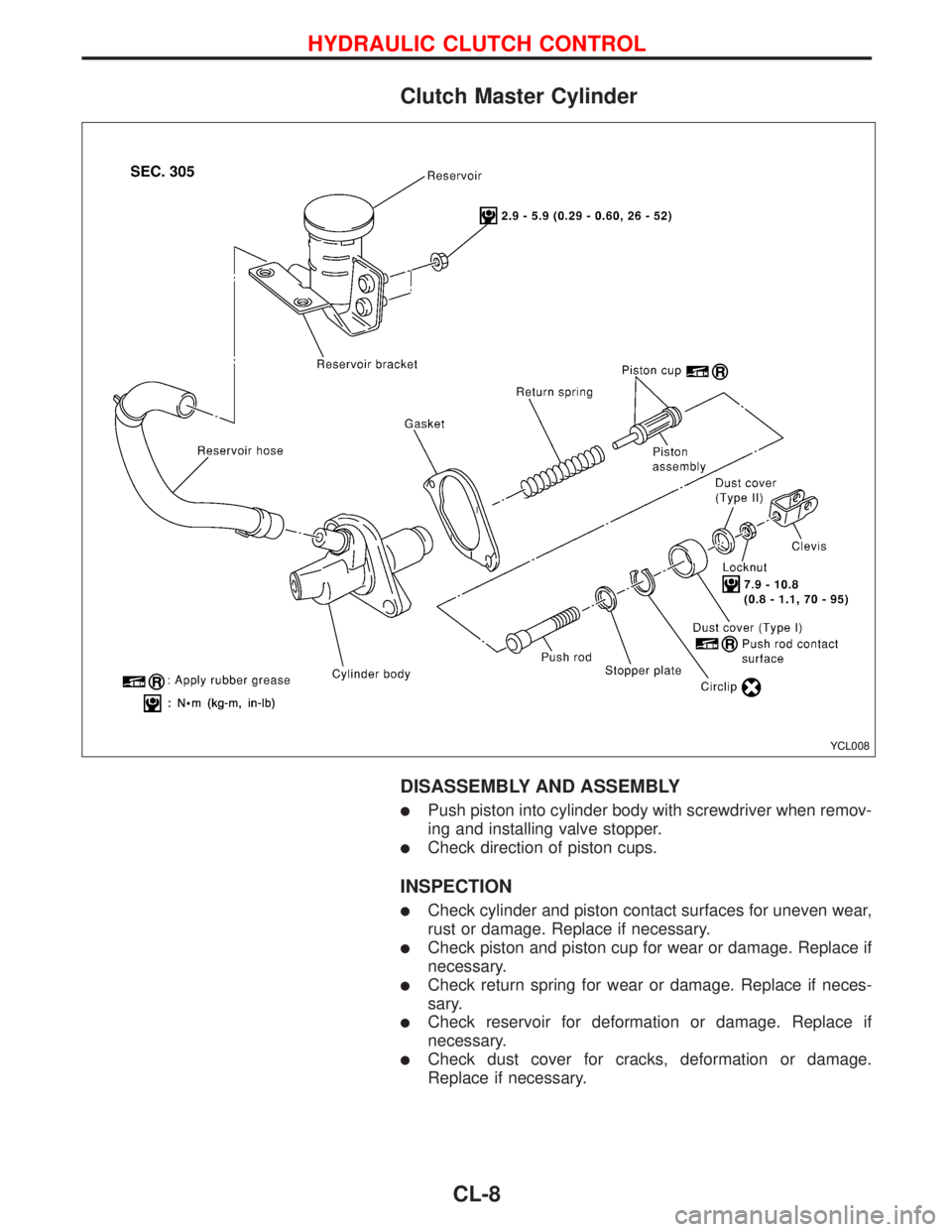
DISASSEMBLY AND ASSEMBLY
lPush piston into cylinder body with screwdriver when remov-
ing and installing valve stopper.
lCheck direction of piston cups.
INSPECTION
lCheck cylinder and piston contact surfaces for uneven wear,
rust or damage. Replace if necessary.
lCheck piston and piston cup for wear or damage. Replace if
necessary.
lCheck return spring for wear or damage. Replace if neces-
sary.
lCheck reservoir for deformation or damage. Replace if
necessary.
lCheck dust cover for cracks, deformation or damage.
Replace if necessary.
YCL008
HYDRAULIC CLUTCH CONTROL
CL-8
Page 287 of 2267
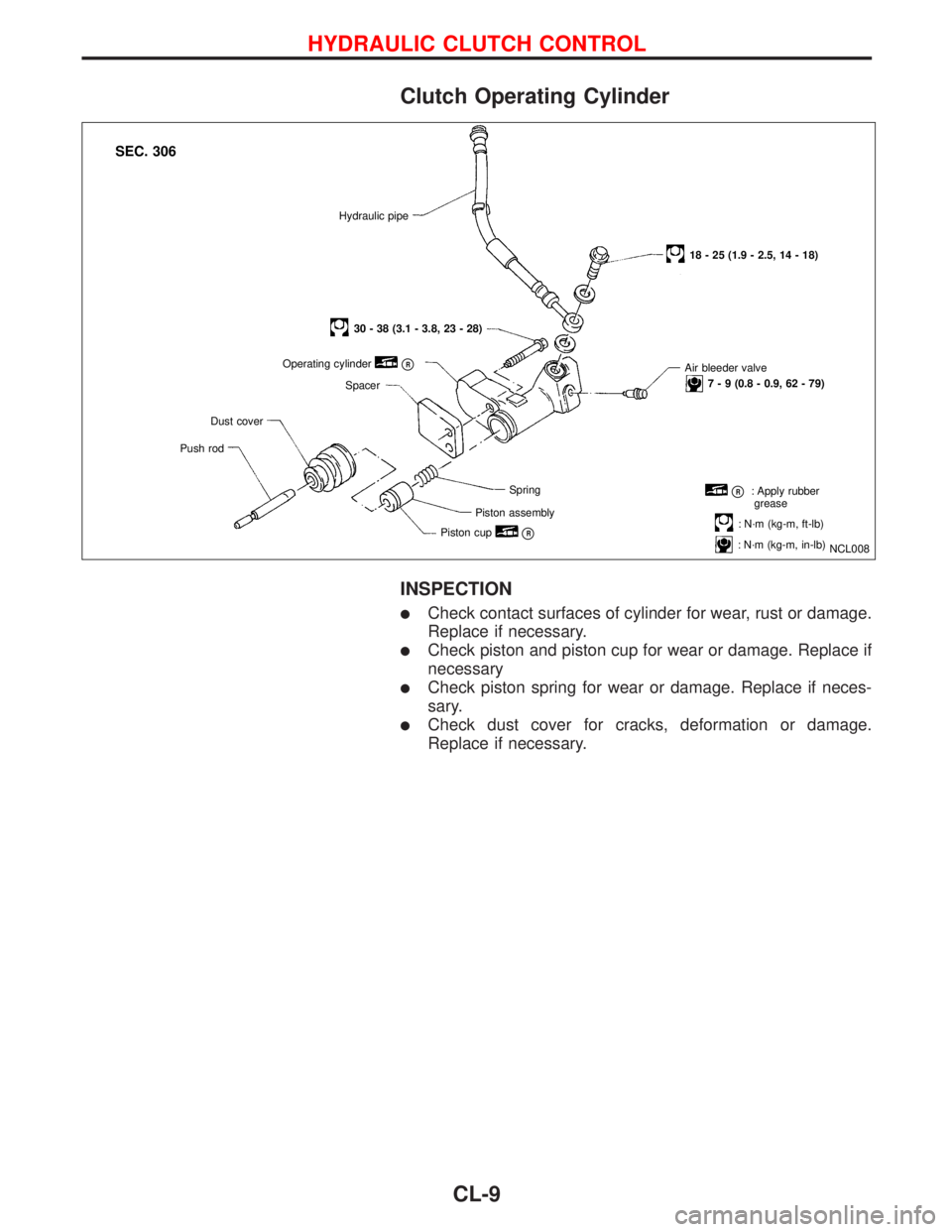
Clutch Operating Cylinder
INSPECTION
lCheck contact surfaces of cylinder for wear, rust or damage.
Replace if necessary.
lCheck piston and piston cup for wear or damage. Replace if
necessary
lCheck piston spring for wear or damage. Replace if neces-
sary.
lCheck dust cover for cracks, deformation or damage.
Replace if necessary.
NCL008
18 - 25 (1.9 - 2.5, 14 - 18) Hydraulic pipe
Air bleeder valve
7 - 9 (0.8 - 0.9, 62 - 79)
30 - 38 (3.1 - 3.8, 23 - 28)
Operating cylinder
pR
Spacer
Dust cover
Push rod
Spring
Piston assembly
Piston cup
pR
pR: Apply rubber
grease
: N´m (kg-m, ft-lb)
: N´m (kg-m, in-lb)
SEC. 306
HYDRAULIC CLUTCH CONTROL
CL-9
Page 288 of 2267
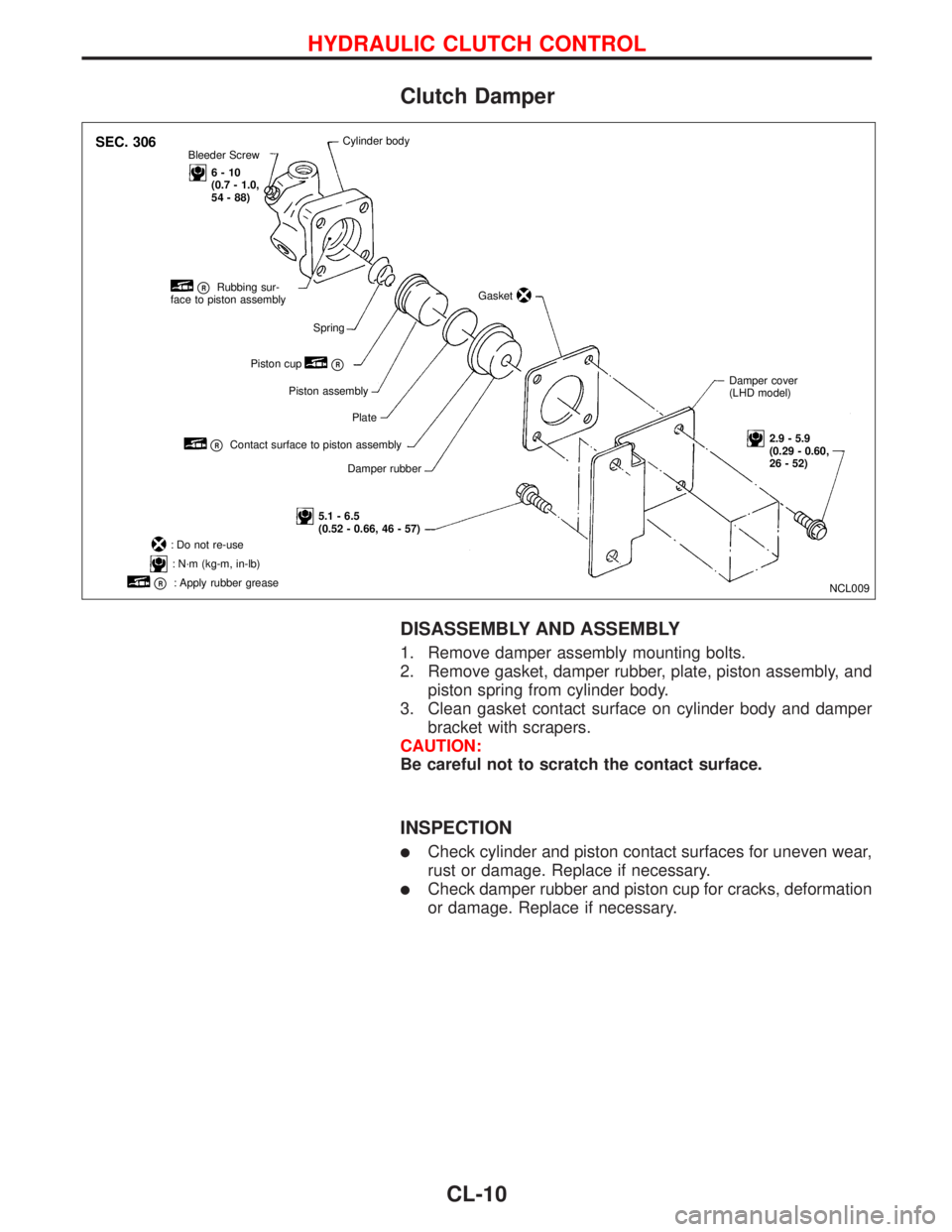
Clutch Damper
DISASSEMBLY AND ASSEMBLY
1. Remove damper assembly mounting bolts.
2. Remove gasket, damper rubber, plate, piston assembly, and
piston spring from cylinder body.
3. Clean gasket contact surface on cylinder body and damper
bracket with scrapers.
CAUTION:
Be careful not to scratch the contact surface.
INSPECTION
lCheck cylinder and piston contact surfaces for uneven wear,
rust or damage. Replace if necessary.
lCheck damper rubber and piston cup for cracks, deformation
or damage. Replace if necessary.
NCL009 Bleeder Screw
6-10
(0.7 - 1.0,
54 - 88)Cylinder body
Gasket
Damper cover
(LHD model)
2.9 - 5.9
(0.29 - 0.60,
26 - 52)
5.1 - 6.5
(0.52 - 0.66, 46 - 57)Damper rubber
pRContact surface to piston assemblyPlate Piston assembly Piston cup
pR
pRRubbing sur-
face to piston assembly
Spring
: Do not re-use
: N´m (kg-m, in-lb)
pR: Apply rubber grease
SEC. 306
HYDRAULIC CLUTCH CONTROL
CL-10
Page 293 of 2267
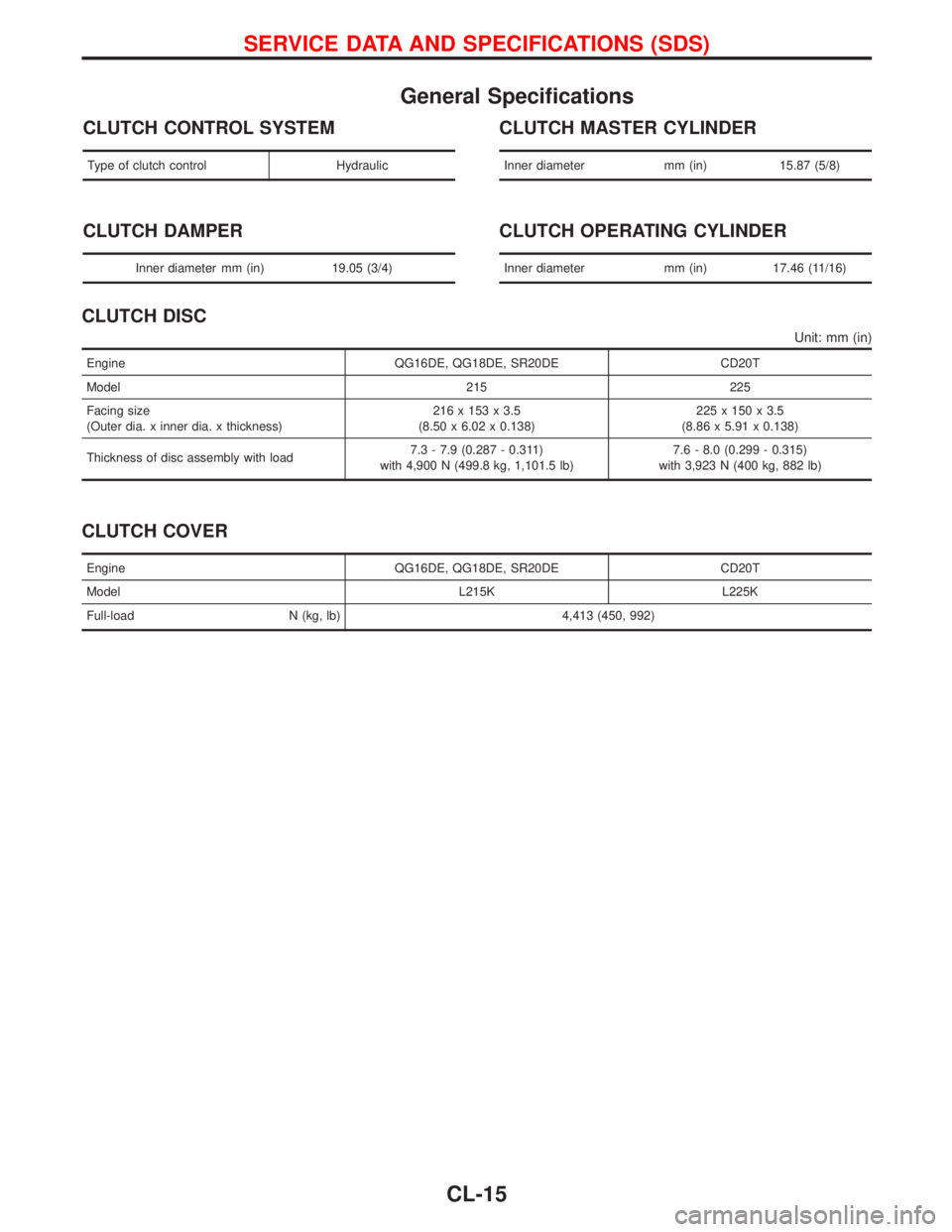
General Specifications
CLUTCH CONTROL SYSTEM
Type of clutch control Hydraulic
CLUTCH DAMPER
Inner diameter mm (in) 19.05 (3/4)
CLUTCH MASTER CYLINDER
Inner diameter mm (in) 15.87 (5/8)
CLUTCH OPERATING CYLINDER
Inner diameter mm (in) 17.46 (11/16)
CLUTCH DISC
Unit: mm (in)
Engine QG16DE, QG18DE, SR20DE CD20T
Model 215 225
Facing size
(Outer dia. x inner dia. x thickness)216 x 153 x 3.5
(8.50 x 6.02 x 0.138)225 x 150 x 3.5
(8.86 x 5.91 x 0.138)
Thickness of disc assembly with load7.3 - 7.9 (0.287 - 0.311)
with 4,900 N (499.8 kg, 1,101.5 lb)7.6 - 8.0 (0.299 - 0.315)
with 3,923 N (400 kg, 882 lb)
CLUTCH COVER
Engine QG16DE, QG18DE, SR20DE CD20T
Model L215K L225K
Full-load N (kg, lb) 4,413 (450, 992)
SERVICE DATA AND SPECIFICATIONS (SDS)
CL-15
Page 295 of 2267
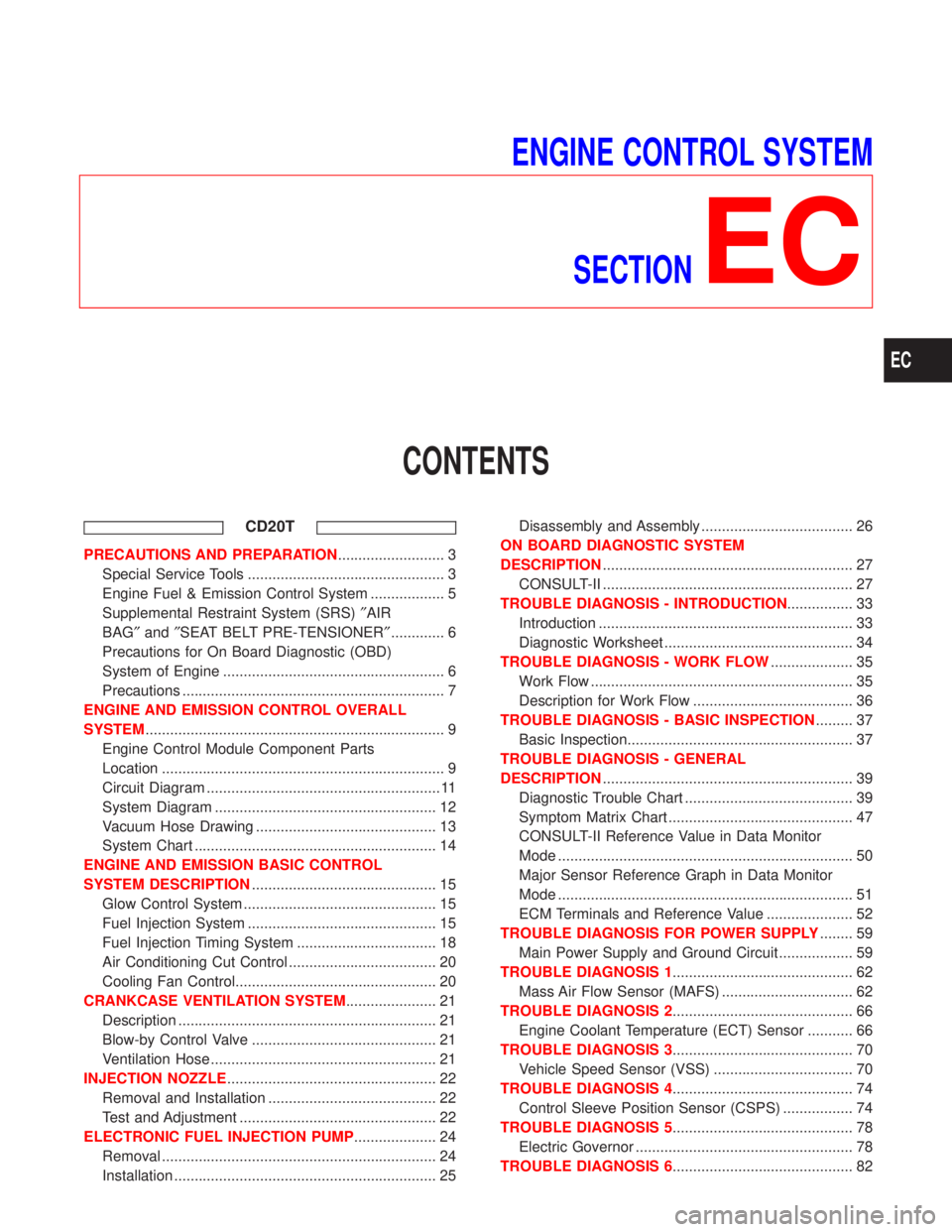
ENGINE CONTROL SYSTEM
SECTION
EC
CONTENTS
CD20T
PRECAUTIONS AND PREPARATION.......................... 3
Special Service Tools ................................................ 3
Engine Fuel & Emission Control System .................. 5
Supplemental Restraint System (SRS)²AIR
BAG²and²SEAT BELT PRE-TENSIONER²............. 6
Precautions for On Board Diagnostic (OBD)
System of Engine ...................................................... 6
Precautions ................................................................ 7
ENGINE AND EMISSION CONTROL OVERALL
SYSTEM......................................................................... 9
Engine Control Module Component Parts
Location ..................................................................... 9
Circuit Diagram ......................................................... 11
System Diagram ...................................................... 12
Vacuum Hose Drawing ............................................ 13
System Chart ........................................................... 14
ENGINE AND EMISSION BASIC CONTROL
SYSTEM DESCRIPTION............................................. 15
Glow Control System ............................................... 15
Fuel Injection System .............................................. 15
Fuel Injection Timing System .................................. 18
Air Conditioning Cut Control .................................... 20
Cooling Fan Control................................................. 20
CRANKCASE VENTILATION SYSTEM...................... 21
Description ............................................................... 21
Blow-by Control Valve ............................................. 21
Ventilation Hose ....................................................... 21
INJECTION NOZZLE................................................... 22
Removal and Installation ......................................... 22
Test and Adjustment ................................................ 22
ELECTRONIC FUEL INJECTION PUMP.................... 24
Removal ................................................................... 24
Installation ................................................................ 25Disassembly and Assembly ..................................... 26
ON BOARD DIAGNOSTIC SYSTEM
DESCRIPTION............................................................. 27
CONSULT-II ............................................................. 27
TROUBLE DIAGNOSIS - INTRODUCTION................ 33
Introduction .............................................................. 33
Diagnostic Worksheet .............................................. 34
TROUBLE DIAGNOSIS - WORK FLOW.................... 35
Work Flow ................................................................ 35
Description for Work Flow ....................................... 36
TROUBLE DIAGNOSIS - BASIC INSPECTION......... 37
Basic Inspection....................................................... 37
TROUBLE DIAGNOSIS - GENERAL
DESCRIPTION............................................................. 39
Diagnostic Trouble Chart ......................................... 39
Symptom Matrix Chart ............................................. 47
CONSULT-II Reference Value in Data Monitor
Mode ........................................................................ 50
Major Sensor Reference Graph in Data Monitor
Mode ........................................................................ 51
ECM Terminals and Reference Value ..................... 52
TROUBLE DIAGNOSIS FOR POWER SUPPLY........ 59
Main Power Supply and Ground Circuit .................. 59
TROUBLE DIAGNOSIS 1............................................ 62
Mass Air Flow Sensor (MAFS) ................................ 62
TROUBLE DIAGNOSIS 2............................................ 66
Engine Coolant Temperature (ECT) Sensor ........... 66
TROUBLE DIAGNOSIS 3............................................ 70
Vehicle Speed Sensor (VSS) .................................. 70
TROUBLE DIAGNOSIS 4............................................ 74
Control Sleeve Position Sensor (CSPS) ................. 74
TROUBLE DIAGNOSIS 5............................................ 78
Electric Governor ..................................................... 78
TROUBLE DIAGNOSIS 6............................................ 82
EC
Page 296 of 2267
Injection Timing Control Valve ................................. 82
TROUBLE DIAGNOSIS 7............................................ 86
Engine Control Module (ECM) ................................ 86
TROUBLE DIAGNOSIS 8............................................ 87
Cooling Fan (Overheat) ........................................... 87
TROUBLE DIAGNOSIS 9............................................ 97
Needle Lift Sensor (NLS) ........................................ 97
TROUBLE DIAGNOSIS 10........................................ 100
Fuel Cut Solenoid Valve ........................................ 100
TROUBLE DIAGNOSIS 11........................................ 104
Fuel Temperature Sensor (FTS)............................ 104
TROUBLE DIAGNOSIS 12........................................ 108
Accelerator Position Sensor & Switch ................... 108
TROUBLE DIAGNOSIS 13......................................... 114
Crankshaft Position Sensor (TDC) ......................... 114
TROUBLE DIAGNOSES 14....................................... 118
Glow Control System .............................................. 118TROUBLE DIAGNOSES 15...................................... 126
Air Conditioner Cut Control ................................... 126
TROUBLE DIAGNOSES 16...................................... 129
EGRC-Solenoid Valve ........................................... 129
TROUBLE DIAGNOSES 17...................................... 136
Brake Switch .......................................................... 136
TROUBLE DIAGNOSES 18...................................... 140
ECM Relay............................................................. 140
TROUBLE DIAGNOSES 19...................................... 141
MI & Data Link Connectors ................................... 141
TROUBLE DIAGNOSES 20...................................... 145
Start Signal ............................................................ 145
SERVICE DATA AND SPECIFICATIONS (SDS)...... 147
General Specifications ........................................... 147
Injection Nozzle ..................................................... 147
Inspection and Adjustment .................................... 147
When you read wiring diagrams:
lRead GI section, ªHOW TO READ WIRING DIAGRAMSº.
lSee EL section, ªPOWER SUPPLY ROUTINGº for power distribution circuit.
lSee EL section for NATS information and wiring diagram.
When you perform trouble diagnoses, read GI section, ªHOW TO FOLLOW FLOW CHART
IN TROUBLE DIAGNOSESº and ªHOW TO PERFORM EFFICIENT DIAGNOSIS FOR AN
ELECTRICAL INCIDENTº.
For clarification of system component abbreviations and terminology read GI section
ªSAE J1930 TERMINOLOGY LISTº.
EC-2
Page 299 of 2267
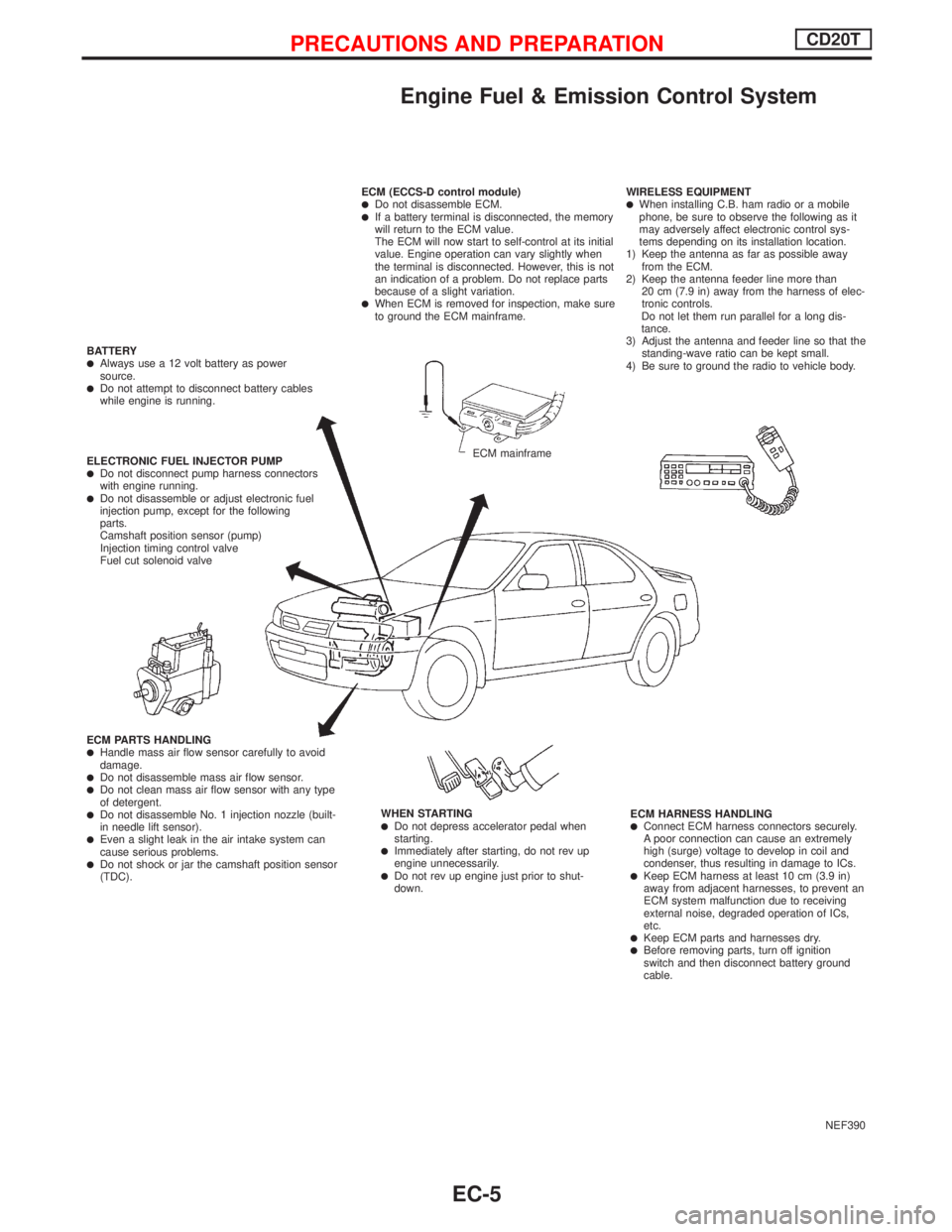
Engine Fuel & Emission Control System
NEF390 ECM (ECCS-D control module)
lDo not disassemble ECM.lIf a battery terminal is disconnected, the memory
will return to the ECM value.
The ECM will now start to self-control at its initial
value. Engine operation can vary slightly when
the terminal is disconnected. However, this is not
an indication of a problem. Do not replace parts
because of a slight variation.
lWhen ECM is removed for inspection, make sure
to ground the ECM mainframe.WIRELESS EQUIPMENT
lWhen installing C.B. ham radio or a mobile
phone, be sure to observe the following as it
may adversely affect electronic control sys-
tems depending on its installation location.
1) Keep the antenna as far as possible away
from the ECM.
2) Keep the antenna feeder line more than
20 cm (7.9 in) away from the harness of elec-
tronic controls.
Do not let them run parallel for a long dis-
tance.
3) Adjust the antenna and feeder line so that the
standing-wave ratio can be kept small.
4) Be sure to ground the radio to vehicle body.
ECM HARNESS HANDLING
lConnect ECM harness connectors securely.
A poor connection can cause an extremely
high (surge) voltage to develop in coil and
condenser, thus resulting in damage to ICs.
lKeep ECM harness at least 10 cm (3.9 in)
away from adjacent harnesses, to prevent an
ECM system malfunction due to receiving
external noise, degraded operation of ICs,
etc.
lKeep ECM parts and harnesses dry.lBefore removing parts, turn off ignition
switch and then disconnect battery ground
cable. WHEN STARTING
lDo not depress accelerator pedal when
starting.
lImmediately after starting, do not rev up
engine unnecessarily.
lDo not rev up engine just prior to shut-
down. ECM PARTS HANDLING
lHandle mass air flow sensor carefully to avoid
damage.
lDo not disassemble mass air flow sensor.lDo not clean mass air flow sensor with any type
of detergent.
lDo not disassemble No. 1 injection nozzle (built-
in needle lift sensor).
lEven a slight leak in the air intake system can
cause serious problems.
lDo not shock or jar the camshaft position sensor
(TDC). ELECTRONIC FUEL INJECTOR PUMP
lDo not disconnect pump harness connectors
with engine running.
lDo not disassemble or adjust electronic fuel
injection pump, except for the following
parts.
Camshaft position sensor (pump)
Injection timing control valve
Fuel cut solenoid valve BATTERY
lAlways use a 12 volt battery as power
source.
lDo not attempt to disconnect battery cables
while engine is running.
ECM mainframe
PRECAUTIONS AND PREPARATIONCD20T
EC-5