oil level NISSAN PULSAR 1987 User Guide
[x] Cancel search | Manufacturer: NISSAN, Model Year: 1987, Model line: PULSAR, Model: NISSAN PULSAR 1987Pages: 238, PDF Size: 28.91 MB
Page 68 of 238
68
COOLING AND HEATING SYSTEMS
SPECIFICATIONS
Coolant capacity ........................................ 6.0 liters
Thermostat:
Opening temperature........................... 91 deg
C
Fully open temperature .................... 103 deg
C
Cooling fan:
Fan cut in temperat ure ....................... 100 deg C
Fan cut out temperature ...................... 95 deg C
Radiator cap opening
pressure ................................................... 78 -98 kPa
TORQUE WRENCH SETTINGS
Water pump retaining bolts .............................25 Nm
Thermostat housing bolts .................................15 Nm
Sender unit .......................................................10 Nm
1. COOLING SYSTEM TROUBLE SHOOTING
COOLANT LEAKAGE - EXTERNAL
(1) Loose hose clips or faulty hoses: Tighten the
hose clips or renew the faulty water hoses.
(2) Leaking radiator core or tanks: Repair or
renew the radiator. (3) Leaking heater core or hoses: Repair or renew the heater core. Check the hose clips and hoses
and renew if necessary.
(4)
Leaks at the thermostat cover and/or water
pump O rings. Renew the O rings. (5) Worn or damaged water pump seal assembly:
Renew the water pump. (6) Worn or damaged water pump bearing as-
sembly: Renew the water pump.
(7) Loose or rusted welch plugs; Renew the
welch plugs. (8) Faulty cylinder head gasket or loose cylinder
head bolts: Renew the cylinder head gasket and
correctly tighten the cylinder head bolts. (9) External crack in the cy linder head or cylin-
der block: Repair or renew the faulty components.
NOTE: Check the system for external leak-
age by running the engine to operating
temperature over a dry floor and checking
for the leak source.
Check the vehicle interior below the
heater core for moisture. If a rusted welch
plug is found, it is a good practice to renew
all the welch plugs.
COOLANT LEAKAGE - INTERNAL
( 1 ) Cylinder head gasket leak due to warped
cylinder head or cylinder block gasket faces: Reface
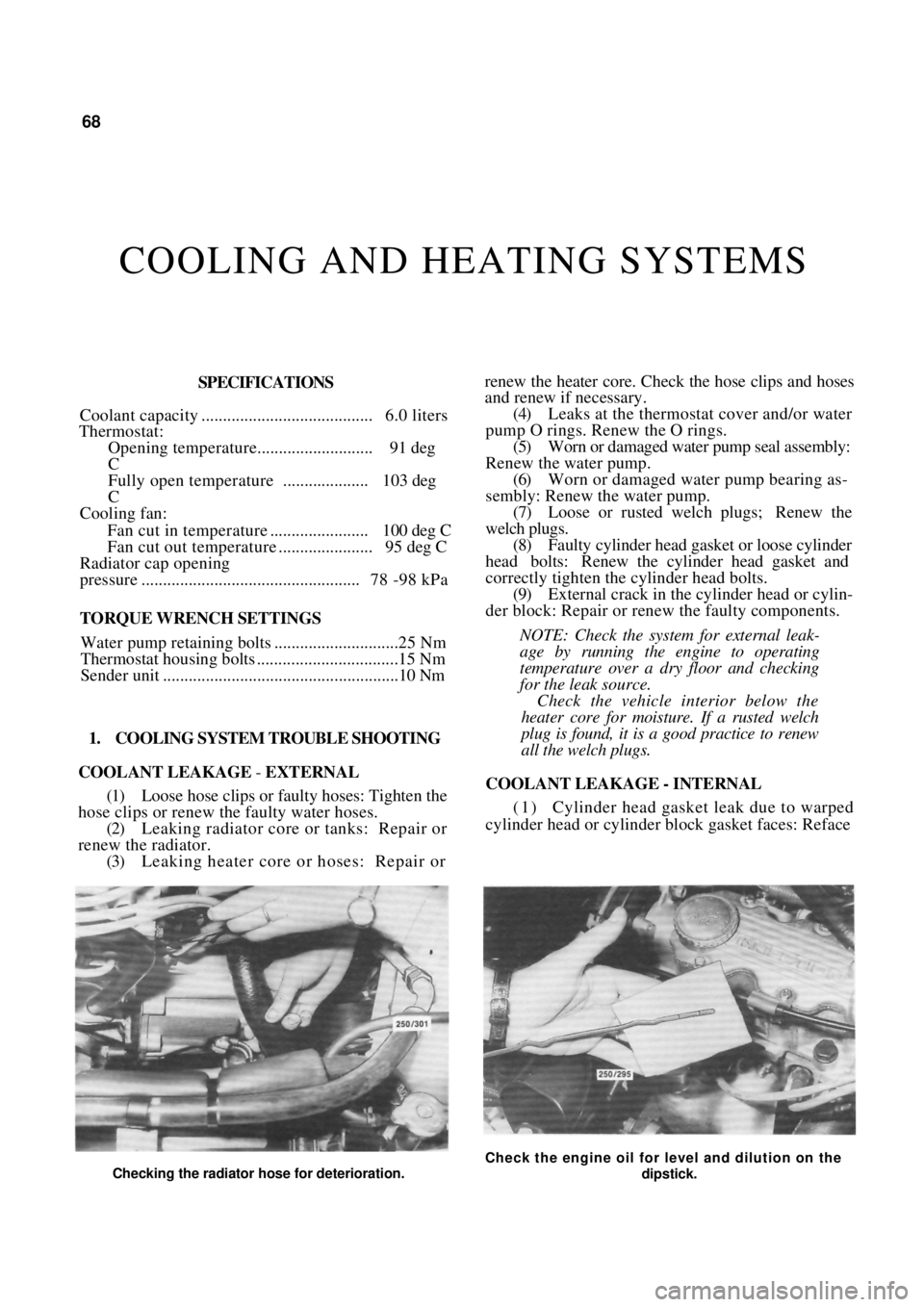
Checking the radiator hose for deterioration.
Check the engine oil for level and dilution on the
dipstick.
Page 69 of 238
Cooling and Heating Systems 69
the cylinder head or cylinder block and renew the
cylinder head gasket.
(2) Crack in the cylinder head or cylinder block:
Repair or renew as necessary.
NOTE; Check the engine for internal leak-
age by withdrawing the dipstick and inspect-
ing for emulsified oil. Run the engine and
check for excessive steam at the exhaust
pipe which would indi cate coolant leakage
into the combustion chamber.
COOLANT LOSS BY OVERFLOW
(1) Overfull system: Drain the excess coolant
from the system.
(2) Faulty radiator cap: Renew the faulty cap.
(3) Blocked radiator core tubes: Clean or renew
the radiator core.
(4) Faulty thermostat: Renew the thermostat.
(5) Coolant foaming due to poor quality anti-
freeze or corrosion inhibitor: Drain the system and
renew the coolant and additive.
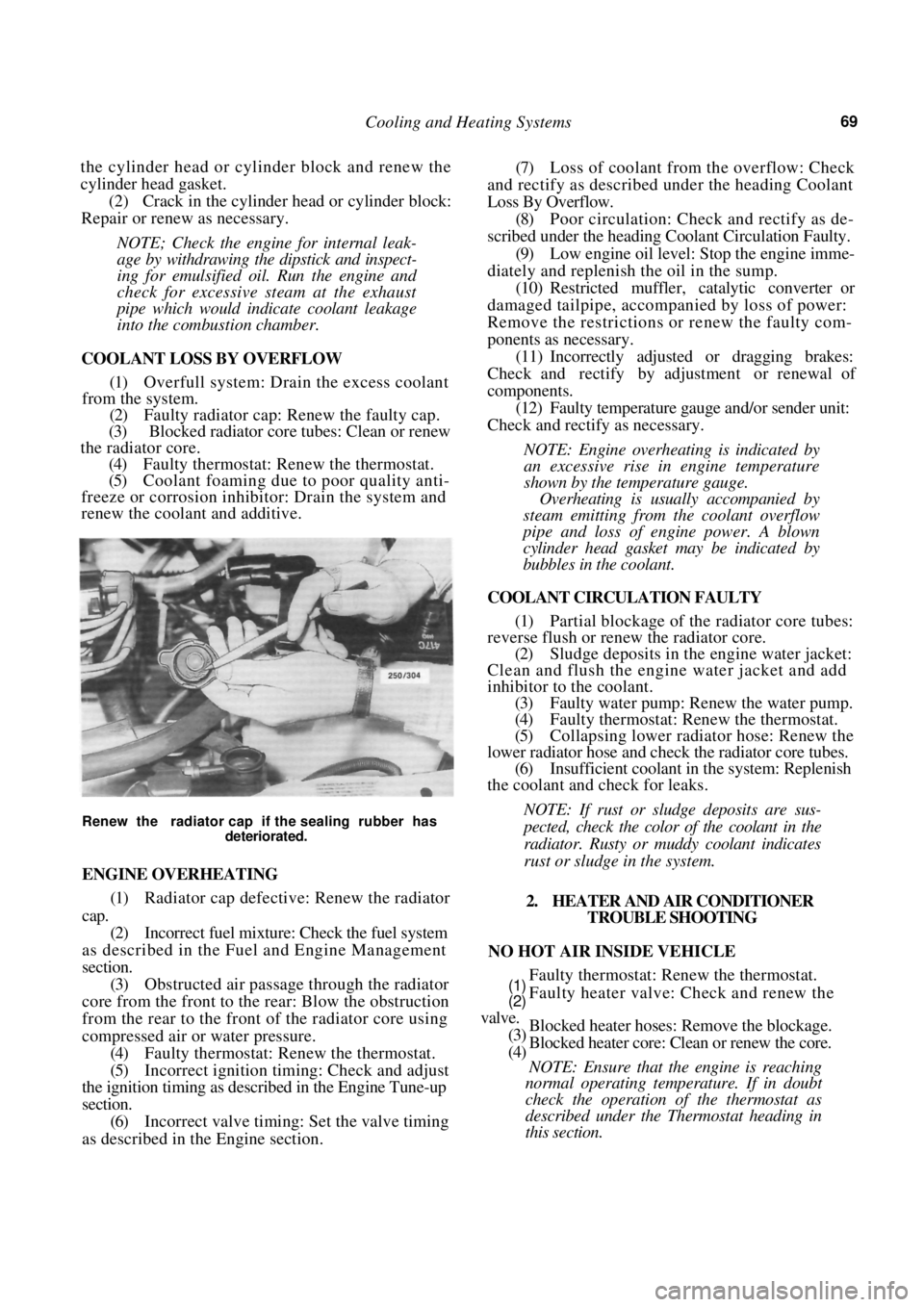
Renew the radiator cap if the sealing rubber has
deteriorated.
ENGINE OVERHEATING
(1) Radiator cap defective: Renew the radiator
cap.
(2) Incorrect fuel mixture: Check the fuel system
as described in the Fuel and Engine Management
section. (3) Obstructed air passage through the radiator
core from the front to the rear: Blow the obstruction
from the rear to the front of the radiator core using
compressed air or water pressure. (4) Faulty thermostat: Renew the thermostat.
(5) Incorrect ignition timing: Check and adjust
the ignition timing as described in the Engine Tune-up
section. (6) Incorrect valve timing: Set the valve timing
as described in th e Engine section.
(7) Loss of coolant from the overflow: Check
and rectify as described under the heading Coolant
Loss By Overflow.
(8) Poor circulation: Check and rectify as de-
scribed under the heading Coolant Circulation Faulty.
(9) Low engine oil level: Stop the engine imme-
diately and replenish the oil in the sump. (10) Restricted muffler, catalytic converter or
damaged tailpipe, accompanied by loss of power:
Remove the restrictions or renew the faulty com-
ponents as necessary.
(11) Incorrectly adjusted or dragging brakes:
Check and rectify by adjustment or renewal of
components. (12) Faulty temperature gauge and/or sender unit:
Check and rectify as necessary.
NOTE: Engine overheating is indicated by
an excessive rise in engine temperature
shown by the temperature gauge.
Overheating is usually accompanied by
steam emitting from the coolant overflow
pipe and loss of engine power. A blown
cylinder head gasket may be indicated by
bubbles in the coolant.
COOLANT CIRCULATION FAULTY
(1) Partial blockage of the radiator core tubes:
reverse flush or renew the radiator core.
(2) Sludge deposits in the engine water jacket:
Clean and flush the engine water jacket and add
inhibitor to the coolant. (3) Faulty water pump: Renew the water pump.
(4) Faulty thermostat: Renew the thermostat.
(5) Collapsing lower radiator hose: Renew the
lower radiator hose and check the radiator core tubes. (6) Insufficient coolant in the system: Replenish
the coolant and check for leaks.
NOTE: If rust or sludge deposits are sus-
pected, check the color of the coolant in the
radiator. Rusty or muddy coolant indicates
rust or sludge in the system.
2. HEATER AND AIR CONDITIONER TROUBLE SHOOTING
NO HOT AIR INSIDE VEHICLE
Faulty thermostat: Renew the thermostat.
Faulty heater valve: Check and renew the
Blocked heater hoses: Remove the blockage.
Blocked heater core: Clean or renew the core.
NOTE: Ensure that the engine is reaching
normal operating temperature. If in doubt
check the operation of the thermostat as
described under the Thermostat heading in
this section.
(1)
(2)
valve.
(3)
(4)
Page 70 of 238
70 Cooling and Heating Systems
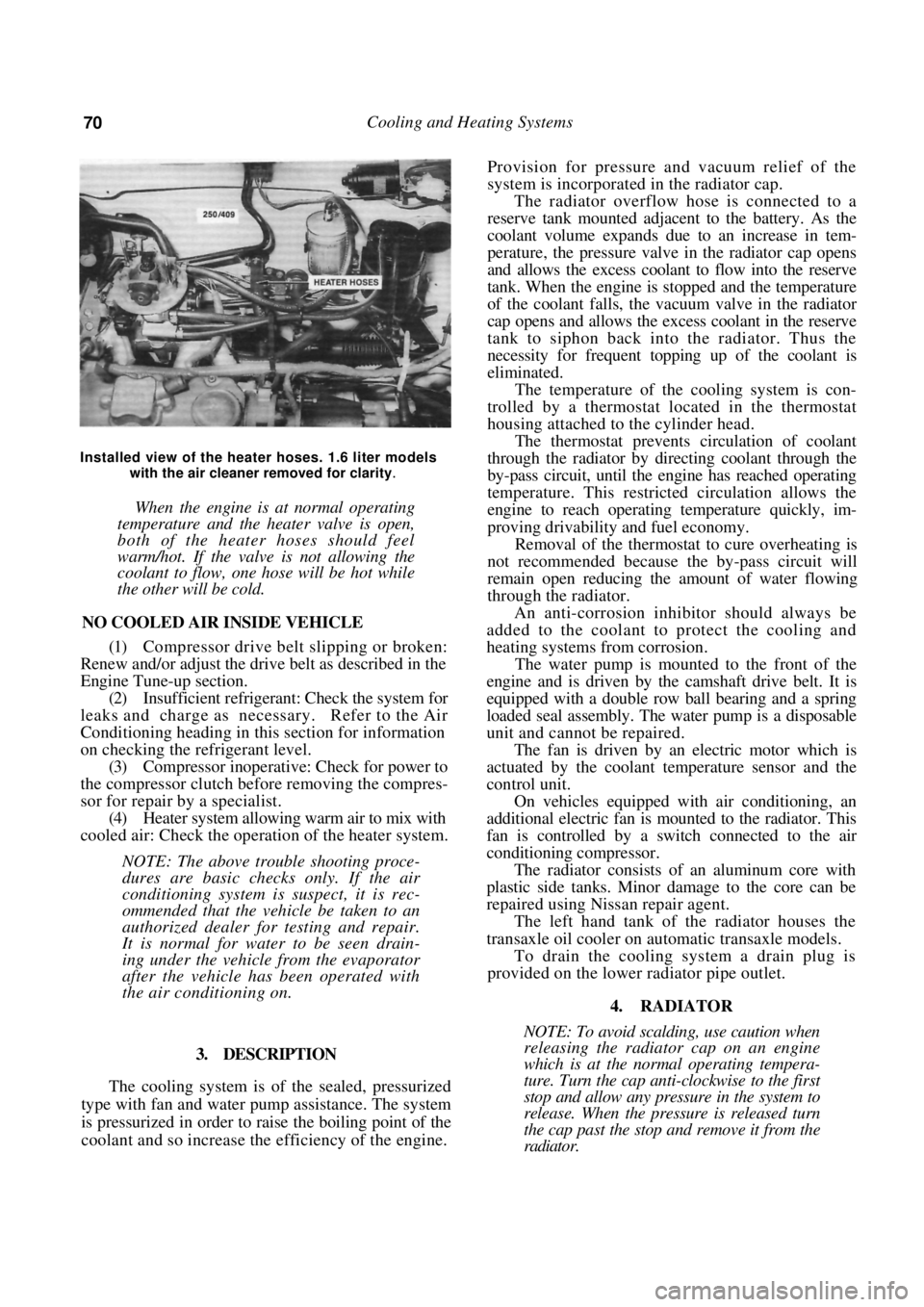
Installed view of the heater hoses. 1.6 liter models with the air cleaner removed for clarity
.
When the engine is at normal operating
temperature and the heater valve is open,
both of the heater hoses should feel
warm/hot. If the valve is not allowing the
coolant to flow, one hose will be hot while
the other will be cold.
NO COOLED AIR INSIDE VEHICLE
(1) Compressor drive belt slipping or broken:
Renew and/or adjust the drive belt as described in the
Engine Tune-up section.
(2) Insufficient refrigerant: Check the system for
leaks and charge as necessary. Refer to the Air
Conditioning heading in th is section for information
on checking the refrigerant level. (3) Compressor inoperative: Check for power to
the compressor clutch before removing the compres-
sor for repair by a specialist. (4) Heater system allowing warm air to mix with
cooled air: Check the operation of the heater system.
NOTE: The above trouble shooting proce-
dures are basic checks only. If the air
conditioning system is suspect, it is rec-
ommended that the vehicle be taken to an
authorized dealer for testing and repair.
It is normal for water to be seen drain-
ing under the vehicle from the evaporator
after the vehicle has been operated with
the air conditioning on.
3. DESCRIPTION
The cooling system is of the sealed, pressurized
type with fan and water pump assistance. The system
is pressurized in order to raise the boiling point of the
coolant and so increase the efficiency of the engine.
Provision for pressure a nd vacuum relief of the
system is incorporated in the radiator cap.
The radiator overflow hose is connected to a
reserve tank mounted adjacent to the battery. As the
coolant volume expands due to an increase in tem-
perature, the pressure valve in the radiator cap opens
and allows the excess coolant to flow into the reserve
tank. When the engine is stopped and the temperature
of the coolant falls, the vacuum valve in the radiator
cap opens and allows the excess coolant in the reserve
tank to siphon back into the radiator. Thus the
necessity for frequent topping up of the coolant is
eliminated.
The temperature of the cooling system is con-
trolled by a thermostat located in the thermostat
housing attached to the cylinder head.
The thermostat prevents circulation of coolant
through the radiator by directing coolant through the
by-pass circuit, until the engine has reached operating
temperature. This restricted circulation allows the
engine to reach operating temperature quickly, im-
proving drivability and fuel economy.
Removal of the thermostat to cure overheating is
not recommended because th e by-pass circuit will
remain open reducing the amount of water flowing
through the radiator.
An anti-corrosion inhibitor should always be
added to the coolant to protect the cooling and
heating systems from corrosion.
The water pump is mounted to the front of the
engine and is driven by the camshaft drive belt. It is
equipped with a double row ball bearing and a spring
loaded seal assembly. The water pump is a disposable
unit and cannot be repaired.
The fan is driven by an electric motor which is
actuated by the coolant temperature sensor and the
control unit.
On vehicles equipped with air conditioning, an
additional electric fan is m ounted to the radiator. This
fan is controlled by a sw itch connected to the air
conditioning compressor.
The radiator consists of an aluminum core with
plastic side tanks. Minor damage to the core can be
repaired using Nissan repair agent.
The left hand tank of the radiator houses the
transaxle oil cooler on automatic transaxle models.
To drain the cooling system a drain plug is
provided on the lower radiator pipe outlet.
4. RADIATOR
NOTE: To avoid scalding, use caution when
releasing the radiator cap on an engine
which is at the normal operating tempera-
ture. Turn the cap anti-clockwise to the first
stop and allow any pressure in the system to
release. When the pressure is released turn
the cap past the stop and remove it from the
radiator.
Page 72 of 238
72 Cooling and Heating Systems
(16) After the vehicle has been driven several
kilometers check the coolant level in the reserve tank
and top up if necessary.
TO REMOVE
(1) Drain the cooling system as previously de-
scribed.
(2) Loosen the hose clamps and disconnect the
hoses from the radiator. (3) If applicable disconnect the automatic trans-
axle oil cooler hoses from the left hand side radiator
tank. Plug the hoses and fitt ings to prevent the entry
of dirt and the loss of fluid.
(4) Disconnect the hose from the reserve tank at
the top of the radiator. (5) On models with air conditioning, remove the
hoses and support bracket bolts and move the bracket
and hoses away from the top of the radiator. (6) Remove the radiator support bracket bolts
from the radiator support pa nel and lift the radiator
from the lower mountings and out of the vehicle.
NOTE: A radiator that has been in use for
some time should not be allowed to stand
empty for any length of time. The radiator
should be immersed in a tank of coolant or
otherwise kept full. If applicable, ensure that
no coolant is allowed to enter the automatic
transaxle oil cooler in the left hand side tank
of the radiator.
Failure to observe this precaution may
result in overheating when the engine is put
back into service. This is caused by internal
deposits in the radiator drying and flaking
and so obstructing the circulation of the
coolant in the system.
TO FLUSH AND CLEAN
(1) Remove the radiator as previously described.
(2) Apply a water hose to the radiator outlet and
reverse flush the radiator until the water flowing from
it is clean.
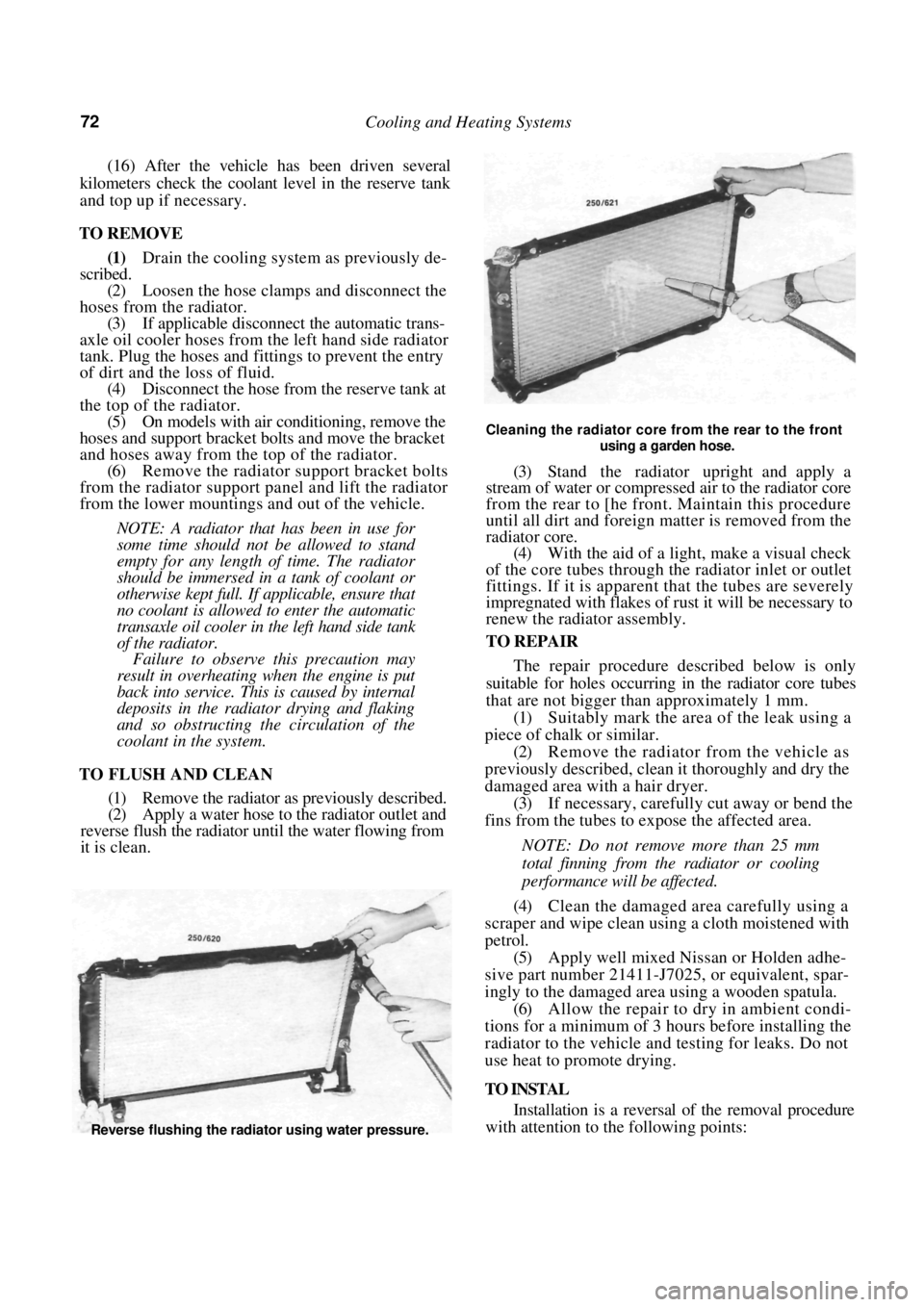
Cleaning the radiator core from the rear to the front
using a garden hose.
(3) Stand the radiator upright and apply a
stream of water or compressed air to the radiator core
from the rear to [he front. Maintain this procedure
until all dirt and foreign matter is removed from the
radiator core.
(4) With the aid of a light, make a visual check
of the core tubes through the radiator inlet or outlet
fittings. If it is apparent that the tubes are severely
impregnated with flakes of rust it will be necessary to
renew the radiator assembly.
TO REPAIR
The repair procedure described below is only
suitable for holes occurring in the radiator core tubes
that are not bigger than approximately 1 mm.
(1) Suitably mark the area of the leak using a
piece of chalk or similar. (2) Remove the radiator from the vehicle as
previously described, clean it thoroughly and dry the
damaged area with a hair dryer. (3) If necessary, carefully cut away or bend the
fins from the tubes to expose the affected area.
NOTE: Do not remove more than 25 mm
total finning from the radiator or cooling
performance will be affected.
(4) Clean the damaged area carefully using a
scraper and wipe clean using a cloth moistened with
petrol.
(5) Apply well mixed Nissan or Holden adhe-
sive part number 21411-J7025, or equivalent, spar-
ingly to the damaged area using a wooden spatula.
(6) Allow the repair to dry in ambient condi-
tions for a minimum of 3 hours before installing the
radiator to the vehicle and testing for leaks. Do not
use heat to promote drying.
TO INSTAL
Installation is a reversal of the removal procedure
with attention to the following points:
Reverse flushing the radiator using water pressure.
Page 81 of 238

Cooling and Heating Systems 81
continuous stream of bubbles indicates that the refriger-
ant charge is low.
A large number of bubbles or foam indicates that
the refrigerant charge is very low.
No bubbles or the presen ce of oil streaks in the
sight glass indicate that the system is completely
empty.
NOTE: If the outside air temperature is
high, a certain number of bubbles may be
observed in the sight gl ass, even though the
system is fully charged.
If the system requires recharging, the vehicle
should be taken to an authorized dealer for evacu-
ation, leak testing and recharging.
Do not operate the system if it is known that the
refrigerant charge is low as damage may result.
MAINTENANCE
The air conditioning system requires l i t t l e main-
tenance other than the following. Where applicable,
refer to the Lubrication an d Maintenance section for
the recommended service intervals.
(1) Check the refrigerant charge level in the
receiver/dryer sight glass. Recharge the system as
necessary. It is considered normal for the system to
require periodic recharging. (2) Inspect the air conditioner pipes and hoses
for leaks, deterioration and alignment. Evidence of oil
leakage is an indication of refrigerant leakage. Repair
or renew as necessary.
(3) Inspect the evaporator drain tube and the
condenser cooling fins for blockage. Clean as neces-
sary.
(4) Check the drive belt for deterioration and for
correct tension. Refer to the Engine Tune-up section
for the correct procedure.
(5) Operate the system at least once a week for
approximately 15 minutes to keep the compressor
seals lubricated.
Page 117 of 238
117
EMISSION CONTROL
INTRODUCTION
To reduce the output level of the three primary
automotive emissions, carbon monoxide (CO), hydro-
carbons (HC) and oxides of nitrogen (NOx), and thus
comply with legislation on the maintenance of clean
air, several different emissi on control systems are used
in the Pulsar range of vehicles covered by this manual.
The systems will be discussed under the headings
( 1 ) Crankcase Ventilation System, (2) Evaporative
Control System, (3) Air Preheat System — 1.6 Liter
Engine and (4) Exhaust Control System.
1. CRANKCASE VENTILATION SYSTEM
DESCRIPTION
The crankcase ventilation system is of the closed
type and is designed to prevent crankcase vapors
being emitted into the atmosphere. Crankcase
vapors are caused by gases escaping past the piston
rings into the crankcase during the combustion pro-
cess.
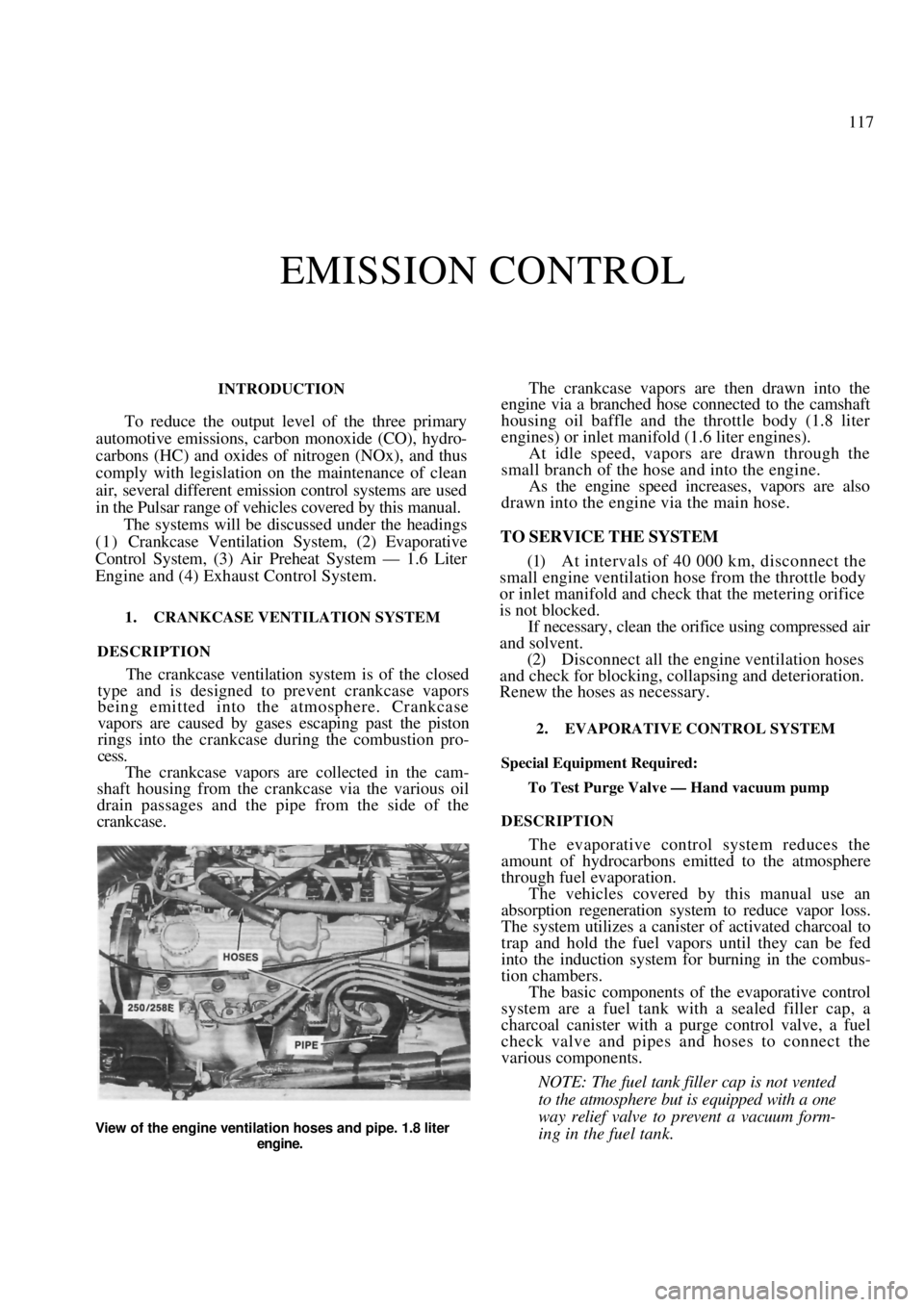
The crankcase vapors are collected in the cam-
shaft housing from the cra nkcase via the various oil
drain passages and the pipe from the side of the
crankcase.
The crankcase vapors are then drawn into the
engine via a branched hose connected to the camshaft
housing oil baffle and the throttle body (1.8 liter
engines) or inlet manifold (1.6 liter engines).
At idle speed, vapors are drawn through the
small branch of the hose and into the engine.
As the engine speed increases, vapors are also
drawn into the engine via the main hose.
TO SERVICE THE SYSTEM
(1) At intervals of 40 000 km, disconnect the
small engine ventilation hose from the throttle body
or inlet manifold and check that the metering orifice
is not blocked.
If necessary, clean the orifice using compressed air
and solvent.
(2) Disconnect all the engine ventilation hoses
and check for blocking, collapsing and deterioration.
Renew the hoses as necessary.
2. EVAPORATIVE CONTROL SYSTEM
Special Equipment Required:
To Test Purge Valve — Hand vacuum pump
DESCRIPTION
The evaporative control system reduces the
amount of hydrocarbons emitted to the atmosphere
through fuel evaporation.
The vehicles covered by this manual use an
absorption regeneration system to reduce vapor loss.
The system utilizes a canister of activated charcoal to
trap and hold the fuel vapors until they can be fed
into the induction system for burning in the combus-
tion chambers.
The basic components of the evaporative control
system are a fuel tank with a sealed filler cap, a
charcoal canister with a pur ge control valve, a fuel
check valve and pipes a nd hoses to connect the
various components.
NOTE: The fuel tank filler cap is not vented
to the atmosphere but is equipped with a one
way relief valve to prevent a vacuum form-
ing in the fuel tank.
View of the engine ventilation hoses and pipe. 1.8 liter
engine.
Page 120 of 238

120 Emission Control
If the flap does not operate as described, renew
the air cleaner housing.
(2) Disconnect the vacuum hose from the servo
unit and connect it to a vacuum gauge.
(3) Start and run the engine at approximately
1 200 rpm. If the engine is cold there should be
vacuum. (4) As the engine temperature increases the
vacuum should decrease to zero. If the vacuum gauge does not read as described,
check that the vacuum supply hose is connected to the
thermal vacuum valve and the throttle body.
If no fault is found, renew the thermal vacuum
valve.
4. EXHAUST CONTROL SYSTEM
DESCRIPTION
The exhaust system is the greatest source of
pollutant emission from the internal combustion
engine.
On the Pulsar range of vehicles covered by this
manual, the exhaust control system consists of a
catalytic converter and the engine management sys-
tem. The engine management system constantly mon-
itors the exhaust gases via an oxygen sensor located in
the exhaust system. Fuel injection is then adjusted
accordingly to give the minimum amount of exhaust
emissions. Refer to the Fuel and Engine Management
section for further information.
CATALYTIC CONVERTER
The catalytic converter, which is located in the
exhaust system, converts hydrocarbons, oxides of
nitrogen and carbon monoxide present in the exhaust
gases into carbon dioxide, nitrogen, water and heat.
The catalytic converter does not require periodic
maintenance or replacement under normal circum-
stances. However, it can be damaged or poisoned by
excessively high exhaust gas temperatures, raw fuel
and the use of leaded fuel.
Installed view of the catalytic converter.
To prevent the use of leaded fuel, a small diam-
eter fuel filler neck with a spring loaded trap door is
used.
To prevent damage to the catalytic converter, the
following precautions sh ould be observed.
(1) Do not operate the vehicle on leaded fuel.
(2) Do not push or tow start the vehicle.
(3) Do not allow the engine to idle for prolonged
periods. (4) Do not operate the vehicle if the engine is
misfiring.
(5) Avoid running the vehicle out of fuel.
(6) Ensure that the engine oil is formulated to
contain low phosphorous levels.
To Inspect Catalytic Converter
(1) Inspect the converter for dents and damage.
If the converter is damaged, it should be renewed. (2) Inspect the converter heat shield for damage
and ensure that it is positioned correctly. Renew the
converter heat shield if necessary.
To Remove and Install
To remove and install the catalytic converter,
refer
to the Exhaust System heading in the Engine section.
Page 127 of 238
Manual Transaxle and Drive Shafts 127
(6) Lubricating oil too thick: Drain the transaxle
and refill with the corre ct amount and grade of
lubricating oil. (7) Excessive end float in the mainshaft or input
shaft gears: Overhaul the transaxle.
NOTE: Check the clutch for correct opera-
tion. If reverse gear can be selected without
any gear clash this is a good indication that
the clutch is operating normally. Also check
that the correct type and grade of lubricating
oil is being used.
SLIPPING OUT OF GEAR
(1) Worn gear control rod assembly bushes:
Check and renew the worn components as necessary. (2) Faulty gear lever assembly: Check and renew
the faulty components. (3) Faulty synchroniser mechanism: Overhaul
the transaxle.
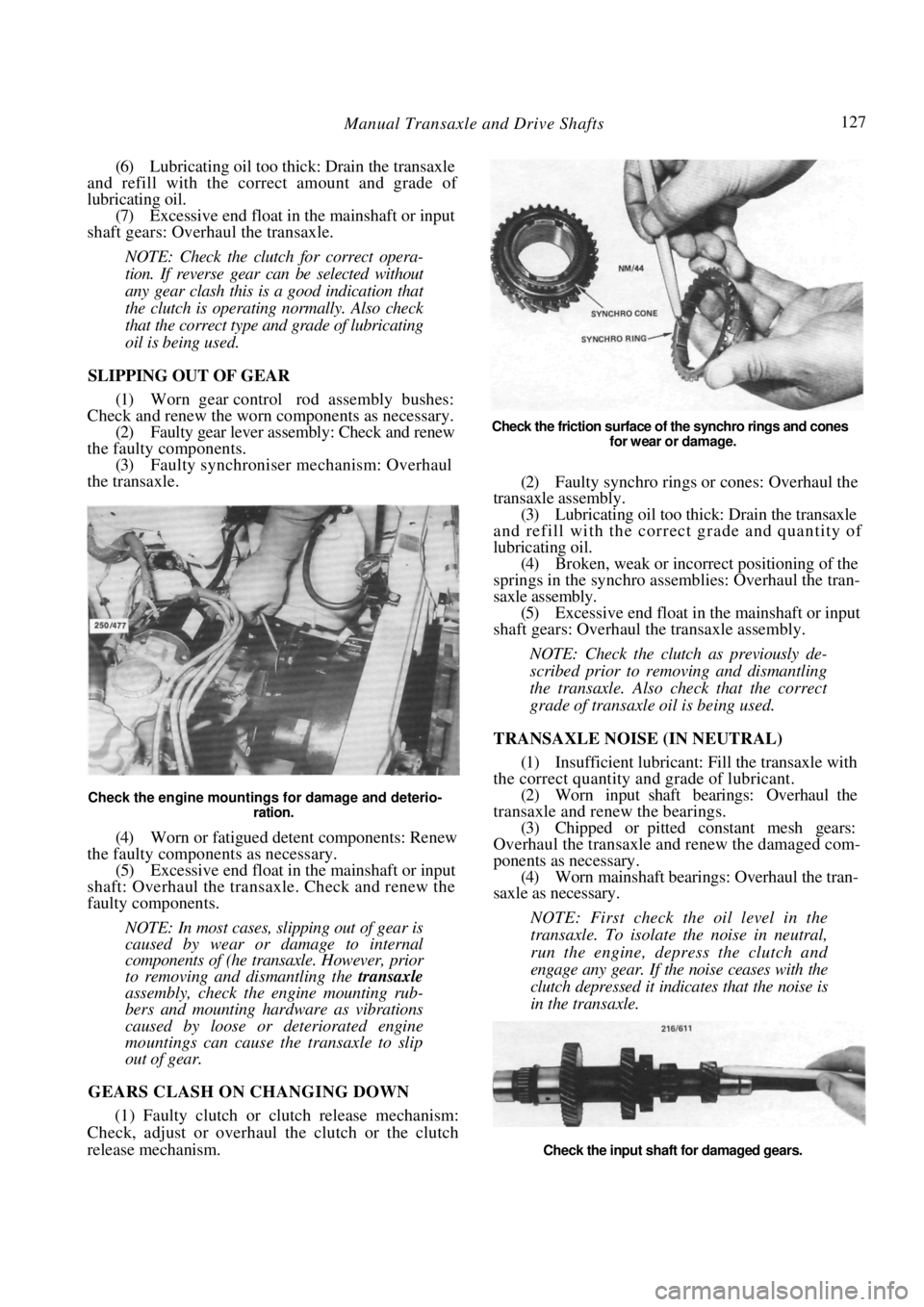
Check the engine mountings for damage and deterio-
ration.
(4) Worn or fatigued detent components: Renew
the faulty components as necessary.
(5) Excessive end float in the mainshaft or input
shaft: Overhaul the transaxle. Check and renew the
faulty components.
NOTE: In most cases, slipping out of gear is
caused by wear or damage to internal
components of (he tran saxle. However, prior
to removing and dismantling the transaxle
assembly, check the engine mounting rub-
bers and mounting hardware as vibrations
caused by loose or deteriorated engine
mountings can cause the transaxle to slip
out of gear.
GEARS CLASH ON CHANGING DOWN
(1) Faulty clutch or clutch release mechanism:
Check, adjust or overhaul the clutch or the clutch
release mechanism.
Check the friction surface of the synchro rings and cones
for wear or damage.
(2) Faulty synchro rings or cones: Overhaul the
transaxle assembly.
(3) Lubricating oil too thick: Drain the transaxle
and refill with the correct grade and quantity of
lubricating oil. (4) Broken, weak or incorrect positioning of the
springs in the synchro asse mblies: Overhaul the tran-
saxle assembly.
(5) Excessive end float in the mainshaft or input
shaft gears: Overhaul the transaxle assembly.
NOTE: Check the clutch as previously de-
scribed prior to removing and dismantling
the transaxle. Also check that the correct
grade of transaxle oil is being used.
TRANSAXLE NOISE (IN NEUTRAL)
(1) Insufficient lubricant: Fill the transaxle with
the correct quantity and grade of lubricant. (2) Worn input shaft bearings: Overhaul the
transaxle and renew the bearings. (3) Chipped or pitted constant mesh gears:
Overhaul the transaxle and renew the damaged com-
ponents as necessary. (4) Worn mainshaft bearings: Overhaul the tran-
saxle as necessary.
NOTE: First check the oil level in the
transaxle. To isolate the noise in neutral,
run the engine, depress the clutch and
engage any gear. If the noise ceases with the
clutch depressed it indicates that the noise is
in the transaxle.
Check the input shaft for damaged gears.
Page 128 of 238
128 Manual Transaxle and Drive Shafts
TRANSAXLE NOISE (FORWARD GEARS
ENGAGED, VEHICLE MOVING)
(1) Insufficient lubricant: Fill the transaxle with
the correct grade and quantity of oil. (2) Worn input shaft or mainshaft bearings:
Overhaul the transaxle and renew the faulty bearings. (3) Chipped or pitted gears: Check and overhaul
the transaxle and renew the faulty gears. (4) Damaged or worn sync hroniser assemblies:
Overhaul the transaxle and renew the synchroniser
assemblies.
FINAL DRIVE GEAR NOISE
(1) Insufficient lubricant: Fill the transaxle case
with the correct grade and quantity of oil. (2) Chipped or pitted final drive gear and/or ring
gear: Overhaul the transaxle and renew components as
necessary. (3) Worn differential carrier bearings: Overhaul
the differential assembly.
(4) Worn mainshaft or input shaft bearings:
Overhaul the transaxle.
NOTE: Check the oil level in the transaxle
case and the condition of the front hub
bearings and drive shaft joints prior to
overhauling the transaxle.
EXCESSIVE BACKLASH IN FINAL DRIVE
(1) Excessive end float in the differential carrier
bearings due to worn or incorrect bearing preload
adjustment: Check and adjust the bearing preload or
renew the bearings.
(2) Ring gear to differential case bolts loose:
Overhaul the transaxle and tighten the bolts to the
specified torque.
(3) Excessive wear in the final drive gear: Check
and overhaul the transaxle. (4) Excessive wear in the differential pinions,
side gears or pinion shaft: Overhaul the differential
assembly.
NOTE: Prior to overhauling the differential,
check the serviceability of the C.V joints on
the drive shafts.
NO DRIVE IN ANY GEAR
(1) Sheared ring gear to differential case bolts:
Overhaul the differential assembly.
(2) Broken drive shaft: Check and renew com-
ponents as necessary.
(3) Inner C.V. joint shaft out of mesh with
differential side gear: Weak or broken inner C.V. joint
shaft snap ring. Renew as necessary.
NOISE OR VIBRATION IN DRIVE SHAFTS
( 1 ) Bent or twisted drive shafts: Check and
renew the drive shafts as necessary.
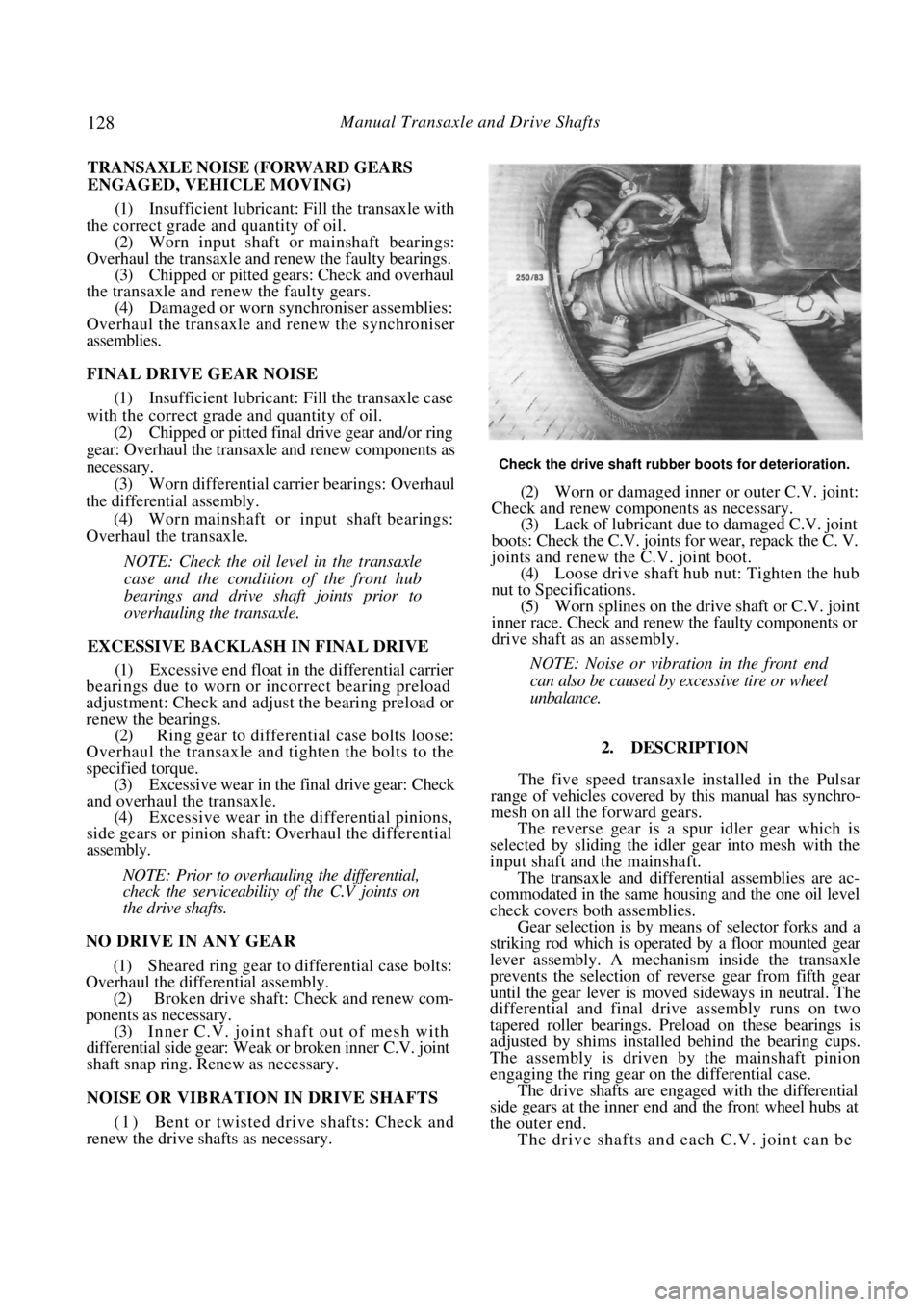
Check the drive shaft rubber boots for deterioration.
(2) Worn or damaged inner or outer C.V. joint:
Check and renew components as necessary. (3) Lack of lubricant due to damaged C.V. joint
boots: Check the C.V. joints for wear, repack the C. V.
joints and renew th e C.V. joint boot.
(4) Loose drive shaft hub nut: Tighten the hub
nut to Specifications. (5) Worn splines on the drive shaft or C.V. joint
inner race. Check and renew the faulty components or
drive shaft as an assembly.
NOTE: Noise or vibration in the front end
can also be caused by excessive tire or wheel
unbalance.
2. DESCRIPTION
The five speed transaxle installed in the Pulsar
range of vehicles covered by this manual has synchro-
mesh on all the forward gears.
The reverse gear is a spur idler gear which is
selected by sliding the idler gear into mesh with the
input shaft and the mainshaft.
The transaxle and differential assemblies are ac-
commodated in the same housing and the one oil level
check covers both assemblies.
Gear selection is by mean s of selector forks and a
striking rod which is operated by a floor mounted gear
lever assembly. A mechanism inside the transaxle
prevents the selection of re verse gear from fifth gear
until the gear lever is moved sideways in neutral. The
differential and final dr ive assembly runs on two
tapered roller bearings. Pr eload on these bearings is
adjusted by shims installed behind the bearing cups.
The assembly is driven by the mainshaft pinion
engaging the ring gear on the differential case.
The drive shafts are engaged with the differential
side gears at the inner end and the front wheel hubs at
the outer end.
The drive shafts and each C.V. joint can be
Page 130 of 238
130 Manual Transaxle and Drive Shafts
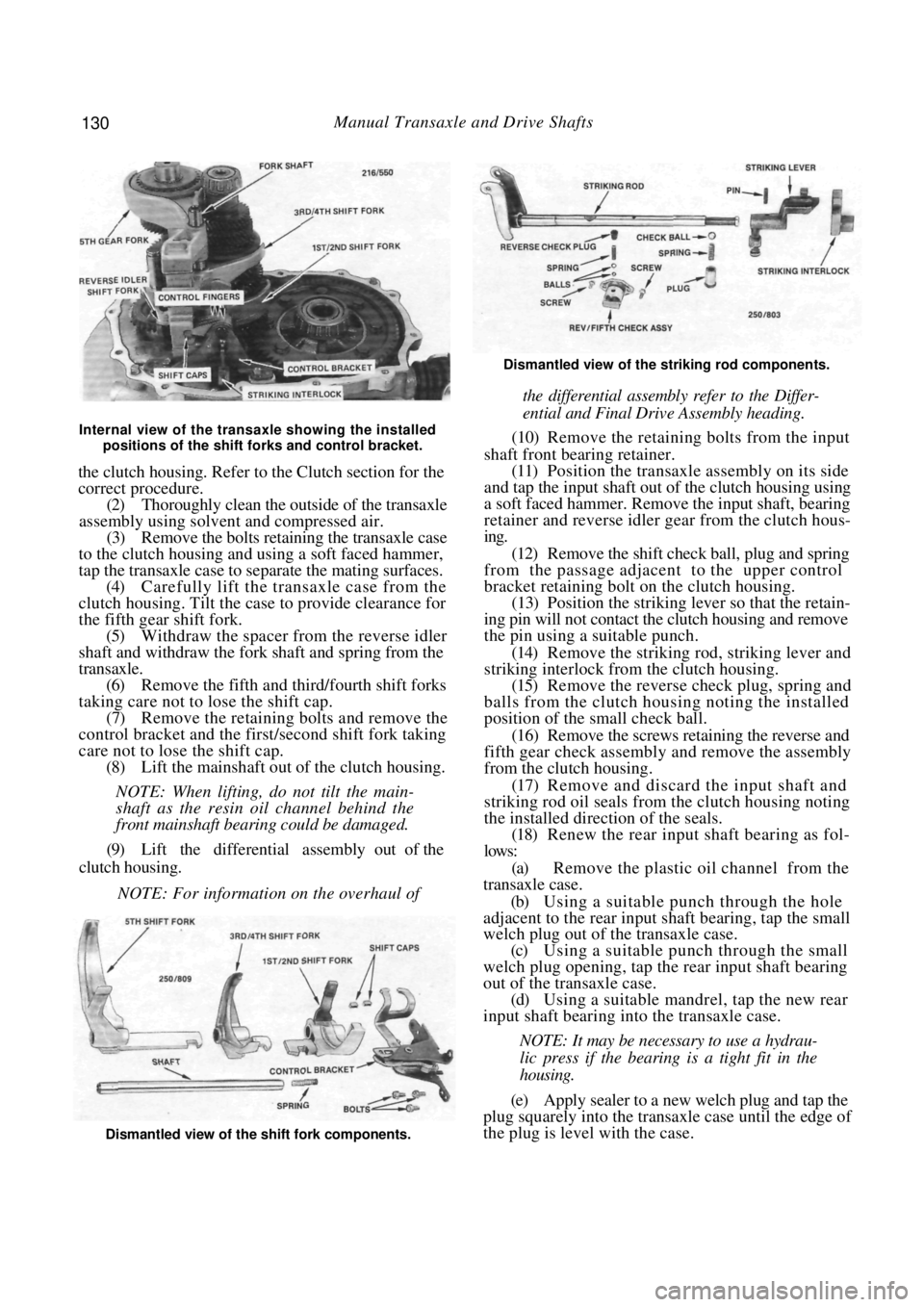
Internal view of the transaxle showing the installed positions of the shift forks and control bracket.
the clutch housing. Refer to the Clutch section for the
correct procedure.
(2) Thoroughly clean the outsi de of the transaxle
assembly using solvent and compressed air. (3) Remove the bolts retaining the transaxle case
to the clutch housing and using a soft faced hammer,
tap the transaxle case to separate the mating surfaces.
(4) Carefully lift the transaxle case from the
clutch housing. Tilt the cas e to provide clearance for
the fifth gear shift fork. (5) Withdraw the spacer from the reverse idler
shaft and withdraw the fork shaft and spring from the
transaxle. (6) Remove the fifth and third/fourth shift forks
taking care not to lose the shift cap. (7) Remove the retaining bolts and remove the
control bracket and the first/second shift fork taking
care not to lose the shift cap. (8) Lift the mainshaft out of the clutch housing.
NOTE: When lifting, do not tilt the main-
shaft as the resin oil channel behind the
front mainshaft bearing could be damaged.
(9) Lift the differential assembly out of the
clutch housing.
NOTE: For information on the overhaul of
Dismantled view of the striking rod components.
the differential assembly refer to the Differ-
ential and Final Drive Assembly heading.
(10) Remove the retaining bolts from the input
shaft front bearing retainer. (11) Position the transaxle assembly on its side
and tap the input shaft out of the clutch housing using
a soft faced hammer. Remove the input shaft, bearing
retainer and reverse idler gear from the clutch hous-
ing.
(12) Remove the shift check ball, plug and spring
from the passage adjacent to the upper control
bracket retaining bolt on the clutch housing.
(13) Position the striking lever so that the retain-
ing pin will not contact the clutch housing and remove
the pin using a suitable punch.
(14) Remove the striking rod, striking lever and
striking interlock from the clutch housing.
(15) Remove the reverse check plug, spring and
balls from the clutch housing noting the installed
position of the small check ball.
(16) Remove the screws retaining the reverse and
fifth gear check assembly and remove the assembly
from the clutch housing.
(17) Remove and discard the input shaft and
striking rod oil seals from the clutch housing noting
the installed direction of the seals.
(18) Renew the rear input shaft bearing as fol-
lows:
(a) Remove the plastic oil channel from the
transaxle case.
(b) Using a suitable punch through the hole
adjacent to the r ear input shaft bearing, tap the small
welch plug out of the transaxle case.
(c) Using a suitable punch through the small
welch plug opening, tap the rear input shaft bearing
out of the transaxle case. (d) Using a suitable mandrel, tap the new rear
input shaft bearing into the transaxle case.
NOTE: It may be necessary to use a hydrau-
lic press if the bearing is a tight fit in the
housing.
(e) Apply sealer to a new welch plug and tap the
plug squarely into the transaxle case until the edge of
the plug is level with the case.
Dismantled view of the shift fork components.