oil level NISSAN PULSAR 1987 Owner's Manual
[x] Cancel search | Manufacturer: NISSAN, Model Year: 1987, Model line: PULSAR, Model: NISSAN PULSAR 1987Pages: 238, PDF Size: 28.91 MB
Page 140 of 238
140
AUTOMATIC TRANSAXLE
SPECIFICATIONS
Make .............................................. JATCO RL3F01A
Type .....................3 speed and reverse epicyclic gear
train with lock up torque converter
Operation .................................... Automatic hydraulic
Lubricant:
Type....................................................... Dexron IT
Capacity................................................. 6.3 liters
TORQUE WRENCH SETTINGS
Drive plate to crankshaft bolls ........................60 Nm
Drive plate to torque converter bolts ..............49 Nm
Convener housing to engine ...........................22 Nm
Converter housing to transaxle ........................23 Nm
Transaxle sump to transaxle ............................. 7 Nm
Oil cooler pipe to transaxle .............................49 Nm
Selector shaft locknut .......................................42 Nm
Transaxle filter bolts.........................................12 Nm
1. AUTOMATIC TRANSAXLE TROUBLE SHOOTING
NO DRIVE IN D RANGE
{1) Low fluid level in transaxle: Check the fluid
level in the transaxle and top up if required.
(2) Incorrectly adjusted selector cable: Check
and adjust the selector cable as detailed. (3) Incorrect or contaminated transaxle fluid:
Drain and refill with the recommend type and quan-
tity of transaxle fluid.
NOTE: Check the possible causes in the
order given.
NO REVERSE IN R RANGE
(1) Low fluid level in transaxle: Check the fluid
level and top up if required. (2) Incorrectly adjusted selector linkage: Check
the condition of the selector cable, selector quadrant
and selector arm for wear and damage. Adjust as
required.
Check the drive shaft oil seals as a likely leak source.
SLIPPING OR ROUGH UPSHIFT
(1) Incorrectly adjusted selector linkage: Check
and adjust the selector linkage. (2) Low fluid level in transaxle: Check the fluid
level and top up if required.
NO TRANSAXLE KICKDOWN
(1) Incorrectly adjusted throttle cable: Check
and adjust the cable as detailed in the Fuel and Engine
Management section.
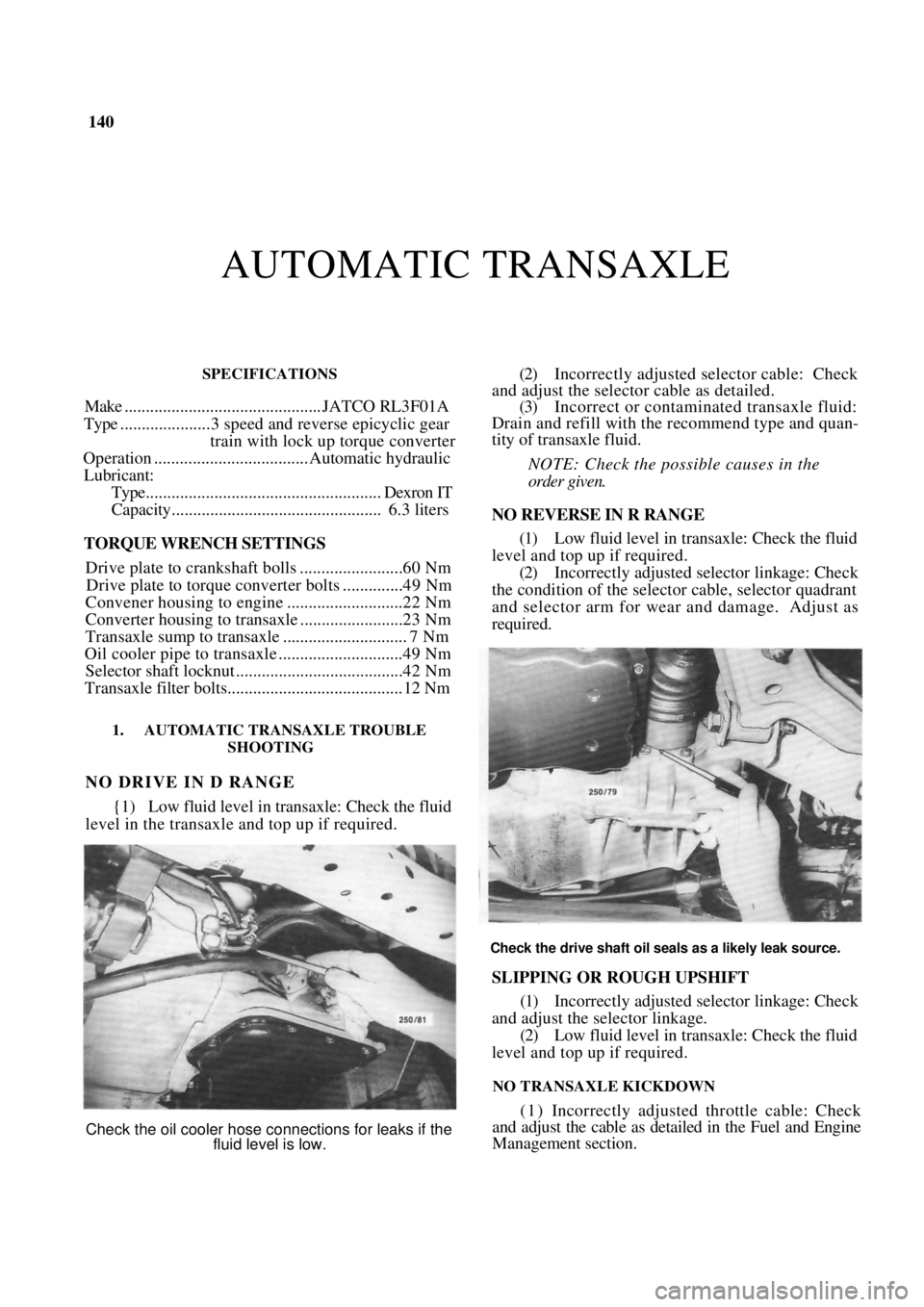
Check the oil cooler hose connections for leaks if the
fluid level is low.
Page 141 of 238
Automatic Transaxle 141
(2) Incorrectly adjusted kickdown cable: Check
and adjust or renew the kickdown cable as required.
NOTE: Check and adjust the throttle cable
before adjusting the kickdown cable.
ENGINE WILL NOT START IN P OR N
RANGE OR WILL START IN ANY RANGE
(1) Neutral safety switch faulty: Adjust or renew
the neutral safety switch. (2) Incorrectly adjusted selector cable: Check
and adjust the selector cable as detailed.
2. DESCRIPTION
The automatic transaxle combines a fluid coup-
ling or torque converter with a fully automatic three
speed epicyclic gear system.
The transaxle provides th ree forward ratios and
one reverse. The hydraulic system consists of a single
pump and valv e arrangement.
The final drive or differential and the transaxle
use a common lubricant. The transaxle oil pan and
final drive drain plug will have to be removed to drain
the transaxle completely. Topping up or refilling is
done through the dipstick tube.
The gear selector lever is floor mounted and
connected to the transaxle by an adjustable cable. The
selector quadrant adjacent to the base of the lever is
marked P, R, N, D, 2, 1.
It is necessary for the selector lever to be in P or
N before the engine can be started. When testing or
tuning the engine, the handbrake must be firmly
applied and the selector lever placed in the P position,
otherwise the vehicle could move forward or back-
wards as the engine speed is increased.
For long distance towing the vehicle should be
towed with the front end raised.
It is not possible to start the engine by either
towing or pushing the vehicle.
The transaxle can be removed from the vehicle
without engine removal.
NOTE: As extensive knowledge and equip-
ment is required to overhaul the automatic
transaxle assembly, it is therefore not a
worthwhile repair proposition for the aver-
age person. However if the transaxle must
be overhauled by a specialist or be replaced
with a reconditioned unit, the removal and
installation procedure is fully described at
the end of this section.
3. TRANSAXLE FLUID
Only use the recommended transaxle fluid speci-
fied by the manufacturer when topping up or changing
the fluid in the system.
TO CHECK AND TOP UP
NOTE: The fluid level should be checked
after approximately 5 minutes driving on
the road when the engine has achieved its
normal operating temperature of approxi-
mately 65 deg C.
(1) Place the vehicle on a level floor and open
the engine bonnet.
NOTE: When working on the automatic
transaxle cleanliness is very important. Do
not reuse transaxle fluid and do not allow
foreign matter to enter the filler opening.
(2) Clean around the top of the dipstick to
ensure that no dirt or foreign matter can enter the
dipstick tube.
(3) Place the selector in the P position and
firmly apply the handbrake. (4) Move the selector thro ugh each gear return-
ing it to the P position.
(5) Check the fluid level with the engine running
at idle. Install the dipstick fully into the dipstick tube.
NOTE: If the vehicle has been driven at high
speed, or has been towing a load, or driven
through heavy city traffic in hot weather, a
period of about 30 minutes should be
allowed to permit the transaxle to cool
before checking the fluid level.
(6) Withdraw the dipstick and check the fluid
level reading. The fluid should be at the H mark on
the dipstick. If the fluid is low, stop the engine and
remove the dipstick from the vehicle. Using a funnel,
top up the transaxle with the recommended type of
transaxle fluid through the dipstick tube. (7) If the level is reading too high allow the
engine to cool down for about 30 minutes and recheck
the level as described. If the level is still too high, a
small amount of transaxle fluid may be drained from
the transaxle.
Checking the fluid level on the automatic transaxle
dipstick.
Page 142 of 238
142 Automatic Transaxle
(8) Install the dipstick and start the engine and
recheck the fluid level.
NOTE; Do not overfill the transaxle or
foaming and unsatisfactory operation of the
transaxle will result.
TO DRAIN AND REFILL
This is not a normal maintenance and lubrication
procedure. It is only necessary to drain the complete
system, including the torq ue converter and the oil
cooler, when the transaxle assembly is removed for
overhaul or the renewal of transaxle components such
as bearings, clutches or as semblies. When this condi-
tion arises, the torque converter and the cooler should
be cleaned and flushed to remove any dirt or sludge.
After transaxle overhaul, install approximately 6
liters of new transaxle fluid, and top up as previously
described.
4. BRAKE BAND
Band adjustment is not a normal maintenance
procedure.
The adjustment entails removal of the valve body
and for this reason the vehicle should be taken to an
authorized dealer.
5. KICKDOWN CABLE
TO ADJUST
(1) On models with a 1.6 liter engine, remove
the air cleaner assembly. (2) With the aid of an assistant, ensure that the
throttle valve is fully open when the throttle pedal is
fully depressed. (3) Push the clip on the outer kickdown cable
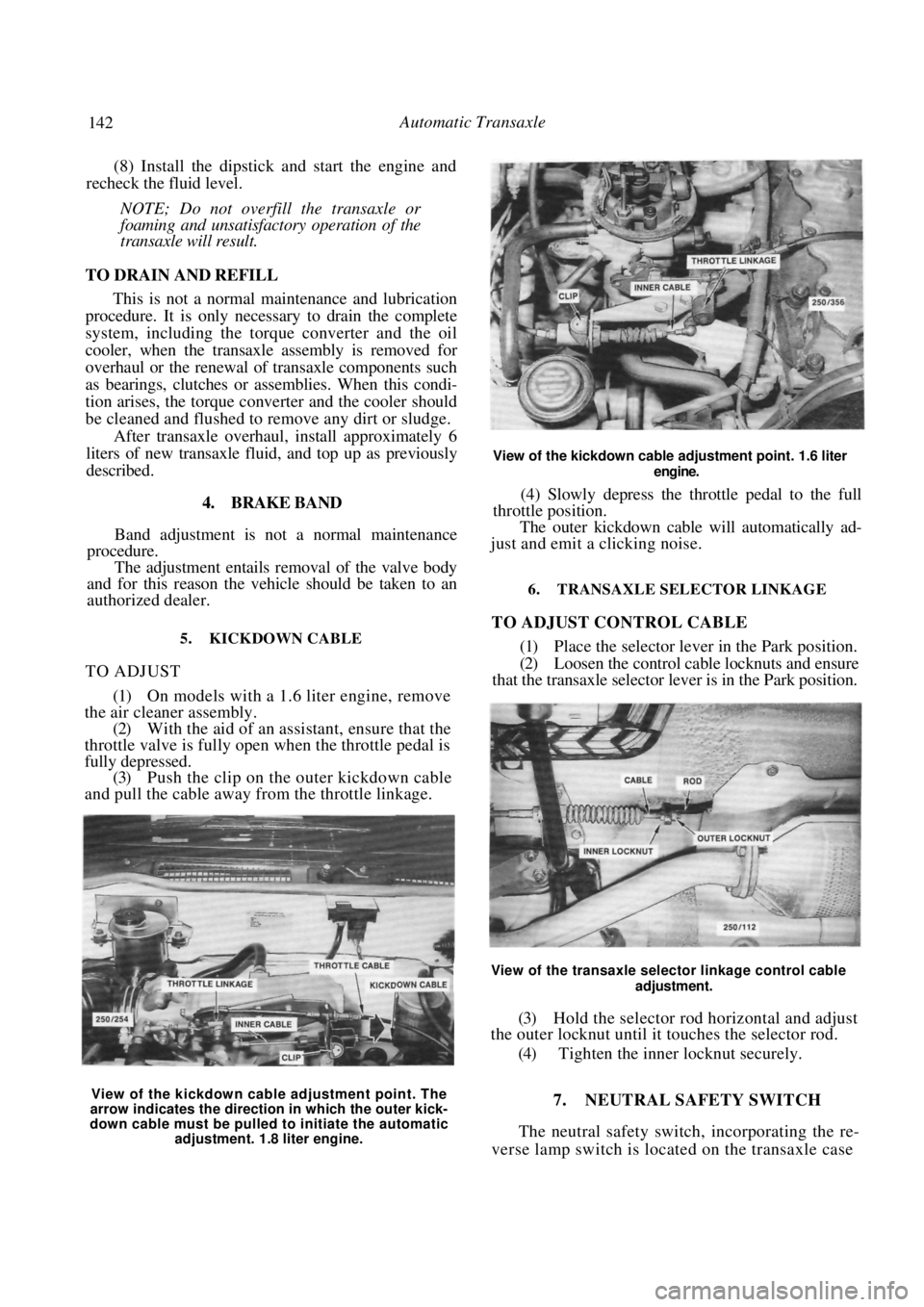
and pull the cable away from the throttle linkage.
View of the kickdown cable adjustment point. 1.6 liter
engine.
(4) Slowly depress the throttle pedal to the full
throttle position.
The outer kickdown cable will automatically ad-
just and emit a clicking noise.
6. TRANSAXLE SELECTOR LINKAGE
TO ADJUST CONTROL CABLE
(1) Place the selector lever in the Park position.
(2) Loosen the control cable locknuts and ensure
that the transaxle selector lever is in the Park position.
View of the transaxle selector linkage control cable
adjustment.
(3) Hold the selector rod horizontal and adjust
the outer locknut until it touches the selector rod.
(4) Tighten the inner locknut securely.
7. NEUTRAL SAFETY SWITCH
The neutral safety switch, incorporating the re-
verse lamp switch is located on the transaxle case
View of the kickdown cable adjustment point. The
arrow indicates the direction in which the outer kick-
down cable must be pulled to initiate the automatic adjustment. 1.8 liter engine.
Page 173 of 238
Brakes 173
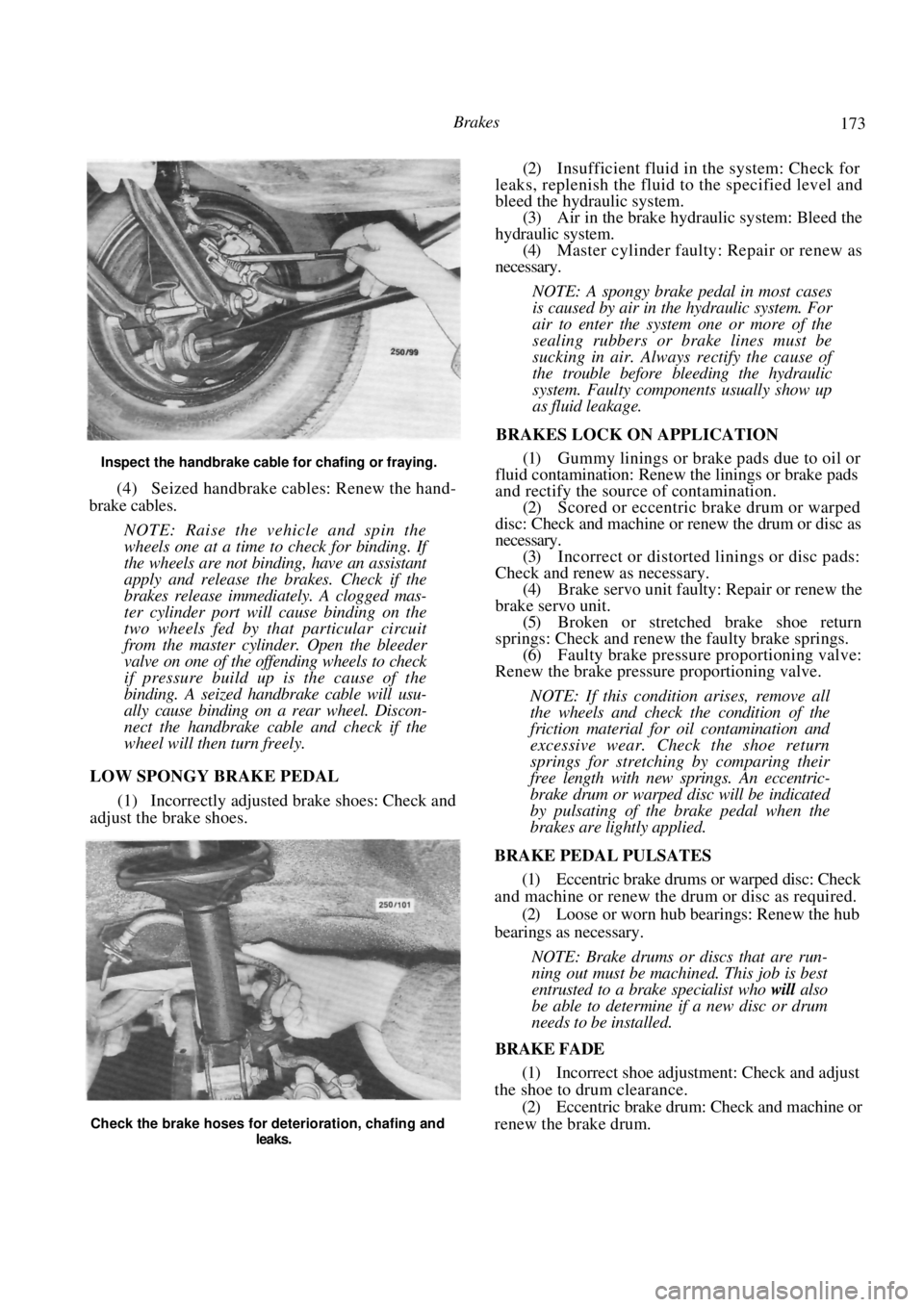
Inspect the handbrake cable for chafing or fraying.
(4) Seized handbrake cables: Renew the hand-
brake cables.
NOTE: Raise the vehicle and spin the
wheels one at a time to check for binding. If
the wheels are not binding, have an assistant
apply and release the brakes. Check if the
brakes release immediately. A clogged mas-
ter cylinder port will cause binding on the
two wheels fed by that particular circuit
from the master cylinder. Open the bleeder
valve on one of the o ffending wheels to check
if pressure build up is the cause of the
binding. A seized handbrake cable will usu-
ally cause binding on a rear wheel. Discon-
nect the handbrake cable and check if the
wheel will then turn freely.
LOW SPONGY BRAKE PEDAL
(1) Incorrectly adjusted brake shoes: Check and
adjust the brake shoes.
(2) Insufficient fluid in the system: Check for
leaks, replenish the fluid to the specified level and
bleed the hydraulic system.
(3) Air in the brake hydraulic system: Bleed the
hydraulic system. (4) Master cylinder faulty: Repair or renew as
necessary.
NOTE: A spongy brake pedal in most cases
is caused by air in the hydraulic system. For
air to enter the system one or more of the
sealing rubbers or brake lines must be
sucking in air. Always rectify the cause of
the trouble before bleeding the hydraulic
system. Faulty components usually show up
as fluid leakage.
BRAKES LOCK ON APPLICATION
(1) Gummy linings or brake pads due to oil or
fluid contamination: Renew the linings or brake pads
and rectify the source of contamination. (2) Scored or eccentric brake drum or warped
disc: Check and machine or renew the drum or disc as
necessary.
(3) Incorrect or distorted linings or disc pads:
Check and renew as necessary. (4) Brake servo unit faulty: Repair or renew the
brake servo unit. (5) Broken or stretched brake shoe return
springs: Check and renew th e faulty brake springs.
(6) Faulty brake pressure proportioning valve:
Renew the brake pressure proportioning valve.
NOTE: If this condition arises, remove all
the wheels and check the condition of the
friction material for oil contamination and
excessive wear. Check the shoe return
springs for stretching by comparing their
free length with new sp rings. An eccentric-
brake drum or warped disc will be indicated
by pulsating of the brake pedal when the
brakes are lightly applied.
BRAKE PEDAL PULSATES
(1) Eccentric brake drums or warped disc: Check
and machine or renew the drum or disc as required.
(2) Loose or worn hub bearings: Renew the hub
bearings as necessary.
NOTE: Brake drums or discs that are run-
ning out must be machined. This job is best
entrusted to a brake specialist who will also
be able to determine if a new disc or drum
needs to be installed.
BRAKE FADE
(1) Incorrect shoe adjustment: Check and adjust
the shoe to drum clearance. (2) Eccentric brake drum: Check and machine or
renew the brake drum.
Check the brake hoses for deterioration, chafing and
leaks.