wiring NISSAN PULSAR 1987 Repair Manual
[x] Cancel search | Manufacturer: NISSAN, Model Year: 1987, Model line: PULSAR, Model: NISSAN PULSAR 1987Pages: 238, PDF Size: 28.91 MB
Page 177 of 238

Brakes 177
installed. Install the second back up ring, large
diam-
eter first.
(6) Install the second garter spring. Insert
a
machined drift into the bore and lightly push the
garter spring into its locating groove.
(7) Smear the secondary piston with clean brake
fluid. Ease the seal over the piston body into the
groove adjacent to the spring, ensuring that the seal lip
faces the spring and that the nylon spacer is against
the back of the seal. (8) Install the guide onto the secondary
piston,
large internal diameter first, followed by the main seal
with the lip facing away from the spring. (9) Lubricate the secondary piston assembly
with clean brake fluid and install the secondary spring
and retainer to the piston. Install the complete assem-
bly into the master cylinder bore. (10) Smear the primary piston with clean brake
fluid. Install the guide, large internal diameter first,
followed by the main seal with the lip facing towards
the small end of the piston.
(11) Install the retainer to the spigot on the front
end of the primary piston ensuring that the legs of the
retainer engage with the groove on the piston. (12) Lubricate the primary piston assembly with
clean brake fluid and install the assembly into the
master cylinder bore. With a blunt rod, push the
assembly down the bore sufficiently to preload the
pistons. While holding the preload, install the stop pin
and valve assemblies into
the master cylinder body and tighten securely. (13) Install a new O ring to the groove on the boss
of the mounting flange of the master cylinder.
(14) Install new O rings to th e pressure differential
pistons, smear them with cl ean brake fluid and install
them into the master cylinder body. (15) Install a new O ring to the pressure differen-
tial end plug, install the plug to the master
cylinder
body and tighten to the specified torque. (16) Using a blunt probe entered through the
sensing switch location hole, separate the pressure
differential pistons and install the switch actuating
lever between them. (17) Screw the sensing switch into its locating
hole until the detents on the switch body just contact
the locating hole facing (w ith the radial grooves).
Screw the switch assembly in a further half to one full
turn ensuring that the dete nts locate in the grooves.
(18) Install new valve seal s to the proportioning
valve plungers, with the serrations of the seals facing
away from the hexagons of the plungers.
(19) Install the new O rings to the
proportioning
valve plugs. (20) Install the valve springs over the stems of the
proportioning valves, insert the install the valve
plugs.
Tighten the plugs to the specified torque.
(21) Install a new O ring to the base of the fast fill
valve assembly. Install a new valve washer to the base
of the valve.
(22) Install the fast fill valve assembly in
the
primary reservoir port (nearest to the mounting flange
of the master cylinder) and install the snap ring
to
retain the assembly. Ensure that the snap ring is
correctly seated in the groove. (23) Smear the new reservoir retainers with clean
brake fluid and install them into the reservoir ports.
Carefully press the brake fluid reservoir into position,
ensuring that the outlet extensions are fully inserted in
the reservoir retainers. (24) Install the reservoir cap insert to the dia-
phragm and press the cap assembly onto the reservoir.
TO INSTAL
Installation is a reversal of the removal procedure
with attention to the following points:
(1) Pour a small amount of clean brake fluid into
the reservoir and pump the master cylinder pistons
with a blunt rod until fluid begins to emerge from the
outlets. (2) Install the master cylinder to the brake servo
unit and loosely install the master cylinder retaining
nuts. (3) Connect the brake pipes to the master cylin-
der outlets, but do not tighten at this stage. (4) Securely tighten the nuts retaining the master
cylinder to the brake servo unit.
(5) Securely tighten the brake pipes and connect
the wiring to the pressure sensing switch.
(6) Fill the master cylinder reservoir with clean
brake fluid and bleed the brakes as described under
the Hydraulic System heading. (7) Check and if necessary adjust the brake
pedal height and free play as described under the
Brake Pedal heading.
4. BRAKE SERVO UNIT
TO CHECK OPERATION
(1) With the engine switched off, apply the
footbrake several times to exhaust all vacuum from
the system.
(2) Apply the footbrake and hold the brake pedal
fully depressed.
(3) Start the engine. If the servo unit is function-
ing satisfactorily a distinct downward movement of
the
brake pedal should be noticed. Should the pedal fail to move downward when the
engine has been started, the vacuum system can be
considered inoperative.
NOTE: If the pedal continues to fall away
there is a fault in the hydraulic system.
(4) Ensure that the brake pedal is fully released,
start the engine and run it at medium speed. Stop the
engine.
Page 186 of 238

186 Brakes
(7) Using a pair of pliers, compress the hand-
brake cable spring and install the cable to the hand-
brake lever.
(8) Position the trailing shoe on the backing
plate with the upper end located on the wheel cylinder
piston and the lower end on the anchor plate. (9) Install the adjuster assembly to the
trailing
shoe ensuring that the adjuster fork is correctly
located on the upper end of the shoe. (10) Install the pin, spring and retainer to the
trailing shoe, turn the reta iner through 90 degrees and
secure the brake shoe to the backing plate. (11) Connect the upper and lower return springs
to the trailing shoe as noted on removal. (12) Position the leading shoe on the backing
plate with the upper end located on the wheel cylinder
piston and the lower end on the anchor plate. Ensure
that the adjuster assembly is correctly located on the
upper end of the shoe. (13) Install the pin, spring and retainer to the
leading shoe, turn the retainer through 90 degrees and
secure the shoe to the backing plate. (14) Connect the upper and lower return springs
to the leading shoe.
(15) By alternatively adjust ing the automatic ad-
juster manually and sliding the brake drum on and off
the brake shoe assembly, adjust the brakes until the
brake drum will just slide over the brake shoes. Ensure
that the adjuster lever contacts the adjuster star wheel.
Install the brake drum and operate the handbrake
several times to adjust the brake shoes. (16) Install the rear wheels and rotate each wheel
to ensure that the brake shoe linings are not dragging.
(17) Bleed the hydraulic system as described
under the Hydraulic System heading. (18) Adjust the handbrake as described under the
Brake Adjustments heading.
8. HANDBRAKE CABLE AND LEVER
ASSEMBLY
HANDBRAKE LEVER AND FRONT CABLE
ASSEMBLY
To Remove and Install
(1) Raise the vehicle and support it on chassis
stands. Release the handbrake.
(2) Working beneath the vehicle, remove the
exhaust pipe centre heat shield retaining bolts and
maneuver the shield from the vehicle. (3) Remove the rear handbrake cable front
clamp retaining nuts and disconnect the rear hand-
brake cable from the equalizer. (4) Working within the vehicle, remove the
carpet square from the rear of the console. Remove
the retaining screw from the front and rear of the rear
console section and maneuver the rear console from
the vehicle.
Dismantled view of the handbrake lever components.
(5) Disconnect the handbrake warning lamp
switch wiring. (6) Remove the handbrake lever assembly re-
taining bolts and remove the handbrake lever and
front cable assembly. (7) If necessary slide the boot and cover towards
the equalizer, straighten the tang on the lower edge of
the lever and remove the adjuster nut and washer.
(8) Withdraw the front cable from the lever and
remove the boot and cover. Inspect the cable for
chafing or broken strands. Renew the cable if damage
is evident. (9) Check the handbrake lever ratchet and pawl
for wear and renew as necessary. Installation is a reversal of the removal procedure
with attention to the following points:
(1) Apply lubricant to all the working parts prior
to installation. (2) Ensure that the handbrake cable clamp is
correctly installed. (3) Adjust the handbrake cable as described
under the Brake Adjustments heading.
REAR HANDBRAKE CABLES
TO Remove and Install
(1) Raise the rear of the vehicle and support it
on chassis stands. Remove th e rear wheels and release
the handbrake.
(2) Working beneath the vehicle, remove the
exhaust pipe centre and rear heat shield retaining
bolts and maneuver the heat shields from the
vehicle.
(3) Remove the bolts and nuts retaining the
handbrake cable clamps to the underbody and discon-
nect the rear handbrake cable from the equalizer.
(4) On disc brake models, remove the handbrake
cable to bracket retaining clip on the rear of the
caliper and disconnect the handbrake cable from the
cam lever. Remove the cable from the vehicle.
(5) On drum brake models , proceed as follows:
(a) Remove and dismantle the rear brakes as
previously described.
Page 187 of 238
Brakes 187
(b) Disengage the handbrake cable return spring
from the backing plate.
plate and remove the cable from the vehicle.
(6) Inspect the rear handbrake cables for chafing
or broken strands. Renew the cables if damage is
evident.
Installation is a reversal of the removal procedure
with attention to the following points:
(1) Ensure that the handbrake cable clamps are
correctly installed. (2) On drum brake models, install the
handbrake
cable to the backing plate by carefully tapping the
flange on the handbrake cable. Ensure that the cable is
not damaged. (3) Adjust the handbrake cable as described
under the Brake Adjustments heading.
9. BRAKE ADJUSTMENTS
FRONT AND REAR DISC BRAKES
The disc brakes are self adjusting and no manual
adjustment is required or provided.
REAR DRUM BRAKES
Depress the handbrake lever button, apply and
release the handbrake lever several times to adjust the
rear brake shoes.
HANDBRAKE
(1) Raise the rear of the vehicle and support it
on chassis stands. (2) Remove the carpet square from the rear of
the console. Remove the retaining screws from the
front and rear of the rear console section and manoeu-
vre the rear console from the vehicle. (3) Tighten the adjusting nut until the hand-
brake lever pull is between 7-11 notches. (4) Check that the rear wheels are not binding. If
the rear wheels do not rotate freely refer to the Brakes
Trouble Shooting for possible causes.
(5) With the ignition switched On, check that
the handbrake warning lamp is extinguished when the
lever is fully released. (6) Lower the vehicle to the ground and test the
handbrake on an incline.
10. BRAKE PEDAL
TO REMOVE AND INSTAL
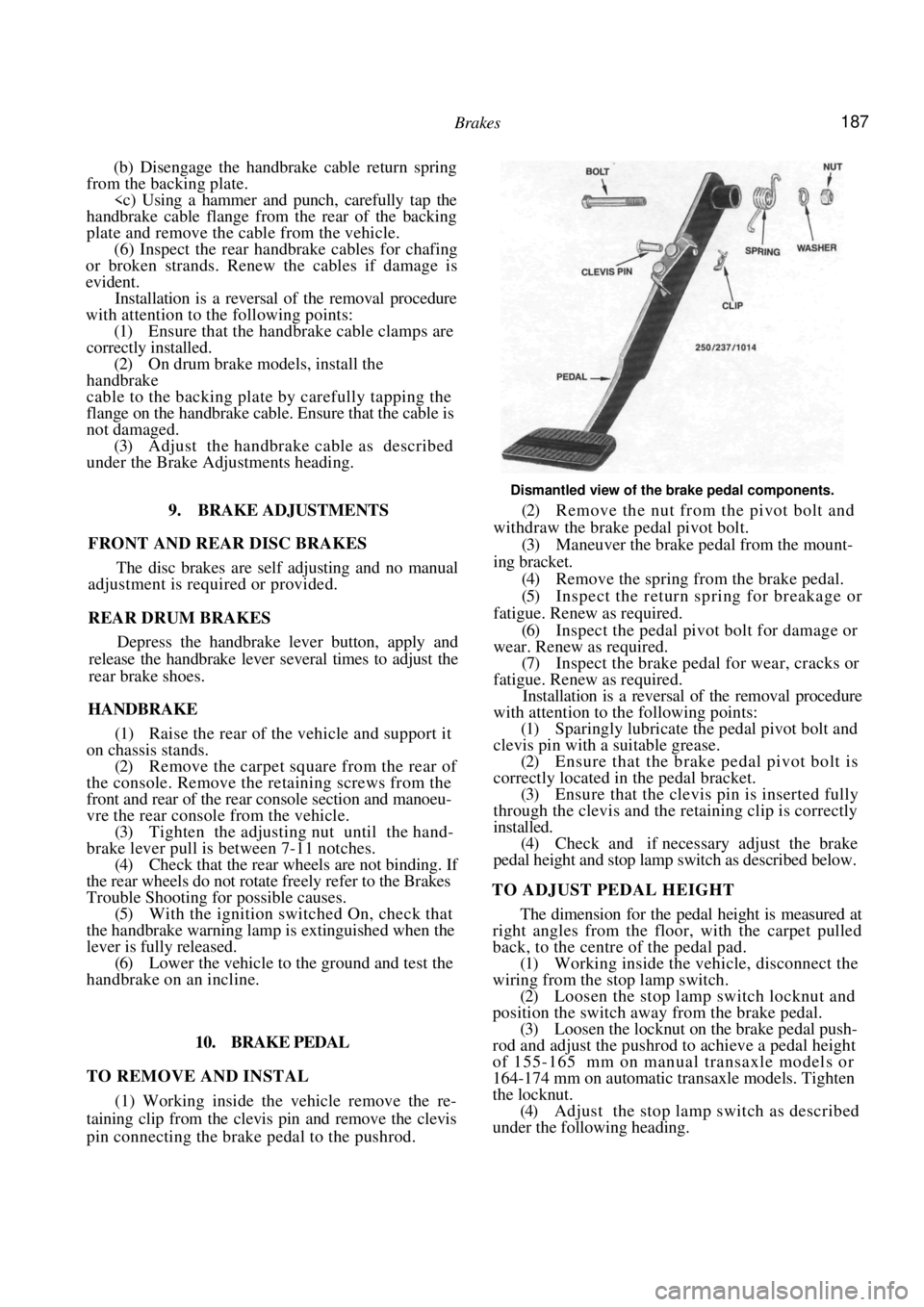
(1) Working inside the vehicle remove the re-
taining clip from the clevis pin and remove the clevis
pin connecting the brake pedal to the pushrod.
Dismantled view of the brake pedal components.
(2) Remove the nut from the pivot bolt and
withdraw the brake pedal pivot bolt.
(3) Maneuver the brake pedal from the mount-
ing bracket. (4) Remove the spring from the brake pedal.
(5) Inspect the return spring for breakage or
fatigue. Renew as required.
(6) Inspect the pedal pivot bolt for damage or
wear. Renew as required. (7) Inspect the brake pedal for wear, cracks or
fatigue. Renew as required. Installation is a reversal of the removal procedure
with attention to the following points:
(1) Sparingly lubricate the pedal pivot bolt and
clevis pin with a suitable grease. (2) Ensure that the brake pedal pivot bolt is
correctly located in the pedal bracket. (3) Ensure that the clevis pin is inserted fully
through the clevis and the retaining clip is correctly
installed. (4) Check and if necessary adjust the brake
pedal height and stop lamp switch as described below.
TO ADJUST PEDAL HEIGHT
The dimension for the pedal height is measured at
right angles from the floor, with the carpet pulled
back, to the centre of the pedal pad.
(1) Working inside the ve hicle, disconnect the
wiring from the stop lamp switch.
(2) Loosen the stop lamp switch locknut and
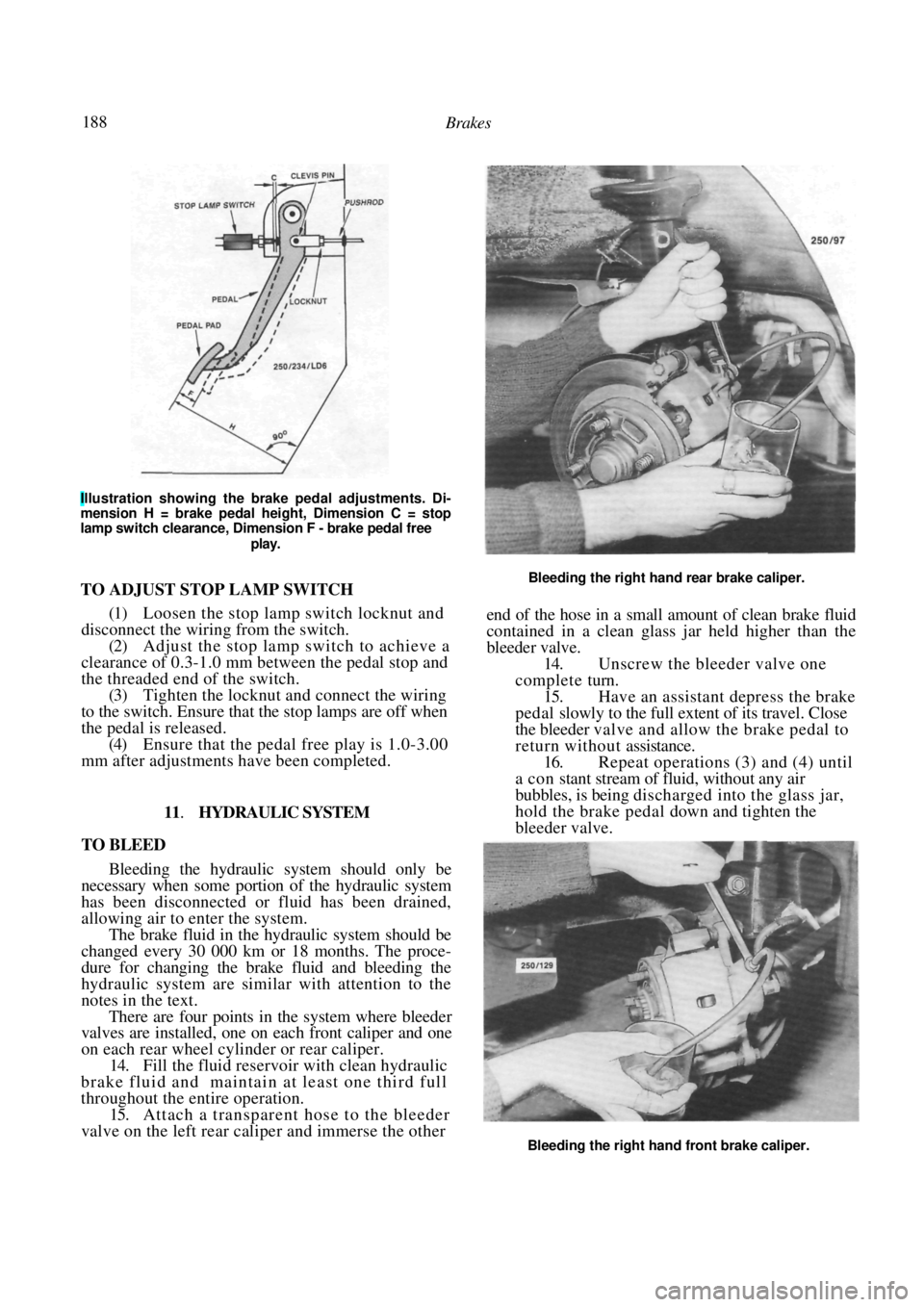
position the switch away from the brake pedal. (3) Loosen the locknut on the brake pedal push-
rod and adjust the pushrod to achieve a pedal height
of 155-165 mm on manual transaxle models or
164-174 mm on automatic transaxle models. Tighten
the locknut. (4) Adjust the stop lamp switch as described
under the following heading.
Page 188 of 238
188 Brakes
Illustration showing the brake pedal adjustments. Di-
mension H = brake pedal height, Dimension C = stop
lamp switch clearance, Dimension F - brake pedal free
play.
TO ADJUST STOP LAMP SWITCH
(1) Loosen the stop lamp switch locknut and
disconnect the wiring from the switch.
(2) Adjust the stop lamp switch to achieve a
clearance of 0.3-1.0 mm between the pedal stop and
the threaded end of the switch. (3) Tighten the locknut and connect the wiring
to the switch. Ensure that the stop lamps are off when
the pedal is released.
(4) Ensure that the pedal free play is 1.0-3.00
mm after adjustments have been completed.
11. HYDRAULIC SYSTEM
TO BLEED
Bleeding the hydraulic system should only be
necessary when some portion of the hydraulic system
has been disconnected or fluid has been drained,
allowing air to enter the system.
The brake fluid in the hydraulic system should be
changed every 30 000 km or 18 months. The proce-
dure for changing the brake fluid and bleeding the
hydraulic system are simila r with attention to the
notes in the text.
There are four points in the system where bleeder
valves are installed, one on each front caliper and one
on each rear wheel cylinder or rear caliper.
14. Fill the fluid reservoir with clean hydraulic
brake fluid and maintain at least one third full
throughout the entire operation. 15. Attach a transparent hose to the bleeder
valve on the left rear cali per and immerse the other
Bleeding the right hand rear brake caliper.
end of the hose in a small amount of clean brake fluid
contained in a clean glass jar held higher than the
bleeder valve.
14. Unscrew the bleeder valve one
complete turn.
15. Have an assistant depress the brake
pedal slowly to the full extent of its travel. Close
the bleeder valve and allow the brake pedal to
r e t u r n w i t h o u t assistance. 16. Repeat operations (3) and (4) until
a con stant stream of fluid, without any air
bubbles, is being discharged into the gl ass jar,
hold the brake pedal down and tighten the
bleeder valve.
Bleeding the right hand front brake caliper.
Page 190 of 238

190
ELECTRICAL SYSTEM
CAUTION: To prevent severe electrical shock extreme care must be taken when
working on or near the electronic ignition system as dangerous high tension voltages
are produced in both the primary and secondary circuits. See the text fo\
r
precautionary notes.
SPECIFICATIONS
BATTERY
Type ..................................................12 volt lead acid
Polarity to earth .................................... Negative ( - )
Specific gravity:
Fully charged ................................... A bove 1.250
Fully discharged ................................Below 1.130
ALTERNATOR
Make .................................................Bosch or Hitachi
Maximum output .......................................... 70 amps
Polarity to earth .................................... Negative ( - )
Stator windings ......................................... Star wound
Regulator type ................................................ Integral
Brush length minimum:
Bosch ........................................................ 5.0 mm
Hitachi ............................. 6.0 mm or limit mark
STARTER MOTOR
Make .................................................Hitach i or Bosch
Type ............................ 4 pole 4 brush reduction gear
Operation control.................................. Solenoid and
overrunning clutch
Undercut of commutator (maximum):
Hitachi ...................................................... 0.8 mm
Brush length (minimum):
Bosch ........................................................ 8.0 mm
Hitachi ........................................................11 mm
Brush spring tension;
Hitachi ............................................... 15.7-19.6 N
Hitachi:
Drive pinion stopper clearance ........ 0.3-1.5 mm
Selective fit adjuster plates ........ 0.5 and 0.8 mm
IGNITION SYSTEM
The ignition system is an integral part of the
engine management system. The Specifications, testing
and overhaul procedures are fully covered in the Fuel
and Engine Management section.
TORQUE WRENCH SETTINGS
Alternator pulley retaining nut:
Bosch ......................................................... 50 Nm
Hitachi ....................................................... 59 Nm
1. BATTERY AND CHARGING SYSTEM
TROUBLE SHOOTING
BATTERY UNDERCHARGED
3. Loose or broken drive belt: Adjust or renew
the drive belt. 4. Faulty alternator regulator; Renew the regu-
lator unit.
5. Faulty battery: Install a new battery of
the
recommended type and capacity. 6. Faulty alternator: Overhaul or renew the
alternator. 7. Fault in the charging circuit wiring: Check
and repair or renew the wiring harness. 8. Faulty connections in the charging circuit:
Check and repair the connections. 9. Fusible link blown; Rectify the fault and
renew as necessary.
NOTE: Check the state of charge (specific
gravity) of the battery- as described under
the
Battery heading in this section. If the battery
is undercharged, check the possible causes in
the order given.
BATTERY OVERCHARGED
• Faulty alternator regulator unit:
Renew the
regulator unit.
• Faulty alternator: Overhaul or
renew the
alternator. • Faulty charging circuit wiring or
connec-
tions: Check and renew or repair the faulty
compo-
nents.
NOTE: An overcharged battery is indicated
by continual loss of water through boiling.
Page 192 of 238
192 Electrical System
transaxle models, check for a faulty or incorrectly
adjusted neutral safety switch.
1. Discharged battery: Check for a fault or short
circuit in the system. 2. Battery fully charged but will not crank
engine. Check for a locked drive and ring gear,
internal starter faul t or seized engine.
3. Fusible link blown: Check and repair the
cause and renew as necessary.
NOTE: Rotate the engine by hand to ensure
that the starter drive is not locked with the
flywheel ring gear and t hat the engine is not
seized. Ensure that the ignition key is
turned off before rotating the engine.
3. LIGHTING SYSTEM TROUBLE SHOOTING
LAMP OR LAMPS FAIL TO LIGHT
1. Faulty bulb(s): Check and renew the faulty
bulb(s). 2. Open circuit in the wiring or connections:
Check the lamp circuits and rectify as necessary.
1. Faulty lamp switch: Check and if necessary
renew the lamp switch. 2. Faulty fuse or fuse connection: Repair the
fuse connection or renew the fuse. 3. Lamp relay faulty: Check and renew as
necessary.
NOTE: Switch on the lamps concerned and
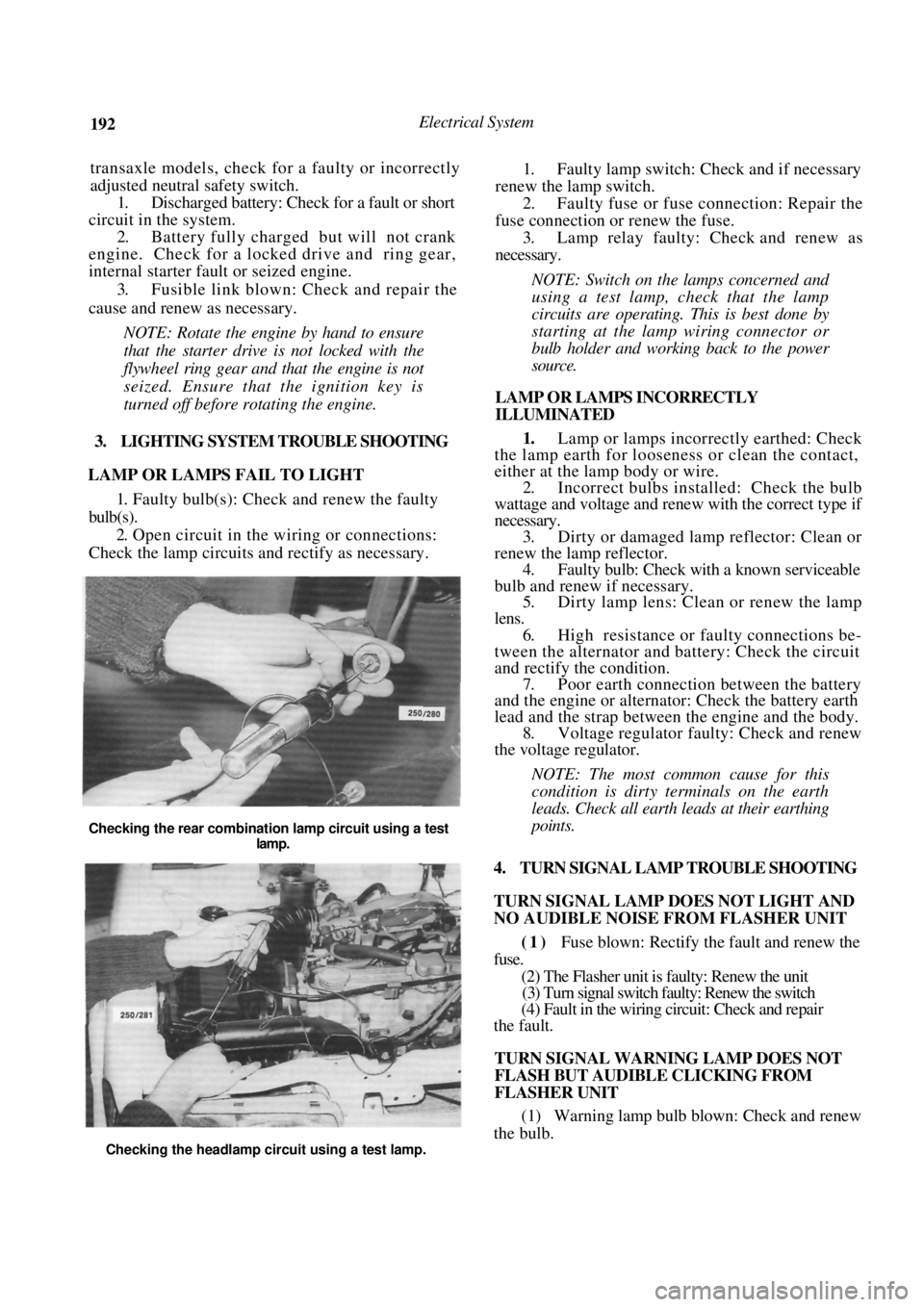
using a test lamp, check that the lamp
circuits are operating. This is best done by
starting at the lamp wiring connector or
bulb holder and work ing back to the power
source.
LAMP OR LAMPS INCORRECTLY
ILLUMINATED
1. Lamp or lamps incorrectly earthed: Check
the lamp earth for loosene ss or clean the contact,
either at the lamp body or wire.
2. Incorrect bulbs installe d: Check the bulb
wattage and voltage and renew with the correct type if
necessary. 3. Dirty or damaged lamp reflector: Clean or
renew the lamp reflector. 4. Faulty bulb: Check with a known serviceable
bulb and renew if necessary. 5. Dirty lamp lens: Clean or renew the lamp
lens. 6. High resistance or faulty connections be-
tween the alternator and battery: Check the circuit
and rectify th e condition.
7. Poor earth connection between the battery
and the engine or alternat or: Check the battery earth
lead and the strap between the engine and the body. 8. Voltage regulator faulty: Check and renew
the voltage regulator.
NOTE: The most common cause for this
condition is dirty t erminals on the earth
leads. Check all earth leads at their earthing
points.
4. TURN SIGNAL LAMP TROUBLE SHOOTING
TURN SIGNAL LAMP DOES NOT LIGHT AND
NO AUDIBLE NOISE FROM FLASHER UNIT
(1) Fuse blown: Rectify the fault and renew the
fuse.
(2) The Flasher unit is faulty: Renew the unit
(3) Turn signal switch faulty: Renew the switch
(4) Fault in the wiring circuit: Check and repair
the fault.
TURN SIGNAL WARNING LAMP DOES NOT
FLASH BUT AUDIBLE CLICKING FROM
FLASHER UNIT
(1) Warning lamp bulb blown: Check and renew
the bulb.
Checking the rear combination lamp circuit using a test
lamp.
Checking the headlamp circuit using a test lamp.
Page 193 of 238
Electrical System 193
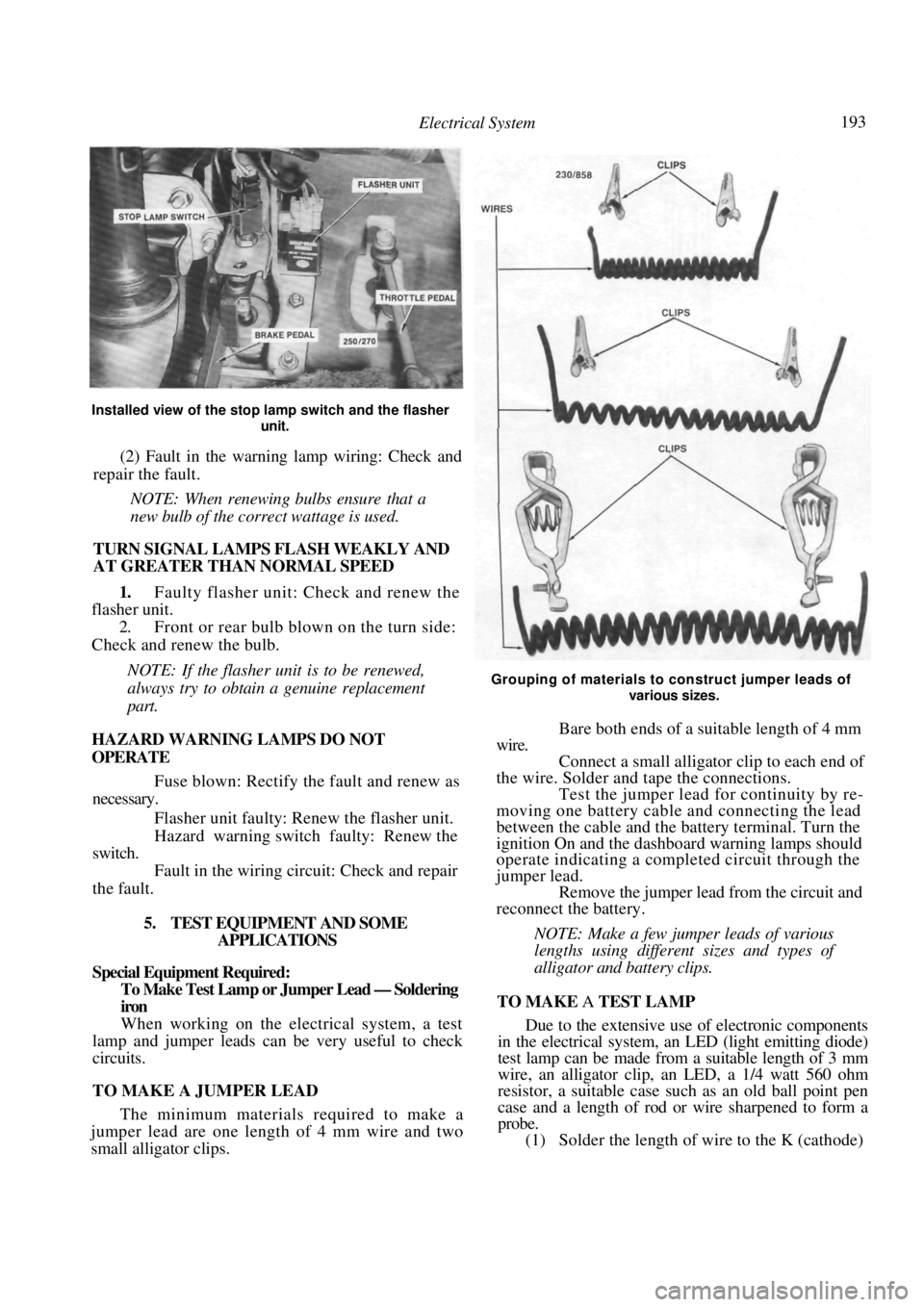
Installed view of the stop lamp switch and the flasher
unit.
(2) Fault in the warning lamp wiring: Check and
repair the fault.
NOTE: When renewing bulbs ensure that a
new bulb of the correct wattage is used.
TURN SIGNAL LAMPS FLASH WEAKLY AND
AT GREATER THAN NORMAL SPEED
1. Faulty flasher unit: Check and renew the
flasher unit.
2. Front or rear bulb blown on the turn side:
Check and renew the bulb.
NOTE: If the flasher unit is to be renewed,
always try to obtain a genuine replacement
part.
HAZARD WARNING LAMPS DO NOT
OPERATE
Fuse blown: Rectify the fault and renew as
necessary.
Flasher unit faulty: Re new the flasher unit.
Hazard warning switch faulty: Renew the
switch.
Fault in the wiring circuit: Check and repair
the fault.
5. TEST EQUIPMENT AND SOME APPLICATIONS
Special Equipment Required:
To Make Test Lamp or Jumper Lead — Soldering
iron
When working on the electrical system, a test
lamp and jumper leads can be very useful to check
circuits.
TO MAKE A JUMPER LEAD
The minimum materials required to make a
jumper lead are one length of 4 mm wire and two
small alligator clips.
Grouping of materials to construct jumper leads of
various sizes.
Bare both ends of a suitable length of 4 mm
wire. Connect a small alligato r clip to each end of
the wire. Solder and tape the connections. Test the jumper lead for continuity by re-
moving one battery cable and connecting the lead
between the cable and the battery terminal. Turn the
ignition On and the dashboard warning lamps should
operate indicating a completed circuit through the
jumper lead. Remove the jumper lead from the circuit and
reconnect the battery.
NOTE: Make a few jumper leads of various
lengths using different sizes and types of
alligator and battery clips.
TO MAKE A TEST LAMP
Due to the extensive use of electronic components
in the electrical system, an LED (light emitting diode)
test lamp can be made from a suitable length of 3 mm
wire, an alligator clip, an LED, a 1/4 watt 560 ohm
resistor, a suitable case such as an old ball point pen
case and a length of rod or wire sharpened to form a
probe.
(1) Solder the length of wire to the K (cathode)
Page 196 of 238
196 Electrical System
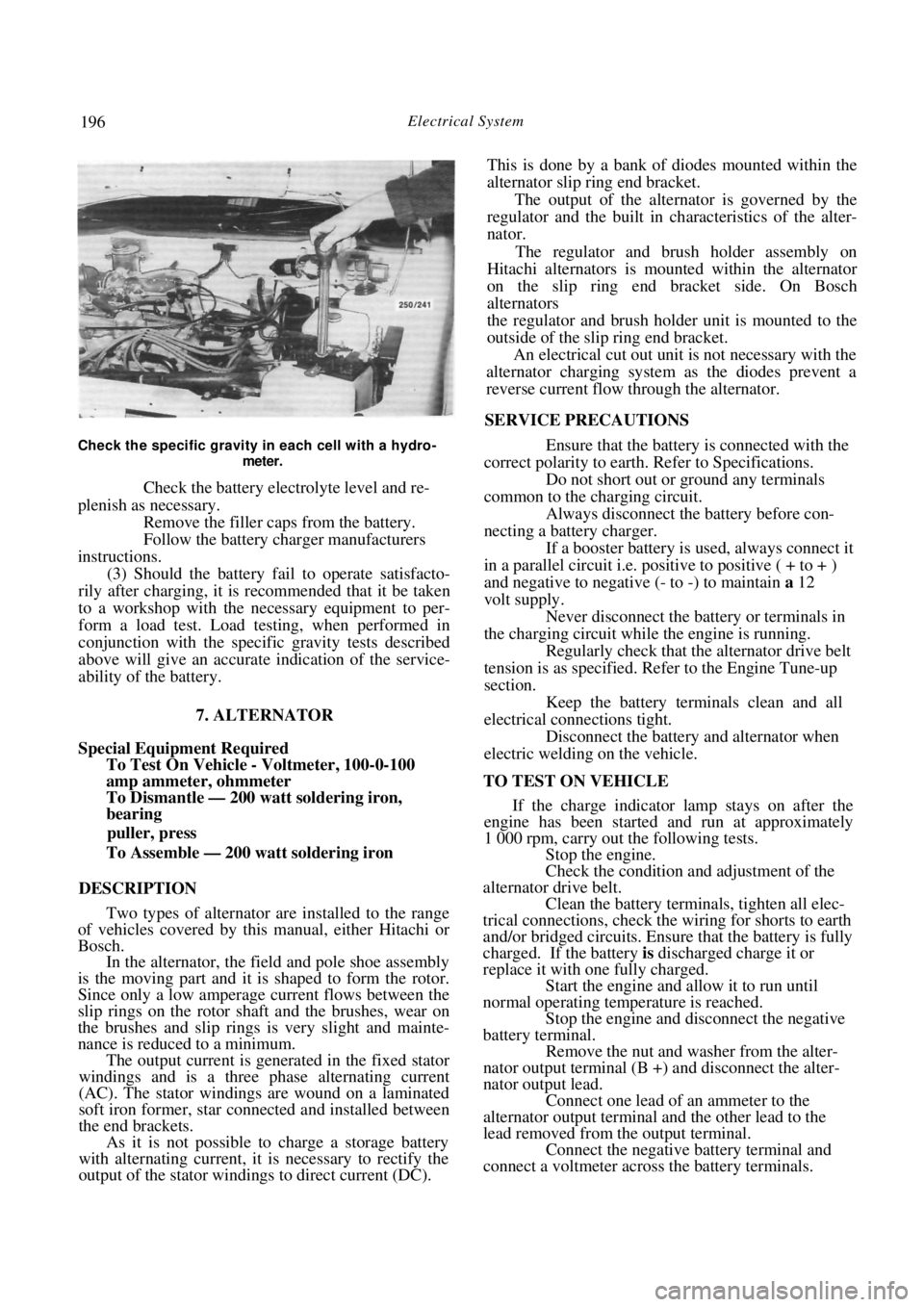
Check the specific gravity in each cell with a hydro-
meter.
Check the battery electrolyte level and re-
plenish as necessary. Remove the filler cap s from the battery.
Follow the battery charger manufacturers
instructions. (3) Should the battery fail to operate satisfacto-
rily after charging, it is recommended that it be taken
to a workshop with the necessary equipment to per-
form a load test. Load testing, when performed in
conjunction with the specific gravity tests described
above will give an accurate indication of the service-
ability of the battery.
7. ALTERNATOR
Special Equipment Required
To Test On Vehicle - Voltmeter, 100-0-100
amp ammeter, ohmmeter
To Dismantle — 200 watt soldering iron,
bearing
puller, press
To Assemble — 200 watt soldering iron
DESCRIPTION
Two types of alternator are installed to the range
of vehicles covered by this manual, either Hitachi or
Bosch. In the alternator, the field and pole shoe assembly
is the moving part and it is shaped to form the rotor.
Since only a low amperage current flows between the
slip rings on the rotor shaft and the brushes, wear on
the brushes and slip rings is very slight and mainte-
nance is reduced to a minimum. The output current is generated in the fixed stator
windings and is a three phase alternating current
(AC). The stator windings are wound on a laminated
soft iron former, star connected and installed between
the end brackets. As it is not possible to charge a storage battery
with alternating current, it is necessary to rectify the
output of the stator windings to direct current (DC). This is done by a bank of diodes mounted within the
alternator slip ring end bracket.
The output of the alternator is governed by the
regulator and the built in ch aracteristics of the alter-
nator.
The regulator and brush holder assembly on
Hitachi alternators is mounted within the alternator
on the slip ring end bracket side. On Bosch
alternators
the regulator and brush holder unit is mounted to the
outside of the slip ring end bracket. An electrical cut out unit is not necessary with the
alternator charging system as the diodes prevent a
reverse current flow through the alternator.
SERVICE PRECAUTIONS
Ensure that the battery is connected with the
correct polarity to earth. Refer to Specifications.
Do not short out or ground any terminals
common to the charging circuit. Always disconnect the battery before con-
necting a battery charger.
If a booster battery is used, always connect it
in a parallel circuit i.e. positive to positive ( + to + )
and negative to negative (- to -) to maintain a 12
volt supply. Never disconnect the battery or terminals in
the charging circuit while the engine is running. Regularly check that the alternator drive belt
tension is as specified. Refer to the Engine Tune-up
section.
Keep the battery terminals clean and all
electrical connections tight. Disconnect the battery and alternator when
electric welding on the vehicle.
TO TEST ON VEHICLE If the charge indicator lamp stays on after the
engine has been started and run at approximately
1 000 rpm, carry out the following tests. Stop the engine.
Check the condition and adjustment of the
alternator drive belt. Clean the battery terminals, tighten all elec-
trical connections, check the wiring for shorts to earth
and/or bridged circuits. Ensure that the battery is fully
charged. If the battery is discharged charge it or
replace it with one fully charged. Start the engine and allow it to run until
normal operating temperature is reached.
Stop the engine and disconnect the negative
battery terminal.
Remove the nut and washer from the alter-
nator output terminal (B +) and disconnect the alter-
nator output lead. Connect one lead of an ammeter to the
alternator output terminal and the other lead to the
lead removed from the output terminal. Connect the negative battery terminal and
connect a voltmeter across the battery terminals.
Page 197 of 238
Electrical System 197
Switch on all lamps and allow them to
illuminate for approximately five minutes to reduce
the charge of the battery and to apply a load to the
circuit.
Start the engine and gradually increase the
speed to approximately 2 500 rpm. The reading on
the ammeter should be approximately 75% of the
rated output of the altern ator. See Specifications.
Switch off all the lamps and run the engine at
1 500-2 000 rpm until the indicated charge is below
10 amps. The voltmeter should now read in excess of
13.6 volts.
NOTE: Should the alternator fail to reach
the specific output, the unit will have to be
removed and overhauled or a replacement
unit installed.
Should the voltage reading be above or
below Specifications, the regulator will have
to be renewed.
TO REMOVE AND INSTAL
Disconnect the negative battery terminal.
On 1.8 liter engines, remove the bolt secur-
ing the air cleaner intake duct and remove the air
cleaner intake duct. Drain the radiator by releasing the radiator
drain plug, located at the bottom of the radiator and
allow the coolant level to fall below the thermostat
housing level. NOTE: Refer to the Cooling and Heating
Systems section when refilling the radiator
coolant to its correct l
evel, failure to do so
could result in severe damage to engine
components.
Remove the retaining bolts securing the
thermostat housing, disconnect the hose from the
radiator and remove the thermostat housing and
radiator hose from the vehicle. Using a socket and extension bar, remove the
bolt securing the alternator to the drive belt tensioning
bar located under the alternator. On vehicles not equipped with air condition-
ing, remove the front splash guard from under the
front of the vehicle and remove the bolt securing the
alternator to the drive belt tensioning bar. Loosen the upper mounting bolts, slacken
the alternator drive belt and remove it from the
alternator pulley.
While supporting the alternator, remove the
upper mounting bolts and remove the alternator from
the vehicle. Installation is a reversal of the removal procedure
with attention to the following points:
Do not over tension the drive belt. Refer
to
the Engine Tune-up section for the correct belt
adjusting procedure. Ensure that the wiring and connectors are
securely located on the alternator.
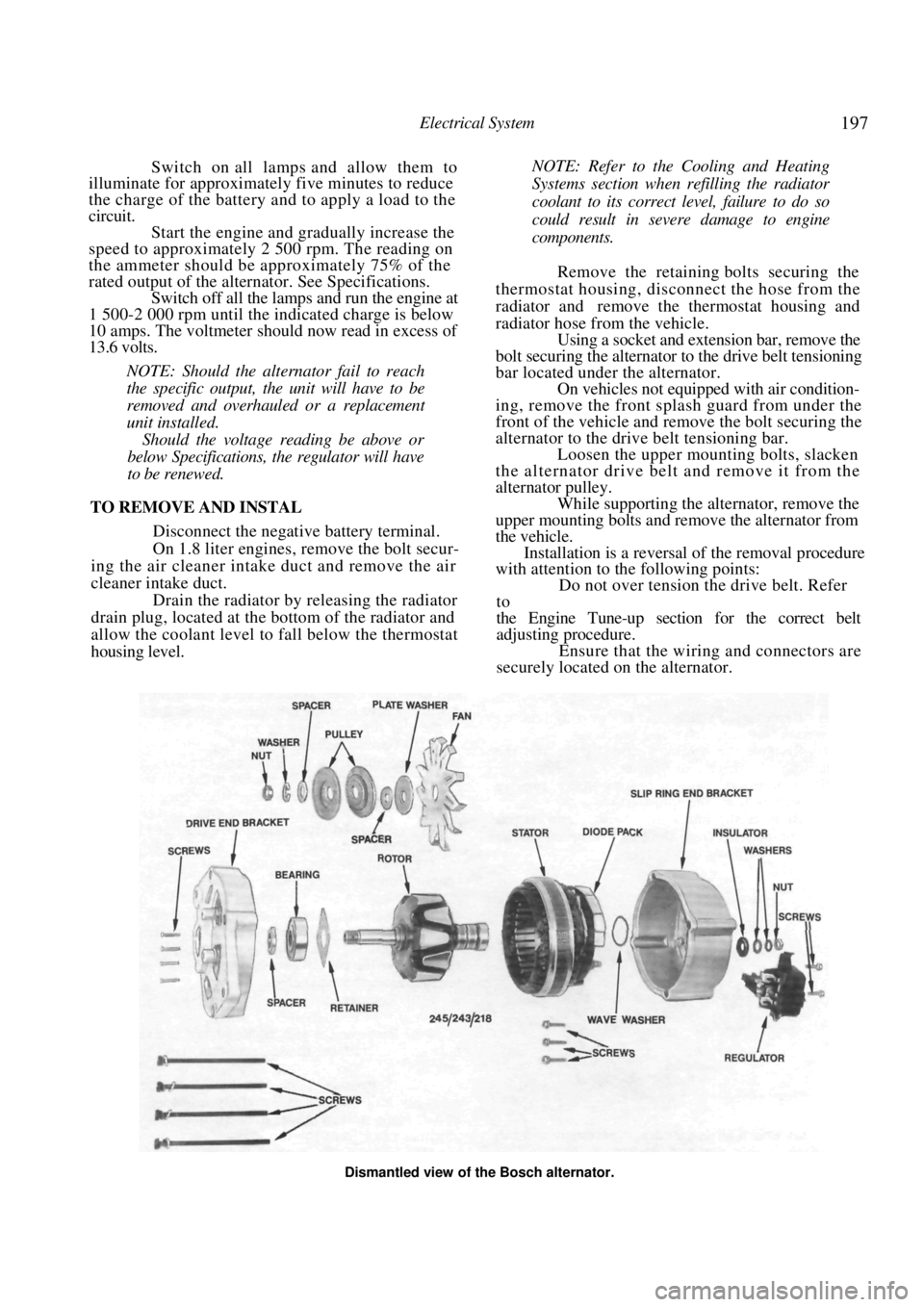
Dismantled view of the Bosch alternator.
Page 198 of 238
198 Electrical System
(3) Replenish the coolant in the radiator. Refer
to the Cooling and Heating Systems section for the
correct procedure.
TO DISMANTLE
Bosch Alternator
Remove the alternator from the vehicle as
previously described.
Scribe a mark across the drive end bracket,
stator and slip ring end bracket to facilitate correct
alignment during assembly. Remove the screws and washers securing the
regulator and brush holder assembly. Withdraw the
regulator and brush holder assembly from the alter-
nator. Remove the long screws securing the drive
end bracket to the slip ring end bracket and withdraw
the drive end bracket, rotor and pulley assembly.
NOTE: Ensure that the wave washer behind
the rotor shaft rear bearing in the slip ring
end bracket is not mislaid.
Holding the rotor in a soft jawed vice,
remove the split drive pulley retaining nut, washer
and spacer from the rotor shaft. Remove the split driv e pulley, spacer, plate
washer and fan from the rotor shaft. Using a suitable pres s and press plates,
support the drive end bracket with the pulley end of
the rotor shaft uppermost a nd carefully press the rotor
shaft from the spacer, bearing and the drive end
bracket.
Remove the spacer and the bearing retainer
plate screws from the drive end bracket. Remove the bearing retainer plate and the
bearing from the drive end bracket. If necessary, using a bearing puller, remove
the rear bearing from the rotor shaft. Remove the nut, spring washer and output
terminal components from the {B + ) terminal on the
outside of the slip ring end bracket.
(12) Working inside the slip ring end bracket,
remove the screws securing the diode pack to the
bracket and withdraw the stator and diode pack as an
assembly. Remove the insulating spacer and washer
from the (B +) terminal.
NOTE: The diode pack is supplied as an
assembly and in the event of a component
'failure, must be renewed as a complete unit.
Mark all wiring connections prior to removal
to aid assembly. Where necessary, unsolder the stator leads
from the connector terminals to separate the diode
pack.
NOTE: When soldering or unsoldering the
stator leads from the diodes, grip the leads
with a pair of long nosed pliers. This will
safeguard the diodes by transferring any
excess heat to the jaws of the pliers.
Hitachi Alternator
Remove the alternator from the vehicle as
previously described.
Scribe a mark across the drive end bracket,
stator and slip ring end bracket to facilitate correct
alignment during assembly. Remove the through bolts retaining the drive
end bracket to the slip ring end bracket. Apply a heated 200 watt soldering iron to the
slip ring end bracket at the bearing mounting boss for
3-4 minutes to heat the bracket and allow the removal
of the slip ring end bearing. Carefully prise the slip ring end bracket and
stator assembly from the drive end bracket and rotor
assembly using suitable levers. Do not insert the levers
too far or damage to the stator will occur.
Hold the rotor and driv e end bracket assem-
bly in a soft jawed vice and remove the nut retaining
the drive pulley to the rotor. Remove the washer, pulley and spacer
washer from the rotor shaft.
Using a soft faced hammer, drive the rotor
shaft assembly from the drive end bracket and remove
the inner spacer washer from the rotor shaft.
Remove the bearing retainer plate screws
and remove the plate. Using a suitable drift, drive the
bearing from the bracket. Remove the retaining nut and insulator
washer from the alternator terminal. Remove the slip ring end bracket retaining
nuts and separate the diode pack, stator and regulator
assembly.
If necessary, file the ends of the brush
assembly retaining rivets, caref ully unsolder the ter-
minal plate and remove the brush assembly and
terminal plate from the diode pack. If necessary, remove the fan guide retaining
View of the Bosch alternator stator assembly and the
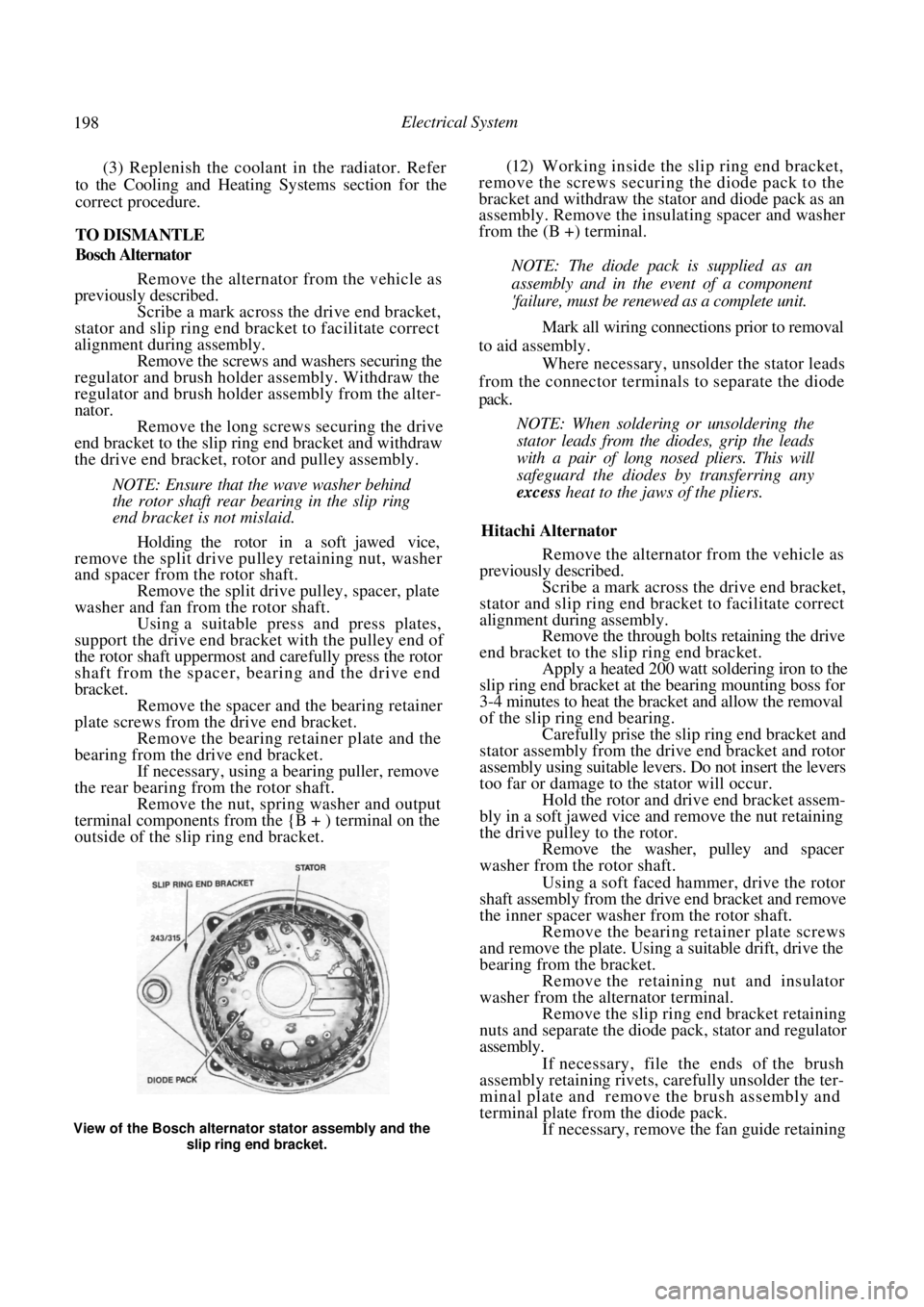
slip ring end bracket.