light NISSAN PULSAR 1987 Manual PDF
[x] Cancel search | Manufacturer: NISSAN, Model Year: 1987, Model line: PULSAR, Model: NISSAN PULSAR 1987Pages: 238, PDF Size: 28.91 MB
Page 224 of 238
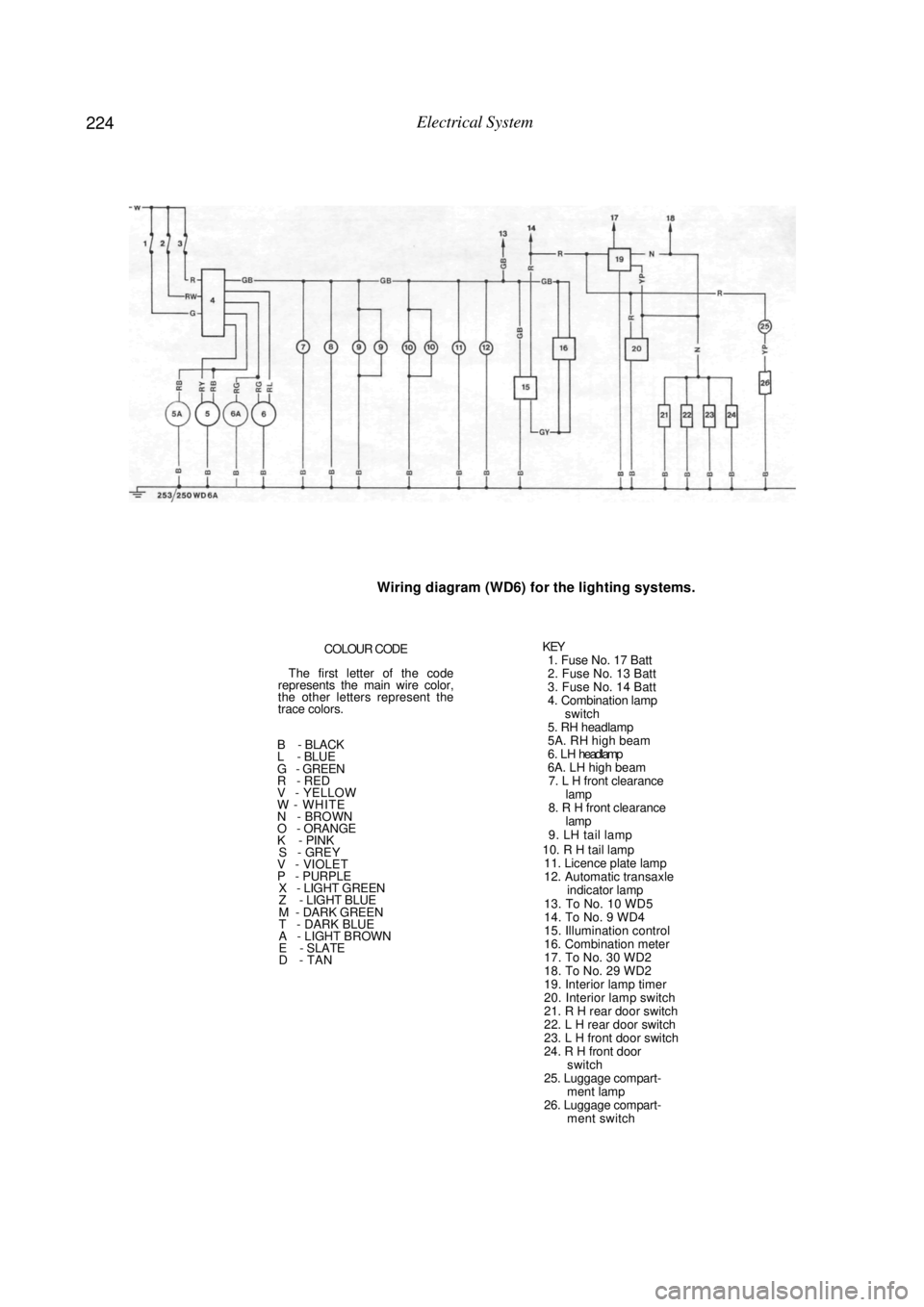
224 Electrical System
Wiring diagram (WD6) for the lighting systems.
COLOUR CODE
The first letter of the code
represents the main wire color,
the other letters represent the
trace colors.
B - BLACK
L - BLUE
G - GREEN
R - RED
V - YELLOW
W - WHITE
N - BROWN
O - ORANGE
K - PINK
S - GREY V - VIOLET
P - PURPLE X - LIGHT GREEN
Z - LIGHT BLUE
M - DARK GREEN
T - DARK BLUE
A - LIGHT BROWN
E - SLATE
D - TAN
KEY 1. Fuse No. 17 Batt
2. Fuse No. 13 Batt
3. Fuse No. 14 Batt
4. Combination lamp
switch
5. RH headlamp
5A. RH high beam
6 . L H headlamp
6A. LH high beam 7. L H front clearance lamp
8. R H front clearance lamp
9. LH tail lamp
10. R H tail lamp 11. Licence plate lamp
12. Automatic transaxle indicator lamp
13. To No. 10 WD5
14. To No. 9 WD4
15. Illumination control
16. Combination meter
17. To No. 30 WD2
18. To No. 29 WD2
19. Interior lamp timer
20. Interior lamp switch
21. R H rear door switch
22. L H rear door switch
23. L H front door switch
24. R H front door switch
25. Luggage compart- ment lamp
26. Luggage compart- ment switch
Page 226 of 238
226 Body
Remove the screws retaining the speaker to
the trim panel, withdraw the speaker slightly and
disconnect the wiring connector at the rear. Place the
speaker to one side clear of the work area.
On models with a step lamp located in the
door trim panel, remove the screws, withdraw the step
lamp and disconnect the wiring connector. Using a broad bladed screwdriver, carefully
lever the trim panel outwa rds and disengage all the
retaining clips. When all the clips have been disen-
gaged maneuver the trim panel from the door. Remove the screw retaining the speaker
water deflector to the inner door panel and withdraw
the water deflector.
Carefully remove the plastic sealing sheet from
the inner door panel.
Installation is a reversal of the removal procedure
with attention to the following points:
Ensure that the plastic sealing sheet is cor-
rectly installed and not torn or damaged.
Check the trim panel retaining clips and
renew any damaged clips as necessary. On models with manual windows, wind the
door glass to the closed position, install the
retaining
clip to the regulator handle and install the regulator
handle to correspond with the regulator handle on the
opposite door.
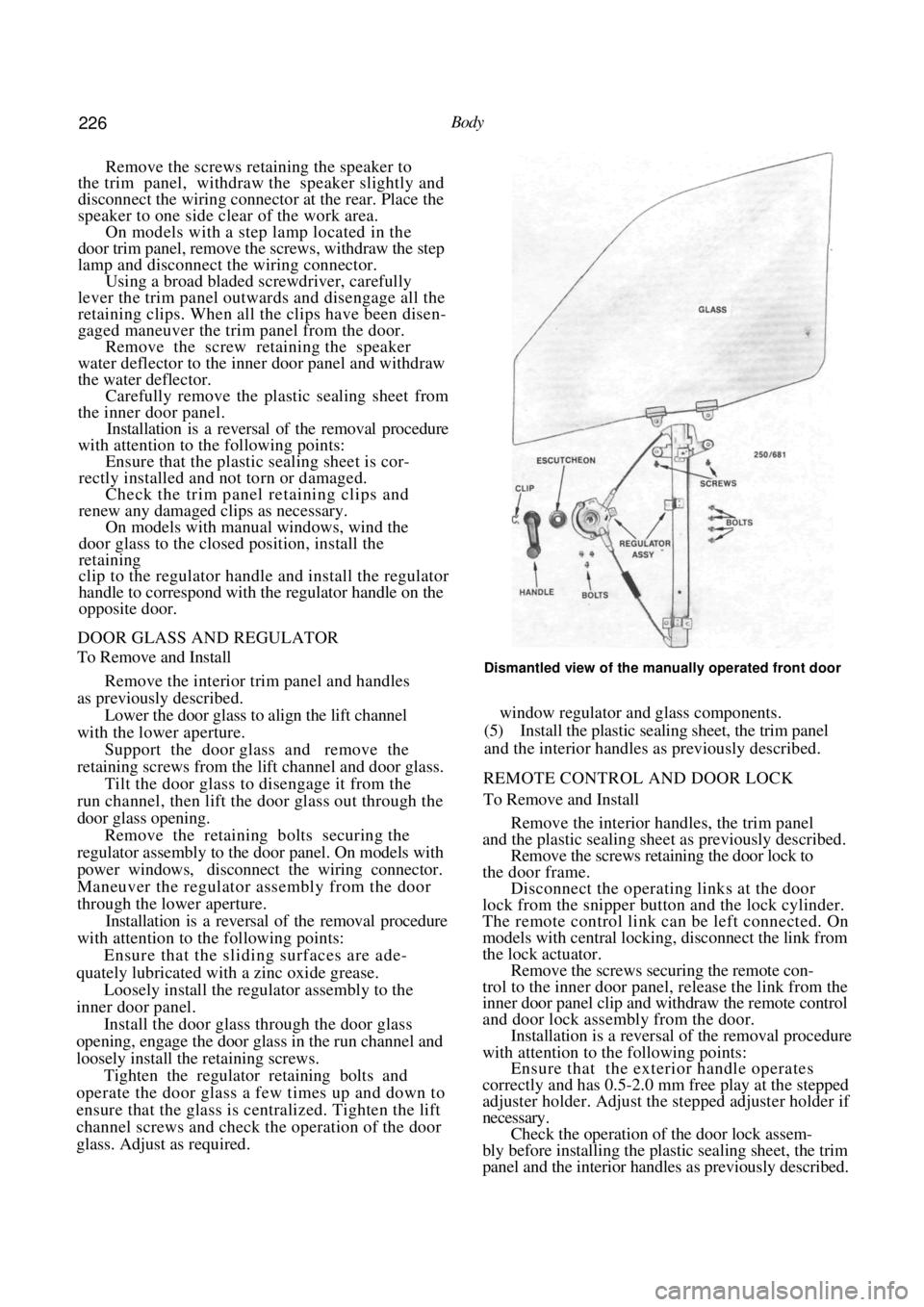
DOOR GLASS AND REGULATOR
To Remove and Install
Remove the interior trim panel and handles
as previously described. Lower the door glass to align the lift channel
with the lower aperture. Support the door glass and remove the
retaining screws from the lift channel and door glass. Tilt the door glass to disengage it from the
run channel, then lift the door glass out through the
door glass opening. Remove the retaining bolts securing the
regulator assembly to the door panel. On models with
power windows, disconnect the wiring connector.
Maneuver the regulator assembly from the door
through the lower aperture. Installation is a reversal of the removal procedure
with attention to the following points:
Ensure that the sliding surfaces are ade-
quately lubricated with a zinc oxide grease.
Loosely install the regulator assembly to the
inner door panel. Install the doo r glass through the door glass
opening, engage the door glass in the run channel and
loosely install the retaining screws.
Tighten the regulator retaining bolts and
operate the door glass a few times up and down to
ensure that the glass is centralized. Tighten the lift
channel screws and check the operation of the door
glass. Adjust as required.
Dismantled view of the manually operated front door
window regulator and glass components.
(5) Install the plastic sealing sheet, the trim panel
and the interior handles as previously described.
REMOTE CONTROL AND DOOR LOCK
To Remove and Install
Remove the interior handles, the trim panel
and the plastic sealing sheet as previously described.
Remove the screws retaining the door lock to
the door frame. Disconnect the operating links at the door
lock from the snipper button and the lock cylinder.
The remote control link can be left connected. On
models with central locking, disconnect the link from
the lock actuator.
Remove the screws securing the remote con-
trol to the inner door panel, release the link from the
inner door panel clip and w ithdraw the remote control
and door lock assembly from the door. Installation is a reversal of the removal procedure
with attention to the following points:
Ensure that the exterior handle operates
correctly and has 0.5-2.0 mm free play at the stepped
adjuster holder. Adjust the stepped adjuster holder if
necessary. Check the operation of the door lock assem-
bly before installing the plastic sealing sheet, the trim
panel and the interior handles as previously described.
Page 227 of 238

Body 227
Dismantled view of the front door lock components. Dimension A at the stepped adjuster holder should be 0.5-2.0 mm. Turn the stepped adjuster holder to give the correct free play.
EXTERIOR DOOR HANDLE
To Remove and Install
Remove the interior handles, the trim panel
and the plastic sealing sheet as previously described.
Remove the retaining nuts from inside the
door panel. Withdraw the handle slightly while ensur-
ing that the link is sliding out of the lock assembly.
Maneuver the exterior handle from the vehicle. Installation is a reversal of the removal procedure
with attention to the following points:
Ensure that the exterior handle and seal are
in a serviceable condition and installed correctly to
prevent the entry of dust and water. Ensure that the exterior handle operates
correctly and has 0.5-2.0 mm free play at the stepped
adjuster holder. Adjust the stepped adjuster holder if
necessary.
Check the operation of the door lock assem-
bly before installing the plastic sealing sheet, the trim
panel and the interior handles as previously described.
LOCK CYLINDER
To Remove and Install
(1) Remove the interior handles, the trim panel
and the plastic sealing sheet as previously described.
Wind the door glass up fully and disconnect
the operating link between the door lock and the lock
cylinder.
Using a suitable screwdriver, remove the
lock cylinder retaining clip and withdraw the lock
cylinder from the outer door panel.
Installation is a reversal of the removal
procedure.
LOCK STRIKER PLATE
To Remove, Install and Adjust
Mark the position of the striker plate on the
door pillar with a soft lead pencil to facilitate correct
replacement of the striker plate.
Remove the retaining screws from the striker
plate to the door pillar and remove the striker plate.
Inspect the striker plate for wear and renew as
necessary.
Install the striker plate to the door pillar
according to the pencil marks made on removal.
Close the door and observe the alignment
with the body panel or rear door. If necessary, loosen
the striker plate retaining screws and move the striker
plate in or out to achieve a flush fit. If the door lifts or drops when the lock
Page 234 of 238
234 Body
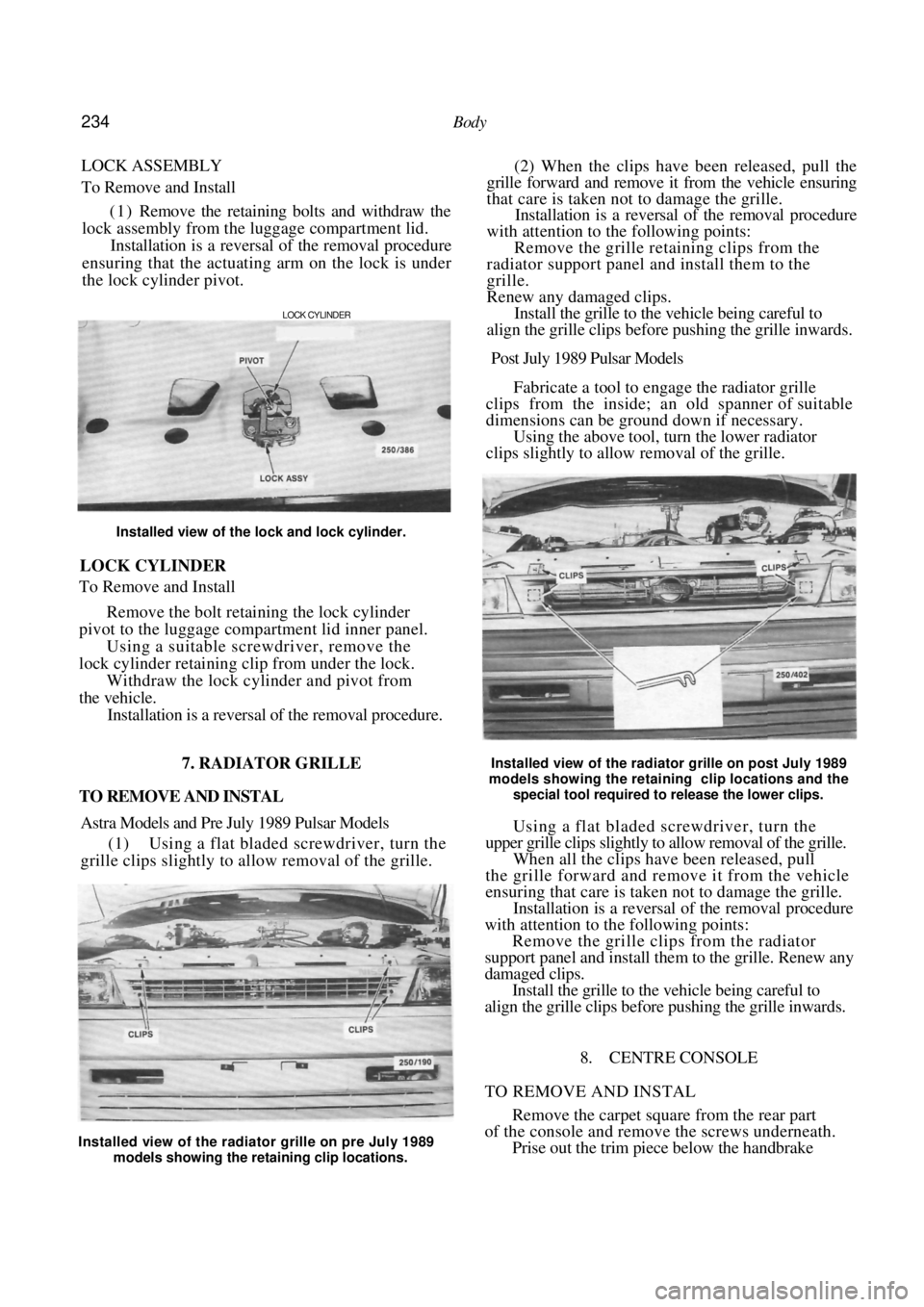
LOCK ASSEMBLY
To Remove and Install
( 1 ) Remove the retaining bolts and withdraw the
lock assembly from the luggage compartment lid.
Installation is a reversal of the removal procedure
ensuring that the actuating arm on the lock is under
the lock cylinder pivot.
LOCK CYLINDER
Installed view of the lock and lock cylinder.
LOCK CYLINDER
To Remove and Install
Remove the bolt retaining the lock cylinder
pivot to the luggage compartment lid inner panel. Using a suitable screwdriver, remove the
lock cylinder retaining clip from under the lock. Withdraw the lock cylinder and pivot from
the vehicle. Installation is a reversal of the removal procedure.
(2) When the clips have been released, pull the
grille forward and remove it from the vehicle ensuring
that care is taken not to damage the grille.
Installation is a reversal of the removal procedure
with attention to the following points:
Remove the grille retaining clips from the
radiator support panel and install them to the
grille.
Renew any damaged clips. Install the grille to the vehicle being careful to
align the grille clips before pushing the grille inwards.
Post July 1989 Pulsar Models
Fabricate a tool to engage the radiator grille
clips from the inside; an old spanner of suitable
dimensions can be ground down if necessary.
Using the above tool, turn the lower radiator
clips slightly to allow removal of the grille.
7. RADIATOR GRILLE
TO REMOVE AND INSTAL
Astra Models and Pre July 1989 Pulsar Models
(1) Using a flat bladed screwdriver, turn the
grille clips slightly to allow removal of the grille.
Installed view of the radiator grille on pre July 1989
models showing the retaining clip locations. Installed view of the radiator grille on post July 1989
models showing the retaining clip locations and the
special tool required to release the lower clips.
Using a flat bladed screwdriver, turn the
upper grille clips slightly to allow removal of the grille. When all the clips have been released, pull
the grille forward and remove it from the vehicle
ensuring that care is taken not to damage the grille.
Installation is a reversal of the removal procedure
with attention to the following points:
Remove the grille clips from the radiator
support panel and install them to the grille. Renew any
damaged clips.
Install the grille to the vehicle being careful to
align the grille clips before pushing the grille inwards.
8. CENTRE CONSOLE
TO REMOVE AND INSTAL
Remove the carpet square from the rear part
of the console and remove the screws underneath. Prise out the trim piece below the handbrake
Page 235 of 238

Body 235
lever and remove the screws underneath. Withdraw
the rear console.
On manual transaxle models, unscrew the
gear lever knob and prise out the gear lever rubber
boot. On automatic transaxle models, prise out the
panel around the selector lever and maneuver the
panel over the lever. Remove the screws retaining the front of the
console to the floor panel and withdraw the console
from the vehicle. Installation is a reversal of the removal procedure.
9, DASHBOARD
TO REMOVE AND INSTAL
Disconnect the negative battery terminal.
Remove the centre console as previously
described in this section. Remove the steering wheel as described in
the Steering section. Remove the upper and lower steering col-
umn shrouds and remove the combination switch.
Refer to the Electrical System section if necessary. Remove the retaining screws and withdraw
the lower trim panel from underneath the steering
column. Remove the screws from underneath the
bonnet lock handle and slide the bonnet lock handle
downwards out of the dashboard. Remove the screws retaining the centre fas-
cia panel, two upper and two lower, withdraw the
fascia panel slightly and disconnect the wiring to the
cigarette lighter.
Dismantled view of the centre console assembly. Au-
tomatic transaxle model.
Remove the radio/cassette bracket retaining
screws. Disconnect the aerial and the wiring and
withdraw the radio/cassette from the centre bracket. Remove the heater control knobs and re-
move the heater fascia panel screws. Carefully remove
the heater fascia panel leaving the heater controls in
place.
Loosen the bolt retaining the large wiring
connector at the lower right hand side of the dash-
board. As the bolt is loosened it will force the
connector apart. Using a screwdriver, carefully prise out the
demister ducts from th e top of the dashboard.
Using a suitable socket, remove the bolts
from underneath the demister ducts. Remove the bolts from the outer lower edges
and the lower part of th e centre bracket assembly.
NOTE: Refer to the illustration for the
location of the dashboard retaining bolts.
(14) With the aid of an assistant lift the dash-
board straight up at the door pillar brackets. Tilt the
View of the dashboard removed from the vehicle. The arrows indicate the location of the retaining bolts.
Page 237 of 238

Body 237
Installed view of the front seat mounting bolts.
Installation is a reversal of the removal procedure
with attention to the following points:
Lubricate the seat slides with multi-purpose
grease prior to installation of the seat.
Install all mounting bolts by hand prior to
tightening the mounting bolts securely.
REAR SEAT CUSHION
To Remove and Install
Firmly bump the lower front of the seat
cushion rearwards and up lo release the retaining clips
from the vehicle floor panel.
With the retaining clips released, lift the
front of the seat cushion and release the rear mounting
wires. (3) Lift the rear seat cushion out of the vehicle.
Installation is a reversal of the removal procedure
with attention to the following points:
Position the centre seat belts on top of the
rear seat cushion prior to in stallation of the cushion.
Ensure that the clips at the forward edge of
the seat cushion are proper ly engaged in the floor
panel.
REAR SEAT BACKREST
To Remove and Install
Fold the rear seat backrest forward.
Remove the outer seat backrest hinge bolts.
Pull each backrest to wards the door and off
the centre hinge pins. Remove the rear seat backrest from the
vehicle. Installation is a reversal of the removal procedure.
12. VEHICLE CLEANING
CLEANING THE EXTERIOR
In order to remove dirt and road grime and thus
preserve paint finish, vehicles in continuous use
should be washed at least once a week.
Before washing the paintwork, it is good policy to
first hose all dirt from the underbody and clean out
the drain holes in the doors and sill panels.
Hose the vehicle to remove as much grit as
possible and wash using a clean chamois or sponge,
ensuring that the chamois or sponge is free from dirt
or grit which could scratch the paint surface.
Avoid washing the vehicle in bright sunlight with
high temperature as this will give the paintwork a
streaky watermarked finish.
If necessary, wash the vehicle using a reputable
brand Wash and Wax liquid. The Wash and Wax
liquid will restore the paint luster and leave the
paintwork with a protective coating of wax.
After a period it may become necessary to polish
the vehicle in order to remove built up foreign matter
and give the paintwork maximum protection from
industrial fall-out and salt from sea air etc. Before
polishing the paintwork, always wash the surface to
remove as much road grime as possible. When
polishing follow the polishing instructions which come
with the polish.
NOTE: Grease, oil or tar on the paint
surface can be removed with a little kerosene
or white spirits. To prevent staining, wash
and polish the affected area as soon as the
grease, oil or tar is removed.
CLEANING VINYL TRIM
To maintain the vinyl interior trim in good
condition it should be regularly vacuumed to remove
loose dirt and then wiped with a dry or damp cloth.
If the trim is soiled or stained, the following
cleaning procedure is recommended:
Using warm water, cheese cloth and a mild
soap, thoroughly wash the affected areas.
Repeat the operation using damp cheese
cloth only.
To complete the cleaning operation wipe the
trim over with a dry piece of cheese cloth.
NOTE: If the interior trim is badly soiled or
stained, wash with a reputable brand of
upholstery cleaner care fully following the
makers instructions.
CLEANING CLOTH TRIM
Loose dirt and dust on cloth trim should be
removed with a vacuum cleaner or a very soft brush.
Do not use a whisk brush or any other type of coarse
brush or damage to the cloth could result. If the fabric
is soiled the following cl eaning procedure is recom-
mended.
Sponge the fabric ligh tly with warm water
containing a little detergen t and household ammonia.
After sponging, rub the fabric lightly. If
soiling is still apparent, re peat the sponging operation.
Use a clean dry cloth to soak up excess fluid.