maintenance NISSAN TEANA 2008 Owners Manual
[x] Cancel search | Manufacturer: NISSAN, Model Year: 2008, Model line: TEANA, Model: NISSAN TEANA 2008Pages: 5121, PDF Size: 69.03 MB
Page 2482 of 5121
FSU-8
< ON-VEHICLE MAINTENANCE >
WHEEL ALIGNMENT
Kingpin inclination angle is reference value, no inspection is required.
Toe-In
Measure toe-in by the following procedure.
WARNING:
Always perform the following procedure on a flat surface.
Make sure that no person is in front of vehicle before pushing it.
1. Bounce front of vehicle up and down to stabilize the vehicle height (posture).
2. Push vehicle straight ahead about 5 m (16 ft).
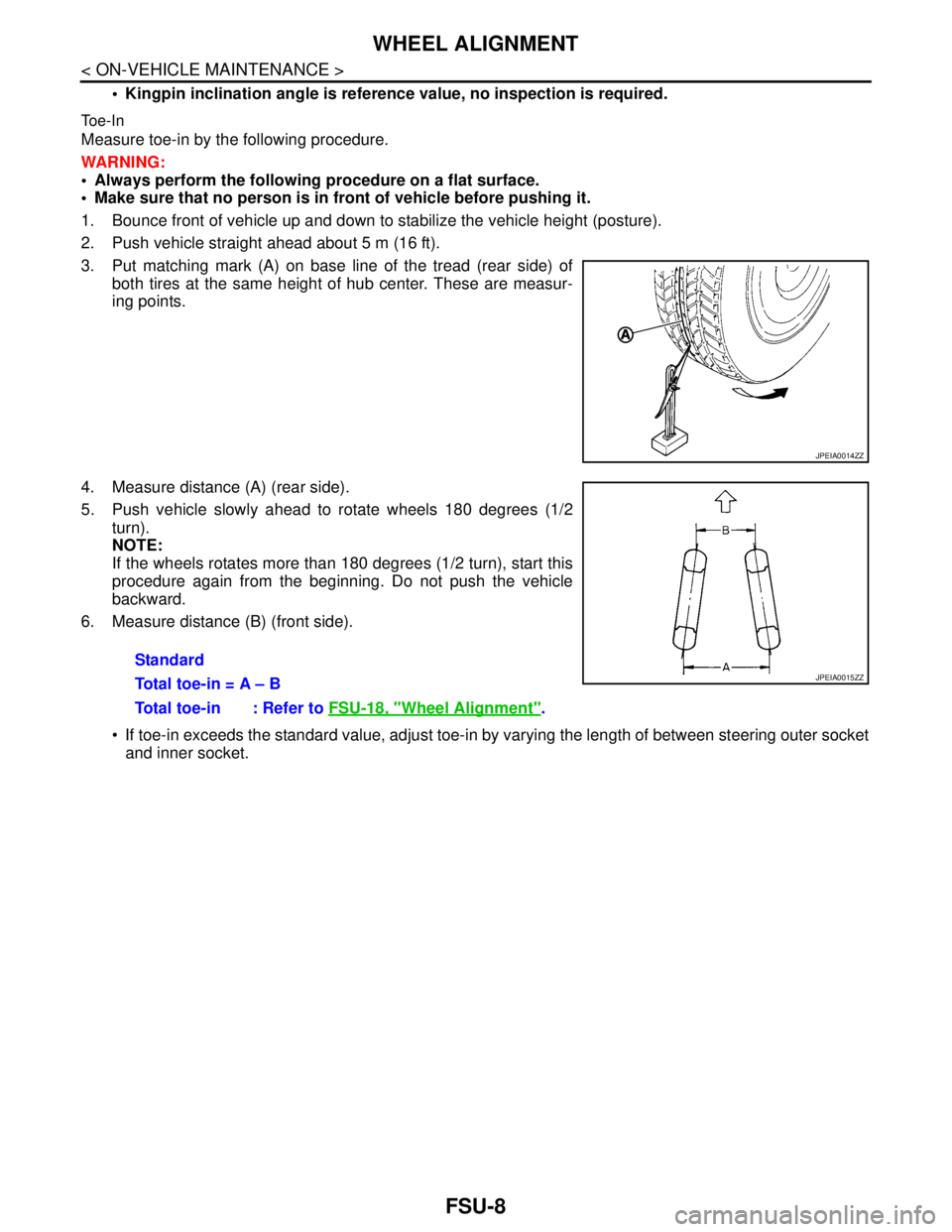
3. Put matching mark (A) on base line of the tread (rear side) of
both tires at the same height of hub center. These are measur-
ing points.
4. Measure distance (A) (rear side).
5. Push vehicle slowly ahead to rotate wheels 180 degrees (1/2
turn).
NOTE:
If the wheels rotates more than 180 degrees (1/2 turn), start this
procedure again from the beginning. Do not push the vehicle
backward.
6. Measure distance (B) (front side).
If toe-in exceeds the standard value, adjust toe-in by varying the length of between steering outer socket
and inner socket.
JPEIA0014ZZ
Standard
Total toe-in = A – B
Total toe-in : Refer to FSU-18, "
Wheel Alignment".
JPEIA0015ZZ
Page 2517 of 5121

GI-24
< PRECAUTION >
PRECAUTIONS
PRECAUTION
PRECAUTIONS
DescriptionINFOID:0000000003852776
Observe the following precautions to ensure safe and proper servicing. These precautions are not
described in each individual section.
Precaution for Supplemental Restraint System (SRS) "AIR BAG" and "SEAT BELT
PRE-TENSIONER"
INFOID:0000000003852830
The Supplemental Restraint System such as “AIR BAG” and “SEAT BELT PRE-TENSIONER”, used along
with a front seat belt, helps to reduce the risk or severity of injury to the driver and front passenger for certain
types of collision. Information necessary to service the system safely is included in the “SRS AIRBAG” and
“SEAT BELT” of this Service Manual.
WARNING:
To avoid rendering the SRS inoperative, which could increase the risk of personal injury or death in
the event of a collision which would result in air bag inflation, all maintenance must be performed by
an authorized NISSAN/INFINITI dealer.
Improper maintenance, including incorrect removal and installation of the SRS, can lead to personal
injury caused by unintentional activation of the system. For removal of Spiral Cable and Air Bag
Module, see the “SRS AIRBAG”.
Never use electrical test equipment on any circuit related to the SRS unless instructed to in this Ser-
vice Manual. SRS wiring harnesses can be identified by yellow and/or orange harnesses or harness
connectors.
Precautions For Xenon Headlamp ServiceINFOID:0000000003852778
WARNING:
Comply with the following warnings to prevent any serious accident.
Disconnect the battery cable (negative terminal) or the power supply fuse before installing, remov-
ing, or touching the xenon headlamp (bulb included). The xenon headlamp contains high-voltage
generated parts.
Never work with wet hands.
Check the xenon headlamp ON-OFF status after assembling it to the vehicle. Never turn the xenon
headlamp ON in other conditions. Connect the power supply to the vehicle-side connector.
(Turning it ON outside the lamp case may cause fire or visual impairments.)
Never touch the bulb glass immediately after turning it OFF. It is extremely hot.
CAUTION:
Comply with the following cautions to prevent any error and malfunction.
Install the xenon bulb securely. (Insufficient bulb socket installation may melt the bulb, the connec-
tor, the housing, etc. by high-voltage leakage or corona discharge.)
Never perform HID circuit inspection with a tester.
Never touch the xenon bulb glass with hands. Never put oil and grease on it.
Dispose of the used xenon bulb after packing it in thick vinyl without breaking it.
Never wipe out dirt and contamination with organic solvent (thinner, gasoline, etc.).
Precaution Necessary for Steering Wheel Rotation after Battery Disconnect
INFOID:0000000003852856
NOTE:
Before removing and installing any control units, first turn the push-button ignition switch to the LOCK posi-
tion, then disconnect both battery cables.
After finishing work, confirm that all control unit connectors are connected properly, then re-connect both
battery cables.
Always use CONSULT-III to perform self-diagnosis as a part of each function inspection after finishing work.
If a DTC is detected, perform trouble diagnosis according to self-diagnosis results.
This vehicle is equipped with a push-button ignition switch and a steering lock unit.
If the battery is disconnected or discharged, the steering wheel will lock and cannot be turned.
Page 2551 of 5121
GW-8
< PRECAUTION >
PRECAUTIONS
PRECAUTION
PRECAUTIONS
Precaution for Supplemental Restraint System (SRS) "AIR BAG" and "SEAT BELT
PRE-TENSIONER"
INFOID:0000000003825365
The Supplemental Restraint System such as “AIR BAG” and “SEAT BELT PRE-TENSIONER”, used along
with a front seat belt, helps to reduce the risk or severity of injury to the driver and front passenger for certain
types of collision. Information necessary to service the system safely is included in the “SRS AIRBAG” and
“SEAT BELT” of this Service Manual.
WARNING:
• To avoid rendering the SRS inoperative, which could increase the risk of personal injury or death in
the event of a collision which would result in air bag inflation, all maintenance must be performed by
an authorized NISSAN/INFINITI dealer.
Improper maintenance, including incorrect removal and installation of the SRS, can lead to personal
injury caused by unintentional activation of the system. For removal of Spiral Cable and Air Bag
Module, see the “SRS AIRBAG”.
Never use electrical test equipment on any circuit related to the SRS unless instructed to in this Ser-
vice Manual. SRS wiring harnesses can be identified by yellow and/or orange harnesses or harness
connectors.
Precaution for Procedure without Cowl Top CoverINFOID:0000000003825366
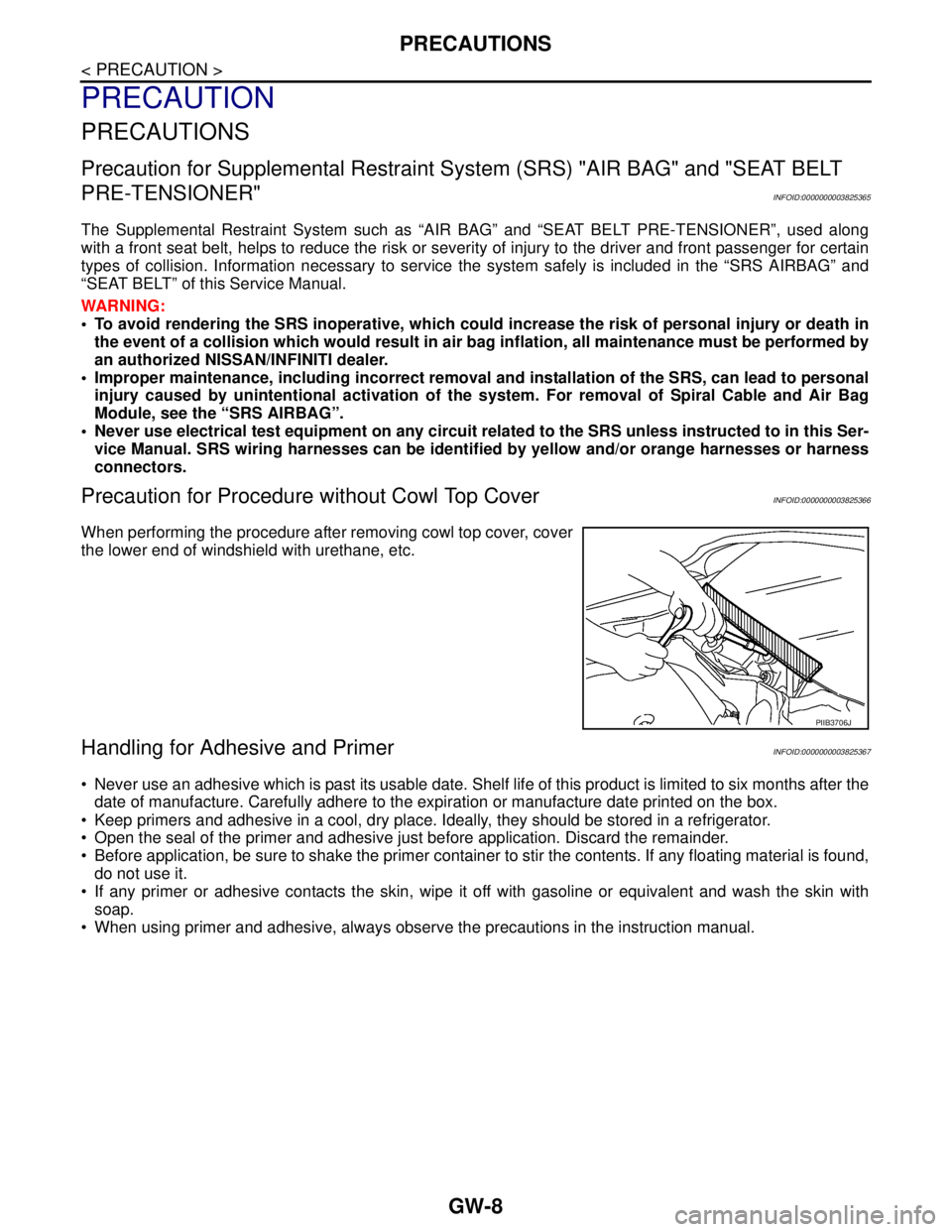
When performing the procedure after removing cowl top cover, cover
the lower end of windshield with urethane, etc.
Handling for Adhesive and PrimerINFOID:0000000003825367
Never use an adhesive which is past its usable date. Shelf life of this product is limited to six months after the
date of manufacture. Carefully adhere to the expiration or manufacture date printed on the box.
Keep primers and adhesive in a cool, dry place. Ideally, they should be stored in a refrigerator.
Open the seal of the primer and adhesive just before application. Discard the remainder.
Before application, be sure to shake the primer container to stir the contents. If any floating material is found,
do not use it.
If any primer or adhesive contacts the skin, wipe it off with gasoline or equivalent and wash the skin with
soap.
When using primer and adhesive, always observe the precautions in the instruction manual.
PIIB3706J
Page 2570 of 5121

HA-1
VENTILATION, HEATER & AIR CONDITIONER
C
D
E
F
G
H
J
K
L
M
SECTION HA
A
B
HA
N
O
P
CONTENTS
HEATER & AIR CONDITIONING SYSTEM
BASIC INSPECTION ....................................3
DIAGNOSIS AND REPAIR WORK FLOW .........3
Work Flow .................................................................3
FUNCTION DIAGNOSIS ...............................5
REFRIGERATION SYSTEM ...............................5
System Diagram ........................................................5
System Description ...................................................5
Component Parts Location ........................................6
Component Description .............................................7
SYMPTOM DIAGNOSIS ...............................8
REFRIGERATION SYSTEM SYMPTOMS ..........8
Trouble Diagnosis For Unusual Pressure .................8
Symptom Table .........................................................8
COMPRESSOR SYSTEM SYMPTOMS .............11
Symptom Table .......................................................11
PRECAUTION ..............................................12
PRECAUTIONS ..................................................12
Precaution for Supplemental Restraint System
(SRS) "AIR BAG" and "SEAT BELT PRE-TEN-
SIONER" .................................................................
12
Precaution Necessary for Steering Wheel Rota-
tion after Battery Disconnect ...................................
12
Precaution for Procedure without Cowl Top Cover ....13
Precautions For Xenon Headlamp Service .............13
Working with HFC-134a (R-134a) ...........................13
General Refrigerant Precaution ..............................13
Refrigerant Connection ...........................................14
Service Equipment ..................................................16
COMPRESSOR ..................................................19
General Precautions ...............................................19
FLUORESCENT LEAK DETECTOR .................20
General Precautions ...............................................20
PREPARATION ...........................................21
PREPARATION .................................................21
Special Service Tool ................................................21
Sealant or/and Lubricant .........................................23
ON-VEHICLE MAINTENANCE ....................24
REFRIGERANT .................................................24
Collection and Charge .............................................24
LUBRICANT ......................................................28
Maintenance of Lubricant Quantity ..........................28
Lubricant Adjusting Procedure for Components
Replacement Except Compressor ...........................
28
Lubricant Adjusting Procedure for Compressor
Replacement ...........................................................
29
REFRIGERATION SYSTEM .............................30
Inspection ................................................................30
Performance Chart ..................................................30
Refrigerant Leakages ..............................................31
FLUORESCENT LEAK DETECTOR ................32
Inspection ................................................................32
ELECTRICAL LEAK DETECTOR ....................33
Inspection ................................................................33
ON-VEHICLE REPAIR .................................36
COMPRESSOR .................................................36
Exploded View .........................................................36
Removal and Installation .........................................36
Inspection ................................................................37
LOW-PRESSURE FLEXIBLE HOSE ................38
Exploded View .........................................................38
Removal and Installation .........................................38
HIGH-PRESSURE FLEXIBLE HOSE ...............40
Exploded View .........................................................40
Removal and Installation .........................................40
Page 2581 of 5121

HA-12
< PRECAUTION >
PRECAUTIONS
PRECAUTION
PRECAUTIONS
Precaution for Supplemental Restraint System (SRS) "AIR BAG" and "SEAT BELT
PRE-TENSIONER"
INFOID:0000000003844112
The Supplemental Restraint System such as “AIR BAG” and “SEAT BELT PRE-TENSIONER”, used along
with a front seat belt, helps to reduce the risk or severity of injury to the driver and front passenger for certain
types of collision. Information necessary to service the system safely is included in the “SRS AIRBAG” and
“SEAT BELT” of this Service Manual.
WARNING:
• To avoid rendering the SRS inoperative, which could increase the risk of personal injury or death in
the event of a collision which would result in air bag inflation, all maintenance must be performed by
an authorized NISSAN/INFINITI dealer.
Improper maintenance, including incorrect removal and installation of the SRS, can lead to personal
injury caused by unintentional activation of the system. For removal of Spiral Cable and Air Bag
Module, see the “SRS AIRBAG”.
Never use electrical test equipment on any circuit related to the SRS unless instructed to in this Ser-
vice Manual. SRS wiring harnesses can be identified by yellow and/or orange harnesses or harness
connectors.
Precaution Necessary for Steering Wheel Rotation after Battery Disconnect
INFOID:0000000003844113
NOTE:
Before removing and installing any control units, first turn the push-button ignition switch to the LOCK posi-
tion, then disconnect both battery cables.
After finishing work, confirm that all control unit connectors are connected properly, then re-connect both
battery cables.
Always use CONSULT-III to perform self-diagnosis as a part of each function inspection after finishing work.
If a DTC is detected, perform trouble diagnosis according to self-diagnosis results.
This vehicle is equipped with a push-button ignition switch and a steering lock unit.
If the battery is disconnected or discharged, the steering wheel will lock and cannot be turned.
If turning the steering wheel is required with the battery disconnected or discharged, follow the procedure
below before starting the repair operation.
OPERATION PROCEDURE
1. Connect both battery cables.
NOTE:
Supply power using jumper cables if battery is discharged.
2. Turn the push-button ignition switch to ACC position.
(At this time, the steering lock will be released.)
3. Disconnect both battery cables. The steering lock will remain released with both battery cables discon-
nected and the steering wheel can be turned.
4. Perform the necessary repair operation.
5. When the repair work is completed, re-connect both battery cables. With the brake pedal released, turn
the push-button ignition switch from ACC position to ON position, then to LOCK position. (The steering
wheel will lock when the push-button ignition switch is turned to LOCK position.)
6. Perform self-diagnosis check of all control units using CONSULT-III.
Page 2585 of 5121
HA-16
< PRECAUTION >
PRECAUTIONS
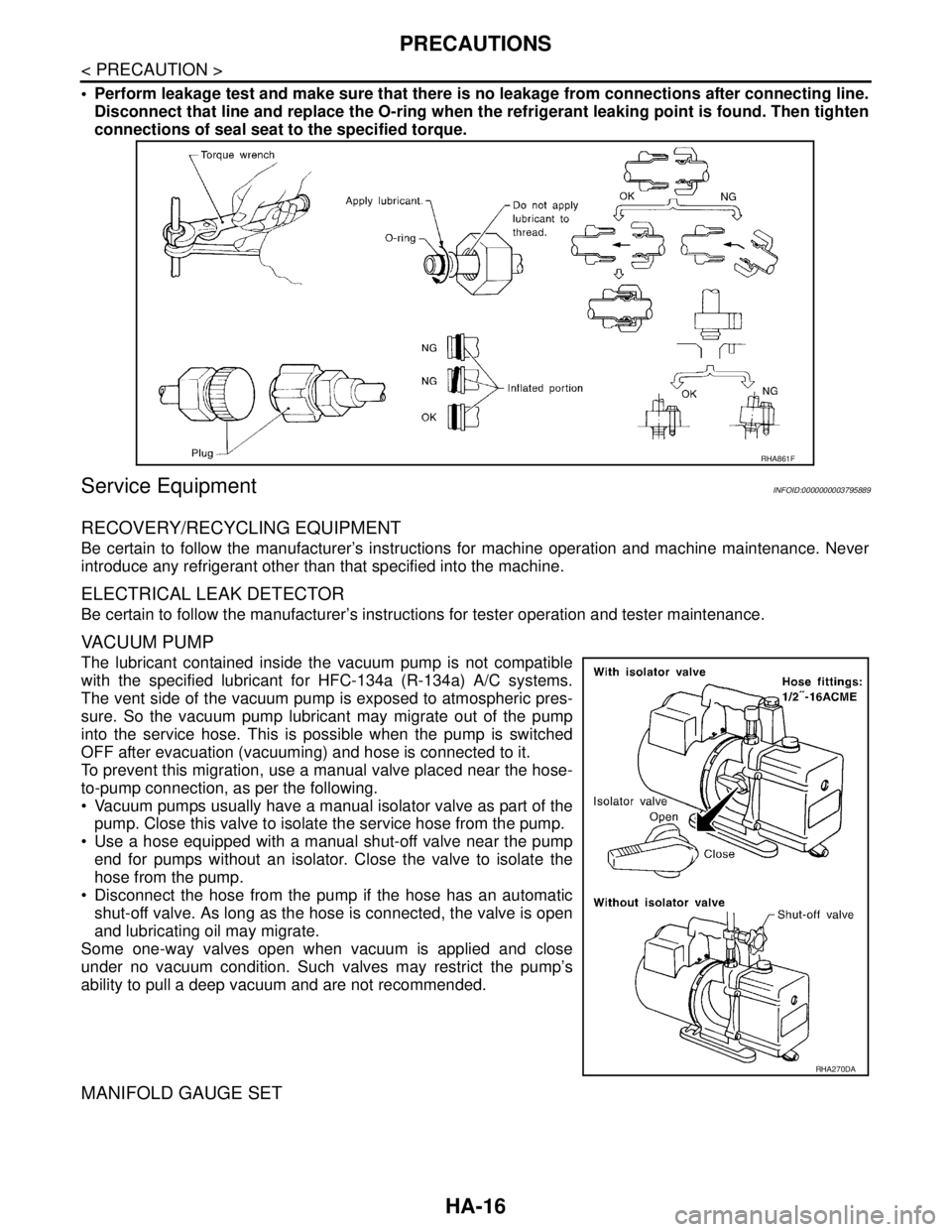
Perform leakage test and make sure that there is no leakage from connections after connecting line.
Disconnect that line and replace the O-ring when the refrigerant leaking point is found. Then tighten
connections of seal seat to the specified torque.
Service EquipmentINFOID:0000000003795889
RECOVERY/RECYCLING EQUIPMENT
Be certain to follow the manufacturer’s instructions for machine operation and machine maintenance. Never
introduce any refrigerant other than that specified into the machine.
ELECTRICAL LEAK DETECTOR
Be certain to follow the manufacturer’s instructions for tester operation and tester maintenance.
VACUUM PUMP
The lubricant contained inside the vacuum pump is not compatible
with the specified lubricant for HFC-134a (R-134a) A/C systems.
The vent side of the vacuum pump is exposed to atmospheric pres-
sure. So the vacuum pump lubricant may migrate out of the pump
into the service hose. This is possible when the pump is switched
OFF after evacuation (vacuuming) and hose is connected to it.
To prevent this migration, use a manual valve placed near the hose-
to-pump connection, as per the following.
Vacuum pumps usually have a manual isolator valve as part of the
pump. Close this valve to isolate the service hose from the pump.
Use a hose equipped with a manual shut-off valve near the pump
end for pumps without an isolator. Close the valve to isolate the
hose from the pump.
Disconnect the hose from the pump if the hose has an automatic
shut-off valve. As long as the hose is connected, the valve is open
and lubricating oil may migrate.
Some one-way valves open when vacuum is applied and close
under no vacuum condition. Such valves may restrict the pump’s
ability to pull a deep vacuum and are not recommended.
MANIFOLD GAUGE SET
RHA861F
RHA270DA
Page 2588 of 5121

COMPRESSOR
HA-19
< PRECAUTION >
C
D
E
F
G
H
J
K
L
MA
B
HA
N
O
P
COMPRESSOR
General PrecautionsINFOID:0000000003795891
CAUTION:
Plug all openings to prevent moisture and foreign matter from entering.
Store it in the same way at it is when mounted on the car when the compressor is removed.
Follow “Maintenance of Lubricant Quantity in Compressor” exactly when replacing or repairing
compressor. Refer to HA-28, "
Maintenance of Lubricant Quantity".
Keep friction surfaces between clutch and pulley clean. Wipe it off by using a clean waste cloth
moistened with thinner if the surface is contaminated with lubricant.
Turn the compressor shaft by hand more than five turns in both directions after compressor service
operation. This distributes equally lubricant inside the compressor. Let the engine idle and operate
the compressor for one hour after the compressor is installed.
Apply voltage to the new one and check for normal operation after replacing the compressor magnet
clutch.
Page 2593 of 5121
HA-24
< ON-VEHICLE MAINTENANCE >
REFRIGERANT
ON-VEHICLE MAINTENANCE
REFRIGERANT
Collection and ChargeINFOID:0000000003795980
SETTING OF SERVICE TOOLS AND EQUIPMENT
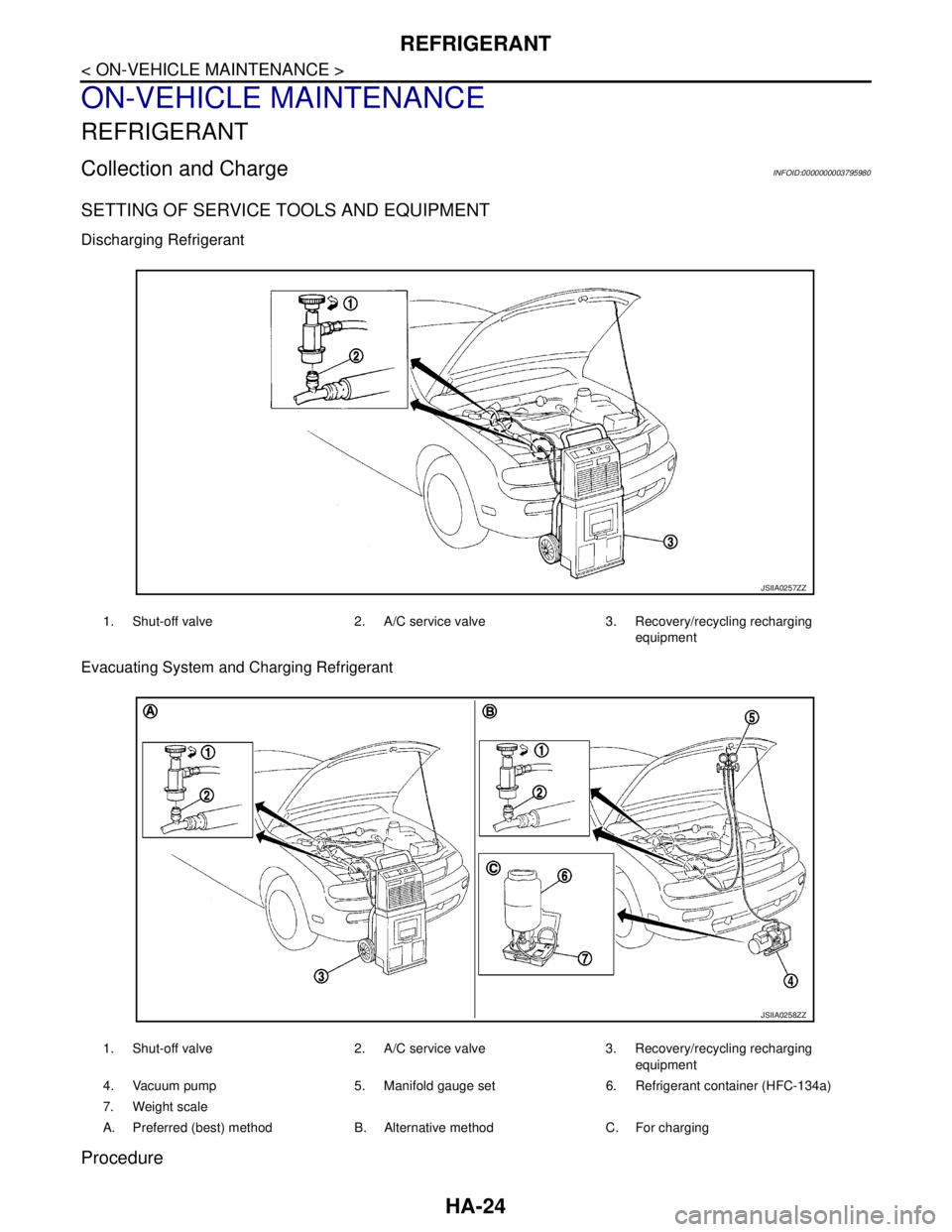
Discharging Refrigerant
Evacuating System and Charging Refrigerant
Procedure
1. Shut-off valve 2. A/C service valve 3. Recovery/recycling recharging
equipment
JSIIA0257ZZ
1. Shut-off valve 2. A/C service valve 3. Recovery/recycling recharging
equipment
4. Vacuum pump 5. Manifold gauge set 6. Refrigerant container (HFC-134a)
7. Weight scale
A. Preferred (best) method B. Alternative method C. For charging
JSIIA0258ZZ
Page 2594 of 5121
REFRIGERANT
HA-25
< ON-VEHICLE MAINTENANCE >
C
D
E
F
G
H
J
K
L
MA
B
HA
N
O
P
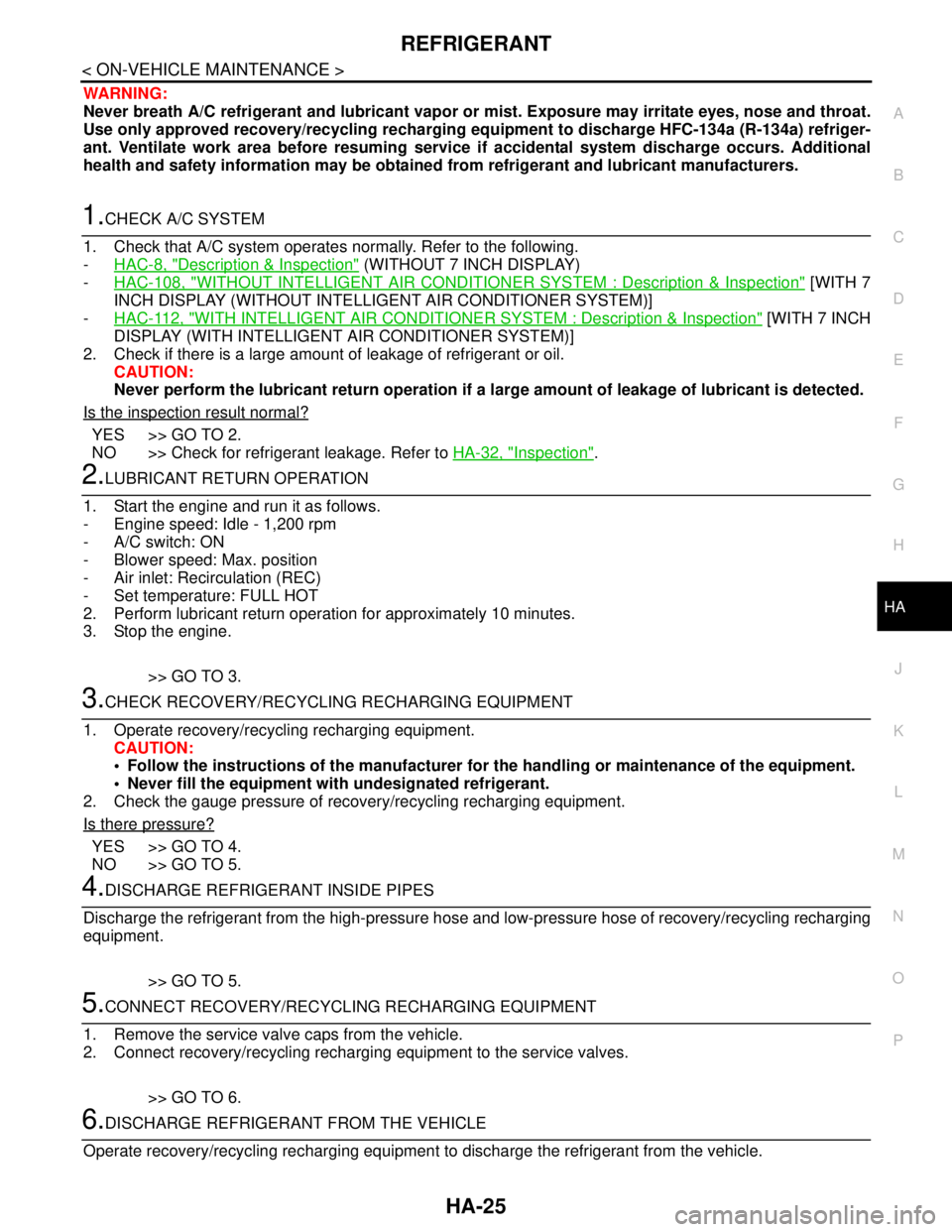
WARNING:
Never breath A/C refrigerant and lubricant vapor or mist. Exposure may irritate eyes, nose and throat.
Use only approved recovery/recycling recharging equipment to discharge HFC-134a (R-134a) refriger-
ant. Ventilate work area before resuming service if accidental system discharge occurs. Additional
health and safety information may be obtained from refrigerant and lubricant manufacturers.
1.CHECK A/C SYSTEM
1. Check that A/C system operates normally. Refer to the following.
-HAC-8, "
Description & Inspection" (WITHOUT 7 INCH DISPLAY)
-HAC-108, "
WITHOUT INTELLIGENT AIR CONDITIONER SYSTEM : Description & Inspection" [WITH 7
INCH DISPLAY (WITHOUT INTELLIGENT AIR CONDITIONER SYSTEM)]
-HAC-112, "
WITH INTELLIGENT AIR CONDITIONER SYSTEM : Description & Inspection" [WITH 7 INCH
DISPLAY (WITH INTELLIGENT AIR CONDITIONER SYSTEM)]
2. Check if there is a large amount of leakage of refrigerant or oil.
CAUTION:
Never perform the lubricant return operation if a large amount of leakage of lubricant is detected.
Is the inspection result normal?
YES >> GO TO 2.
NO >> Check for refrigerant leakage. Refer to HA-32, "
Inspection".
2.LUBRICANT RETURN OPERATION
1. Start the engine and run it as follows.
- Engine speed: Idle - 1,200 rpm
- A/C switch: ON
- Blower speed: Max. position
- Air inlet: Recirculation (REC)
- Set temperature: FULL HOT
2. Perform lubricant return operation for approximately 10 minutes.
3. Stop the engine.
>> GO TO 3.
3.CHECK RECOVERY/RECYCLING RECHARGING EQUIPMENT
1. Operate recovery/recycling recharging equipment.
CAUTION:
Follow the instructions of the manufacturer for the handling or maintenance of the equipment.
Never fill the equipment with undesignated refrigerant.
2. Check the gauge pressure of recovery/recycling recharging equipment.
Is there pressure?
YES >> GO TO 4.
NO >> GO TO 5.
4.DISCHARGE REFRIGERANT INSIDE PIPES
Discharge the refrigerant from the high-pressure hose and low-pressure hose of recovery/recycling recharging
equipment.
>> GO TO 5.
5.CONNECT RECOVERY/RECYCLING RECHARGING EQUIPMENT
1. Remove the service valve caps from the vehicle.
2. Connect recovery/recycling recharging equipment to the service valves.
>> GO TO 6.
6.DISCHARGE REFRIGERANT FROM THE VEHICLE
Operate recovery/recycling recharging equipment to discharge the refrigerant from the vehicle.
Page 2595 of 5121

HA-26
< ON-VEHICLE MAINTENANCE >
REFRIGERANT
>> GO TO 7.
7.REMOVE ANY REMAINING REFRIGERANT
Evacuate air for approximately 10 minutes or more to remove any remaining refrigerant integrated to the com-
pressor oil, etc.
>> GO TO 8.
8.REPLACE OR REPAIR REFRIGERANT SYSTEM PARTS
1. Replace or repair the malfunctioning part.
CAUTION:
Always use a new O-ring for the parts that the cooler system was removed.
Apply compressor oil to the O-rings of piping when installing the piping. However, never apply it
to the threads.
2. Adjust the compressor oil amount according to the replaced parts. Refer to HA-28, "
Maintenance of Lubri-
cant Quantity".
>> GO TO 9.
9.EVACUATE AIR FROM THE REFRIGERANT SYSTEM
Evacuate air from the refrigerant system for approximately 25 minutes or more.
CAUTION:
Evacuate air for at least approximately 15 minutes or more if the parts are replaced.
>> GO TO 10.
10.CHECK AIRTIGHTNESS OF REFRIGERANT SYSTEM
Check the airtightness of the refrigerant system for approximately 25 minutes or more.
CAUTION:
Check the airtightness for at least approximately 15 minutes or more if the parts are replaced.
Does the pressure decrease?
YES >> GO TO 11.
NO >> GO TO 8.
11 .CHECK REFRIGERANT LEAKAGE
1. Connect refrigerant recovery/recycling recharging equipment or manifold gauge set (SST).
2. Charge the refrigerant of approximately 200 g to the refrigerant system.
3. Check for refrigerant leakage. Refer to HA-32, "
Inspection".
NOTE:
When using electrical leak detector (SST). Refer to HA-33, "
Inspection".
Is the inspection result normal?
YES >> GO TO 12.
NO >> Repair or replace parts according to the inspection results.
12.CHARGE REFRIGERANT
1. Connect recovery/recycling recharging equipment or manifold gauge set (SST).
2. Evacuate air again.
3. Charge the specified amount of refrigerant to the refrigerant system.
>> GO TO 13.
13.CHECK REFRIGERANT LEAKAGE
Check for refrigerant leakage again. Refer to HA-32, "
Inspection".
NOTE:
When using electrical leak detector (SST). Refer to HA-33, "
Inspection".
Is the inspection result normal?
YES >> GO TO 14.
NO >> GO TO 6.