check engine light NISSAN TEANA 2008 User Guide
[x] Cancel search | Manufacturer: NISSAN, Model Year: 2008, Model line: TEANA, Model: NISSAN TEANA 2008Pages: 5121, PDF Size: 69.03 MB
Page 1091 of 5121
![NISSAN TEANA 2008 User Guide BRC-150
< PRECAUTION >[VDC/TCS/ABS]
PRECAUTIONS
Precaution for Brake Control
INFOID:0000000003767032
When starting engine or when starting vehicle just after starting engine, brake pedal may vibrate](/img/5/57391/w960_57391-1090.png "NISSAN TEANA 2008 User Guide BRC-150
< PRECAUTION >[VDC/TCS/ABS]
PRECAUTIONS
Precaution for Brake Control
INFOID:0000000003767032
When starting engine or when starting vehicle just after starting engine, brake pedal may vibrate")
BRC-150
< PRECAUTION >[VDC/TCS/ABS]
PRECAUTIONS
Precaution for Brake Control
INFOID:0000000003767032
When starting engine or when starting vehicle just after starting engine, brake pedal may vibrate or motor
operating noise may be heard from engine compartment. This is normal condition.
When an error is indicated by ABS or another warning lamp, collect all necessary information from customer
(what symptoms are present under what conditions) and check for estimate causes before starting diagnos-
tic servicing. Besides electrical system inspection, check brake booster operation, brake fluid level, and oil
leaks.
If tire size and type are used in an improper combination, or brake pads are not Genuine NISSAN parts,
stopping distance or steering stability may deteriorate.
ABS might be out of order or malfunctions by putting a radio (wiring inclusive), an antenna and a lead-in wire
near the control unit.
If aftermarket parts (car stereo, CD player, etc.) have been installed, check for incidents such as harness
pinches, open circuits, and improper wiring.
VDC system may not operate normally or a VDC OFF indicator lamp or SLIP indicator lamp may light.
- When replacing the following parts with parts other than genuine parts or making modifications: Suspension
related parts (shock absorber, spring, bushing, etc.), tires, wheels (other than specified sizes), brake-related
parts (pad, rotor, caliper, etc.), engine-related parts (muffler, ECM, etc.) and body reinforcement-related parts
(roll bar, tower bar, etc.).
- When driving with worn or deteriorated suspension, tires and brake-related parts.
Precautions for Harness RepairINFOID:0000000003843440
COMMUNICATION LINE
Solder the repaired area and wrap tape around the soldered area.
NOTE:
A fray of twisted lines must be within 110 mm (4.33 in).
Bypass connection is never allowed at the repaired area.
NOTE:
Bypass connection may cause communication error as spliced
wires that are separate from the main line or twisted lines lose
noise immunity.
Replace the applicable harness as an assembly if error is detected
on the shield lines of communication line.
SKIB8766E
SKIB8767E
Page 1474 of 5121
![NISSAN TEANA 2008 User Guide INSPECTION AND ADJUSTMENT
EC-13
< BASIC INSPECTION >[VQ25DE, VQ35DE]
C
D
E
F
G
H
I
J
K
L
MA
EC
N
P O
2. Check ignition timing with a timing light.
For procedure, refer to EC-15, "
IGNITION TIMING : Sp](/img/5/57391/w960_57391-1473.png "NISSAN TEANA 2008 User Guide INSPECTION AND ADJUSTMENT
EC-13
< BASIC INSPECTION >[VQ25DE, VQ35DE]
C
D
E
F
G
H
I
J
K
L
MA
EC
N
P O
2. Check ignition timing with a timing light.
For procedure, refer to EC-15, \"
IGNITION TIMING : Sp")
INSPECTION AND ADJUSTMENT
EC-13
< BASIC INSPECTION >[VQ25DE, VQ35DE]
C
D
E
F
G
H
I
J
K
L
MA
EC
N
P O
2. Check ignition timing with a timing light.
For procedure, refer to EC-15, "
IGNITION TIMING : Special Repair Requirement".
For specification, refer to EC-414, "
Ignition Timing".
Is the inspection result normal?
YES >> GO TO 19.
NO >> GO TO 11.
11 .PERFORM ACCELERATOR PEDAL RELEASED POSITION LEARNING
1. Stop engine.
2. Perform EC-15, "
ACCELERATOR PEDAL RELEASED POSITION LEARNING : Special Repair Require-
ment".
>> GO TO 12.
12.PERFORM THROTTLE VALVE CLOSED POSITION LEARNING
Perform EC-16, "
THROTTLE VALVE CLOSED POSITION LEARNING : Special Repair Requirement".
>> GO TO 13.
13.PERFORM IDLE AIR VOLUME LEARNING
Perform EC-16, "
IDLE AIR VOLUME LEARNING : Special Repair Requirement".
Is Idle Air Volume Learning carried out successfully?
YES >> GO TO 14.
NO >> Follow the instruction of Idle Air Volume Learning. Then GO TO 4.
14.CHECK TARGET IDLE SPEED AGAIN
1. Start engine and warm it up to normal operating temperature.
2. Check idle speed.
For procedure, refer to EC-14, "
IDLE SPEED : Special Repair Requirement".
For specification, refer to EC-414, "
Idle Speed".
Is the inspection result normal?
YES >> GO TO 15.
NO >> GO TO 17.
15.CHECK IGNITION TIMING AGAIN
1. Run engine at idle.
2. Check ignition timing with a timing light.
For procedure, refer to EC-15, "
IGNITION TIMING : Special Repair Requirement".
For specification, refer to EC-414, "
Ignition Timing".
Is the inspection result normal?
YES >> GO TO 19.
NO >> GO TO 16.
16.CHECK TIMING CHAIN INSTALLATION
Check timing chain installation. Refer to EM-53, "
Removal and Installation".
Is the inspection result normal?
YES >> GO TO 17.
NO >> 1. Repair the timing chain installation.
2. GO TO 4.
17.DETECT MALFUNCTIONING PART
Check the following.
Check camshaft position sensor (PHASE) and circuit. Refer to EC-223, "
Diagnosis Procedure".
Check crankshaft position sensor (POS) and circuit. Refer to EC-219, "
Diagnosis Procedure".
Is the inspection result normal?
YES >> GO TO 18.
NO >> 1. Repair or replace malfunctioning part.
Page 1477 of 5121
![NISSAN TEANA 2008 User Guide EC-16
< BASIC INSPECTION >[VQ25DE, VQ35DE]
INSPECTION AND ADJUSTMENT
THROTTLE VALVE CLOSED POSITION LEARNING
THROTTLE VALVE CLOSED POSITION LEARNING : DescriptionINFOID:0000000003856455
Throttle Valve](/img/5/57391/w960_57391-1476.png "NISSAN TEANA 2008 User Guide EC-16
< BASIC INSPECTION >[VQ25DE, VQ35DE]
INSPECTION AND ADJUSTMENT
THROTTLE VALVE CLOSED POSITION LEARNING
THROTTLE VALVE CLOSED POSITION LEARNING : DescriptionINFOID:0000000003856455
Throttle Valve")
EC-16
< BASIC INSPECTION >[VQ25DE, VQ35DE]
INSPECTION AND ADJUSTMENT
THROTTLE VALVE CLOSED POSITION LEARNING
THROTTLE VALVE CLOSED POSITION LEARNING : DescriptionINFOID:0000000003856455
Throttle Valve Closed Position Learning is an operation to learn the fully closed position of the throttle valve by
monitoring the throttle position sensor output signal. It must be performed each time harness connector of
electric throttle control actuator or ECM is disconnected.
THROTTLE VALVE CLOSED POSITION LEARNING : Special Repair Requirement
INFOID:0000000003856456
1.START
1. Check that accelerator pedal is fully released.
2. Turn ignition switch ON.
3. Turn ignition switch OFF and wait at least 10 seconds.
Check that throttle valve moves during above 10 seconds by confirming the operating sound.
>> END
IDLE AIR VOLUME LEARNING
IDLE AIR VOLUME LEARNING : DescriptionINFOID:0000000003856457
Idle Air Volume Learning is a function of ECM to learn the idle air volume that keeps engine idle speed within
the specific range. It must be performed under the following conditions:
Each time electric throttle control actuator or ECM is replaced.
Idle speed or ignition timing is out of specification.
IDLE AIR VOLUME LEARNING : Special Repair RequirementINFOID:0000000003856458
1.PRECONDITIONING
Before performing Idle Air Volume Learning, check that all of the following conditions are satisfied.
Learning will be cancelled if any of the following conditions are missed for even a moment.
Battery voltage: More than 12.9 V (At idle)
Engine coolant temperature: 70 - 100°C (158 - 212°F)
Selector lever: P or N
Electric load switch: OFF
(Air conditioner, head lamp, rear window defogger)
-For vehicle equipped with daytime light systems, perform one of the following procedures before
starting engine not to illuminate headlamps.
Apply parking brake
Set lighting switch to the 1st position
Steering wheel: Neutral (Straight-ahead position)
Vehicle speed: Stopped
Transmission: Warmed-up
- With CONSULT-III: Drive vehicle until “ATF TEMP SEN” in “DATA MONITOR” mode of “CVT” system indi-
cates less than 0.9 V.
- Without CONSULT-III: Drive vehicle for 10 minutes.
Will CONSULT-III be used?
YES >> GO TO 2.
NO >> GO TO 3.
2.PERFORM IDLE AIR VOLUME LEARNING
With CONSULT-III
1. Perform EC-15, "
ACCELERATOR PEDAL RELEASED POSITION LEARNING : Special Repair Require-
ment".
2. Perform EC-16, "
THROTTLE VALVE CLOSED POSITION LEARNING : Special Repair Requirement".
3. Start engine and warm it up to normal operating temperature.
4. Select “IDLE AIR VOL LEARN” in “WORK SUPPORT” mode.
5. Touch “START” and wait 20 seconds.
Page 1581 of 5121
![NISSAN TEANA 2008 User Guide EC-120
< FUNCTION DIAGNOSIS >[VQ25DE, VQ35DE]
ON BOARD DIAGNOSTIC (OBD) SYSTEM
*: This item is not used on this vehicle.
NOTE:
Any monitored item that does not match the vehicle being diagnosed is del](/img/5/57391/w960_57391-1580.png "NISSAN TEANA 2008 User Guide EC-120
< FUNCTION DIAGNOSIS >[VQ25DE, VQ35DE]
ON BOARD DIAGNOSTIC (OBD) SYSTEM
*: This item is not used on this vehicle.
NOTE:
Any monitored item that does not match the vehicle being diagnosed is del")
EC-120
< FUNCTION DIAGNOSIS >[VQ25DE, VQ35DE]
ON BOARD DIAGNOSTIC (OBD) SYSTEM
*: This item is not used on this vehicle.
NOTE:
Any monitored item that does not match the vehicle being diagnosed is deleted from the display automatically.
ACTIVE TEST MODE
Test Item
SET LAMP ON/OFF Indicates [ON/OFF] condition of SET lamp deter-
mined by the ECM according to the input signals.
BAT CUR SEN mV The signal voltage of battery current sensor is
displayed.
ALT DUTY SIG ON/OFF The control condition of the power generation
voltage variable control (determined by ECM ac-
cording to the input signals) is indicated.
ON: Power generation voltage variable control is
active.
OFF: Power generation voltage variable control
is inactive.
A/F ADJ-B1
— Indicates the correction of factor stored in ECM.
The factor is calculated from the difference be-
tween the target air-fuel ratio stored in ECM and
the air-fuel ratio calculated from A/F sensor 1 sig-
nal. A/F ADJ-B2
ALT DUTY % Indicates the duty ratio of the power generation
command value. The ratio is calculated by ECM
based on the battery current sensor signal. Monitored item Unit Description Remarks
TEST ITEM CONDITION JUDGMENT CHECK ITEM (REMEDY)
FUEL INJEC-
TION Engine: Return to the original
non-standard condition
Change the amount of fuel injec-
tion using CONSULT-III.If malfunctioning symptom disap-
pears, see CHECK ITEM. Harness and connectors
Fuel injector
Air fuel ratio (A/F) sensor 1
IGNITION TIM-
ING Engine: Return to the original
non-standard condition
Timing light: Set
Retard the ignition timing using
CONSULT-III.If malfunctioning symptom disap-
pears, see CHECK ITEM. Perform Idle Air Volume Learning.
POWER BAL-
ANCE Engine: After warming up, idle the
engine.
A/C switch OFF
Selector lever: P or N
Cut off each injector signal one at
a time using CONSULT-III.Engine runs rough or dies. Harness and connectors
Compression
Fuel injector
Power transistor
Spark plug
Ignition coil
COOLING FAN*
1
Ignition switch: ON
Turn the cooling fan “HI”, “MID”,
“LOW” and “OFF” using CON-
SULT-III.Cooling fan moves and stops. Harness and connectors
Cooling fan motor
IPDM E/R
ENG COOLANT
TEMP Engine: Return to the original
non-standard condition
Change the engine coolant tem-
perature using CONSULT-III.If malfunctioning symptom disap-
pears, see CHECK ITEM. Harness and connectors
Engine coolant temperature sen-
sor
Fuel injector
FUEL PUMP RE-
LAY Ignition switch: ON (Engine
stopped)
Turn the fuel pump relay “ON”
and “OFF” using CONSULT-III
and listen to operating sound.Fuel pump relay makes the operat-
ing sound. Harness and connectors
Fuel pump relay
Page 1585 of 5121
![NISSAN TEANA 2008 User Guide EC-124
< COMPONENT DIAGNOSIS >[VQ25DE, VQ35DE]
TROUBLE DIAGNOSIS - SPECIFICATION VALUE
COMPONENT DIAGNOSIS
TROUBLE DIAGNOSIS - SPECIFICATION VALUE
DescriptionINFOID:0000000003856505
The specification](/img/5/57391/w960_57391-1584.png "NISSAN TEANA 2008 User Guide EC-124
< COMPONENT DIAGNOSIS >[VQ25DE, VQ35DE]
TROUBLE DIAGNOSIS - SPECIFICATION VALUE
COMPONENT DIAGNOSIS
TROUBLE DIAGNOSIS - SPECIFICATION VALUE
DescriptionINFOID:0000000003856505
The specification")
EC-124
< COMPONENT DIAGNOSIS >[VQ25DE, VQ35DE]
TROUBLE DIAGNOSIS - SPECIFICATION VALUE
COMPONENT DIAGNOSIS
TROUBLE DIAGNOSIS - SPECIFICATION VALUE
DescriptionINFOID:0000000003856505
The specification (SP) value indicates the tolerance of the value that is displayed in “SPEC” of “DATA MONI-
TOR” mode of CONSULT-III during normal operation of the Engine Control System. When the value in “SPEC”
in “DATA MONITOR” mode is NOT within the SP value, the Engine Control System may have one or more
malfunctions.
The SP value is used to detect malfunctions that may affect the Engine Control System, but will not illuminate
the MI.
The SP value will be displayed for the following three items:
B/FUEL SCHDL (The fuel injection pulse width programmed into ECM prior to any learned on board correc-
tion)
A/F ALPHA-B1/B2 (The mean value of air-fuel ratio feedback correction factor per cycle)
MAS A/F SE-B1 (The signal voltage of the mass air flow sensor)
Component Function CheckINFOID:0000000003856506
1.START
Check that all of the following conditions are satisfied.
Vehicle driven distance: More than 5,000 km (3,107 miles)
Barometric pressure: 98.3 - 104.3 kPa (0.983 - 1.043 bar, 1.003 - 1.064 kg/cm
2, 14.25 - 15.12 psi)
Atmospheric temperature: 20 - 30°C (68 - 86°F)
Engine coolant temperature: 75 - 95°C (167 - 203°F)
Transmission: Warmed-up
- After the engine is warmed up to normal operating temperature, drive vehicle until “FLUID TEMP SE” (CVT
fluid temperature sensor signal) indicates more than 60°C (140°F).
Electrical load: Not applied
- Rear window defogger switch, air conditioner switch, lighting switch are OFF. Steering wheel is straight
ahead.
Engine speed: Idle
>> GO TO 2.
2.PERFORM “SPEC” OF “DATA MONITOR” MODE
With CONSULT-III
NOTE:
Perform “SPEC” in “DATA MONITOR” mode in maximum scale display.
1. Perform “EC-11, "
BASIC INSPECTION : Special Repair Requirement".
2. Select “B/FUEL SCHDL”, “A/F ALPHA-B1”, “A/F ALPHA-B2” and “MAS A/F SE-B1” in “SPEC” of “DATA
MONITOR” mode with CONSULT-III.
3. Check that monitor items are within the SP value.
Is the measurement value within the SP value?
YES >> INSPECTION END
NO >> Go to EC-125, "
Diagnosis Procedure".
Page 1670 of 5121
![NISSAN TEANA 2008 User Guide P0300, P0301, P0302, P0303, P0304, P0305, P0306 MISFIRE
EC-209
< COMPONENT DIAGNOSIS >[VQ25DE, VQ35DE]
C
D
E
F
G
H
I
J
K
L
MA
EC
N
P O
P0300, P0301, P0302, P0303, P0304, P0305, P0306 MISFIRE
DTC Logic](/img/5/57391/w960_57391-1669.png "NISSAN TEANA 2008 User Guide P0300, P0301, P0302, P0303, P0304, P0305, P0306 MISFIRE
EC-209
< COMPONENT DIAGNOSIS >[VQ25DE, VQ35DE]
C
D
E
F
G
H
I
J
K
L
MA
EC
N
P O
P0300, P0301, P0302, P0303, P0304, P0305, P0306 MISFIRE
DTC Logic")
P0300, P0301, P0302, P0303, P0304, P0305, P0306 MISFIRE
EC-209
< COMPONENT DIAGNOSIS >[VQ25DE, VQ35DE]
C
D
E
F
G
H
I
J
K
L
MA
EC
N
P O
P0300, P0301, P0302, P0303, P0304, P0305, P0306 MISFIRE
DTC LogicINFOID:0000000003856617
DTC DETECTION LOGIC
When a misfire occurs, engine speed will fluctuate. If the engine speed fluctuates enough to cause the crank-
shaft position (CKP) sensor (POS) signal to vary, ECM can determine that a misfire is occurring.
The misfire detection logic consists of the following two conditions.
1. One Trip Detection Logic (Three Way Catalyst Damage)
On the 1st trip that a misfire condition occurs that can damage the three way catalyst (TWC) due to over-
heating, the MI will blink.
When a misfire condition occurs, the ECM monitors the CKP sensor signal every 200 engine revolutions
for a change.
When the misfire condition decreases to a level that will not damage the TWC, the MI will turn off.
If another misfire condition occurs that can damage the TWC on a second trip, the MI will blink.
When the misfire condition decreases to a level that will not damage the TWC, the MI will remain on.
If another misfire condition occurs that can damage the TWC, the MI will begin to blink again.
2. Two Trip Detection Logic (Exhaust quality deterioration)
For misfire conditions that will not damage the TWC (but will affect vehicle emissions), the MI will only light
when the misfire is detected on a second trip. During this condition, the ECM monitors the CKP sensor
signal every 1,000 engine revolutions.
A misfire malfunction can be detected in any one cylinder or in multiple cylinders.
DTC CONFIRMATION PROCEDURE
1.PRECONDITIONING
If DTC Confirmation Procedure has been previously conducted, always turn ignition switch OFF and wait at
least 10 seconds before conducting the next test.
>> GO TO 2.
2.PERFORM DTC CONFIRMATION PROCEDURE-I
1. Start engine and warm it up to normal operating temperature.
2. Turn ignition switch OFF and wait at least 10 seconds.
3. Restart engine and let it idle for about 15 minutes.
4. Check 1st trip DTC.
Is 1st trip DTC detected?
YES >> Go to EC-210, "Diagnosis Procedure".
NO >> GO TO 3.
3.PERFORM DTC CONFIRMATION PROCEDURE-II
1. Turn ignition switch OFF and wait at least 10 seconds.
Sensor Input signal to ECM ECM function
Crankshaft position sensor (POS) Engine speed On board diagnosis of misfire
DTC No. Trouble diagnosis name DTC detecting condition Possible cause
P0300 Multiple cylinder misfires detected Multiple cylinder misfire. Improper spark plug
Insufficient compression
Incorrect fuel pressure
The fuel injector circuit is open or shorted
Fuel injector
Intake air leak
The ignition signal circuit is open or shorted
Lack of fuel
Signal plate
A/F sensor 1
Incorrect PCV hose connection P0301 No.1 cylinder misfire detected No. 1 cylinder misfires.
P0302 No. 2 cylinder misfire detected No. 2 cylinder misfires.
P0303 No. 3 cylinder misfire detected No. 3 cylinder misfires.
P0304 No. 4 cylinder misfire detected No. 4 cylinder misfires.
P0305 No. 5 cylinder misfire detected No. 5 cylinder misfires.
P0306 No. 6 cylinder misfire detected No. 6 cylinder misfires.
Page 1752 of 5121
![NISSAN TEANA 2008 User Guide P1805 BRAKE SWITCH
EC-291
< COMPONENT DIAGNOSIS >[VQ25DE, VQ35DE]
C
D
E
F
G
H
I
J
K
L
MA
EC
N
P O
P1805 BRAKE SWITCH
DescriptionINFOID:0000000003856776
Brake switch signal is applied to the ECM throug](/img/5/57391/w960_57391-1751.png "NISSAN TEANA 2008 User Guide P1805 BRAKE SWITCH
EC-291
< COMPONENT DIAGNOSIS >[VQ25DE, VQ35DE]
C
D
E
F
G
H
I
J
K
L
MA
EC
N
P O
P1805 BRAKE SWITCH
DescriptionINFOID:0000000003856776
Brake switch signal is applied to the ECM throug")
P1805 BRAKE SWITCH
EC-291
< COMPONENT DIAGNOSIS >[VQ25DE, VQ35DE]
C
D
E
F
G
H
I
J
K
L
MA
EC
N
P O
P1805 BRAKE SWITCH
DescriptionINFOID:0000000003856776
Brake switch signal is applied to the ECM through the stop lamp switch when the brake pedal is depressed.
This signal is used mainly to decrease the engine speed when the vehicle is being driver.
DTC LogicINFOID:0000000003856777
DTC DETECTION LOGIC
DTC CONFIRMATION PROCEDURE
1.PERFORM DTC CONFIRMATION PROCEDURE
1. Turn ignition switch ON.
2. Fully depress the brake pedal for at least 5 seconds.
3. Erase the DTC.
4. Check 1st trip DTC.
Is 1st trip DTC detected?
YES >> Go to EC-291, "Diagnosis Procedure".
NO >> INSPECTION END
Diagnosis ProcedureINFOID:0000000003856778
1.CHECK STOP LAMP SWITCH CIRCUIT
1. Turn ignition switch OFF.
2. Check the stop lamp when depressing and releasing the brake pedal.
Is the inspection result normal?
YES >> GO TO 4.
NO >> GO TO 2.
2.CHECK STOP LAMP SWITCH POWER SUPPLY CIRCUIT
1. Disconnect stop lamp switch harness connector.
2. Check the voltage between stop lamp switch harness connector and ground.
Is the inspection result normal?
YES >> GO TO 4.
NO >> GO TO 3.
3.DETECT MALFUNCTIONING PART
Check the following.
Fuse block (J/B) connector E103
10A fuse (No.7)
DTC No. Trouble diagnosis name DTC detecting condition Possible cause
P1805 Brake switchA brake switch signal is not sent to ECM for ex-
tremely long time while the vehicle is being driv-
er. Harness or connectors
(Stop lamp switch circuit is open or short-
ed.)
Stop lamp switch
Brake pedal Stop lamp
Fully released Not illuminated
Slightly depressed Illuminated
Stop lamp switch
Ground Voltage
Connector Terminal
E115 1 Ground Battery voltage
Page 1868 of 5121
![NISSAN TEANA 2008 User Guide PRECAUTIONS
EC-407
< PRECAUTION >[VQ25DE, VQ35DE]
C
D
E
F
G
H
I
J
K
L
MA
EC
N
P O
When connecting or disconnecting pin connectors into or
from ECM, never damage pin terminals (bends or break).
Check](/img/5/57391/w960_57391-1867.png "NISSAN TEANA 2008 User Guide PRECAUTIONS
EC-407
< PRECAUTION >[VQ25DE, VQ35DE]
C
D
E
F
G
H
I
J
K
L
MA
EC
N
P O
When connecting or disconnecting pin connectors into or
from ECM, never damage pin terminals (bends or break).
Check")
PRECAUTIONS
EC-407
< PRECAUTION >[VQ25DE, VQ35DE]
C
D
E
F
G
H
I
J
K
L
MA
EC
N
P O
When connecting or disconnecting pin connectors into or
from ECM, never damage pin terminals (bends or break).
Check that there are not any bends or breaks on ECM pin ter-
minal, when connecting pin connectors.
Securely connect ECM harness connectors.
A poor connection can cause an extremely high (surge) volt-
age to develop in coil and condenser, thus resulting in dam-
age to ICs.
Keep engine control system harness at least 10 cm (4 in) away
from adjacent harness, to prevent engine control system mal-
functions due to receiving external noise, degraded operation
of ICs, etc.
Keep engine control system parts and harness dry.
Before replacing ECM, perform ECM Terminals and Reference
Value inspection and check ECM functions properly. Refer to
EC-357, "
Reference Value".
Handle mass air flow sensor carefully to avoid damage.
Never clean mass air flow sensor with any type of detergent.
Never disassemble electric throttle control actuator.
Even a slight leak in the air intake system can cause serious
incidents.
Never shock or jar the camshaft position sensor (PHASE),
crankshaft position sensor (POS).
After performing each TROUBLE DIAGNOSIS, perform DTC
Confirmation Procedure or Component Function Check.
The DTC should not be displayed in the DTC Confirmation
Procedure if the repair is completed. The Component Func-
tion Check should be a good result if the repair is completed.
PBIB0090E
MEF040D
SAT652J
Page 1882 of 5121
PRECAUTIONS
EM-7
< PRECAUTION >
C
D
E
F
G
H
I
J
K
L
MA
EM
N
P O
Ensure thread and seat surfaces are clean and coated with engine oil.
Precaution for Liquid GasketINFOID:0000000003802233
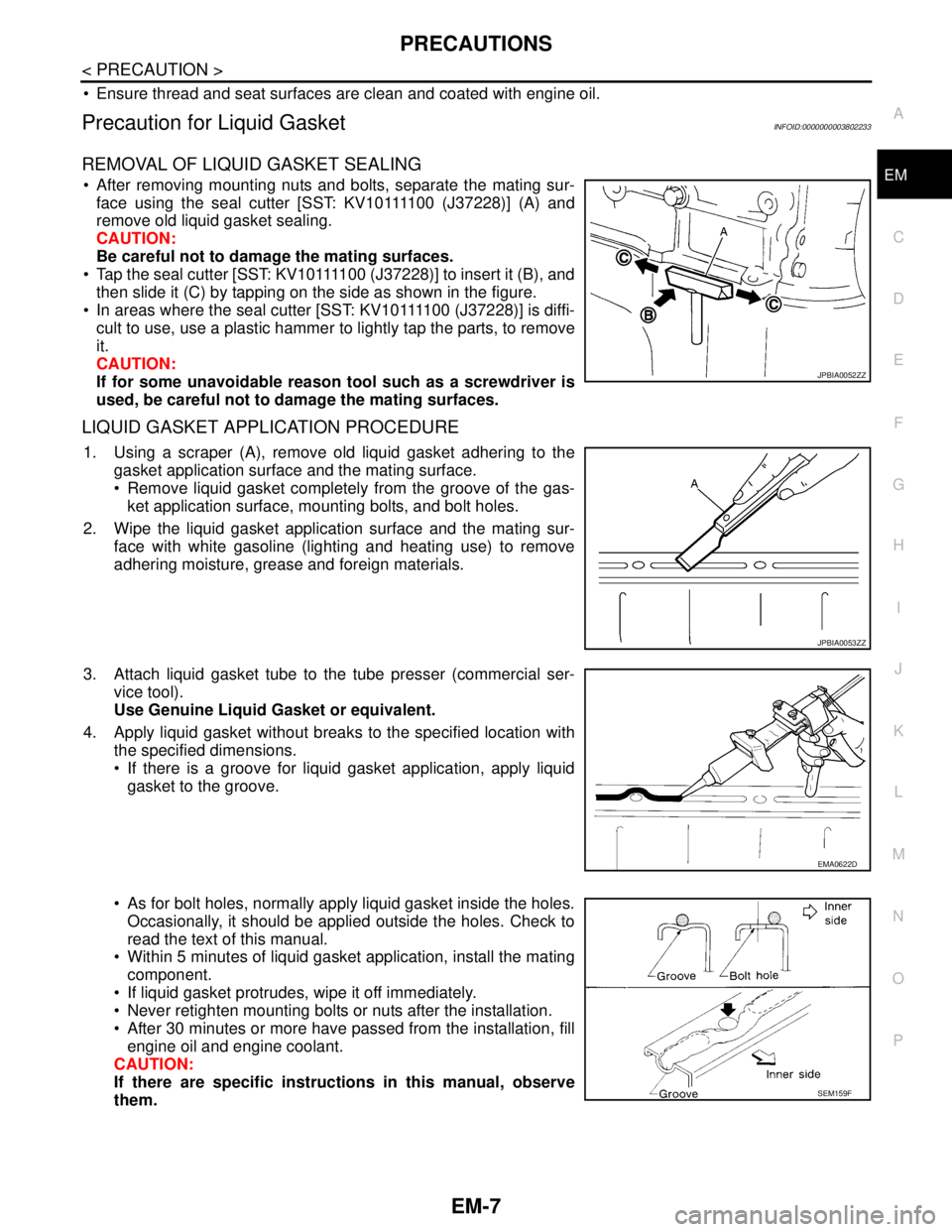
REMOVAL OF LIQUID GASKET SEALING
After removing mounting nuts and bolts, separate the mating sur-
f a c e u s i n g t h e s e a l c u t t e r [ S S T: K V 1 0 1111 0 0 ( J37228)] (A) and
remove old liquid gasket sealing.
CAUTION:
Be careful not to damage the mating surfaces.
Tap the seal cutter [SST: KV10111100 (J37228)] to insert it (B), and
then slide it (C) by tapping on the side as shown in the figure.
In areas where the seal cutter [SST: KV10111100 (J37228)] is diffi-
cult to use, use a plastic hammer to lightly tap the parts, to remove
it.
CAUTION:
If for some unavoidable reason tool such as a screwdriver is
used, be careful not to damage the mating surfaces.
LIQUID GASKET APPLICATION PROCEDURE
1. Using a scraper (A), remove old liquid gasket adhering to the
gasket application surface and the mating surface.
Remove liquid gasket completely from the groove of the gas-
ket application surface, mounting bolts, and bolt holes.
2. Wipe the liquid gasket application surface and the mating sur-
face with white gasoline (lighting and heating use) to remove
adhering moisture, grease and foreign materials.
3. Attach liquid gasket tube to the tube presser (commercial ser-
vice tool).
Use Genuine Liquid Gasket or equivalent.
4. Apply liquid gasket without breaks to the specified location with
the specified dimensions.
If there is a groove for liquid gasket application, apply liquid
gasket to the groove.
As for bolt holes, normally apply liquid gasket inside the holes.
Occasionally, it should be applied outside the holes. Check to
read the text of this manual.
Within 5 minutes of liquid gasket application, install the mating
component.
If liquid gasket protrudes, wipe it off immediately.
Never retighten mounting bolts or nuts after the installation.
After 30 minutes or more have passed from the installation, fill
engine oil and engine coolant.
CAUTION:
If there are specific instructions in this manual, observe
them.
JPBIA0052ZZ
JPBIA0053ZZ
EMA0622D
SEM159F
Page 1978 of 5121
CYLINDER HEAD
EM-103
< DISASSEMBLY AND ASSEMBLY >
C
D
E
F
G
H
I
J
K
L
MA
EM
N
P O
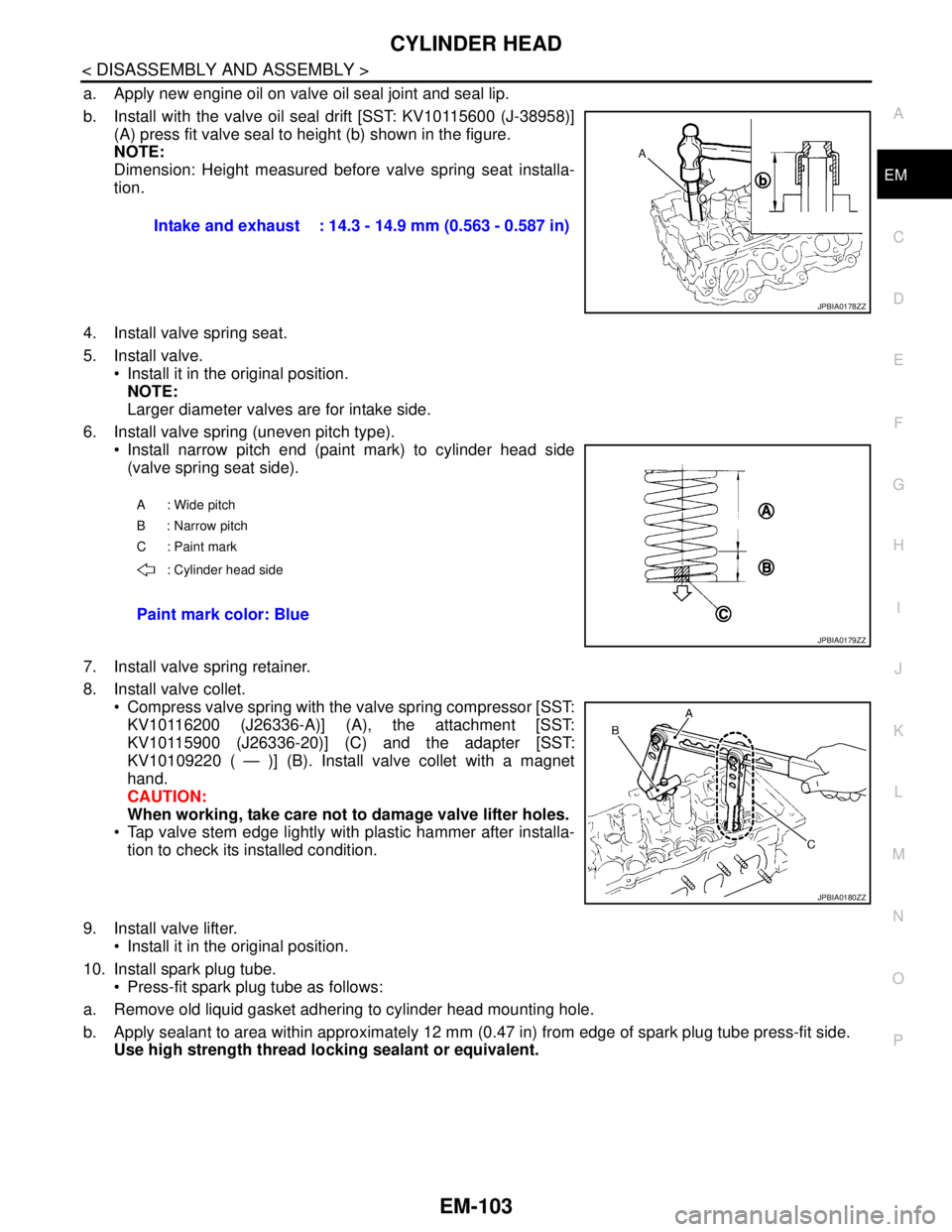
a. Apply new engine oil on valve oil seal joint and seal lip.
b. Install with the valve oil seal drift [SST: KV10115600 (J-38958)]
(A) press fit valve seal to height (b) shown in the figure.
NOTE:
Dimension: Height measured before valve spring seat installa-
tion.
4. Install valve spring seat.
5. Install valve.
Install it in the original position.
NOTE:
Larger diameter valves are for intake side.
6. Install valve spring (uneven pitch type).
Install narrow pitch end (paint mark) to cylinder head side
(valve spring seat side).
7. Install valve spring retainer.
8. Install valve collet.
Compress valve spring with the valve spring compressor [SST:
KV10116200 (J26336-A)] (A), the attachment [SST:
KV10115900 (J26336-20)] (C) and the adapter [SST:
KV10109220 ( — )] (B). Install valve collet with a magnet
hand.
CAUTION:
When working, take care not to damage valve lifter holes.
Tap valve stem edge lightly with plastic hammer after installa-
tion to check its installed condition.
9. Install valve lifter.
Install it in the original position.
10. Install spark plug tube.
Press-fit spark plug tube as follows:
a. Remove old liquid gasket adhering to cylinder head mounting hole.
b. Apply sealant to area within approximately 12 mm (0.47 in) from edge of spark plug tube press-fit side.
Use high strength thread locking sealant or equivalent. Intake and exhaust : 14.3 - 14.9 mm (0.563 - 0.587 in)
JPBIA0178ZZ
A : Wide pitch
B : Narrow pitch
C : Paint mark
: Cylinder head side
Paint mark color: Blue
JPBIA0179ZZ
JPBIA0180ZZ