mileage NISSAN TEANA 2008 User Guide
[x] Cancel search | Manufacturer: NISSAN, Model Year: 2008, Model line: TEANA, Model: NISSAN TEANA 2008Pages: 5121, PDF Size: 69.03 MB
Page 3197 of 5121

PERIODIC MAINTENANCE
MA-9
< ON-VEHICLE MAINTENANCE >
C
D
E
F
G
H
I
J
K
L
MB
MAN
OA
NOTE:
Maintenance items with “ ” should be performed more frequently according to “Maintenance Under Severe Driving Condi-
tions”.
(1) Periodic maintenance is not required. However, if valve noise increases, check valve clearance.
(2) Replace the drive belt if found damaged or if the auto belt tensioner reading reaches the maximum limit.
(3) Use Genuine NISSAN Engine Coolant or equivalent in its quality, in order to avoid possible aluminum corrosion within
the engine cooling system caused by the use of non-genuine coolant.
First replace at 90,000 km (54,000 miles), then every 60,000 km (36,000 miles). Perform "I" (Checking the mixture ratio and
correcting the mixture ratio if necessary) at the middle of replacement interval.
(4) Fuel filter is maintenance-free. For service procedures, refer to FL section.
(5) Replace spark plug when the spark plug gap exceeds 1.4 mm (0.055 in) even if within specified periodic replacement
mileage.
CHASSIS AND BODY MAINTENANCE
(Annual Mileage > 30,000 km/year)
Abbreviations: I = Inspect and correct or replace as necessary, R = Replace, L = Lubricate.
Fuel and EVAP vapor lines I IMA-18,
MA-22
Air cleaner filterRRMA-18
Fuel filter (In-tank type)See
NOTE (4)—
Positive crankcase ventilation (PCV) system I I I IMA-21
Spark-plugs (Iridium-tipped type)See
NOTE (5)R R RRRRRRMA-20
MAINTENANCE OPERATIONMAINTENANCE INTERVAL
Refer-
ence
page Perform at number of kilometers (miles) basis
only.km x
1,000
(Miles x
1,000)15
(9)30
(18)45
(27)60
(36)75
(45)90
(54)105
(63)120
(72)
MAINTENANCE OPERATIONMAINTENANCE INTERVAL
Reference
page Perform at number of kilometers (miles)
basis only.km x 1,000
(Miles x
1,000)15
(9)30
(18)45
(27)60
(36)75
(45)90
(54)105
(63)120
(72)
Underhood and under vehicle
Headlamp aiming I I I IMA-23
,
MA-27
Brake system and fluid (For level &
leaks)IIIIMA-38,
MA-37
Brake fluidRRMA-38
Brake booster vacuum hoses, connec-
tions & check valveIIBR-12
Power steering fluid & lines (For level &
leaks)IIIIMA-40
CVT fluid (For level & leaks)See
NOTE (1)IIIIMA-32,
MA-34
Steering gear & linkage, axle & suspen-
sion parts, & front drive shafts IIMA-39,
MA-40
,
MA-41
Exhaust systemIIMA-32
Brake pads, rotors & other brake com-
ponentsIIIIMA-38,
BR-13
,
BR-15
Foot brake & parking brake (For free
play, stroke & operation)IIIIBR-6,
PB-2
Page 3198 of 5121
MA-10
< ON-VEHICLE MAINTENANCE >
PERIODIC MAINTENANCE
NOTE:
(1) If towing a trailer, using a camper or a car-top carrier, or driving on rough or muddy roads, inspect CVT fluid deterioration
with Consult-III every 90,000 km (54,000 miles), then change CVT fluid NS-2 if necessary. (Refer to TM-204, "
CONSULT-III
Function (TRANSMISSION)" for RE0F10A, TM-37, "CONSULT-III Function (TRANSMISSION)" for RE0F09B.) And if Consult-III
is not available, change (do not just inspect) CVT fluid NS-2 every 90,000 km (54,000 miles). Using transmission fluid other
than Genuine NISSAN CVT Fluid NS-2 will damage the CVT, which is not covered by the warranty.
(2) Inspect once per year.
Maintenance items with “ ” should be performed more frequently according to “Maintenance Under Severe Driving Condi-
tions”.
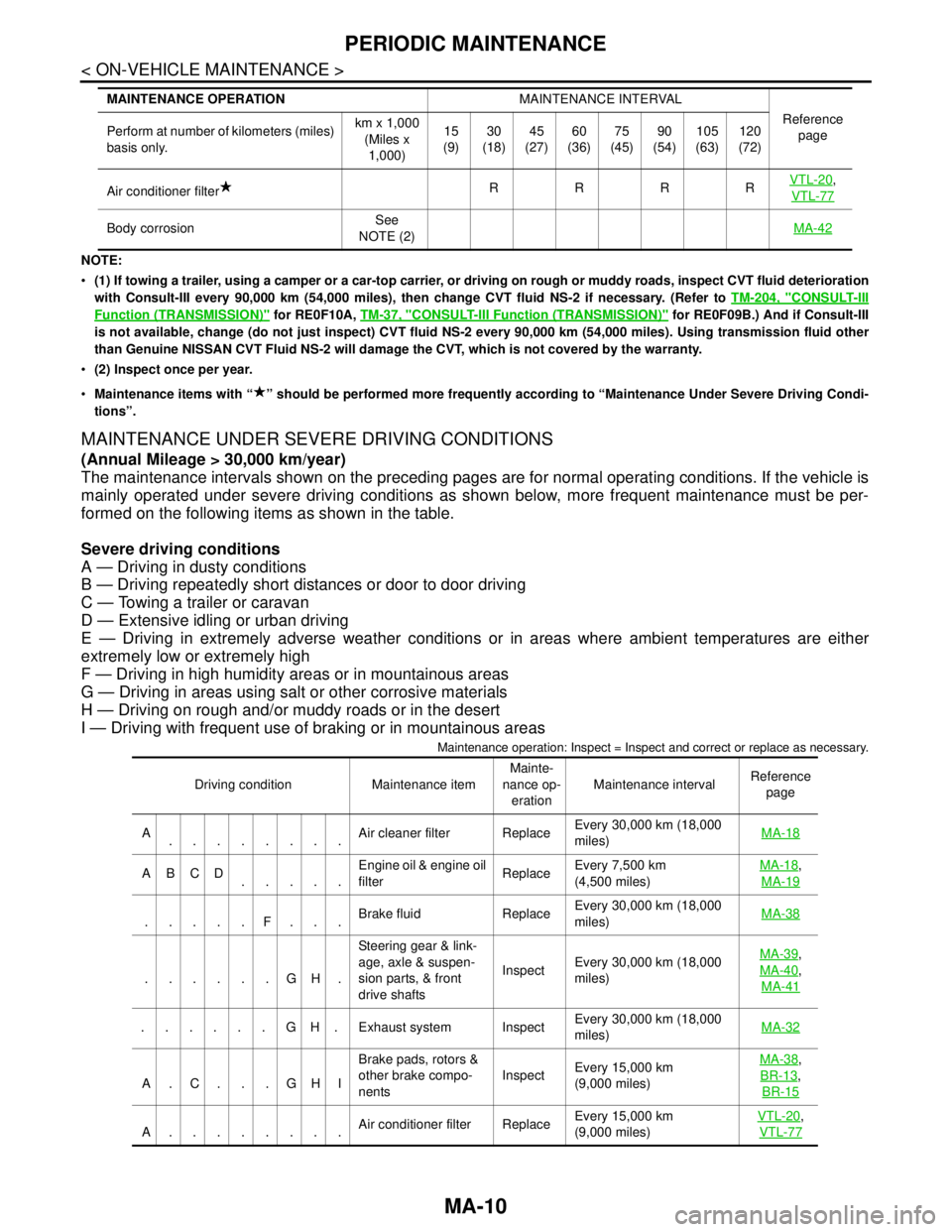
MAINTENANCE UNDER SEVERE DRIVING CONDITIONS
(Annual Mileage > 30,000 km/year)
The maintenance intervals shown on the preceding pages are for normal operating conditions. If the vehicle is
mainly operated under severe driving conditions as shown below, more frequent maintenance must be per-
formed on the following items as shown in the table.
Severe driving conditions
A — Driving in dusty conditions
B — Driving repeatedly short distances or door to door driving
C — Towing a trailer or caravan
D — Extensive idling or urban driving
E — Driving in extremely adverse weather conditions or in areas where ambient temperatures are either
extremely low or extremely high
F — Driving in high humidity areas or in mountainous areas
G — Driving in areas using salt or other corrosive materials
H — Driving on rough and/or muddy roads or in the desert
I — Driving with frequent use of braking or in mountainous areas
Maintenance operation: Inspect = Inspect and correct or replace as necessary.
Air conditioner filterRRRRVTL-20,
VTL-77
Body corrosionSee
NOTE (2)MA-42
MAINTENANCE OPERATIONMAINTENANCE INTERVAL
Reference
page Perform at number of kilometers (miles)
basis only.km x 1,000
(Miles x
1,000)15
(9)30
(18)45
(27)60
(36)75
(45)90
(54)105
(63)120
(72)
Driving condition Maintenance itemMainte-
nance op-
erationMaintenance intervalReference
page
A
........Air cleaner filter ReplaceEvery 30,000 km (18,000
miles) MA-18
ABCD
.....Engine oil & engine oil
filter ReplaceEvery 7,500 km
(4,500 miles) MA-18,
MA-19
.....F...Brake fluid ReplaceEvery 30,000 km (18,000
miles) MA-38
......GH.Steering gear & link-
age, axle & suspen-
sion parts, & front
drive shaftsInspectEvery 30,000 km (18,000
miles) MA-39
,
MA-40
,
MA-41
......GH.Exhaust system InspectEvery 30,000 km (18,000
miles)MA-32
A.C. . .GHIBrake pads, rotors &
other brake compo-
nentsInspectEvery 15,000 km
(9,000 miles) MA-38
,
BR-13
,
BR-15
A........Air conditioner filter ReplaceEvery 15,000 km
(9,000 miles) VTL-20
,
VTL-77
Page 3272 of 5121
MWI-18
< FUNCTION DIAGNOSIS >
METER SYSTEM
FUEL GAUGE : Component Description
INFOID:0000000003792526
ODO/TRIP METER
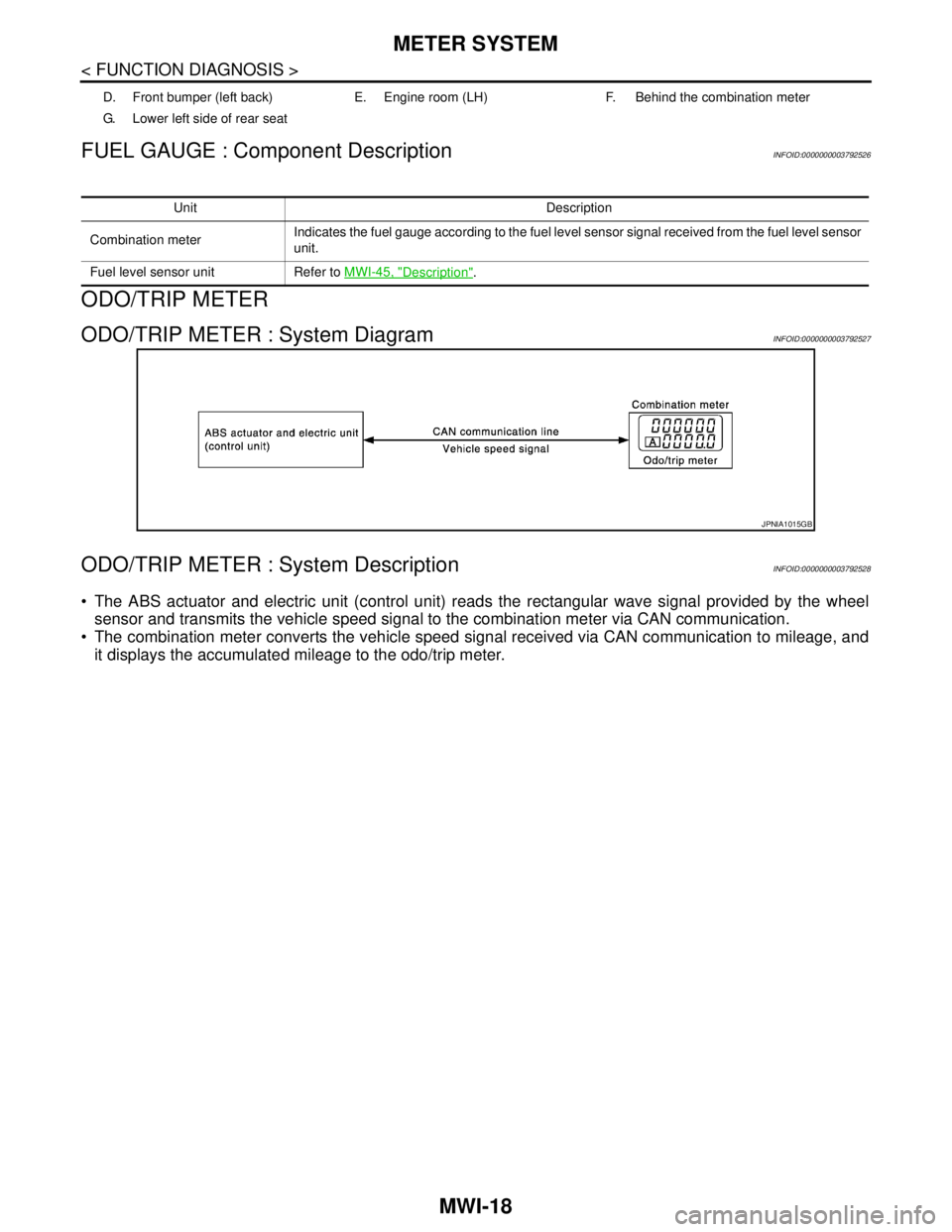
ODO/TRIP METER : System DiagramINFOID:0000000003792527
ODO/TRIP METER : System DescriptionINFOID:0000000003792528
The ABS actuator and electric unit (control unit) reads the rectangular wave signal provided by the wheel
sensor and transmits the vehicle speed signal to the combination meter via CAN communication.
The combination meter converts the vehicle speed signal received via CAN communication to mileage, and
it displays the accumulated mileage to the odo/trip meter.
D. Front bumper (left back) E. Engine room (LH) F. Behind the combination meter
G. Lower left side of rear seat
Unit Description
Combination meterIndicates the fuel gauge according to the fuel level sensor signal received from the fuel level sensor
unit.
Fuel level sensor unit Refer to MWI-45, "
Description".
JPNIA1015GB
Page 3274 of 5121
MWI-20
< FUNCTION DIAGNOSIS >
METER SYSTEM
ODO/TRIP METER : Component Description
INFOID:0000000003792530
SHIFT POSITION INDICATOR
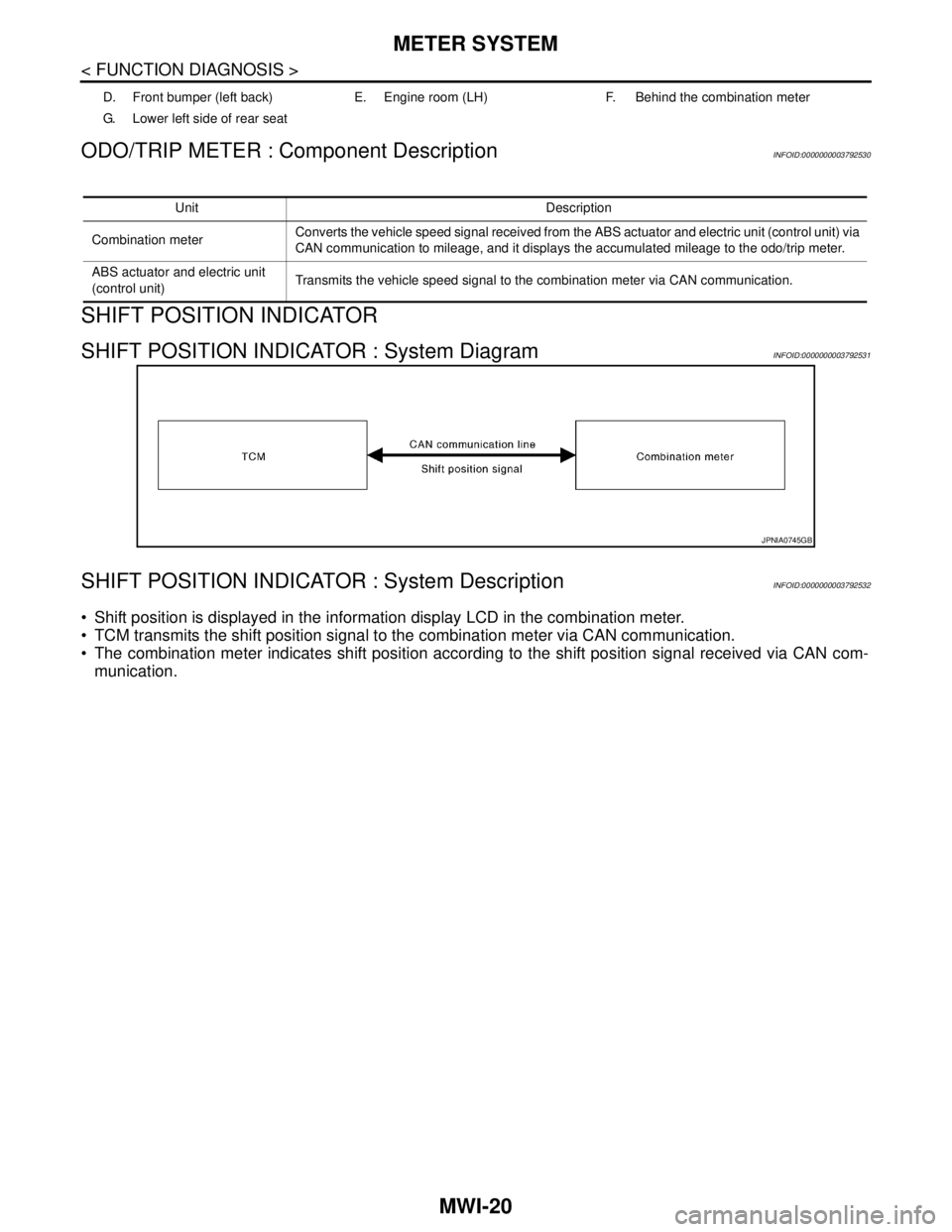
SHIFT POSITION INDICATOR : System DiagramINFOID:0000000003792531
SHIFT POSITION INDICATOR : System DescriptionINFOID:0000000003792532
Shift position is displayed in the information display LCD in the combination meter.
TCM transmits the shift position signal to the combination meter via CAN communication.
The combination meter indicates shift position according to the shift position signal received via CAN com-
munication.
D. Front bumper (left back) E. Engine room (LH) F. Behind the combination meter
G. Lower left side of rear seat
Unit Description
Combination meterConverts the vehicle speed signal received from the ABS actuator and electric unit (control unit) via
CAN communication to mileage, and it displays the accumulated mileage to the odo/trip meter.
ABS actuator and electric unit
(control unit)Transmits the vehicle speed signal to the combination meter via CAN communication.
JPNIA0745GB
Page 3286 of 5121
MWI-32
< FUNCTION DIAGNOSIS >
DIAGNOSIS SYSTEM (METER)
DIAGNOSIS SYSTEM (METER)
Diagnosis DescriptionINFOID:0000000003792550
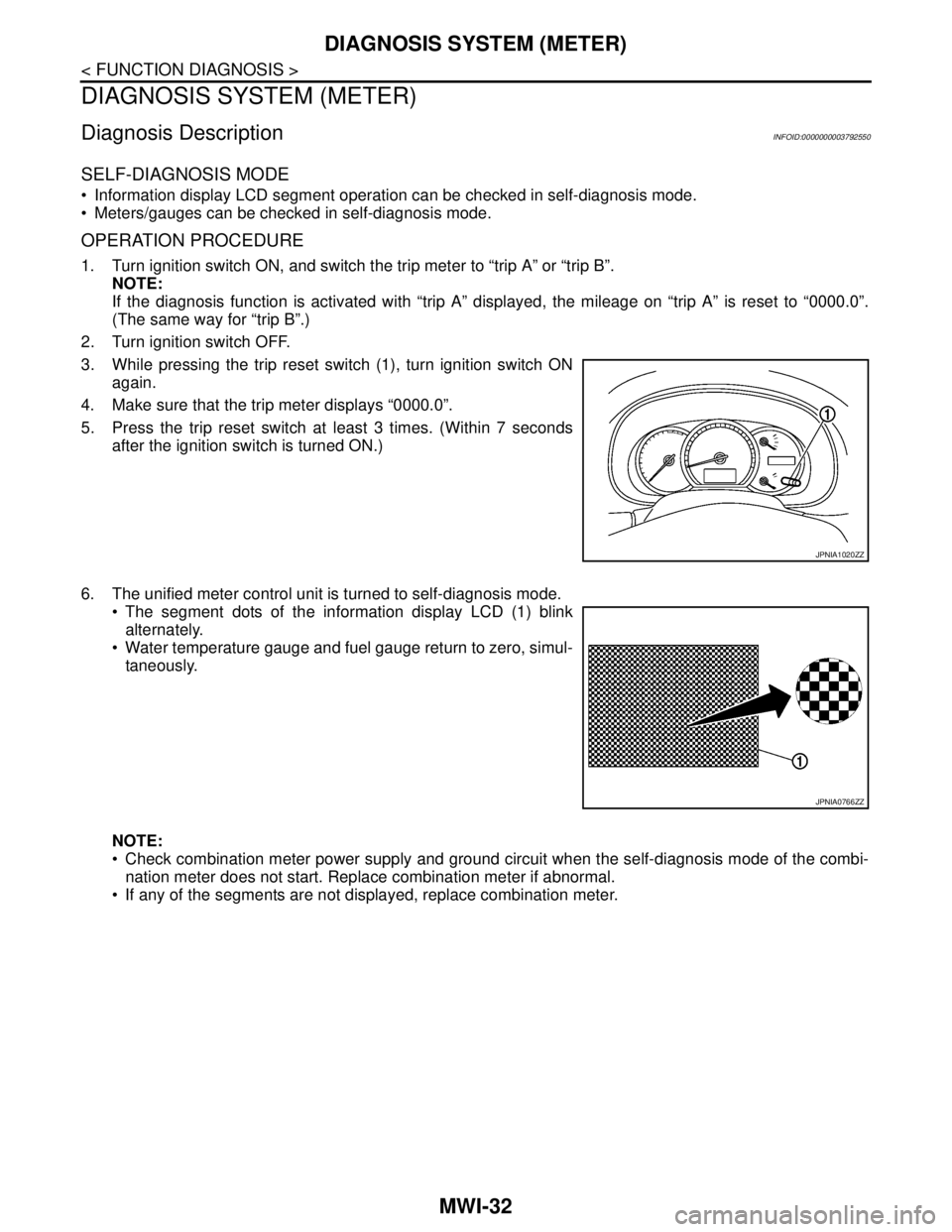
SELF-DIAGNOSIS MODE
Information display LCD segment operation can be checked in self-diagnosis mode.
Meters/gauges can be checked in self-diagnosis mode.
OPERATION PROCEDURE
1. Turn ignition switch ON, and switch the trip meter to “trip A” or “trip B”.
NOTE:
If the diagnosis function is activated with “trip A” displayed, the mileage on “trip A” is reset to “0000.0”.
(The same way for “trip B”.)
2. Turn ignition switch OFF.
3. While pressing the trip reset switch (1), turn ignition switch ON
again.
4. Make sure that the trip meter displays “0000.0”.
5. Press the trip reset switch at least 3 times. (Within 7 seconds
after the ignition switch is turned ON.)
6. The unified meter control unit is turned to self-diagnosis mode.
The segment dots of the information display LCD (1) blink
alternately.
Water temperature gauge and fuel gauge return to zero, simul-
taneously.
NOTE:
Check combination meter power supply and ground circuit when the self-diagnosis mode of the combi-
nation meter does not start. Replace combination meter if abnormal.
If any of the segments are not displayed, replace combination meter.
JPNIA1020ZZ
JPNIA0766ZZ
Page 4483 of 5121
![NISSAN TEANA 2008 User Guide TM-10
< BASIC INSPECTION >[CVT: RE0F09B]
DIAGNOSIS AND REPAIR WORK FLOW
Stall test. Refer to TM-144, "Inspection and Judgment".
>> GO TO 3.
3.CHECK DTC
1. Check DTC.
2. Perform the following procedu](/img/5/57391/w960_57391-4482.png "NISSAN TEANA 2008 User Guide TM-10
< BASIC INSPECTION >[CVT: RE0F09B]
DIAGNOSIS AND REPAIR WORK FLOW
Stall test. Refer to TM-144, \"Inspection and Judgment\".
>> GO TO 3.
3.CHECK DTC
1. Check DTC.
2. Perform the following procedu")
TM-10
< BASIC INSPECTION >[CVT: RE0F09B]
DIAGNOSIS AND REPAIR WORK FLOW
Stall test. Refer to TM-144, "Inspection and Judgment".
>> GO TO 3.
3.CHECK DTC
1. Check DTC.
2. Perform the following procedure if DTC is detected.
Record DTC.
Erase DTC. Refer to TM-35, "
Diagnosis Description".
Is any DTC detected?
YES >> GO TO 4.
NO >> GO TO 5.
4.PERFORM DIAGNOSTIC PROCEDURE
Perform “Diagnostic Procedure” for the displayed DTC. Repair detected items.
>> GO TO 5.
5.PERFORM DTC CONFIRMATION PROCEDURE
Perform “DTC CONFIRMATION PROCEDURE” for the displayed DTC.
Is DTC detected?
YES >> GO TO 4.
NO >> GO TO 6.
6.CHECK SYMPTOM 2
Confirm the symptom described by the customer.
Is any malfunction present?
YES >> GO TO 7.
NO >> INSPECTION END
7.ROAD TEST
Perform “ROAD TEST”. Refer to TM-148, "
Description".
>> GO TO 8.
8.CHECK SYMPTOM 3
Confirm the symptom described by the customer.
Is any malfunction present?
YES >> GO TO 2.
NO >> INSPECTION END
Diagnostic Work SheetINFOID:0000000003848915
INFORMATION FROM CUSTOMER
KEY POINTS
WHAT..... Vehicle & CVT model
WHEN..... Date, Frequencies
WHERE..... Road conditions
HOW..... Operating conditions, Symptoms
Customer name MR/MS Model & Year VIN
Trans. Model Engine Mileage
Malfunction Date Manuf. Date In Service Date
Frequencyo Continuouso Intermittent ( times a day)
Page 4504 of 5121
![NISSAN TEANA 2008 User Guide SHIFT CONTROL SYSTEM
TM-31
< FUNCTION DIAGNOSIS >[CVT: RE0F09B]
C
E
F
G
H
I
J
K
L
MA
B
TM
N
O
P
By limiting the gear range to the lowest position, the strong driving
force and the engine brake can be](/img/5/57391/w960_57391-4503.png "NISSAN TEANA 2008 User Guide SHIFT CONTROL SYSTEM
TM-31
< FUNCTION DIAGNOSIS >[CVT: RE0F09B]
C
E
F
G
H
I
J
K
L
MA
B
TM
N
O
P
By limiting the gear range to the lowest position, the strong driving
force and the engine brake can be")
SHIFT CONTROL SYSTEM
TM-31
< FUNCTION DIAGNOSIS >[CVT: RE0F09B]
C
E
F
G
H
I
J
K
L
MA
B
TM
N
O
P
By limiting the gear range to the lowest position, the strong driving
force and the engine brake can be secured.
DOWNHILL ENGINE BRAKE CONTROL (AUTO ENGINE BRAKE CONTROL)
When a downhill slope is detected with the accelerator pedal released, the engine brake will be strengthened
up by downshifting so as not to accelerate the vehicle more than necessary.
ACCELERATION CONTROL
According to vehicle speed and a change of accelerator pedal angle, driver's request for acceleration and driv-
ing scene are judged. This function assists improvement in the acceleration feeling by making the engine
speed proportionate to the vehicle speed. And a shift map that can gain a larger driving force is available for
compatibility of mileage with driveability.
Component Parts LocationINFOID:0000000003848938
JPDIA0686GB
JPDIA0747ZZ
Page 4650 of 5121
![NISSAN TEANA 2008 User Guide DIAGNOSIS AND REPAIR WORK FLOW
TM-177
< BASIC INSPECTION >[CVT: RE0F10A]
C
E
F
G
H
I
J
K
L
MA
B
TM
N
O
P
Stall test. Refer to TM-306, "Inspection and Judgment".
>> GO TO 3.
3.CHECK DTC
1. Check DTC.](/img/5/57391/w960_57391-4649.png "NISSAN TEANA 2008 User Guide DIAGNOSIS AND REPAIR WORK FLOW
TM-177
< BASIC INSPECTION >[CVT: RE0F10A]
C
E
F
G
H
I
J
K
L
MA
B
TM
N
O
P
Stall test. Refer to TM-306, \"Inspection and Judgment\".
>> GO TO 3.
3.CHECK DTC
1. Check DTC.")
DIAGNOSIS AND REPAIR WORK FLOW
TM-177
< BASIC INSPECTION >[CVT: RE0F10A]
C
E
F
G
H
I
J
K
L
MA
B
TM
N
O
P
Stall test. Refer to TM-306, "Inspection and Judgment".
>> GO TO 3.
3.CHECK DTC
1. Check DTC.
2. Perform the following procedure if DTC is detected.
Record DTC.
Erase DTC. Refer to TM-202, "
Diagnosis Description".
Is any DTC detected?
YES >> GO TO 4.
NO >> GO TO 5.
4.PERFORM DIAGNOSTIC PROCEDURE
Perform “Diagnostic Procedure” for the displayed DTC.
>> GO TO 5.
5.PERFORM DTC CONFIRMATION PROCEDURE
Perform “DTC CONFIRMATION PROCEDURE” for the displayed DTC.
Is DTC detected?
YES >> GO TO 4.
NO >> GO TO 6.
6.CHECK SYMPTOM 2
Confirm the symptom described by the customer.
Is any malfunction present?
YES >> GO TO 7.
NO >> INSPECTION END
7.ROAD TEST
Perform “ROAD TEST”. Refer to TM-310, "
Description".
>> GO TO 8.
8.CHECK SYMPTOM 3
Confirm the symptom described by the customer.
Is any malfunction present?
YES >> GO TO 2.
NO >> INSPECTION END
Diagnostic Work SheetINFOID:0000000003806345
INFORMATION FROM CUSTOMER
KEY POINTS
WHAT..... Vehicle & CVT model
WHEN..... Date, Frequencies
WHERE..... Road conditions
HOW..... Operating conditions, Symptoms
Customer name MR/MS Model & Year VIN
Trans. Model Engine Mileage
Malfunction Date Manuf. Date In Service Date
Frequencyo Continuouso Intermittent ( times a day)
Page 4671 of 5121
![NISSAN TEANA 2008 User Guide TM-198
< FUNCTION DIAGNOSIS >[CVT: RE0F10A]
SHIFT CONTROL SYSTEM
ACCELERATION CONTROL
According to vehicle speed and a change of accelerator pedal angle, drivers request for acceleration and driv-
in](/img/5/57391/w960_57391-4670.png "NISSAN TEANA 2008 User Guide TM-198
< FUNCTION DIAGNOSIS >[CVT: RE0F10A]
SHIFT CONTROL SYSTEM
ACCELERATION CONTROL
According to vehicle speed and a change of accelerator pedal angle, drivers request for acceleration and driv-
in")
TM-198
< FUNCTION DIAGNOSIS >[CVT: RE0F10A]
SHIFT CONTROL SYSTEM
ACCELERATION CONTROL
According to vehicle speed and a change of accelerator pedal angle, driver's request for acceleration and driv-
ing scene are judged. This function assists improvement in the acceleration feeling by making the engine
speed proportionate to the vehicle speed. And a shift map that can gain a larger driving force is available for
compatibility of mileage with driveability.
Component Parts LocationINFOID:0000000003809655
*: Control valve assembly is included in CVT assembly.
NOTE:
The following components are included in control valve assembly (8).
CVT fluid temperature sensor
Torque converter clutch solenoid valve
Line pressure solenoid valve
Step motor
ROM assembly
1. Sport mode switch 2. Shift position indicator 3. SPORT indicator lamp
4. TCM 5. Secondary speed sensor 6. PNP switch
7. Primary speed sensor 8.
Control valve assembly
*9. CVT unit connector
10. Accelerator pedal position sensor
A. Center console B. Combination meter C. Engine room LH
D. CVT assembly E. Accelerator pedal, upper
JPDIA0746ZZ
Page 4941 of 5121
WCS
DIAGNOSIS SYSTEM (METER)
WCS-11
< FUNCTION DIAGNOSIS >
C
D
E
F
G
H
I
J
K
L
MB A
O
P
DIAGNOSIS SYSTEM (METER)
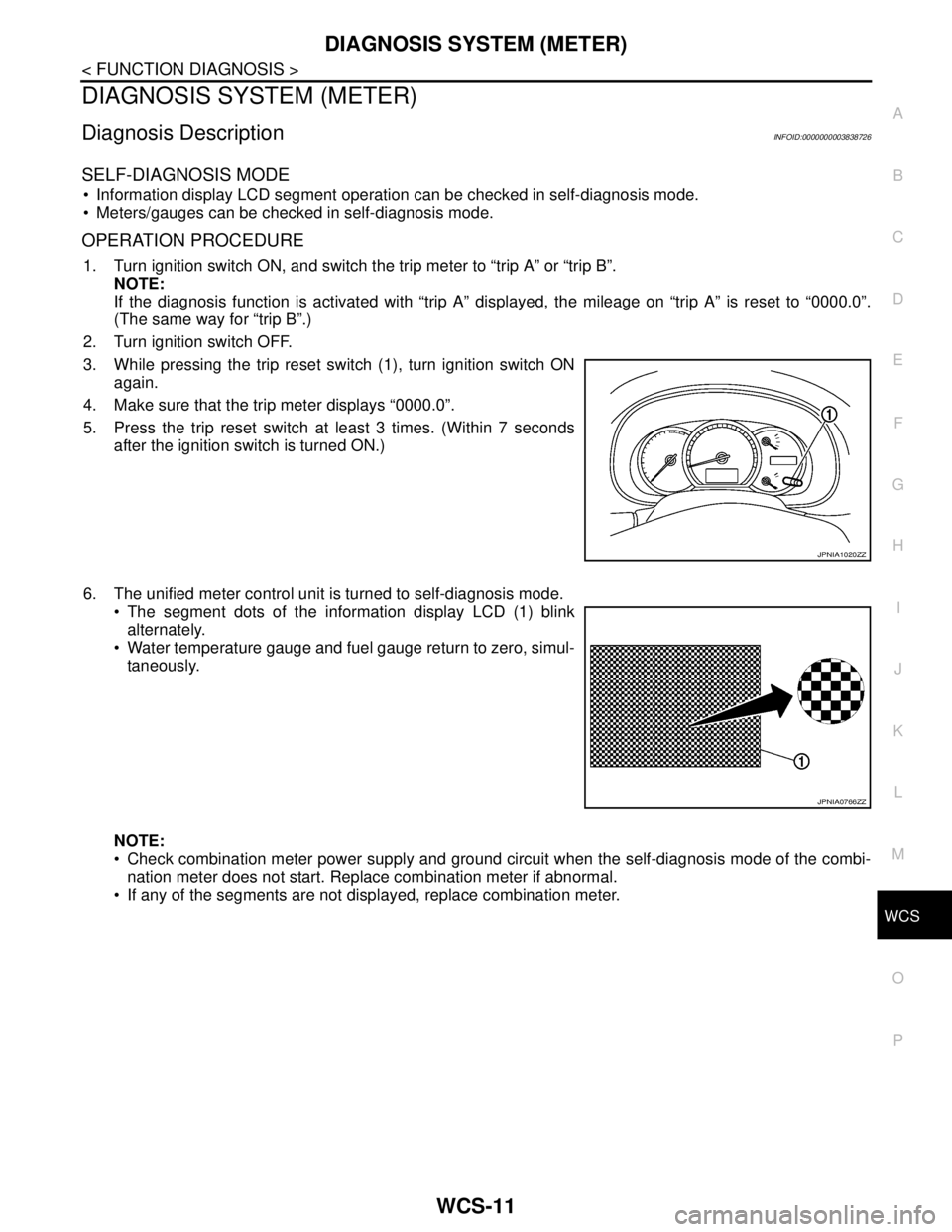
Diagnosis DescriptionINFOID:0000000003838726
SELF-DIAGNOSIS MODE
Information display LCD segment operation can be checked in self-diagnosis mode.
Meters/gauges can be checked in self-diagnosis mode.
OPERATION PROCEDURE
1. Turn ignition switch ON, and switch the trip meter to “trip A” or “trip B”.
NOTE:
If the diagnosis function is activated with “trip A” displayed, the mileage on “trip A” is reset to “0000.0”.
(The same way for “trip B”.)
2. Turn ignition switch OFF.
3. While pressing the trip reset switch (1), turn ignition switch ON
again.
4. Make sure that the trip meter displays “0000.0”.
5. Press the trip reset switch at least 3 times. (Within 7 seconds
after the ignition switch is turned ON.)
6. The unified meter control unit is turned to self-diagnosis mode.
The segment dots of the information display LCD (1) blink
alternately.
Water temperature gauge and fuel gauge return to zero, simul-
taneously.
NOTE:
Check combination meter power supply and ground circuit when the self-diagnosis mode of the combi-
nation meter does not start. Replace combination meter if abnormal.
If any of the segments are not displayed, replace combination meter.
JPNIA1020ZZ
JPNIA0766ZZ