sunroof NISSAN TEANA 2008 User Guide
[x] Cancel search | Manufacturer: NISSAN, Model Year: 2008, Model line: TEANA, Model: NISSAN TEANA 2008Pages: 5121, PDF Size: 69.03 MB
Page 3031 of 5121
INT-54
< ON-VEHICLE REPAIR >
HEADLINING
SUNROOF : Removal and Installation
INFOID:0000000003826878
REMOVAL
1. Remove front body side welt (LH/RH) and front pillar garnish (LH/RH). Refer to INT-39, "Removal and
Installation".
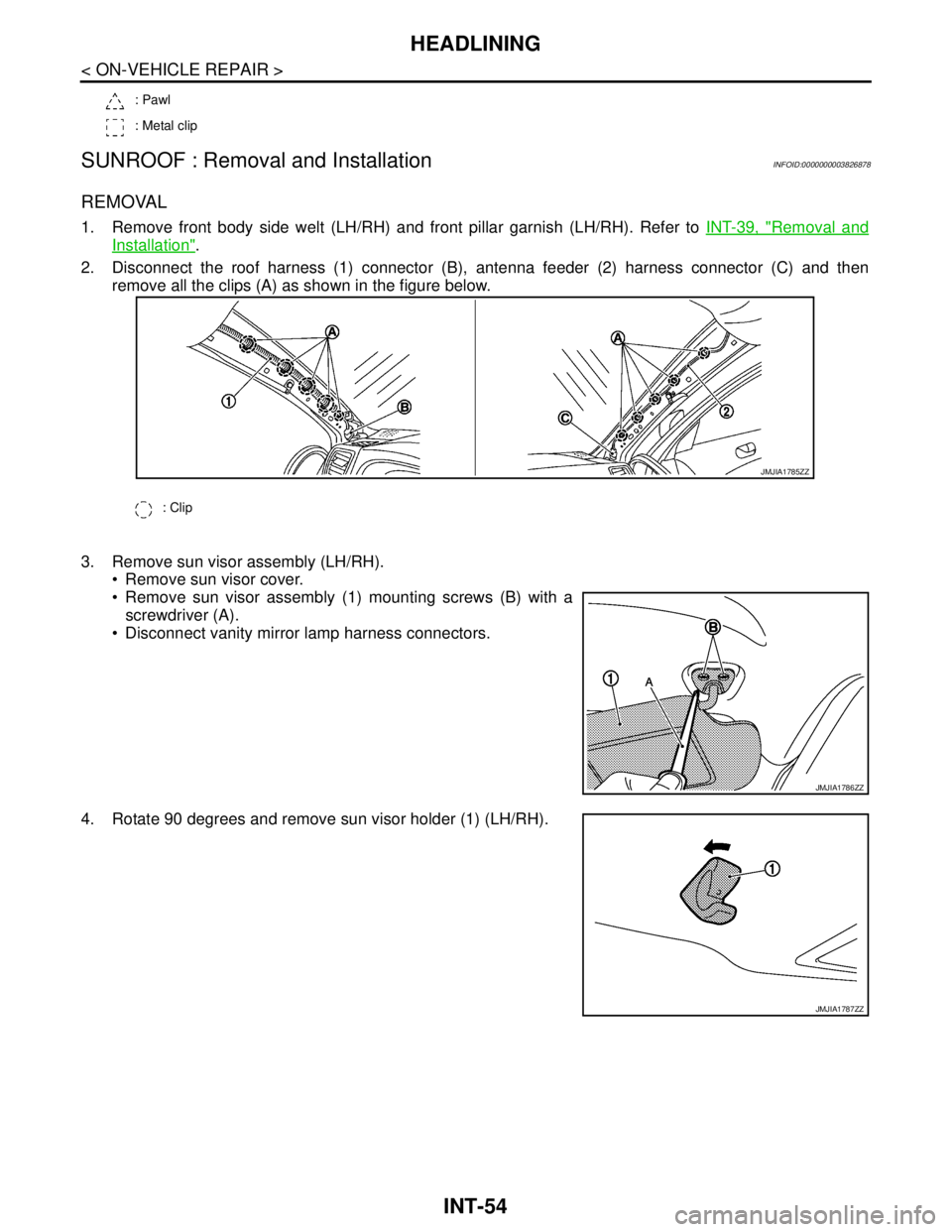
2. Disconnect the roof harness (1) connector (B), antenna feeder (2) harness connector (C) and then
remove all the clips (A) as shown in the figure below.
3. Remove sun visor assembly (LH/RH).
Remove sun visor cover.
Remove sun visor assembly (1) mounting screws (B) with a
screwdriver (A).
Disconnect vanity mirror lamp harness connectors.
4. Rotate 90 degrees and remove sun visor holder (1) (LH/RH).
: Pawl
: Metal clip
: Clip
JMJIA1785ZZ
JMJIA1786ZZ
JMJIA1787ZZ
Page 3044 of 5121

IP-4
< SYMPTOM DIAGNOSIS >
SQUEAK AND RATTLE TROUBLE DIAGNOSES
Confirm that the cause of a noise is repaired by test driving the vehicle. Operate the vehicle under the same
conditions as when the noise originally occurred. Refer to the notes on the Diagnostic Worksheet.
Inspection ProcedureINFOID:0000000003939974
Refer to Table of Contents for specific component removal and installation information.
INSTRUMENT PANEL
Most incidents are caused by contact and movement between:
1. Cluster lid A and instrument panel
2. Acrylic lens and combination meter housing
3. Instrument panel to front pillar garnish
4. Instrument panel to windshield
5. Instrument panel mounting pins
6. Wiring harnesses behind the combination meter
7. A/C defroster duct and duct joint
These incidents can usually be located by tapping or moving the components to duplicate the noise or by
pressing on the components while driving to stop the noise. Most of these incidents can be repaired by apply-
ing felt cloth tape or silicon spray (in hard to reach areas). Urethane pads can be used to insulate wiring har-
ness.
CAUTION:
Never use silicone spray to isolate a squeak or rattle. If the area is saturated with silicone, the recheck
of repair becomes impossible.
CENTER CONSOLE
Components to pay attention to include:
1. Shifter assembly cover to finisher
2. A/C control unit and cluster lid C
3. Wiring harnesses behind audio and A/C control unit
The instrument panel repair and isolation procedures also apply to the center console.
DOORS
Pay attention to the following:
1. Finisher and inner panel making a slapping noise
2. Inside handle escutcheon to door finisher
3. Wiring harnesses tapping
4. Door striker out of alignment causing a popping noise on starts and stops
Tapping or moving the components or pressing on them while driving to duplicate the conditions can isolate
many of these incidents. The areas can usually be insulated with felt cloth tape or insulator foam blocks to
repair the noise.
TRUNK
Trunk noises are often caused by a loose jack or loose items put into the trunk by the customer.
In addition look for the following:
1. Trunk lid dumpers out of adjustment
2. Trunk lid striker out of adjustment
3. Trunk lid torsion bars knocking together
4. A loose license plate or bracket
Most of these incidents can be repaired by adjusting, securing or insulating the item(s) or component(s) caus-
ing the noise.
SUNROOF/HEADLINING
Noises in the sunroof/headlining area can often be traced to one of the following:
1. Sunroof lid, rail, linkage or seals making a rattle or light knocking noise
2. Sunvisor shaft shaking in the holder
3. Front or rear windshield touching headlining and squeaking
Page 3230 of 5121
MA-42
< ON-VEHICLE MAINTENANCE >
BODY MAINTENANCE
BODY MAINTENANCE
LOCKS, HINGES AND HOOD LATCH
LOCKS, HINGES AND HOOD LATCH : LubricatingINFOID:0000000003858318
For hood and hood lock illustration.
Hood: Refer to DLK-191, "
HOOD ASSEMBLY : Exploded View".
Hood lock control: Refer to DLK-220, "
Exploded View".
For door and door lock illustration.
Front door: Refer to DLK-201, "
DOOR ASSEMBLY : Exploded View".
Front door lock: Refer to DLK-222, "
DOOR LOCK : Exploded View".
Rear door: Refer to DLK-207, "
DOOR ASSEMBLY : Exploded View".
Rear door lock: Refer to DLK-227, "
DOOR LOCK : Exploded View".
For trunk lid and trunk lid lock illustration.
Trunk lid: Refer to DLK-213, "
TRUNK LID ASSEMBLY : Exploded View".
Trunk lid lock: Refer to DLK-231, "
Exploded View".
SEAT BELT, BUCKLES, RETRACTORS, ANCHORS AND ADJUSTERS
SEAT BELT, BUCKLES, RETRACTORS, ANCHORS AND ADJUSTERS : Inspection
INFOID:0000000003858319
For front seat belt illustration. Refer to SB-5, "SEAT BELT RETRACTOR : Exploded View".
For rear seat belt illustration. Refer to SB-10, "
SEAT BELT RETRACTOR : Exploded View".
CAUTION:
After any collision, inspect all seat belt assemblies, including retractors and other attached hard-
wares (I.e. anchor bolt, guide rail set). Nissan recommends to replace all seat belt assemblies in use
during a collision, unless not damaged and properly operating after minor collision.
Also inspect seat belt assemblies not in use during a collision, and replace if damaged or improperly
operating.
Seat belt pre-tensioner should be replaced even if the seat belts are not in use during a frontal colli-
sion where the driver and passenger air bags are deployed.
If any component of seat belt assembly is questionable, do not repair.
Replace as seat belt assembly.
If webbing is cut, frayed, or damaged, replace belt assembly.
Never oil tongue and buckle.
Use a genuine NISSAN seat belt assembly.
For details, refer to SB-3, "
SEAT BELT RETRACTOR : Inspection" , SB-8, "SEAT BELT RETRACTOR :
Inspection" in SB section.
Check anchors for loose mounting
Check belts for damage
Check retractor for smooth operation
Check function of buckles and tongues when buckled and released
BODY CORROSION
BODY CORROSION : Checking Body CorrosionINFOID:0000000003858320
Visually check body panels for collision damage (scratches, chipping, rubbing, etc.) or damage to the anti-cor-
rosion materials. In particular, check the following locations.
HEMMED PANELS
Hood front end, door lower end, trunk lid rear end, etc.
PA N E L J O I N T
Side sill of rear fender and center pillar, rear wheel housing of rear fender, around strut tower in engine com-
partment, etc.
PA N E L E D G E
Trunk lid opening, sunroof opening, fender wheel-arch flange, fuel filler lid flange, around holes in panel, etc.
PARTS CONTACT
Waist moulding, windshield moulding, bumper, etc.
Page 3241 of 5121

MIR-8
< SYMPTOM DIAGNOSIS >
SQUEAK AND RATTLE TROUBLE DIAGNOSES
Confirm that the cause of a noise is repaired by test driving the vehicle. Operate the vehicle under the same
conditions as when the noise originally occurred. Refer to the notes on the Diagnostic Worksheet.
Inspection ProcedureINFOID:0000000003941383
Refer to Table of Contents for specific component removal and installation information.
INSTRUMENT PANEL
Most incidents are caused by contact and movement between:
1. Cluster lid A and instrument panel
2. Acrylic lens and combination meter housing
3. Instrument panel to front pillar garnish
4. Instrument panel to windshield
5. Instrument panel mounting pins
6. Wiring harnesses behind the combination meter
7. A/C defroster duct and duct joint
These incidents can usually be located by tapping or moving the components to duplicate the noise or by
pressing on the components while driving to stop the noise. Most of these incidents can be repaired by apply-
ing felt cloth tape or silicon spray (in hard to reach areas). Urethane pads can be used to insulate wiring har-
ness.
CAUTION:
Never use silicone spray to isolate a squeak or rattle. If the area is saturated with silicone, the recheck
of repair becomes impossible.
CENTER CONSOLE
Components to pay attention to include:
1. Shifter assembly cover to finisher
2. A/C control unit and cluster lid C
3. Wiring harnesses behind audio and A/C control unit
The instrument panel repair and isolation procedures also apply to the center console.
DOORS
Pay attention to the following:
1. Finisher and inner panel making a slapping noise
2. Inside handle escutcheon to door finisher
3. Wiring harnesses tapping
4. Door striker out of alignment causing a popping noise on starts and stops
Tapping or moving the components or pressing on them while driving to duplicate the conditions can isolate
many of these incidents. The areas can usually be insulated with felt cloth tape or insulator foam blocks to
repair the noise.
TRUNK
Trunk noises are often caused by a loose jack or loose items put into the trunk by the customer.
In addition look for the following:
1. Trunk lid dumpers out of adjustment
2. Trunk lid striker out of adjustment
3. Trunk lid torsion bars knocking together
4. A loose license plate or bracket
Most of these incidents can be repaired by adjusting, securing or insulating the item(s) or component(s) caus-
ing the noise.
SUNROOF/HEADLINING
Noises in the sunroof/headlining area can often be traced to one of the following:
1. Sunroof lid, rail, linkage or seals making a rattle or light knocking noise
2. Sunvisor shaft shaking in the holder
3. Front or rear windshield touching headlining and squeaking
Page 3732 of 5121

RF-1
BODY EXTERIOR, DOORS, ROOF & VEHICLE SECURITY
C
D
E
F
G
H
I
J
L
M
SECTION RF
A
B
RF
N
O
P
CONTENTS
ROOF
BASIC INSPECTION ....................................3
DIAGNOSIS AND REPAIR WORKFLOW ..........3
WorkFlow ..................................................................3
INSPECTION AND ADJUSTMENT .....................4
ADDITIONAL SERVICE WHEN REPLACING
CONTROL UNIT ..........................................................
4
ADDITIONAL SERVICE WHEN REPLACING
CONTROL UNIT : Description ..................................
4
ADDITIONAL SERVICE WHEN REPLACING
CONTROL UNIT : Special Repair Requirement .......
4
FUNCTION DIAGNOSIS ...............................5
SUNROOF SYSTEM ...........................................5
System Diagram .......................................................5
System Description ...................................................5
Component Parts Location ......................................8
Component Description ............................................8
DIAGNOSIS SYSTEM (BCM) .............................9
COMMON ITEM ...........................................................9
COMMON ITEM : CONSULT-III Function (BCM -
COMMON ITEM) .......................................................
9
RETAINED PWR .......................................................10
RETAINED PWR : CONSULT-III Function (BCM -
RETAINED PWR) ...................................................
10
COMPONENT DIAGNOSIS .........................11
POWER SUPPLY AND GROUND CIRCUIT ......11
BCM ...........................................................................11
BCM : Diagnosis Procedure ....................................11
SUNROOF MOTOR ASSEMBLY ..............................11
SUNROOF MOTOR ASSEMBLY :
Diagnosis Procedure ..............................................
11
SUNSHADE MOTOR ASSEMBLY ............................12
SUNSHADE MOTOR ASSEMBLY :
Diagnosis Procedure ..............................................
12
COMMUNICATION SIGNAL CIRCUIT .............14
Description ...............................................................14
Diagnosis Procedure ...............................................14
SUNROOF SWITCH ..........................................15
Description ...............................................................15
Component Function Check ....................................15
Diagnosis Procedure ..............................................15
Component Inspection .............................................16
DOOR SWITCH .................................................18
Description ...............................................................18
Component Function Check ..................................18
Diagnosis Procedure ...............................................18
Component Inspection .............................................19
ECU DIAGNOSIS .........................................20
BCM (BODY CONTROL MODULE) .................20
Reference Value ......................................................20
Wiring Diagram - BCM - ..........................................43
Fail-safe ...................................................................49
DTC Inspection Priority Chart ...............................51
DTC Index ...............................................................52
SUNROOF MOTOR ASSEMBLY .....................54
Reference Value ......................................................54
Wiring Diagram - SUNROOF CONTROL SYS-
TEM - .......................................................................
56
SUNSHADE MOTOR ASSEMBLY ...................60
Reference Value ......................................................60
Wiring Diagram - SUNROOF CONTROL SYS-
TEM - .......................................................................
61
SYMPTOM DIAGNOSIS ..............................65
SUNROOF DOES NOT OPERATE PROPER-
LY ......................................................................
65
Page 3733 of 5121

RF-2
SUNROOF DOES NOT OPEN ..................................65
SUNROOF DOES NOT OPEN : Description ..........65
SUNROOF DOES NOT OPEN : Diagnosis Proce-
dure ........................................................................
65
SUNROOF DOES NOT CLOSE ................................65
SUNROOF DOES NOT CLOSE : Description ........65
SUNROOF DOES NOT CLOSE : Diagnosis Pro-
cedure .....................................................................
65
SUNROOF DOES NOT TILT UP OR DOWN ............66
SUNROOF DOES NOT TILT UP OR DOWN : De-
scription ..................................................................
66
SUNROOF DOES NOT TILT UP OR DOWN : Di-
agnosis Procedure ..................................................
66
SUNSHADE DOES NOT OPERATE PROP-
ERLY ..................................................................
67
Diagnosis Procedure ..............................................67
AUTO OPERATION DOES NOT OPERATE .....68
Diagnosis Procedure ..............................................68
RETAINED POWER OPERATION DOES NOT
OPERATE PROPERLY .....................................
69
Diagnosis Procedure ..............................................69
ANTI-PINCH FUNCTION DOES NOT OPER-
ATE ....................................................................
70
Diagnosis Procedure ..............................................70
SQUEAK AND RATTLE TROUBLE DIAG-
NOSES ...............................................................
71
Work Flow ...............................................................71
Inspection Procedure ..............................................73
Diagnostic Worksheet .............................................75
PRECAUTION .............................................77
PRECAUTIONS .................................................77
Precaution for Supplemental Restraint System
(SRS) "AIR BAG" and "SEAT BELT PRE-TEN-
SIONER" .................................................................
77
Service Notice ........................................................77
Precaution for Work ................................................77
PREPARATION ..........................................78
PREPARATION .................................................78
Commercial Service Tool ........................................78
ON-VEHICLE REPAIR ...............................79
GLASS LID ........................................................79
Exploded View ........................................................79
Removal and Installation .........................................80
Adjustment ..............................................................81
SUNROOF MOTOR ASSEMBLY ......................82
Exploded View ........................................................82
Removal and Installation .........................................83
SUNSHADE MOTOR ASSEMBLY ....................84
Exploded View ........................................................84
Removal and Installation .........................................85
SUNROOF UNIT ASSEMBLY ...........................86
Exploded View ........................................................86
Removal and Installation .........................................88
Disassembly and Assembly ....................................90
FRONT SUNROOF GLASS ..............................91
Exploded View ........................................................91
Removal and Installation .........................................91
REAR SUNROOF GLASS .................................94
Exploded View ........................................................94
Removal and Installation .........................................94
WIND DEFLECTOR ...........................................97
Exploded View ........................................................97
Removal and Installation .........................................97
SUNSHADE .......................................................99
Exploded View ........................................................99
Removal and Installation .........................................99
SUNROOF SWITCH .........................................101
Exploded View ......................................................101
Removal and Installation .......................................101
Page 3735 of 5121

RF-4
< BASIC INSPECTION >
INSPECTION AND ADJUSTMENT
INSPECTION AND ADJUSTMENT
ADDITIONAL SERVICE WHEN REPLACING CONTROL UNIT
ADDITIONAL SERVICE WHEN REPLACING CONTROL UNIT : Description
INFOID:0000000003812842
Initialization of system should be conducted after the following conditions.
When the sunroof motor or sunshade motor is changed.
When the sunroof or sunshade does not operate normally. (Incomplete initialization conditions)
ADDITIONAL SERVICE WHEN REPLACING CONTROL UNIT : Special Repair Re-
quirement
INFOID:0000000003812843
INITIALIZATION PROCEDURE
If the sunroof or sunshade does not close or open automatically, use the following procedure to return sunroof
or sunshade operation to normal.
1. Close the sunroof and sunshade, then release the sunroof switch once.
2. Press and hold the sunroof switch CLOSE (1st or 2nd) again (for approx. 10 seconds), then sunroof
moves forward and stops mechanically.
3. Release the sunroof switch, and press and hold the sunroof switch CLOSE (1st or 2nd) again. Then sun-
roof and sunshade automatically move to the fully closed⇒fully open⇒fully closed.
4. Release sunroof switch, after the sunroof is fully closed position.
5. Check sunroof and sunshade operation.
CHECK ANTI-PINCH FUNCTION
1. Fully open the sunroof.
2. Place a piece of wood near the fully closed position.
3. Close the sunroof completely with auto-slide closed.
4. Check that sunroof lowers for approximately 150 mm (5.91in) or for 2 seconds without pinching a piece of
wood and stops.
5. Fully open the sunshade.
6. Place a piece of wood near fully closed position.
7. Close the sunroof completely with auto-slide closed.
8. Check that sunroof lowers for approximately 150 mm (5.91in) or for 2 seconds without pinching a piece of
wood and stop.
CAUTION:
• Never check with hands or another part of the body because they may be pinched. never get
pinched.
Depending on environment and driving conditions, if a similar impact or load is applied to the sun-
roof it may lower.
Check that auto-slide operates before inspection when system initialization is performed.
Perform initial setting when auto-slide operation or anti-pinch function does not operate normally.
Page 3736 of 5121
SUNROOF SYSTEM
RF-5
< FUNCTION DIAGNOSIS >
C
D
E
F
G
H
I
J
L
MA
B
RF
N
O
P
FUNCTION DIAGNOSIS
SUNROOF SYSTEM
System DiagramINFOID:0000000003812844
SUNROOF
System DescriptionINFOID:0000000003812845
DESCRIPTION
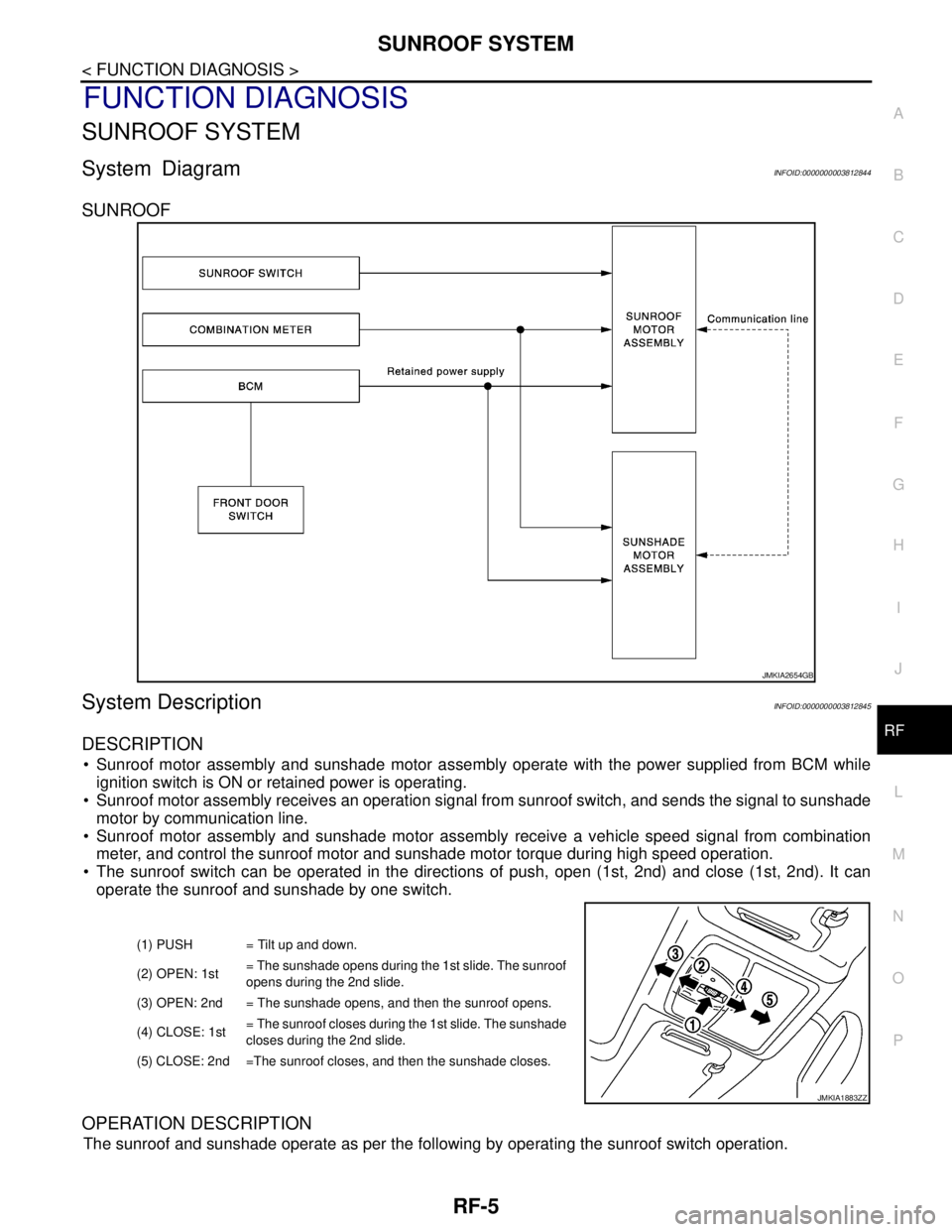
Sunroof motor assembly and sunshade motor assembly operate with the power supplied from BCM while
ignition switch is ON or retained power is operating.
Sunroof motor assembly receives an operation signal from sunroof switch, and sends the signal to sunshade
motor by communication line.
Sunroof motor assembly and sunshade motor assembly receive a vehicle speed signal from combination
meter, and control the sunroof motor and sunshade motor torque during high speed operation.
The sunroof switch can be operated in the directions of push, open (1st, 2nd) and close (1st, 2nd). It can
operate the sunroof and sunshade by one switch.
OPERATION DESCRIPTION
The sunroof and sunshade operate as per the following by operating the sunroof switch operation.
JMKIA2654GB
(1) PUSH = Tilt up and down.
(2) OPEN: 1st= The sunshade opens during the 1st slide. The sunroof
opens during the 2nd slide.
(3) OPEN: 2nd = The sunshade opens, and then the sunroof opens.
(4) CLOSE: 1st= The sunroof closes during the 1st slide. The sunshade
closes during the 2nd slide.
(5) CLOSE: 2nd =The sunroof closes, and then the sunshade closes.
JMKIA1883ZZ
Page 3737 of 5121
RF-6
< FUNCTION DIAGNOSIS >
SUNROOF SYSTEM
Before Operation Switch condition Roof and sunshade operation After Operation
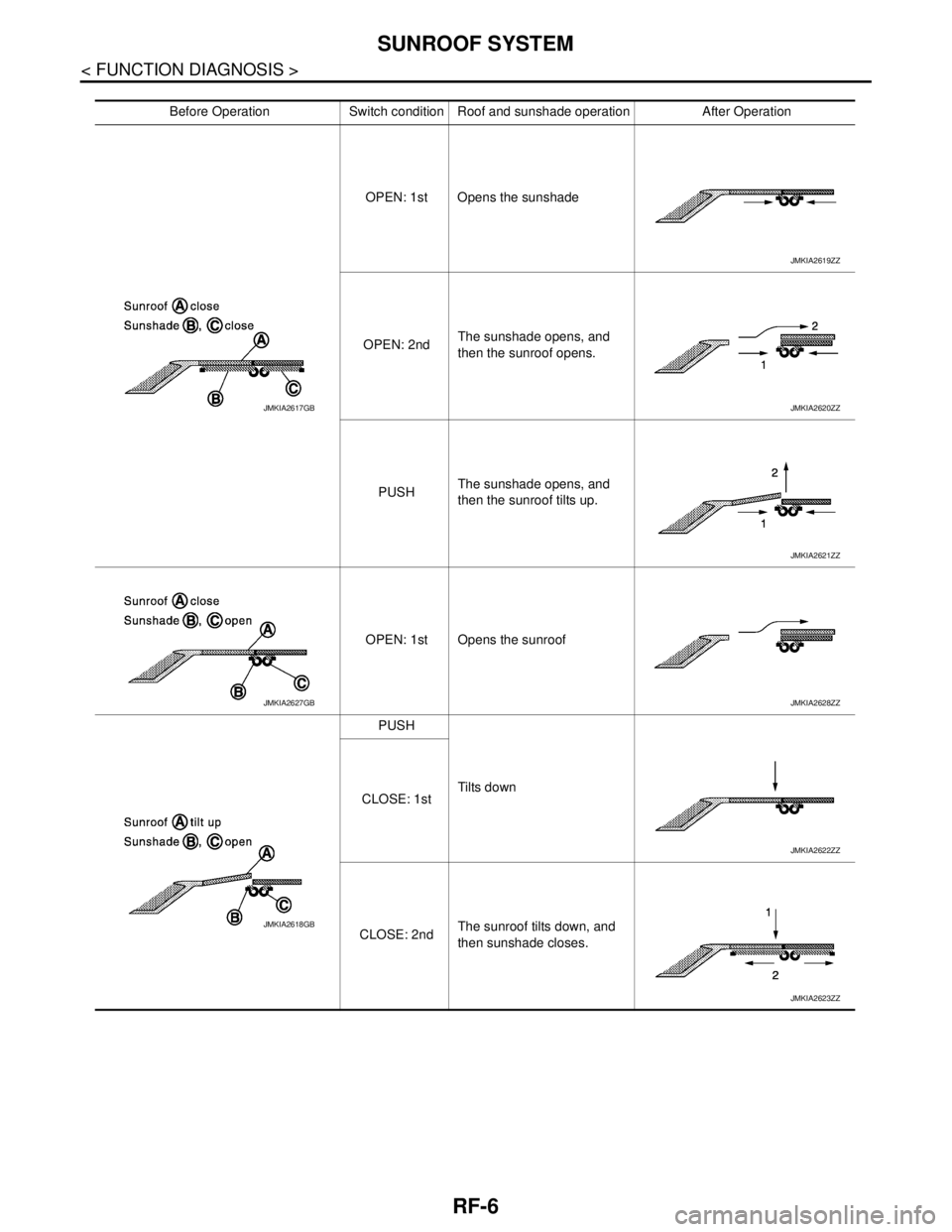
OPEN: 1st Opens the sunshade
OPEN: 2ndThe sunshade opens, and
then the sunroof opens.
PUSHThe sunshade opens, and
then the sunroof tilts up.
OPEN: 1st Opens the sunroof
PUSH
Tilts down
CLOSE: 1st
CLOSE: 2ndThe sunroof tilts down, and
then sunshade closes.
JMKIA2617GB
JMKIA2619ZZ
JMKIA2620ZZ
JMKIA2621ZZ
JMKIA2627GBJMKIA2628ZZ
JMKIA2618GB
JMKIA2622ZZ
JMKIA2623ZZ
Page 3738 of 5121
SUNROOF SYSTEM
RF-7
< FUNCTION DIAGNOSIS >
C
D
E
F
G
H
I
J
L
MA
B
RF
N
O
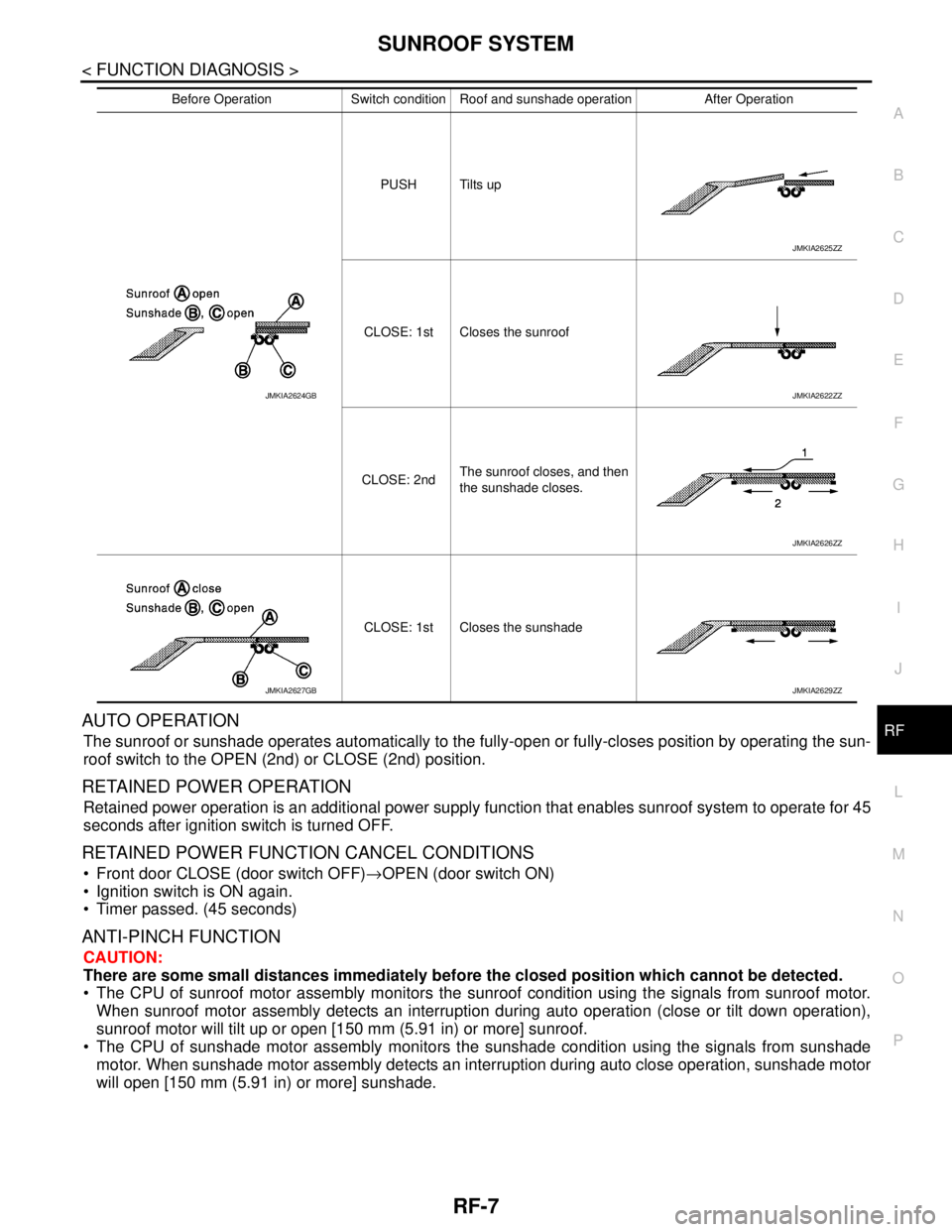
PAUTO OPERATION
The sunroof or sunshade operates automatically to the fully-open or fully-closes position by operating the sun-
roof switch to the OPEN (2nd) or CLOSE (2nd) position.
RETAINED POWER OPERATION
Retained power operation is an additional power supply function that enables sunroof system to operate for 45
seconds after ignition switch is turned OFF.
RETAINED POWER FUNCTION CANCEL CONDITIONS
Front door CLOSE (door switch OFF)→OPEN (door switch ON)
Ignition switch is ON again.
Timer passed. (45 seconds)
ANTI-PINCH FUNCTION
CAUTION:
There are some small distances immediately before the closed position which cannot be detected.
The CPU of sunroof motor assembly monitors the sunroof condition using the signals from sunroof motor.
When sunroof motor assembly detects an interruption during auto operation (close or tilt down operation),
sunroof motor will tilt up or open [150 mm (5.91 in) or more] sunroof.
The CPU of sunshade motor assembly monitors the sunshade condition using the signals from sunshade
motor. When sunshade motor assembly detects an interruption during auto close operation, sunshade motor
will open [150 mm (5.91 in) or more] sunshade.
PUSH Tilts up
CLOSE: 1st Closes the sunroof
CLOSE: 2ndThe sunroof closes, and then
the sunshade closes.
CLOSE: 1st Closes the sunshade Before Operation Switch condition Roof and sunshade operation After Operation
JMKIA2624GB
JMKIA2625ZZ
JMKIA2622ZZ
JMKIA2626ZZ
JMKIA2627GBJMKIA2629ZZ