automatic transmission NISSAN TEANA 2008 Owner's Manual
[x] Cancel search | Manufacturer: NISSAN, Model Year: 2008, Model line: TEANA, Model: NISSAN TEANA 2008Pages: 5121, PDF Size: 69.03 MB
Page 2765 of 5121
![NISSAN TEANA 2008 Owners Manual AUTOMATIC AIR CONDITIONER SYSTEM
HAC-137
< FUNCTION DIAGNOSIS >[WITH 7 INCH DISPLAY]
C
D
E
F
G
H
J
K
L
MA
B
HAC
N
O
P
A configuration of these components is as shown in the figure below.
SYSTEM CONSTR](/img/5/57391/w960_57391-2764.png "NISSAN TEANA 2008 Owners Manual AUTOMATIC AIR CONDITIONER SYSTEM
HAC-137
< FUNCTION DIAGNOSIS >[WITH 7 INCH DISPLAY]
C
D
E
F
G
H
J
K
L
MA
B
HAC
N
O
P
A configuration of these components is as shown in the figure below.
SYSTEM CONSTR")
AUTOMATIC AIR CONDITIONER SYSTEM
HAC-137
< FUNCTION DIAGNOSIS >[WITH 7 INCH DISPLAY]
C
D
E
F
G
H
J
K
L
MA
B
HAC
N
O
P
A configuration of these components is as shown in the figure below.
SYSTEM CONSTRUCTION
A small network exists between the A/C auto amp., the mode door motor, the air mix door motor and the intake
door motor. The A/C auto amp. and motors are connected by data transmission lines and motor power supply
lines. The LAN network is built through the ground circuits of each door motor.
Addresses, motor opening angle signals, motor stop signals and error checking messages are all transmitted
through the data transmission lines connecting the A/C auto amp. and each door motor.
The following functions are contained in LCUs built into the mode door motor, the air mix door motors and the
intake door motor.
Address
Motor opening angle signals
Data transmission
Motor stop and drive decision
Opening angle sensor (PBR function)
Comparison
Decision (A/C auto amp. indicated value and motor opening angle comparison)
Operation
The A/C auto amp. receives data from each of the sensors. The A/C auto amp. sends mode door, the air mix
door and the intake door opening angle data to the mode door motor LCU, the air mix door motor LCUs and
the intake door motor LCU.
The mode door motor, the air mix door motors and the intake door motor read their respective signals accord-
ing to the address signal. Opening angle indication signals received from the A/C auto amp. and each of the
motor position sensors is compared by the LCUs in each door motor with the existing decision and opening
angles. Next, HOT/COLD, DEF/VENT, OPEN/SHUT or FRE/REC operation is selected. The new selection
data is returned to the A/C auto amp.
Transmission Data and Transmission Order
A/C auto amp. data is transmitted consecutively to each of the door motors following the form as shown in the
figure below.
JSIIA1129GB
JSIIA1130GB
JSIIA1131GB
Page 2766 of 5121
![NISSAN TEANA 2008 Owners Manual HAC-138
< FUNCTION DIAGNOSIS >[WITH 7 INCH DISPLAY]
AUTOMATIC AIR CONDITIONER SYSTEM
START: Initial compulsory signal is sent to each of the door motors.
ADDRESS: Data sent from the A/C auto amp. is](/img/5/57391/w960_57391-2765.png "NISSAN TEANA 2008 Owners Manual HAC-138
< FUNCTION DIAGNOSIS >[WITH 7 INCH DISPLAY]
AUTOMATIC AIR CONDITIONER SYSTEM
START: Initial compulsory signal is sent to each of the door motors.
ADDRESS: Data sent from the A/C auto amp. is")
HAC-138
< FUNCTION DIAGNOSIS >[WITH 7 INCH DISPLAY]
AUTOMATIC AIR CONDITIONER SYSTEM
START: Initial compulsory signal is sent to each of the door motors.
ADDRESS: Data sent from the A/C auto amp. is selected according to data-based decisions made by the mode door
motor, the air mix door motors and the intake door motor.
If the addresses are identical, the opening angle data and error check signals are received by the door motor
LCUs. The LCUs then make the appropriate error decision. If the opening angle data has no error, door con-
trol begins.
If an error exists, the received data is rejected and the corrected data received. Finally, door control is based
upon the corrected opening angle data.
OPENING ANGLE:
Data that shows the indicated door opening angle of each door motor.
ERROR CHECK: In this procedure, transmitted and received data is checked for errors. Error data is then compiled. The error
check prevents corrupted data from being used by the mode door motor, the air mix door motors and the
intake door motor. Error data can be related to the following symptoms.
- Malfunction of electrical frequency
- Poor electrical connections
- Signal leakage from transmission lines
- Signal level fluctuation
STOP SIGNAL:
At the end of each transmission, a stop operation, in-operation, or internal malfunction message is delivered
to the A/C auto amp. This completes one data transmission and control cycle.
WITH INTELLIGENT AIR CONDITIONER SYSTEM : Component Part Location
INFOID:0000000003885178
ENGINE COMPARTMENT
JSIIA1132GB
Page 3025 of 5121
INT-48
< ON-VEHICLE REPAIR >
FLOOR TRIM
6. Remove instrument lower cover, instrument driver panel, instrument assist lower panel and instrument
side panel (LH/RH). Refer to IP-12, "
Removal and Installation".
7. Remove G-sensor. Refer to VTL-82, "
WITH INTELLIGENT AIR CONDITIONER SYSTEM : Removal and
Installation".
8. Remove diagnosis sensor unit. Refer to SR-22, "
Removal and Installation".
9. Remove dash side finisher (LH/RH), front kicking plate inner (LH/RH), center pillar lower garnish (LH/RH)
and body side welt (LH/RH). Refer to INT-39, "
Removal and Installation".
10. Remove side brake wire. Refer to BR-17, "
Removal and Installation".
11. Remove automatic transmission drive. Refer to FAX-16, "
Exploded View".
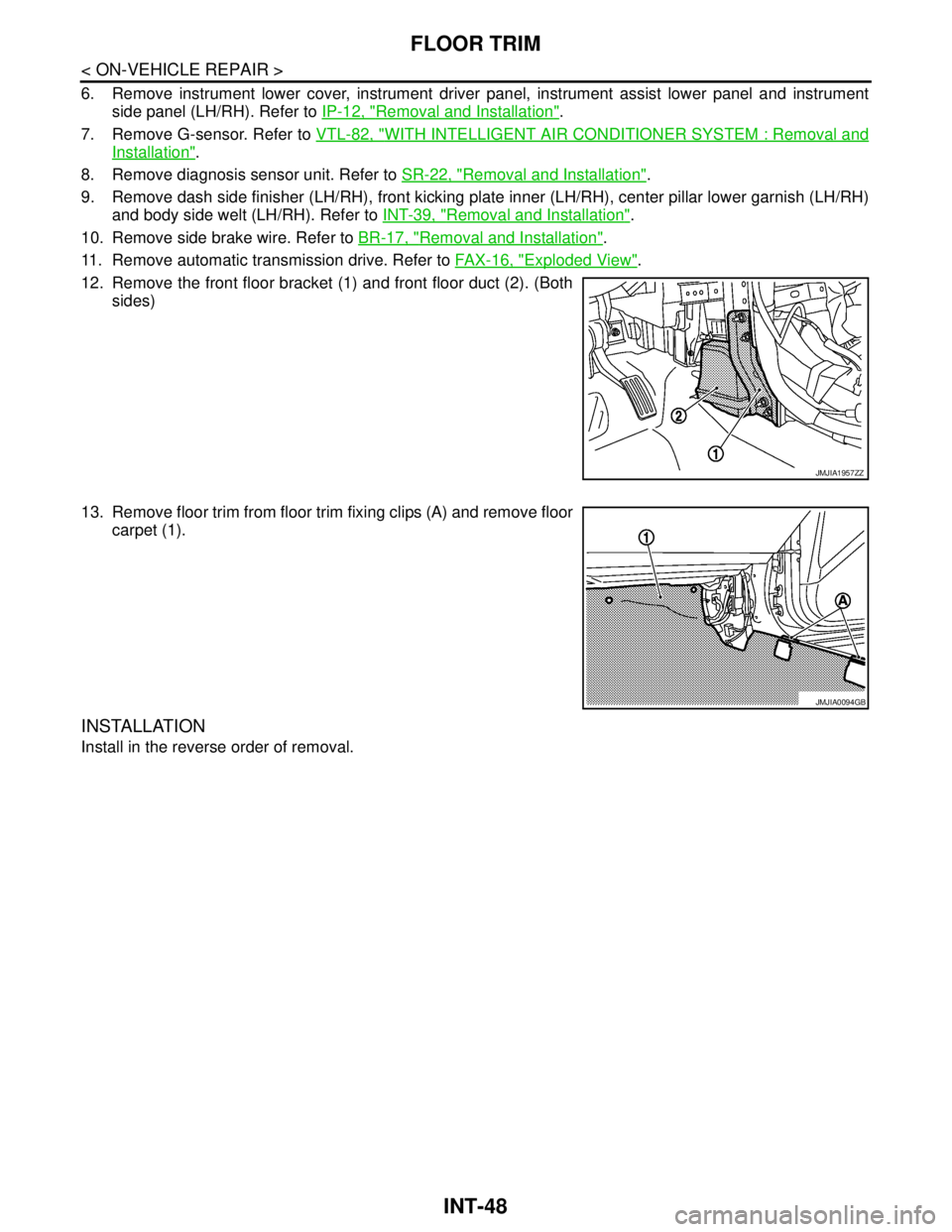
12. Remove the front floor bracket (1) and front floor duct (2). (Both
sides)
13. Remove floor trim from floor trim fixing clips (A) and remove floor
carpet (1).
INSTALLATION
Install in the reverse order of removal.
JMJIA1957ZZ
JMJIA0094GB
Page 3089 of 5121
![NISSAN TEANA 2008 Owners Manual LAN-22
< FUNCTION DIAGNOSIS >[CAN]
CAN COMMUNICATION SYSTEM
FUNCTION DIAGNOSIS
CAN COMMUNICATION SYSTEM
CAN System Specification ChartINFOID:0000000003767684
Determine CAN system type from the followi](/img/5/57391/w960_57391-3088.png "NISSAN TEANA 2008 Owners Manual LAN-22
< FUNCTION DIAGNOSIS >[CAN]
CAN COMMUNICATION SYSTEM
FUNCTION DIAGNOSIS
CAN COMMUNICATION SYSTEM
CAN System Specification ChartINFOID:0000000003767684
Determine CAN system type from the followi")
LAN-22
< FUNCTION DIAGNOSIS >[CAN]
CAN COMMUNICATION SYSTEM
FUNCTION DIAGNOSIS
CAN COMMUNICATION SYSTEM
CAN System Specification ChartINFOID:0000000003767684
Determine CAN system type from the following specification chart.
NOTE:
Refer to LAN-14, "
Trouble Diagnosis Procedure" for how to use CAN system specification chart.
×: Applicable
VEHICLE EQUIPMENT IDENTIFICATION INFORMATION
NOTE:
Check CAN system type from the vehicle shape and equipment.
CAN Communication Signal ChartINFOID:0000000003767685
Refer to LAN-13, "How to Use CAN Communication Signal Chart" for how to use CAN communication signal
chart.
Body typeSedan
Axle2WD
Engine VQ25DE VQ35DE
TransmissionCVT
Brake control ABS VDC
Automatic drive positioner××
Color display×××
CAN system type 2469
Start CAN Diagnosis (CONSULT-III) 2469
JPMIA1011GB
Page 4611 of 5121
![NISSAN TEANA 2008 Owners Manual TM-138
< PRECAUTION >[CVT: RE0F09B]
PRECAUTIONS
Precaution
INFOID:0000000003849071
Turn ignition switch OFF and disconnect negative battery
cable before connecting or disconnecting the TCM harness
co](/img/5/57391/w960_57391-4610.png "NISSAN TEANA 2008 Owners Manual TM-138
< PRECAUTION >[CVT: RE0F09B]
PRECAUTIONS
Precaution
INFOID:0000000003849071
Turn ignition switch OFF and disconnect negative battery
cable before connecting or disconnecting the TCM harness
co")
TM-138
< PRECAUTION >[CVT: RE0F09B]
PRECAUTIONS
Precaution
INFOID:0000000003849071
Turn ignition switch OFF and disconnect negative battery
cable before connecting or disconnecting the TCM harness
connector. Because battery voltage is applied to TCM even if
ignition switch is turned OFF.
When connecting or disconnecting pin connectors into or
from TCM, do not damage pin terminals (bend or break).
Check that there are not any bends or breaks on TCM pin ter-
minal, when connecting pin connectors.
Perform TCM input/output signal inspection and check
whether TCM functions normally or not before replacing TCM.
TM-111, "
Reference Value".
Perform “DTC Confirmation Procedure” after performing each
TROUBLE DIAGNOSIS.
If the repair is completed the DTC should not be displayed in
the “DTC Confirmation Procedure”.
Always use the specified brand of CVT fluid. Refer to MA-11, "
Flu-
ids and Lubricants".
Use lint-free paper, not cloth rags, during work.
Dispose of the waste oil using the methods prescribed by law, ordi-
nance, etc. after replacing the CVT fluid.
Service Notice or PrecautionINFOID:0000000003849072
OBD SELF-DIAGNOSIS
CVT self-diagnosis is performed by the TCM in combination with the ECM. The results can be read through
the blinking pattern of the Malfunction Indicator (MI). Refer to the table on TM-37, "
CONSULT-III Function
(TRANSMISSION)" for the indicator used to display each self-diagnostic result.
The self-diagnostic results indicated by the MI are automatically stored in both the ECM and TCM memories.
SEF289H
SEF291H
MEF040DA
SAT652J
Page 4675 of 5121
![NISSAN TEANA 2008 Owners Manual TM-202
< FUNCTION DIAGNOSIS >[CVT: RE0F10A]
ON BOARD DIAGNOSTIC (OBD) SYSTEM
ON BOARD DIAGNOSTIC (OBD) SYSTEM
Diagnosis DescriptionINFOID:0000000003806373
DESCRIPTION
The CVT system has two self-diagn](/img/5/57391/w960_57391-4674.png "NISSAN TEANA 2008 Owners Manual TM-202
< FUNCTION DIAGNOSIS >[CVT: RE0F10A]
ON BOARD DIAGNOSTIC (OBD) SYSTEM
ON BOARD DIAGNOSTIC (OBD) SYSTEM
Diagnosis DescriptionINFOID:0000000003806373
DESCRIPTION
The CVT system has two self-diagn")
TM-202
< FUNCTION DIAGNOSIS >[CVT: RE0F10A]
ON BOARD DIAGNOSTIC (OBD) SYSTEM
ON BOARD DIAGNOSTIC (OBD) SYSTEM
Diagnosis DescriptionINFOID:0000000003806373
DESCRIPTION
The CVT system has two self-diagnostic systems.
The first is the emission-related on board diagnostic system (OBD) performed by the TCM in combination with
the ECM. A malfunction is indicated by the MI (Malfunction Indicator) and is stored as a DTC in the ECM mem-
ory and in the TCM memory.
The second is the TCM original self-diagnosis performed by the TCM. A malfunction history is stored in the
TCM memory. The detected items are overlapped with OBD self-diagnostic items. For details, refer to TM-204,
"CONSULT-III Function (TRANSMISSION)".
OBD FUNCTION
The ECM provides emission-related on board diagnostic (OBD) functions for the CVT system. One function is
to receive a signal from the TCM used with OBD-related parts of the CVT system. The signal is sent to the
ECM when a malfunction occurs in the corresponding OBD-related part. The other function is to indicate a
diagnostic result by means of the MI (Malfunction Indicator) on the instrument panel. Sensors, switches and
solenoid valves are used as sensing elements.
The MI automatically illuminates in “One or Two Trip Detection Logic” when a malfunction is sensed in relation
to CVT system parts.
ONE OR TWO TRIP DETECTION LOGIC OF OBD
One Trip Detection Logic
If a malfunction is sensed during the first test drive, the MI illuminates and the ECM memory stores the mal-
function as a DTC. The TCM is not provided with such a memory function.
Two Trip Detection Logic
When a malfunction is sensed during the first test drive, it is stored in the ECM memory as a 1st trip DTC
(diagnostic trouble code) or 1st trip freeze frame data. At this point, the MI does not illuminate. — 1st trip
If the same malfunction as that experienced during the first test drive is sensed during the second test drive,
the MI will illuminate. — 2nd trip
The “trip” in the “One or Two Trip Detection Logic” means a driving mode in which self-diagnosis is performed
during vehicle operation.
OBD DIAGNOSTIC TROUBLE CODE (DTC)
How to Read DTC and 1st Trip DTC
DTC and 1st trip DTC can be read by the following methods.
( with CONSULT-III or GST) CONSULT-III or GST (Generic Scan Tool) Examples: P0705, P0720, etc.
These DTC are prescribed by ISO 15031-6.
(CONSULT-III also displays the malfunctioning component or system.)
1st trip DTC No. is the same as DTC No.
Output of the diagnostic trouble code indicates that the indicated circuit has a malfunction. How-
ever, in case of the Mode II and GST, they do not indicate whether the malfunction is still occurring or
it occurred in the past and has returned to normal.
CONSULT-III can identify them as shown below, therefore, CONSULT-III (if available) is recom-
mended.
- DTC or 1st trip DTC of a malfunction is displayed in SELF-DIAGNOSTIC RESULTS mode for “ENGINE” with
CONSULT-III. Time data indicates how many times the vehicle was driven after the last detection of a DTC.
- If the DTC is being detected currently, the time data will be “0”.
- If a 1st trip DTC is stored in the ECM, the time data will be “1t”.
Freeze Frame Data and 1st Trip Freeze Frame Data The ECM has a memory function, which stores the driving conditions such as fuel system status, calculated
load value, engine coolant temperature, short-term fuel trim, long-term fuel trim, engine speed and vehicle
speed at the moment the ECM detects a malfunction.
Data that are stored in the ECM memory, along with the 1st trip DTC, are called 1st trip freeze frame data,
and the data, stored together with the DTC data, are called freeze frame data and displayed on CONSULT-
III or GST. The 1st trip freeze frame data can only be displayed on the CONSULT-III screen, not on the GST.
For details, refer to EC-113, "
CONSULT-III Function".
Page 4773 of 5121
![NISSAN TEANA 2008 Owners Manual TM-300
< PRECAUTION >[CVT: RE0F10A]
PRECAUTIONS
Turn ignition switch OFF and disconnect negative battery
cable before connecting or disconnecting the TCM harness
connector. Because battery voltage is](/img/5/57391/w960_57391-4772.png "NISSAN TEANA 2008 Owners Manual TM-300
< PRECAUTION >[CVT: RE0F10A]
PRECAUTIONS
Turn ignition switch OFF and disconnect negative battery
cable before connecting or disconnecting the TCM harness
connector. Because battery voltage is")
TM-300
< PRECAUTION >[CVT: RE0F10A]
PRECAUTIONS
Turn ignition switch OFF and disconnect negative battery
cable before connecting or disconnecting the TCM harness
connector. Because battery voltage is applied to TCM even if
ignition switch is turned OFF.
When connecting or disconnecting pin connectors into or
from TCM, do not damage pin terminals (bend or break).
Check that there are not any bends or breaks on TCM pin ter-
minal, when connecting pin connectors.
Perform TCM input/output signal inspection and check
whether TCM functions normally or not before replacing TCM.
Refer to TM-275, "
Reference Value".
Perform “DTC Confirmation Procedure” after performing each
TROUBLE DIAGNOSIS.
If the repair is completed the DTC should not be displayed in
the “DTC Confirmation Procedure”.
Always use the specified brand of CVT fluid. Refer to MA-11, "
Flu-
ids and Lubricants".
Use lint-free paper, not cloth rags, during work.
Dispose of the waste oil using the methods prescribed by law, ordi-
nance, etc. after replacing the CVT fluid.
Service Notice or PrecautionINFOID:0000000003806500
OBD SELF-DIAGNOSIS
CVT self-diagnosis is performed by the TCM in combination with the ECM. The results can be read through
the blinking pattern of the Malfunction Indicator (MI). Refer to the table on TM-204, "
CONSULT-III Function
(TRANSMISSION)" for the indicator used to display each self-diagnostic result.
The self-diagnostic results indicated by the MI are automatically stored in both the ECM and TCM memories.
Always perform the procedure on TM-202, "
Diagnosis Description" to complete the repair and avoid
unnecessary blinking of the MIL.
For details of OBD, refer to EC-102, "
Diagnosis Description".
SEF289H
SEF291H
MEF040DA
SAT652J