steering NISSAN TEANA 2008 Service Manual
[x] Cancel search | Manufacturer: NISSAN, Model Year: 2008, Model line: TEANA, Model: NISSAN TEANA 2008Pages: 5121, PDF Size: 69.03 MB
Page 2506 of 5121

ABBREVIATIONS
GI-13
< HOW TO USE THIS MANUAL >
C
D
E
F
G
H
I
J
K
L
MB
GI
N
O
PABBREVIATIONS
Abbreviation ListINFOID:0000000003852769
The following ABBREVIATIONS are used:
ABBREVIATION DESCRIPTION
A/C Air Conditioner
A/T Automatic Transaxle/Transmission
ATF Automatic Transmission Fluid
D
1Drive range 1st gear
D
2Drive range 2nd gear
D
3Drive range 3rd gear
D
4Drive range 4th gear
FR, RR Front, Rear
LH, RH Left-Hand, Right-Hand
M/T Manual Transaxle/Transmission
OD Overdrive
P/S Power Steering
SAE Society of Automotive Engineers, Inc.
SDS Service Data and Specifications
SST Special Service Tools
2WD 2-Wheel Drive
2
22nd range 2nd gear
2
12nd range 1st gear
1
21st range 2nd gear
1
11st range 1st gear
Page 2517 of 5121

GI-24
< PRECAUTION >
PRECAUTIONS
PRECAUTION
PRECAUTIONS
DescriptionINFOID:0000000003852776
Observe the following precautions to ensure safe and proper servicing. These precautions are not
described in each individual section.
Precaution for Supplemental Restraint System (SRS) "AIR BAG" and "SEAT BELT
PRE-TENSIONER"
INFOID:0000000003852830
The Supplemental Restraint System such as “AIR BAG” and “SEAT BELT PRE-TENSIONER”, used along
with a front seat belt, helps to reduce the risk or severity of injury to the driver and front passenger for certain
types of collision. Information necessary to service the system safely is included in the “SRS AIRBAG” and
“SEAT BELT” of this Service Manual.
WARNING:
To avoid rendering the SRS inoperative, which could increase the risk of personal injury or death in
the event of a collision which would result in air bag inflation, all maintenance must be performed by
an authorized NISSAN/INFINITI dealer.
Improper maintenance, including incorrect removal and installation of the SRS, can lead to personal
injury caused by unintentional activation of the system. For removal of Spiral Cable and Air Bag
Module, see the “SRS AIRBAG”.
Never use electrical test equipment on any circuit related to the SRS unless instructed to in this Ser-
vice Manual. SRS wiring harnesses can be identified by yellow and/or orange harnesses or harness
connectors.
Precautions For Xenon Headlamp ServiceINFOID:0000000003852778
WARNING:
Comply with the following warnings to prevent any serious accident.
Disconnect the battery cable (negative terminal) or the power supply fuse before installing, remov-
ing, or touching the xenon headlamp (bulb included). The xenon headlamp contains high-voltage
generated parts.
Never work with wet hands.
Check the xenon headlamp ON-OFF status after assembling it to the vehicle. Never turn the xenon
headlamp ON in other conditions. Connect the power supply to the vehicle-side connector.
(Turning it ON outside the lamp case may cause fire or visual impairments.)
Never touch the bulb glass immediately after turning it OFF. It is extremely hot.
CAUTION:
Comply with the following cautions to prevent any error and malfunction.
Install the xenon bulb securely. (Insufficient bulb socket installation may melt the bulb, the connec-
tor, the housing, etc. by high-voltage leakage or corona discharge.)
Never perform HID circuit inspection with a tester.
Never touch the xenon bulb glass with hands. Never put oil and grease on it.
Dispose of the used xenon bulb after packing it in thick vinyl without breaking it.
Never wipe out dirt and contamination with organic solvent (thinner, gasoline, etc.).
Precaution Necessary for Steering Wheel Rotation after Battery Disconnect
INFOID:0000000003852856
NOTE:
Before removing and installing any control units, first turn the push-button ignition switch to the LOCK posi-
tion, then disconnect both battery cables.
After finishing work, confirm that all control unit connectors are connected properly, then re-connect both
battery cables.
Always use CONSULT-III to perform self-diagnosis as a part of each function inspection after finishing work.
If a DTC is detected, perform trouble diagnosis according to self-diagnosis results.
This vehicle is equipped with a push-button ignition switch and a steering lock unit.
If the battery is disconnected or discharged, the steering wheel will lock and cannot be turned.
Page 2518 of 5121
PRECAUTIONS
GI-25
< PRECAUTION >
C
D
E
F
G
H
I
J
K
L
MB
GI
N
O
P
If turning the steering wheel is required with the battery disconnected or discharged, follow the procedure
below before starting the repair operation.
OPERATION PROCEDURE
1. Connect both battery cables.
NOTE:
Supply power using jumper cables if battery is discharged.
2. Turn the push-button ignition switch to ACC position.
(At this time, the steering lock will be released.)
3. Disconnect both battery cables. The steering lock will remain released with both battery cables discon-
nected and the steering wheel can be turned.
4. Perform the necessary repair operation.
5. When the repair work is completed, re-connect both battery cables. With the brake pedal released, turn
the push-button ignition switch from ACC position to ON position, then to LOCK position. (The steering
wheel will lock when the push-button ignition switch is turned to LOCK position.)
6. Perform self-diagnosis check of all control units using CONSULT-III.
Precaution for Procedure without Cowl Top CoverINFOID:0000000003852857
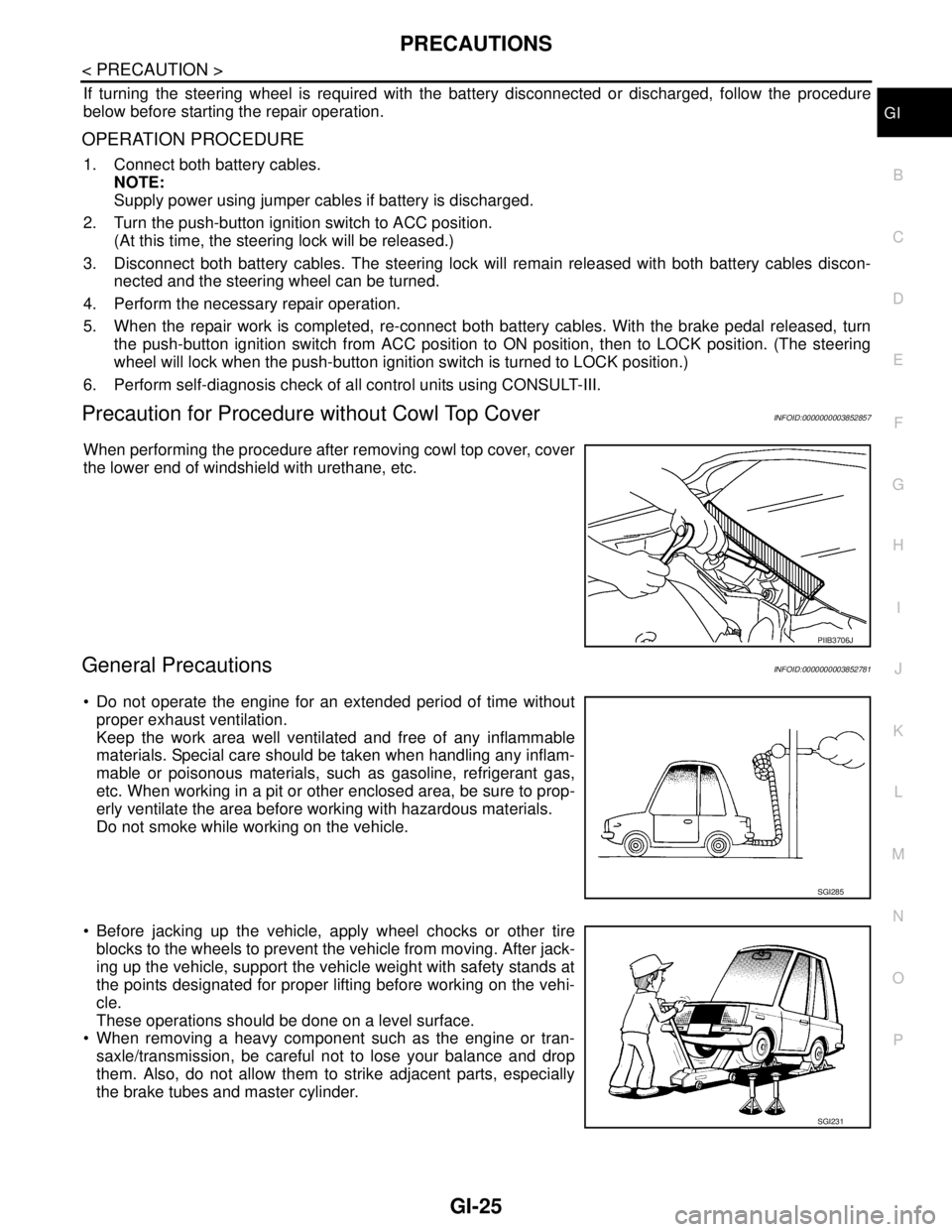
When performing the procedure after removing cowl top cover, cover
the lower end of windshield with urethane, etc.
General PrecautionsINFOID:0000000003852781
Do not operate the engine for an extended period of time without
proper exhaust ventilation.
Keep the work area well ventilated and free of any inflammable
materials. Special care should be taken when handling any inflam-
mable or poisonous materials, such as gasoline, refrigerant gas,
etc. When working in a pit or other enclosed area, be sure to prop-
erly ventilate the area before working with hazardous materials.
Do not smoke while working on the vehicle.
Before jacking up the vehicle, apply wheel chocks or other tire
blocks to the wheels to prevent the vehicle from moving. After jack-
ing up the vehicle, support the vehicle weight with safety stands at
the points designated for proper lifting before working on the vehi-
cle.
These operations should be done on a level surface.
When removing a heavy component such as the engine or tran-
saxle/transmission, be careful not to lose your balance and drop
them. Also, do not allow them to strike adjacent parts, especially
the brake tubes and master cylinder.
PIIB3706J
SGI285
SGI231
Page 2525 of 5121
GI-32
< PRECAUTION >
TOW TRUCK TOWING
TOW TRUCK TOWING
Tow Truck TowingINFOID:0000000003852791
CAUTION:
All applicable state or Provincial laws and local laws regarding the towing operation must be
obeyed.
It is necessary to use proper towing equipment to avoid possible damage to the vehicle during tow-
ing operation. Towing is in accordance with Towing Procedure Manual at dealer.
Always attach safety chains before towing.
When towing, make sure that the transaxle, steering system and powertrain are in good order. If any
unit is damaged, dollies must be used.
Never tow a CVT model with the rear wheels raised and the front wheels on the ground. This may
cause serious and expensive damage to the transaxle. If it is necessary to tow the vehicle with the
rear wheels raised, always use towing dollies under the front wheels.
Never tow an automatic transaxle model from the rear (that is backward) with four wheels on the
ground. This may cause serious and expensive damage to the transaxle.
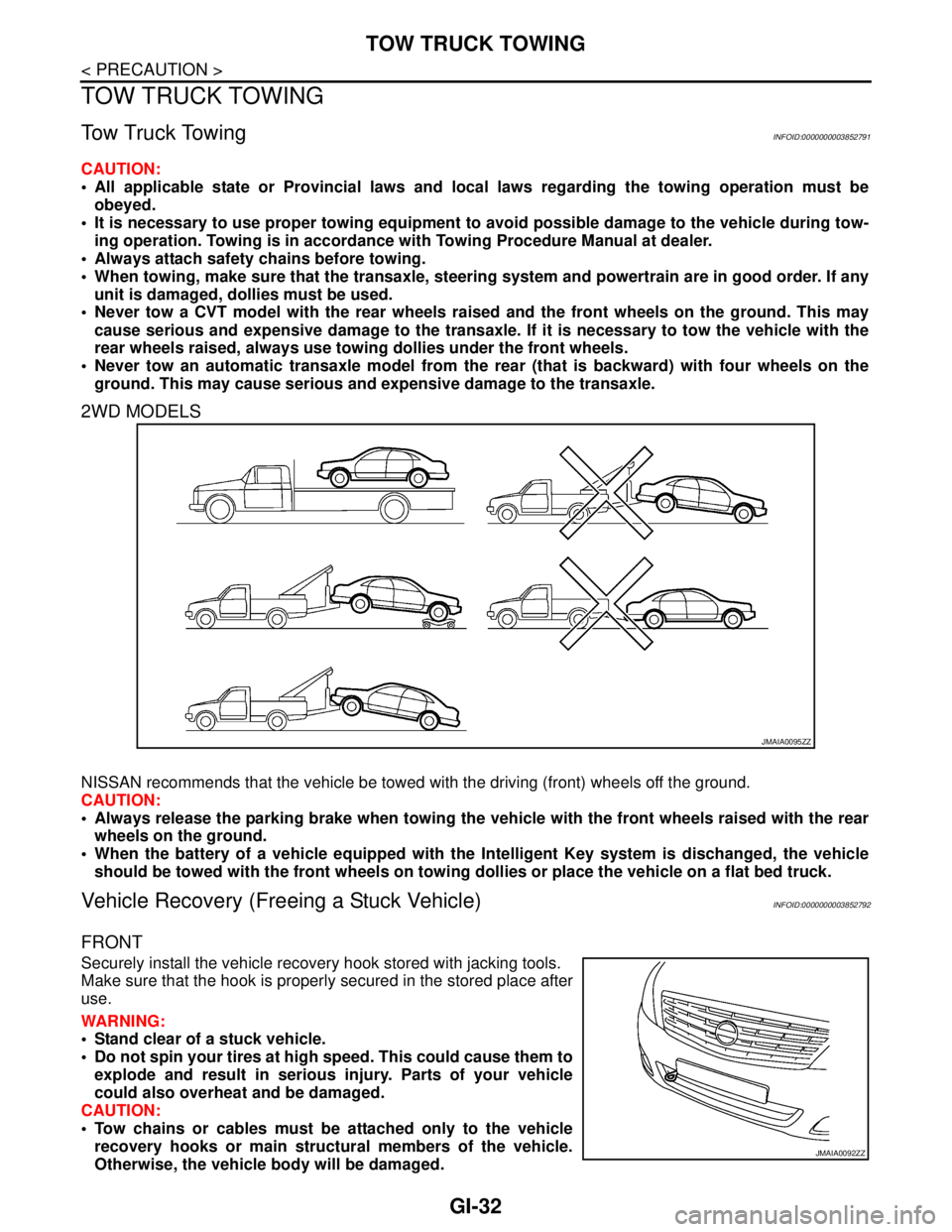
2WD MODELS
NISSAN recommends that the vehicle be towed with the driving (front) wheels off the ground.
CAUTION:
Always release the parking brake when towing the vehicle with the front wheels raised with the rear
wheels on the ground.
When the battery of a vehicle equipped with the Intelligent Key system is dischanged, the vehicle
should be towed with the front wheels on towing dollies or place the vehicle on a flat bed truck.
Vehicle Recovery (Freeing a Stuck Vehicle)INFOID:0000000003852792
FRONT
Securely install the vehicle recovery hook stored with jacking tools.
Make sure that the hook is properly secured in the stored place after
use.
WARNING:
Stand clear of a stuck vehicle.
Do not spin your tires at high speed. This could cause them to
explode and result in serious injury. Parts of your vehicle
could also overheat and be damaged.
CAUTION:
Tow chains or cables must be attached only to the vehicle
recovery hooks or main structural members of the vehicle.
Otherwise, the vehicle body will be damaged.
JMAIA0095ZZ
JMAIA0092ZZ
Page 2526 of 5121
TOW TRUCK TOWING
GI-33
< PRECAUTION >
C
D
E
F
G
H
I
J
K
L
MB
GI
N
O
P
Do not use the vehicle tie downs to free a vehicle stuck in sand, snow, mud, etc. Never tow the vehi-
cle using the vehicle tie downs or recovery hooks.
Always pull the cable straight out from the front of the vehicle. Never pull on the hook at an angle.
Pulling devices should be routed so they do not touch any part of the suspension, steering, brake or
cooling systems.
Pulling devices such as ropes or canvas straps are not recommended for use in vehicle towing or
recovery.
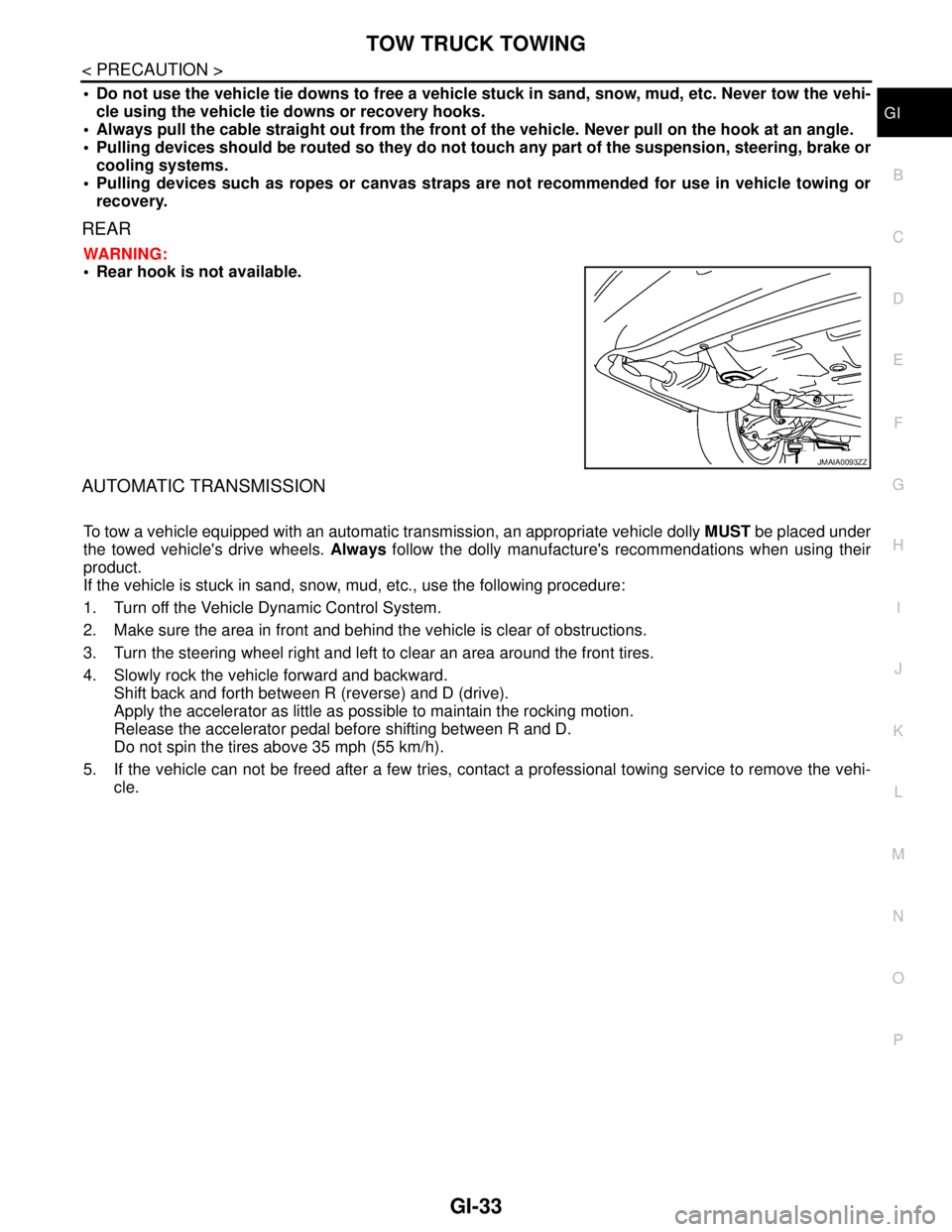
REAR
WARNING:
Rear hook is not available.
AUTOMATIC TRANSMISSION
To tow a vehicle equipped with an automatic transmission, an appropriate vehicle dolly MUST be placed under
the towed vehicle's drive wheels. Always follow the dolly manufacture's recommendations when using their
product.
If the vehicle is stuck in sand, snow, mud, etc., use the following procedure:
1. Turn off the Vehicle Dynamic Control System.
2. Make sure the area in front and behind the vehicle is clear of obstructions.
3. Turn the steering wheel right and left to clear an area around the front tires.
4. Slowly rock the vehicle forward and backward.
Shift back and forth between R (reverse) and D (drive).
Apply the accelerator as little as possible to maintain the rocking motion.
Release the accelerator pedal before shifting between R and D.
Do not spin the tires above 35 mph (55 km/h).
5. If the vehicle can not be freed after a few tries, contact a professional towing service to remove the vehi-
cle.
JMAIA0093ZZ
Page 2570 of 5121

HA-1
VENTILATION, HEATER & AIR CONDITIONER
C
D
E
F
G
H
J
K
L
M
SECTION HA
A
B
HA
N
O
P
CONTENTS
HEATER & AIR CONDITIONING SYSTEM
BASIC INSPECTION ....................................3
DIAGNOSIS AND REPAIR WORK FLOW .........3
Work Flow .................................................................3
FUNCTION DIAGNOSIS ...............................5
REFRIGERATION SYSTEM ...............................5
System Diagram ........................................................5
System Description ...................................................5
Component Parts Location ........................................6
Component Description .............................................7
SYMPTOM DIAGNOSIS ...............................8
REFRIGERATION SYSTEM SYMPTOMS ..........8
Trouble Diagnosis For Unusual Pressure .................8
Symptom Table .........................................................8
COMPRESSOR SYSTEM SYMPTOMS .............11
Symptom Table .......................................................11
PRECAUTION ..............................................12
PRECAUTIONS ..................................................12
Precaution for Supplemental Restraint System
(SRS) "AIR BAG" and "SEAT BELT PRE-TEN-
SIONER" .................................................................
12
Precaution Necessary for Steering Wheel Rota-
tion after Battery Disconnect ...................................
12
Precaution for Procedure without Cowl Top Cover ....13
Precautions For Xenon Headlamp Service .............13
Working with HFC-134a (R-134a) ...........................13
General Refrigerant Precaution ..............................13
Refrigerant Connection ...........................................14
Service Equipment ..................................................16
COMPRESSOR ..................................................19
General Precautions ...............................................19
FLUORESCENT LEAK DETECTOR .................20
General Precautions ...............................................20
PREPARATION ...........................................21
PREPARATION .................................................21
Special Service Tool ................................................21
Sealant or/and Lubricant .........................................23
ON-VEHICLE MAINTENANCE ....................24
REFRIGERANT .................................................24
Collection and Charge .............................................24
LUBRICANT ......................................................28
Maintenance of Lubricant Quantity ..........................28
Lubricant Adjusting Procedure for Components
Replacement Except Compressor ...........................
28
Lubricant Adjusting Procedure for Compressor
Replacement ...........................................................
29
REFRIGERATION SYSTEM .............................30
Inspection ................................................................30
Performance Chart ..................................................30
Refrigerant Leakages ..............................................31
FLUORESCENT LEAK DETECTOR ................32
Inspection ................................................................32
ELECTRICAL LEAK DETECTOR ....................33
Inspection ................................................................33
ON-VEHICLE REPAIR .................................36
COMPRESSOR .................................................36
Exploded View .........................................................36
Removal and Installation .........................................36
Inspection ................................................................37
LOW-PRESSURE FLEXIBLE HOSE ................38
Exploded View .........................................................38
Removal and Installation .........................................38
HIGH-PRESSURE FLEXIBLE HOSE ...............40
Exploded View .........................................................40
Removal and Installation .........................................40
Page 2581 of 5121

HA-12
< PRECAUTION >
PRECAUTIONS
PRECAUTION
PRECAUTIONS
Precaution for Supplemental Restraint System (SRS) "AIR BAG" and "SEAT BELT
PRE-TENSIONER"
INFOID:0000000003844112
The Supplemental Restraint System such as “AIR BAG” and “SEAT BELT PRE-TENSIONER”, used along
with a front seat belt, helps to reduce the risk or severity of injury to the driver and front passenger for certain
types of collision. Information necessary to service the system safely is included in the “SRS AIRBAG” and
“SEAT BELT” of this Service Manual.
WARNING:
• To avoid rendering the SRS inoperative, which could increase the risk of personal injury or death in
the event of a collision which would result in air bag inflation, all maintenance must be performed by
an authorized NISSAN/INFINITI dealer.
Improper maintenance, including incorrect removal and installation of the SRS, can lead to personal
injury caused by unintentional activation of the system. For removal of Spiral Cable and Air Bag
Module, see the “SRS AIRBAG”.
Never use electrical test equipment on any circuit related to the SRS unless instructed to in this Ser-
vice Manual. SRS wiring harnesses can be identified by yellow and/or orange harnesses or harness
connectors.
Precaution Necessary for Steering Wheel Rotation after Battery Disconnect
INFOID:0000000003844113
NOTE:
Before removing and installing any control units, first turn the push-button ignition switch to the LOCK posi-
tion, then disconnect both battery cables.
After finishing work, confirm that all control unit connectors are connected properly, then re-connect both
battery cables.
Always use CONSULT-III to perform self-diagnosis as a part of each function inspection after finishing work.
If a DTC is detected, perform trouble diagnosis according to self-diagnosis results.
This vehicle is equipped with a push-button ignition switch and a steering lock unit.
If the battery is disconnected or discharged, the steering wheel will lock and cannot be turned.
If turning the steering wheel is required with the battery disconnected or discharged, follow the procedure
below before starting the repair operation.
OPERATION PROCEDURE
1. Connect both battery cables.
NOTE:
Supply power using jumper cables if battery is discharged.
2. Turn the push-button ignition switch to ACC position.
(At this time, the steering lock will be released.)
3. Disconnect both battery cables. The steering lock will remain released with both battery cables discon-
nected and the steering wheel can be turned.
4. Perform the necessary repair operation.
5. When the repair work is completed, re-connect both battery cables. With the brake pedal released, turn
the push-button ignition switch from ACC position to ON position, then to LOCK position. (The steering
wheel will lock when the push-button ignition switch is turned to LOCK position.)
6. Perform self-diagnosis check of all control units using CONSULT-III.
Page 2611 of 5121
HA-42
< ON-VEHICLE REPAIR >
LOW-PRESSURE PIPE
LOW-PRESSURE PIPE
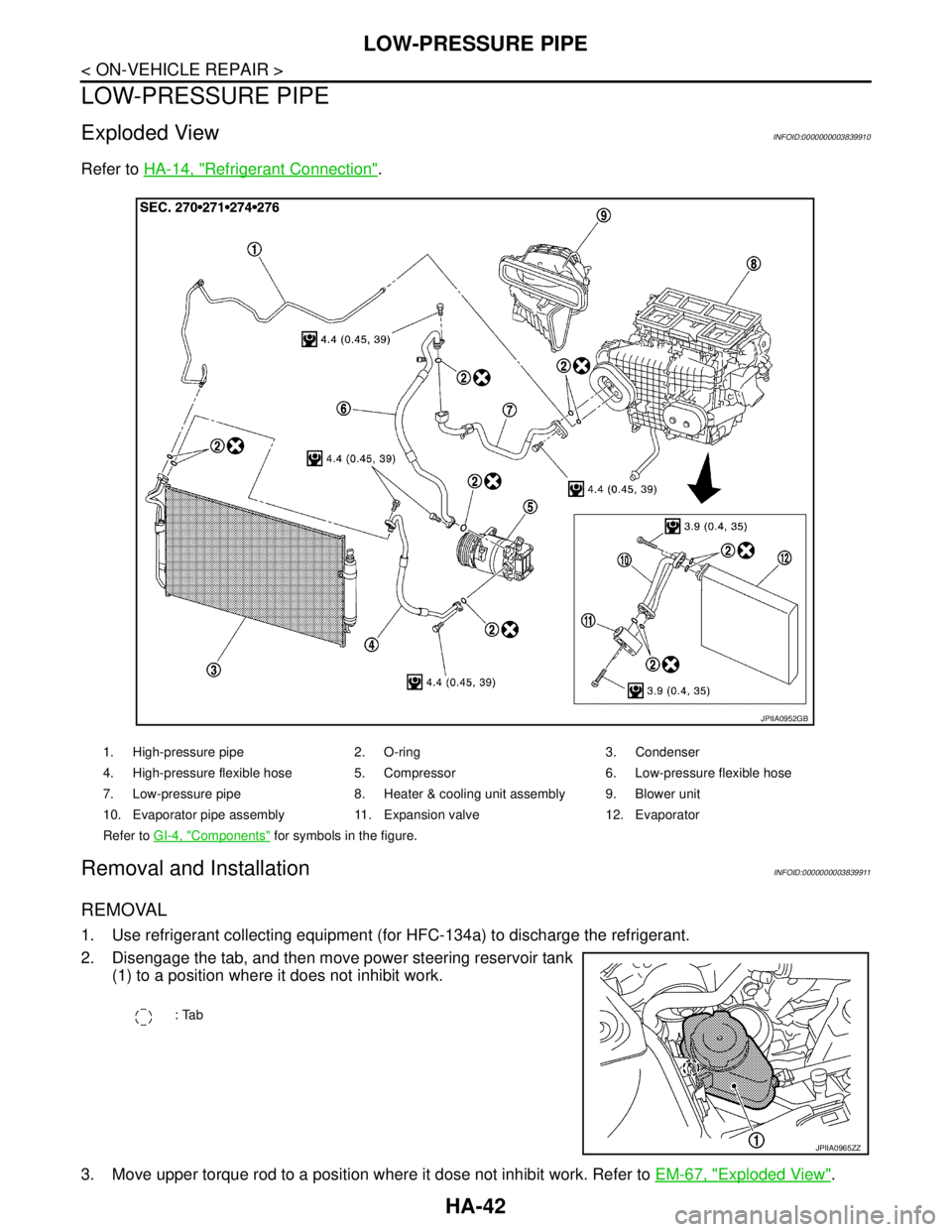
Exploded ViewINFOID:0000000003839910
Refer to HA-14, "Refrigerant Connection".
Removal and InstallationINFOID:0000000003839911
REMOVAL
1. Use refrigerant collecting equipment (for HFC-134a) to discharge the refrigerant.
2. Disengage the tab, and then move power steering reservoir tank
(1) to a position where it does not inhibit work.
3. Move upper torque rod to a position where it dose not inhibit work. Refer to EM-67, "
Exploded View".
1. High-pressure pipe 2. O-ring 3. Condenser
4. High-pressure flexible hose 5. Compressor 6. Low-pressure flexible hose
7. Low-pressure pipe 8. Heater & cooling unit assembly 9. Blower unit
10. Evaporator pipe assembly 11. Expansion valve 12. Evaporator
Refer to GI-4, "
Components" for symbols in the figure.
JPIIA0952GB
: Tab
JPIIA0965ZZ
Page 2630 of 5121

HAC-2
DTC Logic ...............................................................53
Diagnosis Procedure ..............................................54
Component Inspection ............................................55
B2632, B2633 AIR MIX DOOR MOTOR
(DRIVER SIDE) ..................................................
56
Description ..............................................................56
DTC Logic ...............................................................56
Diagnosis Procedure ..............................................57
B2634, B2635 AIR MIX DOOR MOTOR (PAS-
SENGER SIDE) ..................................................
58
Description ..............................................................58
DTC Logic ...............................................................58
Diagnosis Procedure ..............................................59
B2636, B2637, B2638, B2639, B2654, B2655
MODE DOOR MOTOR ......................................
60
Description ..............................................................60
DTC Logic ...............................................................60
Diagnosis Procedure ..............................................61
B263D B263E, B263F, B2656 INTAKE DOOR
MOTOR ..............................................................
63
Description ..............................................................63
DTC Logic ...............................................................63
Diagnosis Procedure ..............................................64
POWER SUPPLY AND GROUND CIRCUIT .....65
A/C AUTO AMP. .......................................................65
A/C AUTO AMP. : Diagnosis Procedure ................65
A/C CONTROL ..........................................................65
A/C CONTROL : Diagnosis Procedure ...................65
A/C DISPLAY ............................................................66
A/C DISPLAY : Diagnosis Procedure .....................66
A/C AUTO AMP. ................................................67
Description ..............................................................67
Component Function Check ...................................67
Diagnosis Procedure ..............................................67
BLOWER MOTOR .............................................68
Description ..............................................................68
Component Function Check .................................68
Diagnosis Procedure ..............................................68
Component Inspection ............................................71
MAGNET CLUTCH ............................................72
Description ..............................................................72
Component Function Check ...................................72
Diagnosis Procedure ..............................................72
A/C CONTROL SIGNAL CIRCUIT ....................74
Diagnosis Procedure ..............................................74
ECU DIAGNOSIS ........................................75
A/C AUTO AMP. ................................................75
Reference Value .....................................................75
Wiring Diagram - AIR CONDITIONER CONTROL
SYSTEM - ...............................................................
77
Fail-Safe ..................................................................84
DTC Inspection Priority Chart ...............................85
DTC Index ...............................................................85
SYMPTOM DIAGNOSIS ............................87
AIR CONDITIONER CONTROL ........................87
Diagnosis Chart By Symptom .................................87
INSUFFICIENT COOLING .................................88
Description ..............................................................88
Inspection procedure ..............................................88
INSUFFICIENT HEATING .................................91
Description ..............................................................91
Inspection procedure ..............................................91
NOISE ................................................................94
Description ..............................................................94
Inspection procedure ..............................................94
MEMORY FUNCTION DOES NOT OPERATE ...96
Description ..............................................................96
Inspection procedure ..............................................96
PRECAUTION ............................................97
PRECAUTIONS .................................................97
Precaution for Supplemental Restraint System
(SRS) "AIR BAG" and "SEAT BELT PRE-TEN-
SIONER" .................................................................
97
Precaution Necessary for Steering Wheel Rota-
tion after Battery Disconnect ...................................
97
Precaution for Procedure without Cowl Top Cover ...98
Precautions For Xenon Headlamp Service .............98
Working with HFC-134a (R-134a) ...........................98
General Refrigerant Precaution ..............................99
Refrigerant Connection ...........................................99
Service Equipment ................................................101
COMPRESSOR ................................................104
General Precautions .............................................104
FLUORESCENT LEAK DETECTOR ................105
General Precautions .............................................105
WITH 7 INCH DISPLAY
BASIC INSPECTION .................................
106
DIAGNOSIS AND REPAIR WORKFLOW ........106
Work Flow .............................................................106
INSPECTION AND ADJUSTMENT ..................108
WITHOUT INTELLIGENT AIR CONDITIONER
SYSTEM ..................................................................
108
WITHOUT INTELLIGENT AIR CONDITIONER
SYSTEM : Description & Inspection .....................
108
WITHOUT INTELLIGENT AIR CONDITIONER
SYSTEM : Temperature Setting Trimmer .............
110
Page 2633 of 5121

HAC-5
C
D
E
F
G
H
J
K
L
MA
B
HAC
N
O
P WITH INTELLIGENT AIR CONDITIONER SYS-
TEM : Wiring Diagram - AIR CONDITIONER
CONTROL SYSTEM - ...........................................
215
WITH INTELLIGENT AIR CONDITIONER SYS-
TEM : Fail-Safe .....................................................
223
WITH INTELLIGENT AIR CONDITIONER SYS-
TEM : DTC Inspection Priority Chart ..................
224
WITH INTELLIGENT AIR CONDITIONER SYS-
TEM : DTC Index ..................................................
224
SYMPTOM DIAGNOSIS ............................226
AIR CONDITIONER CONTROL .......................226
Diagnosis Chart By Symptom ...............................226
PLASMACLUSTER SYSTEM DOES NOT OP-
ERATE ..............................................................
227
WITH INTELLIGENT AIR CONDITIONER SYS-
TEM ..........................................................................
227
WITH INTELLIGENT AIR CONDITIONER SYS-
TEM : Description ..................................................
227
WITH INTELLIGENT AIR CONDITIONER SYS-
TEM : Inspection procedure ..................................
227
INSUFFICIENT COOLING ...............................228
Description ............................................................228
Inspection procedure .............................................228
INSUFFICIENT HEATING ................................231
Description ............................................................231
Inspection procedure .............................................231
NOISE ..............................................................234
Description .............................................................234
Inspection procedure .............................................234
MEMORY FUNCTION DOES NOT OPERATE .236
Description .............................................................236
Inspection procedure .............................................236
PRECAUTION ............................................237
PRECAUTIONS ...............................................237
Precaution for Supplemental Restraint System
(SRS) "AIR BAG" and "SEAT BELT PRE-TEN-
SIONER" ...............................................................
237
Precaution Necessary for Steering Wheel Rota-
tion after Battery Disconnect .................................
237
Precaution for Procedure without Cowl Top Cover ..238
Precautions For Xenon Headlamp Service ...........238
Working with HFC-134a (R-134a) .........................238
General Refrigerant Precaution .............................239
Refrigerant Connection ..........................................239
Service Equipment ................................................241
COMPRESSOR ...............................................244
General Precautions ..............................................244
FLUORESCENT LEAK DETECTOR ..............245
General Precautions ..............................................245