Ccu NISSAN TEANA 2008 Workshop Manual
[x] Cancel search | Manufacturer: NISSAN, Model Year: 2008, Model line: TEANA, Model: NISSAN TEANA 2008Pages: 5121, PDF Size: 69.03 MB
Page 910 of 5121
BR-14
< ON-VEHICLE MAINTENANCE >
FRONT DISC BRAKE
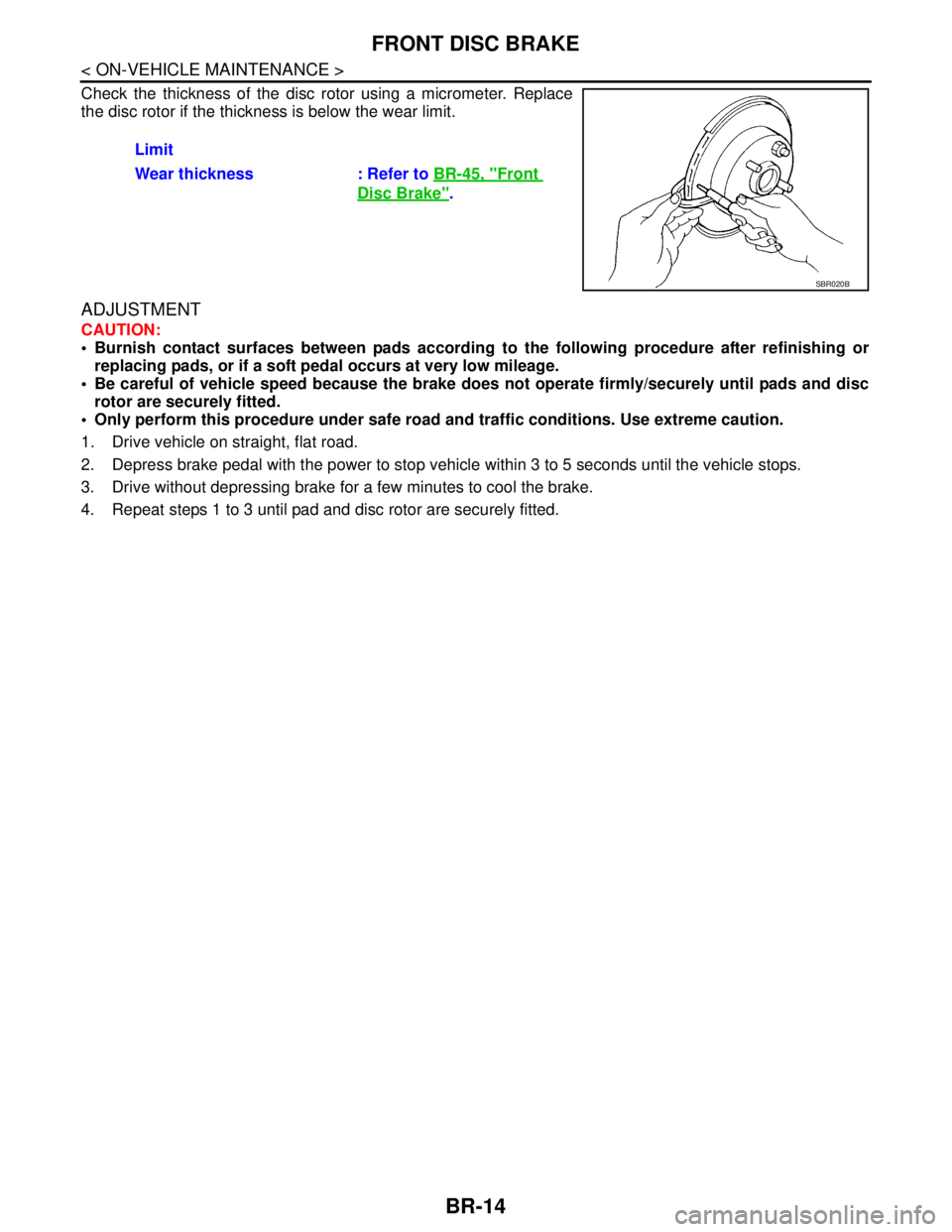
Check the thickness of the disc rotor using a micrometer. Replace
the disc rotor if the thickness is below the wear limit.
ADJUSTMENT
CAUTION:
Burnish contact surfaces between pads according to the following procedure after refinishing or
replacing pads, or if a soft pedal occurs at very low mileage.
Be careful of vehicle speed because the brake does not operate firmly/securely until pads and disc
rotor are securely fitted.
Only perform this procedure under safe road and traffic conditions. Use extreme caution.
1. Drive vehicle on straight, flat road.
2. Depress brake pedal with the power to stop vehicle within 3 to 5 seconds until the vehicle stops.
3. Drive without depressing brake for a few minutes to cool the brake.
4. Repeat steps 1 to 3 until pad and disc rotor are securely fitted.Limit
Wear thickness : Refer to BR-45, "
Front
Disc Brake".
SBR020B
Page 911 of 5121
REAR DISC BRAKE
BR-15
< ON-VEHICLE MAINTENANCE >
C
D
E
G
H
I
J
K
L
MA
B
BR
N
O
P
REAR DISC BRAKE
BRAKE PAD
BRAKE PAD : Inspection and AdjustmentINFOID:0000000003811181
INSPECTION
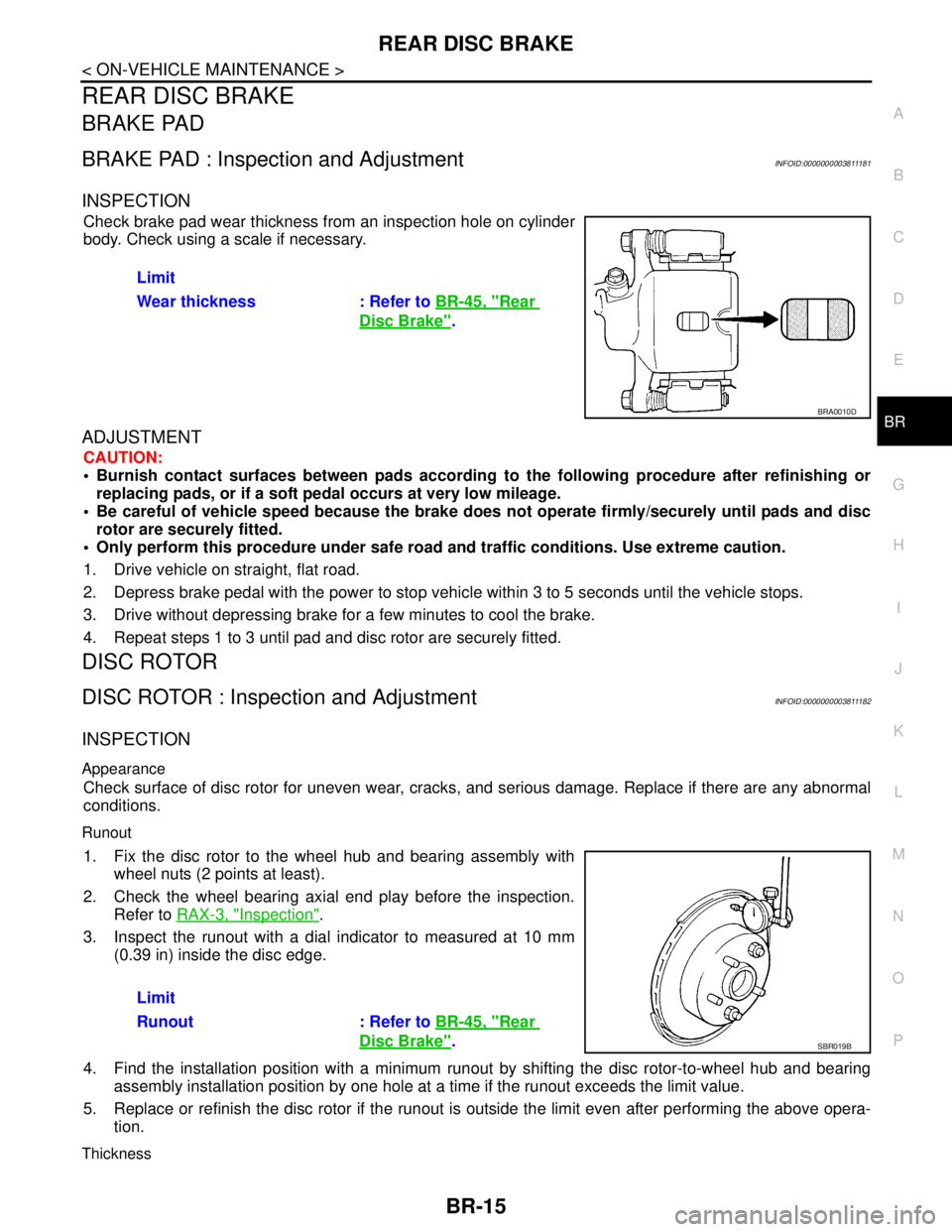
Check brake pad wear thickness from an inspection hole on cylinder
body. Check using a scale if necessary.
ADJUSTMENT
CAUTION:
Burnish contact surfaces between pads according to the following procedure after refinishing or
replacing pads, or if a soft pedal occurs at very low mileage.
Be careful of vehicle speed because the brake does not operate firmly/securely until pads and disc
rotor are securely fitted.
Only perform this procedure under safe road and traffic conditions. Use extreme caution.
1. Drive vehicle on straight, flat road.
2. Depress brake pedal with the power to stop vehicle within 3 to 5 seconds until the vehicle stops.
3. Drive without depressing brake for a few minutes to cool the brake.
4. Repeat steps 1 to 3 until pad and disc rotor are securely fitted.
DISC ROTOR
DISC ROTOR : Inspection and AdjustmentINFOID:0000000003811182
INSPECTION
Appearance
Check surface of disc rotor for uneven wear, cracks, and serious damage. Replace if there are any abnormal
conditions.
Runout
1. Fix the disc rotor to the wheel hub and bearing assembly with
wheel nuts (2 points at least).
2. Check the wheel bearing axial end play before the inspection.
Refer to RAX-3, "
Inspection".
3. Inspect the runout with a dial indicator to measured at 10 mm
(0.39 in) inside the disc edge.
4. Find the installation position with a minimum runout by shifting the disc rotor-to-wheel hub and bearing
assembly installation position by one hole at a time if the runout exceeds the limit value.
5. Replace or refinish the disc rotor if the runout is outside the limit even after performing the above opera-
tion.
Thickness
Limit
Wear thickness : Refer to BR-45, "
Rear
Disc Brake".
BRA0010D
Limit
Runout : Refer to BR-45, "
Rear
Disc Brake".SBR019B
Page 912 of 5121
BR-16
< ON-VEHICLE MAINTENANCE >
REAR DISC BRAKE
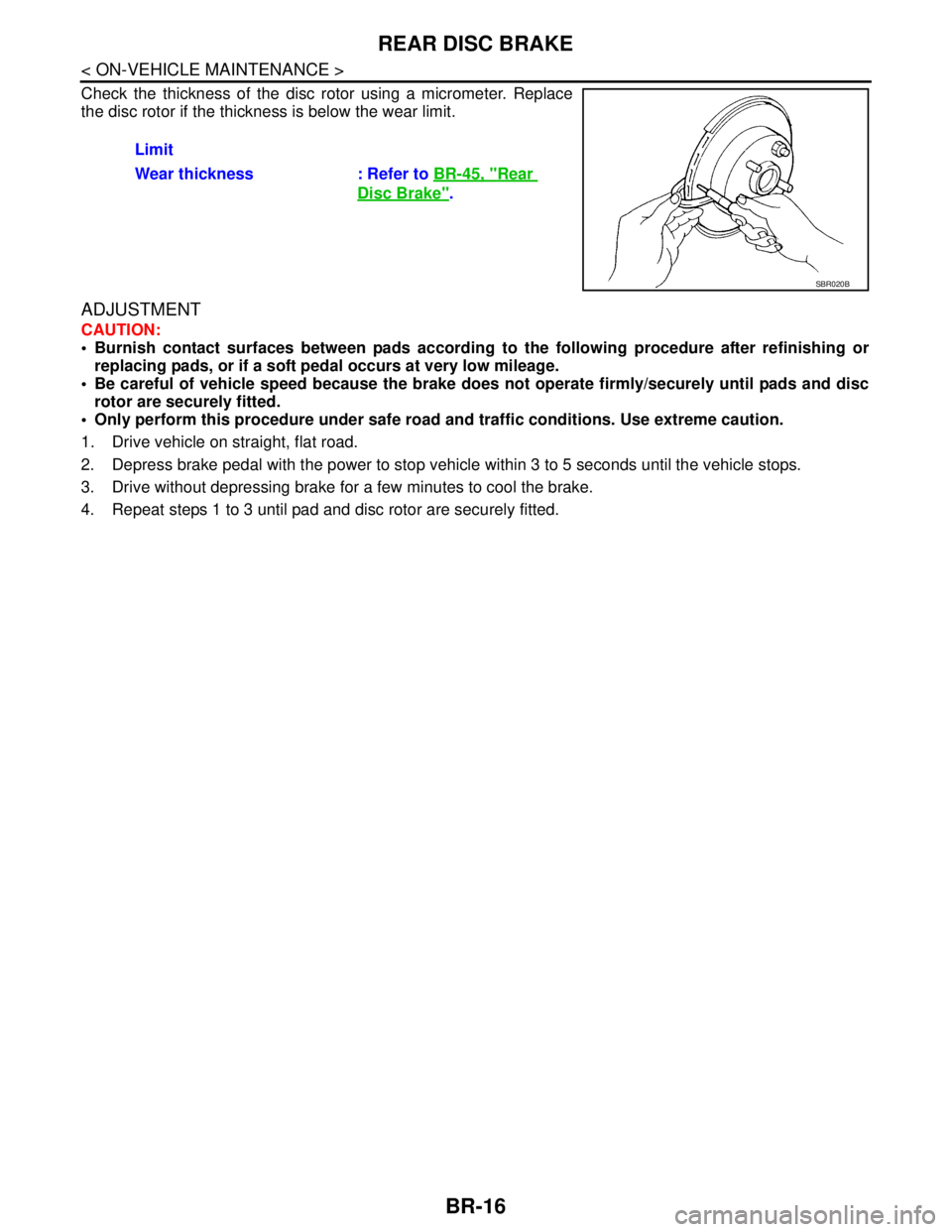
Check the thickness of the disc rotor using a micrometer. Replace
the disc rotor if the thickness is below the wear limit.
ADJUSTMENT
CAUTION:
Burnish contact surfaces between pads according to the following procedure after refinishing or
replacing pads, or if a soft pedal occurs at very low mileage.
Be careful of vehicle speed because the brake does not operate firmly/securely until pads and disc
rotor are securely fitted.
Only perform this procedure under safe road and traffic conditions. Use extreme caution.
1. Drive vehicle on straight, flat road.
2. Depress brake pedal with the power to stop vehicle within 3 to 5 seconds until the vehicle stops.
3. Drive without depressing brake for a few minutes to cool the brake.
4. Repeat steps 1 to 3 until pad and disc rotor are securely fitted.Limit
Wear thickness : Refer to BR-45, "
Rear
Disc Brake".
SBR020B
Page 926 of 5121

BR-30
< ON-VEHICLE REPAIR >
BRAKE BOOSTER
Idle the engine for 1 minute to apply vacuum to the brake booster,
and stop the engine. Then depress the brake pedal several times
at 5-second intervals until the accumulated vacuum is released to
atmospheric pressure. Check that the clearance between brake
pedal and dash lower panel gradually increases (A → B → C) each
time the brake pedal is depressed during this operation.
Depress the brake pedal with the engine running. Then stop the
engine while holding down the brake pedal. Check that the brake
pedal stroke does not change after holding down the brake pedal
for 30 seconds or more.
NOTE:
A slight impact with a small click may be felt on the pedal when the
brake pedal is fully depressed. This is a normal phenomenon due
to the brake system operation.
ADJUSTMENT AFTER INSTALLATION
Perform the brake pedal adjustment after installing the brake pedal assembly. Refer to BR-6, "Inspection and
Adjustment".
JPFIA0043ZZ
JPFIA0044ZZ
Page 930 of 5121
BR-34
< ON-VEHICLE REPAIR >
FRONT DISC BRAKE
1. Install the pad retainer to the torque member if the pad retainers has been removed.
CAUTION:
Securely assemble the pad retainers so that it will not be lifted up from the torque member.
Never deform the pad retainers.
2. Apply copper based brake grease to the mating faces between the brake pads and pad retainers.
3. Apply PBC (Poly Butyl Cuprysil) grease or silicone-based grease to the mating faces between the brake
pads, shims and shim cover, and install them to the brake pad.
CAUTION:
Always replace the shims together with the shim cover when replacing the brake pad.
4. Install the cylinder body and brake pads to the torque member.
CAUTION:
Never damage the piston boot.
When replacing a pad with new one, check a brake fluid level in the reservoir tank because brake
fluid returns to master cylinder reservoir tank when pressing piston in.
NOTE:
Use a disc brake piston tool to easily press piston.
5. Install the lower sliding pin bolt and tighten it to the specified torque.
6. Depress the brake pedal several times to check that no drag feel is present for the front disc brake. Refer
to BR-34, "
BRAKE PAD : Inspection".
BRAKE PAD : InspectionINFOID:0000000003811206
INSPECTION AFTER REMOVAL
Replace the shims and the shim cover if rust is excessively attached.
INSPECTION AFTER INSTALLATION
1. Check a drag of front disc brake. If any drag is found, follow the procedure described below.
2. Remove brake pads.
3. Press the piston.
CAUTION:
Never damage the piston boot.
When replacing a pad with new one, check a brake fluid level in the reservoir tank because brake
fluid returns to master cylinder reservoir tank when pressing piston in.
NOTE:
Use a disc brake piston tool to easily press piston.
4. Install brake pads.
5. Depress the brake pedal several times.
6. Check a drag of front disc brake again. If any drag is found, disassemble the cylinder body. Refer to BR-
36, "BRAKE CALIPER ASSEMBLY : Disassembly and Assembly".
7. Burnish contact surfaces after refinishing or replacing pads, or if a soft pedal occurs at very low mileage.
Refer to BR-13, "
BRAKE PAD : Inspection and Adjustment".
BRAKE CALIPER ASSEMBLY
BRAKE CALIPER ASSEMBLY : Exploded ViewINFOID:0000000003811207
REMOVAL
Page 934 of 5121
BR-38
< ON-VEHICLE REPAIR >
FRONT DISC BRAKE
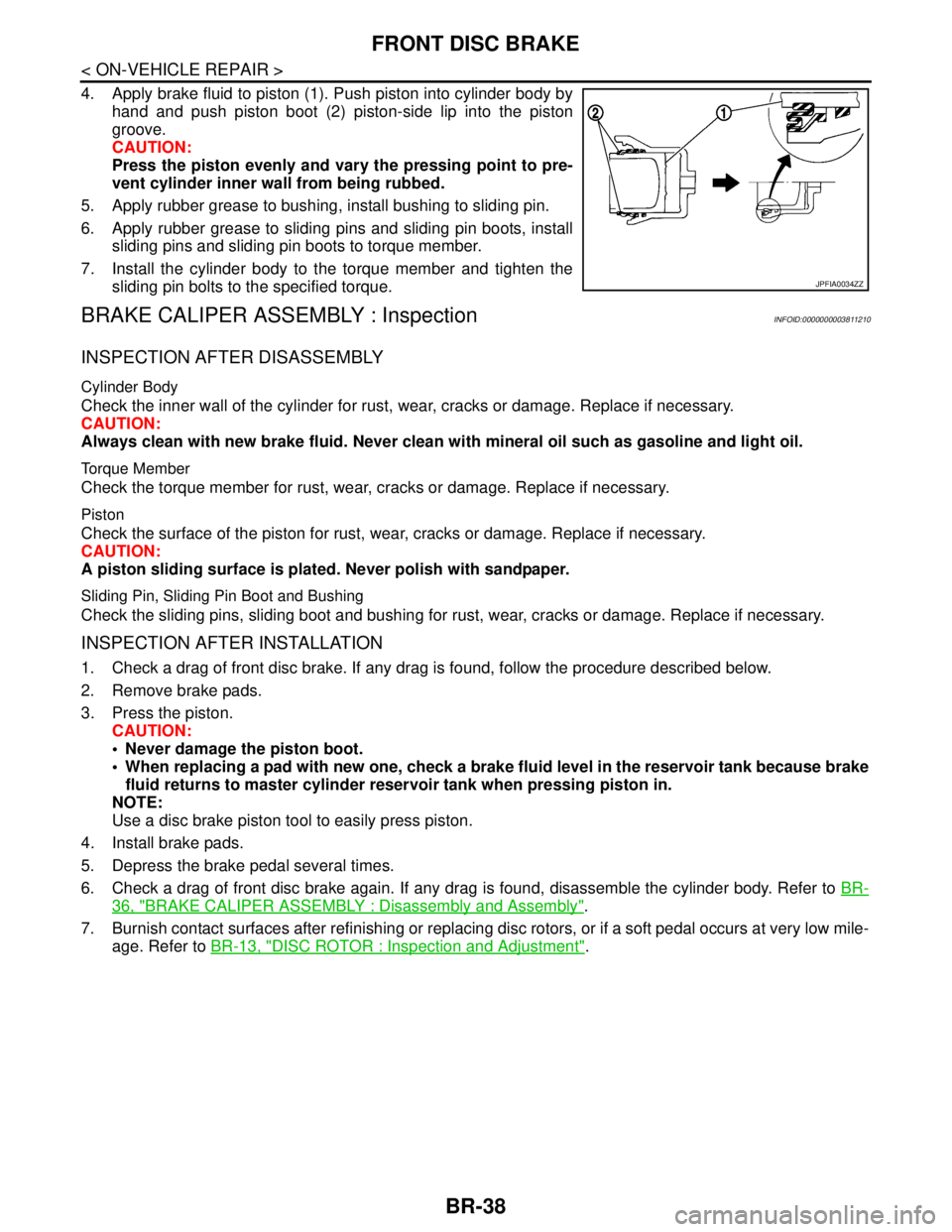
4. Apply brake fluid to piston (1). Push piston into cylinder body by
hand and push piston boot (2) piston-side lip into the piston
groove.
CAUTION:
Press the piston evenly and vary the pressing point to pre-
vent cylinder inner wall from being rubbed.
5. Apply rubber grease to bushing, install bushing to sliding pin.
6. Apply rubber grease to sliding pins and sliding pin boots, install
sliding pins and sliding pin boots to torque member.
7. Install the cylinder body to the torque member and tighten the
sliding pin bolts to the specified torque.
BRAKE CALIPER ASSEMBLY : InspectionINFOID:0000000003811210
INSPECTION AFTER DISASSEMBLY
Cylinder Body
Check the inner wall of the cylinder for rust, wear, cracks or damage. Replace if necessary.
CAUTION:
Always clean with new brake fluid. Never clean with mineral oil such as gasoline and light oil.
Torque Member
Check the torque member for rust, wear, cracks or damage. Replace if necessary.
Piston
Check the surface of the piston for rust, wear, cracks or damage. Replace if necessary.
CAUTION:
A piston sliding surface is plated. Never polish with sandpaper.
Sliding Pin, Sliding Pin Boot and Bushing
Check the sliding pins, sliding boot and bushing for rust, wear, cracks or damage. Replace if necessary.
INSPECTION AFTER INSTALLATION
1. Check a drag of front disc brake. If any drag is found, follow the procedure described below.
2. Remove brake pads.
3. Press the piston.
CAUTION:
Never damage the piston boot.
When replacing a pad with new one, check a brake fluid level in the reservoir tank because brake
fluid returns to master cylinder reservoir tank when pressing piston in.
NOTE:
Use a disc brake piston tool to easily press piston.
4. Install brake pads.
5. Depress the brake pedal several times.
6. Check a drag of front disc brake again. If any drag is found, disassemble the cylinder body. Refer to BR-
36, "BRAKE CALIPER ASSEMBLY : Disassembly and Assembly".
7. Burnish contact surfaces after refinishing or replacing disc rotors, or if a soft pedal occurs at very low mile-
age. Refer to BR-13, "
DISC ROTOR : Inspection and Adjustment".
JPFIA0034ZZ
Page 936 of 5121
BR-40
< ON-VEHICLE REPAIR >
REAR DISC BRAKE
Never depress the brake pedal while removing the brake pads or the cylinder body because the pis-
ton may pop out.
Never spill or splash brake fluid on the disc rotor.
1. Install the pad retainers to the torque member if the pad retainers has been removed.
CAUTION:
Securely assemble the pad retainers not to be lifted up from the torque member.
Never deform the pad retainers.
2. Apply PBC (Poly Butyl Cuprysil) grease or silicone-based grease to the mating faces between the brake
pads, the shims and pawls part of cylinder body, and install them to the brake pad.
CAUTION:
Always replace the shims together when replacing the brake pad.
3. Install cylinder body and brake pads to torque member.
CAUTION:
Never damage the piston boot.
When replacing pads with new one, check a brake fluid level in the reservoir tank because brake
fluid returns to master cylinder reservoir tank when pressing piston in.
NOTE:
Use a disc brake piston tool to easily press piston.
4. Install the upper sliding pin bolt and tighten it to the specified torque.
5. Depress the brake pedal several times to check that no drag feel is present for the rear disc brake. Refer
to BR-40, "
BRAKE PAD : Inspection".
BRAKE PAD : InspectionINFOID:0000000003811213
INSPECTION AFTER REMOVAL
Replace the shims if rust is excessively attached.
INSPECTION AFTER INSTALLATION
1. Check a drag of rear disc brake. If any drag is found, follow the procedure described below.
2. Remove brake pads.
3. Press the piston.
CAUTION:
Never damage the piston boot.
When replacing a pad with new one, check a brake fluid level in the reservoir tank because brake
fluid returns to master cylinder reservoir tank when pressing piston in.
NOTE:
Use a disc brake piston tool to easily press piston.
4. Install brake pads.
5. Depress the brake pedal several times.
6. Check a drag of rear disc brake again. If any drag is found, disassemble the cylinder body. Refer to BR-
42, "BRAKE CALIPER ASSEMBLY : Disassembly and Assembly".
7. Burnish contact surfaces after refinishing or replacing pads, or if a soft pedal occurs at very low mileage.
Refer to BR-15, "
BRAKE PAD : Inspection and Adjustment".
BRAKE CALIPER ASSEMBLY
BRAKE CALIPER ASSEMBLY : Exploded ViewINFOID:0000000003811214
REMOVAL
Page 940 of 5121
BR-44
< ON-VEHICLE REPAIR >
REAR DISC BRAKE
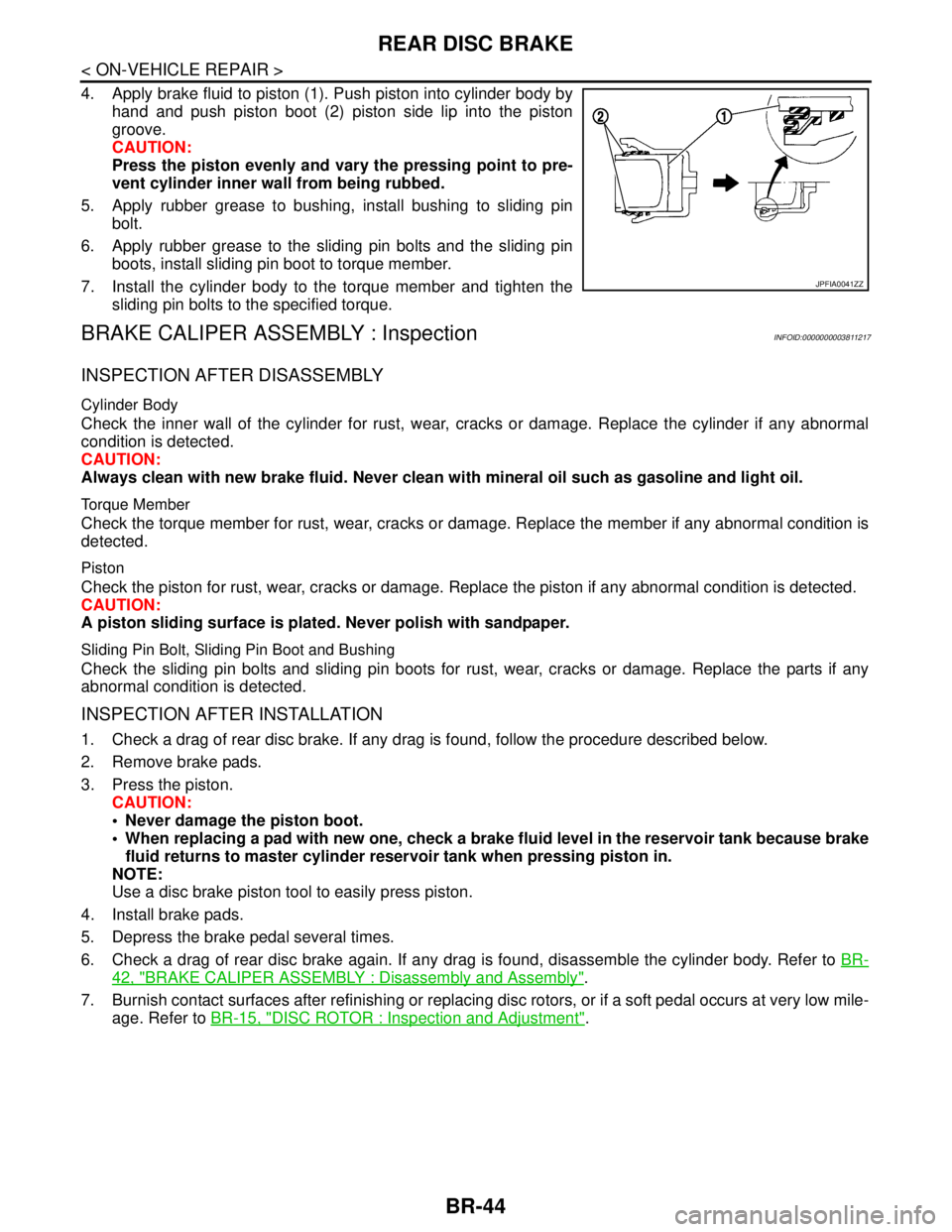
4. Apply brake fluid to piston (1). Push piston into cylinder body by
hand and push piston boot (2) piston side lip into the piston
groove.
CAUTION:
Press the piston evenly and vary the pressing point to pre-
vent cylinder inner wall from being rubbed.
5. Apply rubber grease to bushing, install bushing to sliding pin
bolt.
6. Apply rubber grease to the sliding pin bolts and the sliding pin
boots, install sliding pin boot to torque member.
7. Install the cylinder body to the torque member and tighten the
sliding pin bolts to the specified torque.
BRAKE CALIPER ASSEMBLY : InspectionINFOID:0000000003811217
INSPECTION AFTER DISASSEMBLY
Cylinder Body
Check the inner wall of the cylinder for rust, wear, cracks or damage. Replace the cylinder if any abnormal
condition is detected.
CAUTION:
Always clean with new brake fluid. Never clean with mineral oil such as gasoline and light oil.
Torque Member
Check the torque member for rust, wear, cracks or damage. Replace the member if any abnormal condition is
detected.
Piston
Check the piston for rust, wear, cracks or damage. Replace the piston if any abnormal condition is detected.
CAUTION:
A piston sliding surface is plated. Never polish with sandpaper.
Sliding Pin Bolt, Sliding Pin Boot and Bushing
Check the sliding pin bolts and sliding pin boots for rust, wear, cracks or damage. Replace the parts if any
abnormal condition is detected.
INSPECTION AFTER INSTALLATION
1. Check a drag of rear disc brake. If any drag is found, follow the procedure described below.
2. Remove brake pads.
3. Press the piston.
CAUTION:
Never damage the piston boot.
When replacing a pad with new one, check a brake fluid level in the reservoir tank because brake
fluid returns to master cylinder reservoir tank when pressing piston in.
NOTE:
Use a disc brake piston tool to easily press piston.
4. Install brake pads.
5. Depress the brake pedal several times.
6. Check a drag of rear disc brake again. If any drag is found, disassemble the cylinder body. Refer to BR-
42, "BRAKE CALIPER ASSEMBLY : Disassembly and Assembly".
7. Burnish contact surfaces after refinishing or replacing disc rotors, or if a soft pedal occurs at very low mile-
age. Refer to BR-15, "
DISC ROTOR : Inspection and Adjustment".
JPFIA0041ZZ
Page 943 of 5121

BRC-2
Description ..............................................................36
DTC Logic ...............................................................36
Diagnosis Procedure ..............................................36
Component Inspection ............................................37
U1000, U1002 CAN COMM CIRCUIT ...............38
Description ..............................................................38
DTC Logic ...............................................................38
Diagnosis Procedure ..............................................38
POWER SUPPLY AND GROUND CIRCUIT .....39
Description ..............................................................39
Diagnosis Procedure ..............................................39
ABS WARNING LAMP ......................................40
Description ..............................................................40
Component Function Check ...................................40
Diagnosis Procedure ..............................................40
BRAKE WARNING LAMP .................................41
Description ..............................................................41
Component Function Check ...................................41
Diagnosis Procedure ..............................................41
ECU DIAGNOSIS ........................................42
ABS ACTUATOR AND ELECTRIC UNIT
(CONTROL UNIT) ..............................................
42
Reference Value .....................................................42
Wiring Diagram - BRAKE CONTROL SYSTEM - ...44
Fail-Safe .................................................................47
DTC No. Index ........................................................48
SYMPTOM DIAGNOSIS .............................49
EXCESSIVE ABS FUNCTION OPERATION
FREQUENCY .....................................................
49
Diagnosis Procedure ..............................................49
UNEXPECTED PEDAL REACTION ..................50
Diagnosis Procedure ..............................................50
THE BRAKING DISTANCE IS LONG ...............51
Diagnosis Procedure ..............................................51
ABS FUNCTION DOES NOT OPERATE ..........52
Diagnosis Procedure ..............................................52
PEDAL VIBRATION OR ABS OPERATION
SOUND OCCURS ..............................................
53
Diagnosis Procedure ..............................................53
NORMAL OPERATING CONDITION ................54
Description ..............................................................54
PRECAUTION .............................................55
PRECAUTIONS .................................................55
Precaution for Supplemental Restraint System
(SRS) "AIR BAG" and "SEAT BELT PRE-TEN-
SIONER" .................................................................
55
Precaution for Procedure without Cowl Top Cover ...55
Precaution for Brake System ..................................55
Precaution for Brake Control ...................................56
Precautions for Harness Repair ..............................56
ON-VEHICLE REPAIR ...............................57
WHEEL SENSOR ..............................................57
FRONT WHEEL SENSOR ........................................57
FRONT WHEEL SENSOR : Exploded View ...........57
FRONT WHEEL SENSOR : Removal and Instal-
lation .......................................................................
57
REAR WHEEL SENSOR ...........................................58
REAR WHEEL SENSOR : Exploded View .............58
REAR WHEEL SENSOR : Removal and Installa-
tion ..........................................................................
58
SENSOR ROTOR ..............................................59
FRONT SENSOR ROTOR ........................................59
FRONT SENSOR ROTOR : Exploded View ...........59
FRONT SENSOR ROTOR : Removal and Instal-
lation .......................................................................
59
REAR SENSOR ROTOR ...........................................59
REAR SENSOR ROTOR : Exploded View .............59
REAR SENSOR ROTOR : Removal and Installa-
tion ..........................................................................
59
ABS ACTUATOR AND ELECTRIC UNIT
(CONTROL UNIT) ..............................................
60
Exploded View ........................................................60
Removal and Installation .........................................60
VDC/TCS/ABS
BASIC INSPECTION ..................................
62
DIAGNOSIS AND REPAIR WORK FLOW ........62
Work Flow ...............................................................62
Diagnostic Work Sheet ...........................................65
INSPECTION AND ADJUSTMENT ...................66
ADDITIONAL SERVICE WHEN REPLACING
CONTROL UNIT ........................................................
66
ADDITIONAL SERVICE WHEN REPLACING
CONTROL UNIT : Description ................................
66
ADDITIONAL SERVICE WHEN REPLACING
CONTROL UNIT : Special Repair Requirement .....
66
ADJUSTMENT OF STEERING ANGLE SENSOR
NEUTRAL POSITION ................................................
66
ADJUSTMENT OF STEERING ANGLE SENSOR
NEUTRAL POSITION : Description ........................
66
ADJUSTMENT OF STEERING ANGLE SENSOR
NEUTRAL POSITION : Special Repair Require-
ment ........................................................................
66
FUNCTION DIAGNOSIS ............................68
VDC ....................................................................68
Page 945 of 5121

BRC-4
Diagnosis Procedure .............................................112
Special Repair Requirement ..................................112
C1145, C1146 YAW RATE/SIDE G SENSOR .113
Description .............................................................113
DTC Logic ..............................................................113
Diagnosis Procedure .............................................113
Component Inspection ...........................................114
Special Repair Requirement ..................................115
C1155 BRAKE FLUID LEVEL SWITCH ..........116
Description .............................................................116
DTC Logic ..............................................................116
Diagnosis Procedure .............................................116
Component Inspection ...........................................117
Special Repair Requirement ..................................117
C1164, C1165 CV SYSTEM ............................118
Description .............................................................118
DTC Logic ..............................................................118
Diagnosis Procedure .............................................118
Component Inspection ...........................................119
Special Repair Requirement ..................................119
C1166, C1167 SV SYSTEM .............................120
Description .............................................................120
DTC Logic ..............................................................120
Diagnosis Procedure .............................................120
Component Inspection ...........................................121
Special Repair Requirement ..................................121
U1000, U1002 CAN COMM CIRCUIT .............122
Description .............................................................122
DTC Logic ..............................................................122
Diagnosis Procedure .............................................122
Special Repair Requirement ..................................122
POWER SUPPLY AND GROUND CIRCUIT ...123
Description .............................................................123
Diagnosis Procedure .............................................123
PARKING BRAKE SWITCH ............................124
Component Function Check ..................................124
Diagnosis Procedure .............................................124
Component Inspection ...........................................124
VDC OFF SWITCH ..........................................126
Description .............................................................126
Component Function Check ..................................126
Diagnosis Procedure .............................................126
Component Inspection ...........................................127
ABS WARNING LAMP ....................................128
Description .............................................................128
Component Function Check ..................................128
Diagnosis Procedure .............................................128
BRAKE WARNING LAMP ...............................129
Description .............................................................129
Component Function Check ..................................129
Diagnosis Procedure .............................................129
VDC OFF INDICATOR LAMP ..........................130
Description ............................................................130
Component Function Check .................................130
Diagnosis Procedure .............................................130
SLIP INDICATOR LAMP ..................................131
Description ............................................................131
Component Function Check .................................131
Diagnosis Procedure .............................................131
ECU DIAGNOSIS ......................................132
ABS ACTUATOR AND ELECTRIC UNIT
(CONTROL UNIT) .............................................
132
Reference Value ...................................................132
Wiring Diagram - BRAKE CONTROL SYSTEM - .136
Fail-Safe ................................................................139
DTC No. Index ......................................................140
SYMPTOM DIAGNOSIS ...........................142
EXCESSIVE ABS FUNCTION OPERATION
FREQUENCY ....................................................
142
Diagnosis Procedure .............................................142
UNEXPECTED PEDAL REACTION .................143
Diagnosis Procedure .............................................143
THE BRAKING DISTANCE IS LONG ..............144
Diagnosis Procedure .............................................144
ABS FUNCTION DOES NOT OPERATE .........145
Diagnosis Procedure .............................................145
PEDAL VIBRATION OR ABS OPERATION
SOUND OCCURS .............................................
146
Diagnosis Procedure .............................................146
VEHICLE JERKS DURING VDC/TCS/ABS
CONTROL ........................................................
147
Diagnosis Procedure .............................................147
NORMAL OPERATING CONDITION ...............148
Description ............................................................148
PRECAUTION ...........................................149
PRECAUTIONS ................................................149
Precaution for Supplemental Restraint System
(SRS) "AIR BAG" and "SEAT BELT PRE-TEN-
SIONER" ...............................................................
149
Precaution for Procedure without Cowl Top Cover .149
Precaution for Brake System ................................149
Precaution for Brake Control .................................150
Precautions for Harness Repair ............................150
ON-VEHICLE REPAIR ..............................151
WHEEL SENSOR .............................................151
FRONT WHEEL SENSOR ......................................151
FRONT WHEEL SENSOR : Exploded View .........151