esp NISSAN TEANA 2014 Service Manual
[x] Cancel search | Manufacturer: NISSAN, Model Year: 2014, Model line: TEANA, Model: NISSAN TEANA 2014Pages: 4801, PDF Size: 51.2 MB
Page 2743 of 4801
![NISSAN TEANA 2014 Service Manual
HAC-94
< SYMPTOM DIAGNOSIS >[AUTOMATIC AIR CONDITIONER]
HEATER AND AIR CONDITIONING
SYSTEM CONTROL SYMPTOMS
SYMPTOM DIAGNOSIS
HEATER AND AIR CONDITIONING SYSTEM CONTROL SYMPTOMS
Diagnosis Chart By S](/img/5/57390/w960_57390-2742.png "NISSAN TEANA 2014 Service Manual
HAC-94
< SYMPTOM DIAGNOSIS >[AUTOMATIC AIR CONDITIONER]
HEATER AND AIR CONDITIONING
SYSTEM CONTROL SYMPTOMS
SYMPTOM DIAGNOSIS
HEATER AND AIR CONDITIONING SYSTEM CONTROL SYMPTOMS
Diagnosis Chart By S")
HAC-94
< SYMPTOM DIAGNOSIS >[AUTOMATIC AIR CONDITIONER]
HEATER AND AIR CONDITIONING
SYSTEM CONTROL SYMPTOMS
SYMPTOM DIAGNOSIS
HEATER AND AIR CONDITIONING SYSTEM CONTROL SYMPTOMS
Diagnosis Chart By SymptomINFOID:0000000009463166
NOTE:
Perform the self-diagnoses with CONSULT before perfo rming the symptom diagnosis. If DTC is detected, per-
form the corresponding diagnosis.
Symptom Corresponding malfunction part Reference
• Air conditioning does not activate.
• Air conditioning cannot be controlled.
• Operation status of air conditioning is not indicated on display. • A/C auto amp. ignition power supply
circuit
• Front A/C control (A/C auto amp.) HAC-78, "A/C AUTO AMP. : Diag-
nosis Procedure"
• Air outlet does not change.
• Mode door motor does not operate normally. • Circuit between mode door motor
and A/C auto amp.
• Mode door motor control linkage
• Mode door motor
• A/C auto amp. HAC-80, "MODE DOOR MOTOR :
Diagnosis Procedure"
• Discharge air temperature of driver side does not
change.
• Air mix door motor LH does not operate normally. • Circuit between air mix door motor
LH and A/C auto amp.
• Air mix door motor LH installation condition
• Air mix door motor LH
• A/C auto amp. HAC-78, "AIR MIX DOOR MOTOR
(DRIVER SIDE) : Diagnosis Proce-
dure"
• Discharge air temperature of passenger side does
not change.
• Air mix door motor RH does not operate normally. • Circuit between air mix door motor
RH and A/C auto amp.
• Air mix door motor RH installation condition
• Air mix door motor RH
• A/C auto amp. HAC-79, "AIR MIX DOOR MOTOR
(PASSENGER SIDE) : Diagnosis
Procedure"
• Intake door does not change.
• Intake door motor does not operate normally. • Circuit between intake door motor
and A/C auto amp.
• Intake door motor control linkage
• Intake door motor
• A/C auto amp. HAC-81, "INTAKE DOOR MOTOR :
Diagnosis Procedure"
All door motors do not operate normally.
• Each door motor power supply and
ground circuit
• A/C auto amp. HAC-89, "Diagnosis Procedure"
Blower motor operation is malfunctioning. • Power supply system of front blower
motor
• Circuit between front blower motor
and A/C auto amp.
• Front blower motor
• A/C auto amp. HAC-84, "Diagnosis Procedure"
Compressor does not operate. • Circuit between magnet clutch and
IPDM E/R
• Magnet clutch
• IPDM E/R (A/C relay)
• Circuit between ECM and refriger- ant pressure sensor
• Refrigerant pressure sensor
• CAN communication circuit
• A/C auto amp. HAC-87, "Diagnosis Procedure"
Revision: November 20132014 Altima NAMRevision: November 20132014 Altima NAM
Page 2744 of 4801
![NISSAN TEANA 2014 Service Manual
HEATER AND AIR CONDITIONING SYSTEM CONTROL SYMPTOMS
HAC-95
< SYMPTOM DIAGNOSIS > [AUTOMATIC AIR CONDITIONER]
C
D E
F
G H
J
K L
M A
B
HAC
N
O P
• Insufficient cooling.
• No cool air comes out.](/img/5/57390/w960_57390-2743.png "NISSAN TEANA 2014 Service Manual
HEATER AND AIR CONDITIONING SYSTEM CONTROL SYMPTOMS
HAC-95
< SYMPTOM DIAGNOSIS > [AUTOMATIC AIR CONDITIONER]
C
D E
F
G H
J
K L
M A
B
HAC
N
O P
• Insufficient cooling.
• No cool air comes out.")
HEATER AND AIR CONDITIONING SYSTEM CONTROL SYMPTOMS
HAC-95
< SYMPTOM DIAGNOSIS > [AUTOMATIC AIR CONDITIONER]
C
D E
F
G H
J
K L
M A
B
HAC
N
O P
• Insufficient cooling.
• No cool air comes out. (Air flow volume is normal.) • Magnet clutch control system
• Drive belt slipping
• Refrigerant cycle
• ECV (electrical control valve)
• Air leakage from each duct
• A/C auto amp. connection recogni- tion signal circuit
• Temperature setting trimmer (front)HAC-96, "Diagnosis Procedure"
• Insufficient heating.
• No warm air comes out. (Air flow volume is nor- mal.) • Engine cooling system
• Heater hose
• Heater core
• Air leakage from each duct
• Temperature setting trimmer (front)HAC-98, "Diagnosis Procedure"
Noise is heard when front
air conditioning system op-
erates. During compressor
operation Refrigerant cycle
HA-18, "Symptom Table"
During front blower
motor operation • Mixing any foreign object in front
blower motor
• Front blower motor fan breakage
• Front blower motor rotation inferiori-
ty HAC-85, "Component Inspection
(Blower Motor)"
• Memory function does not operate.
• Setting temperature is not memorized. • Battery power supply system of A/C
auto amp.
• A/C auto amp. HAC-78, "A/C AUTO AMP. : Diag-
nosis Procedure"
Symptom Corresponding malfunction part Reference
Revision: November 20132014 Altima NAMRevision: November 20132014 Altima NAM
Page 2745 of 4801
![NISSAN TEANA 2014 Service Manual
HAC-96
< SYMPTOM DIAGNOSIS >[AUTOMATIC AIR CONDITIONER]
INSUFFICIENT COOLING
INSUFFICIENT COOLING
DescriptionINFOID:0000000009463167
Symptom
• Insufficient cooling
• No cool air comes out. (Air](/img/5/57390/w960_57390-2744.png "NISSAN TEANA 2014 Service Manual
HAC-96
< SYMPTOM DIAGNOSIS >[AUTOMATIC AIR CONDITIONER]
INSUFFICIENT COOLING
INSUFFICIENT COOLING
DescriptionINFOID:0000000009463167
Symptom
• Insufficient cooling
• No cool air comes out. (Air")
HAC-96
< SYMPTOM DIAGNOSIS >[AUTOMATIC AIR CONDITIONER]
INSUFFICIENT COOLING
INSUFFICIENT COOLING
DescriptionINFOID:0000000009463167
Symptom
• Insufficient cooling
• No cool air comes out. (Air flow volume is normal.)
Diagnosis ProcedureINFOID:0000000009463168
NOTE:
Perform self-diagnoses with CONSULT before performi ng symptom diagnosis. If any DTC is detected, per-
form the corresponding diagnosis.
1.CHECK MAGNET CLUTCH OPERATION
1. Turn ignition switch ON.
2. Operate fan switch.
3. Press A/C switch.
4. Check that A/C indicator turns ON. Check visually and by sound that compressor operates.
5. Press A/C switch again.
6. Check that A/C indicator turns OFF. Check that compressor stops.
Is the inspection result normal?
YES >> GO TO 2.
NO >> Perform diagnosis of “COMPRESSOR DOES NOT OPERATE” in “SYMPTOM DIAGNOSIS”.
Refer to HAC-99, "Diagnosis Procedure"
.
2.CHECK DRIVE BELT
Check tension of drive belt. Refer to EM-19, "Checking Drive Belts"
(QR25DE) or EM-134, "Checking Drive
Belts" (VQ35DE).
Is the inspection result normal?
YES >> GO TO 3.
NO >> Adjust or replace drive belt depending on the inspection results.
3.CHECK REFRIGERANT CYCLE
Connect recovery/recycling recharging equipment to the vehicle and perform pressure inspection with gauge.
Refer to HA-18, "Symptom Table"
.
Is the inspection result normal?
YES >> GO TO 4.
NO >> Repair or replace parts depending on the inspection results.
4.CHECK AIR LEAKAGE FROM EACH DUCT
Check duct and nozzle, etc. of the fr ont air conditioning system for leakage.
Is the inspection result normal?
YES >> GO TO 5.
NO >> Repair or replace parts depending on the inspection results.
5.CHECK AMBIENT TEMPERATURE DISPLAY
Check that there is not much difference between act ual ambient temperature and indicated temperature on
information display in combination meter.
Is the inspection result normal?
YES >> GO TO 6.
NO >> Perform diagnosis for the A/C auto amp. connection recognition signal circuit. Refer to HAC-60,
"Diagnosis Procedure".
6.CHECK SETTING OF TEMPERATURE SETTING TRIMMER (FRONT)
1. Check setting value of temperature setting trimmer (front). Refer to HAC-50, "Temperature Setting Trim-
mer".
2. Check that temperature setting trimme r (front) is set to “+ direction”.
Revision: November 20132014 Altima NAMRevision: November 20132014 Altima NAM
Page 2747 of 4801
![NISSAN TEANA 2014 Service Manual
HAC-98
< SYMPTOM DIAGNOSIS >[AUTOMATIC AIR CONDITIONER]
INSUFFICIENT HEATING
INSUFFICIENT HEATING
DescriptionINFOID:0000000009463169
Symptom
• Insufficient heating
• No warm air comes out. (Air](/img/5/57390/w960_57390-2746.png "NISSAN TEANA 2014 Service Manual
HAC-98
< SYMPTOM DIAGNOSIS >[AUTOMATIC AIR CONDITIONER]
INSUFFICIENT HEATING
INSUFFICIENT HEATING
DescriptionINFOID:0000000009463169
Symptom
• Insufficient heating
• No warm air comes out. (Air")
HAC-98
< SYMPTOM DIAGNOSIS >[AUTOMATIC AIR CONDITIONER]
INSUFFICIENT HEATING
INSUFFICIENT HEATING
DescriptionINFOID:0000000009463169
Symptom
• Insufficient heating
• No warm air comes out. (Air flow volume is normal.)
Diagnosis ProcedureINFOID:0000000009463170
NOTE:
Perform self-diagnosis with CONSULT before performing symptom diagnosis. If DTC is detected, perform the
corresponding diagnosis.
1.CHECK COOLING SYSTEM
1. Check engine coolant level and check leakage. Refer to CO-11, "System Inspection"
(QR25DE) or CO-
35, "System Inspection" (VQ35DE).
2. Check reservoir tank cap. Refer to CO-11, "System Inspection"
(QR25DE) or CO-35, "System Inspection"
(VQ35DE).
3. Check water flow sounds of the engine coolant. Refer to CO-11, "System Inspection"
(QR25DE) or CO-
35, "System Inspection" (VQ35DE).
Is the inspection result normal?
YES >> GO TO 2.
NO >> Refill engine coolant and repair or repl ace parts depending on the inspection results.
2.CHECK HEATER HOSE
Check installation of heater hose visually or by touching.
Is the inspection result normal?
YES >> GO TO 3.
NO >> Repair or replace parts depending on the inspection results.
3.CHECK HEATER CORE
1. Check temperature of inlet hose and outlet hose of front heater core.
2. Check that inlet side of heater core is hot and the outle t side is slightly lower than/almost equal to the inlet
side.
CAUTION:
Always perform the temperature in spection in a short period of time because the engine coolant
temperature is very hot.
Is the inspection result normal?
YES >> GO TO 4.
NO >> Replace heater core. Refer to HA-42, "HEATER CORE : Removal and Installation"
.
4.CHECK AIR LEAKAGE FROM EACH DUCT
Check duct and nozzle, etc. of front air conditioning system for air leakage.
Is the inspection result normal?
YES >> GO TO 5.
NO >> Repair or replace parts depending on the inspection results.
5.CHECK SETTING OF TEMPERATURE SETTING TRIMMER (FRONT)
1. Check setting value of temperature setting trimmer (front). Refer to HAC-50, "Temperature Setting Trim-
mer".
2. Check that temperature setting trimmer (front) is set to “ − direction”.
NOTE:
The control temperature can be set by t he temperature setting trimmer (front).
3. Set difference between the set temperature and control temperature to “0”.
Are the symptoms solved?
YES >> Inspection End.
NO >> Replace A/C auto amp. Refer to HAC-102, "Removal and Installation"
.
Revision: November 20132014 Altima NAMRevision: November 20132014 Altima NAM
Page 2748 of 4801
![NISSAN TEANA 2014 Service Manual
COMPRESSOR DOES NOT OPERATEHAC-99
< SYMPTOM DIAGNOSIS > [AUTOMATIC AIR CONDITIONER]
C
D E
F
G H
J
K L
M A
B
HAC
N
O P
COMPRESSOR DOES NOT OPERATE
DescriptionINFOID:0000000009463171
Symptom: Compres](/img/5/57390/w960_57390-2747.png "NISSAN TEANA 2014 Service Manual
COMPRESSOR DOES NOT OPERATEHAC-99
< SYMPTOM DIAGNOSIS > [AUTOMATIC AIR CONDITIONER]
C
D E
F
G H
J
K L
M A
B
HAC
N
O P
COMPRESSOR DOES NOT OPERATE
DescriptionINFOID:0000000009463171
Symptom: Compres")
COMPRESSOR DOES NOT OPERATEHAC-99
< SYMPTOM DIAGNOSIS > [AUTOMATIC AIR CONDITIONER]
C
D E
F
G H
J
K L
M A
B
HAC
N
O P
COMPRESSOR DOES NOT OPERATE
DescriptionINFOID:0000000009463171
Symptom: Compressor does not operate.
Diagnosis ProcedureINFOID:0000000009463172
NOTE:
• Perform self-diagnoses with CONSULT before perform ing symptom diagnosis. If DTC is detected, perform
the corresponding diagnosis.
• Check that refrigerant system is properly charged. If refrigerant amount is below the proper amount, perform
inspection of refrigerant leakage.
1.CHECK MAGNET CLUTCH OPERATION
Check magnet clutch. Refer to HAC-87, "Component Function Check"
.
Does it operate normally?
YES >> GO TO 2.
NO >> Repair or replace malfunctioning parts.
2.CHECK REFRIGERANT PRESSURE SENSOR
Check refrigerant pressure sensor. Refer to EC-523, "Component Function Check"
(QR25DE) or EC-979,
"Component Function Check" (VQ35DE).
Is the inspection result normal?
YES >> GO TO 3.
NO >> Repair or replace malfunctioning parts.
3.CHECK A/C AUTO AMP. OUTPUT SIGNAL
With CONSULT
Check “COMP REQ SIG” and “FAN REQ SIG” in “D ATA MONITOR” mode of “HVAC” using CONSULT.
Is the inspection result normal?
YES >> GO TO 4.
NO >> Replace A/C auto amp. Refer to HAC-102, "Removal and Installation"
.
4.CHECK ECM INPUT SIGNAL
With CONSULT
Check “AIR COND SIG” and “HEATER FAN SW” in “DATA MONITOR” mode of “ECM” using CONSULT.
Is the inspection result normal?
YES >> GO TO 5.
NO >> Check CAN communication system. Refer to LAN-18, "Trouble Diagnosis Flow Chart"
.
5.CHECK IPDM E/R INPUT SIGNAL
With CONSULT
Monitor item Condition Status
COMP REQ SIG A/C switch ON On
OFF Off
FAN REQ SIG Blower motor ON On
OFF Off
Monitor item Condition Status
AIR COND SIG A/C switch ON On
OFF Off
HEATER FAN SW Blower motor ON On
OFF Off
Revision: November 20132014 Altima NAMRevision: November 20132014 Altima NAM
Page 2764 of 4801
![NISSAN TEANA 2014 Service Manual
COMPONENT PARTSHAC-115
< SYSTEM DESCRIPTION > [MANUAL AIR CONDITIONER]
C
D E
F
G H
J
K L
M A
B
HAC
N
O P
Component DescriptionINFOID:0000000009463193
7. Refrigerant pressure sensor (view with fron](/img/5/57390/w960_57390-2763.png "NISSAN TEANA 2014 Service Manual
COMPONENT PARTSHAC-115
< SYSTEM DESCRIPTION > [MANUAL AIR CONDITIONER]
C
D E
F
G H
J
K L
M A
B
HAC
N
O P
Component DescriptionINFOID:0000000009463193
7. Refrigerant pressure sensor (view with fron")
COMPONENT PARTSHAC-115
< SYSTEM DESCRIPTION > [MANUAL AIR CONDITIONER]
C
D E
F
G H
J
K L
M A
B
HAC
N
O P
Component DescriptionINFOID:0000000009463193
7. Refrigerant pressure sensor (view with front bumper fascia removed) 8. Blower motor (view with front air con-
ditioning assembly removed from ve-
hicle) 9. Intake door motor
10. Mode door motor 11. Air mix door motor
Component Description
A/C Compressor Vaporized refrigerant is drawn into the A/C compressor from the evaporator, where it is compressed
to a high pressure, high temperature vapor. The hot, compressed vapor is then discharged to the con-
denser.
Air mix door motor The air mix door controls the mix of hot or cold air that enters the ventilation system. It is controlled
by the front air control based on the position of the temperature dial. The air mix door motor receives
position commands from the front air control and reports actual door position back via an LCU (Local
Control Unit) installed inside the motor. Commands and responses are sent across the LIN (Local In-
terconnect Network) to each motor simultaneously, with each motor having its own unique address,
thereby only responding to requests sent to its specific address. The LCU reads the door position from
a Position Balanced Resistor (PBR), also part of the motor, and returns that information to the front
air control. The LCU switches the polarity of the circuits connected to the DC motor to drive the motor
forward or backward as requested by the front air control.
BCM The BCM receives the fan ON and A/C ON signals from the front air control and sends a compressor
ON request to the ECM.
Blower motor The blower motor varies the speed at which the air flows through the ventilation system.
ECM The ECM sends a compressor ON request to the IPDM E/R based on the status of engine operation
and load as well as refrigerant pressure information. If all the conditions are met for A/C operation,
the ECM transmits the compressor ON request to the IPDM E/R. The ECM shares the refrigerant
pressure sensor signal, engine RPM, and engine coolant temperature with the front air control via
CAN communication line.
Front air control The front air control controls the operation of the A/C and heating system based on inputs from the
temperature control knob, the mode switches, the blower control dial, and inputs received from the
ECM and combination meter across the CAN.
Front blower motor relay The front blower motor relay controls the flow of current to fuses 17 and 27 in the Fuse Block (J/B).
The relay is connected directly to ground, and is energized when the ignition switch is in the ON or
START position.
Fuse Block (J/B) Located in the passenger compartment, behind the left lower IP, the Fuse Block (J/B) contains the
front blower motor relay and several fuses required for the air conditioner control system.
Intake door motor The intake door motor controls the position of the intake door. Fresh air is allowed to enter the cabin
in one position, and recirculated inside air is allowed to enter in the other position. At times the front
air control may command partial fresh or recirculation based on evaporator or coolant temperatures.
The intake door motor receives position commands from the front air control and reports actual door
position back via an LCU (Local Control Unit) installed inside the motor. Commands and responses
are sent across the LIN (Local Interconnect Network) to each motor simultaneously, with each motor
having its own unique address, thereby only responding to requests sent to its specific address. The
LCU reads the door position from a Position Balanced Resistor (PBR), also part of the motor, and re-
turns that information to the front air control. The LCU switches the polarity of the circuits connected
to the DC motor to drive the motor forward or backward as requested by the front air control.
IPDM E/R Refer to PCS-6, "RELAY CONTROL SYSTEM : System Description"
.
Revision: November 20132014 Altima NAMRevision: November 20132014 Altima NAM
Page 2765 of 4801
![NISSAN TEANA 2014 Service Manual
HAC-116
< SYSTEM DESCRIPTION >[MANUAL AIR CONDITIONER]
COMPONENT PARTS
Mode door motorThe mode door controls the direction the conditioned air passes through the ventilation system.
Through a serie](/img/5/57390/w960_57390-2764.png "NISSAN TEANA 2014 Service Manual
HAC-116
< SYSTEM DESCRIPTION >[MANUAL AIR CONDITIONER]
COMPONENT PARTS
Mode door motorThe mode door controls the direction the conditioned air passes through the ventilation system.
Through a serie")
HAC-116
< SYSTEM DESCRIPTION >[MANUAL AIR CONDITIONER]
COMPONENT PARTS
Mode door motorThe mode door controls the direction the conditioned air passes through the ventilation system.
Through a series of levers and gears, the mode door controls the defrost door, the foot door, and the
vent door. There are 5 preset positions: VENT, B/L, FOOT, D/F, and DEF. The FOOT position can be
set to allow some airflow through to the defroster vent, or to completely block the defroster vent using
the CONSULT. The mode door motor receives position commands from the front air control and re-
ports actual door position back via an LCU (Local Control Unit) installed inside the motor. Commands
and responses are sent across the LIN (Local Interconnect Network) to each motor simultaneously,
with each motor having its own unique address, thereby only responding to requests sent to its spe-
cific address. The LCU reads the door position from a Position Balanced Resistor (PBR), also part of
the motor, and returns that information to the front air control. The LCU switches the polarity of the
circuits connected to the DC motor to drive the motor forward or backward as requested by the front
air control.
Refrigerant pressure sensor Refer to
EC-36, "Refrigerant Pressure Sensor"
for QR25DE and EC-562, "Refrigerant Pressure Sen-
sor" for VQ35DE.
Component Description
Revision: November 20132014 Altima NAMRevision: November 20132014 Altima NAM
Page 2808 of 4801
![NISSAN TEANA 2014 Service Manual
COMPRESSOR DOES NOT OPERATEHAC-159
< SYMPTOM DIAGNOSIS > [MANUAL AIR CONDITIONER]
C
D E
F
G H
J
K L
M A
B
HAC
N
O P
COMPRESSOR DOES NOT OPERATE
DescriptionINFOID:0000000009463225
Symptom: Compresso](/img/5/57390/w960_57390-2807.png "NISSAN TEANA 2014 Service Manual
COMPRESSOR DOES NOT OPERATEHAC-159
< SYMPTOM DIAGNOSIS > [MANUAL AIR CONDITIONER]
C
D E
F
G H
J
K L
M A
B
HAC
N
O P
COMPRESSOR DOES NOT OPERATE
DescriptionINFOID:0000000009463225
Symptom: Compresso")
COMPRESSOR DOES NOT OPERATEHAC-159
< SYMPTOM DIAGNOSIS > [MANUAL AIR CONDITIONER]
C
D E
F
G H
J
K L
M A
B
HAC
N
O P
COMPRESSOR DOES NOT OPERATE
DescriptionINFOID:0000000009463225
Symptom: Compressor does not operate.
Diagnosis ProcedureINFOID:0000000009463226
NOTE:
• Perform self-diagnoses with CONSULT before perform ing symptom diagnosis. If DTC is detected, perform
the corresponding diagnosis.
• Check that refrigerant system is properly charged. If refrigerant amount is below the proper amount, perform
inspection of refrigerant leakage.
1.CHECK MAGNET CLUTCH OPERATION
Check magnet clutch. Refer to HAC-87, "Component Function Check"
.
Does it operate normally?
YES >> GO TO 2.
NO >> Repair or replace malfunctioning parts.
2.CHECK REFRIGERANT PRESSURE SENSOR
Check refrigerant pressure sensor. Refer to EC-523, "Component Function Check"
(QR25DE) or EC-979,
"Component Function Check" (VQ35DE).
Is the inspection result normal?
YES >> GO TO 3.
NO >> Repair or replace malfunctioning parts.
3.CHECK FRONT AIR CONTROL OUTPUT SIGNAL
With CONSULT
Check “FAN ON” and “” in “DATA MONI TOR” mode of “” using CONSULT.
Is the inspection result normal?
YES >> GO TO 4.
NO >> Replace front air control. Refer to HAC-161, "Removal and Installation"
.
4.CHECK ECM INPUT SIGNAL
With CONSULT
Check “AIR COND SIG” and “HEATER FAN SW” in “DATA MONITOR” mode of “ECM” using CONSULT.
Is the inspection result normal?
YES >> GO TO 5.
NO >> Check CAN communication system. Refer to LAN-18, "Trouble Diagnosis Flow Chart"
.
5.CHECK IPDM E/R INPUT SIGNAL
With CONSULT
Monitor item Condition Status
AIR COND SW A/C switch ON On
OFF Off
FAN ON Blower motor ON On
OFF Off
Monitor item Condition Status
AIR COND SIG A/C switch ON On
OFF Off
HEATER FAN SW Blower motor ON On
OFF Off
Revision: November 20132014 Altima NAMRevision: November 20132014 Altima NAM
Page 2900 of 4801
SQUEAK AND RATTLE TROUBLE DIAGNOSESINT-9
< SYMPTOM DIAGNOSIS >
C
D E
F
G H
I
K L
M A
B
INT
N
O P
SYMPTOM DIAGNOSIS
SQUEAK AND RATTLE TROUBLE DIAGNOSES
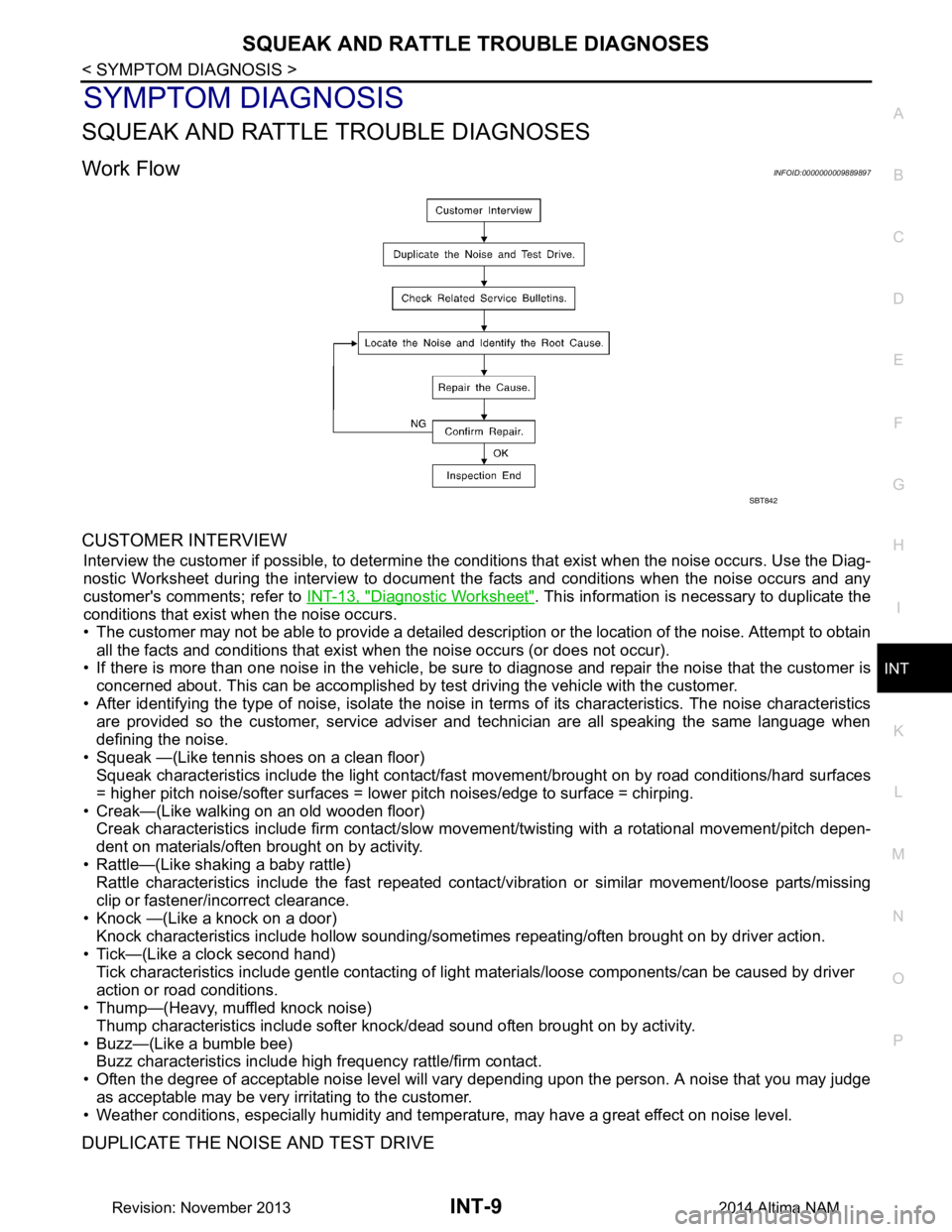
Work FlowINFOID:0000000009889897
CUSTOMER INTERVIEW
Interview the customer if possible, to determine the c onditions that exist when the noise occurs. Use the Diag-
nostic Worksheet during the interv iew to document the facts and conditions when the noise occurs and any
customer's comments; refer to INT-13, "Diagnostic Worksheet"
. This information is necessary to duplicate the
conditions that exist when the noise occurs.
• The customer may not be able to provide a detailed descr iption or the location of the noise. Attempt to obtain
all the facts and conditions that exist when the noise occurs (or does not occur).
• If there is more than one noise in the vehicle, be sure to diagnose and repair the noise that the customer is
concerned about. This can be accomplished by test driving the vehicle with the customer.
• After identifying the type of noise, isolate the noise in terms of its characteristics. The noise characteristics
are provided so the customer, service adviser and technician are all speaking the same language when
defining the noise.
• Squeak —(Like tennis shoes on a clean floor) Squeak characteristics include the light contact/fast movement/brought on by road conditions/hard surfaces
= higher pitch noise/softer surfaces = lower pitch noises/edge to surface = chirping.
• Creak—(Like walking on an old wooden floor) Creak characteristics include firm contact/slow mo vement/twisting with a rotational movement/pitch depen-
dent on materials/often brought on by activity.
• Rattle—(Like shaking a baby rattle) Rattle characteristics include the fast repeated contac t/vibration or similar movement/loose parts/missing
clip or fastener/incorrect clearance.
• Knock —(Like a knock on a door) Knock characteristics include hollow sounding/someti mes repeating/often brought on by driver action.
• Tick—(Like a clock second hand) Tick characteristics include gentle contacting of li ght materials/loose components/can be caused by driver
action or road conditions.
• Thump—(Heavy, muffled knock noise)
Thump characteristics include softer k nock/dead sound often brought on by activity.
• Buzz—(Like a bumble bee) Buzz characteristics include high frequency rattle/firm contact.
• Often the degree of acceptable noise level will vary depending upon the person. A noise that you may judge
as acceptable may be very irritating to the customer.
• Weather conditions, especially humidity and temperature, may have a great effect on noise level.
DUPLICATE THE NOISE AND TEST DRIVE
SBT842
Revision: November 20132014 Altima NAM
Page 2934 of 4801
IP-8
< SYMPTOM DIAGNOSIS >
SQUEAK AND RATTLE TROUBLE DIAGNOSES
SYMPTOM DIAGNOSIS
SQUEAK AND RATTLE TROUBLE DIAGNOSES
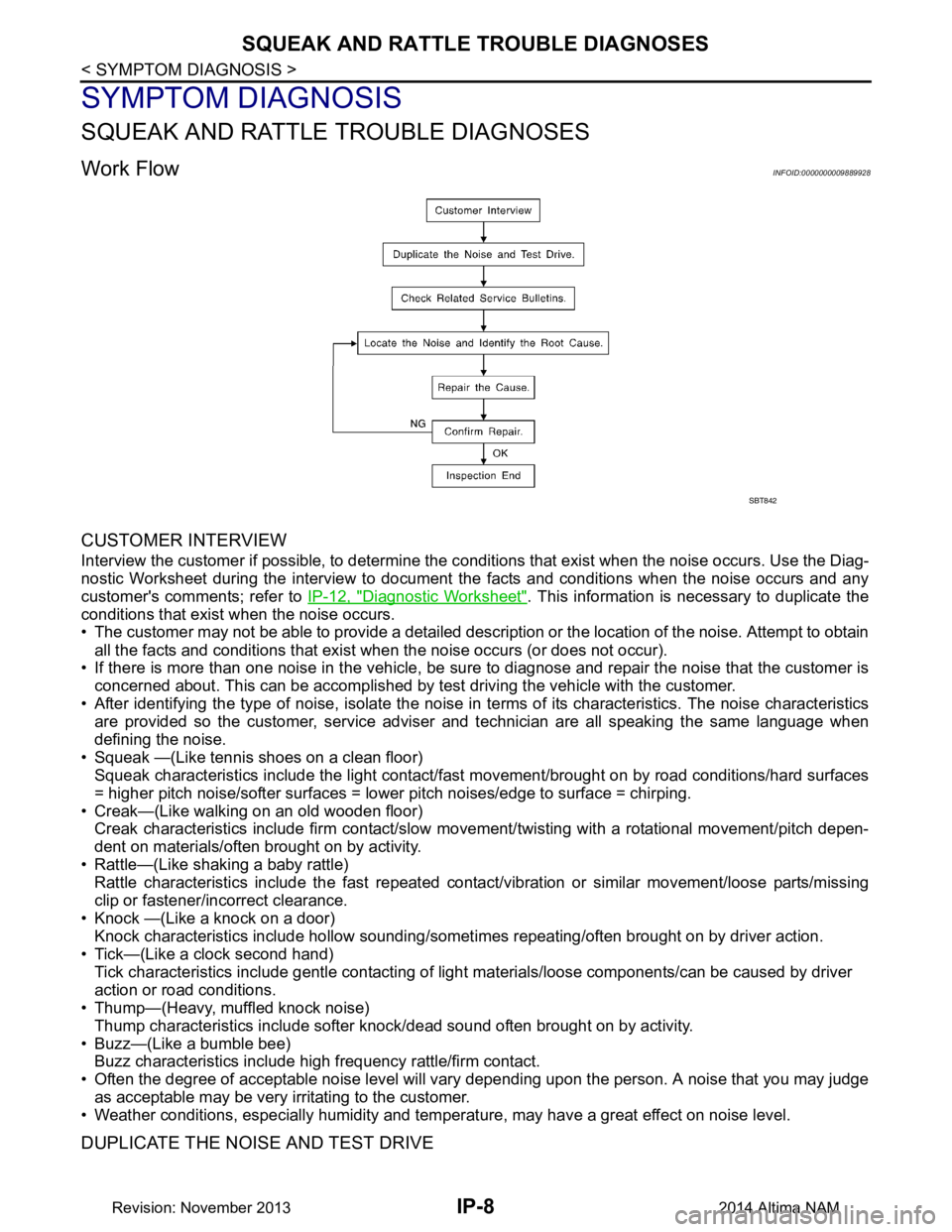
Work FlowINFOID:0000000009889928
CUSTOMER INTERVIEW
Interview the customer if possible, to determine the conditions that exist when the noise occurs. Use the Diag-
nostic Worksheet during the interview to document the facts and conditions when the noise occurs and any
customer's comments; refer to IP-12, "Diagnostic Worksheet"
. This information is necessary to duplicate the
conditions that exist when the noise occurs.
• The customer may not be able to provide a detailed description or the location of the noise. Attempt to obtain
all the facts and conditions that exist w hen the noise occurs (or does not occur).
• If there is more than one noise in the vehicle, be sure to diagnose and repair the noise that the customer is
concerned about. This can be accomplished by test driving the vehicle with the customer.
• After identifying the type of noise, isolate the noise in terms of its characteristics. The noise characteristics
are provided so the customer, service adviser and technician are all speaking the same language when
defining the noise.
• Squeak —(Like tennis shoes on a clean floor) Squeak characteristics include the light contact/fast movement/brought on by road conditions/hard surfaces
= higher pitch noise/softer surfaces = lower pitch noises/edge to surface = chirping.
• Creak—(Like walking on an old wooden floor) Creak characteristics include firm contact/slow mo vement/twisting with a rotational movement/pitch depen-
dent on materials/often brought on by activity.
• Rattle—(Like shaking a baby rattle) Rattle characteristics include the fast repeated contac t/vibration or similar movement/loose parts/missing
clip or fastener/incorrect clearance.
• Knock —(Like a knock on a door) Knock characteristics include hollow sounding/someti mes repeating/often brought on by driver action.
• Tick—(Like a clock second hand) Tick characteristics include gentle contacting of light materials/loose components/can be caused by driver
action or road conditions.
• Thump—(Heavy, muffled knock noise)
Thump characteristics include softer k nock/dead sound often brought on by activity.
• Buzz—(Like a bumble bee) Buzz characteristics include hi gh frequency rattle/firm contact.
• Often the degree of acceptable noise level will vary depending upon the person. A noise that you may judge
as acceptable may be very irritating to the customer.
• Weather conditions, especially humidity and temperat ure, may have a great effect on noise level.
DUPLICATE THE NOISE AND TEST DRIVE
SBT842
Revision: November 20132014 Altima NAM