esp NISSAN TEANA 2014 Service Manual
[x] Cancel search | Manufacturer: NISSAN, Model Year: 2014, Model line: TEANA, Model: NISSAN TEANA 2014Pages: 4801, PDF Size: 51.2 MB
Page 3580 of 4801
![NISSAN TEANA 2014 Service Manual
SYSTEMPWC-73
< SYSTEM DESCRIPTION > [LH & RH FRONT ANTI-PINCH]
C
D E
F
G H
I
J
L
M A
B
PWC
N
O P
POWER WINDOW OPERATION
• Power window system activated by the power window swit ch when the igniti](/img/5/57390/w960_57390-3579.png "NISSAN TEANA 2014 Service Manual
SYSTEMPWC-73
< SYSTEM DESCRIPTION > [LH & RH FRONT ANTI-PINCH]
C
D E
F
G H
I
J
L
M A
B
PWC
N
O P
POWER WINDOW OPERATION
• Power window system activated by the power window swit ch when the igniti")
SYSTEMPWC-73
< SYSTEM DESCRIPTION > [LH & RH FRONT ANTI-PINCH]
C
D E
F
G H
I
J
L
M A
B
PWC
N
O P
POWER WINDOW OPERATION
• Power window system activated by the power window swit ch when the ignition switch is in the ON position
or during the retained power operation after ignition switch turns OFF.
• Power window main switch (driver side) can open/close all windows.
• Front & rear power window switch can open/close the corresponding windows.
• If door glass receives resistance that is more than the specified value and the power window is in the AUTO-
UP operation (Front LH & RH), power window will move in the reverse direction (Anti-Pinch Function).
POWER WINDOW AUTO-OPERATION (FRONT LH & RH)
• AUTO UP/DOWN operation can be performed when main power window and door lock/unlock switch &
power window and door lock/unlock switch RH turns to AUTO.
• Encoder continues detecting the movement of power window motor and transmits to power window switch
as the encoder pulse signal while power window motor is operating.
• Power window switch reads the changes of encoder signal and stops AUTO operation when door glass is at fully opened/closed position.
• Power window motor is operable in case encoder is malfunctioning.
• AUTO function does not operate if encoder is malfunctioning.
RETAINED POWER OPERATION
• Retained power operation is an additional power supply function that enables power window system to oper-
ate during the 45 seconds even when ignition switch is turned OFF
Retained power function cancel conditions • Front door CLOSE (door switch OFF) →OPEN (door switch ON).
• When ignition switch is ON.
• When timer time passes. (45 seconds)
POWER WINDOW LOCK FUNCTION
Ground circuit inside power window main switch shuts off when power window lock switch is ON. This inhibits
power window switch operation except with the power window switch.
ANTI-PINCH OPERATION (FRONT LH & RH)
• Pinch foreign material in the door glass during AUTO-U P operation, and it is the anti-pinch function that low-
ers the door glass 150 mm (5.9 in.) or 2 seconds when detected.
• Encoder continues detecting the movement of power window motor and transmits to power window switch
as the encoder pulse signal while power window motor is operating.
• Resistance is applied to the power window motor ro tation that changes the frequency of encoder pulse sig-
nal if foreign material is trapped in the door glass.
• Power window switch controls to lower the window glas s for 150 mm (5.9 in.) or 2 seconds after it detects
encoder pulse signal frequency change.
OPERATION CONDITION
• When all door glass AUTO-UP operation is performed ( anti-pinch function does not operate just before the
door glass closes and is fully closed)
NOTE:
Depending on environment and driving conditions, if a similar impact or load is applied to the door glass, it
may lower.
KEY CYLINDER SWITCH OPERATION
Hold the door key cylinder to the LOCK or UNLOCK dire ction for more than 1 second to OPEN or CLOSE front
power windows when ignition switch is OFF. In addition, it stops when key position is moved to NEUTRAL
when operating.
OPERATION CONDITION
• Ignition switch OFF
Item Input signal to front power window
switch Front power window switch
function Actuator
Power window and
door lock/unlock
switch RH Front power window motor RH UP/
DOWN signal Power window control Front power window motor RH
Encoder Encoder pulse signal
BCM RAP signal
Revision: November 20132014 Altima NAMRevision: November 20132014 Altima NAM
Page 3602 of 4801
![NISSAN TEANA 2014 Service Manual
POWER SUPPLY AND GROUND CIRCUITPWC-95
< DTC/CIRCUIT DIAGNOSIS > [LH & RH FRONT ANTI-PINCH]
C
D E
F
G H
I
J
L
M A
B
PWC
N
O P
DTC/CIRCUIT DIAGNOSIS
POWER SUPPLY AND GROUND CIRCUIT
BCM
BCM : Diagnosi](/img/5/57390/w960_57390-3601.png "NISSAN TEANA 2014 Service Manual
POWER SUPPLY AND GROUND CIRCUITPWC-95
< DTC/CIRCUIT DIAGNOSIS > [LH & RH FRONT ANTI-PINCH]
C
D E
F
G H
I
J
L
M A
B
PWC
N
O P
DTC/CIRCUIT DIAGNOSIS
POWER SUPPLY AND GROUND CIRCUIT
BCM
BCM : Diagnosi")
POWER SUPPLY AND GROUND CIRCUITPWC-95
< DTC/CIRCUIT DIAGNOSIS > [LH & RH FRONT ANTI-PINCH]
C
D E
F
G H
I
J
L
M A
B
PWC
N
O P
DTC/CIRCUIT DIAGNOSIS
POWER SUPPLY AND GROUND CIRCUIT
BCM
BCM : Diagnosis ProcedureINFOID:0000000009955268
Regarding Wiring Diagram information, refer to BCS-55, "Wiring Diagram".
1. CHECK FUSE AND FUSIBLE LINK
Check that the following fuse and fusible link are not blown.
Is the fuse or fusible link blown?
YES >> Replace the blown fuse or fusible link after repairing the affected circuit.
NO >> GO TO 2
2. CHECK POWER SUPPLY CIRCUIT
1. Disconnect BCM connector M21.
2. Check voltage between BCM connector M21 terminals 131, 139 and ground.
Is the inspection result normal?
YES >> GO TO 3
NO >> Repair or replace harness or connectors.
3. CHECK GROUND CIRCUIT
Check continuity between BCM connector M21 terminals 134, 143 and ground.
Is the inspection result normal?
YES >> Inspection End.
NO >> Repair or replace harness or connectors.
POWER WINDOW MAIN SWITCH
POWER WINDOW MAIN SWITCH : DescriptionINFOID:0000000009460913
• BCM supplies power.
• It operates each power window motor via corresponding power window switch and makes window move up/
down when main power window and door lock/unlock switch is operated.
Terminal No. Signal name Fuse and fusible link No.
139 Fusible link battery power I (40A)
131 BCM battery fuse 1 (10A)
BCM GroundVo l ta g e
(Approx.)
Connector Terminal
M21 131
—Batteryvoltage
139
BCM Ground Continuity
Connector Terminal
M21 134
—Yes
143
Revision: November 20132014 Altima NAMRevision: November 20132014 Altima NAM
Page 3700 of 4801
SQUEAK AND RATTLE TROUBLE DIAGNOSESRF-35
< SYMPTOM DIAGNOSIS >
C
D E
F
G H
I
J
L
M A
B
RF
N
O P
SQUEAK AND RATTLE TROUBLE DIAGNOSES
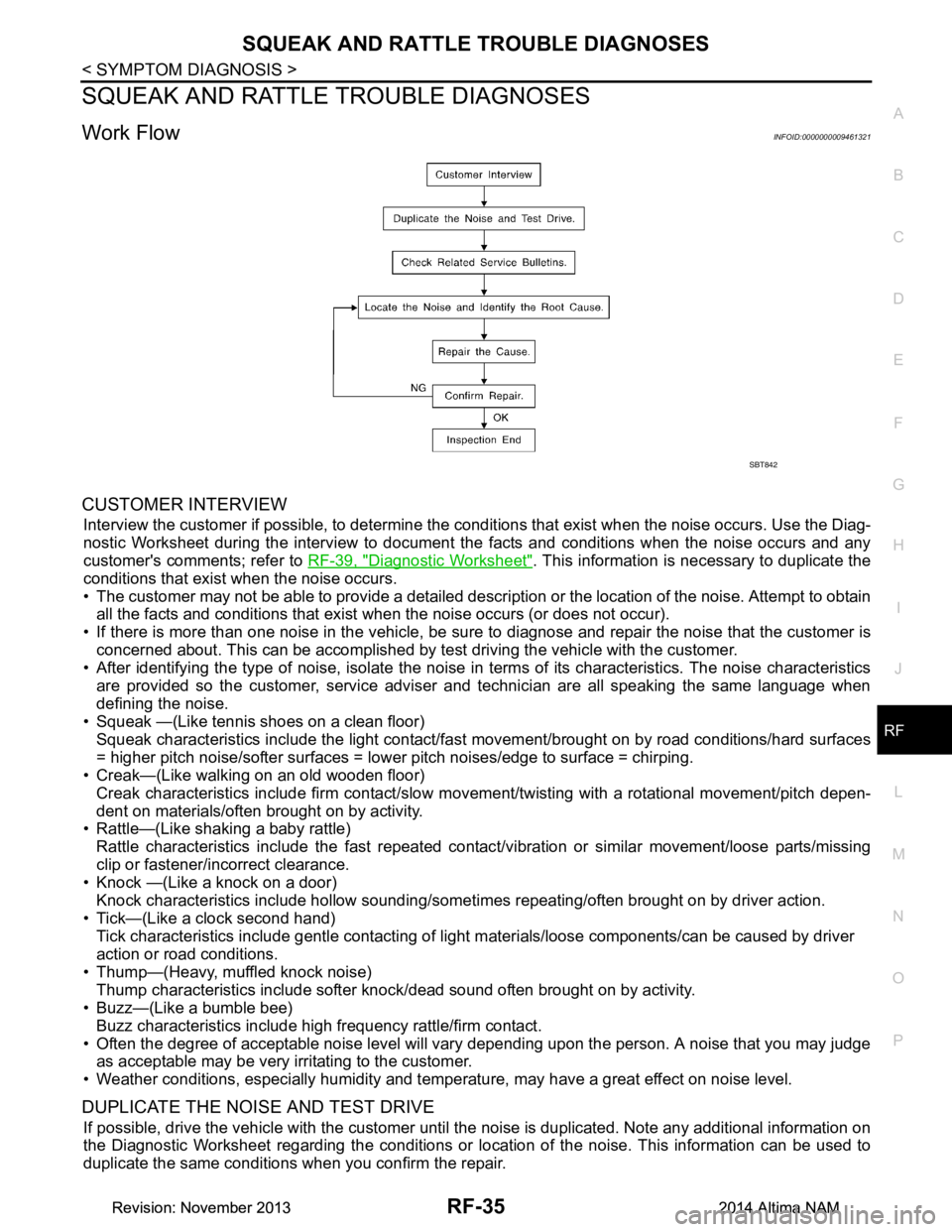
Work FlowINFOID:0000000009461321
CUSTOMER INTERVIEW
Interview the customer if possible, to determine the c onditions that exist when the noise occurs. Use the Diag-
nostic Worksheet during the interv iew to document the facts and conditions when the noise occurs and any
customer's comments; refer to RF-39, "Diagnostic Worksheet"
. This information is necessary to duplicate the
conditions that exist when the noise occurs.
• The customer may not be able to provide a detailed descr iption or the location of the noise. Attempt to obtain
all the facts and conditions that exist when the noise occurs (or does not occur).
• If there is more than one noise in the vehicle, be sure to diagnose and repair the noise that the customer is
concerned about. This can be accomplished by test driving the vehicle with the customer.
• After identifying the type of noise, isolate the noise in terms of its characteristics. The noise characteristics
are provided so the customer, service adviser and technician are all speaking the same language when
defining the noise.
• Squeak —(Like tennis shoes on a clean floor)
Squeak characteristics include the light contact/fast movement/brought on by road conditions/hard surfaces
= higher pitch noise/softer surfaces = lower pitch noises/edge to surface = chirping.
• Creak—(Like walking on an old wooden floor)
Creak characteristics include firm contact/slow mo vement/twisting with a rotational movement/pitch depen-
dent on materials/often brought on by activity.
• Rattle—(Like shaking a baby rattle)
Rattle characteristics include the fast repeated contac t/vibration or similar movement/loose parts/missing
clip or fastener/incorrect clearance.
• Knock —(Like a knock on a door)
Knock characteristics include hollow sounding/someti mes repeating/often brought on by driver action.
• Tick—(Like a clock second hand) Tick characteristics include gentle contacting of li ght materials/loose components/can be caused by driver
action or road conditions.
• Thump—(Heavy, muffled knock noise) Thump characteristics include softer k nock/dead sound often brought on by activity.
• Buzz—(Like a bumble bee)
Buzz characteristics include high frequency rattle/firm contact.
• Often the degree of acceptable noise level will vary depending upon the person. A noise that you may judge as acceptable may be very irritating to the customer.
• Weather conditions, especially humidity and temperature, may have a great effect on noise level.
DUPLICATE THE NOISE AND TEST DRIVE
If possible, drive the vehicle with the customer until the noise is duplicated. Note any additional information on
the Diagnostic Worksheet regarding the conditions or lo cation of the noise. This information can be used to
duplicate the same conditions when you confirm the repair.
SBT842
Revision: November 20132014 Altima NAMRevision: November 20132014 Altima NAM
Page 3766 of 4801
SQUEAK AND RATTLE TROUBLE DIAGNOSESSE-17
< SYMPTOM DIAGNOSIS >
C
D E
F
G H
I
K L
M A
B
SE
N
O P
SYMPTOM DIAGNOSIS
SQUEAK AND RATTLE TROUBLE DIAGNOSES
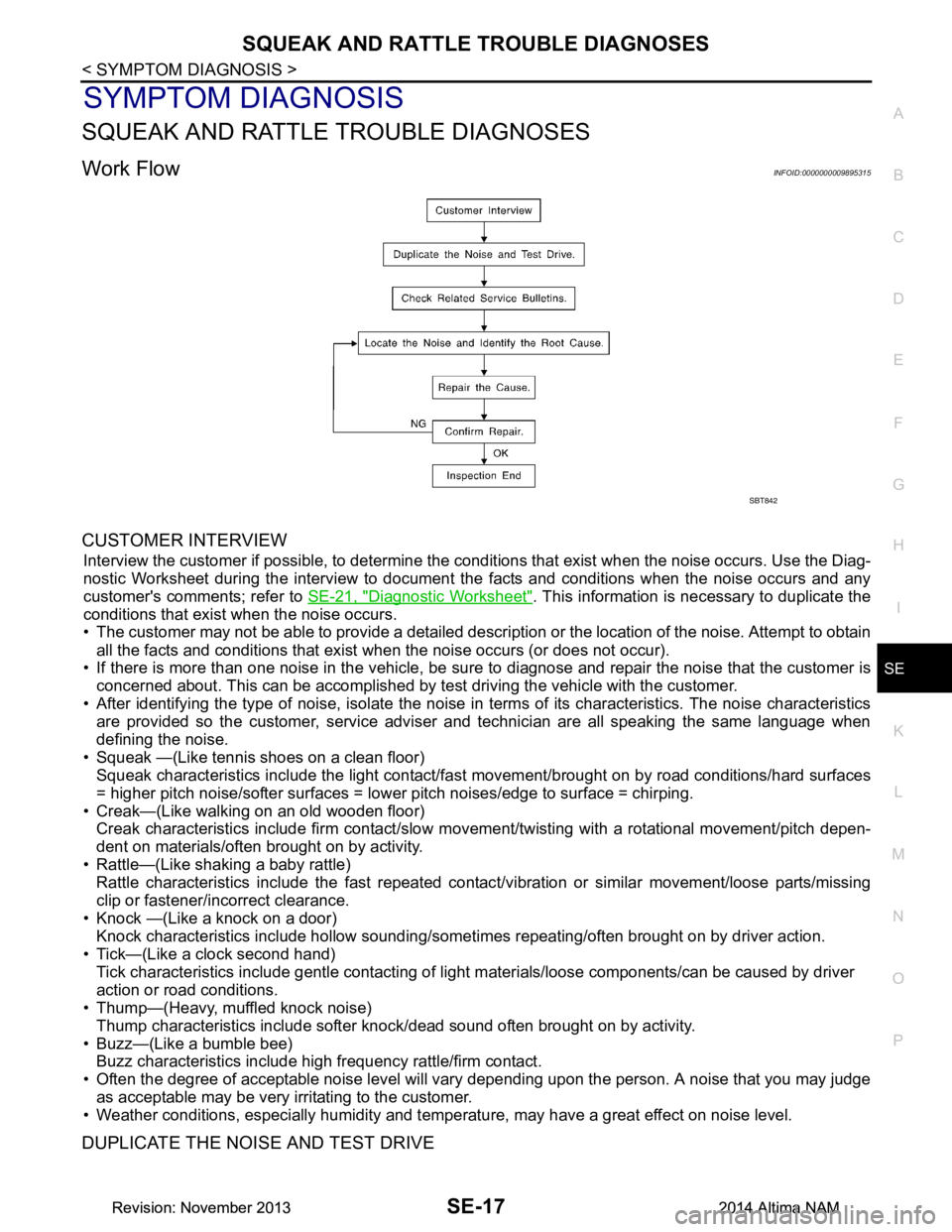
Work FlowINFOID:0000000009895315
CUSTOMER INTERVIEW
Interview the customer if possible, to determine the c onditions that exist when the noise occurs. Use the Diag-
nostic Worksheet during the interv iew to document the facts and conditions when the noise occurs and any
customer's comments; refer to SE-21, "Diagnostic Worksheet"
. This information is necessary to duplicate the
conditions that exist when the noise occurs.
• The customer may not be able to provide a detailed descr iption or the location of the noise. Attempt to obtain
all the facts and conditions that exist when the noise occurs (or does not occur).
• If there is more than one noise in the vehicle, be sure to diagnose and repair the noise that the customer is
concerned about. This can be accomplished by test driving the vehicle with the customer.
• After identifying the type of noise, isolate the noise in terms of its characteristics. The noise characteristics
are provided so the customer, service adviser and technician are all speaking the same language when
defining the noise.
• Squeak —(Like tennis shoes on a clean floor) Squeak characteristics include the light contact/fast movement/brought on by road conditions/hard surfaces
= higher pitch noise/softer surfaces = lower pitch noises/edge to surface = chirping.
• Creak—(Like walking on an old wooden floor) Creak characteristics include firm contact/slow mo vement/twisting with a rotational movement/pitch depen-
dent on materials/often brought on by activity.
• Rattle—(Like shaking a baby rattle) Rattle characteristics include the fast repeated contac t/vibration or similar movement/loose parts/missing
clip or fastener/incorrect clearance.
• Knock —(Like a knock on a door) Knock characteristics include hollow sounding/someti mes repeating/often brought on by driver action.
• Tick—(Like a clock second hand) Tick characteristics include gentle contacting of li ght materials/loose components/can be caused by driver
action or road conditions.
• Thump—(Heavy, muffled knock noise)
Thump characteristics include softer k nock/dead sound often brought on by activity.
• Buzz—(Like a bumble bee) Buzz characteristics include high frequency rattle/firm contact.
• Often the degree of acceptable noise level will vary depending upon the person. A noise that you may judge
as acceptable may be very irritating to the customer.
• Weather conditions, especially humidity and temperature, may have a great effect on noise level.
DUPLICATE THE NOISE AND TEST DRIVE
SBT842
Revision: November 20132014 Altima NAMRevision: November 20132014 Altima NAM
Page 3943 of 4801
SEC-118
< DTC/CIRCUIT DIAGNOSIS >
B2617 STARTER RELAY CIRCUIT
B2617 STARTER RELAY CIRCUIT
DescriptionINFOID:0000000009461176
Located in IPDM E/R, it runs the starter motor. The starter relay is turned ON by the BCM when the ignition
switch is in START position. IPDM E/R transmits t he starter relay ON signal to BCM via CAN communication.
DTC LogicINFOID:0000000009461177
DTC DETECTION LOGIC
NOTE:
• If DTC B2617 is displayed with DTC U1000, first perform the trouble diagnosis for DTC U1000. Refer to
BCS-68, "DTC Logic"
.
• If DTC B2617 is displayed with DTC U1010, first perform the trouble diagnosis for DTC U1010. Refer to BCS-69, "DTC Logic"
.
DTC CONFIRMATION PROCEDURE
1.PERFORM DTC CONFIRMATION PROCEDURE
1. Turn ignition switch ON under the following conditions and wait for at least 1 second.
- CVT selector lever is in the P (Park) position.
- Do not depress the brake pedal.
2. Check Self-Diagnostic Result with CONSULT.
Is DTC detected?
YES >> Refer to SEC-118, "Diagnosis Procedure".
NO >> Inspection End.
Diagnosis ProcedureINFOID:0000000009461178
Regarding Wiring Diagram information, refer to SEC-29, "Wiring Diagram".
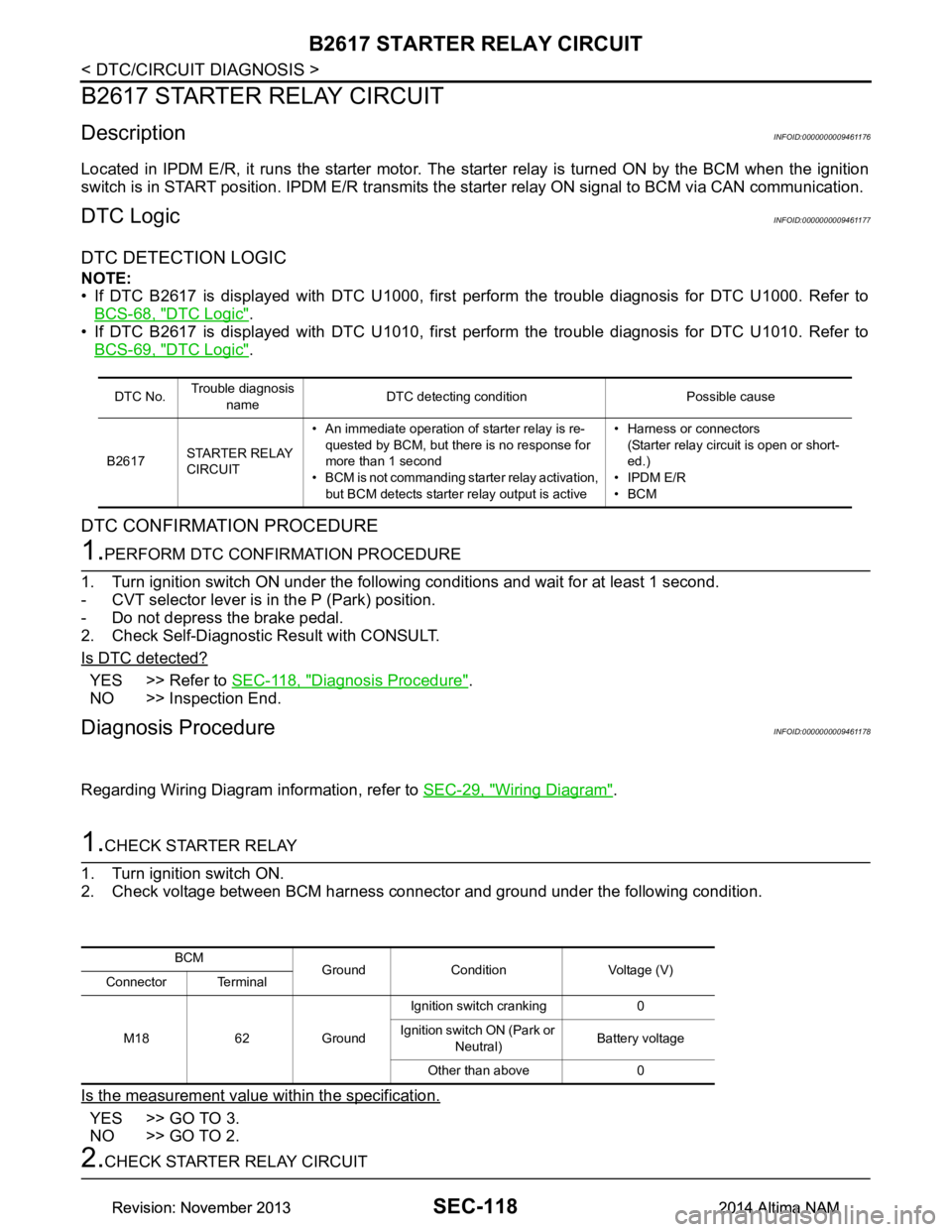
1.CHECK STARTER RELAY
1. Turn ignition switch ON.
2. Check voltage between BCM harness connector and ground under the following condition.
Is the measurement value within the specification.
YES >> GO TO 3.
NO >> GO TO 2.
2.CHECK STARTER RELAY CIRCUIT
DTC No. Trouble diagnosis
name DTC detecting condition Possible cause
B2617 STARTER RELAY
CIRCUIT • An immediate operation of starter relay is re-
quested by BCM, but there is no response for
more than 1 second
• BCM is not commanding starter relay activation, but BCM detects starter relay output is active • Harness or connectors
(Starter relay circuit is open or short-
ed.)
• IPDM E/R
•BCM
BCM Ground Condition Voltage (V)
Connector Terminal
M18 62 Ground Ignition switch cranking 0
Ignition switch ON (Park or Neutral) Battery voltage
Other than above 0
Revision: November 20132014 Altima NAMRevision: November 20132014 Altima NAM
Page 4002 of 4801
COMPONENT PARTSSRC-9
< SYSTEM DESCRIPTION >
C
D E
F
G
I
J
K L
M A
B
SRC
N
O P
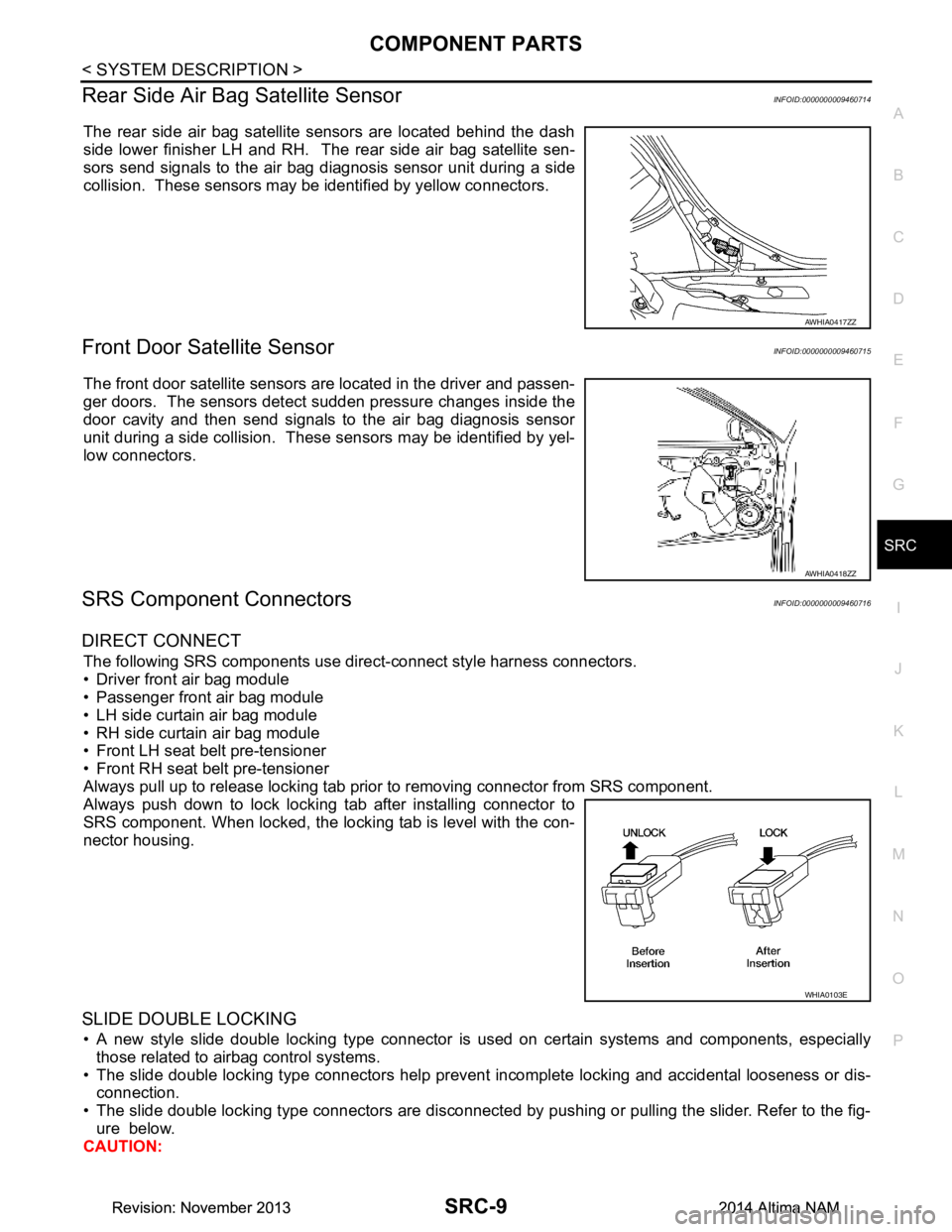
Rear Side Air Bag Satellite SensorINFOID:0000000009460714
The rear side air bag satellite sensors are located behind the dash
side lower finisher LH and RH. The rear side air bag satellite sen-
sors send signals to the air bag diagnosis sensor unit during a side
collision. These sensors may be identified by yellow connectors.
Front Door Satellite SensorINFOID:0000000009460715
The front door satellite sensors are located in the driver and passen-
ger doors. The sensors detect sudden pressure changes inside the
door cavity and then send signals to the air bag diagnosis sensor
unit during a side collision. These sensors may be identified by yel-
low connectors.
SRS Component ConnectorsINFOID:0000000009460716
DIRECT CONNECT
The following SRS components use dire ct-connect style harness connectors.
• Driver front air bag module
• Passenger front air bag module
• LH side curtain air bag module
• RH side curtain air bag module
• Front LH seat belt pre-tensioner
• Front RH seat belt pre-tensioner
Always pull up to release locking tab prior to removing connector from SRS component.
Always push down to lock locking tab after installing connector to
SRS component. When locked, the locking tab is level with the con-
nector housing.
SLIDE DOUBLE LOCKING
• A new style slide double locking type connector is used on certain systems and components, especially those related to airbag control systems.
• The slide double locking type connectors help prevent incomplete locking and accidental looseness or dis- connection.
• The slide double locking type connectors are disconnected by pushing or pulling the slider. Refer to the fig-
ure below.
CAUTION:
AWHIA0417ZZ
AWHIA0418ZZ
WHIA0103E
Revision: November 20132014 Altima NAMRevision: November 20132014 Altima NAM
Page 4239 of 4801
![NISSAN TEANA 2014 Service Manual
TM-24
< SYSTEM DESCRIPTION >[CVT: RE0F10D]
STRUCTURE AND OPERATION
The groove width changes according to wrapping radius of
steel belt and pulley from low status to overdrive
status continuously wit](/img/5/57390/w960_57390-4238.png "NISSAN TEANA 2014 Service Manual
TM-24
< SYSTEM DESCRIPTION >[CVT: RE0F10D]
STRUCTURE AND OPERATION
The groove width changes according to wrapping radius of
steel belt and pulley from low status to overdrive
status continuously wit")
TM-24
< SYSTEM DESCRIPTION >[CVT: RE0F10D]
STRUCTURE AND OPERATION
The groove width changes according to wrapping radius of
steel belt and pulley from low status to overdrive
status continuously with non-step. It is controlled wit h the oil pressures of primary pulley and secondary pulley.
Steel Belt
It is composed of multiple steel plates (A) and two steel rings (B)
stacked to a several number. The feature of this steel belt transmits
power with compression of the steel plate in contrast with transmis-
sion of power in pulling with a rubber belt. Friction force is required
with the pulley slope to transmit power from the steel plate. The force
is generated with the following mechanism:
Oil pressure applies to the secondary pulley to nip the plate. ⇒The
plate is pushed and extended outward. ⇒The steel ring shows with-
stands. ⇒Pulling force is generated on the steel ring. ⇒The plate of
the primary pulley is nipped between the pulley. ⇒Friction force is
generated between the steel belt and the pulley.
Therefore, responsibilities are divi ded by the steel plate that trans-
mits the power with compression and the steel ring that main tains necessary friction force. In this way, the
tension of the steel ring is distributed on the entire su rface and stress variation is limited, resulting in good
durability.
Pulley
The primary pulley (input shaft side) and the secondary pulley (output shaft side) have the shaft with slope
(fixed cone surface), movable sheave (movable cone surface that can move in the axial direction) and oil pres-
sure chamber at the back of the movable sheave.
JSDIA2428GB
JSDIA2431ZZ
Revision: November 20132014 Altima NAMRevision: November 20132014 Altima NAM
Page 4242 of 4801
![NISSAN TEANA 2014 Service Manual
STRUCTURE AND OPERATIONTM-27
< SYSTEM DESCRIPTION > [CVT: RE0F10D]
C
EF
G H
I
J
K L
M A
B
TM
N
O P
TRANSAXLE : Component DescriptionINFOID:0000000009463984
FLUID COOLER & FLUID WARMER SYSTEM
Part na](/img/5/57390/w960_57390-4241.png "NISSAN TEANA 2014 Service Manual
STRUCTURE AND OPERATIONTM-27
< SYSTEM DESCRIPTION > [CVT: RE0F10D]
C
EF
G H
I
J
K L
M A
B
TM
N
O P
TRANSAXLE : Component DescriptionINFOID:0000000009463984
FLUID COOLER & FLUID WARMER SYSTEM
Part na")
STRUCTURE AND OPERATIONTM-27
< SYSTEM DESCRIPTION > [CVT: RE0F10D]
C
EF
G H
I
J
K L
M A
B
TM
N
O P
TRANSAXLE : Component DescriptionINFOID:0000000009463984
FLUID COOLER & FLUID WARMER SYSTEM
Part name Function
Torque converter Increases engine torque and transmits it to the transaxle.
Oil pump Utilizes a vane-type oil pump that is driven by the engine through the oil pump drive chain in order to
increase efficiency of pump discharge volume in low-speed zone and optimize pump discharge volume
in high-speed zone. Discharged oil from oil pump is tr ansmitted to control valve. It is used as the oil of
primary and secondary pulley operation, the oil of clutch operation, and the lubricant for each part.
Forward clutch The forward clutch is wet and multiple plate type clutch that consists of clutch drum, piston, drive plate,
and driven plate. It is a clutch to move the vehicle forward by activating piston hydraulically, engaging
plates, and directly connecting sun gear and input shaft.
Reverse brake The reverse brake is a wet multiple-plate type brake that consists of transaxle case, piston, drive plate,
and driven plate. It is a brake to move the vehicle in reverse by activating piston hydraulically, engaging
plates, and fixing planetary gear.
Internal gear The internal gear is directly connected to forward clutch drum. It is a gear that moves the outer edge of
pinion planet of planet carrier. It transmits power to move the vehicle in reverse when the planet carrier
is fixed.
Planet carrier Composed of a carrier, pinion planet, and pinion shaft. This gear fixes and releases the planet carrier in
order to switch between forward and reverse driving.
Sun gear Sun gear is a set part with planet carrier and internal gear. It transmits transmitted force to primary fixed
sheave. It rotates in forward or reverse direction according to activation of either forward clutch or re-
verse brake.
Input shaft The input shaft is directly connected to forward clutch drum and transmits traction force from torque con-
verter. In shaft center, there are holes for hydraulic distribution to primary pulley and hydraulic distribution
for lockup ON/OFF.
Primary pulley It is composed of a pair of pulleys (the groove width is changed freely in the axial direction) and the steel belt. The groove width changes according to wrapping radius of steel belt and pulley from low status to
overdrive status continuously with non-step. It is controlled with the oil pressures of primary pulley and
secondary pulley.
Secondary pulley
Steel belt
Manual shaft When the manual shaft is in the P position, the parking rod that is linked to the manual shaft rotates the
parking pole. When the parking pole rotates, it engages with the parking gear, fixing the parking gear. As
a result, the secondary pulley that is integrated with the parking gear is fixed.
Parking rod
Parking pawl
Parking gear
Output gear
The deceleration gears are composed of 2 stages: primary deceleration (output gear, idler gear pair) and
secondary deceleration (reduction gear, final gear pair). All of these gears are helical gears.
Idler gear
Reduction gear
Differential
Torque converter regulator
valve Adjusts the feed pressure to the torque converter to the optimum pressure corresponding to the driving
condition.
Pressure regulator valve Adjusts the discharge pressure from the oil pump to the optimum pressure (line pressure) corresponding
to the driving condition.
Torque converter clutch
control valve Adjusts the torque converter engage and disengage pressures.
Manual valve Distributes the clutch operation pressure to each circuit according to the selector lever position.
Secondary reducing valve Reduces line pressure and adjusts secondary pressure.
Primary reducing valve Reduces line pressure and adjusts primary pressure.
Pilot valve A Reduces line pressure and adjusts pilot pressure to the solenoid valves listed below.
• Primary pressure solenoid valve
• Secondary pressure solenoid valve
• Select solenoid valve
• Line pressure solenoid valve
Pilot valve B Reduces pilot pressure and adjusts pilot pressure to the torque converter clutch solenoid valve.
Revision: November 20132014 Altima NAMRevision: November 20132014 Altima NAM
Page 4243 of 4801
![NISSAN TEANA 2014 Service Manual
TM-28
< SYSTEM DESCRIPTION >[CVT: RE0F10D]
STRUCTURE AND OPERATION
FLUID COOLER & FLUID WARMER SYSTEM : System Description
INFOID:0000000009463985
CVT FLUID COOLER SCHEMATIC
COMPONENT DESCRIPTION
C](/img/5/57390/w960_57390-4242.png "NISSAN TEANA 2014 Service Manual
TM-28
< SYSTEM DESCRIPTION >[CVT: RE0F10D]
STRUCTURE AND OPERATION
FLUID COOLER & FLUID WARMER SYSTEM : System Description
INFOID:0000000009463985
CVT FLUID COOLER SCHEMATIC
COMPONENT DESCRIPTION
C")
TM-28
< SYSTEM DESCRIPTION >[CVT: RE0F10D]
STRUCTURE AND OPERATION
FLUID COOLER & FLUID WARMER SYSTEM : System Description
INFOID:0000000009463985
CVT FLUID COOLER SCHEMATIC
COMPONENT DESCRIPTION
CVT Oil Warmer
• The CVT oil warmer (1) is installed on the front part of transaxle
assembly.
• When engine is started while engine and CVT are cold, engine coolant temperature rises more quickly than CVT fluid tempera-
ture. CVT oil warmer is provided with two circuits for CVT and
engine coolant respectively so that warmed engine coolant warms
CVT quickly. This helps shorten CVT warming up time, improving
fuel economy.
• A cooling effect is obtained when CVT fluid temperature is high.
Heater Thermostat
• The heater thermostat (1) is insta lled on the front part of transaxle
assembly.
• The heater thermostat open and close with set temperature.
SHIFT LOCK SYSTEM
SHIFT LOCK SYSTEM : System DescriptionINFOID:0000000009463986
The shift lever cannot be shifted from the “P” positi on unless the brake pedal is depressed while the ignition
switch is set to ON. The shift lock is unlocked by turn ing the shift lock solenoid ON when the ignition switch is
set to ON, the park position switch is turned ON (selec tor lever is in “P” position), and the stop lamp switch is
turned ON (brake pedal is depressed) as shown in the oper ation chart in the figure. Therefore, the shift lock
solenoid receives no ON signal and the shift lock remains locked if all of the above conditions are not fulfilled.
However, selector operation is allowed if the shift lock release button is pressed.
JSDIA3787GB
JSDIA2280ZZ
JSDIA2585ZZ
Revision: November 20132014 Altima NAMRevision: November 20132014 Altima NAM
Page 4413 of 4801
![NISSAN TEANA 2014 Service Manual
TM-198
< REMOVAL AND INSTALLATION >[CVT: RE0F10D]
DIFFERENTIAL SIDE OIL SEAL
Install each differential side oil seal evenly using Tool so that differ-
ential side oil seal protrudes by the dimension](/img/5/57390/w960_57390-4412.png "NISSAN TEANA 2014 Service Manual
TM-198
< REMOVAL AND INSTALLATION >[CVT: RE0F10D]
DIFFERENTIAL SIDE OIL SEAL
Install each differential side oil seal evenly using Tool so that differ-
ential side oil seal protrudes by the dimension")
TM-198
< REMOVAL AND INSTALLATION >[CVT: RE0F10D]
DIFFERENTIAL SIDE OIL SEAL
Install each differential side oil seal evenly using Tool so that differ-
ential side oil seal protrudes by the dimension (C) and (D) respect-
fully.
NOTE:
The reference is the installation direction of the differential side oil seal.
Drift to be used:
Inspection and AdjustmentINFOID:0000000009464144
INSPECTION AFTER INSTALLATION
Check for CVT fluid leakage. Refer to TM-178, "Inspection".
ADJUSTMENT AFTER INSTALLATION
Adjust the CVT fluid level. Refer to TM-84, "Adjustment".
(A) : Differential side oil seal (LH)
(B) : Differential side oil seal (RH)
JSDIA1836ZZ
Dimension (C) :Height difference from case end surface is within 1.8 ± 0.5 mm (0.071 ±
0.020 in).
Dimension (D) :Height difference from case end surface is within 2.2 ± 0.5 mm (0.087 ±
0.020 in).
Location Commercial Service Tools
Transaxle case side Commercial service tool with outer dia. 56 mm (2.20 in) and in-
ner dia. 50 mm (1.97 in)
Converter housing side
Revision: November 20132014 Altima NAMRevision: November 20132014 Altima NAM