compression ratio NISSAN TEANA 2014 User Guide
[x] Cancel search | Manufacturer: NISSAN, Model Year: 2014, Model line: TEANA, Model: NISSAN TEANA 2014Pages: 4801, PDF Size: 51.2 MB
Page 2183 of 4801
![NISSAN TEANA 2014 User Guide
TIMING CHAINEM-185
< REMOVAL AND INSTALLATION > [VQ35DE]
C
D E
F
G H
I
J
K L
M A
EM
NP
O
9. Remove the chain tension guide.
INSPECTION
Check for cracks and any excessive
wear of the timing chain. R](/img/5/57390/w960_57390-2182.png "NISSAN TEANA 2014 User Guide
TIMING CHAINEM-185
< REMOVAL AND INSTALLATION > [VQ35DE]
C
D E
F
G H
I
J
K L
M A
EM
NP
O
9. Remove the chain tension guide.
INSPECTION
Check for cracks and any excessive
wear of the timing chain. R")
TIMING CHAINEM-185
< REMOVAL AND INSTALLATION > [VQ35DE]
C
D E
F
G H
I
J
K L
M A
EM
NP
O
9. Remove the chain tension guide.
INSPECTION
Check for cracks and any excessive
wear of the timing chain. Replace the timing chain as necessary.
INSTALLATION
NOTE:
The illustration shows the relationship between the mating mark on each timing chain and that on the corre-
sponding sprocket, the components installed.
1. Install the timing chain tension guide.
2. Check that dowel pin (A) and crankshaft key (1) are located as shown. (No. 1 cylinder at compression TDC)
NOTE:
Though camshaft does not stop at the position as shown, for the
placement of cam nose, it is generally accepted camshaft is
placed in the same direction.
WBIA0280E
1. Internal chain guide 2. Camshaft sprocket (intake) 3. Mating mark (pink link)
4. Mating mark (punched) 5. Secondary timing chain tensioner 6. Mating mark (orange link)
7. Secondary timing chain 8. Camshaft sprocket (exhaust) 9. Tension guide
10. Water pump 11. Crankshaft sprocket 12. Mating mark (notched)
13. Primary timing chain 14. Slack guide 15. Primary timing chain tensioner
16. Mating mark (back side) 17. Crankshaft key
Camshaft dowel pin : At cylinder head upper face side in each bank
Crankshaft key : At cylinder head side of bank 1
AWBIA1221GB
Revision: November 20132014 Altima NAM
Page 2244 of 4801
![NISSAN TEANA 2014 User Guide
EM-246
< SERVICE DATA AND SPECIFICATIONS (SDS) [VQ35DE]
SERVICE DATA AND SPECIFICATIONS (SDS)
SERVICE DATA AND SPECIFICATIONS (SDS)
SERVICE DATA AND SPECIFICATIONS (SDS)
General SpecificationINFOID:0](/img/5/57390/w960_57390-2243.png "NISSAN TEANA 2014 User Guide
EM-246
< SERVICE DATA AND SPECIFICATIONS (SDS) [VQ35DE]
SERVICE DATA AND SPECIFICATIONS (SDS)
SERVICE DATA AND SPECIFICATIONS (SDS)
SERVICE DATA AND SPECIFICATIONS (SDS)
General SpecificationINFOID:0")
EM-246
< SERVICE DATA AND SPECIFICATIONS (SDS) [VQ35DE]
SERVICE DATA AND SPECIFICATIONS (SDS)
SERVICE DATA AND SPECIFICATIONS (SDS)
SERVICE DATA AND SPECIFICATIONS (SDS)
General SpecificationINFOID:0000000009460584
GENERAL SPECIFICATIONS
Drive BeltINFOID:0000000009460585
DRIVE BELT
Cylinder arrangement
V-6
Displacement cm
3 (cu in) 3,498 (213.45)
Bore and stroke mm (in) 95.5 x 81.4 (3.760 x 3.205)
Valve arrangement DOHC
Firing order 1-2-3-4-5-6
Number of piston rings Compression 2
Oil 1
Number of main bearings 4
Compression ratio 10.3:1
Compression pressure
kPa (kg/cm
2, psi)/300 rpm Standard 1,275 (13.0, 185)
Minimum 981 (10.0, 142)
Differential limit between cylinders 98 (1.0, 14)
Cylinder number
Valve timing
(Valve timing control - “OFF”)
Unit: degree
abcde f
240 240 −
10 (-35)
AT D C 70(25)
ABDC 10 50
SEM713A
PBIC0187E
Revision: November 20132014 Altima NAM
Page 2469 of 4801
FRONT DRIVE SHAFTFAX-17
< UNIT DISASSEMBLY AND ASSEMBLY >
CEF
G H
I
J
K L
M A
B
FA X
N
O P
Slide Joint Housing
• Make sure there are no compression scars, cracks or
fractures or unusual wear of ball rolling surface.
• Make sure there is no damage to shaft screws.
• Make sure there is no deformation of boot installation parts.
Ball Cage
• Make sure there are no compression scars, cracks, fractures of sliding surface.
Steel Ball
• Make sure there are no compression scars , cracks, fractures or unusual wear.
Inner Race
• Check ball sliding surface for compression scars, cracks or fractures.
• Make sure there is no damage to serrated part.
CAUTION:
If there are any irregular condit ions in the component, replace with a new set of joint sub-assembly,
ball cage, steel ball and inner race.
Damper
• Check damper for cracks or wear. Install damper with new damper bands.
ASSEMBLY
Transaxle Side
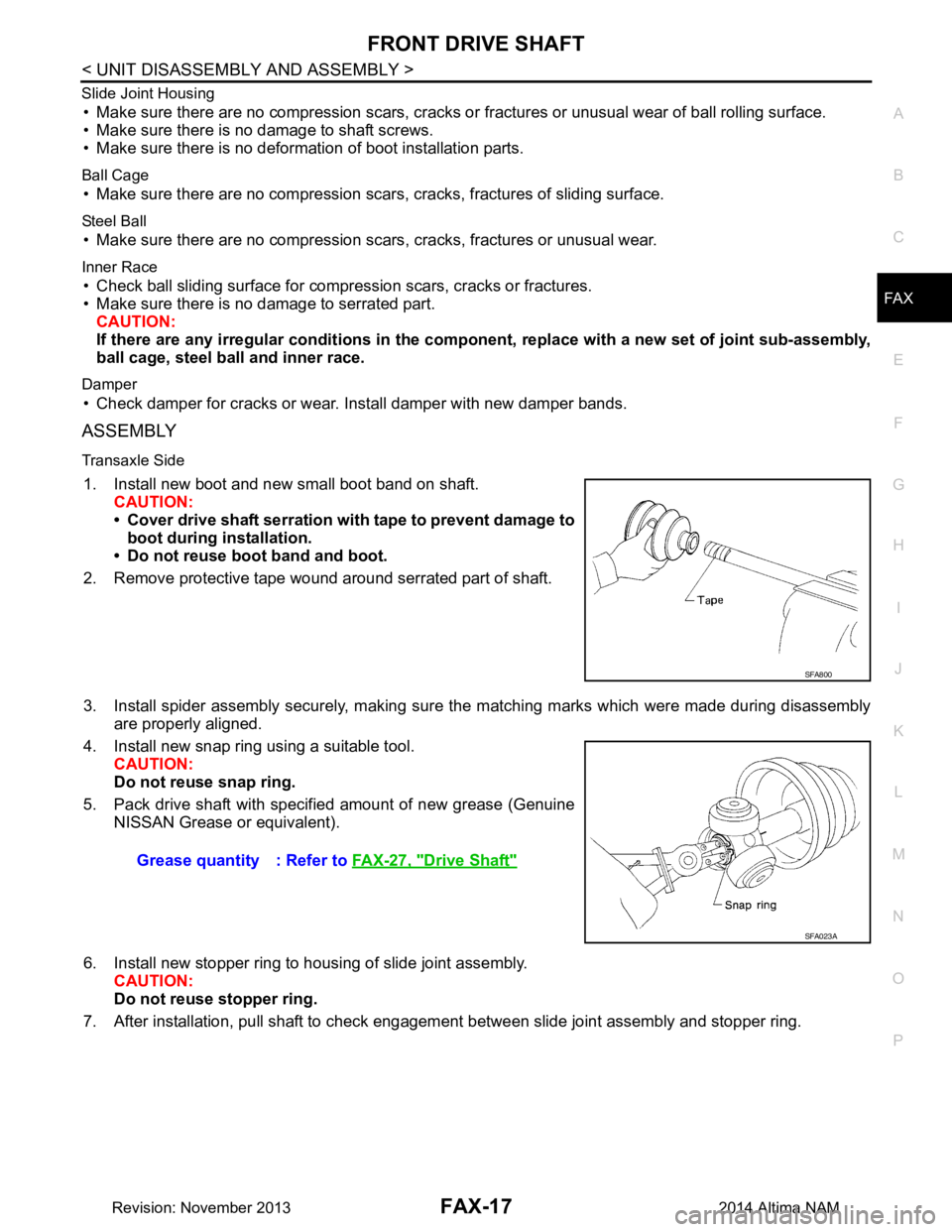
1. Install new boot and new small boot band on shaft.
CAUTION:
• Cover drive shaft serration with tape to prevent damage to boot during installation.
• Do not reuse boot band and boot.
2. Remove protective tape wound around serrated part of shaft.
3. Install spider assembly securely, making sure the matching marks which were made during disassembly are properly aligned.
4. Install new snap ring using a suitable tool. CAUTION:
Do not reuse snap ring.
5. Pack drive shaft with specified amount of new grease (Genuine NISSAN Grease or equivalent).
6. Install new stopper ring to housing of slide joint assembly. CAUTION:
Do not reuse stopper ring.
7. After installation, pull shaft to check engagement between slide joint assembly and stopper ring.
SFA800
Grease quantity : Refer to FAX-27, "Drive Shaft"
SFA023A
Revision: November 20132014 Altima NAM
Page 3722 of 4801
REAR SUSPENSION ASSEMBLYRSU-5
< PERIODIC MAINTENANCE >
C
D
F
G H
I
J
K L
M A
B
RSU
N
O P
PERIODIC MAINTENANCE
REAR SUSPENSION ASSEMBLY
On-vehicle ServiceINFOID:0000000009464454
• Check the suspension parts for excessive play, cracks, wear or damage. Shake each rear wheel to check for
excessive play.
• Retighten all nuts and bolts to the specified torque.
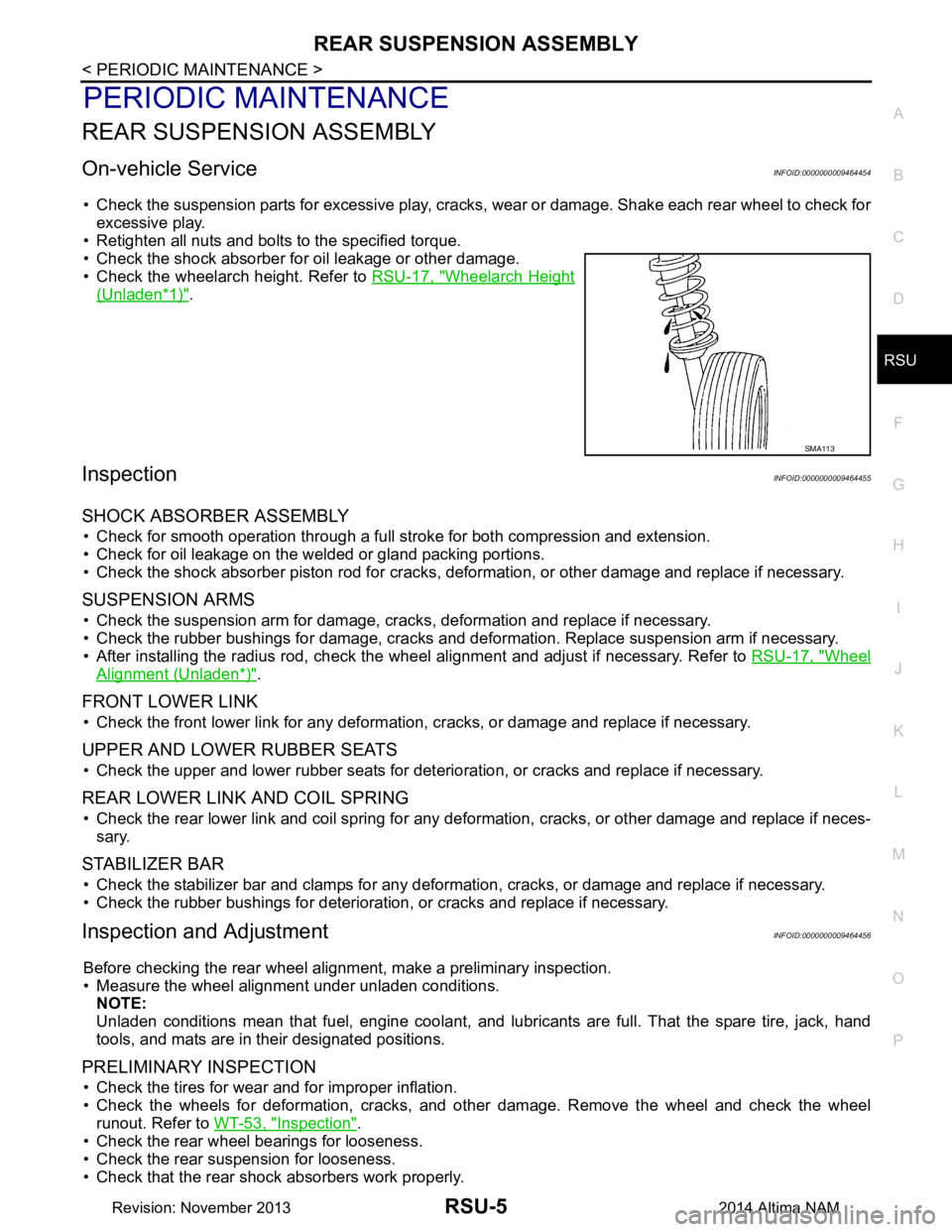
• Check the shock absorber for oil leakage or other damage.
• Check the wheelarch height. Refer to RSU-17, "Wheelarch Height
(Unladen*1)".
InspectionINFOID:0000000009464455
SHOCK ABSORBER ASSEMBLY
• Check for smooth operation through a full stroke for both compression and extension.
• Check for oil leakage on the welded or gland packing portions.
• Check the shock absorber piston r od for cracks, deformation, or other damage and replace if necessary.
SUSPENSION ARMS
• Check the suspension arm for damage, cracks, deformation and replace if necessary.
• Check the rubber bushings for damage, cracks and defo rmation. Replace suspension arm if necessary.
• After installing the radius rod, check the wheel alignment and adjust if necessary. Refer to RSU-17, "Wheel
Alignment (Unladen*)".
FRONT LOWER LINK
• Check the front lower link for any deformation, cracks, or damage and replace if necessary.
UPPER AND LOWER RUBBER SEATS
• Check the upper and lower rubber seats for deterioration, or cracks and replace if necessary.
REAR LOWER LINK AND COIL SPRING
• Check the rear lower link and coil spring for any def ormation, cracks, or other damage and replace if neces-
sary.
STABILIZER BAR
• Check the stabilizer bar and clamps for any deformation, cracks, or damage and replace if necessary.
• Check the rubber bushings for deterioration, or cracks and replace if necessary.
Inspection and AdjustmentINFOID:0000000009464456
Before checking the rear wheel ali gnment, make a preliminary inspection.
• Measure the wheel alignment under unladen conditions. NOTE:
Unladen conditions mean that fuel, engine coolant, and l ubricants are full. That the spare tire, jack, hand
tools, and mats are in their designated positions.
PRELIMINARY INSPECTION
• Check the tires for wear and for improper inflation.
• Check the wheels for deformation, cracks, and ot her damage. Remove the wheel and check the wheel
runout. Refer to WT-53, "Inspection"
.
• Check the rear wheel bearings for looseness.
• Check the rear suspension for looseness.
• Check that the rear shock absorbers work properly.
SMA113
Revision: November 20132014 Altima NAM
Page 4239 of 4801
![NISSAN TEANA 2014 User Guide
TM-24
< SYSTEM DESCRIPTION >[CVT: RE0F10D]
STRUCTURE AND OPERATION
The groove width changes according to wrapping radius of
steel belt and pulley from low status to overdrive
status continuously wit](/img/5/57390/w960_57390-4238.png "NISSAN TEANA 2014 User Guide
TM-24
< SYSTEM DESCRIPTION >[CVT: RE0F10D]
STRUCTURE AND OPERATION
The groove width changes according to wrapping radius of
steel belt and pulley from low status to overdrive
status continuously wit")
TM-24
< SYSTEM DESCRIPTION >[CVT: RE0F10D]
STRUCTURE AND OPERATION
The groove width changes according to wrapping radius of
steel belt and pulley from low status to overdrive
status continuously with non-step. It is controlled wit h the oil pressures of primary pulley and secondary pulley.
Steel Belt
It is composed of multiple steel plates (A) and two steel rings (B)
stacked to a several number. The feature of this steel belt transmits
power with compression of the steel plate in contrast with transmis-
sion of power in pulling with a rubber belt. Friction force is required
with the pulley slope to transmit power from the steel plate. The force
is generated with the following mechanism:
Oil pressure applies to the secondary pulley to nip the plate. ⇒The
plate is pushed and extended outward. ⇒The steel ring shows with-
stands. ⇒Pulling force is generated on the steel ring. ⇒The plate of
the primary pulley is nipped between the pulley. ⇒Friction force is
generated between the steel belt and the pulley.
Therefore, responsibilities are divi ded by the steel plate that trans-
mits the power with compression and the steel ring that main tains necessary friction force. In this way, the
tension of the steel ring is distributed on the entire su rface and stress variation is limited, resulting in good
durability.
Pulley
The primary pulley (input shaft side) and the secondary pulley (output shaft side) have the shaft with slope
(fixed cone surface), movable sheave (movable cone surface that can move in the axial direction) and oil pres-
sure chamber at the back of the movable sheave.
JSDIA2428GB
JSDIA2431ZZ
Revision: November 20132014 Altima NAMRevision: November 20132014 Altima NAM