parking brake NISSAN TEANA 2014 Owner's Manual
[x] Cancel search | Manufacturer: NISSAN, Model Year: 2014, Model line: TEANA, Model: NISSAN TEANA 2014Pages: 4801, PDF Size: 51.2 MB
Page 723 of 4801
![NISSAN TEANA 2014 Owners Manual
DAS-290
< SYMPTOM DIAGNOSIS >[MOD]
NORMAL OPERATING CONDITION
NORMAL OPERATING CONDITION
DescriptionINFOID:0000000009464956
MOVING OBJECT DETECTION
• The Moving Object Detection system is not a rep](/img/5/57390/w960_57390-722.png "NISSAN TEANA 2014 Owners Manual
DAS-290
< SYMPTOM DIAGNOSIS >[MOD]
NORMAL OPERATING CONDITION
NORMAL OPERATING CONDITION
DescriptionINFOID:0000000009464956
MOVING OBJECT DETECTION
• The Moving Object Detection system is not a rep")
DAS-290
< SYMPTOM DIAGNOSIS >[MOD]
NORMAL OPERATING CONDITION
NORMAL OPERATING CONDITION
DescriptionINFOID:0000000009464956
MOVING OBJECT DETECTION
• The Moving Object Detection system is not a repl
acement for proper driving procedure and is not designed
to prevent contact with vehicles or objects. When backing up. always look in the direction driver will move to
ensure it is safe to proceed. Never rely solely on the Moving Object Detection system.
• Using the Moving Object Detection system under some road or weather condition could lead to improper
system operation. Always rely on driver's own steering and braking operation to avoid accidents.
• The Moving Object Detection system may not provide a warning for vehicles that pass through the detection
zone quickly.
• Do not use the Moving Object Detection system when towing a trailer.
• Excessive noise (e.g., audio system volume, open v ehicle window) will interfere with the chime sound, and it
may not be heard.
- Pedestrians, bicycles, animals.
- A vehicle passing at a speed greater than approximately 24km/h (15 MPH ).
• A rear view camera may not detect approaching vehicles in certain situations:
- When the vehicle parked aside obstruct the beam of the rear view camera.
- When the vehicle is parked in an angled parking space.
- When the vehicle is parked on an inclined ground.
- When the vehicle turns around into your vehicle’s aisle.
- When the angle formed by your vehicle and approaching vehicle is small.
• Severe weather or road spray conditions may reduce the ability of the radar to detect other vehicles.
• The rear view camera system may not detect:
- Small or moving object.
- Wedge-shaped objects.
- Object closer to the bumper than 30 cm (10 inch).
- Thin objects such as rope, wire, chain, etc.
• Do not use the MOD system under the following condi tions because the system may not function properly:
- When driving with a tire that is not the within normal tire condition (example: tire wear, low pressure, spare
tire, chain, non-standard wheels).
- When the vehicle is equipped with non-original brake parts or suspension parts.
Revision: November 20132014 Altima NAMRevision: November 20132014 Altima NAM
Page 1683 of 4801
![NISSAN TEANA 2014 Owners Manual
IDLE AIR VOLUME LEARNINGEC-683
< BASIC INSPECTION > [VQ35DE]
C
D E
F
G H
I
J
K L
M A
EC
NP
O
IDLE AIR VOLUME LEARNING
DescriptionINFOID:0000000009462557
Idle Air Volume Learning is a function of ECM](/img/5/57390/w960_57390-1682.png "NISSAN TEANA 2014 Owners Manual
IDLE AIR VOLUME LEARNINGEC-683
< BASIC INSPECTION > [VQ35DE]
C
D E
F
G H
I
J
K L
M A
EC
NP
O
IDLE AIR VOLUME LEARNING
DescriptionINFOID:0000000009462557
Idle Air Volume Learning is a function of ECM")
IDLE AIR VOLUME LEARNINGEC-683
< BASIC INSPECTION > [VQ35DE]
C
D E
F
G H
I
J
K L
M A
EC
NP
O
IDLE AIR VOLUME LEARNING
DescriptionINFOID:0000000009462557
Idle Air Volume Learning is a function of ECM to learn
the idle air volume that keeps engine idle speed within
the specific range. It must be performed under the following conditions:
• Each time the electric throttle c ontrol actuator or ECM is replaced.
• Idle speed or ignition timing is out of the specification.
Work ProcedureINFOID:0000000009462558
1.PRECONDITIONING
Check that all of the following conditions are satisfied.
Learning will be cancelled if any of the following conditions are missed for even a moment.
• Battery voltage: More than 12.9 V (At idle)
• Engine coolant temperature: 70 - 100 °C (158 - 212 °F)
• Selector lever position: P or N
• Electric load switch: OFF
(Air conditioner, head lamp, rear window defogger)
On vehicles equipped with daytime light systems, if the parking brake is applied before the engine is
started the head lamp will not illuminate.
• Steering wheel: Neutral (Straight-ahead position)
• Vehicle speed: Stopped
• Transmission: Warmed-up
- With CONSULT: Drive vehicle until “ATF TEMP SEN” in “DATA MONITOR” mode of “CVT” system indicates
less than 0.9 V.
- Without CONSULT: Drive vehicle for 10 minutes.
Will CONSULT be used?
YES >> GO TO 2.
NO >> GO TO 3.
2.PERFORM IDLE AIR VOLUME LEARNING
With CONSULT
1. Perform Accelerator Pedal Released Position Learning. Refer to EC-681, "Work Procedure"
.
2. Perform Throttle Valve Closed Position Learning. Refer to EC-682, "Work Procedure"
.
3. Start engine and warm it up to normal operating temperature.
4. Select “IDLE AIR VOL LEA RN” in “WORK SUPPORT” mode.
5. Touch “START” and wait 20 seconds.
Is
“CMPLT” displayed on CONSULT screen?
YES >> GO TO 4.
NO >> GO TO 5.
3.PERFORM IDLE AIR VOLUME LEARNING
Without CONSULT
NOTE:
• It is better to count the time accurately with a clock.
• It is impossible to switch the di agnostic mode when an accelerator pedal position sensor circuit has
a malfunction.
1. Perform Accelerator Pedal Released Position Learning. Refer to EC-681, "Work Procedure"
.
2. Perform Throttle Valve Closed Position Learning. Refer to EC-682, "Work Procedure"
.
3. Start engine and warm it up to normal operating temperature.
4. Turn ignition switch OFF and wait at least 10 seconds.
5. Confirm that accelerator pedal is fully releas ed, turn ignition switch ON and wait 3 seconds.
6. Repeat the following procedure quickly 5 times within 5 seconds.
- Fully depress the accelerator pedal.
- Fully release the accelerator pedal.
7. Wait 7 seconds, fully depress the accelerator pedal for approx. 20 seconds until the MIL stops blinking
and turns ON.
8. Fully release the accelerator pedal within 3 seconds after the MIL turns ON.
Revision: November 20132014 Altima NAMRevision: November 20132014 Altima NAM
Page 1959 of 4801
![NISSAN TEANA 2014 Owners Manual
ELECTRONIC CONTROLLED ENGINE MOUNTEC-959
< DTC/CIRCUIT DIAGNOSIS > [VQ35DE]
C
D E
F
G H
I
J
K L
M A
EC
NP
O
ELECTRONIC CONTROLLED ENGINE MOUNT
Component Function CheckINFOID:0000000009462839
1.CHECK](/img/5/57390/w960_57390-1958.png "NISSAN TEANA 2014 Owners Manual
ELECTRONIC CONTROLLED ENGINE MOUNTEC-959
< DTC/CIRCUIT DIAGNOSIS > [VQ35DE]
C
D E
F
G H
I
J
K L
M A
EC
NP
O
ELECTRONIC CONTROLLED ENGINE MOUNT
Component Function CheckINFOID:0000000009462839
1.CHECK")
ELECTRONIC CONTROLLED ENGINE MOUNTEC-959
< DTC/CIRCUIT DIAGNOSIS > [VQ35DE]
C
D E
F
G H
I
J
K L
M A
EC
NP
O
ELECTRONIC CONTROLLED ENGINE MOUNT
Component Function CheckINFOID:0000000009462839
1.CHECK OVERALL FUNCTION
1. Start engine and warm it up to normal operating temperature.
2. Shift selector position is D while depressing the brake pedal and parking brake pedal.
3. Disconnect electronic controlled engine mount control solenoid valve harness connector.
4. Check that body vibration increases compared to the condition of step 2 above (with vehicle stopped).
Is the inspection result normal?
YES >> INSPECTION END
NO >> EC-959, "Diagnosis Procedure"
.
Diagnosis ProcedureINFOID:0000000009462840
1.CHECK VACUUM SOURCE
1. Turn ignition switch OFF.
2. Reconnect electronic controlled engine mount control solenoid valve harness connector.
3. Disconnect vacuum hose connected to electronic controlled engine mount.
4. Start engine and let it idle.
5. Check vacuum hose for vacuum existence.
Is the inspection result normal?
YES >> GO TO 7.
NO >> GO TO 2.
2.CHECK VACUUM HOSES AND VACUUM GALLERY
1. Turn ignition switch OFF.
2. Check vacuum hoses and vacuum gallery for cl ogging, cracks or improper connection. Refer to EC-577,
"ELECTRONIC CONTROLLED ENGINE MOUNT : System Description".
Is the inspection result normal?
YES >> GO TO 3.
NO >> Repair or replace vacuum hoses and vacuum gallery.
3.CHECK ELECTRONIC CONTROLLED ENGINE MOUNT CONTROL SOLENOID VALVE POWER SUPPLY
1. Disconnect electronic controlled engine mount control solenoid valve harness connector.
2. Turn ignition switch ON.
3. Check the voltage between front electronic controlled engine mount harness connector and ground.
Is the inspection result normal?
YES >> GO TO 5.
NO >> GO TO 4.
4.CHECK ELECTRONIC CONTROLLED ENGINE MOUNT CONTROL SOLENOID VALVE POWER SUPPLY
CIRCUIT
1. Turn ignition switch OFF.
2. Disconnect fuse block (J/B) harness connector.
3. Check the continuity between electronic controll ed engine mount harness connector and fuse block (J/B)
harness connector. Vacuum should exist.
Electronic controlled engine mount
control solenoid valve Ground Voltage
Connector Terminal
F64 1 Ground Battery voltage
Revision: November 20132014 Altima NAMRevision: November 20132014 Altima NAM
Page 2274 of 4801

EXL-8
< SYSTEM DESCRIPTION >
COMPONENT PARTS
Component Description
INFOID:0000000009463542
1. BCM (view with combination meter re-
moved) 2. Combination switch
(lighting and turn signal switch) 3. IPDM E/R, (Headlamp high relay,
Headlamp low relay, Tail lamp relay
and Front fog lamp relay (if equipped))
4. Fuse, fusible link and relay box (Stop lamp relay) 5. Combination meter 6. Parking brake switch
7. Stop lamp switch 8. Hazard switch 9. Optical sensor
10. Front door switch LH (RH similar) 11. Rear door switch LH
(RH similar) 12. Daytime light relay
(if equipped)
Part Description
BCM Controls the exterior lighting system.
Combination switch
(Lighting & turn signal switch) Refer to
BCS-8, "COMBINATION SWITCH READIN G SYSTEM : System Description"
.
IPDM E/R Controls the integrated relays and supplies voltage to the load according to the request from the BCM
via CAN communication.
Stop lamp switch Transmits power to the stop lamp relay when the brake pedal is pressed to operate stop lamps.
Combination meter Refer to MWI-9, "METER SYSTEM : System Description"
.
Daytime light relay
(if equipped) Sends power to the daytime lamp when operated by the IPDM E/R.
Stop lamp relay Transmits power to the stop lamps when the brake pedal is pressed.
Front door switch LH/RH Transmits the door open signal to the BCM.
Rear door switch LH/RH
Optical sensor Optical sensor converts the outside brightness (lux) to voltage and transmits the optical sensor signal
to BCM to operate the auto light system.
Parking brake switch Transmits the parking brake switch signal to the combination meter to operate the auto light system.
Hazard switch Inputs the hazard switch signal to BCM.
Revision: November 20132014 Altima NAMRevision: November 20132014 Altima NAM
Page 2277 of 4801
SYSTEMEXL-11
< SYSTEM DESCRIPTION >
C
D E
F
G H
I
J
K
M A
B
EXL
N
O P
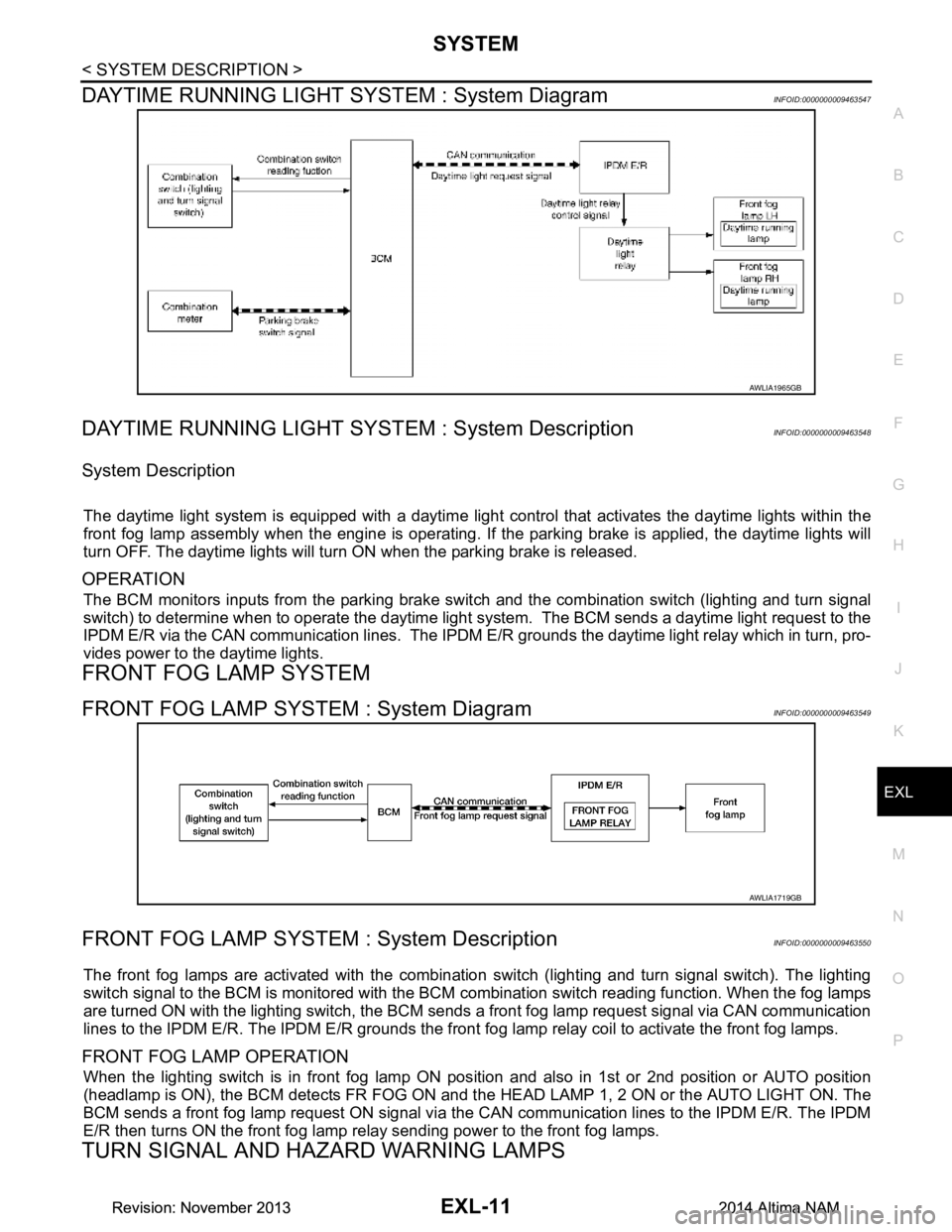
DAYTIME RUNNING LIGHT SY STEM : System DiagramINFOID:0000000009463547
DAYTIME RUNNING LIGHT SYST EM : System DescriptionINFOID:0000000009463548
System Description
The daytime light system is equipped with a daytime light control that activates the daytime lights within the
front fog lamp assembly when the engine is operating. If the parking brake is applied, the daytime lights will
turn OFF. The daytime lights will turn ON when the parking brake is released.
OPERATION
The BCM monitors inputs from the parking brake swit ch and the combination switch (lighting and turn signal
switch) to determine when to operate the daytime light s ystem. The BCM sends a daytime light request to the
IPDM E/R via the CAN communication lines. The IPDM E/ R grounds the daytime light relay which in turn, pro-
vides power to the daytime lights.
FRONT FOG LAMP SYSTEM
FRONT FOG LAMP SYSTEM : System DiagramINFOID:0000000009463549
FRONT FOG LAMP SYSTEM : System DescriptionINFOID:0000000009463550
The front fog lamps are activated with the combination switch (lighting and turn signal switch). The lighting
switch signal to the BCM is monitored with the BCM combination switch reading function. When the fog lamps
are turned ON with the lighting switch, the BCM sends a front fog lamp request signal via CAN communication
lines to the IPDM E/R. The IPDM E/R grounds the front fog lamp relay coil to activate the front fog lamps.
FRONT FOG LAMP OPERATION
When the lighting switch is in front fog lamp ON position and also in 1st or 2nd position or AUTO position
(headlamp is ON), the BCM detects FR FOG ON and the HEAD LAMP 1, 2 ON or the AUTO LIGHT ON. The
BCM sends a front fog lamp request ON signal via the CAN communication lines to the IPDM E/R. The IPDM
E/R then turns ON the front fog lamp re lay sending power to the front fog lamps.
TURN SIGNAL AND HAZARD WARNING LAMPS
AWLIA1965GB
AWLIA1719GB
Revision: November 20132014 Altima NAMRevision: November 20132014 Altima NAM
Page 2384 of 4801
EXL-118
< SYMPTOM DIAGNOSIS >
DAYTIME LIGHT SYSTEM INOPERATIVE
DAYTIME LIGHT SYSTEM INOPERATIVE
DescriptionINFOID:0000000009463609
The daytime light system is inoperative even though the combination switch (lighting and turn signal switch)
and parking brake switch are in the normal setting, also whenever engine is operating.
Diagnosis ProcedureINFOID:0000000009463610
1.CHECK DAYTIME LIGHT OPERATION
1. Perform BCM(HEADLAMP) DAYTIME RUNNING LIGHT active test. Refer to BCS-19, "HEADLAMP :
CONSULT Function (BCM - HEADLAMP)".
2. Check that the daytime lights turn on.
Is the inspection results normal?
YES >> Replace BCM. Refer to BCS-80, "Removal and Installation".
NO >> GO TO 2.
2.CHECK DAYTIME LIGHT RELAY FUSE
1. Turn ignition switch OFF.
2. Check that the following fuse is not blown.
Is the fuse blown?
YES >> Replace the blown fuse after repairing the affected circuit.
NO >> GO TO 3.
3.CHECK DAYTIME LIGHT BULBS
Check the daytime light bulbs are not open.
Is the inspection result normal?
YES >> GO TO 4.
NO >> Replace the bulbs.
4.PERFORM DAYTIME LIGH T CIRCUIT INSPECTION
Check the daytime light circuit. Refer to EXL-98, "Diagnosis Procedure"
.
Is the inspection results normal?
YES >> Replace IPDM E/R. Refer to PCS-32, "Removal and Installation".
NO >> Repair or replace the malfunctioning part.
Unit Fuse No. Capacity
Daytime light 43 10 A
Revision: November 20132014 Altima NAMRevision: November 20132014 Altima NAM
Page 2492 of 4801
FL-12
< REMOVAL AND INSTALLATION >
FUEL TANK
8. Remove rear wheel and tire using power tool. Refer to WT-55, "Adjustment".
9. Remove rear brake pads. Refer to BR-38, "BRAKE PAD : Removal and Installation"
.
10. Remove rear torque members and rear disc brake rotor.
11. Disconnect rear parking brake shoe, and remove rear cables from toggle lever. Refer to PB-9, "Removal
and Installation".
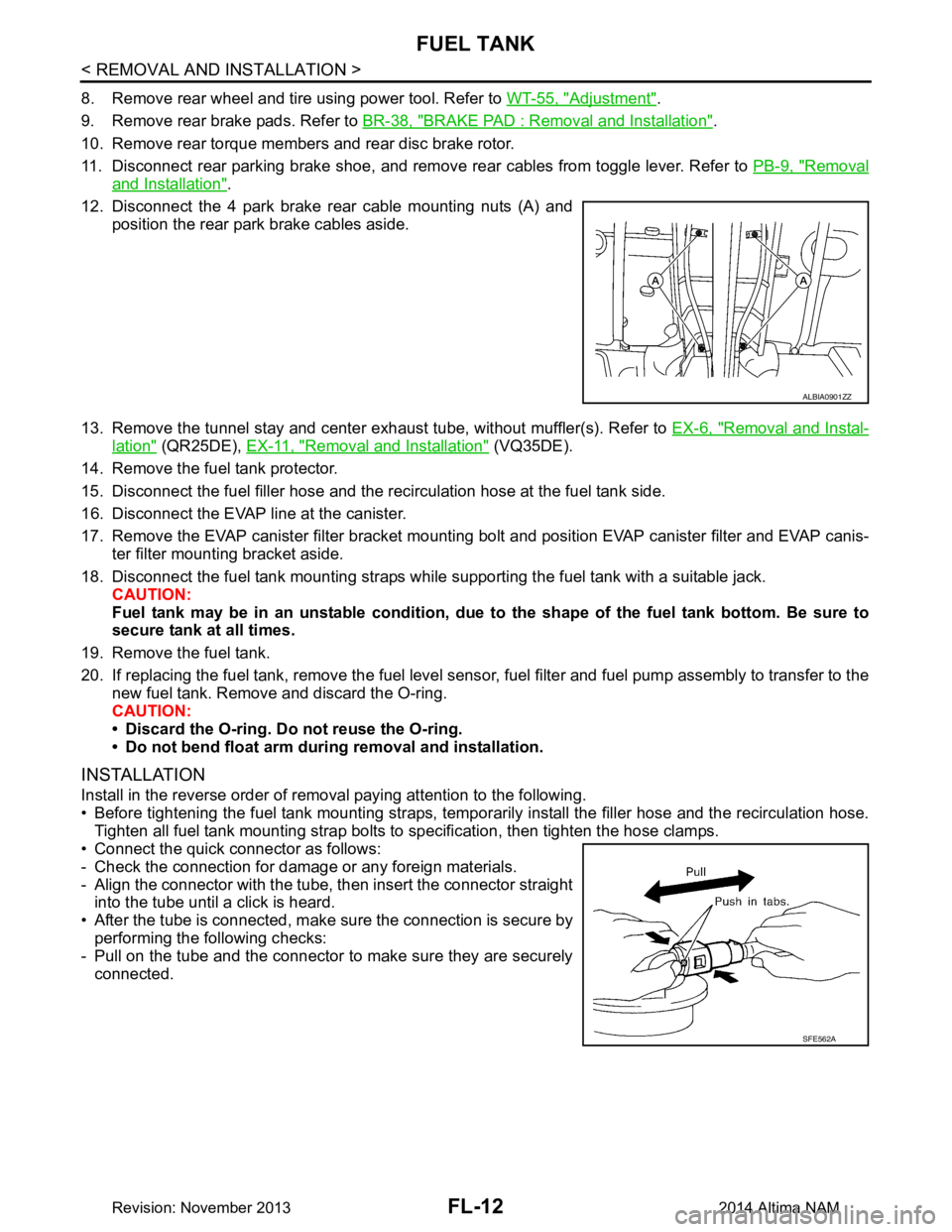
12. Disconnect the 4 park brake rear cable mounting nuts (A) and position the rear park brake cables aside.
13. Remove the tunnel stay and center exhaust tube, without muffler(s). Refer to EX-6, "Removal and Instal-
lation" (QR25DE), EX-11, "Removal and Installation" (VQ35DE).
14. Remove the fuel tank protector.
15. Disconnect the fuel filler hose and the recirculation hose at the fuel tank side.
16. Disconnect the EVAP line at the canister.
17. Remove the EVAP canister filter bracket mounti ng bolt and position EVAP canister filter and EVAP canis-
ter filter mounting bracket aside.
18. Disconnect the fuel tank mounting straps while supporting the fuel tank with a suitable jack. CAUTION:
Fuel tank may be in an unstable condition, due to the shape of the fuel tank bottom. Be sure to
secure tank at all times.
19. Remove the fuel tank.
20. If replacing the fuel tank, remove the fuel level sens or, fuel filter and fuel pump assembly to transfer to the
new fuel tank. Remove and discard the O-ring.
CAUTION:
• Discard the O-ring. Do not reuse the O-ring.
• Do not bend float arm during removal and installation.
INSTALLATION
Install in the reverse order of removal paying attention to the following.
• Before tightening the fuel tank mounting straps, tempor arily install the filler hose and the recirculation hose.
Tighten all fuel tank mounting strap bolts to specification, then tighten the hose clamps.
• Connect the quick connector as follows:
- Check the connection for damage or any foreign materials.
- Align the connector with the tube, then insert the connector straight into the tube until a click is heard.
• After the tube is connected, make sure the connection is secure by performing the following checks:
- Pull on the tube and the connector to make sure they are securely
connected.
ALBIA0901ZZ
SFE562A
Revision: November 20132014 Altima NAM
Page 2540 of 4801
GI-12
< HOW TO USE THIS MANUAL >
HOW TO READ WIRING DIAGRAMS
• ignition switch is “OFF”,
• doors, hood and trunk lid/back door are closed,
• pedals are not depressed, and
• parking brake is released.
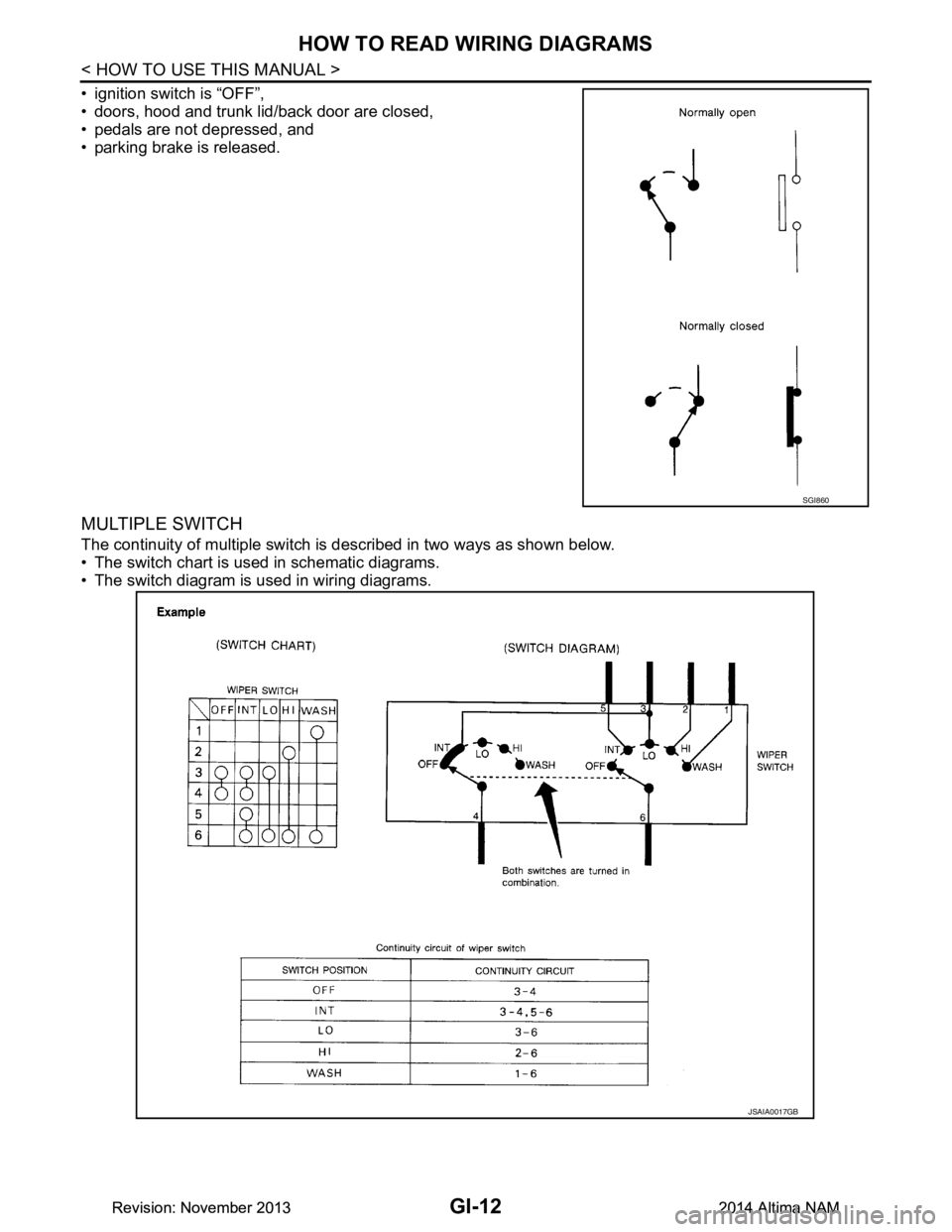
MULTIPLE SWITCH
The continuity of multiple switch is described in two ways as shown below.
• The switch chart is used in schematic diagrams.
• The switch diagram is used in wiring diagrams.
SGI860
JSAIA0017GB
Revision: November 20132014 Altima NAMRevision: November 20132014 Altima NAM
Page 2564 of 4801
GI-36
< PRECAUTION >
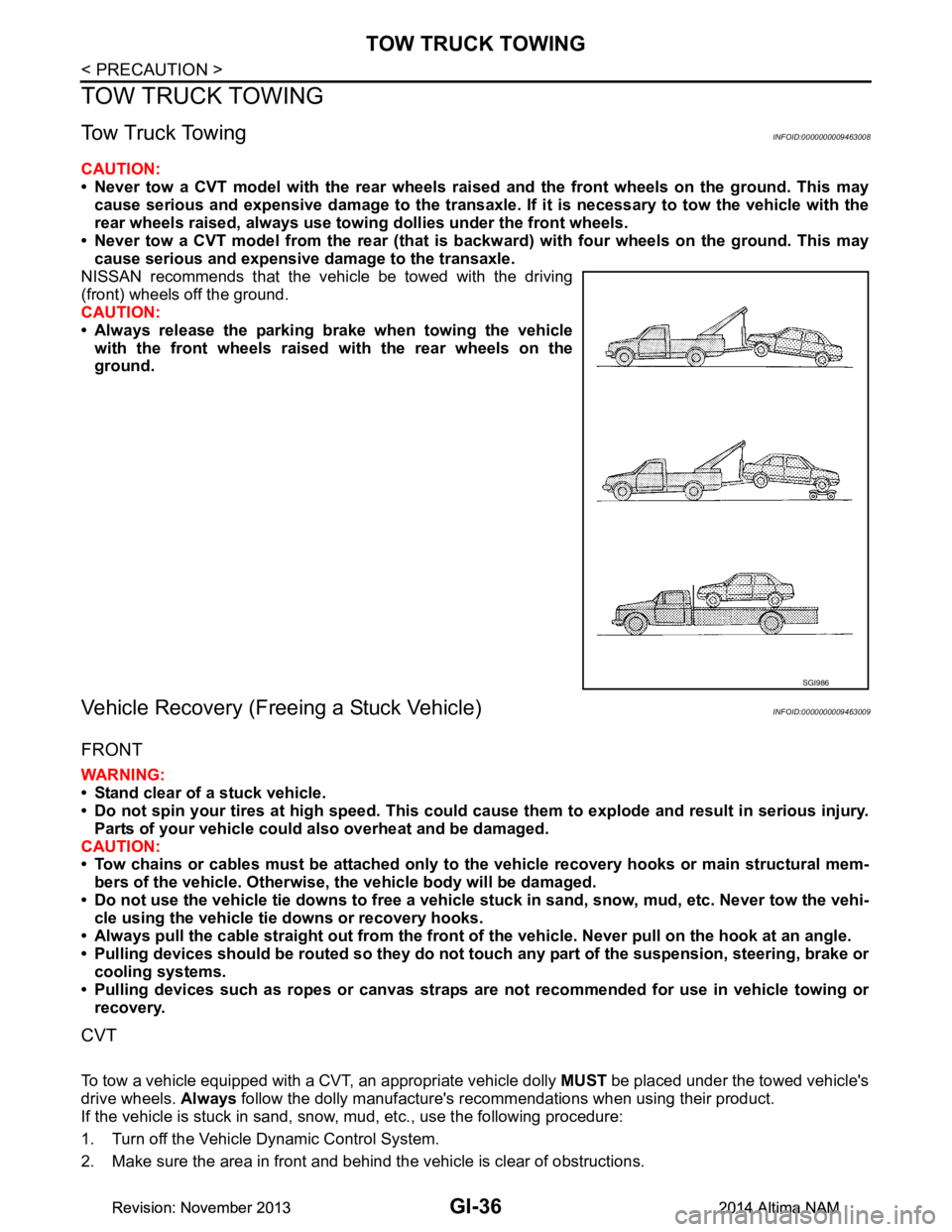
TOW TRUCK TOWING
TOW TRUCK TOWING
Tow Truck TowingINFOID:0000000009463008
CAUTION:
• Never tow a CVT model with the rear wheels raised and the front wheels on the ground. This may
cause serious and expensive damage to the transaxle. If it is necessary to tow the vehicle with the
rear wheels raised, always use towi ng dollies under the front wheels.
• Never tow a CVT model from the rear (that is backw ard) with four wheels on the ground. This may
cause serious and expensive damage to the transaxle.
NISSAN recommends that the vehicle be towed with the driving
(front) wheels off the ground.
CAUTION:
• Always release the parking brake when towing the vehicle with the front wheels raised with the rear wheels on the
ground.
Vehicle Recovery (Freeing a Stuck Vehicle)INFOID:0000000009463009
FRONT
WARNING:
• Stand clear of a stuck vehicle.
• Do not spin your tires at high speed. This could cause them to explode and result in serious injury.
Parts of your vehicle could also overheat and be damaged.
CAUTION:
• Tow chains or cables must be attached only to the vehicle recovery hooks or main structural mem-
bers of the vehicle. Otherwise, the vehicle body will be damaged.
• Do not use the vehicle tie downs to free a vehicle stuck in sand, snow, mud, etc. Never tow the vehi-
cle using the vehicle tie downs or recovery hooks.
• Always pull the cable straight out from the front of the vehicle. Never pull on the hook at an angle.
• Pulling devices should be routed so they do not touch any part of the suspension, steering, brake or
cooling systems.
• Pulling devices such as ropes or canvas straps ar e not recommended for use in vehicle towing or
recovery.
CVT
To tow a vehicle equipped with a CVT, an appropriate vehicle dolly MUST be placed under the towed vehicle's
drive wheels. Always follow the dolly manufacture's recommendations when using their product.
If the vehicle is stuck in sand, snow , mud, etc., use the following procedure:
1. Turn off the Vehicle Dynamic Control System.
2. Make sure the area in front and behind the vehicle is clear of obstructions.
SGI986
Revision: November 20132014 Altima NAMRevision: November 20132014 Altima NAM
Page 2983 of 4801
![NISSAN TEANA 2014 Owners Manual
LAN-34
< SYSTEM DESCRIPTION >[CAN]
SYSTEM
Paddle shift down signal*2
RT
Paddle shift up signal
*2RT
Manual mode signal
*2RT
Market information signal T R R
Not manual mode signal
*2RT
Overdrive cont](/img/5/57390/w960_57390-2982.png "NISSAN TEANA 2014 Owners Manual
LAN-34
< SYSTEM DESCRIPTION >[CAN]
SYSTEM
Paddle shift down signal*2
RT
Paddle shift up signal
*2RT
Manual mode signal
*2RT
Market information signal T R R
Not manual mode signal
*2RT
Overdrive cont")
LAN-34
< SYSTEM DESCRIPTION >[CAN]
SYSTEM
Paddle shift down signal*2
RT
Paddle shift up signal
*2RT
Manual mode signal
*2RT
Market information signal T R R
Not manual mode signal
*2RT
Overdrive control switch signal
*1RT
Parking brake switch signal T R R R
Seat belt buckle switch signal T R
Vehicle speed signal RRRR T R R R
RRRRRR TR
Steering angle sensor signal R T R R
Buzzer output signal RT
RT
Meter display signal R T
A/C switch signal R T
*3T*4
Ambient sensor signal*3RT
Blower fan motor switch signal R T
*3T*4
ABS operation signal R T
ABS warning lamp signal R T
Brake warning lamp signal R T
SLIP indicator lamp signal R T
TCS operation signal R T
VDC OFF indicator lamp signal R T
VDC operation signal R T
Yaw rate signal RT
Day time running light request signal R R R T
Door switch signal R R R R T
Front fog light request signal R R R R T
Front wiper request signal R R T
High beam request signal R R R R T
Horn reminder signal R T
Ignition switch ON signal R T
Key warning signal R T
Low beam request signal R R R R T
Meter TPMS display signal R T
Position light request signal R R R R T
Rear window defogger switch signal R R T
Sleep wake up signal R R T
Starter control relay signal R T
Theft warning horn request signal R T
Tire pressure data signal R R T Signal name
ECM
EPS
IPDM-E TCM
M&A
STRG AV
AV M
HVAC ABS
BCM
Revision: November 20132014 Altima NAMRevision: November 20132014 Altima NAM