Condition NISSAN TERRANO 2002 Service Repair Manual
[x] Cancel search | Manufacturer: NISSAN, Model Year: 2002, Model line: TERRANO, Model: NISSAN TERRANO 2002Pages: 1767, PDF Size: 41.51 MB
Page 733 of 1767
Component Inspection
ACCELERATOR POSITION SENSOR
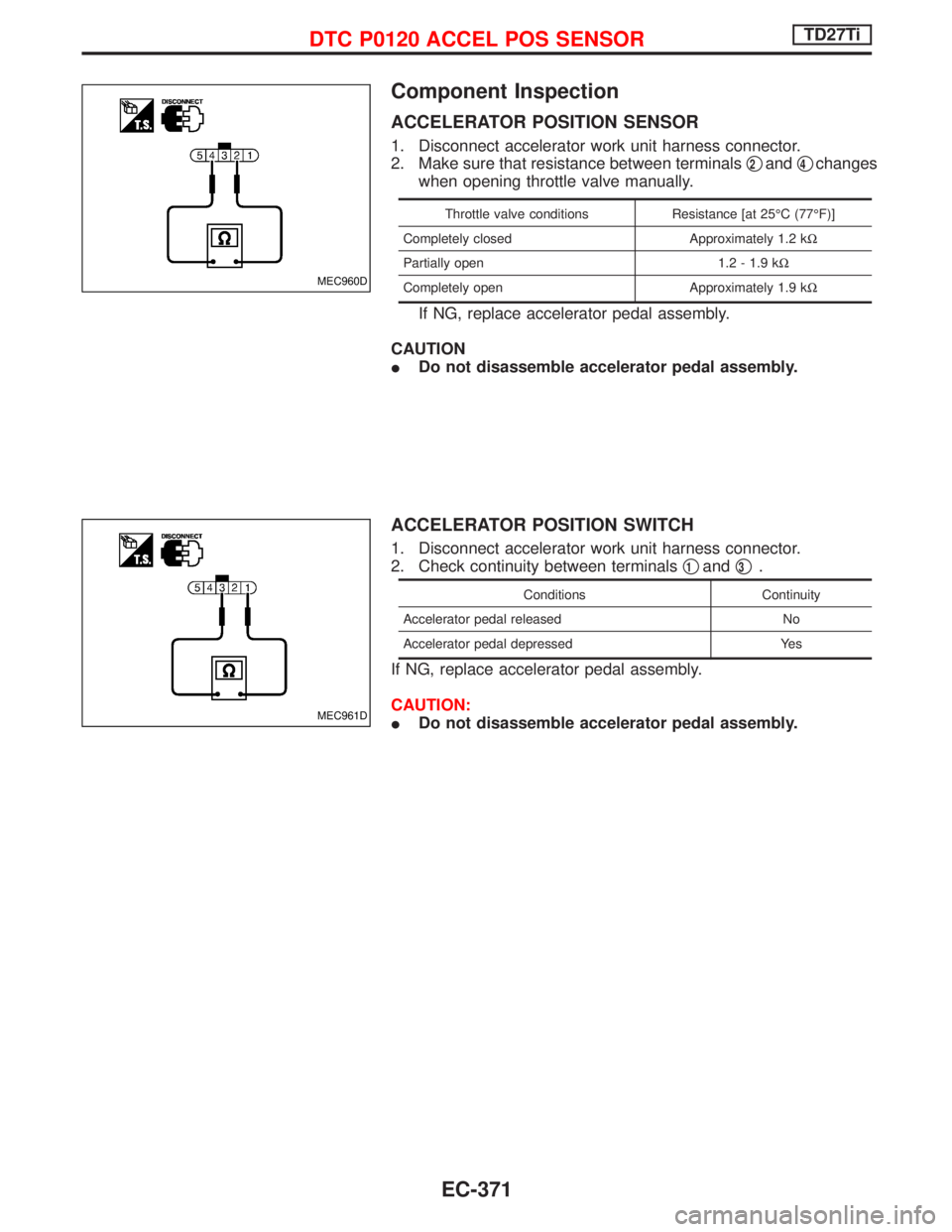
1. Disconnect accelerator work unit harness connector.
2. Make sure that resistance between terminalsq
2andq4changes
when opening throttle valve manually.
Throttle valve conditions Resistance [at 25ÉC (77ÉF)]
Completely closed Approximately 1.2 kW
Partially open 1.2 - 1.9 kW
Completely open Approximately 1.9 kW
If NG, replace accelerator pedal assembly.
CAUTION
IDo not disassemble accelerator pedal assembly.
ACCELERATOR POSITION SWITCH
1. Disconnect accelerator work unit harness connector.
2. Check continuity between terminalsq
1andq3.
Conditions Continuity
Accelerator pedal released No
Accelerator pedal depressed Yes
If NG, replace accelerator pedal assembly.
CAUTION:
IDo not disassemble accelerator pedal assembly.
MEC960D
MEC961D
DTC P0120 ACCEL POS SENSORTD27Ti
EC-371
Page 738 of 1767
Component Description
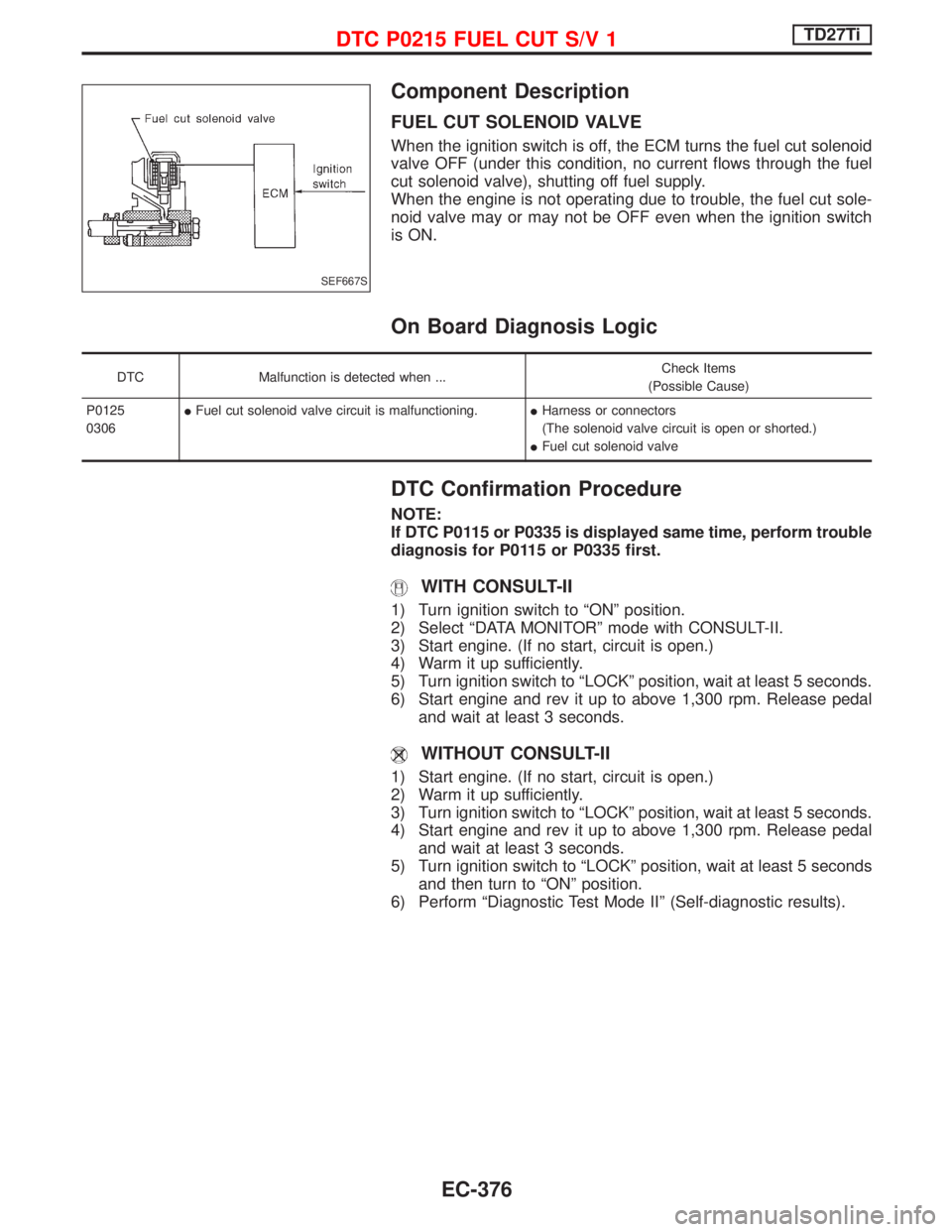
FUEL CUT SOLENOID VALVE
When the ignition switch is off, the ECM turns the fuel cut solenoid
valve OFF (under this condition, no current flows through the fuel
cut solenoid valve), shutting off fuel supply.
When the engine is not operating due to trouble, the fuel cut sole-
noid valve may or may not be OFF even when the ignition switch
is ON.
On Board Diagnosis Logic
DTC Malfunction is detected when ...Check Items
(Possible Cause)
P0125
0306IFuel cut solenoid valve circuit is malfunctioning.IHarness or connectors
(The solenoid valve circuit is open or shorted.)
IFuel cut solenoid valve
DTC Confirmation Procedure
NOTE:
If DTC P0115 or P0335 is displayed same time, perform trouble
diagnosis for P0115 or P0335 first.
WITH CONSULT-II
1) Turn ignition switch to ªONº position.
2) Select ªDATA MONITORº mode with CONSULT-II.
3) Start engine. (If no start, circuit is open.)
4) Warm it up sufficiently.
5) Turn ignition switch to ªLOCKº position, wait at least 5 seconds.
6) Start engine and rev it up to above 1,300 rpm. Release pedal
and wait at least 3 seconds.
WITHOUT CONSULT-II
1) Start engine. (If no start, circuit is open.)
2) Warm it up sufficiently.
3) Turn ignition switch to ªLOCKº position, wait at least 5 seconds.
4) Start engine and rev it up to above 1,300 rpm. Release pedal
and wait at least 3 seconds.
5) Turn ignition switch to ªLOCKº position, wait at least 5 seconds
and then turn to ªONº position.
6) Perform ªDiagnostic Test Mode IIº (Self-diagnostic results).
SEF667S
DTC P0215 FUEL CUT S/V 1TD27Ti
EC-376
Page 758 of 1767
Component Inspection
GLOW RELAY
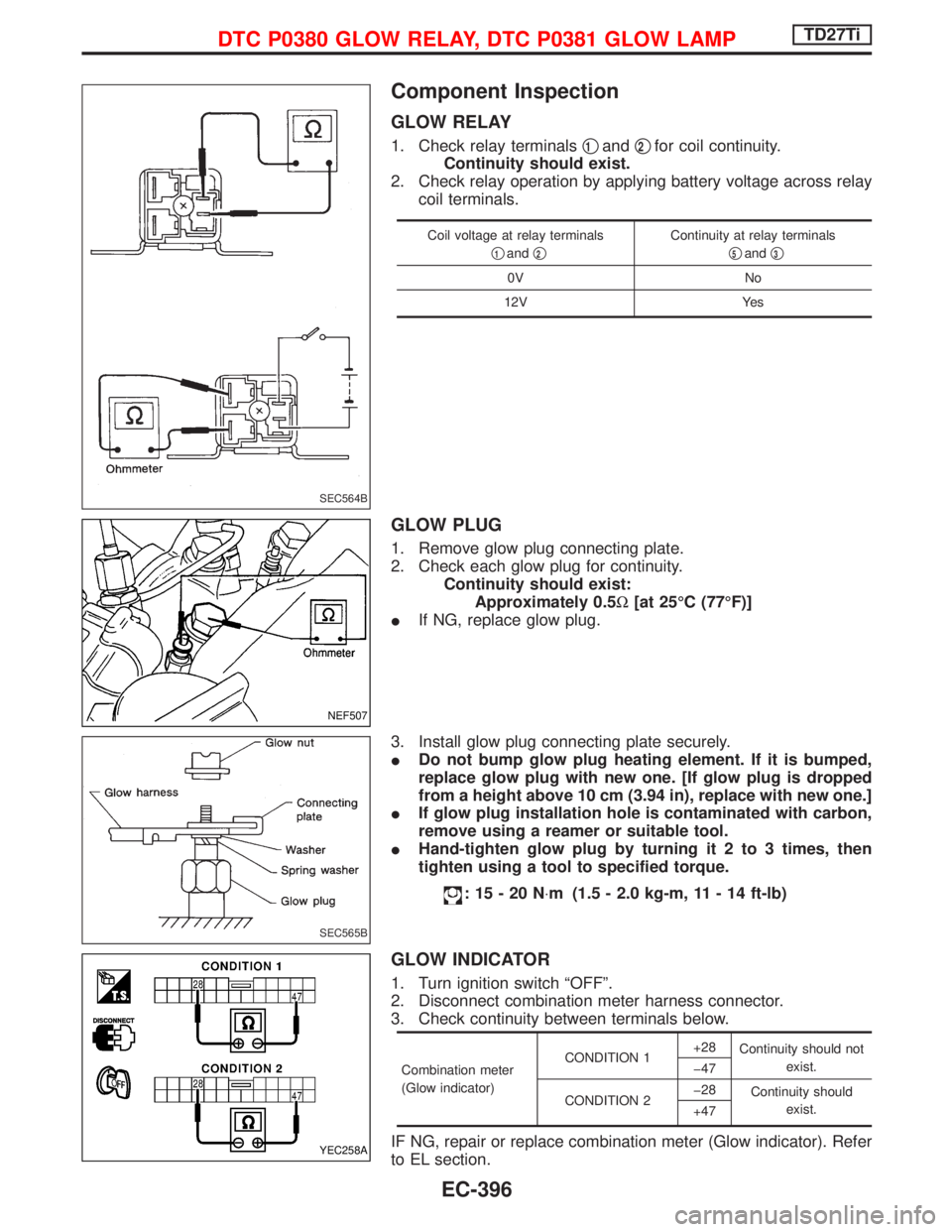
1. Check relay terminalsq1andq2for coil continuity.
Continuity should exist.
2. Check relay operation by applying battery voltage across relay
coil terminals.
Coil voltage at relay terminals
q
1andq2
Continuity at relay terminals
q
5andq3
0V No
12V Yes
GLOW PLUG
1. Remove glow plug connecting plate.
2. Check each glow plug for continuity.
Continuity should exist:
Approximately 0.5W[at 25ÉC (77ÉF)]
IIf NG, replace glow plug.
3. Install glow plug connecting plate securely.
IDo not bump glow plug heating element. If it is bumped,
replace glow plug with new one. [If glow plug is dropped
from a height above 10 cm (3.94 in), replace with new one.]
IIf glow plug installation hole is contaminated with carbon,
remove using a reamer or suitable tool.
IHand-tighten glow plug by turning it 2 to 3 times, then
tighten using a tool to specified torque.
:15-20N×m (1.5 - 2.0 kg-m, 11 - 14 ft-lb)
GLOW INDICATOR
1. Turn ignition switch ªOFFº.
2. Disconnect combination meter harness connector.
3. Check continuity between terminals below.
Combination meter
(Glow indicator)CONDITION 1+28
Continuity should not
exist.
þ47
CONDITION 2þ28
Continuity should
exist.
+47
IF NG, repair or replace combination meter (Glow indicator). Refer
to EL section.
SEC564B
NEF507
SEC565B
YEC258A
DTC P0380 GLOW RELAY, DTC P0381 GLOW LAMPTD27Ti
EC-396
Page 766 of 1767
Component Description
Malfunction Indicator (MI) is located on the instrument panel. When the ignition switch is turned ON without
engine running, MI will light up. This is a bulb check. When the engine is started, MI should go off. If MI remains
on, the on board diagnostic system has detected an engine system malfunction.
On Board Diagnosis Logic
DTC No. Trouble diagnosis name DTC detecting condition Possible cause
P0650
0907Malfunction indicator (MI) control cir-
cuitIAn excessively high voltage is sent
to ECM through the MI circuit
under the condition that calls for MI
light up.
IAn excessively low voltage is sent
to ECM through the MI circuit
under the condition that calls for MI
not to light up.IHarness or connectors
(MI circuit is open or shorted.)
IMI
DTC Confirmation Procedure
NOTE:
If ªDTC Confirmation Procedureº has been previously
conducted, always turn ignition switch ªOFFº and wait at least
10 seconds before conducting the next test.
WITH CONSULT-II
1. Turn ignition switch ªONº.
2. Select ªDATA MONITORº mode with CONSULT-II.
3. Start engine and let it idle for 2 second.
WITHOUT CONSULT-II
1. Turn ignition switch ªONº.
2. Perform ªDiagnostic Test Mode IIº (Self-diagnostic results).
3. Start engine and let it idle for 2 second.
4. Perform ªDiagnostic Test Mode IIº (Self-diagnostic results).
SEF817Y
DTC P0650 MITD27Ti
EC-404
Page 768 of 1767
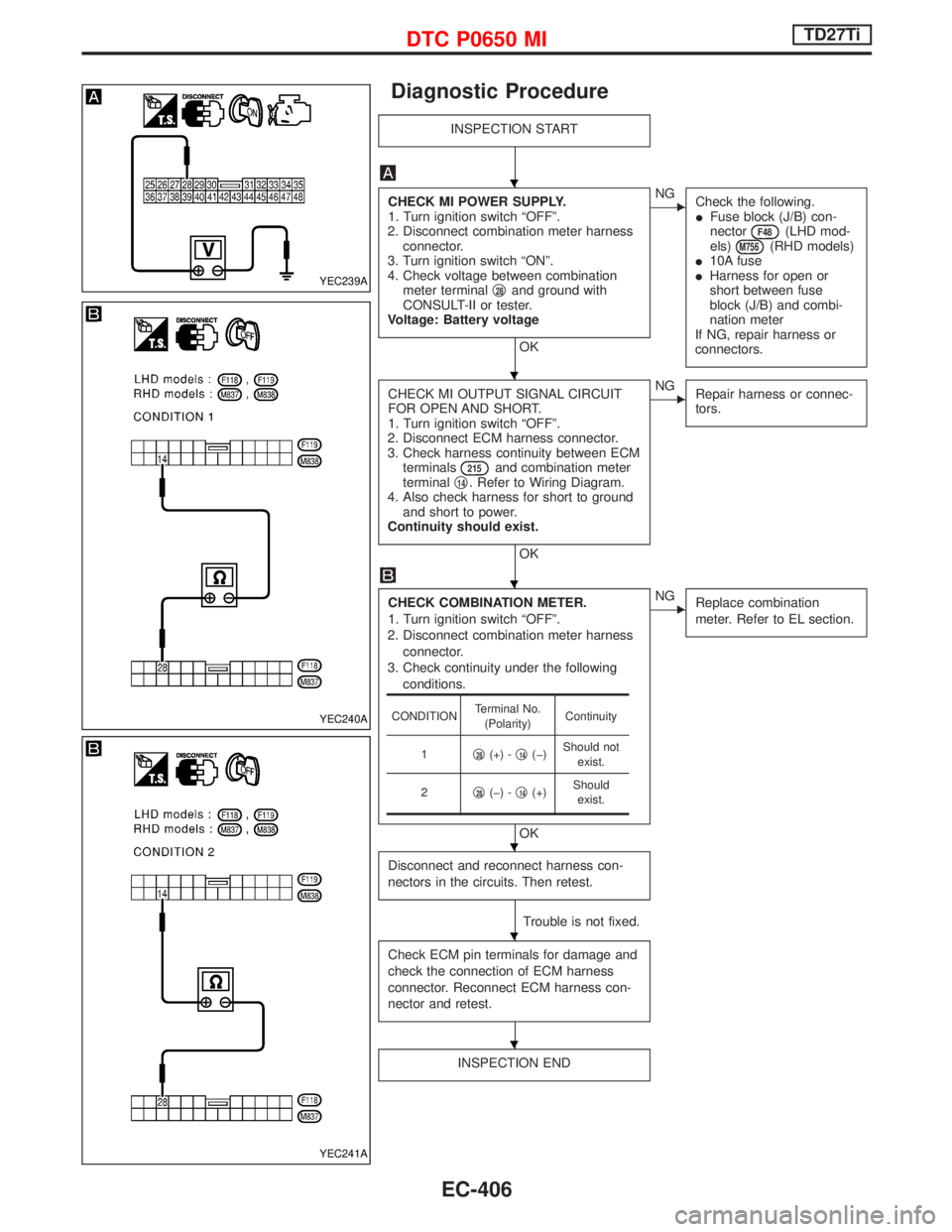
Diagnostic Procedure
INSPECTION START
CHECK MI POWER SUPPLY.
1. Turn ignition switch ªOFFº.
2. Disconnect combination meter harness
connector.
3. Turn ignition switch ªONº.
4. Check voltage between combination
meter terminalq
28and ground with
CONSULT-II or tester.
Voltage: Battery voltage
OK
ENG
Check the following.
IFuse block (J/B) con-
nector
F48(LHD mod-
els)M756(RHD models)
I10A fuse
IHarness for open or
short between fuse
block (J/B) and combi-
nation meter
If NG, repair harness or
connectors.
CHECK MI OUTPUT SIGNAL CIRCUIT
FOR OPEN AND SHORT.
1. Turn ignition switch ªOFFº.
2. Disconnect ECM harness connector.
3. Check harness continuity between ECM
terminals
215and combination meter
terminalq14. Refer to Wiring Diagram.
4. Also check harness for short to ground
and short to power.
Continuity should exist.
OK
ENG
Repair harness or connec-
tors.
CHECK COMBINATION METER.
1. Turn ignition switch ªOFFº.
2. Disconnect combination meter harness
connector.
3. Check continuity under the following
conditions.
OK
ENG
Replace combination
meter. Refer to EL section.
Disconnect and reconnect harness con-
nectors in the circuits. Then retest.
Trouble is not fixed.
Check ECM pin terminals for damage and
check the connection of ECM harness
connector. Reconnect ECM harness con-
nector and retest.
INSPECTION END
CONDITIONTerminal No.
(Polarity)Continuity
1q
28(+) -q14(þ)Should not
exist.
2q
28(þ) -q14(+)Should
exist.
YEC239A
YEC240A
YEC241A
H
H
H
H
H
H
DTC P0650 MITD27Ti
EC-406
Page 771 of 1767
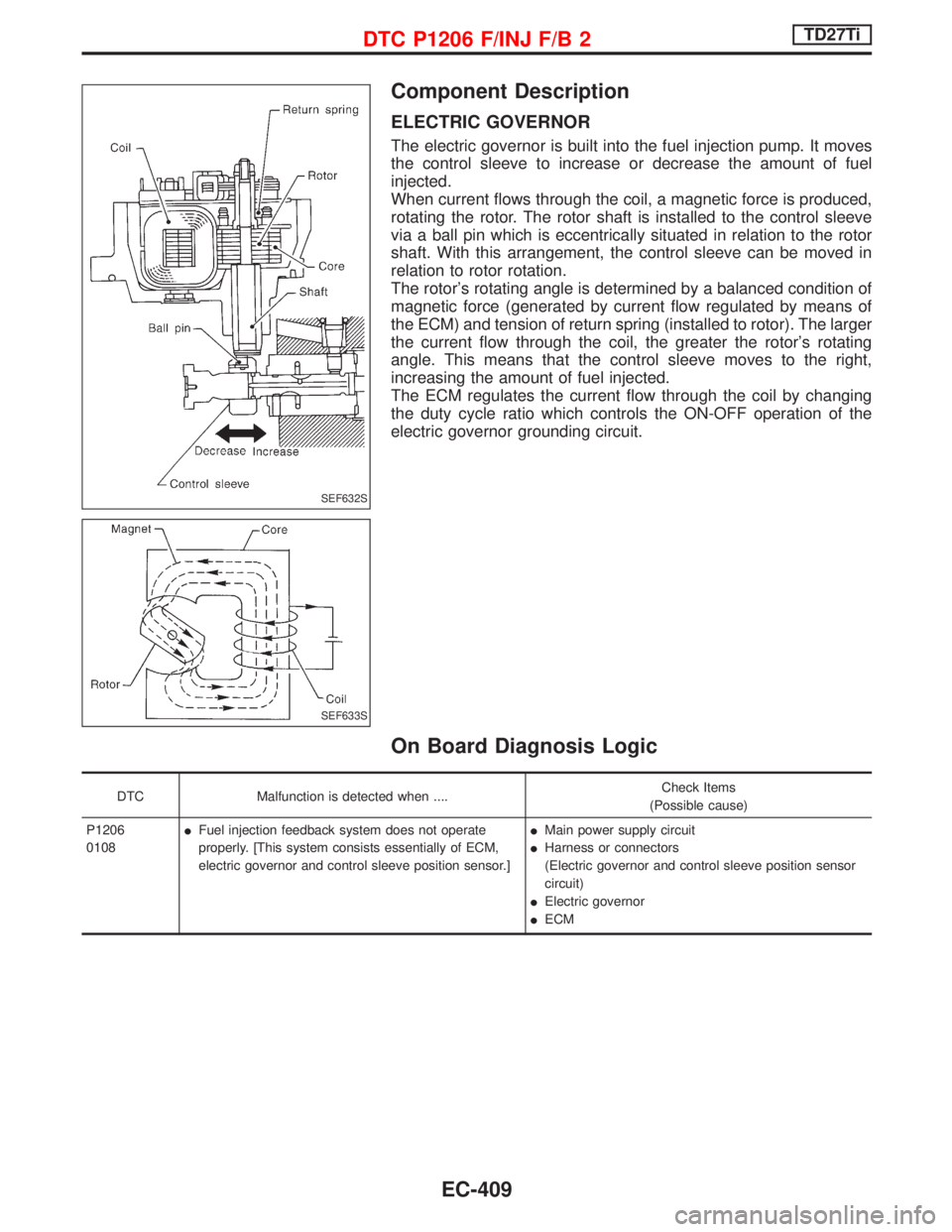
Component Description
ELECTRIC GOVERNOR
The electric governor is built into the fuel injection pump. It moves
the control sleeve to increase or decrease the amount of fuel
injected.
When current flows through the coil, a magnetic force is produced,
rotating the rotor. The rotor shaft is installed to the control sleeve
via a ball pin which is eccentrically situated in relation to the rotor
shaft. With this arrangement, the control sleeve can be moved in
relation to rotor rotation.
The rotor's rotating angle is determined by a balanced condition of
magnetic force (generated by current flow regulated by means of
the ECM) and tension of return spring (installed to rotor). The larger
the current flow through the coil, the greater the rotor's rotating
angle. This means that the control sleeve moves to the right,
increasing the amount of fuel injected.
The ECM regulates the current flow through the coil by changing
the duty cycle ratio which controls the ON-OFF operation of the
electric governor grounding circuit.
On Board Diagnosis Logic
DTC Malfunction is detected when ....Check Items
(Possible cause)
P1206
0108IFuel injection feedback system does not operate
properly. [This system consists essentially of ECM,
electric governor and control sleeve position sensor.]IMain power supply circuit
IHarness or connectors
(Electric governor and control sleeve position sensor
circuit)
IElectric governor
IECM
SEF632S
SEF633S
DTC P1206 F/INJ F/B 2TD27Ti
EC-409
Page 780 of 1767
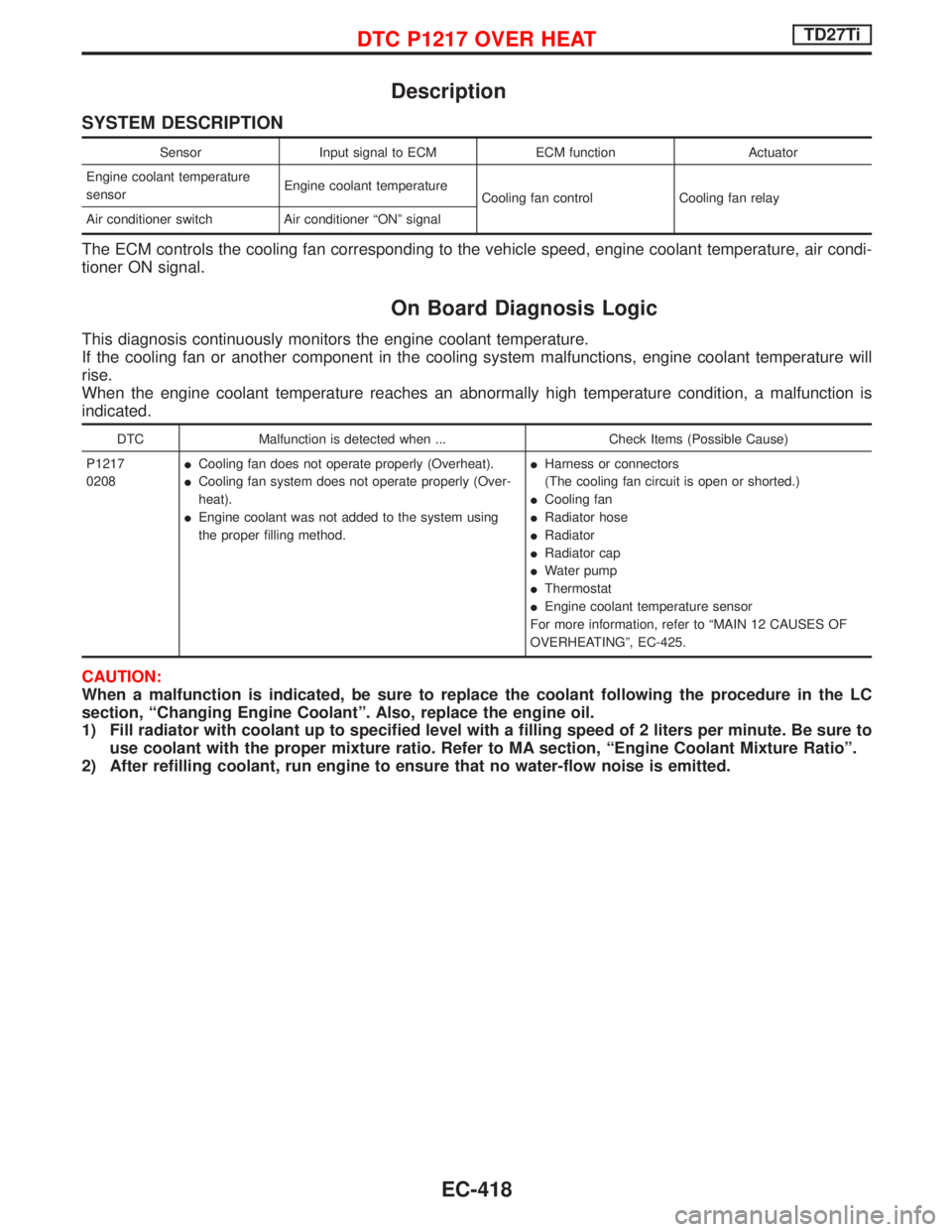
Description
SYSTEM DESCRIPTION
Sensor Input signal to ECM ECM function Actuator
Engine coolant temperature
sensorEngine coolant temperature
Cooling fan control Cooling fan relay
Air conditioner switch Air conditioner ªONº signal
The ECM controls the cooling fan corresponding to the vehicle speed, engine coolant temperature, air condi-
tioner ON signal.
On Board Diagnosis Logic
This diagnosis continuously monitors the engine coolant temperature.
If the cooling fan or another component in the cooling system malfunctions, engine coolant temperature will
rise.
When the engine coolant temperature reaches an abnormally high temperature condition, a malfunction is
indicated.
DTC Malfunction is detected when ... Check Items (Possible Cause)
P1217
0208ICooling fan does not operate properly (Overheat).
ICooling fan system does not operate properly (Over-
heat).
IEngine coolant was not added to the system using
the proper filling method.IHarness or connectors
(The cooling fan circuit is open or shorted.)
ICooling fan
IRadiator hose
IRadiator
IRadiator cap
IWater pump
IThermostat
IEngine coolant temperature sensor
For more information, refer to ªMAIN 12 CAUSES OF
OVERHEATINGº, EC-425.
CAUTION:
When a malfunction is indicated, be sure to replace the coolant following the procedure in the LC
section, ªChanging Engine Coolantº. Also, replace the engine oil.
1) Fill radiator with coolant up to specified level with a filling speed of 2 liters per minute. Be sure to
use coolant with the proper mixture ratio. Refer to MA section, ªEngine Coolant Mixture Ratioº.
2) After refilling coolant, run engine to ensure that no water-flow noise is emitted.
DTC P1217 OVER HEATTD27Ti
EC-418
Page 781 of 1767
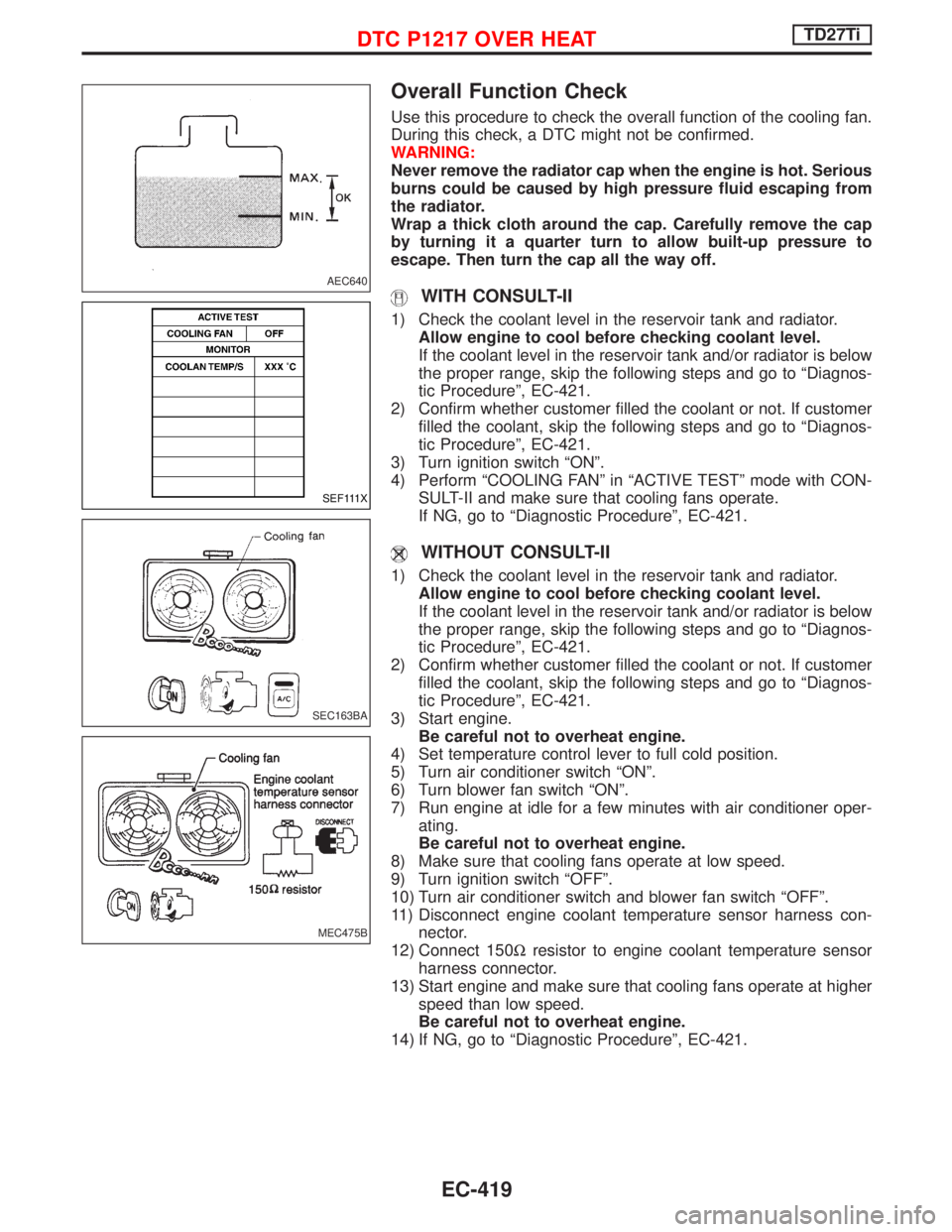
Overall Function Check
Use this procedure to check the overall function of the cooling fan.
During this check, a DTC might not be confirmed.
WARNING:
Never remove the radiator cap when the engine is hot. Serious
burns could be caused by high pressure fluid escaping from
the radiator.
Wrap a thick cloth around the cap. Carefully remove the cap
by turning it a quarter turn to allow built-up pressure to
escape. Then turn the cap all the way off.
WITH CONSULT-II
1) Check the coolant level in the reservoir tank and radiator.
Allow engine to cool before checking coolant level.
If the coolant level in the reservoir tank and/or radiator is below
the proper range, skip the following steps and go to ªDiagnos-
tic Procedureº, EC-421.
2) Confirm whether customer filled the coolant or not. If customer
filled the coolant, skip the following steps and go to ªDiagnos-
tic Procedureº, EC-421.
3) Turn ignition switch ªONº.
4) Perform ªCOOLING FANº in ªACTIVE TESTº mode with CON-
SULT-II and make sure that cooling fans operate.
If NG, go to ªDiagnostic Procedureº, EC-421.
WITHOUT CONSULT-II
1) Check the coolant level in the reservoir tank and radiator.
Allow engine to cool before checking coolant level.
If the coolant level in the reservoir tank and/or radiator is below
the proper range, skip the following steps and go to ªDiagnos-
tic Procedureº, EC-421.
2) Confirm whether customer filled the coolant or not. If customer
filled the coolant, skip the following steps and go to ªDiagnos-
tic Procedureº, EC-421.
3) Start engine.
Be careful not to overheat engine.
4) Set temperature control lever to full cold position.
5) Turn air conditioner switch ªONº.
6) Turn blower fan switch ªONº.
7) Run engine at idle for a few minutes with air conditioner oper-
ating.
Be careful not to overheat engine.
8) Make sure that cooling fans operate at low speed.
9) Turn ignition switch ªOFFº.
10) Turn air conditioner switch and blower fan switch ªOFFº.
11) Disconnect engine coolant temperature sensor harness con-
nector.
12) Connect 150Wresistor to engine coolant temperature sensor
harness connector.
13) Start engine and make sure that cooling fans operate at higher
speed than low speed.
Be careful not to overheat engine.
14) If NG, go to ªDiagnostic Procedureº, EC-421.
AEC640
SEF111X
SEC163BA
MEC475B
DTC P1217 OVER HEATTD27Ti
EC-419
Page 783 of 1767
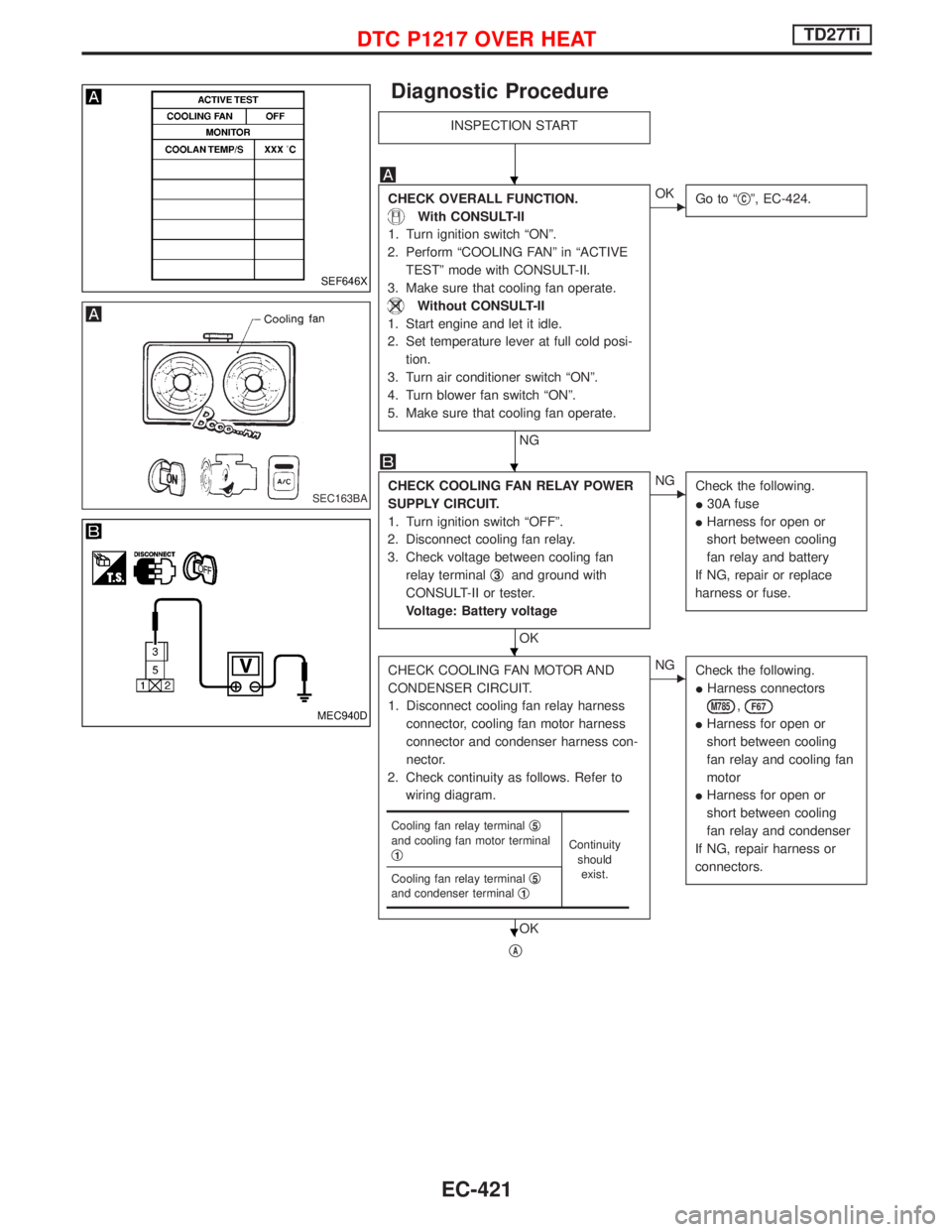
Diagnostic Procedure
INSPECTION START
CHECK OVERALL FUNCTION.
With CONSULT-II
1. Turn ignition switch ªONº.
2. Perform ªCOOLING FANº in ªACTIVE
TESTº mode with CONSULT-II.
3. Make sure that cooling fan operate.
Without CONSULT-II
1. Start engine and let it idle.
2. Set temperature lever at full cold posi-
tion.
3. Turn air conditioner switch ªONº.
4. Turn blower fan switch ªONº.
5. Make sure that cooling fan operate.
NG
EOK
Go to ªqCº, EC-424.
CHECK COOLING FAN RELAY POWER
SUPPLY CIRCUIT.
1. Turn ignition switch ªOFFº.
2. Disconnect cooling fan relay.
3. Check voltage between cooling fan
relay terminalq
3and ground with
CONSULT-II or tester.
Voltage: Battery voltage
OK
ENG
Check the following.
I30A fuse
IHarness for open or
short between cooling
fan relay and battery
If NG, repair or replace
harness or fuse.
CHECK COOLING FAN MOTOR AND
CONDENSER CIRCUIT.
1. Disconnect cooling fan relay harness
connector, cooling fan motor harness
connector and condenser harness con-
nector.
2. Check continuity as follows. Refer to
wiring diagram.
OK
ENG
Check the following.
IHarness connectors
M785,F67
IHarness for open or
short between cooling
fan relay and cooling fan
motor
IHarness for open or
short between cooling
fan relay and condenser
If NG, repair harness or
connectors.
qA
Cooling fan relay terminalq5and cooling fan motor terminal
q1Continuity
should
exist.
Cooling fan relay terminalq
5and condenser terminalq1
SEF646X
SEC163BA
MEC940D
H
H
H
H
DTC P1217 OVER HEATTD27Ti
EC-421
Page 786 of 1767
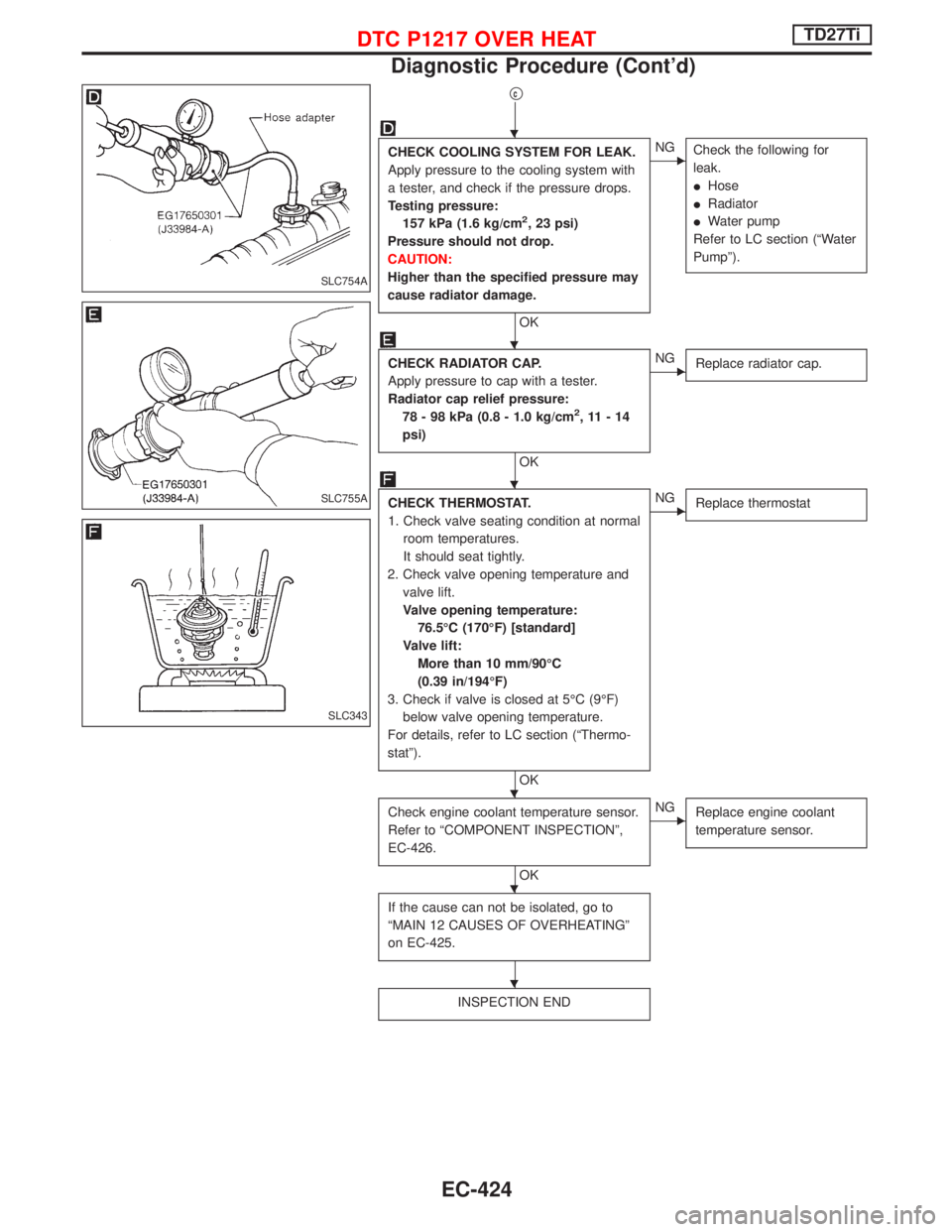
qc
CHECK COOLING SYSTEM FOR LEAK.
Apply pressure to the cooling system with
a tester, and check if the pressure drops.
Testing pressure:
157 kPa (1.6 kg/cm
2, 23 psi)
Pressure should not drop.
CAUTION:
Higher than the specified pressure may
cause radiator damage.
OK
ENG
Check the following for
leak.
IHose
IRadiator
IWater pump
Refer to LC section (ªWater
Pumpº).
CHECK RADIATOR CAP.
Apply pressure to cap with a tester.
Radiator cap relief pressure:
78 - 98 kPa (0.8 - 1.0 kg/cm
2,11-14
psi)
OK
ENG
Replace radiator cap.
CHECK THERMOSTAT.
1. Check valve seating condition at normal
room temperatures.
It should seat tightly.
2. Check valve opening temperature and
valve lift.
Valve opening temperature:
76.5ÉC (170ÉF) [standard]
Valve lift:
More than 10 mm/90ÉC
(0.39 in/194ÉF)
3. Check if valve is closed at 5ÉC (9ÉF)
below valve opening temperature.
For details, refer to LC section (ªThermo-
statº).
OK
ENG
Replace thermostat
Check engine coolant temperature sensor.
Refer to ªCOMPONENT INSPECTIONº,
EC-426.
OK
ENG
Replace engine coolant
temperature sensor.
If the cause can not be isolated, go to
ªMAIN 12 CAUSES OF OVERHEATINGº
on EC-425.
INSPECTION END
SLC754A
SLC755A
SLC343
H
H
H
H
H
H
DTC P1217 OVER HEATTD27Ti
Diagnostic Procedure (Cont'd)
EC-424