system NISSAN TERRANO 2004 Service Repair Manual
[x] Cancel search | Manufacturer: NISSAN, Model Year: 2004, Model line: TERRANO, Model: NISSAN TERRANO 2004Pages: 1833, PDF Size: 53.42 MB
Page 1198 of 1833
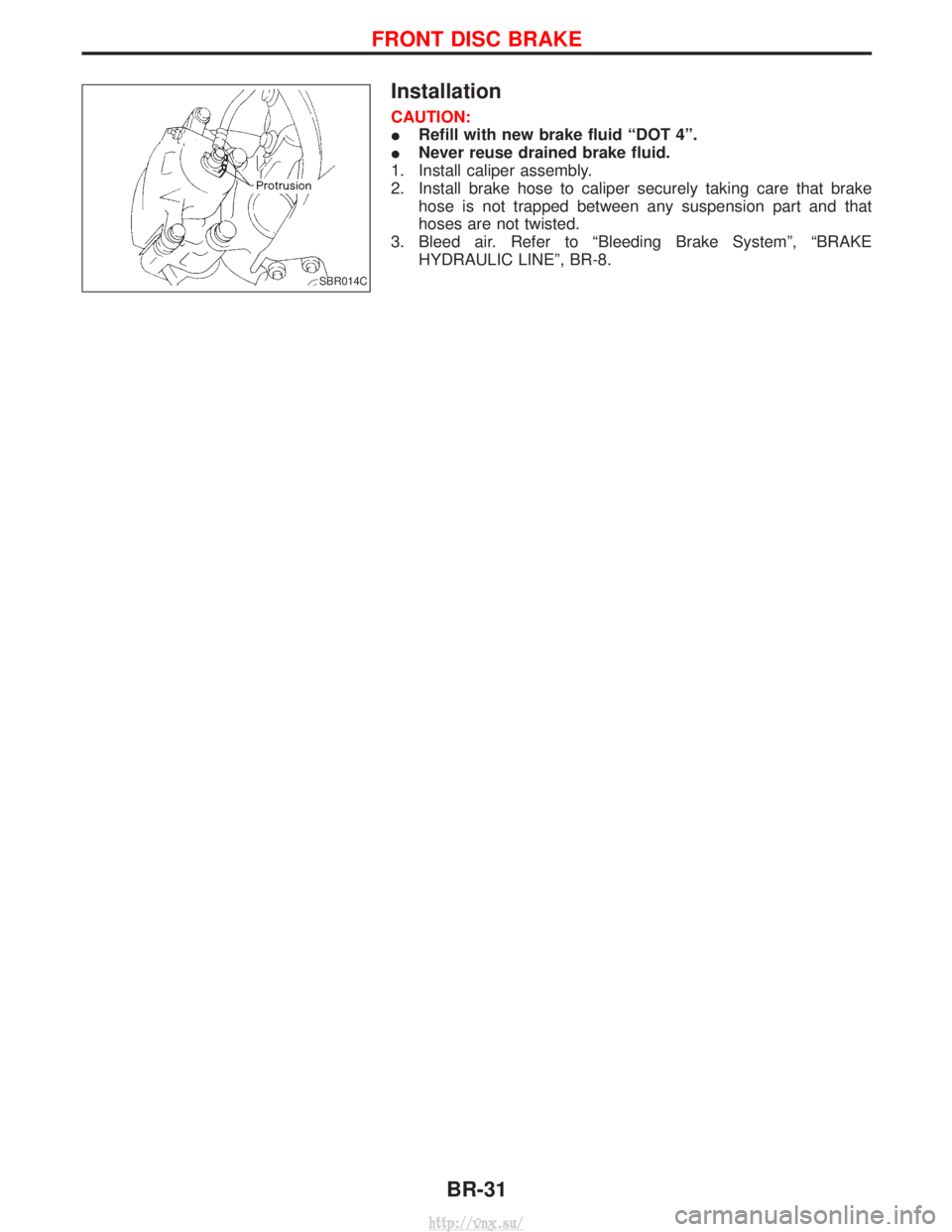
Installation
CAUTION:
IRefill with new brake fluid ªDOT 4º.
I Never reuse drained brake fluid.
1. Install caliper assembly.
2. Install brake hose to caliper securely taking care that brake hose is not trapped between any suspension part and that
hoses are not twisted.
3. Bleed air. Refer to ªBleeding Brake Systemº, ªBRAKE HYDRAULIC LINEº, BR-8.
SBR014C
FRONT DISC BRAKE
BR-31
http://vnx.su/
Page 1202 of 1833
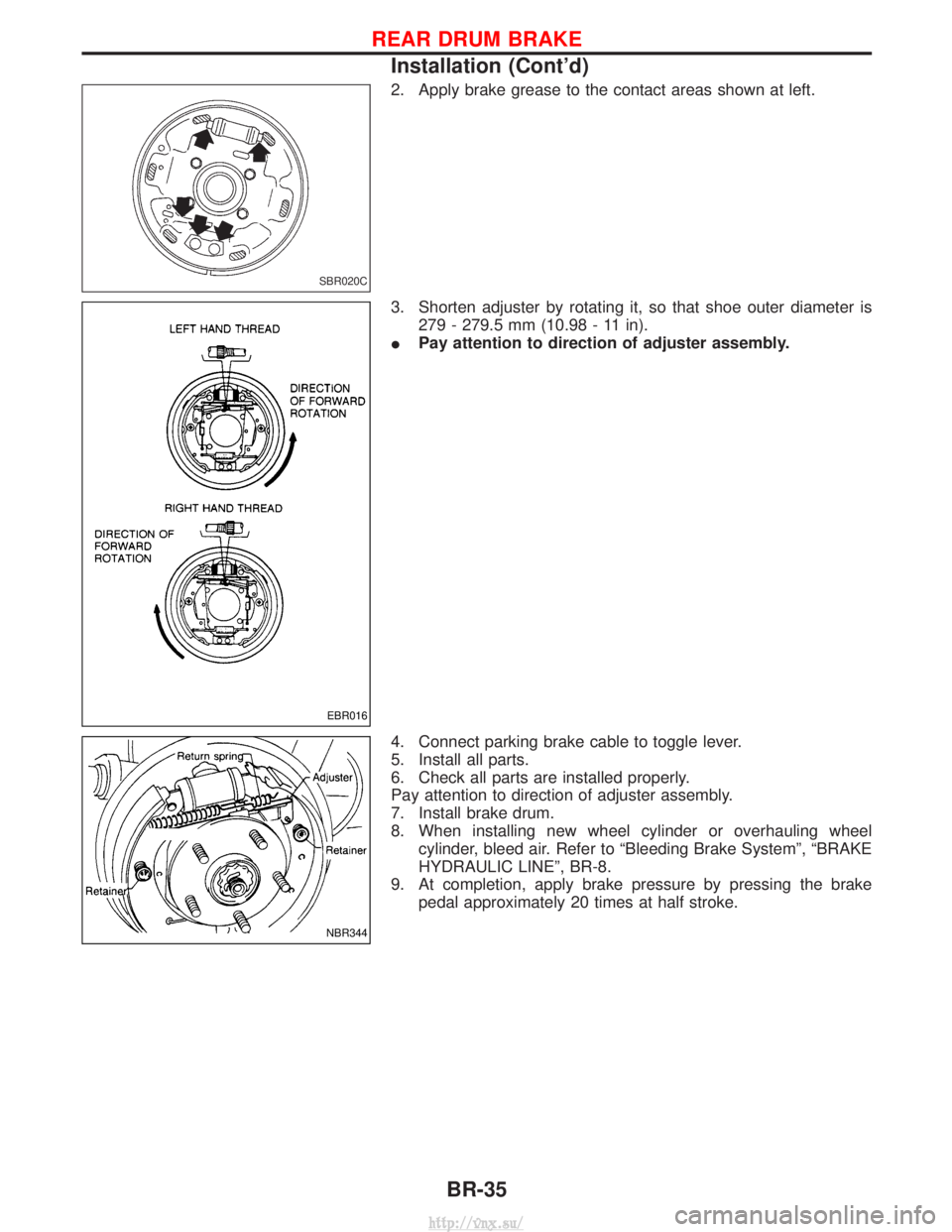
2. Apply brake grease to the contact areas shown at left.
3. Shorten adjuster by rotating it, so that shoe outer diameter is279 - 279.5 mm (10.98 - 11 in).
I Pay attention to direction of adjuster assembly.
4. Connect parking brake cable to toggle lever.
5. Install all parts.
6. Check all parts are installed properly.
Pay attention to direction of adjuster assembly.
7. Install brake drum.
8. When installing new wheel cylinder or overhauling wheel cylinder, bleed air. Refer to ªBleeding Brake Systemº, ªBRAKE
HYDRAULIC LINEº, BR-8.
9. At completion, apply brake pressure by pressing the brake pedal approximately 20 times at half stroke.
SBR020C
EBR016
NBR344
REAR DRUM BRAKE
Installation (Cont'd)
BR-35
http://vnx.su/
Page 1205 of 1833
Purpose
The Anti-lock Brake System (ABS) with an integrated Electronic Brake force Distribution (EBD) system con-
sists of electronic and hydraulic components. It allows you to control the braking force so that wheel lock can
be avoided during braking.
The advantages of ABS with EBD
1) Better tracking performance through improved steering wheel control.
2) Improved maneuverability and safer vehicle control.
3) Improved vehicle stability by preventing flat spins.
4) Shorter stopping distance and optimal utilisation of the rear brakes under many different circumstances.
Operation
IABS with EBD has self-test capabilities. The ABS warning lamp is illuminated for 1 second each time the
ignition switch is turned ªONº. After the engine is started, the ABS warning lamp turns off. An ABS self-test
is performed the first time the vehicle reaches 6 km/h (4 MPH) to ensure the system is operational. A
mechanical noise may be heard as the ABS performs this self-test and is a normal part of the self-test
feature. If a malfunction is detected during this check, the ABS warning lamp will stay on.
During the self-test, it also performs a EBD check when it detects a failure the ABS warning light will go
on simultaneously with the brake warning light and an audible sound will sound constantly.
I EBD system will only operate when the ABS is not in active status and it uses the inlet valves of ABS con-
trol unit to limit the pressure to the rear wheels when they tend to go into slip.
I When the vehicle speed is less than 10 km/h (6 MPH) the ABS system does not operate.
I While driving, a mechanical noise may be heard during ABS operation, this is a normal system condition.
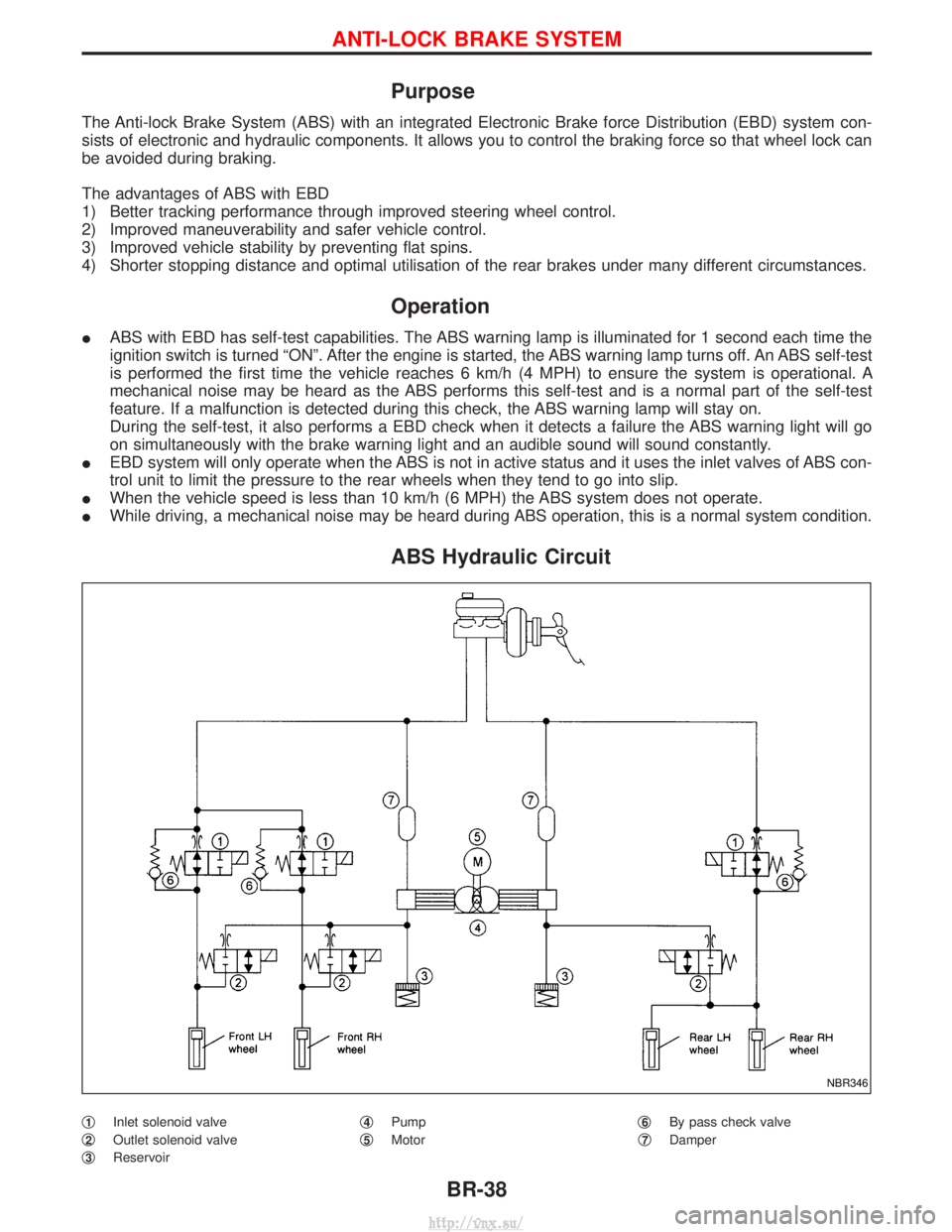
ABS Hydraulic Circuit
q1Inlet solenoid valve
q
2Outlet solenoid valve
q
3Reservoir q
4Pump
q
5Motor q
6By pass check valve
q
7Damper
NBR346
ANTI-LOCK BRAKE SYSTEM
BR-38
http://vnx.su/
Page 1206 of 1833
System Description
Sensor
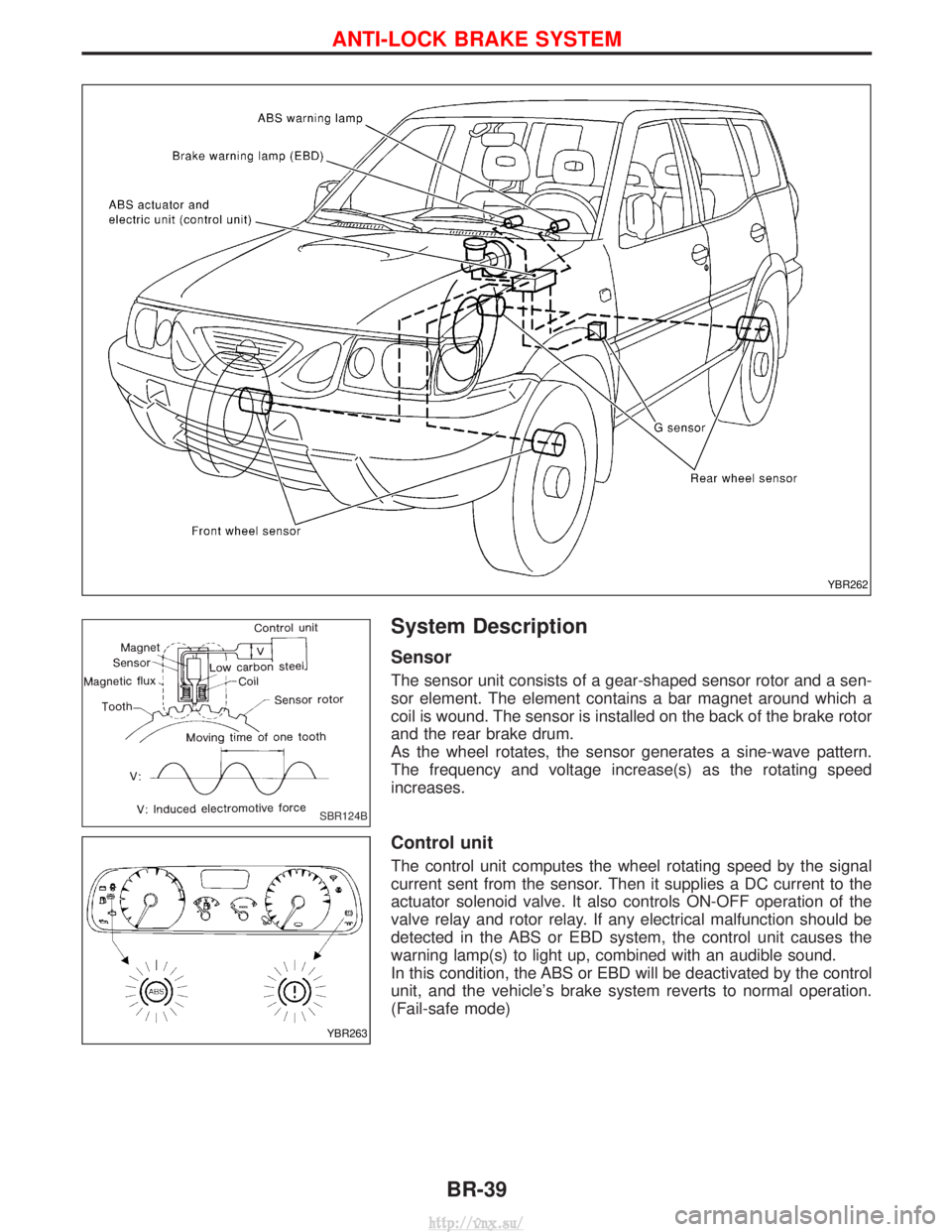
The sensor unit consists of a gear-shaped sensor rotor and a sen-
sor element. The element contains a bar magnet around which a
coil is wound. The sensor is installed on the back of the brake rotor
and the rear brake drum.
As the wheel rotates, the sensor generates a sine-wave pattern.
The frequency and voltage increase(s) as the rotating speed
increases.
Control unit
The control unit computes the wheel rotating speed by the signal
current sent from the sensor. Then it supplies a DC current to the
actuator solenoid valve. It also controls ON-OFF operation of the
valve relay and rotor relay. If any electrical malfunction should be
detected in the ABS or EBD system, the control unit causes the
warning lamp(s) to light up, combined with an audible sound.
In this condition, the ABS or EBD will be deactivated by the control
unit, and the vehicle's brake system reverts to normal operation.
(Fail-safe mode)
YBR262
SBR124B
YBR263
ANTI-LOCK BRAKE SYSTEM
BR-39
http://vnx.su/
Page 1207 of 1833

G SENSOR
The G sensor analyses deceleration during braking to determine whether the vehicle is being driven on a road
with low surface resistance () (snow-covered road, etc.). The ABS control unit uses the signal from the
deceleration sensor to compensate for road surface conditions when controlling the braking operation.
NBR136
ANTI-LOCK BRAKE SYSTEM
System Description (Cont'd)BR-40
http://vnx.su/
Page 1208 of 1833

ACTUATOR AND ELECTRIC UNIT
The actuator and electric unit contains:
IAn electric motor and pump
I Two relays
I Six solenoid valves, each inlet and outlet for
Ð LH front
Ð RH front
Ð Rear
I ABS control unit
These components control the hydraulic circuit. The ABS control
unit directs the actuator to increase, hold or decrease hydraulic
pressure to all or individual wheels. The ABS actuator and electric
unit cannot be disassembled and has to be serviced as an assem-
bly.
YBR299
ANTI-LOCK BRAKE SYSTEM
System Description (Cont'd)
BR-41
http://vnx.su/
Page 1209 of 1833
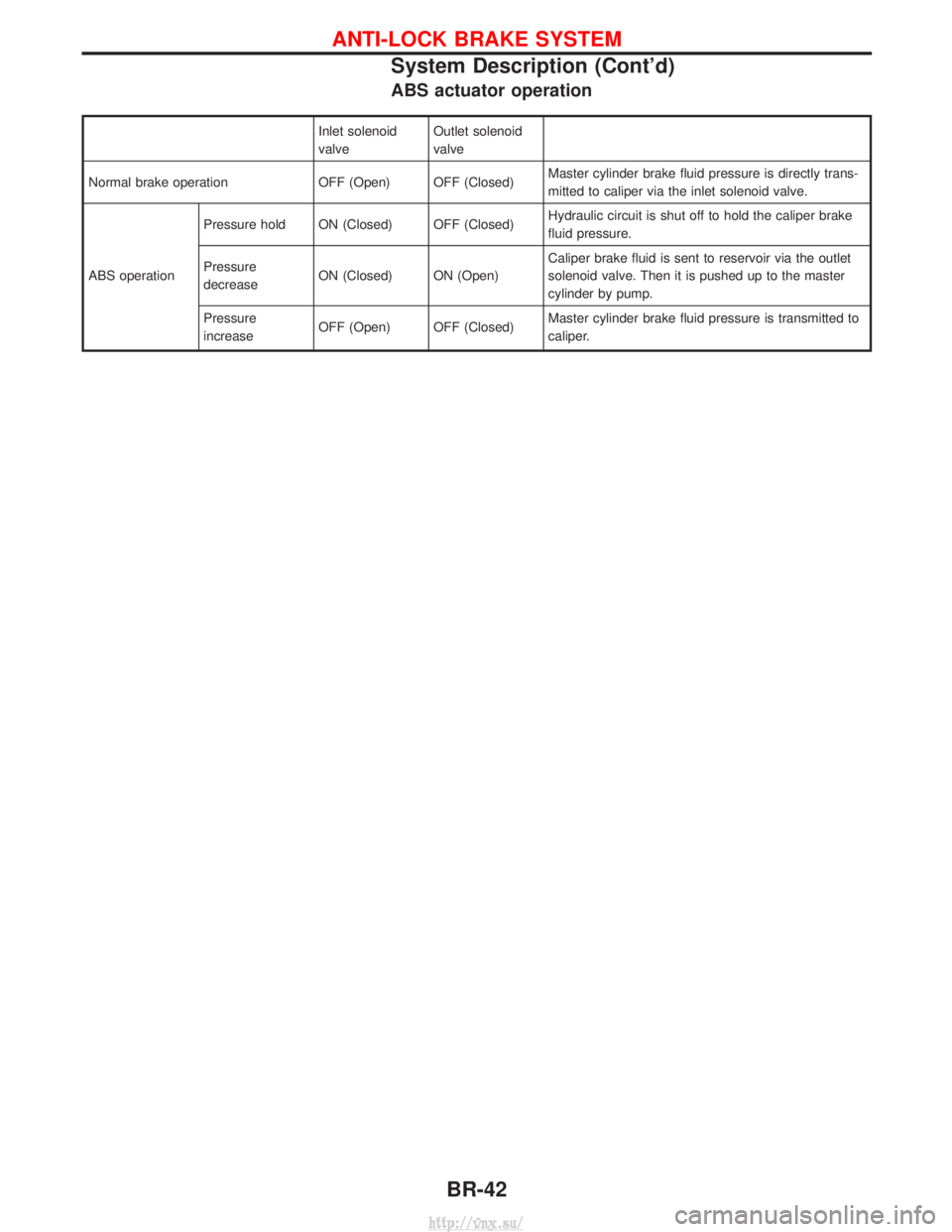
ABS actuator operation
Inlet solenoid
valveOutlet solenoid
valve
Normal brake operation OFF (Open) OFF (Closed) Master cylinder brake fluid pressure is directly trans-
mitted to caliper via the inlet solenoid valve.
ABS operation Pressure hold ON (Closed) OFF (Closed)
Hydraulic circuit is shut off to hold the caliper brake
fluid pressure.
Pressure
decrease ON (Closed) ON (Open) Caliper brake fluid is sent to reservoir via the outlet
solenoid valve. Then it is pushed up to the master
cylinder by pump.
Pressure
increase OFF (Open) OFF (Closed) Master cylinder brake fluid pressure is transmitted to
caliper.
ANTI-LOCK BRAKE SYSTEM
System Description (Cont'd)
BR-42
http://vnx.su/
Page 1210 of 1833

Removal and Installation
CAUTION:
Be careful not to damage sensor edge and sensor rotor teeth.
When removing the front or rear wheel hub assembly, discon-
nect the ABS wheel sensor from the assembly and move it
away.
FRONT WHEEL SENSOR
REAR WHEEL SENSOR
NBR122
YBR455
ANTI-LOCK BRAKE SYSTEM
BR-43
http://vnx.su/
Page 1211 of 1833
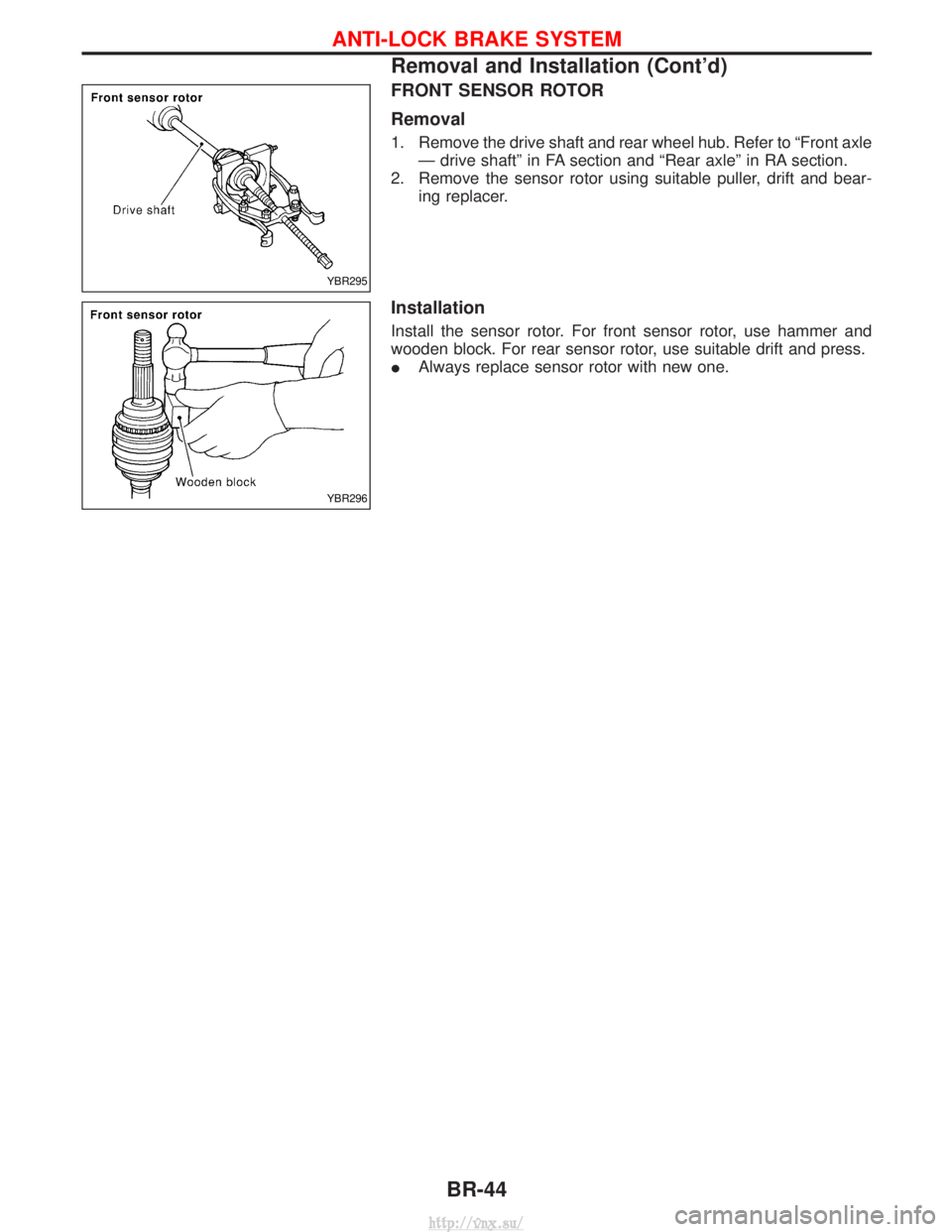
FRONT SENSOR ROTOR
Removal
1. Remove the drive shaft and rear wheel hub. Refer to ªFront axleÐ drive shaftº in FA section and ªRear axleº in RA section.
2. Remove the sensor rotor using suitable puller, drift and bear- ing replacer.
Installation
Install the sensor rotor. For front sensor rotor, use hammer and
wooden block. For rear sensor rotor, use suitable drift and press.
IAlways replace sensor rotor with new one.
YBR295
YBR296
ANTI-LOCK BRAKE SYSTEM
Removal and Installation (Cont'd)
BR-44
http://vnx.su/
Page 1212 of 1833
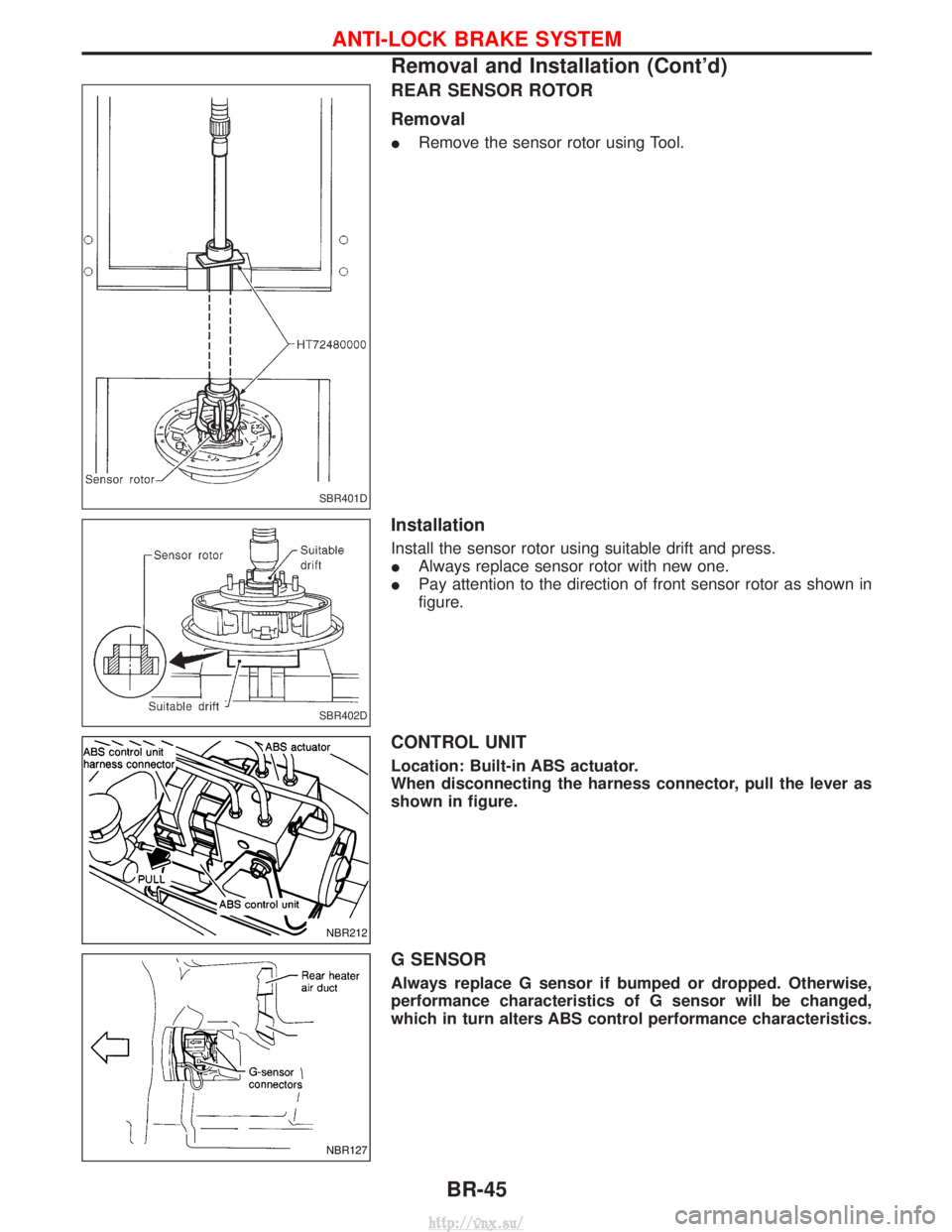
REAR SENSOR ROTOR
Removal
IRemove the sensor rotor using Tool.
Installation
Install the sensor rotor using suitable drift and press.
IAlways replace sensor rotor with new one.
I Pay attention to the direction of front sensor rotor as shown in
figure.
CONTROL UNIT
Location: Built-in ABS actuator.
When disconnecting the harness connector, pull the lever as
shown in figure.
G SENSOR
Always replace G sensor if bumped or dropped. Otherwise,
performance characteristics of G sensor will be changed,
which in turn alters ABS control performance characteristics.
SBR401D
SBR402D
NBR212
NBR127
ANTI-LOCK BRAKE SYSTEM
Removal and Installation (Cont'd)
BR-45
http://vnx.su/