engine NISSAN TIIDA 2007 Service Repair Manual
[x] Cancel search | Manufacturer: NISSAN, Model Year: 2007, Model line: TIIDA, Model: NISSAN TIIDA 2007Pages: 5883, PDF Size: 78.95 MB
Page 3612 of 5883
![NISSAN TIIDA 2007 Service Repair Manual AIR CONDITIONER CONTROL
HAC-279
< ECU DIAGNOSIS >[AUTO AIR CONDITIONER (W/NAVI)]
C
D
E
F
G
H
J
K
L
MA
B
HAC
N
O
P
ECU DIAGNOSIS
AIR CONDITIONER CONTROL
Front Air Control Terminals Reference ValuesINFO](/img/5/57395/w960_57395-3611.png "NISSAN TIIDA 2007 Service Repair Manual AIR CONDITIONER CONTROL
HAC-279
< ECU DIAGNOSIS >[AUTO AIR CONDITIONER (W/NAVI)]
C
D
E
F
G
H
J
K
L
MA
B
HAC
N
O
P
ECU DIAGNOSIS
AIR CONDITIONER CONTROL
Front Air Control Terminals Reference ValuesINFO")
AIR CONDITIONER CONTROL
HAC-279
< ECU DIAGNOSIS >[AUTO AIR CONDITIONER (W/NAVI)]
C
D
E
F
G
H
J
K
L
MA
B
HAC
N
O
P
ECU DIAGNOSIS
AIR CONDITIONER CONTROL
Front Air Control Terminals Reference ValuesINFOID:0000000001547371
Measure voltage between each terminal and ground by following ter-
minals and reference value for front air control
A/C FRONT AIR CONTROL HARNESS CONNECTOR TERMINAL LAYOUT
TERMINALS AND REFERENCE VALUE FOR FRONT AIR CONTROL
SJIA0739E
AWIIA0564ZZ
Te r m i n a l
No.Wire
colorItemIgnition
switchConditionVo l ta g e
(V)
1R Gas sensor
Power supply for intake
door PBR (5V output)ON - Approx. 5
2RRear window defogger feed-
back signalON Rear window defogger: ON Approx. 12
3 SB Ambient sensor - - -
4 LG In-vehicle sensor - - -
5 P Sunload sensor - - -
6 O Intake sensor - - -
9 B Illumination Ground ON - Approx. 0
10 BR Sensor ground ON - Approx. 0
11 R Power supply for IGN 2 ON - Battery voltage
12 BREngine coolant temperature
sensor signalONAt idle (after warming up, ap-
prox. 80°C)
CAUTION:
The waveforms vary depend-
ing on coolant temperature.
14 SBIntake door motor feedback
signalONREC position Approx. 5
FRE position Approx. 0
SKIB3651J
Page 3633 of 5883
![NISSAN TIIDA 2007 Service Repair Manual HAC-300
< SYMPTOM DIAGNOSIS >[AUTO AIR CONDITIONER (W/NAVI)]
INSUFFICIENT COOLING
>> GO TO 9.
9.CHECK REFRIGERANT PURITY
1. Connect recovery/recycling equipment to vehicle.
2. Confirm refrigerant puri](/img/5/57395/w960_57395-3632.png "NISSAN TIIDA 2007 Service Repair Manual HAC-300
< SYMPTOM DIAGNOSIS >[AUTO AIR CONDITIONER (W/NAVI)]
INSUFFICIENT COOLING
>> GO TO 9.
9.CHECK REFRIGERANT PURITY
1. Connect recovery/recycling equipment to vehicle.
2. Confirm refrigerant puri")
HAC-300
< SYMPTOM DIAGNOSIS >[AUTO AIR CONDITIONER (W/NAVI)]
INSUFFICIENT COOLING
>> GO TO 9.
9.CHECK REFRIGERANT PURITY
1. Connect recovery/recycling equipment to vehicle.
2. Confirm refrigerant purity in supply tank using recovery/recycling and refrigerant identifier.
Is the inspection result normal?
YES >> GO TO 10.
NO >> Check contaminated refrigerant. Refer to HA-21, "
HFC-134a (R-134a) Service Procedure".
10.CHECK FOR EVAPORATOR FREEZE UP
Start engine and run A/C. Check for evaporator freeze up.
Does evaporator freeze up?
YES >> Perform performance test diagnoses. Refer to HAC-300, "Performance Test Diagnoses".
NO >> GO TO 11.
11 .CHECK REFRIGERANT PRESSURE
Check refrigerant pressure with manifold gauge connected. Refer to HAC-303, "
Test Reading".
Is the inspection result normal?
YES >> Perform performance test diagnoses. Refer to HAC-300, "Performance Test Diagnoses".
NO >> GO TO 12.
12.CHECK AIR DUCTS
Check ducts for air leaks.
Is the inspection result normal?
YES >> System OK.
NO >> Repair air leaks.
Performance Test DiagnosesINFOID:0000000001547375
PERFORMANCE TEST DIAGNOSIS
Page 3636 of 5883
![NISSAN TIIDA 2007 Service Repair Manual INSUFFICIENT COOLING
HAC-303
< SYMPTOM DIAGNOSIS >[AUTO AIR CONDITIONER (W/NAVI)]
C
D
E
F
G
H
J
K
L
MA
B
HAC
N
O
P
Testing must be performed as follows:
Test ReadingINFOID:0000000001547377
TEST READIN](/img/5/57395/w960_57395-3635.png "NISSAN TIIDA 2007 Service Repair Manual INSUFFICIENT COOLING
HAC-303
< SYMPTOM DIAGNOSIS >[AUTO AIR CONDITIONER (W/NAVI)]
C
D
E
F
G
H
J
K
L
MA
B
HAC
N
O
P
Testing must be performed as follows:
Test ReadingINFOID:0000000001547377
TEST READIN")
INSUFFICIENT COOLING
HAC-303
< SYMPTOM DIAGNOSIS >[AUTO AIR CONDITIONER (W/NAVI)]
C
D
E
F
G
H
J
K
L
MA
B
HAC
N
O
P
Testing must be performed as follows:
Test ReadingINFOID:0000000001547377
TEST READING
Recirculating-to-discharge Air Temperature Table
Ambient Air Temperature-to-operating Pressure Table
*1: In the blower motor low-speed control
*2: In the blower motor high-speed control
Trouble Diagnoses for Unusual PressureINFOID:0000000001547378
TROUBLE DIAGNOSIS FOR UNUSUAL PRESSURE
Vehicle condition Indoors or in the shade (in a well-ventilated place)
Doors Closed
Door window Open
Hood Open
TEMP. Max. COLD
Mode control dial
(Ventilation) set
Intake switch
(Recirculation) set
Blower speedMax. speed set
Engine speed Idle speed
Operate the air conditioning system for 10 minutes before taking measurements.
Inside air (Recirculating air) at blower assembly inlet
Discharge air temperature at center ventilator
°C (°F) Relative humidity
%Air temperature
°C (°F)
50 - 6020 (68) 7.2 - 9.1 (45 - 48)
25 (77) 11.4 - 13.8 (53 - 57)
30 (86) 15.5 - 18.4 (60 - 65)
35 (95) 20.3 - 23.7 (69 - 75)
60 - 7020 (68) 9.1 - 10.9 (48 - 52)
25 (77) 13.8 - 16.2 (57 - 61)
30 (86) 18.4 - 21.3 (65 - 70)
35 (95) 23.7 - 27.1 (75 - 81)
Ambient air
High-pressure (Discharge side)
kPa (bar, kg/cm
2, psi)Low-pressure (Suction side)
kPa (bar, kg/cm2, psi) Relative humidity
%Air temperature
°C (°F)
50 - 7020 (68)843 - 1,036 *1
(11.08 - 13.63, 8.6 - 10.6, 122 - 150)159.0 - 194.0
(1.59 - 1.94, 1.62 - 1.98, 23.1 - 28.1)
25 (77)1,094 - 1,338 *1
(10.94 - 13.38, 11.2 - 13.6, 159 - 194)196.3 - 240.0
(1.96 - 2.40, 2.00 - 2.45, 28.5 - 34.8)
30 (86)1,298 - 1,590 *1
(12.98 - 15.90, 13.2 - 16.2, 188 - 231)248.0 - 302.7
(2.48 - 3.03, 2.53 - 3.09, 36.0 - 43.9)
35 (95)1,383 - 1,688 *2
(13.83 - 16.88, 14.1 - 17.2, 201 - 245)308.8 - 377.4
(3.09 - 3.77, 3.15 - 3.85, 44.8 - 54.7)
40 (104)1,628 - 1,988 *2
(16.28 - 19.88, 16.6 - 20.3, 236 - 288)377.4 - 461.2
(3.77 - 4.61, 3.85 - 4.70, 54.7 - 66.8)
Page 3637 of 5883
![NISSAN TIIDA 2007 Service Repair Manual HAC-304
< SYMPTOM DIAGNOSIS >[AUTO AIR CONDITIONER (W/NAVI)]
INSUFFICIENT COOLING
Whenever system’s high and/or low side pressure(s) is/are unusual, diagnose using a manifold gauge. The
marker above](/img/5/57395/w960_57395-3636.png "NISSAN TIIDA 2007 Service Repair Manual HAC-304
< SYMPTOM DIAGNOSIS >[AUTO AIR CONDITIONER (W/NAVI)]
INSUFFICIENT COOLING
Whenever system’s high and/or low side pressure(s) is/are unusual, diagnose using a manifold gauge. The
marker above")
HAC-304
< SYMPTOM DIAGNOSIS >[AUTO AIR CONDITIONER (W/NAVI)]
INSUFFICIENT COOLING
Whenever system’s high and/or low side pressure(s) is/are unusual, diagnose using a manifold gauge. The
marker above the gauge scale in the following tables indicates the standard (usual) pressure range. Since the
standard (usual) pressure, however, differs from vehicle to vehicle, refer to above table (Ambient air tempera-
ture-to-operating pressure table).
Both High- and Low-pressure Sides are Too High
High-pressure Side is Too High and Low-pressure Side is Too Low
High-pressure Side is Too Low and Low-pressure Side is Too High
Gauge indication Refrigerant cycle Probable cause Corrective action
Both high- and low-pressure
sides are too high.Pressure is reduced soon af-
ter water is splashed on con-
denser.Excessive refrigerant charge in refrig-
eration cycle.Reduce refrigerant until
specified pressure is ob-
tained.
Air suction by cooling fan is in-
sufficient.Insufficient condenser cooling perfor-
mance.
↓
1. Condenser fins are clogged.
2. Improper fan rotation of cooling
fan. Clean condenser.
Check and repair cooling
fan if necessary.
Low-pressure pipe is not
cold.
When compressor is
stopped high-pressure val-
ue quickly drops by approx-
imately 196 kPa (1.96 bar, 2
kg/cm
2, 28 psi). It then de-
creases gradually thereaf-
ter.Poor heat exchange in condenser
(After compressor operation stops,
high-pressure decreases too slowly.).
↓
Air in refrigeration cycle.Evacuate repeatedly and
recharge system.
Engine tends to overheat. Engine cooling systems malfunction.Check and repair each en-
gine cooling system.
An area of the low-pressure
pipe is colder than areas
near the evaporator outlet.
Plates are sometimes cov-
ered with frost. Excessive liquid refrigerant on low-
pressure side.
Excessive refrigerant discharge
flow.
Expansion valve is open a little
compared with the specification.
↓
Improper expansion valve adjust-
ment.Replace expansion valve.
AC359A
Gauge indication Refrigerant cycle Probable cause Corrective action
High-pressure side is too high
and low-pressure side is too low.
Upper side of condenser and
high-pressure side are hot,
however, liquid tank is not so
hot.High-pressure tube or parts located
between compressor and condenser
are clogged or crushed. Check and repair or re-
place malfunctioning
parts.
Check oil for contami-
nation.
AC360A
Page 3640 of 5883
![NISSAN TIIDA 2007 Service Repair Manual INSUFFICIENT HEATING
HAC-307
< SYMPTOM DIAGNOSIS >[AUTO AIR CONDITIONER (W/NAVI)]
C
D
E
F
G
H
J
K
L
MA
B
HAC
N
O
P
INSUFFICIENT HEATING
Component Function CheckINFOID:0000000001547379
SYMPTOM: Insuffi](/img/5/57395/w960_57395-3639.png "NISSAN TIIDA 2007 Service Repair Manual INSUFFICIENT HEATING
HAC-307
< SYMPTOM DIAGNOSIS >[AUTO AIR CONDITIONER (W/NAVI)]
C
D
E
F
G
H
J
K
L
MA
B
HAC
N
O
P
INSUFFICIENT HEATING
Component Function CheckINFOID:0000000001547379
SYMPTOM: Insuffi")
INSUFFICIENT HEATING
HAC-307
< SYMPTOM DIAGNOSIS >[AUTO AIR CONDITIONER (W/NAVI)]
C
D
E
F
G
H
J
K
L
MA
B
HAC
N
O
P
INSUFFICIENT HEATING
Component Function CheckINFOID:0000000001547379
SYMPTOM: Insufficient heating
INSPECTION FLOW
1.CONFIRM SYMPTOM BY PERFORMING OPERATIONAL CHECK - TEMPERATURE INCREASE
1. Press the AUTO switch.
2. Turn the temperature control dial (driver) clockwise until 32° C (90° F) is displayed.
3. Check for hot air at discharge air outlets.
Can this symptom be duplicated?
YES >> GO TO 2.
NO >> Perform complete system operational check. Refer to HAC-202, "
Operational Check".
2.CHECK FOR SERVICE BULLETINS
Check for any service bulletins.
>> GO TO 3.
3.PERFORM SELF-DIAGNOSIS
Perform self-diagnosis. Refer to HAC-213, "
Front Air Control Self-Diagnosis".
Is the inspection results normal?
YES >> GO TO 4.
NO >> Refer to HAC-218, "
Front Air Control Self-Diagnosis Code Chart".
4.CHECK ENGINE COOLING SYSTEM
1. Check for proper engine coolant level. Refer to CO-11, "
Inspection" (HR16DE) or CO-35, "Inspection"
(HR18DE) or CO-58, "Inspection" (K9K).
2. Check hoses for leaks or kinks.
3. Check radiator cap. Refer to CO-14, "
Checking Radiator Cap" (HR16DE) CO-38, "Checking Radiator
Cap" or (HR18DE) or CO-60, "Checking Radiator Cap" (K9K).
4. Check for air in cooling system.
>> GO TO 5.
5.CHECK AIR MIX DOOR OPERATION
Check the operation of the air mix door. Refer to HAC-225, "
Air Mix Door Motor Component Function Check".
Is the inspection result normal?
YES >> GO TO 6.
NO >> Check the air mix door motor circuit. Refer to HAC-226, "
Air Mix Door Motor Diagnosis Proce-
dure".
6.CHECK AIR DUCTS
Check for disconnected or leaking air ducts.
Is the inspection result normal?
YES >> GO TO 7.
NO >> Repair all disconnected or leaking air ducts.
7.CHECK HEATER HOSE TEMPERATURES
1. Start engine and warm it up to normal operating temperature.
2. Touch both the inlet and outlet heater hoses.
Is the inspection result normal?
YES >> Hot inlet hose and a warm outlet hose: GO TO 8.
NO >> Inlet hose cold: GO TO 11.
Both hoses warm: GO TO 9.
Page 3641 of 5883
![NISSAN TIIDA 2007 Service Repair Manual HAC-308
< SYMPTOM DIAGNOSIS >[AUTO AIR CONDITIONER (W/NAVI)]
INSUFFICIENT HEATING
8.CHECK ENGINE COOLANT SYSTEM
Check engine control temperature sensor. Refer to XX-XX, "*****"
HR16DE WITH EURO-OBD](/img/5/57395/w960_57395-3640.png "NISSAN TIIDA 2007 Service Repair Manual HAC-308
< SYMPTOM DIAGNOSIS >[AUTO AIR CONDITIONER (W/NAVI)]
INSUFFICIENT HEATING
8.CHECK ENGINE COOLANT SYSTEM
Check engine control temperature sensor. Refer to XX-XX, \"*****\"
HR16DE WITH EURO-OBD")
HAC-308
< SYMPTOM DIAGNOSIS >[AUTO AIR CONDITIONER (W/NAVI)]
INSUFFICIENT HEATING
8.CHECK ENGINE COOLANT SYSTEM
Check engine control temperature sensor. Refer to XX-XX, "*****"
HR16DE WITH EURO-OBD or XX-XX,
"*****" HR16DE WITHOUT EURO-OBD or EC-808, "Component Inspection" MRDE or EC-1133, "Component
Inspection" K9K.
Is the inspection result normal?
YES >> System OK.
NO >> Repair or replace as necessary. Retest.
9.CHECK HEATER HOSES
Check heater hoses for proper installation.
Is the inspection result normal?
YES >> System OK.
NO >> 1. Back flush heater core.
2. Drain the water from the system.
3. Refill system with new engine coolant. Refer to CO-11, "
Changing Engine Coolant" HR16DE
CO-35, "
Changing Engine Coolant" HR18DE or CO-58, "Inspection" K9K.
4. GO TO 10 to retest.
10.CHECK HEATER HOSE TEMPERATURES
1. Start engine and warm it up to normal operating temperature.
2. Touch both the inlet and outlet heater hoses.
Is the inspection result normal?
YES >> System OK.
NO >> Replace heater core. Refer to XXXX.
Page 3659 of 5883
INL-8
< FUNCTION DIAGNOSIS >
ILLUMINATION CONTROL SYSTEM
ILLUMINATION CONTROL SYSTEM
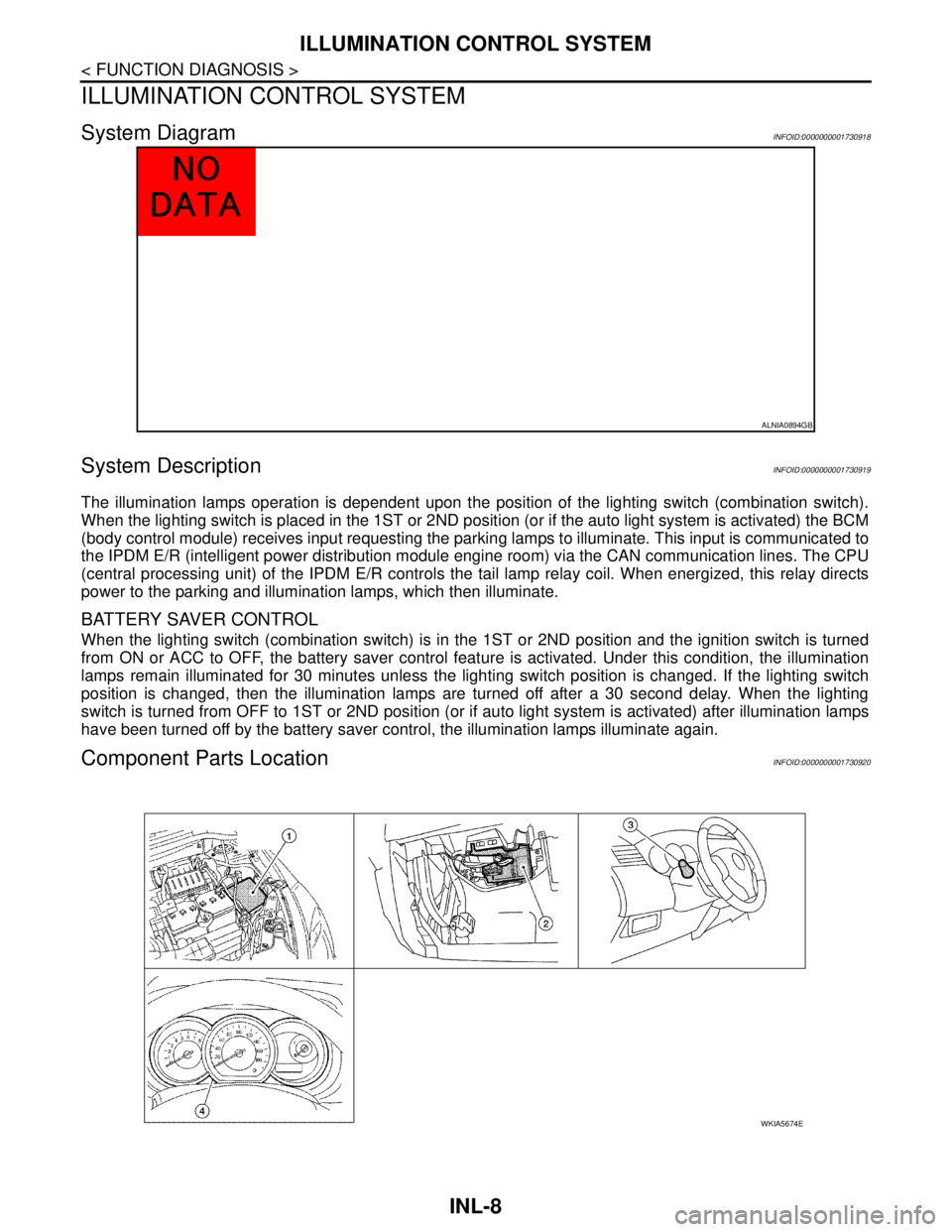
System DiagramINFOID:0000000001730918
System DescriptionINFOID:0000000001730919
The illumination lamps operation is dependent upon the position of the lighting switch (combination switch).
When the lighting switch is placed in the 1ST or 2ND position (or if the auto light system is activated) the BCM
(body control module) receives input requesting the parking lamps to illuminate. This input is communicated to
the IPDM E/R (intelligent power distribution module engine room) via the CAN communication lines. The CPU
(central processing unit) of the IPDM E/R controls the tail lamp relay coil. When energized, this relay directs
power to the parking and illumination lamps, which then illuminate.
BATTERY SAVER CONTROL
When the lighting switch (combination switch) is in the 1ST or 2ND position and the ignition switch is turned
from ON or ACC to OFF, the battery saver control feature is activated. Under this condition, the illumination
lamps remain illuminated for 30 minutes unless the lighting switch position is changed. If the lighting switch
position is changed, then the illumination lamps are turned off after a 30 second delay. When the lighting
switch is turned from OFF to 1ST or 2ND position (or if auto light system is activated) after illumination lamps
have been turned off by the battery saver control, the illumination lamps illuminate again.
Component Parts LocationINFOID:0000000001730920
ALNIA0894GB
WKIA5674E
Page 3682 of 5883
PREPARATION
INT-3
< PREPARATION >
C
D
E
F
G
H
I
K
L
MA
B
INT
N
O
P
PREPARATION
PREPARATION
Commercial Service ToolINFOID:0000000001329041
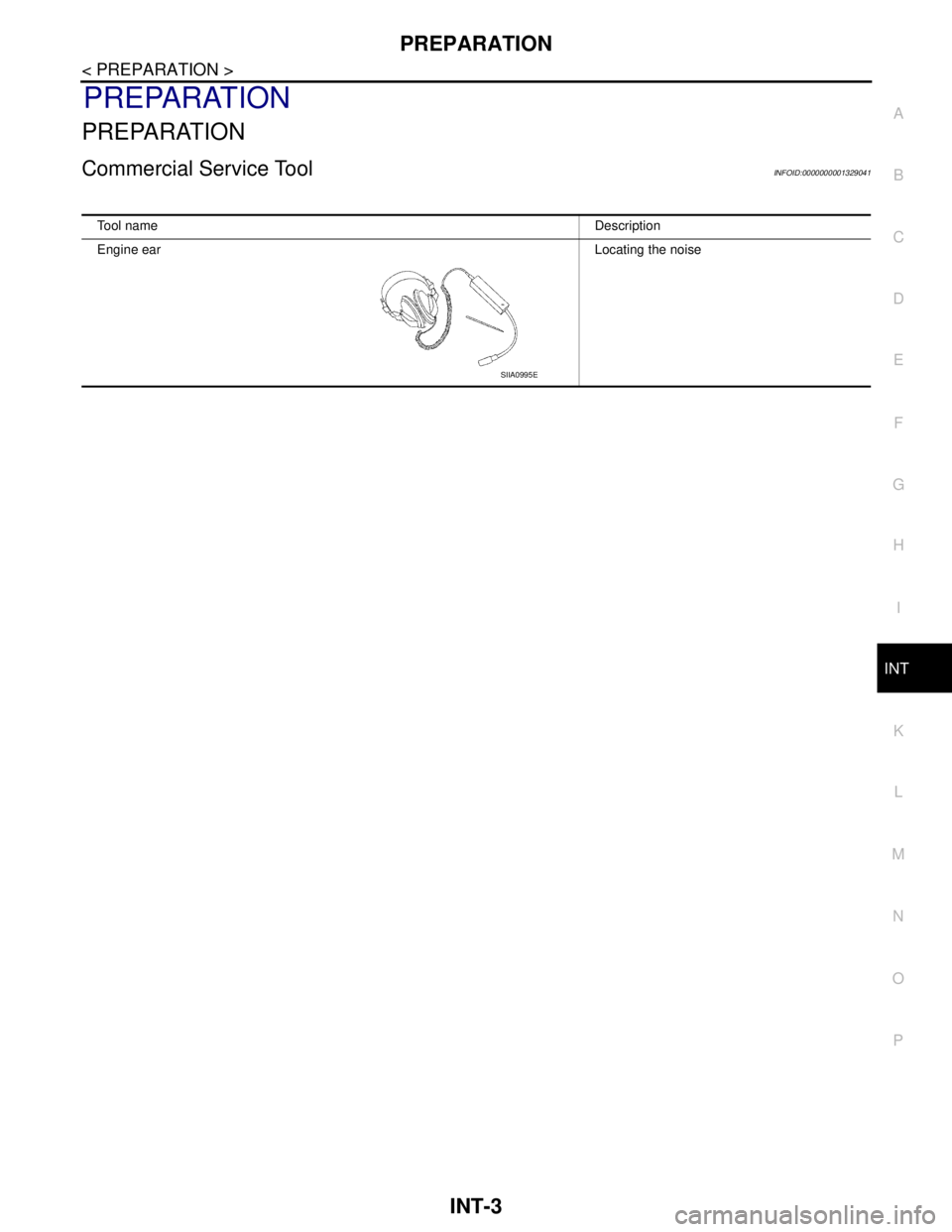
Tool nameDescription
Engine earLocating the noise
SIIA0995E
Page 3687 of 5883

INT-8
< PREPARATION >
SQUEAK AND RATTLE TROUBLE DIAGNOSIS
If the noise can be duplicated easily during the test drive, to help identify the source of the noise, try to dupli-
cate the noise with the vehicle stopped by doing one or all of the following:
Close a door.
Tap or push/pull around the area where the noise appears to be coming from.
Rev the engine.
Use a floor jack to recreate vehicle “twist”.
At idle, apply engine load (electrical load, half-clutch on M/T model, drive position on A/T model).
Raise the vehicle on a hoist and hit a tire with a rubber hammer.
Drive the vehicle and attempt to duplicate the conditions the customer states exist when the noise occurs.
If it is difficult to duplicate the noise, drive the vehicle slowly on an undulating or rough road to stress the
vehicle body.
CHECK RELATED SERVICE BULLETINS
After verifying the customer concern or symptom, check ASIST for Technical Service Bulletins (TSBs) related
to that concern or symptom.
If a TSB relates to the symptom, follow the procedure to repair the noise.
LOCATE THE NOISE AND IDENTIFY THE ROOT CAUSE
1. Narrow down the noise to a general area. To help pinpoint the source of the noise, use a listening tool
(Chassis Ear: J-39570, Engine Ear: J-39565 and mechanics stethoscope).
2. Narrow down the noise to a more specific area and identify the cause of the noise by:
Removing the components in the area that you suspect the noise is coming from.
Do not use too much force when removing clips and fasteners, otherwise clips and fasteners
can be broken or lost during the repair, resulting in the creation of new noise.
Tapping or pushing/pulling the component that you suspect is causing the noise.
Do not tap or push/pull the component with excessive force, otherwise the noise will be elimi-
nated only temporarily.
Feeling for a vibration with your hand by touching the component(s) that you suspect is (are) causing
the noise.
Placing a piece of paper between components that you suspect are causing the noise.
Looking for loose components and contact marks.
Refer to INT-9, "
Generic Squeak and Rattle Troubleshooting".
REPAIR THE CAUSE
If the cause is a loose component, tighten the component securely.
If the cause is insufficient clearance between components:
- Separate components by repositioning or loosening and retightening the component, if possible.
- Insulate components with a suitable insulator such as urethane pads, foam blocks, felt cloth tape or ure-
thane tape. A NISSAN Squeak and Rattle Kit (J-43980) is available through your authorized NISSAN Parts
Department.
CAUTION:
Do not use excessive force as many components are constructed of plastic and may be damaged.
Always check with the Parts Department for the latest parts information.
The following materials are contained in the NISSAN Squeak and Rattle Kit (J-43980). Each item can be
ordered separately as needed.
URETHANE PADS [1.5 mm (0.059 in) thick]
Insulates connectors, harness, etc.
76268-9E005: 100 x 135 mm (3.94 x 5.31 in)/76884-71L01: 60 x 85 mm (2.36 x 3.35 in)/76884-71L02: 15 x 25
mm (0.59 x 0.98 in)
INSULATOR (Foam blocks)
Insulates components from contact. Can be used to fill space behind a panel.
73982-9E000: 45 mm (1.77 in) thick, 50 x 50 mm (1.97 x 1.97 in)/73982-50Y00: 10 mm (0.39 in) thick, 50 x 50
mm (1.97 x 1.97 in)
INSULATOR (Light foam block)
80845-71L00: 30 mm (1.18 in) thick, 30 x 50 mm (1.18 x 1.97 in)
FELT CLOTH TAPE
Used to insulate where movement does not occur. Ideal for instrument panel applications.
68370-4B000: 15 x 25 mm (0.59 x 0.98 in) pad/68239-13E00: 5 mm (0.20 in) wide tape roll
The following materials, not found in the kit, can also be used to repair squeaks and rattles.
UHMW (TEFLON) TAPE
Insulates where slight movement is present. Ideal for instrument panel applications.
Page 3689 of 5883

INT-10
< PREPARATION >
SQUEAK AND RATTLE TROUBLE DIAGNOSIS
Most of these incidents can be repaired by adjusting, securing or insulating the item(s) or component(s) caus-
ing the noise.
SUNROOF/HEADLINING
Noises in the sunroof/headlining area can often be traced to one of the following:
1. Sunroof lid, rail, linkage or seals making a rattle or light knocking noise
2. Sun visor shaft shaking in the holder
3. Front or rear windshield touching headliner and squeaking
Again, pressing on the components to stop the noise while duplicating the conditions can isolate most of these
incidents. Repairs usually consist of insulating with felt cloth tape.
OVERHEAD CONSOLE (FRONT AND REAR)
Overhead console noises are often caused by the console panel clips not being engaged correctly. Most of
these incidents are repaired by pushing up on the console at the clip locations until the clips engage.
In addition look for:
1. Loose harness or harness connectors.
2. Front console map/reading lamp lens loose.
3. Loose screws at console attachment points.
SEATS
When isolating seat noise it's important to note the position the seat is in and the load placed on the seat when
the noise is present. These conditions should be duplicated when verifying and isolating the cause of the
noise.
Cause of seat noise include:
1. Headrest rods and holder
2. A squeak between the seat pad cushion and frame
3. The rear seatback lock and bracket
These noises can be isolated by moving or pressing on the suspected components while duplicating the con-
ditions under which the noise occurs. Most of these incidents can be repaired by repositioning the component
or applying urethane tape to the contact area.
UNDERHOOD
Some interior noise may be caused by components under the hood or on the engine wall. The noise is then
transmitted into the passenger compartment.
Causes of transmitted underhood noise include:
1. Any component installed on the engine wall
2. Components that pass through the engine wall
3. Engine wall mounts and connectors
4. Loose radiator pins
5. Hood bumpers out of adjustment
6. Hood striker out of adjustment
These noises can be difficult to isolate since they cannot be reached from the interior of the vehicle. The best
method is to secure, move or insulate one component at a time and test drive the vehicle. Also, engine RPM
or load can be changed to isolate the noise. Repairs can usually be made by moving, adjusting, securing, or
insulating the component causing the noise.