windshield NISSAN TIIDA 2007 Service Owner's Guide
[x] Cancel search | Manufacturer: NISSAN, Model Year: 2007, Model line: TIIDA, Model: NISSAN TIIDA 2007Pages: 5883, PDF Size: 78.95 MB
Page 3306 of 5883

HA-24
< ON-VEHICLE MAINTENANCE >
FLUORESCENT LEAK DETECTOR
FLUORESCENT LEAK DETECTOR
Checking System for Leaks Using the Fluorescent Leak DetectorINFOID:0000000001396445
1. Check A/C system for leaks using the UV lamp and safety goggles J-42220 in a low sunlight area (area
without windows preferable). Illuminate all components, fittings and lines. The dye will appear as a bright
green/yellow area at the point of leakage. Fluorescent dye observed at the evaporator drain opening indi-
cates an evaporator core assembly (tubes, core or expansion valve) leak.
2. If the suspected area is difficult to see, use an adjustable mirror or wipe the area with a clean shop rag or
cloth, with the UV lamp for dye residue.
3. After the leak is repaired, remove any residual dye using dye cleaner J-43872 to prevent future misdiag-
nosis.
4. Perform a system performance check and verify the leak repair with an approved electronic refrigerant
leak detector.
NOTE:
Other gases in the work area or substances on the A/C components, for example, anti-freeze, windshield
washer fluid, solvents and oils, may falsely trigger the leak detector. Make sure the surfaces to be checked are
clean.
Clean with a dry cloth or blow off with shop air.
Do not allow the sensor tip of the detector to contact with any substance. This can also cause false readings
and may damage the detector.
Dye InjectionINFOID:0000000001396446
(This procedure is only necessary when recharging the system or when the compressor has seized and was
replaced.)
1. Check A/C system static (at rest) pressure. Pressure must be at least 345 kPa (3.45 bar, 3.52 kg/cm
2, 50
psi).
2. Pour one bottle (1/4 ounce / 7.4 cc) of the A/C refrigerant dye into the injector tool J-41459.
3. Connect the injector tool to the A/C low-pressure side service fitting.
4. Start engine and switch A/C ON.
5. When the A/C operating (compressor running), inject one bottle (1/4 ounce / 7.4 cc) of fluorescent dye
through the low-pressure service valve using dye injector tool J-41459 (refer to the manufacture’s operat-
ing instructions).
6. With the engine still running, disconnect the injector tool from the service fitting.
CAUTION:
Be careful the A/C system or replacing a component, pour the dye directly into the open system
connection and proceed with the service procedures.
7. Operate the A/C system for a minimum of 20 minutes to mix the dye with the system oil. Depending on the
leak size, operating conditions and location of the leak, it may take from minutes to days for the dye to
penetrate a leak and become visible.
Page 3417 of 5883
![NISSAN TIIDA 2007 Service Owners Guide HAC-84
< PRECAUTION >[MANUAL AIR CONDITIONER]
PRECAUTIONS
PRECAUTION
PRECAUTIONS
Precaution for Supplemental Restraint System (SRS) "AIR BAG" and "SEAT BELT
PRE-TENSIONER"
INFOID:0000000001683796
The](/img/5/57395/w960_57395-3416.png "NISSAN TIIDA 2007 Service Owners Guide HAC-84
< PRECAUTION >[MANUAL AIR CONDITIONER]
PRECAUTIONS
PRECAUTION
PRECAUTIONS
Precaution for Supplemental Restraint System (SRS) \"AIR BAG\" and \"SEAT BELT
PRE-TENSIONER\"
INFOID:0000000001683796
The")
HAC-84
< PRECAUTION >[MANUAL AIR CONDITIONER]
PRECAUTIONS
PRECAUTION
PRECAUTIONS
Precaution for Supplemental Restraint System (SRS) "AIR BAG" and "SEAT BELT
PRE-TENSIONER"
INFOID:0000000001683796
The Supplemental Restraint System such as “AIR BAG” and “SEAT BELT PRE-TENSIONER”, used along
with a front seat belt, helps to reduce the risk or severity of injury to the driver and front passenger for certain
types of collision. Information necessary to service the system safely is included in the SRS and SB section of
this Service Manual.
WARNING:
• To avoid rendering the SRS inoperative, which could increase the risk of personal injury or death in
the event of a collision which would result in air bag inflation, all maintenance must be performed by
an authorized NISSAN/INFINITI dealer.
Improper maintenance, including incorrect removal and installation of the SRS, can lead to personal
injury caused by unintentional activation of the system. For removal of Spiral Cable and Air Bag
Module, see the SRS section.
Do not use electrical test equipment on any circuit related to the SRS unless instructed to in this
Service Manual. SRS wiring harnesses can be identified by yellow and/or orange harnesses or har-
ness connectors.
Precaution for Procedures Without Cowl Top CoverINFOID:0000000001203084
When performing the procedure after removing cowl top cover, cover
the lower end of windshield with urethane, etc.
Working with HFC-134a (R-134a)INFOID:0000000001203085
WARNING:
CFC-12 (R-12) refrigerant and HFC-134a (R-134a) refrigerant are not compatible. These refrigerants
must never be mixed, even in the smallest amounts. If the refrigerants are mixed a compressor mal-
function is likely to occur.
Use only specified oil for the HFC-134a (R-134a) A/C system and HFC-134a (R-134a) components. If
oil other than that specified is used, compressor malfunction is likely to occur.
The specified HFC-134a (R-134a) oil rapidly absorbs moisture from the atmosphere. The following
handling precautions must be observed:
- When removing refrigerant components from a vehicle, immediately cap (seal) the component to
minimize the entry of moisture from the atmosphere.
- When installing refrigerant components to a vehicle, do not remove the caps (unseal) until just
before connecting the components. Connect all refrigerant loop components as quickly as possible
to minimize the entry of moisture into system.
- Only use the specified oil from a sealed container. Immediately reseal containers of oil. Without
proper sealing, oil will become moisture saturated and should not be used.
- Avoid breathing A/C refrigerant and oil vapor or mist. Exposure may irritate eyes, nose and throat.
Use only approved recovery/recycling equipment to discharge HFC-134a (R-134a) refrigerant. If acci-
dental system discharge occurs, ventilate work area before resuming service. Additional health and
safety information may be obtained from refrigerant and oil manufacturers.
- Do not allow A/C oil to come in contact with styrofoam parts. Damage may result.
PIIB3706J
Page 3439 of 5883
![NISSAN TIIDA 2007 Service Owners Guide HAC-106
< COMPONENT DIAGNOSIS >[AUTO AIR CONDITIONER (W/O NAVI)]
MODE DOOR MOTOR
COMPONENT DIAGNOSIS
MODE DOOR MOTOR
System DescriptionINFOID:0000000001547404
SYSTEM DESCRIPTION
Component Parts
Mode d](/img/5/57395/w960_57395-3438.png "NISSAN TIIDA 2007 Service Owners Guide HAC-106
< COMPONENT DIAGNOSIS >[AUTO AIR CONDITIONER (W/O NAVI)]
MODE DOOR MOTOR
COMPONENT DIAGNOSIS
MODE DOOR MOTOR
System DescriptionINFOID:0000000001547404
SYSTEM DESCRIPTION
Component Parts
Mode d")
HAC-106
< COMPONENT DIAGNOSIS >[AUTO AIR CONDITIONER (W/O NAVI)]
MODE DOOR MOTOR
COMPONENT DIAGNOSIS
MODE DOOR MOTOR
System DescriptionINFOID:0000000001547404
SYSTEM DESCRIPTION
Component Parts
Mode door control system components are:
Front air control
Mode door motor
In-vehicle sensor
Ambient sensor
Sunload sensor
System Operation
The front air control receives data from each of the sensors. When a drive signal is input from front air control
to door motor, a step motor built into the door motor rotates according to the drive signal, and then stops at the
position of target door.
Mode door changes to manual select mode by pressing MODE/DEF switch of the controller. That allows mode
door to be fixed.
Pressing AUTO switch allows automatic control by front air control, and mode door is fixed in the FOOT posi-
tion by pressing OFF switch.
During automatic operation of mode door, mode door position (VENT, B/L, FOOT) is selected according to the
temperature of discharge air calculated by front air control based on the target opening angle of air mix door
and the amount of sunload. And only when ambient temperature is extremely low with the mode door in the
FOOT position, D/F is selected and prevents windshield fogging.
AWIIA0290GB
Page 3469 of 5883
![NISSAN TIIDA 2007 Service Owners Guide HAC-136
< COMPONENT DIAGNOSIS >[AUTO AIR CONDITIONER (W/O NAVI)]
SUNLOAD SENSOR
SUNLOAD SENSOR
System DescriptionINFOID:0000000001547443
COMPONENT DESCRIPTION
Sunload Sensor
The sunload sensor (1) is](/img/5/57395/w960_57395-3468.png "NISSAN TIIDA 2007 Service Owners Guide HAC-136
< COMPONENT DIAGNOSIS >[AUTO AIR CONDITIONER (W/O NAVI)]
SUNLOAD SENSOR
SUNLOAD SENSOR
System DescriptionINFOID:0000000001547443
COMPONENT DESCRIPTION
Sunload Sensor
The sunload sensor (1) is")
HAC-136
< COMPONENT DIAGNOSIS >[AUTO AIR CONDITIONER (W/O NAVI)]
SUNLOAD SENSOR
SUNLOAD SENSOR
System DescriptionINFOID:0000000001547443
COMPONENT DESCRIPTION
Sunload Sensor
The sunload sensor (1) is located on the instrument upper mask. It
detects sunload entering through windshield by means of a photo
diode. The sensor converts the sunload into a current value which is
then input into the front air control.
SUNLOAD INPUT PROCESS
The front air control also includes a processing circuit which averages the variations in detected sunload over
a period of time. This prevents drastic swings in the ATC system operation due to small or quick variations in
detected sunload.
For example, consider driving along a road bordered by an occasional group of large trees. The sunload
detected by the sunload sensor will vary whenever the trees obstruct the sunlight. The processing circuit aver-
ages the detected sunload over a period of time, so that the (insignificant) effect of the trees momentarily
obstructing the sunlight does not cause any change in the ATC system operation. On the other hand, shortly
after entering a long tunnel, the system will recognize the change in sunload, and the system will react accord-
ingly.
Sunload Sensor Diagnosis ProcedureINFOID:0000000001547442
DIAGNOSTIC PROCEDURE FOR SUNLOAD SENSOR
SYMPTOM: Sunload sensor circuit is open or shorted. (25 or AUTO25
is indicated on front air control as a result of performing self-diagno-
sis STEP-2.)
1.CHECK VOLTAGE BETWEEN SUNLOAD SENSOR AND GROUND
1. Turn ignition switch OFF.
2. Disconnect sunload sensor connector M94.
3. Turn ignition switch ON.
4. Check voltage between sunload sensor harness connector M94
terminal 1 and ground.
Is the inspection result normal?
SJIA0819E
AWIIA0312GB
Te r m i n a l s
Voltag e
(Approx.) (+) (−)
Connector Terminal
Ground
Sunload sensor: M94 1 5V
SJIA0821E
Page 3532 of 5883
![NISSAN TIIDA 2007 Service Owners Guide PRECAUTIONS
HAC-199
< PRECAUTION >[AUTO AIR CONDITIONER (W/O NAVI)]
C
D
E
F
G
H
J
K
L
MA
B
HAC
N
O
P
PRECAUTION
PRECAUTIONS
Precaution for Supplemental Restraint System (SRS) "AIR BAG" and "SEAT BELT](/img/5/57395/w960_57395-3531.png "NISSAN TIIDA 2007 Service Owners Guide PRECAUTIONS
HAC-199
< PRECAUTION >[AUTO AIR CONDITIONER (W/O NAVI)]
C
D
E
F
G
H
J
K
L
MA
B
HAC
N
O
P
PRECAUTION
PRECAUTIONS
Precaution for Supplemental Restraint System (SRS) \"AIR BAG\" and \"SEAT BELT")
PRECAUTIONS
HAC-199
< PRECAUTION >[AUTO AIR CONDITIONER (W/O NAVI)]
C
D
E
F
G
H
J
K
L
MA
B
HAC
N
O
P
PRECAUTION
PRECAUTIONS
Precaution for Supplemental Restraint System (SRS) "AIR BAG" and "SEAT BELT
PRE-TENSIONER"
INFOID:0000000001548138
The Supplemental Restraint System such as “AIR BAG” and “SEAT BELT PRE-TENSIONER”, used along
with a front seat belt, helps to reduce the risk or severity of injury to the driver and front passenger for certain
types of collision. Information necessary to service the system safely is included in the SRS and SB section of
this Service Manual.
WARNING:
To avoid rendering the SRS inoperative, which could increase the risk of personal injury or death in
the event of a collision which would result in air bag inflation, all maintenance must be performed by
an authorized NISSAN/INFINITI dealer.
Improper maintenance, including incorrect removal and installation of the SRS, can lead to personal
injury caused by unintentional activation of the system. For removal of Spiral Cable and Air Bag
Module, see the SRS section.
Do not use electrical test equipment on any circuit related to the SRS unless instructed to in this
Service Manual. SRS wiring harnesses can be identified by yellow and/or orange harnesses or har-
ness connectors.
Precaution for Procedures Without Cowl Top CoverINFOID:0000000001548139
When performing the procedure after removing cowl top cover, cover
the lower end of windshield with urethane, etc.
Working with HFC-134a (R-134a)INFOID:0000000001547461
WARNING:
CFC-12 (R-12) refrigerant and HFC-134a (R-134a) refrigerant are not compatible. If the refrigerants
are mixed compressor failure is likely to occur. Refer to XX-XX, "*****"
. To determine the purity of
HFC-134a (R-134a) in the vehicle and recovery tank, use Refrigerant Recovery/Recycling Recharging
equipment and Refrigerant Identifier.
Use only specified oil for the HFC-134a (R-134a) A/C system and HFC-134a (R-134a) components. If
oil other than that specified is used, compressor failure is likely to occur.
The specified HFC-134a (R-134a) oil rapidly absorbs moisture from the atmosphere. The following
handling precautions must be observed:
- When removing refrigerant components from a vehicle, immediately cap (seal) the component to
minimize the entry of moisture from the atmosphere.
- When installing refrigerant components to a vehicle, do not remove the caps (unseal) until just
before connecting the components. Connect all refrigerant loop components as quickly as possible
to minimize the entry of moisture into system.
- Only use the specified oil from a sealed container. Immediately reseal containers of oil. Without
proper sealing, oil will become moisture saturated and should not be used.
- Avoid breathing A/C refrigerant and oil vapor or mist. Exposure may irritate eyes, nose and throat.
Remove HFC-134a (R-134a) from the A/C system using certified service equipment meeting require-
ments of SAE J2210 [HFC-134a (R-134a) recycling equipment], or J2209 [HFC-134a (R-134a) recy-
cling equipment], If accidental system discharge occurs, ventilate work area before resuming
service. Additional health and safety information may be obtained from refrigerant and oil manufac-
turers.
PIIB3706J
Page 3552 of 5883
![NISSAN TIIDA 2007 Service Owners Guide MODE DOOR MOTOR
HAC-219
< COMPONENT DIAGNOSIS >[AUTO AIR CONDITIONER (W/NAVI)]
C
D
E
F
G
H
J
K
L
MA
B
HAC
N
O
P
COMPONENT DIAGNOSIS
MODE DOOR MOTOR
System DescriptionINFOID:0000000001547326
SYSTEM DES](/img/5/57395/w960_57395-3551.png "NISSAN TIIDA 2007 Service Owners Guide MODE DOOR MOTOR
HAC-219
< COMPONENT DIAGNOSIS >[AUTO AIR CONDITIONER (W/NAVI)]
C
D
E
F
G
H
J
K
L
MA
B
HAC
N
O
P
COMPONENT DIAGNOSIS
MODE DOOR MOTOR
System DescriptionINFOID:0000000001547326
SYSTEM DES")
MODE DOOR MOTOR
HAC-219
< COMPONENT DIAGNOSIS >[AUTO AIR CONDITIONER (W/NAVI)]
C
D
E
F
G
H
J
K
L
MA
B
HAC
N
O
P
COMPONENT DIAGNOSIS
MODE DOOR MOTOR
System DescriptionINFOID:0000000001547326
SYSTEM DESCRIPTION
Component Parts
Mode door control system components are:
Front air control
Mode door motor
In-vehicle sensor
Ambient sensor
Sunload sensor
System Operation
The front air control receives data from each of the sensors. When a drive signal is input from front air control
to door motor, a step motor built into the door motor rotates according to the drive signal, and then stops at the
position of target door.
Mode door changes to manual select mode by turning mode control dial of the controller. That allows mode
door to be fixed.
Pressing AUTO switch allows automatic control by front air control, and mode door is fixed in the FOOT posi-
tion by pressing OFF switch.
During automatic operation of mode door, mode door position (VENT, B/L, FOOT) is selected according to the
temperature of blow-off wind calculated by front air control based on the target opening angle of air mix door
and the amount of solar radiation. And only when ambient temperature is extremely low with the mode door in
the FOOT position, D/F is selected and prevents windshield fogging.
AWIIA0333GB
Page 3583 of 5883
![NISSAN TIIDA 2007 Service Owners Guide HAC-250
< COMPONENT DIAGNOSIS >[AUTO AIR CONDITIONER (W/NAVI)]
SUNLOAD SENSOR
SUNLOAD SENSOR
Component DescriptionINFOID:0000000001547363
COMPONENT DESCRIPTION
Sunload Sensor
The sunload sensor (1) is](/img/5/57395/w960_57395-3582.png "NISSAN TIIDA 2007 Service Owners Guide HAC-250
< COMPONENT DIAGNOSIS >[AUTO AIR CONDITIONER (W/NAVI)]
SUNLOAD SENSOR
SUNLOAD SENSOR
Component DescriptionINFOID:0000000001547363
COMPONENT DESCRIPTION
Sunload Sensor
The sunload sensor (1) is")
HAC-250
< COMPONENT DIAGNOSIS >[AUTO AIR CONDITIONER (W/NAVI)]
SUNLOAD SENSOR
SUNLOAD SENSOR
Component DescriptionINFOID:0000000001547363
COMPONENT DESCRIPTION
Sunload Sensor
The sunload sensor (1) is located on the instrument upper mask. It
detects sunload entering through windshield by means of a photo
diode. The sensor converts the sunload into a current value which is
then input into the front air control.
SUNLOAD INPUT PROCESS
The front air control also includes a processing circuit which averages the variations in detected sunload over
a period of time. This prevents drastic swings in the ATC system operation due to small or quick variations in
detected sunload.
For example, consider driving along a road bordered by an occasional group of large trees. The sunload
detected by the sunload sensor will vary whenever the trees obstruct the sunlight. The processing circuit aver-
ages the detected sunload over a period of time, so that the (insignificant) effect of the trees momentarily
obstructing the sunlight does not cause any change in the ATC system operation. On the other hand, shortly
after entering a long tunnel, the system will recognize the change in sunload, and the system will react accord-
ingly.
Sunload Sensor Diagnosis ProcedureINFOID:0000000001547364
DIAGNOSTIC PROCEDURE FOR SUNLOAD SENSOR
SYMPTOM: Sunload sensor circuit is open or shorted.
LEDs of intake switch (FRE, REC) does not illuminate as a result of
performing self-diagnosis STEP-2.
1.CHECK VOLTAGE BETWEEN SUNLOAD SENSOR AND GROUND
1. Turn ignition switch OFF.
2. Disconnect sunload sensor connector.
3. Turn ignition switch ON.
4. Check voltage between sunload sensor harness connector M94
terminal 1 and ground.
Is the inspection result normal
SJIA0819E
AWIIA0347GB
Te r m i n a l s
Voltag e
(Approx.) (+) (−)
Connector Terminal
Ground
Sunload sensor: M94 1 5V
SJIA0821E
Page 3646 of 5883
![NISSAN TIIDA 2007 Service Owners Guide PRECAUTIONS
HAC-313
< PRECAUTION >[AUTO AIR CONDITIONER (W/NAVI)]
C
D
E
F
G
H
J
K
L
MA
B
HAC
N
O
P
PRECAUTION
PRECAUTIONS
Precaution for Supplemental Restraint System (SRS) "AIR BAG" and "SEAT BELT
P](/img/5/57395/w960_57395-3645.png "NISSAN TIIDA 2007 Service Owners Guide PRECAUTIONS
HAC-313
< PRECAUTION >[AUTO AIR CONDITIONER (W/NAVI)]
C
D
E
F
G
H
J
K
L
MA
B
HAC
N
O
P
PRECAUTION
PRECAUTIONS
Precaution for Supplemental Restraint System (SRS) \"AIR BAG\" and \"SEAT BELT
P")
PRECAUTIONS
HAC-313
< PRECAUTION >[AUTO AIR CONDITIONER (W/NAVI)]
C
D
E
F
G
H
J
K
L
MA
B
HAC
N
O
P
PRECAUTION
PRECAUTIONS
Precaution for Supplemental Restraint System (SRS) "AIR BAG" and "SEAT BELT
PRE-TENSIONER"
INFOID:0000000001548120
The Supplemental Restraint System such as “AIR BAG” and “SEAT BELT PRE-TENSIONER”, used along
with a front seat belt, helps to reduce the risk or severity of injury to the driver and front passenger for certain
types of collision. Information necessary to service the system safely is included in the SRS and SB section of
this Service Manual.
WARNING:
To avoid rendering the SRS inoperative, which could increase the risk of personal injury or death in
the event of a collision which would result in air bag inflation, all maintenance must be performed by
an authorized NISSAN/INFINITI dealer.
Improper maintenance, including incorrect removal and installation of the SRS, can lead to personal
injury caused by unintentional activation of the system. For removal of Spiral Cable and Air Bag
Module, see the SRS section.
Do not use electrical test equipment on any circuit related to the SRS unless instructed to in this
Service Manual. SRS wiring harnesses can be identified by yellow and/or orange harnesses or har-
ness connectors.
Precaution for Procedures Without Cowl Top CoverINFOID:0000000001548121
When performing the procedure after removing cowl top cover, cover
the lower end of windshield with urethane, etc.
Working with HFC-134a (R-134a)INFOID:0000000001547383
WARNING:
CFC-12 (R-12) refrigerant and HFC-134a (R-134a) refrigerant are not compatible. If the refrigerants
are mixed compressor failure is likely to occur. Refer to XX-XX, "*****"
. To determine the purity of
HFC-134a (R-134a) in the vehicle and recovery tank, use Refrigerant Recovery/Recycling Recharging
equipment and Refrigerant Identifier.
Use only specified oil for the HFC-134a (R-134a) A/C system and HFC-134a (R-134a) components. If
oil other than that specified is used, compressor failure is likely to occur.
The specified HFC-134a (R-134a) oil rapidly absorbs moisture from the atmosphere. The following
handling precautions must be observed:
- When removing refrigerant components from a vehicle, immediately cap (seal) the component to
minimize the entry of moisture from the atmosphere.
- When installing refrigerant components to a vehicle, do not remove the caps (unseal) until just
before connecting the components. Connect all refrigerant loop components as quickly as possible
to minimize the entry of moisture into system.
- Only use the specified oil from a sealed container. Immediately reseal containers of oil. Without
proper sealing, oil will become moisture saturated and should not be used.
- Avoid breathing A/C refrigerant and oil vapor or mist. Exposure may irritate eyes, nose and throat.
Remove HFC-134a (R-134a) from the A/C system using certified service equipment meeting require-
ments of SAE J2210 [HFC-134a (R-134a) recycling equipment], or J2209 [HFC-134a (R-134a) recy-
cling equipment], If accidental system discharge occurs, ventilate work area before resuming
service. Additional health and safety information may be obtained from refrigerant and oil manufac-
turers.
PIIB3706J
Page 3681 of 5883
INT-2
< PRECAUTION >
PRECAUTIONS
PRECAUTION
PRECAUTIONS
Precaution for Supplemental Restraint System (SRS) "AIR BAG" and "SEAT BELT
PRE-TENSIONER"
INFOID:0000000001530009
The Supplemental Restraint System such as “AIR BAG” and “SEAT BELT PRE-TENSIONER”, used along
with a front seat belt, helps to reduce the risk or severity of injury to the driver and front passenger for certain
types of collision. Information necessary to service the system safely is included in the SR and SB section of
this Service Manual.
WARNING:
• To avoid rendering the SRS inoperative, which could increase the risk of personal injury or death in
the event of a collision which would result in air bag inflation, all maintenance must be performed by
an authorized NISSAN/INFINITI dealer.
Improper maintenance, including incorrect removal and installation of the SRS, can lead to personal
injury caused by unintentional activation of the system. For removal of Spiral Cable and Air Bag
Module, see the SR section.
Do not use electrical test equipment on any circuit related to the SRS unless instructed to in this
Service Manual. SRS wiring harnesses can be identified by yellow and/or orange harnesses or har-
ness connectors.
PrecautionINFOID:0000000001329036
When removing or disassembling any part, be careful not to damage or deform it. Protect parts which may
get in the way with cloth.
When removing parts with a screwdriver or other tool, protect parts by wrapping them with vinyl or tape.
Keep removed parts protected with cloth.
If a clip is deformed or damaged, replace it.
If an unreusable part is removed, replace it with a new one.
Tighten bolts and nuts firmly to the specified torque.
After re-assembly has been completed, make sure each part functions correctly.
Remove stains in the following way.
- Water-soluble stains:
Dip a cloth in warm water, and squeeze tightly. After wiping the stain, wipe with a soft dry cloth.
- Oil stain:
Dissolve a synthetic detergent in warm water (density of 2 to 3% or less), dip the cloth, then clean off the
stain with the cloth. Next, dip the soft cloth in fresh water, and then squeeze it tightly. Then clean off the
detergent completely. Then wipe the area with a soft dry cloth.
Do not use any organic solvent, such as thinner or benzine.
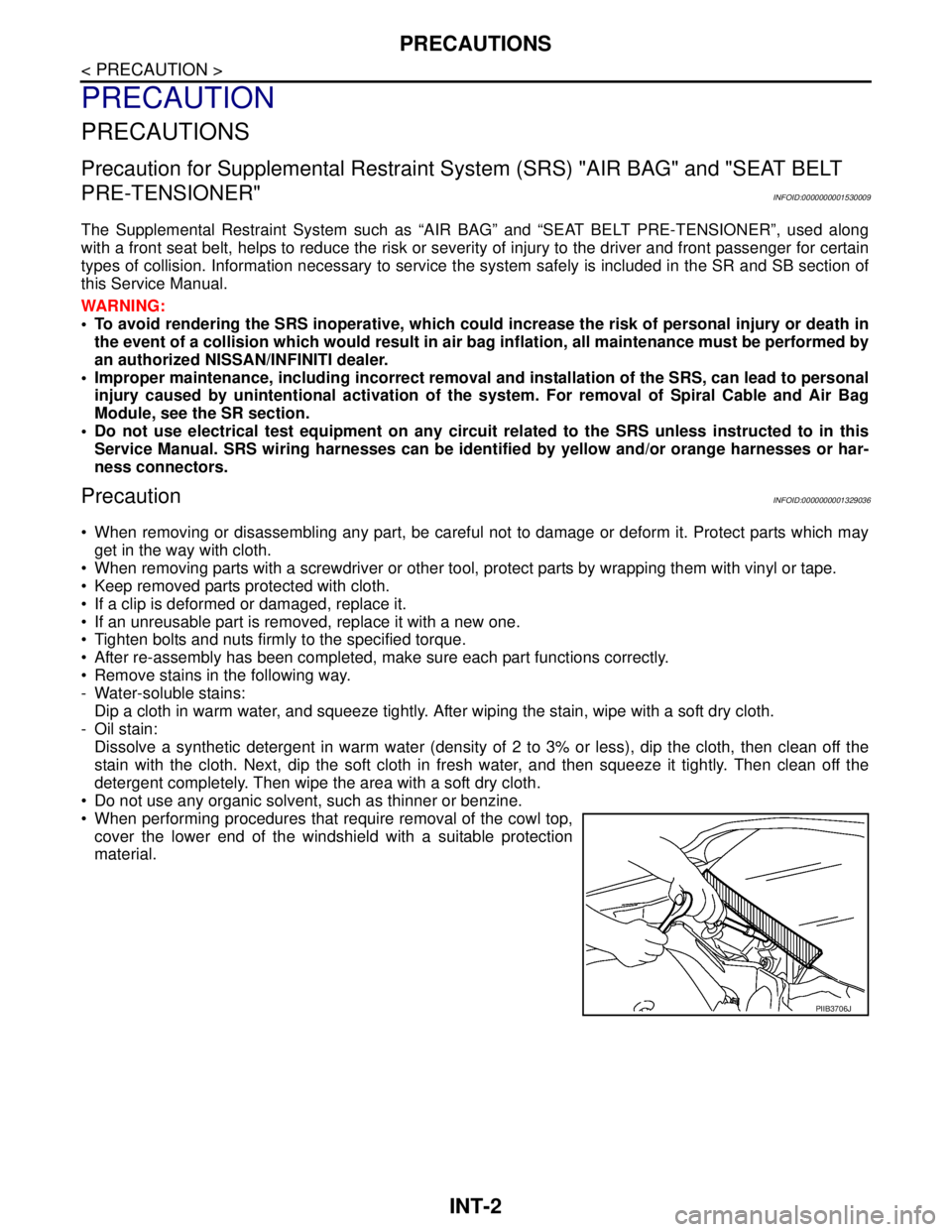
When performing procedures that require removal of the cowl top,
cover the lower end of the windshield with a suitable protection
material.
PIIB3706J
Page 3688 of 5883

SQUEAK AND RATTLE TROUBLE DIAGNOSIS
INT-9
< PREPARATION >
C
D
E
F
G
H
I
K
L
MA
B
INT
N
O
P
SILICONE GREASE
Used in place of UHMW tape that will be visible or not fit.
Note: Will only last a few months.
SILICONE SPRAY
Use when grease cannot be applied.
DUCT TAPE
Use to eliminate movement.
CONFIRM THE REPAIR
Confirm that the cause of a noise is repaired by test driving the vehicle. Operate the vehicle under the same
conditions as when the noise originally occurred. Refer to the notes on the Diagnostic Worksheet.
Generic Squeak and Rattle TroubleshootingINFOID:0000000001329047
Refer to Table of Contents for specific component removal and installation information.
INSTRUMENT PANEL
Most incidents are caused by contact and movement between:
1. The cluster lid A and instrument panel
2. Acrylic lens and combination meter housing
3. Instrument panel to front pillar garnish
4. Instrument panel to windshield
5. Instrument panel pins
6. Wiring harnesses behind the combination meter
7. A/C defroster duct and duct joint
These incidents can usually be located by tapping or moving the components to duplicate the noise or by
pressing on the components while driving to stop the noise. Most of these incidents can be repaired by apply-
ing felt cloth tape or silicone spray (in hard to reach areas). Urethane pads can be used to insulate wiring har-
ness.
CAUTION:
Do not use silicone spray to isolate a squeak or rattle. If you saturate the area with silicone, you will
not be able to recheck the repair.
CENTER CONSOLE
Components to pay attention to include:
1. Shifter assembly cover to finisher
2. A/C control unit and cluster lid C
3. Wiring harnesses behind audio and A/C control unit
The instrument panel repair and isolation procedures also apply to the center console.
DOORS
Pay attention to the:
1. Finisher and inner panel making a slapping noise
2. Inside handle escutcheon to door finisher
3. Wiring harnesses tapping
4. Door striker out of alignment causing a popping noise on starts and stops
Tapping or moving the components or pressing on them while driving to duplicate the conditions can isolate
many of these incidents. You can usually insulate the areas with felt cloth tape or insulator foam blocks from
the NISSAN Squeak and Rattle Kit (J-43980) to repair the noise.
TRUNK
Trunk noises are often caused by a loose jack or loose items put into the trunk by the owner.
In addition look for:
1. Trunk lid bumpers out of adjustment
2. Trunk lid striker out of adjustment
3. The trunk lid torsion bars knocking together
4. A loose license plate or bracket