clock NISSAN TIIDA 2009 Service User Guide
[x] Cancel search | Manufacturer: NISSAN, Model Year: 2009, Model line: TIIDA, Model: NISSAN TIIDA 2009Pages: 4331, PDF Size: 58.04 MB
Page 1299 of 4331
![NISSAN TIIDA 2009 Service User Guide TRANSAXLE ASSEMBLY
CVT-355
< SERVICE INFORMATION >
[RE0F08B] D
E
F
G H
I
J
K L
M A
B CVT
N
O P
4. Remove the four drive plate to torque converter nuts.
NOTE:
Rotate the crankshaft clockwise as vi](/img/5/57398/w960_57398-1298.png "NISSAN TIIDA 2009 Service User Guide TRANSAXLE ASSEMBLY
CVT-355
< SERVICE INFORMATION >
[RE0F08B] D
E
F
G H
I
J
K L
M A
B CVT
N
O P
4. Remove the four drive plate to torque converter nuts.
NOTE:
Rotate the crankshaft clockwise as vi")
TRANSAXLE ASSEMBLY
CVT-355
< SERVICE INFORMATION >
[RE0F08B] D
E
F
G H
I
J
K L
M A
B CVT
N
O P
4. Remove the four drive plate to torque converter nuts.
NOTE:
Rotate the crankshaft clockwise as viewed from front of engine
for access to drive plate to torque converter nuts.
5. Put matching marks on the drive plate and torque converter alignment stud. CAUTION:
For matching marks, use paint. Never dama ge the drive plate or torque converter.
6. Remove the transaxle to engine and engine to transaxle bolts.
7. Separate the transaxle from the engine.
8. If necessary, remove the following from the transaxle: • CVT fluid charging pipe
• Engine mounting bracket (LH)
• Fluid cooler tubes
• Air breather hose
• Any necessary brackets
INSTALLATION Installation is in the reverse order of removal.
CAUTION:
• When replacing an engine or transmission you mu st make sure any dowels are installed correctly
during re-assembly.
• Improper alignment caused by missing dowels m ay cause vibration, oil leaks or breakage of drive
train components.
• Do not reuse O-rings and copper washers.
• When turning crankshaft, turn it clockwise as viewed from the front of the engine.
• When tightening the nuts for the torque converter while securing the crankshaft pulley bolt, be sure
to confirm the tightening torque of the crankshaft pulley bolt. Refer to EM-160 .
• After converter is installed to drive plate, ro tate crankshaft several turns to check that transaxle
rotates freely without binding.
• When installing the torque converter to the transaxle measure dis- tance A. WCIA0616E
Distance A: 14.4 mm (0.57 in) or more
WCIA0617E
Page 1454 of 4331
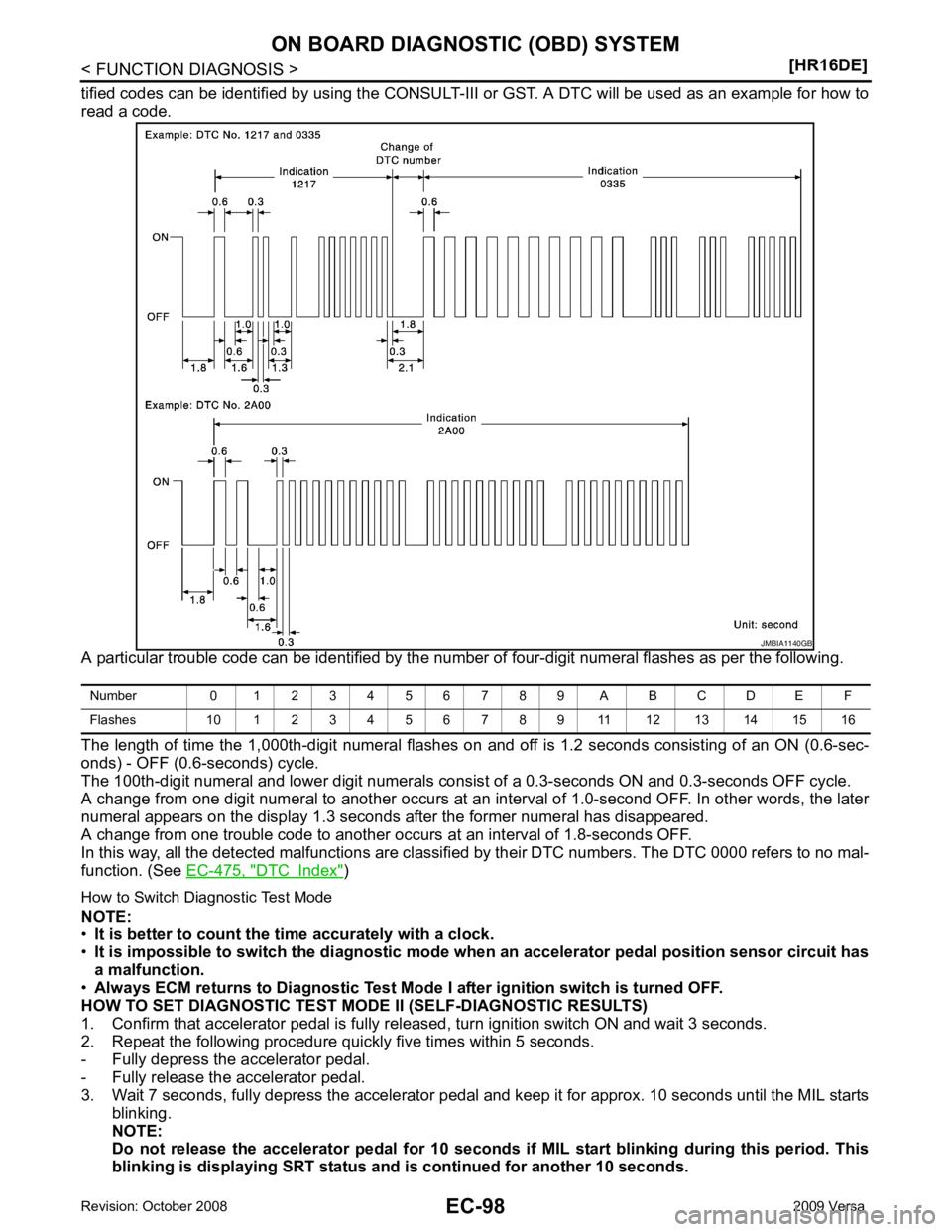
DTC Index " )
How to Switch Diagnostic Test Mode
NOTE:
• It is better to count the ti me accurately with a clock.
• It is impossible to switch the di agnostic mode when an accelerator pedal position sensor circuit has
a malfunction.
• Always ECM returns to Diagnostic Test Mode I after ignition switch is turned OFF.
HOW TO SET DIAGNOSTIC TEST MODE II (SELF-DIAGNOSTIC RESULTS)
1. Confirm that accelerator pedal is fully releas ed, turn ignition switch ON and wait 3 seconds.
2. Repeat the following procedure quickly five times within 5 seconds.
- Fully depress the accelerator pedal.
- Fully release the accelerator pedal.
3. Wait 7 seconds, fully depress the accelerator pedal and keep it for approx. 10 seconds until the MIL starts
blinking.
NOTE:
Do not release the accelerator pedal for 10 seconds if MIL start blinking during this period. This
blinking is displaying SRT status and is continued for another 10 seconds.
Page 1687 of 4331
![NISSAN TIIDA 2009 Service User Guide P0455 EVAP CONTROL SYSTEM
EC-331
< COMPONENT DIAGNOSIS >
[HR16DE] C
D E
F
G H
I
J
K L
M A EC
NP
O
1. Turn ignition switch OFF.
2. Check for genuine NISSAN fuel filler cap design.
Is the inspection res](/img/5/57398/w960_57398-1686.png "NISSAN TIIDA 2009 Service User Guide P0455 EVAP CONTROL SYSTEM
EC-331
< COMPONENT DIAGNOSIS >
[HR16DE] C
D E
F
G H
I
J
K L
M A EC
NP
O
1. Turn ignition switch OFF.
2. Check for genuine NISSAN fuel filler cap design.
Is the inspection res")
P0455 EVAP CONTROL SYSTEM
EC-331
< COMPONENT DIAGNOSIS >
[HR16DE] C
D E
F
G H
I
J
K L
M A EC
NP
O
1. Turn ignition switch OFF.
2. Check for genuine NISSAN fuel filler cap design.
Is the inspection result normal? YES >> GO TO 2.
NO >> Replace with genuine NISSAN fuel filler cap. 2.
CHECK FUEL FILLER CAP INSTALLATION
Check that the cap is tightened properly by rotating the cap clockwise.
Is the inspection result normal? YES >> GO TO 3.
NO >> Open fuel filler cap, then clean cap and fuel fi ller neck threads using air blower. Then retighten
until ratcheting sound is heard. 3.
CHECK FUEL FILLER CAP FUNCTION
Check for air releasing sound while opening the fuel filler cap.
Is the inspection result normal? YES >> GO TO 5.
NO >> GO TO 4. 4.
CHECK FUEL TANK VACUUM RELIEF VALVE
Refer to EC-333, " Component Inspection (Fuel filler cap) " .
Is the inspection result normal? YES >> GO TO 5.
NO >> Replace fuel filler cap with a genuine one. 5.
CHECK EVAP PURGE LINE
Check EVAP purge line (pipe, rubber tube, fuel tank and EVAP canister) for cracks, improper connection or
disconnection.
Refer to EC-74, " System Description " .
Is the inspection result normal? YES >> GO TO 6.
NO >> Repair or reconnect the hose. 6.
CLEAN EVAP PURGE LINE
Clean EVAP purge line (pipe and rubber tube) using air blower.
>> GO TO 7. 7.
CHECK DRAIN FILTER
Refer to EC-334, " Component Inspection (Drain filter) " .
Is the inspection result normal? YES >> GO TO 8.
NO >> Replace drain filter. 8.
CHECK EVAP CANISTER VENT CONTROL VALVE
Check the following.
• EVAP canister vent control valve is installed properly.
Refer to EC-502, " Exploded View " .
• EVAP canister vent control valve. Refer to EC-304, " Component Inspection " . SEF915U
Page 1887 of 4331
![NISSAN TIIDA 2009 Service User Guide EVAPORATIVE EMISSION SYSTEM
EC-531
< SERVICE INFOMATION >
[MR TYPE 1] C
D E
F
G H
I
J
K L
M A EC
NP
O
Positive pressure is delivered to the EVAP system through the EVAP
service port. If fuel vapor lea](/img/5/57398/w960_57398-1886.png "NISSAN TIIDA 2009 Service User Guide EVAPORATIVE EMISSION SYSTEM
EC-531
< SERVICE INFOMATION >
[MR TYPE 1] C
D E
F
G H
I
J
K L
M A EC
NP
O
Positive pressure is delivered to the EVAP system through the EVAP
service port. If fuel vapor lea")
EVAPORATIVE EMISSION SYSTEM
EC-531
< SERVICE INFOMATION >
[MR TYPE 1] C
D E
F
G H
I
J
K L
M A EC
NP
O
Positive pressure is delivered to the EVAP system through the EVAP
service port. If fuel vapor leakage in the EVAP system occurs, use a
leak detector to locate the leak.
Removal and Installation INFOID:0000000004537030
EVAP CANISTER Tighten EVAP canister as shown in the figure.
EVAP CANISTER VENT CONTROL VALVE 1. Turn EVAP canister vent control valve counterclockwise.
• Lock (A)
• Unlock (B)
2. Remove the EVAP canister vent control valve.
Always replace O-ring with a new one.
How to Detect Fuel Vapor Leakage INFOID:0000000004537031
CAUTION:
• Never use compressed air or a high pressure pump.
• Do not exceed 4.12 kPa (0.042 kg/cm 2
, 0.6 psi) of pressure in EVAP system.
NOTE:
• Do not start engine.
• Improper installation of EVAP service port adapter to the EVAP service port may cause a leak.
WITH CONSULT-III
1. Attach the EVAP service port adapter securely to the EVAP service port.
2. Also attach the pressure pump and hose to the EVAP service port adapter. SEF462UC
PBIB1214E
PBIB3091E
Page 1914 of 4331

Emission-
related Diagnostic Information " .
HOW TO SWITCH DIAGNOSTIC TEST MODE
NOTE:
• It is better to count the ti me accurately with a clock.
• It is impossible to switch the di agnostic mode when an accelerator pedal position sensor circuit has
a malfunction.
• Always ECM returns to Diagnostic Test Mode I after ignition switch is turned OFF.
How to Set Diagnostic Test Mode II (Self-diagnostic Results)
1. Confirm that accelerator pedal is fully releas ed, turn ignition switch ON and wait 3 seconds.
2. Repeat the following procedure quickly five times within 5 seconds.
a. Fully depress the accelerator pedal.
b. Fully release the accelerator pedal.
3. Wait 7 seconds, fully depress the accelerator pedal and keep it for approx. 10 seconds until the MIL starts blinking.
4. Fully release the accelerator pedal. Diagnostic Test
Mode KEY and ENG.
Status Function Explanation of Function
Mode I Ignition switch in ON position
Engine stopped BULB CHECK This function checks the MIL bulb for damage (blown, open
circuit, etc.).
If the MIL does not come on, check MIL circuit.
Engine running MALFUNCTION WARNING This is a usual driving condition. When a malfunction is de-
tected twice in two consecutive driving cycles (two trip de-
tection logic), the MIL will light up to inform the driver that a
malfunction has been detected.
The following malfunctions will light up or blink the MIL in
the 1st trip.
• Misfire (Possible three way catalyst damage)
• One trip detection diagnoses
Mode II Ignition switch in ON position
Engine stopped SELF-DIAGNOSTIC
RESULTS This function allows DTCs an
d 1st trip DTCs to be read.
Page 1929 of 4331
![NISSAN TIIDA 2009 Service User Guide EC
NP
O
[Air conditioner, headlamp, rear window defogger]
On vehicles equipped with daytime light systems, if the parking brake is applied before the engine is
started the headlamp will not be illumi](/img/5/57398/w960_57398-1928.png "NISSAN TIIDA 2009 Service User Guide EC
NP
O
[Air conditioner, headlamp, rear window defogger]
On vehicles equipped with daytime light systems, if the parking brake is applied before the engine is
started the headlamp will not be illumi")
EC
NP
O
[Air conditioner, headlamp, rear window defogger]
On vehicles equipped with daytime light systems, if the parking brake is applied before the engine is
started the headlamp will not be illuminated.
• Steering wheel: Neutral (Straight-ahead position)
• Vehicle speed: Stopped
• Transmission: Warmed-up
- Models with CONSULT-III (A/T and CVT models)
• Drive vehicle until “FLUID TEMP SE” in “DATA MONI TOR” mode of “A/T” or “CVT” system indicates less
than 0.9V.
- Models without CONSULT-III (A/T and CVT models) and M/T models
• Drive vehicle for 10 minutes.
OPERATION PROCEDURE
With CONSULT-III
1. Perform EC-572, " Accelerator Pedal Released Position Learning " .
2. Perform EC-572, " Throttle Valve Closed Position Learning " .
3. Start engine and warm it up to normal operating temperature.
4. Check that all items listed under the topic PREP ARATION (previously mentioned) are in good order.
5. Select “IDLE AIR VOL LEA RN” in “WORK SUPPORT” mode.
6. Touch “START” and wait 20 seconds.
7. Make sure that “CMPLT” is displayed on CONSULT-III screen. If “CMPLT” is not displayed, Idle Air Vol-
ume Learning will not be carried out successfully. In this case, find the cause of the incident by referring to
the DIAGNOSTIC PROCEDURE below.
8. Rev up the engine two or three times and make sure that idle speed and ignition timing are within the specifications.
Refer to EC-566, " Basic Inspection " .
Without CONSULT-III
NOTE:
• It is better to count the time accurately with a clock.
• It is impossible to switch the di agnostic mode when an accelerator pedal position sensor circuit has
a malfunction.
1. Perform EC-572, " Accelerator Pedal Released Position Learning " .
2. Perform EC-572, " Throttle Valve Closed Position Learning " .
3. Start engine and warm it up to normal operating temperature.
4. Check that all items listed under the topic PREP ARATION (previously mentioned) are in good order.
5. Turn ignition switch OFF and wait at least 10 seconds.
6. Confirm that accelerator pedal is fully releas ed, turn ignition switch ON and wait 3 seconds.
7. Repeat the following procedure quick ly five times within 5 seconds.
a. Fully depress the accelerator pedal.
b. Fully release the accelerator pedal.
8. Wait 7 seconds, fully depress the accelerator pedal and keep it for approx. 20 seconds until the MIL stops
blinking and turned ON.
9. Fully release the accelerator pedal within 3 seconds after the MIL turned ON.
10. Start engine and let it idle.
Page 2154 of 4331
![NISSAN TIIDA 2009 Service User Guide EC-798< SERVICE INFOMATION >
[MR TYPE 1]
DTC P0442 EVAP CONTROL SYSTEM
If DTC Confirmation Procedure has been previously conduc ted, always turn ignition switch OFF and wait at
least 10](/img/5/57398/w960_57398-2153.png "NISSAN TIIDA 2009 Service User Guide EC-798< SERVICE INFOMATION >
[MR TYPE 1]
DTC P0442 EVAP CONTROL SYSTEM
If DTC Confirmation Procedure has been previously conduc ted, always turn ignition switch OFF and wait at
least 10")
EC-798< SERVICE INFOMATION >
[MR TYPE 1]
DTC P0442 EVAP CONTROL SYSTEM
If DTC Confirmation Procedure has been previously conduc ted, always turn ignition switch OFF and wait at
least 10 seconds before conducting the next test.
TESTING CONDITION:
• Perform “DTC WORK SUPPORT” when the fuel level is between 1/4 and 3/4 full, and vehicle is placed
on flat level surface.
• Always perform test at a temperature of 0 to 30 °C (32 to 86 °F).
• Open engine hood before conducting following procedure.
WITH CONSULT-III
1. Turn ignition switch ON.
2. Turn ignition switch OFF and wait at least 10 seconds.
3. Turn ignition switch ON and select “DATA MONITOR” mode with CONSULT-III.
4. Check the following conditions are met.
COOLAN TEMP/S: 0 - 70 °C (32 - 158 °F)
INT/A TEMP SE: 0 - 30 °C (32 - 86 °F)
5. Select “EVAP SML LEAK P0442/P1442” of “EV APORATIVE SYSTEM” in “DTC WORK SUPPORT” mode
with CONSULT-III.
Follow the instruction displayed.
NOTE:
If the engine speed cannot be maintained within t he range displayed on the CONSULT-III screen, go to
EC-566, " Basic Inspection " .
6. Make sure that “OK” is displayed. If “NG” is displayed, refer to EC-798, " Diagnosis Procedure " .
NOTE:
Make sure that EVAP hoses are connected to th e EVAP canister purge volume control solenoid
valve properly.
WITH GST
NOTE:
Be sure to read the explanation of Driving Pattern on EC-542, " Emission-related Diagnostic Information "
before driving vehicle.
1. Start engine.
2. Drive vehicle according to Driving Pattern, EC-542, " Emission-related Diagnostic Information " .
3. Stop vehicle.
4. Turn ignition switch OFF and wait at leas t 10 seconds and then turn ignition switch ON.
5. Select Service $07 with GST.
- If P0442 is displayed on the screen, go to EC-798, " Diagnosis Procedure " .
- If P0441 is displayed on the screen, go to EC-793, " Diagnosis Procedure " for DTC P0441.
Diagnosis Procedure INFOID:00000000045372911.
CHECK FUEL FILLER CAP DESIGN
1. Turn ignition switch OFF.
2. Check for genuine NISSAN fuel filler cap design.
OK or NG OK >> GO TO 2.
NG >> Replace with genuine NISSAN fuel filler cap. 2.
CHECK FUEL FILLER CAP INSTALLATION
Check that the cap is tightened proper ly by rotating the cap clockwise.
OK or NG OK >> GO TO 3.
NG >> 1. Open fuel filler cap, then clean cap and fuel filler neck threads using air blower. SEF915U
Page 2204 of 4331
![NISSAN TIIDA 2009 Service User Guide EC-848< SERVICE INFOMATION >
[MR TYPE 1]
DTC P0455 EVAP CONTROL SYSTEM
• Make sure that EVAP hose are connected to EVAP canister purge volume control solenoid valve
properly.
• If DT](/img/5/57398/w960_57398-2203.png "NISSAN TIIDA 2009 Service User Guide EC-848< SERVICE INFOMATION >
[MR TYPE 1]
DTC P0455 EVAP CONTROL SYSTEM
• Make sure that EVAP hose are connected to EVAP canister purge volume control solenoid valve
properly.
• If DT")
EC-848< SERVICE INFOMATION >
[MR TYPE 1]
DTC P0455 EVAP CONTROL SYSTEM
• Make sure that EVAP hose are connected to EVAP canister purge volume control solenoid valve
properly.
• If DTC Confirmation Procedure has been previously conduc ted, always turn ignition switch OFF and wait at
least 10 seconds before conducting the next test.
TESTING CONDITION:
• Perform “DTC WORK SUPPORT” when the fuel level is between 1/4 and 3/4 full, and vehicle is placed
on flat level surface.
• Open engine hood before conducting the following procedure.
WITH CONSULT-III
1. Tighten fuel filler cap securely until reteaching sound is heard.
2. Turn ignition switch ON.
3. Turn ignition switch OFF and wait at least 10 seconds.
4. Turn ignition switch ON and select “DATA MONITOR” mode with CONSULT-III.
5. Make sure that the following conditions are met.
COOLAN TEMP/S: 0 - 70 °C (32 - 158 °F)
INT/A TEMP SE: 0 - 60 °C (32 - 140 °F)
6. Select “EVAP SML LEAK P0442/P1442” of “EV APORATIVE SYSTEM” in “DTC WORK SUPPORT” mode
with CONSULT-III.
Follow the instruction displayed.
NOTE:
If the engine speed cannot be maintained within t he range displayed on the CONSULT-III screen, go to
EC-566, " Basic Inspection " .
7. Make sure that “OK” is displayed.
If “NG” is displayed, select “SELF-DIAG RESULT S” mode with CONSULT-III and make sure that “EVAP
GROSS LEAK [P0455]” is displayed. If it is displayed, refer to EC-848, " Diagnosis Procedure " .
If P0442 is displayed, perform Diagnostic Procedure for DTC P0442, EC-798, " Diagnosis Procedure " .
WITH GST
NOTE:
Be sure to read the explanation of Driving Pattern on EC-542, " Emission-related Diagnostic Information "
before driving vehicle.
1. Start engine.
2. Drive vehicle according to Driving Pattern, EC-542, " Emission-related Diagnostic Information " .
3. Stop vehicle.
4. Turn ignition switch OFF, wait at least 10 seconds and then turn ignition switch ON.
5. Select Service $07 with GST.
• If P0441 is displayed on the screen, go to EC-793, " Diagnosis Procedure " for DTC P0441.
• If P0442 is displayed on the screen, go to EC-798, " Diagnosis Procedure " for DTC P0442.
• If P0455 is displayed on the screen, go to EC-848, " Diagnosis Procedure " .
Diagnosis Procedure INFOID:00000000045373441.
CHECK FUEL FILLER CAP DESIGN
1. Turn ignition switch OFF.
2. Check for genuine NISSAN fuel filler cap design.
OK or NG OK >> GO TO 2.
NG >> Replace with genuine NISSAN fuel filler cap. 2.
CHECK FUEL FILLER CAP INSTALLATION
Check that the cap is tightened proper ly by rotating the cap clockwise. SEF915U
Page 2211 of 4331
![NISSAN TIIDA 2009 Service User Guide DTC P0456 EVAP CONTROL SYSTEM
EC-855
< SERVICE INFOMATION >
[MR TYPE 1] C
D E
F
G H
I
J
K L
M A EC
NP
O
2. Set the pressure pump and a hose.
3. Also set the pressure pump with pressure gauge t](/img/5/57398/w960_57398-2210.png "NISSAN TIIDA 2009 Service User Guide DTC P0456 EVAP CONTROL SYSTEM
EC-855
< SERVICE INFOMATION >
[MR TYPE 1] C
D E
F
G H
I
J
K L
M A EC
NP
O
2. Set the pressure pump and a hose.
3. Also set the pressure pump with pressure gauge t")
DTC P0456 EVAP CONTROL SYSTEM
EC-855
< SERVICE INFOMATION >
[MR TYPE 1] C
D E
F
G H
I
J
K L
M A EC
NP
O
2. Set the pressure pump and a hose.
3. Also set the pressure pump with pressure gauge to the EVAP service port adapter.
4. Turn ignition switch ON.
5. Connect GST and select Service $08.
6. Using Service $08 control the EVAP canister vent control valve
(close).
7. Apply pressure and make sure the following conditions are sat- isfied.
Pressure to be applied: 2.7 kPa (20 mmHg, 0.79 inHg)
Time to be waited after the pressure drawn in to the EVAP
system and the pressure to be dropped: 60 seconds and
the pressure should not be dropped more than 0.4 kPa (3 mmHg, 0.12 inHg).
If NG, go to EC-855, " Diagnosis Procedure " .
If OK, go to next step.
8. Disconnect GST.
9. Start engine and warm it up to normal operating temperature.
10. Turn ignition switch OFF and wait at least 10 seconds.
11. Restart engine and let it idle for 90 seconds.
12. Keep engine speed at 2,000 rpm for 30 seconds.
13. Turn ignition switch OFF. NOTE:
For more information, refe r to GST Instruction Manual.
Diagnosis Procedure INFOID:00000000045373481.
CHECK FUEL FILLER CAP DESIGN
1. Turn ignition switch OFF.
2. Check for genuine NISSAN fuel filler cap design.
OK or NG OK >> GO TO 2.
NG >> Replace with genuine NISSAN fuel filler cap. 2.
CHECK FUEL FILLER CAP INSTALLATION
Check that the cap is tightened properly by rotating the cap clockwise.
OK or NG OK >> GO TO 3.
NG >> 1. Open fuel filler cap, then clean cap and fuel filler neck threads using air blower. 2. Retighten until reteaching sound is heard. 3.
CHECK FUEL FILLER CAP FUNCTION
Check for air releasing sound while opening the fuel filler cap.
OK or NG OK >> GO TO 5.
NG >> GO TO 4. 4.
CHECK FUEL TANK VACUUM RELIEF VALVE
Refer to EC-529, " Component Inspection " .
OK or NG OK >> GO TO 5.
NG >> Replace fuel filler cap with a genuine one. SEF462UI
SEF915U
Page 2396 of 4331
![NISSAN TIIDA 2009 Service User Guide EC-1040< SERVICE INFOMATION >
[MR TYPE 2]
EVAPORATIVE EMISSION SYSTEM
Positive pressure is delivered to the EVAP system through the EVAP
service port. If fuel vapor leak age in the EVAP system occurs,](/img/5/57398/w960_57398-2395.png "NISSAN TIIDA 2009 Service User Guide EC-1040< SERVICE INFOMATION >
[MR TYPE 2]
EVAPORATIVE EMISSION SYSTEM
Positive pressure is delivered to the EVAP system through the EVAP
service port. If fuel vapor leak age in the EVAP system occurs,")
EC-1040< SERVICE INFOMATION >
[MR TYPE 2]
EVAPORATIVE EMISSION SYSTEM
Positive pressure is delivered to the EVAP system through the EVAP
service port. If fuel vapor leak age in the EVAP system occurs, use a
leak detector to locate the leak.
Removal and Installation INFOID:0000000004499916
EVAP CANISTER
Tighten EVAP canister as shown in the figure.
EVAP CANISTER VENT CONTROL VALVE
1. Turn EVAP canister vent control valve counterclockwise.
• Lock (A)
• Unlock (B)
2. Remove the EVAP canister vent control valve.
Always replace O-ring with a new one.
How to Detect Fuel Vapor Leakage INFOID:0000000004499917
CAUTION:
• Never use compressed air or a high pressure pump.
• Do not exceed 4.12 kPa (0.042 kg/cm 2
, 0.6 psi) of pressure in EVAP system.
NOTE:
• Do not start engine.
• Improper installation of EVAP service port adapter to the EVAP service port may cause a leak.
WITH CONSULT-III
1. Attach the EVAP service port adapter securely to the EVAP service port.
2. Also attach the pressure pump and hose to the EVAP service port adapter. SEF462UC
PBIB1214E
PBIB3091E