engine control system NISSAN TIIDA 2009 Service Service Manual
[x] Cancel search | Manufacturer: NISSAN, Model Year: 2009, Model line: TIIDA, Model: NISSAN TIIDA 2009Pages: 4331, PDF Size: 58.04 MB
Page 1167 of 4331
![NISSAN TIIDA 2009 Service Service Manual TROUBLE DIAGNOSIS
CVT-223
< SERVICE INFORMATION >
[RE0F08B] D
E
F
G H
I
J
K L
M A
B CVT
N
O P
Road Test
INFOID:0000000004305594
DESCRIPTION • The purpose of the test is to determine overall performa](/img/5/57398/w960_57398-1166.png "NISSAN TIIDA 2009 Service Service Manual TROUBLE DIAGNOSIS
CVT-223
< SERVICE INFORMATION >
[RE0F08B] D
E
F
G H
I
J
K L
M A
B CVT
N
O P
Road Test
INFOID:0000000004305594
DESCRIPTION • The purpose of the test is to determine overall performa")
TROUBLE DIAGNOSIS
CVT-223
< SERVICE INFORMATION >
[RE0F08B] D
E
F
G H
I
J
K L
M A
B CVT
N
O P
Road Test
INFOID:0000000004305594
DESCRIPTION • The purpose of the test is to determine overall performance of CVT and analyze causes of problems.
• The road test consists of the following three parts:
1. “Check Before Engine Is Started” CVT-224 .
2. “Check at Idle” CVT-224 .
3. “Cruise Test” CVT-226 .
Judgement Possible cause
Idle speed Low for all positions
(“P”, “R”, “N”, “D”, “L”) Possible causes include malfunctions in the pressure supply system and low oil pump output.
For example
• Oil pump wear
• Pressure regulator valve or plug sticking or spring fatigue
• Oil strainer ⇒ oil pump ⇒ pressure regulator valve passage oil leak
• Engine idle speed too low
Only low for a specific
position Possible causes include an oil pressure leak in a passage or device related to the position after
the pressure is distributed by the manual valve.
High Possible causes include a sensor malfunction or malfunction in the line pressure adjustment
function.
For example
• Accelerator pedal position signal malfunction
• CVT fluid temperature sensor malfunction
• Pressure control solenoid A (line pressure solenoid) malfunction (sticking in OFF state, filter
clog, cut line)
• Pressure regulator valve or plug sticking
Stall speed Line pressure does
not rise higher than
the line pressure for
idle. Possible causes include a sensor malfunction or malfunction in the pressure adjustment func-
tion.
For example
• Accelerator pedal position signal malfunction
• TCM malfunction
• Pressure control solenoid A (lin e pressure solenoid) malfunction (shorting, sticking in ON
state)
• Pressure regulator valve or plug sticking
The pressure rises,
but does not enter the
standard position. Possible causes include malfunctions in the pressure supply system and malfunction in the pres-
sure adjustment function.
For example
• Accelerator pedal position signal malfunction
• Pressure control solenoid A (l ine pressure solenoid) malfunction (sticking, filter clog)
• Pressure regulator valve or plug sticking
Only low for a specific
position Possible causes include an oil pressure leak in a passage or device related to the position after
the pressure is distributed by the manual valve. SAT786A
Page 1237 of 4331

CVT
N
O P
DTC P0868 SECONDARY PRESSURE DOWN
Description INFOID:0000000004305730
• The pressure control solenoid valve B (secondary pressure solenoid valve) is included in the control valve assembly.
• The pressure control solenoid valve B (secondary pressure solenoid valve) regulates the secondary pres-
sure to suit the driving condition in response to a signal sent from the TCM.
CONSULT-III Reference Val ue in Data Monitor Mode INFOID:0000000004305731
Remarks: Specification data are reference values.
On Board Diagnosis Logic INFOID:0000000004305732
• This is not an OBD-II self-diagnostic item.
• Diagnostic trouble code “P0868 SEC/PRESS DOWN” with CONSULT-III is detected when secondary fluid
pressure is too low compared with the commanded value while driving.
Possible Cause INFOID:0000000004305733
• Harness or connectors (Solenoid circuit is open or shorted.)
• Pressure control solenoid valve B (Secondary pressure solenoid valve) system
• Transmission fluid pressure sensor A (Secondary pressure sensor)
• Line pressure control system
DTC Confirmation Procedure INFOID:0000000004305734
CAUTION:
Always drive vehicle at a safe speed.
NOTE:
If “DTC Confirmation Procedure” has been previously performed, alw ays turn ignition switch OFF and
wait at least 10 seconds before performing the next test.
After the repair, perform the following procedure to confirm the malfunction is eliminated.
WITH CONSULT-III
1. Turn ignition switch ON and select “DATA MO NITOR” mode for “TRANSMISSION” with CONSULT-III.
2. Make sure that output voltage of CVT fluid temperature sensor is within the range below.
ATF TEMP SEN: 1.0 - 2.0 V
If out of range, drive the vehicle to decrease the voltage (warm up the fluid) or stop engine to
increase the voltage (c ool down the fluid)
3. Start engine and maintain the following conditions for at least 10 consecutive seconds. VEHICLE SPEED (accelerate slowly): 0 → 50 km/h (31 MPH)
ACC PEDAL OPEN: 0.5/8 - 1.0/8
RANGE: “D” position
4. If DTC is detected, go to CVT-293, " Diagnosis Procedure " .
Diagnosis Procedure INFOID:0000000004305735
Page 1247 of 4331

CVT
N
O P
DTC P1723 CVT SPEED SENSOR FUNCTION
Description INFOID:0000000004305754
• The input speed sensor (primary speed sensor) is included in the control valve assembly.
• The vehicle speed sensor CVT [output speed sensor (s econdary speed sensor)] detects the revolution of the
idler gear and generates a pulse signal. The pulse signal is sent to the TCM, which converts it into vehicle
speed.
• The input speed sensor (primary speed sensor) detects the primary pulley revolution speed and sends a sig-
nal to the TCM.
On Board Diagnosis Logic INFOID:0000000004305755
• This is not an OBD-II self-diagnostic item.
• Diagnostic trouble code “P1723 CVT SPD SEN/FNCTN” with CONSULT-III is detected when there is a great
difference between the vehicle speed signal and the secondary speed sensor signal.
CAUTION:
One of the “P0720 VEH SPD SEN/CIR AT”, the “P0715 INPUT SPD SEN/CIRC” or the “P0725 ENGINE
SPEED SIG“ is displayed with the DTC at the same time.
Possible Cause INFOID:0000000004305756
• Harness or connectors (Sensor circuit is open or shorted.)
• Output speed sensor (Secondary speed sensor)
• Input speed sensor (Primary speed sensor)
• Engine speed signal system
DTC Confirmation Procedure INFOID:0000000004305757
CAUTION:
Always drive vehicle at a safe speed.
NOTE:
If “DTC Confirmation Procedure” has been previously performed, alw ays turn ignition switch OFF and
wait at least 10 seconds before performing the next test.
After the repair, touch “ERASE” on “SELF-DIAG RESU LTS” and then perform the following procedure to con-
firm the malfunction is eliminated.
WITH CONSULT-III
1. Turn ignition switch ON and select “DATA MO NITOR” mode for “TRANSMISSION” with CONSULT-III.
2. Start engine and maintain the following conditions for at least 5 consecutive seconds.
VEHICLE SPEED SE: 10 km/h (6 MPH) or more
ACC PEDAL OPEN: More than 1.0/8
RANGE: “D” position
ENG SPEED: 450 rpm or more
Driving location: Driving the vehic le uphill (increased engine load) will help maintain the driving
conditions required for this test.
3. If DTC is detected, go to CVT-303, " Diagnosis Procedure " .
Diagnosis Procedure INFOID:0000000004305758CONSULT-III Functi
on (TRANSMISSION) " .
Is a malfunction in the step motor function indicated in the results? YES >> Repair or replace damaged parts. (C
heck the step motor function. Refer to CVT-315 .)
NO >> GO TO 2.
2. CHECK OUTPUT SPEED SENSOR (SECONDARY SPEED SENSOR SYSTEM) AND INPUT SPEED ,
CVT-254 .
Page 1249 of 4331
CVT
N
O P
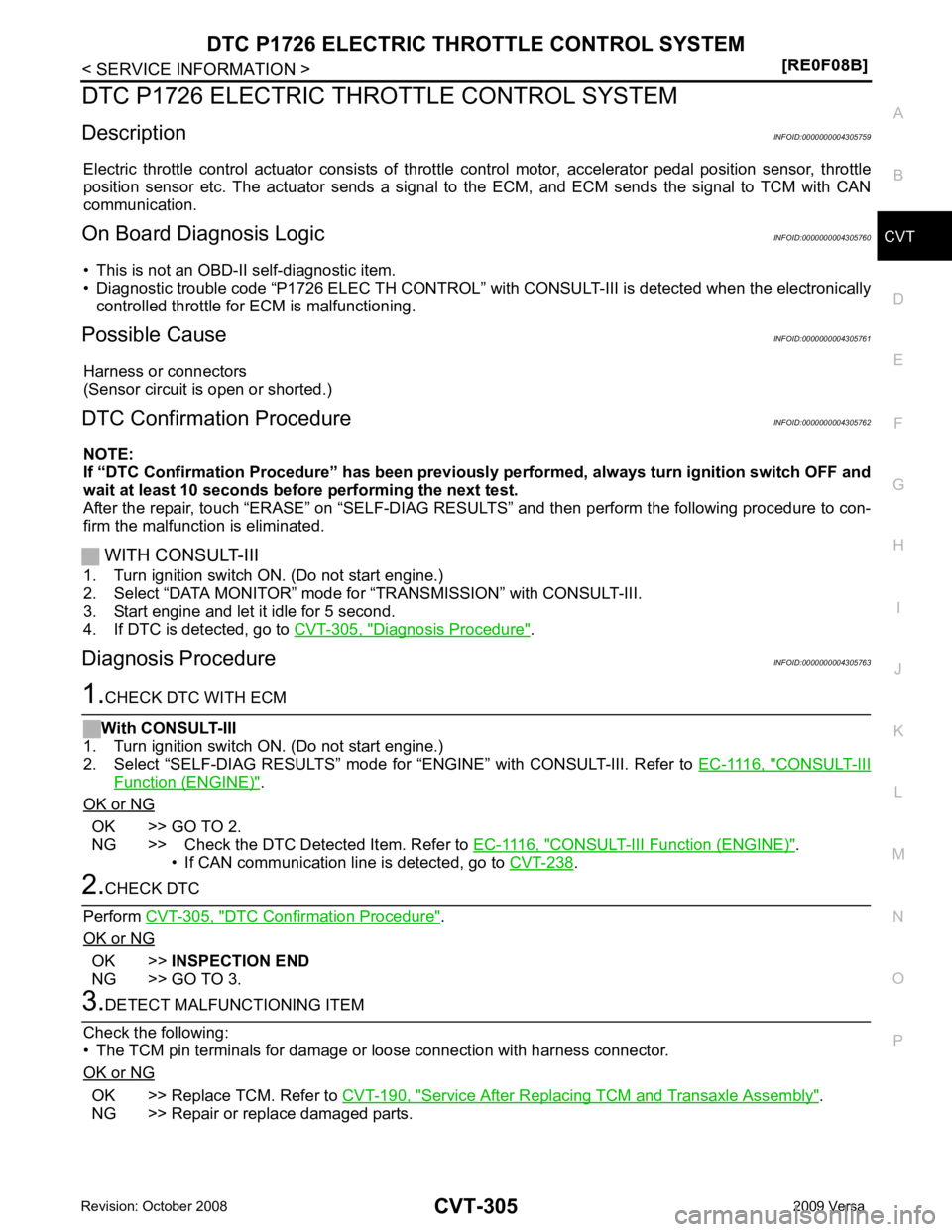
DTC P1726 ELECTRIC TH
ROTTLE CONTROL SYSTEM
Description INFOID:0000000004305759
Electric throttle control actuator consists of throttle control motor, accelerator pedal position sensor, throttle
position sensor etc. The actuator sends a signal to the ECM, and ECM sends the signal to TCM with CAN
communication.
On Board Diagnosis Logic INFOID:0000000004305760
• This is not an OBD-II self-diagnostic item.
• Diagnostic trouble code “P1726 ELEC TH CONTROL” wit h CONSULT-III is detected when the electronically
controlled throttle for ECM is malfunctioning.
Possible Cause INFOID:0000000004305761
Harness or connectors
(Sensor circuit is open or shorted.)
DTC Confirmation Procedure INFOID:0000000004305762
NOTE:
If “DTC Confirmation Procedure” has been previously performed, alw ays turn ignition switch OFF and
wait at least 10 seconds before performing the next test.
After the repair, touch “ERASE” on “SELF-DIAG RESU LTS” and then perform the following procedure to con-
firm the malfunction is eliminated.
WITH CONSULT-III
1. Turn ignition switch ON. (Do not start engine.)
2. Select “DATA MONITOR” mode for “TRANSMISSION” with CONSULT-III.
3. Start engine and let it idle for 5 second.
4. If DTC is detected, go to CVT-305, " Diagnosis Procedure " .
Diagnosis Procedure INFOID:0000000004305763 CONSULT-III
Function (ENGINE) " .
OK or NG OK >> GO TO 2.
NG >> Check the DTC Detected Item. Refer to EC-1116, " CONSULT-III Function (ENGINE) " .
• If CAN communication line is detected, go to CVT-238 .
DTC Confirmation Procedure " .
OK or NG OK >>
INSPECTION END
NG >> GO TO 3. OK >> Replace TCM. Refer to
CVT-190, " Service After Replacing TCM and Transaxle Assembly " .
NG >> Repair or replace damaged parts.
Page 1259 of 4331

CVT
N
O P
DTC P1778 STEP MOTOR - FUNCTION
Description INFOID:0000000004305785
• The step motor is included in the control valve assembly.
• The step motor's 4 aspects of ON/OFF change according to the signal from TCM. As a result, the flow of line
pressure to primary pulley is changed and pulley ratio is controlled.
• This diagnosis item is detected when electrical system is OK, but mechanical system is NG.
• This diagnosis item is detected when the state of the changing the speed mechanism in unit does not oper-
ate normally.
CONSULT-III Reference Val ue in Data Monitor Mode INFOID:0000000004305786
Remarks: Specification data are reference values.
On Board Diagnosis Logic INFOID:0000000004305787
• This is an OBD-II self-diagnostic item.
• Diagnostic trouble code “P1778 STEP MOTR/FNC” with CO NSULT-III is detected under the following condi-
tions.
- When not changing the pulley ratio according to the instruction of TCM.
Possible Cause INFOID:0000000004305788
Step motor
DTC Confirmation Procedure INFOID:0000000004305789
CAUTION:
• Always drive vehicle at a safe speed.
• Before starting “DTC Confirmation Procedure”, confirm “Hi” or “Mid” or “Low” fixation by “PRI SPEED” and “VEHICLE SPEED” on “DATA MONITOR MODE”.
• If hi-geared fixation occurred, go to CVT-316, " Diagnosis Procedure " .
NOTE:
If “DTC Confirmation Procedure” has been previously performed, alw ays turn ignition switch OFF and
wait at least 10 seconds before performing the next test.
After the repair, touch “ERASE” on “SELF-DIAG RESU LTS” and then perform the following procedure to con-
firm the malfunction is eliminated.
WITH CONSULT-III
1. Turn ignition switch ON and select “DATA MO NITOR” mode for “TRANSMISSION” with CONSULT-III.
2. Make sure that output voltage of CVT fluid temperature sensor is within the range below.
ATF TEMP SEN: 1.0 - 2.0 V
If out of range, drive the vehicle to decrease the voltage (warm up the fluid) or stop engine to
increase the voltage (c ool down the fluid)
3. Select “DATA MONITOR” mode for “TRANSMISSION” with CONSULT-III.
4. Start engine and maintain the following conditions for at least 30 consecutive seconds.
TEST START FROM 0 km/h (0 MPH)
CONSTANT ACCELERATION: Keep 30 sec or more
VEHICLE SPEED: 10 km/h (6 MPH) or more
ACC PEDAL OPEN: More than 1.0/8
RANGE: “D” position
ENG SPEED: 450 rpm or more
5. If DTC is detected, go to CVT-316, " Diagnosis Procedure " .
WITH GST
Follow the procedure “WITH CONSULT-III”. Item name Condition Display value (Approx.)
STM STEP During driving−
20 step - 180 step
GEAR RATIO 2.56 - 0.43
Page 1281 of 4331
![NISSAN TIIDA 2009 Service Service Manual CVT SHIFT LOCK SYSTEM
CVT-337
< SERVICE INFORMATION >
[RE0F08B] D
E
F
G H
I
J
K L
M A
B CVT
N
O P
•
Selector lever can be moved fr om “P” position with ignition key in ON position](/img/5/57398/w960_57398-1280.png "NISSAN TIIDA 2009 Service Service Manual CVT SHIFT LOCK SYSTEM
CVT-337
< SERVICE INFORMATION >
[RE0F08B] D
E
F
G H
I
J
K L
M A
B CVT
N
O P
•
Selector lever can be moved fr om “P” position with ignition key in ON position")
CVT SHIFT LOCK SYSTEM
CVT-337
< SERVICE INFORMATION >
[RE0F08B] D
E
F
G H
I
J
K L
M A
B CVT
N
O P
•
Selector lever can be moved fr om “P” position with ignition key in ON position and brake pedal
released.
• Selector lever can be moved from “P” position when ignition switch is removed from key cylinder.
SYMPTOM 2:
• Ignition key cannot be removed when sel ector lever is set to “P” position.
• Ignition key can be removed wh en selector lever is set to any position except “P” position.1.
CHECK KEY INTERLOCK CABLE
Check key interlock cable for damage.
OK or NG OK >> GO TO 2.
NG >> Repair key interlock cable. Refer to AT-218, " Removal and Installation " .
2.
CHECK CVT POSITION
Check CVT position. Refer to CVT-345, " Checking of CVT Position " .
OK or NG OK >> GO TO 3.
NG >> Adjust control cable. Refer to CVT-345, " Adjustment of CVT Position " .
3.
CHECK SHIFT LOCK SOLENOID AND PARK POSITION SWITCH
1. Turn ignition switch ON. (Do not start engine.)
2. Selector lever is set in “P” position.
3. Check operation sound.
OK or NG OK >>
INSPECTION END
NG - 1 >> With intelligent key: GO TO 4.
NG - 2 >> Without intelligent key: GO TO 5. 4.
CHECK POWER SOURCE
1. Turn ignition switch ON. (Do not start engine.)
2. Check voltage between CVT device harness connector terminal 5 and ground.
OK or NG OK >> GO TO 8.
NG >> GO TO 6. 5.
CHECK POWER SOURCE
1. Turn ignition switch ON. (Do not start engine.) Condition Brake pedal Operation sound
When ignition switch is turned to ON position and selector lever is set in
“P” position. Depressed Yes
Released No Voltage:
Brake pedal depressed: Battery voltage
Brake pedal released: 0V SCIA7934E
Page 1289 of 4331
![NISSAN TIIDA 2009 Service Service Manual SHIFT CONTROL SYSTEM
CVT-345
< SERVICE INFORMATION >
[RE0F08B] D
E
F
G H
I
J
K L
M A
B CVT
N
O P
1. Set selector lever knob (1) in “N” position.
2. Slide knob cover (2) downward.
3. Pull out lock](/img/5/57398/w960_57398-1288.png "NISSAN TIIDA 2009 Service Service Manual SHIFT CONTROL SYSTEM
CVT-345
< SERVICE INFORMATION >
[RE0F08B] D
E
F
G H
I
J
K L
M A
B CVT
N
O P
1. Set selector lever knob (1) in “N” position.
2. Slide knob cover (2) downward.
3. Pull out lock")
SHIFT CONTROL SYSTEM
CVT-345
< SERVICE INFORMATION >
[RE0F08B] D
E
F
G H
I
J
K L
M A
B CVT
N
O P
1. Set selector lever knob (1) in “N” position.
2. Slide knob cover (2) downward.
3. Pull out lock pin (3) from selector lever knob (1).
4. Remove selector lever knob (1) and knob cover (2) as a set from selector lever.
CAUTION:
Do not push selector button.
INSTALLATION 1. Insert lock pin (1) to selector lever knob (2).
2. Install knob cover (3) to selector lever knob (2).
3. Set selector lever in “N” position.
4. Install selector lever knob onto selector lever until a click is felt. CAUTION:
• Do not tilt selector lever knob when installing. Install it
straight, and do not tap or ap ply any shock to install it.
• Do not push selector button.
Adjustment of CVT Position INFOID:0000000004305819
CAUTION:
Make sure that parking brake is applied before adjustment.
1. Loosen the control cable nut (A) and place the manual lever (1) in “P” position.
2. Place selector lever in “P” position.
3. Push the control cable (2) in with a load of 9.8 N (approximately 1 kg, 2.2 lb). Release the control cable and temporarily tighten
the control cable nut.
NOTE:
Do not move the manual lever. Make sure the manual lever
stays in the “P” position.
4. Tighten the control cable nut. CAUTION:
Secure the manual lever when tightening nut.
5. Check the operation of the CVT. Refer to CVT-345, " Checking of CVT Position " .
Checking of CVT Position INFOID:0000000004305820
1. Place selector lever in “P” position, and tu rn ignition switch ON. (Do not start engine.)
2. Make sure selector lever can be shifted to other than “P” position when brake pedal is depressed. Also
make sure selector lever can be shifted from “P” position only when brake pedal is depressed.
3. Move the selector lever and check for excessive effort, sticking, noise or rattle.
4. Confirm the selector lever stops at each position with the feel of engagement when it is moved through all
the positions. Check that t he actual position of the selector lever matches the position shown by the shift
position indicator and the manual lever on the transaxle. SCIA6971E
SCIA6972E
Control cable nut: Refer to
CVT-341, " Removal
and Installation " . WCIA0608E
Page 1290 of 4331
![NISSAN TIIDA 2009 Service Service Manual CVT-346< SERVICE INFORMATION >
[RE0F08B]
SHIFT CONTROL SYSTEM
5. The method of operating the selector lever to individual posi- tions correctly should be as shown.
• (A): Press selector](/img/5/57398/w960_57398-1289.png "NISSAN TIIDA 2009 Service Service Manual CVT-346< SERVICE INFORMATION >
[RE0F08B]
SHIFT CONTROL SYSTEM
5. The method of operating the selector lever to individual posi- tions correctly should be as shown.
• (A): Press selector")
CVT-346< SERVICE INFORMATION >
[RE0F08B]
SHIFT CONTROL SYSTEM
5. The method of operating the selector lever to individual posi- tions correctly should be as shown.
• (A): Press selector button to operate selector lever, while
depressing the brake pedal.
• (B): Press selector button to operate selector lever.
• (C): Selector lever can be operated without pressing selector
button.
6. Confirm the back-up lamps illuminate only when selector lever is placed in the “R” position. Confirm the back-up lamps do not illu-
minate when the selector lever is pushed toward the “R” position
side with the gear position remained in the “P” or “N” position.
7. Confirm the engine can only be started with the selector lever in the “P” and “N” positions.
8. Make sure transaxle is locked completely in “P” position. WCIA0620E
Page 1314 of 4331
![NISSAN TIIDA 2009 Service Service Manual CONSULT-III display Malfunction Reference page
CAN COMM CIRC [U1000] Malfunction is detected in CAN communication lines.
CAUTION:
Even when there is no malfunct ion on CAN communication system, mal-
f](/img/5/57398/w960_57398-1313.png "NISSAN TIIDA 2009 Service Service Manual CONSULT-III display Malfunction Reference page
CAN COMM CIRC [U1000] Malfunction is detected in CAN communication lines.
CAUTION:
Even when there is no malfunct ion on CAN communication system, mal-
f")
CONSULT-III display Malfunction Reference page
CAN COMM CIRC [U1000] Malfunction is detected in CAN communication lines.
CAUTION:
Even when there is no malfunct ion on CAN communication system, mal-
function may be misinterpreted when battery has low voltage (when main-
taining 7 - 8 V for about 2 seconds) or 10A fuse [No. 14, located in the fuse
block (J/B)] is removed. DI-18VEHICLE SPEED CIRC [B2205]
Malfunction is detected when an erroneous speed signal is input.
CAUTION:
Even when there is no malfunction on speed signal system, malfunctions
may be misinterpreted when battery has low voltage (when maintaining 7
- 8 V for about 2 seconds). DI-15Display item [Unit]
MAIN
SIGNALS SELECTION
FROM MENU Contents
SPEED METER [km/h] X X The value of vehicle speed sign
al, which is input from ABS ac-
tuator and electric unit (control unit).
SPEED OUTPUT [km/h] X X The value of vehicle speed signal, which is transmitted to each
unit with CAN communication.
TACHO METER [rpm] X X The value of engine speed signal, which is input from ECM.
W TEMP METER [ °C] X X The value of engine coolant temperature signal, which is input
from ECM.
FUEL METER [lit.] X X The value, which processes a resistance signal from fuel
gauge.
DISTANCE [km] X X The value, which is calculated by vehicle speed signal from
ABS actuator and electric unit (con trol unit), fuel gauge and fuel
consumption signal from ECM.
FUEL W/L [ON/OFF] X X Indicates [ON/OFF] condition of low-fuel warning lamp.
C-ENG W/L [ON/OFF] X Indicates [ON/OFF] condition of malfunction indicator lamp
(MIL).
AIR PRES W/L X Indicates [ON/OFF] condition of low tire pressure warning lamp.
SEAT BELT W/L X Indicates [ON/OFF] condition of seat belt warning lamp.
BUZZER [ON/OFF] X X Indicates [ON/ OFF] condition of buzzer.
DOOR W/L [ON/OFF] X Indicates [ON/OFF] condition of door warning lamp.
HI-BEAM IND [ON/OFF] X Indicat es [ON/OFF] condition of high beam indicator lamp.
Page 1357 of 4331

EC
N
O P
CONTENTS
ENGINE CONTROL SYSTEM
HR16DE
BASIC INSPECTION ....... ............................
22
DIAGNOSIS AND REPAIR WORK FLOW .... ....22
Work Flow ........................................................... ....22
Diagnostic Work Sheet ........................................ ....25
INSPECTION AND ADJUSTMENT ................ ....26
BASIC INSPECTION ......... ........................................26
BASIC INSPECTION : Spec ial Repair Require-
ment .................................................................... ....
26
ADDITIONAL SERVICE WHEN REPLACING
CONTROL UNIT .................................................... ....
29
ADDITIONAL SERVICE WHEN REPLACING
CONTROL UNIT : Description ............................ ....
29
ADDITIONAL SERVICE WHEN REPLACING
CONTROL UNIT : Special Repair Requirement .....
29
IDLE SPEED .......................................................... ....30
IDLE SPEED : Description ........................ ..............30
IDLE SPEED : Special R epair Requirement ...........30
IGNITION TIMING .................................................. ....30
IGNITION TIMING : Description .......................... ....30
IGNITION TIMING : Special Repair Requirement ....30
VIN REGISTRATION ............................................. ....30
VIN REGISTRATION : Description ..................... ....30
VIN REGISTRATION : Special Repair Require-
ment .................................................................... ....
31
ACCELERATOR PEDAL RE LEASED POSITION
LEARNING ............................................................ ....
31
ACCELERATOR PEDAL RELEASED POSITION
LEARNING : Description ..................................... ....
31
ACCELERATOR PEDAL RELEASED POSITION
LEARNING : Special Repair Requirement .......... ....
31
THROTTLE VALVE CLO SED POSITION LEARN-
ING ......................................................................... ....
31 THROTTLE VALVE CLOSED POSITION
LEARNING : Description ..................................... ....
31
THROTTLE VALVE CLOSED POSITION
LEARNING : Special Repai r Requirement ..............
31
IDLE AIR VOLUME LEARNING ............................ ....31
IDLE AIR VOLUME LEARNI NG : Description .........31
IDLE AIR VOLUME LEARNI NG : Special Repair
Requirement ........................................................ ....
32
MIXTURE RATIO SELF-LEARNING VALUE
CLEAR ................................................................... ....
33
MIXTURE RATIO SELF-LEARNING VALUE
CLEAR : Description ............................................ ....
33
MIXTURE RATIO SELF-LEARNING VALUE
CLEAR : Special Repair Requirement ................. ....
33
FUNCTION DIAGNOSIS .. ............................35
ENGINE CONTRO L SYSTEM .......................... 35
System Diagram ................................................. ....35
System Description .............................................. ....36
Component Parts Location ................................ ....36
Component Description ....................................... ....40
MULTIPORT FUEL INJECTION SYSTEM ....... 42
System Diagram ................................................. ....42
System Description .............................................. ....42
Component Parts Location ................................ ....45
Component Description ....................................... ....49
ELECTRIC IGNITI ON SYSTEM ........................ 51
System Diagram ................................................. ....51
System Description .............................................. ....51
Component Parts Location ................................ ....52
Component Description ....................................... ....56
AIR CONDITIONING CUT CONTROL .............. 58
System Diagram .................................................. ....58
System Description .............................................. ....58
Component Parts Location ................................ ....59
Component Description ....................................... ....63