width NISSAN X-TRAIL 2001 Service Repair Manual
[x] Cancel search | Manufacturer: NISSAN, Model Year: 2001, Model line: X-TRAIL, Model: NISSAN X-TRAIL 2001Pages: 3833, PDF Size: 39.49 MB
Page 46 of 3833
GI-44
IDENTIFICATION INFORMATION
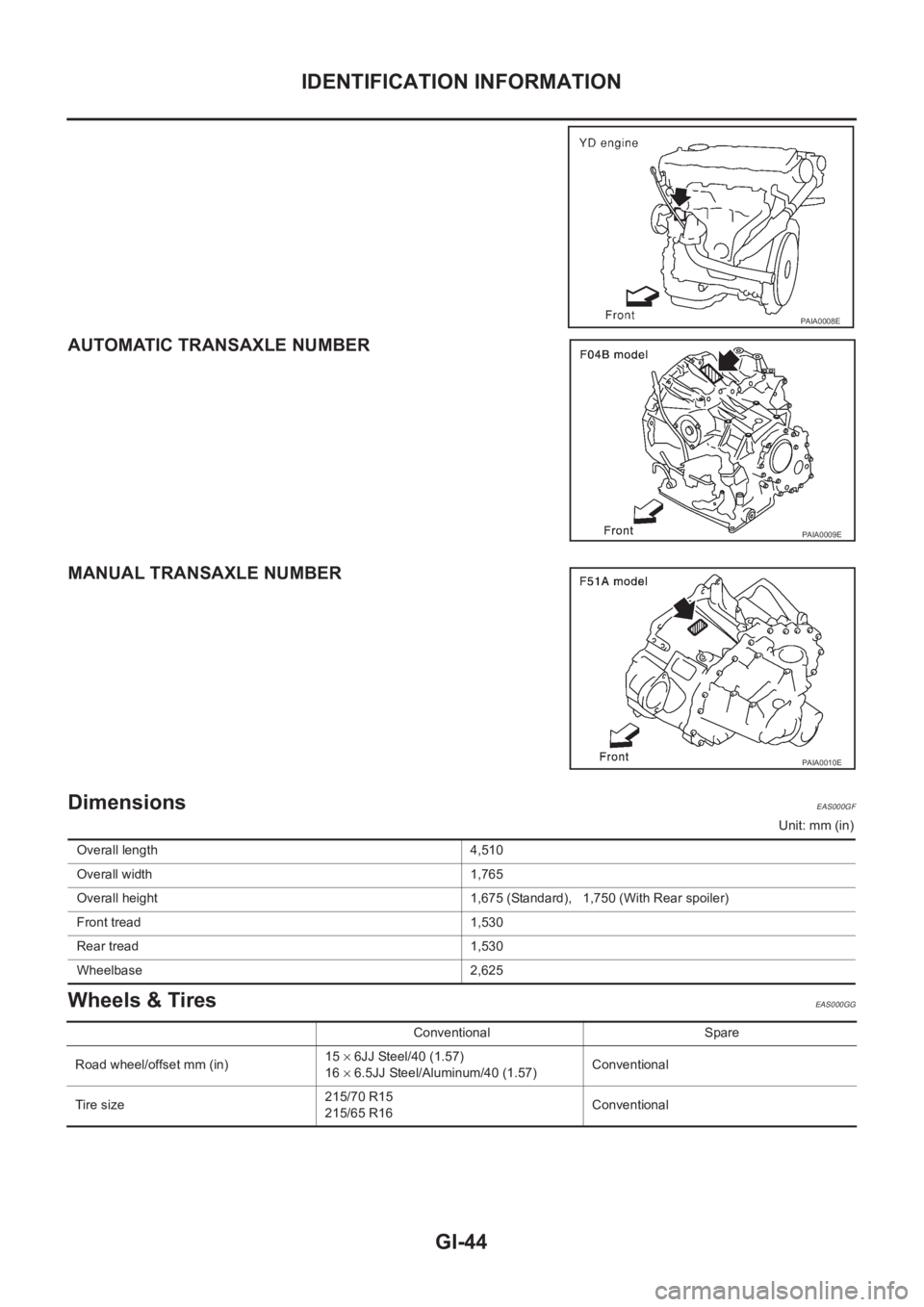
AUTOMATIC TRANSAXLE NUMBER
MANUAL TRANSAXLE NUMBER
Dimensions EAS000GF
Unit: mm (in)
Wheels & Tires EAS000GG
PAIA0008E
PAIA0009E
PAIA0010E
Overall length 4,510
Overall width 1,765
Overall height 1,675 (Standard), 1,750 (With Rear spoiler)
Front tread 1,530
Rear tread 1,530
Wheelbase 2,625
Conventional Spare
Road wheel/offset mm (in)15 × 6JJ Steel/40 (1.57)
16 × 6.5JJ Steel/Aluminum/40 (1.57)Conventional
Tir e s iz e215/70 R15
215/65 R16Conventional
Page 114 of 3833
![NISSAN X-TRAIL 2001 Service Repair Manual EM-64
[QR]
CYLINDER HEAD
5. Install valve spring.
●Install smaller pitch (valve spring seat side) to cylinder head
side.
●Confirm identification color of valve spring.
6. Install valve sp](/img/5/57405/w960_57405-113.png "NISSAN X-TRAIL 2001 Service Repair Manual EM-64
[QR]
CYLINDER HEAD
5. Install valve spring.
●Install smaller pitch (valve spring seat side) to cylinder head
side.
●Confirm identification color of valve spring.
6. Install valve sp")
EM-64
[QR]
CYLINDER HEAD
5. Install valve spring.
●Install smaller pitch (valve spring seat side) to cylinder head
side.
●Confirm identification color of valve spring.
6. Install valve spring retainer.
7. Install valve collet.
●Compress valve spring with valve spring compressor. Install
valve collet with magnet hand.
●Tap stem edge lightly with plastic hammer after installation to check its installed condition.
8. Install valve lifter.
9. Install spark plug tube.
●Press fit it into cylinder head as follows.
a. Remove old liquid gasket from cylinder head side mounting
hole.
b. Apply liquid gasket all round on spark plug tube with a 12 mm
(0.47 in) width from edge of spark plug tube on the press fit side.
Use Genuine Liquid gasket or equivalent.
c. Using a drift (commercial service tool), press fit spark plug tube
so that height is as same as H shown in figure.
CAUTION:
●When press fitting be careful not to deform spark plug tube.
●After press fitting, wipe off any protruding liquid gasket on top surface of cylinder head.
10. Install spark plug with spark plug wrench.
Inspection After DisassemblyEBS00KNS
CYLINDER HEAD DISTORTION
1. Wipe off engine oil and remove water scale (like deposit), gas-
ket, sealer, carbon, etc with scraper.
CAUTION:
Use utmost care not to allow gasket debris to enter pas-
sages for engine oil or water.
2. At each of several locations on bottom surface of cylinder head,
measure distortion in six directions.
VALVE DIMENSIONS
Check dimensions of each valve. For dimensions, refer to SDS, EM-
99, "Valve Dimensions" . Intake : Blue
Exhaust : Yellow
Press fit height “H” standard value:
38.55 - 38.65 mm (1.518 - 1.522 in)
PBIC0525E
SBIA0252E
Standard: 0.1mm (0.004 in)
PBIC0075E
SEM188A
Page 145 of 3833
![NISSAN X-TRAIL 2001 Service Repair Manual CYLINDER BLOCK
EM-95
[QR]
C
D
E
F
G
H
I
J
K
L
MA
EM
CRANKSHAFT RUNOUT
●Place a V-block on a precise flat table to support the journals on
the both end of the crankshaft.
●Place a dial gauge strai](/img/5/57405/w960_57405-144.png "NISSAN X-TRAIL 2001 Service Repair Manual CYLINDER BLOCK
EM-95
[QR]
C
D
E
F
G
H
I
J
K
L
MA
EM
CRANKSHAFT RUNOUT
●Place a V-block on a precise flat table to support the journals on
the both end of the crankshaft.
●Place a dial gauge strai")
CYLINDER BLOCK
EM-95
[QR]
C
D
E
F
G
H
I
J
K
L
MA
EM
CRANKSHAFT RUNOUT
●Place a V-block on a precise flat table to support the journals on
the both end of the crankshaft.
●Place a dial gauge straight up on the No. 3 journal.
●While rotating the crankshaft, read the movement of the pointer
on the dial gauge. (Total indicator reading)
CONNECTING ROD BEARING OIL CLEARANCE
Method of Measurement
●Install the connecting rod bearings to the connecting rod and the
cap, and tighten the connecting rod bolts to the specified torque.
Using a inside micrometer measure the inner diameter of con-
necting rod bearing.
(Oil clearance) = (Inner diameter of connecting rod bearing) –
(Outer diameter of crankshaft pin)
●If out of specifications, check connecting rod big end inner diam-
eter and crankshaft pin outer diameter, and select appropriate
connecting rod bearing to adjust clearance to specifications.
Refer to EM-83, "
HOW TO SELECT CONNECTING ROD BEARING" .
Method of Using Plastigage
●Remove engine oil and dust on the crankshaft pin and the sur-
faces of each bearing completely.
●Cut a plastigage slightly shorter than the bearing width, and
place it in crankshaft axial direction, avoiding oil holes.
●Install the connecting rod bearings to the connecting rod cap,
and tighten the connecting rod bolts to the specified torque.
CAUTION:
Never rotate the crankshaft.
●Remove the connecting rod cap and bearings, and using the
scale on the plastigage bag, measure the plastigage width.
NOTE:
The procedure when the measured value exceeds the limit is same as that described in “Method of Mea-
surement”.
MAIN BEARING OIL CLEARANCE
Method of Measurement
●Install the main bearings to the cylinder block and bearing cap. Measure the main bearing inner diameter
with the bearing cap bolt tightened to the specified torque.
(Oil clearance) = (Inner diameter of main bearing) – (Outer diameter of crankshaft journal)
●If out of specification, check main bearing housing inner diameter and crankshaft journal outer diameter,
and select appropriate main bearing to adjust clearance to specifications. Refer to EM-85, "
HOW TO
SELECT MAIN BEARING" . Limit: Less than 0.05 mm (0.002 in)
PBIC0271E
Standard : 0.028 - 0.045 mm (0.0011 - 0.0018 in)
Limit : 0.10 mm (0.0039 in)
PBIC0119E
EM142
Standard
No. 1, 3 and 5 journals : 0.012 - 0.022 mm (0.0005 - 0.0009 in)
No. 2 and 4 journals : 0.018 - 0.028 mm (0.0007 - 0.0011 in)
Limit : 0.1 mm (0.004 in)
Page 146 of 3833
![NISSAN X-TRAIL 2001 Service Repair Manual EM-96
[QR]
CYLINDER BLOCK
Method of Using Plastigage
●Remove engine oil and dust on the crankshaft journal and the
surfaces of each bearing completely.
●Cut a plastigage slightly sh](/img/5/57405/w960_57405-145.png "NISSAN X-TRAIL 2001 Service Repair Manual EM-96
[QR]
CYLINDER BLOCK
Method of Using Plastigage
●Remove engine oil and dust on the crankshaft journal and the
surfaces of each bearing completely.
●Cut a plastigage slightly sh")
EM-96
[QR]
CYLINDER BLOCK
Method of Using Plastigage
●Remove engine oil and dust on the crankshaft journal and the
surfaces of each bearing completely.
●Cut a plastigage slightly shorter than the bearing width, and
place it in crankshaft axial direction, avoiding oil holes.
●Tighten the main bearing bolts to the specified torque.
CAUTION:
Never rotate the crankshaft.
●Remove the bearing cap and bearings, and using the scale on
the plastigage bag, measure the plastigage width.
NOTE:
The procedure when the measured value exceeds the limit is
same as that described in “Method of Measurement”.
MAIN BEARING CRUSH HEIGHT
●When the bearing cap is removed after being tightened to the
specified torque with main bearings installed, the tip end of bear-
ing must protrude.
●If the standard is not met, replace main bearings.
OUTER DIAMETER OF LOWER CYLINDER BLOCK MOUNTING BOLT
●Perform only with M10 (0.39 in) bolts.
●Measure outer diameters (d1, d2) at two positions shown in the figure.
●Measure d2 at a point within block A.
●When the value of d1- d2 exceeds the limit (a large difference in
dimensions), replace the bolt with a new one.
OUTER DIAMETER OF CONNECTING ROD BOLT
●Measure outer diameter (d) at position shown in the figure.
●When “d ” exceeds the limit (when it becomes thinner), replace
the bolt with a new one.
EM142
Standard: There must be crush height.
SEM502G
Limit: 0.13 mm (0.0051 in) or more.
SBIA0285E
Limit: 7.75 mm (0.3051 in) or less.
SBIA0286E
Page 266 of 3833
![NISSAN X-TRAIL 2001 Service Repair Manual EM-216
[YD22DDTi]
CYLINDER BLOCK
CRANKSHAFT RUNOUT
●Place V-block onto surface plate to support journals at both ends
of crankshaft.
●Position dial indicator vertically onto No. 3 journal.
●Rota](/img/5/57405/w960_57405-265.png "NISSAN X-TRAIL 2001 Service Repair Manual EM-216
[YD22DDTi]
CYLINDER BLOCK
CRANKSHAFT RUNOUT
●Place V-block onto surface plate to support journals at both ends
of crankshaft.
●Position dial indicator vertically onto No. 3 journal.
●Rota")
EM-216
[YD22DDTi]
CYLINDER BLOCK
CRANKSHAFT RUNOUT
●Place V-block onto surface plate to support journals at both ends
of crankshaft.
●Position dial indicator vertically onto No. 3 journal.
●Rotate crankshaft to read needle movement on dial indicator.
(Total indicator reading)
CONNECTING ROD BEARING OIL CLEARANCE
Method by Measurement
●Install connecting rod bearings to connecting rod and cap, and
tighten connecting nuts to the specified torque. Use inside
micrometer to measure connecting rod bearing inner diameter.
(Bearing clearance) = (Connecting rod bearing inner diameter) −
(Crankshaft pin outer diameter)
●If out of specifications, check connecting rod big end inner diam-
eter and crankshaft pin outer diameter, and select appropriate
connecting rod bearing to adjust clearance to specifications.
Refer to EM-207, "
HOW TO SELECT CONNECTING ROD
BEARING" .
Method Using Plastigage
●Remove contamination such as engine oil, dust completely from
crankshaft pins and each bearing surface.
●Cut plastigage slightly shorter than bearing width, place it in
crankshaft direction, avoiding oil holes.
●Install connecting rod bearings to caps, and tighten connecting
rod nuts to the specified torque.
CAUTION:
Never rotate crankshaft.
●Remove connecting rod caps and bearings, and measure plasti-
gage width using scale on plastigage bag.
CAUTION:
If out of specification, take same action mentioned in “Method by Measurement”.
MAIN BEARING OIL CLEARANCE
Method by Measurement
●Install main bearings to the cylinder block and bearing cap, and tighten the bolts to the specified torque.
Then, measure the inner diameter of the main bearings.
(Bearing clearance) = (Bearing inner diameter) − (Crankshaft journal outer diameter)
●If out of specification, check main bearing housing inner diameter and crankshaft journal outer diameter,
and select appropriate main bearing to adjust clearance to specifications. Refer to EM-208, "
HOW TO
SELECT MAIN BEARING" . Standard : 0.05 mm (0.0020 in)
Limit : 0.10 mm (0.0039 in)
FEM116
Standard : 0.031 - 0.061 mm (0.0012 - 0.0024 in)
PBIC0119E
EM142
Standard : 0.039 - 0.066 mm (0.0015 - 0.0026 in)
Page 267 of 3833
![NISSAN X-TRAIL 2001 Service Repair Manual CYLINDER BLOCK
EM-217
[YD22DDTi]
C
D
E
F
G
H
I
J
K
L
MA
EM
Method Using Plastigage
●Remove contamination such as engine oil and dust completely
from crankshaft journals and each bearing surf](/img/5/57405/w960_57405-266.png "NISSAN X-TRAIL 2001 Service Repair Manual CYLINDER BLOCK
EM-217
[YD22DDTi]
C
D
E
F
G
H
I
J
K
L
MA
EM
Method Using Plastigage
●Remove contamination such as engine oil and dust completely
from crankshaft journals and each bearing surf")
CYLINDER BLOCK
EM-217
[YD22DDTi]
C
D
E
F
G
H
I
J
K
L
MA
EM
Method Using Plastigage
●Remove contamination such as engine oil and dust completely
from crankshaft journals and each bearing surface.
●Cut plastigage slightly shorter than bearing width. Place it in
crankshaft turning direction, avoiding oil holes.
●Install main bearings and bearing cap and tighten to the speci-
fied torque.
CAUTION:
Never rotate crankshaft.
●Remove main bearings and bearing caps, and measure plasti-
gage width using scale on plastigage bag.
CAUTION:
If out of specification, take same action mentioned in “Method by Measurement”.
MAIN BEARING CRUSH HEIGHT
●When the bearing cap is removed after being tightened to the
specified torque with main bearings installed, the tip end of bear-
ing must protrude.
●If out of specification, replace main bearings.
MAIN BEARING CAP BOLT DEFORMATION
●Measure the outer diameter of threaded area, d1 and d2, at the
points specified in the figure.
●When the necked point is identified at a point other than where
specified, measure at the point as d2.
●Calculate the difference between d1 and d2.
CONNECTING ROD BOLT DEFORMATION
●Install nuts to connecting rod bolts. Check that the nut can be
screwed smoothly on bolt threads by hand to the last thread on
the bolt.
●If the nut does not screw in smoothly, measure the outer diame-
ter of the bolt thread at the point specified in the figure.
●If a necked point is identified, measure at that point.
●If the measurement exceeds the limit, replace connecting rod
bolts and nuts.
EM142
Standard : Crush height must exist.
SEM502G
Limit : 0.13 mm (0.0051 in)
JEM219G
Standard : 8.90 - 9.00 mm (0.3504 - 0.3543 in) dia.
Limit : 8.75 mm (0. 3445 in) dia.
JEM220G
Page 278 of 3833
![NISSAN X-TRAIL 2001 Service Repair Manual EM-228
[YD22DDTi]
SERVICE DATA AND SPECIFICATIONS (SDS)
AVAILABLE MAIN BEARING
Main bearing
Unit: mm (in)
Under size
Unit: mm (in)
AVAILABLE CONNECTING ROD BEARING
Connecting Rod Bearing
Unit: mm (in](/img/5/57405/w960_57405-277.png "NISSAN X-TRAIL 2001 Service Repair Manual EM-228
[YD22DDTi]
SERVICE DATA AND SPECIFICATIONS (SDS)
AVAILABLE MAIN BEARING
Main bearing
Unit: mm (in)
Under size
Unit: mm (in)
AVAILABLE CONNECTING ROD BEARING
Connecting Rod Bearing
Unit: mm (in")
EM-228
[YD22DDTi]
SERVICE DATA AND SPECIFICATIONS (SDS)
AVAILABLE MAIN BEARING
Main bearing
Unit: mm (in)
Under size
Unit: mm (in)
AVAILABLE CONNECTING ROD BEARING
Connecting Rod Bearing
Unit: mm (in)
Under size
Unit: mm (in)
MISCELLANEOUS COMPONENTS
Flywheel
Unit: mm (in)
*: Total indicator reading Grade number Thickness “T” Width “W” Identification color
0 1.816 - 1.820 (0.0715 - 0.0717)
19.9 - 20.1 (0.783 - 0.791)Black
1 1.820 - 1.824 (0.0717 - 0.0718) Brown
2 1.824 - 1.828 (0.0718 - 0.0720) Green
3 1.828 - 1.832 (0.0720 - 0.0721) Yellow
4 1.832 - 1.836 (0.0721 - 0.0723) Blue
SEM255G
Size Thickness Main journal diameter “Dm”
0.25 (0.0098) 1.949 - 1.953 (0.0767 - 0.0769)Grind so that bearing clearance is the
specified value.
Grade number Thickness “T” Width “W” Identification color (mark)
0 1.492 - 1.496 (0.0587 - 0.0589)
22.9 - 23.1
(0.902 - 0.909)Black
1 1.496 - 1.500 (0.0589 - 0.0591) Brown
2 1.500 - 1.504 (0.0591 - 0.0592) Green
Size Thickness Crank pin journal diameter “Dp”
0.08 (0.0031) 1.536 - 1.540 (0.0605 - 0.0606)
Grind so that bearing clearance is the
specified value. 0.12 (0.0047) 1.556 - 1.560 (0.0613 - 0.0614)
0.25 (0.0098) 1.621 - 1.625 (0.0638 - 0.0640)
Flywheel runout [TIR]*Standard 0.45 (0.0177) or less
Limit 1.3 (0.051) or less
Page 300 of 3833
![NISSAN X-TRAIL 2001 Service Repair Manual LU-20
[YD22DDTi]
OIL FILTER
OIL FILTER
PFP:15208
Removal and InstallationEBS00B05
REMOVAL
CAUTION:
●Be careful not to get burned when the engine and engine oil
are hot.
●When removing, prepare a s](/img/5/57405/w960_57405-299.png "NISSAN X-TRAIL 2001 Service Repair Manual LU-20
[YD22DDTi]
OIL FILTER
OIL FILTER
PFP:15208
Removal and InstallationEBS00B05
REMOVAL
CAUTION:
●Be careful not to get burned when the engine and engine oil
are hot.
●When removing, prepare a s")
LU-20
[YD22DDTi]
OIL FILTER
OIL FILTER
PFP:15208
Removal and InstallationEBS00B05
REMOVAL
CAUTION:
●Be careful not to get burned when the engine and engine oil
are hot.
●When removing, prepare a shop cloth to absorb any engine
oil leakage or spillage.
●Do not allow engine oil to adhere to the drive belts.
●Completely wipe off any engine oil that adhere to the engine
and the vehicle.
1. Using a socket wrench [plane-to-plane width: 17 mm (0.67 in)],
loosen the filter body approximately four turns.
2. Drain the engine oil after matching the "DRAIN" arrow mark at
the bottom of the filter body to the protrusion on the oil filter
bracket.
●Catch the engine oil with a pan or cloth.
CAUTION:
●The drained engine oil flows over the right surface of
the filter body.
●Completely wipe clean any engine oil remaining on the
filter body or vehicle.
3. Remove the filter body, then remove the oil filter.
PBIC1248E
JLC290B
JLC291B
Page 384 of 3833
![NISSAN X-TRAIL 2001 Service Repair Manual EC-34
[QR25(WITH EURO-OBD)]
ENGINE CONTROL SYSTEM
by input signals (for engine speed and intake air) from both the crankshaft position sensor and the mass air
flow sensor.
VARIOUS FUEL INJ](/img/5/57405/w960_57405-383.png "NISSAN X-TRAIL 2001 Service Repair Manual EC-34
[QR25(WITH EURO-OBD)]
ENGINE CONTROL SYSTEM
by input signals (for engine speed and intake air) from both the crankshaft position sensor and the mass air
flow sensor.
VARIOUS FUEL INJ")
EC-34
[QR25(WITH EURO-OBD)]
ENGINE CONTROL SYSTEM
by input signals (for engine speed and intake air) from both the crankshaft position sensor and the mass air
flow sensor.
VARIOUS FUEL INJECTION INCREASE/DECREASE COMPENSATION
In addition, the amount of fuel injected is compensated to improve engine performance under various operat-
ing conditions as listed below.
●During warm-up
●When starting the engine
●During acceleration
●Hot-engine operation
●When selector lever is changed from “N” to “D”
●High-load, high-speed operation
●During deceleration
●During high engine speed operation
MIXTURE RATIO FEEDBACK CONTROL (CLOSED LOOP CONTROL)
The mixture ratio feedback system provides the best air-fuel mixture ratio for driveability and emission control.
The three way catalyst (manifold) can then better reduce CO, HC and NOx emissions. This system uses
heated oxygen sensor 1 in the exhaust manifold to monitor if the engine operation is rich or lean. The ECM
adjusts the injection pulse width according to the sensor voltage signal. For more information about heated
oxygen sensor 1, refer to EC-163
. This maintains the mixture ratio within the range of stoichiometric (ideal air-
fuel mixture).
This stage is referred to as the closed loop control condition.
Heated oxygen sensor 2 is located downstream of the three way catalyst (manifold). Even if the switching
characteristics of heated oxygen sensor 1 shift, the air-fuel ratio is controlled to stoichiometric by the signal
from heated oxygen sensor 2.
Open Loop Control
The open loop system condition refers to when the ECM detects any of the following conditions. Feedback
control stops in order to maintain stabilized fuel combustion.
●Deceleration and acceleration
●High-load, high-speed operation
●Malfunction of heated oxygen sensor 1 or its circuit
●Insufficient activation of heated oxygen sensor 1 at low engine coolant temperature
●High engine coolant temperature
●During warm-up
●After shifting from “N” to “D”
●When starting the engine
MIXTURE RATIO SELF-LEARNING CONTROL
The mixture ratio feedback control system monitors the mixture ratio signal transmitted from heated oxygen
sensor 1. This feedback signal is then sent to the ECM. The ECM controls the basic mixture ratio as close to
the theoretical mixture ratio as possible. However, the basic mixture ratio is not necessarily controlled as orig-
PBIB0121E
Page 385 of 3833
![NISSAN X-TRAIL 2001 Service Repair Manual ENGINE CONTROL SYSTEM
EC-35
[QR25(WITH EURO-OBD)]
C
D
E
F
G
H
I
J
K
L
MA
EC
inally designed. Both manufacturing differences (i.e., mass air flow sensor hot film) and characteristic changes
during oper](/img/5/57405/w960_57405-384.png "NISSAN X-TRAIL 2001 Service Repair Manual ENGINE CONTROL SYSTEM
EC-35
[QR25(WITH EURO-OBD)]
C
D
E
F
G
H
I
J
K
L
MA
EC
inally designed. Both manufacturing differences (i.e., mass air flow sensor hot film) and characteristic changes
during oper")
ENGINE CONTROL SYSTEM
EC-35
[QR25(WITH EURO-OBD)]
C
D
E
F
G
H
I
J
K
L
MA
EC
inally designed. Both manufacturing differences (i.e., mass air flow sensor hot film) and characteristic changes
during operation (i.e., injector clogging) directly affect mixture ratio.
Accordingly, the difference between the basic and theoretical mixture ratios is monitored in this system. This is
then computed in terms of “injection pulse duration” to automatically compensate for the difference between
the two ratios.
“Fuel trim” refers to the feedback compensation value compared against the basic injection duration. Fuel trim
includes short term fuel trim and long term fuel trim.
“Short term fuel trim” is the short-term fuel compensation used to maintain the mixture ratio at its theoretical
value. The signal from heated oxygen sensor 1 indicates whether the mixture ratio is RICH or LEAN compared
to the theoretical value. The signal then triggers a reduction in fuel volume if the mixture ratio is rich, and an
increase in fuel volume if it is lean.
“Long term fuel trim” is overall fuel compensation carried out long-term to compensate for continual deviation
of the short term fuel trim from the central value. Such deviation will occur due to individual engine differences,
wear over time and changes in the usage environment.
FUEL INJECTION TIMING
Two types of systems are used.
Sequential Multiport Fuel Injection System
Fuel is injected into each cylinder during each engine cycle according to the firing order. This system is used
when the engine is running.
Simultaneous Multiport Fuel Injection System
Fuel is injected simultaneously into all four cylinders twice each engine cycle. In other words, pulse signals of
the same width are simultaneously transmitted from the ECM.
The four injectors will then receive the signals two times for each engine cycle.
This system is used when the engine is being started and/or if the fail-safe system (CPU) is operating.
FUEL SHUT-OFF
Fuel to each cylinder is cut off during deceleration or operation of the engine at excessively high speeds.
Electronic Ignition (EI) SystemEBS00M0D
INPUT/OUTPUT SIGNAL CHART
SEF337W
Sensor Input Signal to ECMECM func-
tionActuator
Crankshaft position sensor (POS)
Engine speed
Piston position
Ignition
timing con-
trolPower transistor Camshaft position sensor (PHASE)
Mass air flow sensor Amount of intake air
Engine coolant temperature sensor Engine coolant temperature
Throttle position sensor Throttle position
Accelerator pedal position sensor Accelerator pedal position
Ignition switch Start signal
Knock sensor Engine knocking
Park/neutral position (PNP) switch Gear position
Battery Battery voltage
Wheel sensor Vehicle speed