light NISSAN X-TRAIL 2003 Electronic Workshop Manual
[x] Cancel search | Manufacturer: NISSAN, Model Year: 2003, Model line: X-TRAIL, Model: NISSAN X-TRAIL 2003Pages: 3066, PDF Size: 51.47 MB
Page 925 of 3066
![NISSAN X-TRAIL 2003 Electronic Workshop Manual GENERAL INFORMATION
BRC-57
[ESP/TCS/ABS]
C
D
E
G
H
I
J
K
L
MA
B
BRC
lWhen starting the engine, or just after starting the vehicle, the brake pedal may vibrate or the
motor operating noise may be heard](/img/5/57402/w960_57402-924.png "NISSAN X-TRAIL 2003 Electronic Workshop Manual GENERAL INFORMATION
BRC-57
[ESP/TCS/ABS]
C
D
E
G
H
I
J
K
L
MA
B
BRC
lWhen starting the engine, or just after starting the vehicle, the brake pedal may vibrate or the
motor operating noise may be heard")
GENERAL INFORMATION
BRC-57
[ESP/TCS/ABS]
C
D
E
G
H
I
J
K
L
MA
B
BRC
lWhen starting the engine, or just after starting the vehicle, the brake pedal may vibrate or the
motor operating noise may be heard from the engine compartment. This is a normal status of the
operation check.
lThe stopping distance may be longer than that of vehicles without ABS when the vehicle drives on
rough, gravel, or snowy (fresh deep snow) road.
TCS FunctionsEFS0019V
1. With the wheel speed sensor signals from 4 wheels, the ESP/TCS/ABS control unit detects a wheel spin.
If a wheel spins, the control unit controls brake fluid pressure to the spinning wheel, and cuts the fuel to
the engine. It also closes the throttle valve to reduce the engine torque. Furthermore, throttle position is
controlled to the appropriate engine torque.
2. If a wheel spins, the TCS system works same as LSD (Limited Slip Differential) function applying brake
fluid pressure to the spinning wheel.
3. During TCS operation, it informs a driver of system operation by flashing SLIP indicator lamp.
CAUTION:
lDuring TCS operation, the body and the brake pedal lightly vibrate and the mechanical noise may
be heard. This is a normal condition.
lDepending on road circumstances, the driver may have a sluggish feel. This is not abnormal,
because the optimum traction has the highest priority by TCS operation.
lWhen the vehicle is passing through a road where the surface friction coefficient varies, down-
shifting or depressing the accelerator pedal fully may activate TCS temporarily.
ESP FunctionsEFS0019W
1. The Electronic Stability Program is called the ESP for short.
The ESP is indicated as the VDC (the Vehicle Dynamics Control) on the CONSULT-II screen.
2. In addition to the ABS/TCS function, ESP detects the driver's steering operation amount and brake opera-
tion amount from the steering angle sensor and pressure sensor. Using the information from the yaw rate/
side G sensor and wheel speed sensors, ESP judges the driving condition (conditions of understeer and
oversteer) to improve the stability by controlling the brake on 4 wheels and engine output.
3. During ESP operation, the SLIP indicator lamp flashes to inform the driver of the operation.
CAUTION:
lDuring ESP operation, the body and the brake pedal lightly vibrate and their mechanical noise
may be heard. This is a normal condition.
lIf the vehicle is rotated on a turn table, or rolled and rocked on a ship, the ABS warning lamp,
ESP OFF indicator lamp, and SLIP indicator lamp may turn ON. In this case, start the engine on a
normal road again. If the ABS warning lamp, ESP OFF indicator lamp, and SLIP indicator lamp
turn OFF after the restart, it is normal.
lWhen driving in a steep slope such as a bank, the ABS warning lamp, ESP OFF indicator lamp,
and SLIP indicator lamp may turn ON. In this case, start the engine on a normal road again. If the
ABS warning lamp, ESP OFF indicator lamp, and SLIP indicator lamp turn OFF after the restart, it
is normal.
Page 956 of 3066
![NISSAN X-TRAIL 2003 Electronic Workshop Manual BRC-88
[ESP/TCS/ABS]
TROUBLE DIAGNOSIS
For Correct and Quick Diagnosis
EFS001A8
PRECAUTIONS FOR TROUBLE DIAGNOSIS
lBefore performing the trouble diagnosis, always read theGI-3, "PRECAUTIONS"to confirm](/img/5/57402/w960_57402-955.png "NISSAN X-TRAIL 2003 Electronic Workshop Manual BRC-88
[ESP/TCS/ABS]
TROUBLE DIAGNOSIS
For Correct and Quick Diagnosis
EFS001A8
PRECAUTIONS FOR TROUBLE DIAGNOSIS
lBefore performing the trouble diagnosis, always read theGI-3, \"PRECAUTIONS\"to confirm")
BRC-88
[ESP/TCS/ABS]
TROUBLE DIAGNOSIS
For Correct and Quick Diagnosis
EFS001A8
PRECAUTIONS FOR TROUBLE DIAGNOSIS
lBefore performing the trouble diagnosis, always read theGI-3, "PRECAUTIONS"to confirm the general
precautions.
lAfter replacement of ESP/TCS/ABS control unit, steering angle sensor, steering parts, suspension parts,
or tires, and adjustment of alignment, always adjust the neutral position of steering angle sensor before
driving.
lWhen the ESP/TCS/ABS control unit is replaced, check that the label on the computer unit is identical
color.
lAfter completing the trouble diagnosis, always erase the malfunctioning memory.BRC-77, "Functions of
CONSULT-II"
lWhen inspection of the continuity or voltage between units is performed, check the connector terminals for
disconnection, looseness, bend, or collapse. If any malfunction is detected, repair or replace the applica-
ble part.
lIntermittent problems may be caused by a malfunction on harness, connector, or terminal. Move the har-
nesses, harness connectors, or terminals by hand to make sure that there is no contact malfunction.
lIf a circuit tester is used for the check, be careful not to forcibly extend any connector terminal.
lFor self-diagnosis, active test, and work support of ESP/TCS/ABS control unit with CONSULT-II, stop and
connect CONSULT-II and select²ABS².
lCONSULT-II self-diagnosis results are displayed without regard to occurrence timing. In some case, the
later ones (timing value is small) appear on the next screen.
lWhile the self-diagnosis results of CONSULT-II shows a malfunction, if CONSULT-II active test is per-
formed, an engine system malfunction may be indicated. In this case, start the engine to resume the nor-
mal screen.
lESP/TCS/ABS system electronically controls the brake operation and engine output. The following symp-
toms may be caused by the normal operations.
Symptom Symptom description Result
Motor operation noiseDuring ESP, TCS, or ABS operation, sometimes a faint noise can be
heard. This is a motor operation noise in the ESP/TCS/ABS actuator.
Normal
Just after the engine starts, the motor operating noise may be heard.
This is a normal status of the system operation check.
System operation check
noiseWhen the engine starts, a²click²noise may be heard from the engine
compartment. This is a normal status of the system operation check.Normal
ESP/TCS operation
(SLIP lamp ON)When the vehicle is passing through a road where the surface friction
coefficient varies or the wheel speed changes suddenly by downshifting
or depressing of the accelerator pedal fully, TCS may be activated tem-
porarily.
Normal
Cancel the ESP/TCS
function for the
inspection on a chas-
sis dynamometer. Before the speedometer inspection, turn ESP OFF switch off to cancel
the ESP/TCS function.
When the accelerator pedal is depressed on a chassis dynamometer,
the vehicle speed will not increase. This is not malfunction, because
TCS is activated by the wheel speed difference between front and rear.
The warning lamp may also illuminate to show²sensor system failure²in
this case. This is not malfunction either, because the stationary front
wheels are detected. Restart the engine, and drive the vehicle at 30 km/
h or higher to check that the warning lamp no longer illuminates.
ABS operation (Longer stop-
ping distance)The stopping distance may be longer for the vehicles with ABS when the
vehicle is driver on snowy and rough road. When driving on the road like
that, slow down the speed.Normal
Sluggish feelDepending on road circumstances, the driver may have a sluggish feel.
This is not abnormal, because the optimum traction has the highest pri-
ority (safety first) by TCS operation. Sometimes the driver has a slight
sluggish feel against the substantial accelerator pedal operation.Normal
Page 975 of 3066
![NISSAN X-TRAIL 2003 Electronic Workshop Manual TROUBLE DIAGNOSIS
BRC-107
[ESP/TCS/ABS]
C
D
E
G
H
I
J
K
L
MA
B
BRC
2.SELF-DIAGNOSIS RESULT CHECK 2
Turn the ignition switch OFF, and ON to erase the self-diagnosis results. And perform the ESP/TCS/ABS](/img/5/57402/w960_57402-974.png "NISSAN X-TRAIL 2003 Electronic Workshop Manual TROUBLE DIAGNOSIS
BRC-107
[ESP/TCS/ABS]
C
D
E
G
H
I
J
K
L
MA
B
BRC
2.SELF-DIAGNOSIS RESULT CHECK 2
Turn the ignition switch OFF, and ON to erase the self-diagnosis results. And perform the ESP/TCS/ABS")
TROUBLE DIAGNOSIS
BRC-107
[ESP/TCS/ABS]
C
D
E
G
H
I
J
K
L
MA
B
BRC
2.SELF-DIAGNOSIS RESULT CHECK 2
Turn the ignition switch OFF, and ON to erase the self-diagnosis results. And perform the ESP/TCS/ABS con-
trol unit self-diagnosis again.
Is the same self-diagnosis item indicated again?
YES >> After replacing the spiral cable (with the steering angle sensor), perform the neutral position
adjustment. Then conduct the self-diagnosis again.
NO >> Inspection End
Inspection 14 Brake Fluid Level of Reservoir Tank, Communication Circuit
between ESP/TCS/ABS Control Unit and Brake Fluid Level Warning Switch
EFS001AQ
Inspection procedure
1.SELF-DIAGNOSIS RESULT CHECK 1
Check the self-diagnosis results.
Does the brake warning light turn on?
YES >> Check the pad for wear. Check the brake fluid for leakage.
NO >> GO TO 2.
2.SELF-DIAGNOSIS RESULT CHECK 2
1. Disconnect connectors for the brake fluid level warning switch and the ESP/TCS/ABS control unit.
2. Securely connect connectors. Perform the ESP/TCS/ABS control unit self-diagnosis again.
Is the same self-diagnosis item indicated again?
YES >> Poor connection of connector. Repair or replace the poorly connected connector.
NO >> GO TO 3.
3.CIRCUIT CHECK BETWEEN BRAKE FLUID LEVEL WARNING SWITCH AND ESP/TCS/ABS CON-
TROL UNIT
1. Disconnect connectors for the brake fluid level warning switch
and the ESP/TCS/ABS control unit.
2. Check for continuity between the brake fluid level warning switch (vehicle-side connector) and the ESP/
TCS/ABS control unit (vehicle-side connector).
Is inspection result OK?
OK >> Perform the ESP/TCS/ABS control unit self-diagnosis again.
NG >> Repair or replace the disconnected harness.Self-diagnosis results
CONSULT-II indication item
BR FLUID LEVEL LOW
SFIA0388E
ESP/TCS/ABS control unit
(Vehicle-side connector)Brake fluid level warning switch
(Vehicle-side connector)Continuity
40 1 Yes
Page 980 of 3066
![NISSAN X-TRAIL 2003 Electronic Workshop Manual BRC-112
[ESP/TCS/ABS]
TROUBLE DIAGNOSIS
Actuator operation check
1. Connect 19 and 21 terminals of actuator to 40 and 41 terminals
of relay box.
2. Measure the motor voltage (No.4 terminal to body ear](/img/5/57402/w960_57402-979.png "NISSAN X-TRAIL 2003 Electronic Workshop Manual BRC-112
[ESP/TCS/ABS]
TROUBLE DIAGNOSIS
Actuator operation check
1. Connect 19 and 21 terminals of actuator to 40 and 41 terminals
of relay box.
2. Measure the motor voltage (No.4 terminal to body ear")
BRC-112
[ESP/TCS/ABS]
TROUBLE DIAGNOSIS
Actuator operation check
1. Connect 19 and 21 terminals of actuator to 40 and 41 terminals
of relay box.
2. Measure the motor voltage (No.4 terminal to body earth ) with
oscilloscope. Then check the motor reverse voltage occasioned
time.
The motor reverse voltage occasioned time is more than 0.1
sec.
CAUTION:
lPerform checking of motor relay unit .Then confirm that
relay functions.
lDriving actuator motor is with in 4 sec to prevent heating
up.
lStandard condition of the motor reverse voltage occa-
sioned time is: Battery voltage is 12V. temperature 20°.
when the battery voltage or temperature is lower than the
standard, the motor reverse voltage occasioned time
becomesslightlyshorter.
Symptom 1: ABS Works Frequently.EFS001AS
Inspection procedure
1.INSPECTION START
Check the wheel speed sensor system.
lSensor mounting inspection
lSensor pick-up inspection for iron chips
lSensor rotor inspection (e.g. number of teeth, damaged teeth)
lSensor connector engagement inspection
Is inspection result OK?
YES >> GO TO 2.
NO >> Refer to wheel speed sensor and rotor lines.
2.LOOSENESS INSPECTION
Check the front axle for looseness.
Is inspection result OK?
YES >>BRC-112, "Symptom 2: Unexpected Pedal Action"
NO >> Axle inspection and repair
Symptom 2: Unexpected Pedal ActionEFS001AT
Inspection procedure
1.BRAKE PEDAL STROKE INSPECTION
Check the brake pedal stroke.
Is stroke excessively long?
YES >> Check the bleeding and brake system.
NO >> GO TO 2.
SFIA0400E
Page 982 of 3066
![NISSAN X-TRAIL 2003 Electronic Workshop Manual BRC-114
[ESP/TCS/ABS]
TROUBLE DIAGNOSIS
4.WHEEL SPEED SENSOR INSPECTION
Check the wheel speed sensor system.
lSensor mounting inspection
lSensor pick-up inspection for iron chips
lSensor rotor inspect](/img/5/57402/w960_57402-981.png "NISSAN X-TRAIL 2003 Electronic Workshop Manual BRC-114
[ESP/TCS/ABS]
TROUBLE DIAGNOSIS
4.WHEEL SPEED SENSOR INSPECTION
Check the wheel speed sensor system.
lSensor mounting inspection
lSensor pick-up inspection for iron chips
lSensor rotor inspect")
BRC-114
[ESP/TCS/ABS]
TROUBLE DIAGNOSIS
4.WHEEL SPEED SENSOR INSPECTION
Check the wheel speed sensor system.
lSensor mounting inspection
lSensor pick-up inspection for iron chips
lSensor rotor inspection (e.g. Number of teeth, damaged teeth)
lSensor connector engagement inspection
Is inspection result OK?
YES >> Normal
NO >> Wheel speed sensor and rotor lines repair
Symptom 4: ABS Does Not Work.EF S0 01 AV
Inspection procedure
1.ABS WARNING LAMP INDICATOR INSPECTION
Check that the ABS warning lamp illuminates.
Does the ABS warning lamp illuminate?
YES >> Perform the self-diagnosis.
NO >> GO TO 2.
2.WHEEL SPEED SENSOR INSPECTION
Check the wheel speed sensor system.
lSensor mounting inspection
lSensor pick-up inspection for iron chips
lSensor rotor inspection (e.g. Number of teeth, damaged teeth)
lSensor connector engagement inspection
Is inspection result OK?
YES >> Normal
NO >> Wheel speed sensor and rotor lines repair
Symptom 5: Pedal Vibration and NoiseEFS001AW
Inspection procedure
1.SYMPTOM CHECK
Check the brake system for pedal vibration or noise at the engine start.
Is inspection result OK?
YES >> Perform the self-diagnosis.
NO >> GO TO 2.
2.SYMPTOM CHECK 2
Check the brake system for pedal vibration or noise when the pedal depressed lightly (just put a foot on).
CAUTION:
Under the following driving conditions, the wheel speed will fluctuates, resulting in ABS activation.
lWhen shifting gears
lHigh speed cornering
lWhenagustofwind
Is inspection result OK?
YES >> GO TO 3.
NO >> Normal
Page 998 of 3066
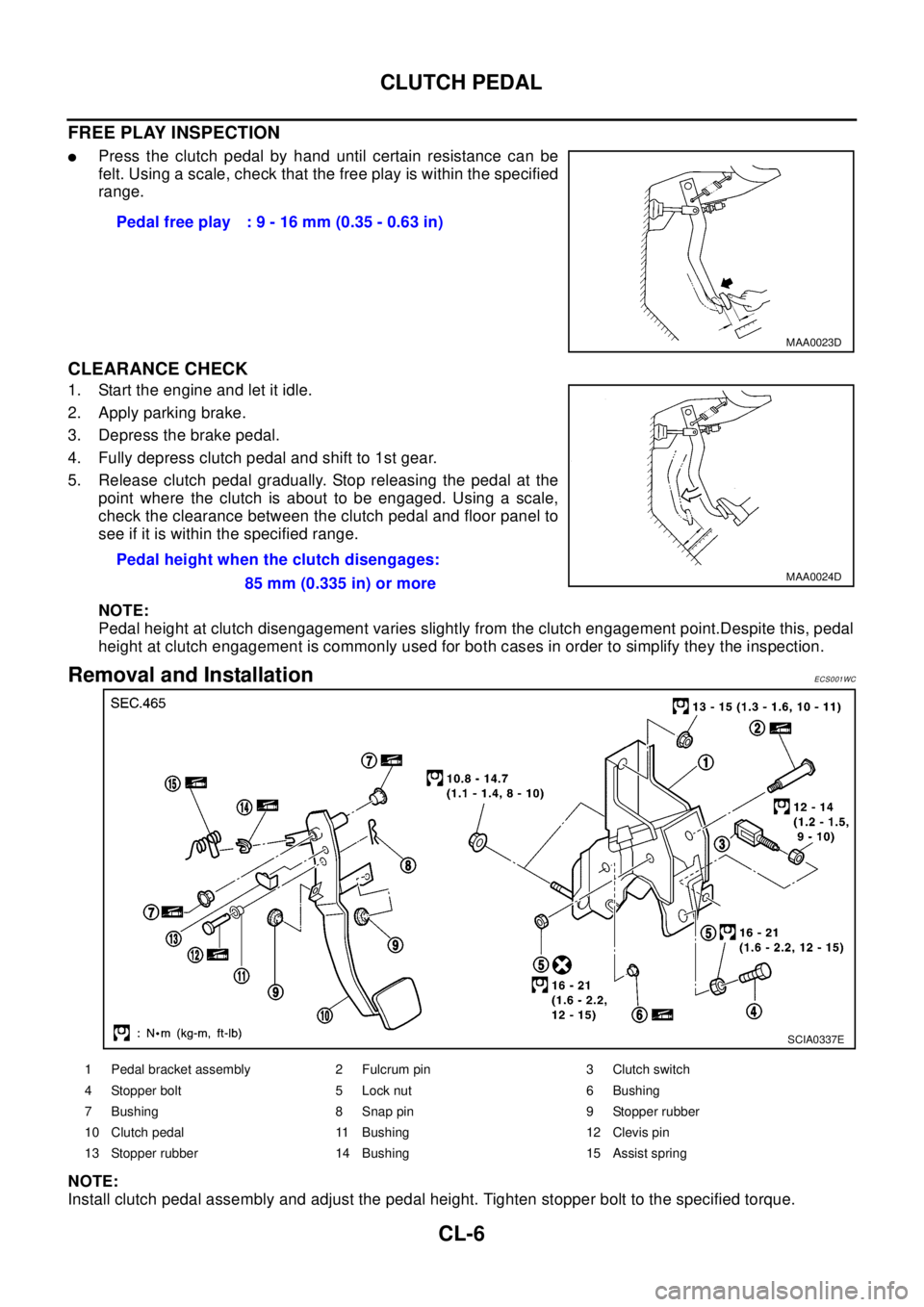
CL-6
CLUTCH PEDAL
FREE PLAY INSPECTION
lPress the clutch pedal by hand until certain resistance can be
felt. Using a scale, check that the free play is within the specified
range.
CLEARANCE CHECK
1. Start the engine and let it idle.
2. Apply parking brake.
3. Depress the brake pedal.
4. Fully depress clutch pedal and shift to 1st gear.
5. Release clutch pedal gradually. Stop releasing the pedal at the
point where the clutch is about to be engaged. Using a scale,
check the clearance between the clutch pedal and floor panel to
see if it is within the specified range.
NOTE:
Pedal height at clutch disengagement varies slightly from the clutch engagement point.Despite this, pedal
height at clutch engagement is commonly used for both cases in order to simplify they the inspection.
Removal and InstallationECS001WC
NOTE:
Install clutch pedal assembly and adjust the pedal height. Tighten stopper bolt to the specified torque.Pedalfreeplay :9-16mm(0.35-0.63in)
MAA0023D
Pedal height when the clutch disengages:
85 mm (0.335 in) or more
MAA0024D
SCIA0337E
1 Pedal bracket assembly 2 Fulcrum pin 3 Clutch switch
4 Stopper bolt 5 Lock nut 6 Bushing
7 Bushing 8 Snap pin 9 Stopper rubber
10 Clutch pedal 11 Bushing 12 Clevis pin
13 Stopper rubber 14 Bushing 15 Assist spring
Page 1013 of 3066
![NISSAN X-TRAIL 2003 Electronic Workshop Manual PRECAUTIONS
CO-3
[QR20DE]
C
D
E
F
G
H
I
J
K
L
MA
CO
[QR20DE]PRECAUTIONSPFP:00001
Precautions For Liquid GasketEBS009S9
REMOVAL OF LIQUID GASKET
lAfter removing the mounting bolts and nuts, disconnect](/img/5/57402/w960_57402-1012.png "NISSAN X-TRAIL 2003 Electronic Workshop Manual PRECAUTIONS
CO-3
[QR20DE]
C
D
E
F
G
H
I
J
K
L
MA
CO
[QR20DE]PRECAUTIONSPFP:00001
Precautions For Liquid GasketEBS009S9
REMOVAL OF LIQUID GASKET
lAfter removing the mounting bolts and nuts, disconnect")
PRECAUTIONS
CO-3
[QR20DE]
C
D
E
F
G
H
I
J
K
L
MA
CO
[QR20DE]PRECAUTIONSPFP:00001
Precautions For Liquid GasketEBS009S9
REMOVAL OF LIQUID GASKET
lAfter removing the mounting bolts and nuts, disconnect and
remove the liquid gasket using a seal cutter.
CAUTION:
Be careful not to damage the mating surfaces.
lIn areas where the cutter is difficult to use, use a plastic hammer
to lightly tap the gasket applied area.
CAUTION:
Ifforsomeunavoidablereasonatoolsuchasaflat-blade
screwdriver is used, be careful not to damage the mating sur-
faces.
LIQUID GASKET APPLICATION PROCEDURE
1. Using a scraper, remove the old liquid gasket adhering to the
gasket application surface and the mating surface.
lRemove the liquid gasket completely from the groove of the gas-
ket application surface, mounting bolts and bolt holes.
2. Wipe the gasket application surface and the mating surface with
white gasoline (lighting and heating use) to remove adhering
moisture, grease and foreign materials.
3. Attach the liquid gasket to the tube presser.
Use Genuine Liquid Gasket or equivalent.
4. Apply the gasket without breaks to the specified location with the
specified dimensions.
lIf there is a groove for the liquid gasket application, apply the
gasket to the groove.
lAs for the bolt holes, normally apply the gasket inside the holes.
Occasionally, it should be applied outside the holes. Make sure
to read the instruction in this manual.
lWithin five minutes of gasket application, install the mating com-
ponent.
lIf the liquid gasket protrudes, wipe it off immediately.
lDo not retighten after the installation.
lAfter 30 minutes or more have passed from the installation, fill
the engine oil and coolant.
CAUTION:
If there are instructions in this manual, observe them.
PBIC0275E
PBIC0003E
EMA0622D
SEM164F
Page 1034 of 3066
![NISSAN X-TRAIL 2003 Electronic Workshop Manual CO-24
[YD22DDTi]
PRECAUTIONS
[YD22DDTi]PRECAUTIONSPFP:00001
Precautions For Liquid GasketEBS00BAU
REMOVAL AND LIQUID GASKET
lAfter removing the mounting bolts and nuts, disconnect and
remove the liqui](/img/5/57402/w960_57402-1033.png "NISSAN X-TRAIL 2003 Electronic Workshop Manual CO-24
[YD22DDTi]
PRECAUTIONS
[YD22DDTi]PRECAUTIONSPFP:00001
Precautions For Liquid GasketEBS00BAU
REMOVAL AND LIQUID GASKET
lAfter removing the mounting bolts and nuts, disconnect and
remove the liqui")
CO-24
[YD22DDTi]
PRECAUTIONS
[YD22DDTi]PRECAUTIONSPFP:00001
Precautions For Liquid GasketEBS00BAU
REMOVAL AND LIQUID GASKET
lAfter removing the mounting bolts and nuts, disconnect and
remove the liquid gasket using a seal cutter.
CAUTION:
Be careful not to damage the mating surfaces.
lIn areas where the cutter is difficult to use, use a plastic hammer
to lightly tap the gasket applied area.
CAUTION:
If for some unavoidable reason a tool such as a flat-blade
screwdriver is used, be careful not to damage the mating sur-
faces.
LIQUID GASKET APPLICATION PROCEDURE
1. Using a scraper, remove the old liquid gasket adhering to the
gasket application surface and the mating surface.
lRemove the liquid gasket completely from the groove of the gas-
ket application surface, mounting bolts, and bolt holes.
2. Wipe the gasket application surface and the mating surface with
white gasoline (lighting and heating use) to remove adhering
moisture, grease and foreign materials.
3. Attach the liquid gasket to the tube presser.
Use Genuine Liquid Gasket or equivalent.
4. Apply the gasket without breaks to the specified location with the
specified dimensions.
lIf there is a groove for the liquid gasket application, apply the
gasket to the groove.
lAs for the bolt holes, normally apply the gasket inside the holes.
Occasionally, it should be applied outside the holes. Make sure
to read the service manual.
lWithin five minutes of gasket application, install the mating com-
ponent.
lIf the liquid gasket protrudes, wipe it off immediately.
lDo not retighten after the installation.
lAfter 30 minutes or more have passed from the installation, fill
the engine oil and coolant.
CAUTION:
If there are specific instructions in the service manual, observe
them.
PBIC0275E
PBIC0003E
EMA0622D
SEM164F
Page 1056 of 3066

DI-2
Engine Models) ....................................................... 31
Inspection/Vehicle speed signal ............................. 32
Inspection/Fuel Level Sensor Unit .......................... 33
FUEL LEVEL SENSOR UNIT .............................. 33
LOW-FUEL WARNING LAMP ............................. 33
The Fuel Gauge Pointer Fluctuates·Indicator
Wrong Value·or Varies. ........................................... 35
The Fuel Gauge Does Not Move to F-position. ...... 36
The Fuel Gauge Does Not Work. ........................... 36
Low Fuel Warning Lamp Illuminate or Not Illuminate... 37
Electrical Components Inspection .......................... 37
FUEL LEVEL SENSOR UNIT CHECK / GASO-
LINE ENGINE MODELS ...................................... 37
FUEL LEVEL SENSOR UNIT CHECK / DIESEL
ENGINE MODELS ............................................... 37
THERMAL TRANSMITTER CHECK ................... 38
Removal and Installation for Combination Meter .... 38
Disassembly and Assembly for Combination Meter... 38
WARNING LAMPS .................................................... 39
Schematic ............................................................... 39
Wiring Diagram — WARN —/ LHD Models ............ 40Wiring Diagram — WARN — / RHD Models ...........45
Electrical Components Inspection ...........................50
FUEL WARNING LAMP OPERATION CHECK ... 50
OIL PRESSURE SWITCH CHECK ......................50
DIODE CHECK ....................................................50
A/T INDICATOR .........................................................51
Wiring Diagram — AT/IND — .................................51
WARNING CHIME .....................................................52
System Description .................................................52
POWER SUPPLY AND GROUND CIRCUIT .......52
IGNITION KEY WARNING CHIME ......................52
LIGHT WARNING CHIME ...................................52
Component Parts and Harness Connector Location... 53
Wiring Diagram — CHIME — .................................54
Symptom Chart .......................................................56
Power Supply and Ground Circuit Check ...............56
Lighting Switch Input Signal Check .........................57
Key Switch Insert Signal Check ..............................57
Door Unlock Sensor Check .....................................58
Front Door Switch (driver side) Check ....................59
CLOCK ......................................................................60
Wiring Diagram — CLOCK — .................................60
Page 1106 of 3066

DI-52
WARNING CHIME
WARNING CHIME
PFP:24814
System DescriptionEKS002XF
POWER SUPPLY AND GROUND CIRCUIT
Power is supplied at all times
lthrough 10A fuse (No.31, located in fuse and fusible link box)
lto combination switch terminal 11,and
lto daytime light control unit terminal 1(with daytime light control unit).
lthrough 10A fuse [No.28, located in the fuse block (J/B)]
lto key switch terminal 1 and
lto time control unit terminal 1.
With ignition switch in ON or START position, power is supplied
lthrough 10A fuse [No.5, located in the fuse block (J/B)]
lto time control unit terminal 17.
Ground is supplied
lto time control unit terminal 16
lthrough body grounds M27 and M70.
When a signal, or combination of signals, is received by the time control unit, the warning chime will sound.
IGNITION KEY WARNING CHIME
With ignition switch in OFF or ACC position, and the driver's door open and driver’s door locked, the warning
chime will sound. Power is supplied
lthrough key switch terminal 2
lto time control unit terminal 18 and
Ground is supplied
lto time control unit terminal 28
lthrough unlock sensor terminal 5
Unlock sensor terminal 2 is grounded through body grounds M27 and M70, and
Ground is supplied
lto time control unit terminal 30
lthrough front door (driver side) switch terminal 2.
Front door switch (driver side) terminal 3 is grounded through body grounds B8 and B18.
LIGHT WARNING CHIME
With ignition switch OFF position, driver's door open, and lighting switch in 1ST or 2ND position, warning
chime will sound. Power is supplied
lfrom the lighting switch terminal 12 or daytime light control unit terminal 10 (with daytime light system)
lto time control unit terminal 19.
Ground is supplied
lfrom Front door switch (driver side) terminal 2
lto time control unit terminal 30.
Front door switch (driver side) terminal 3 is grounded through body grounds B8 and B18.