light NISSAN X-TRAIL 2003 Electronic Manual PDF
[x] Cancel search | Manufacturer: NISSAN, Model Year: 2003, Model line: X-TRAIL, Model: NISSAN X-TRAIL 2003Pages: 3066, PDF Size: 51.47 MB
Page 1110 of 3066
DI-56
WARNING CHIME
Symptom Chart
EKS002XQ
Power Supply and Ground Circuit CheckEKS002YF
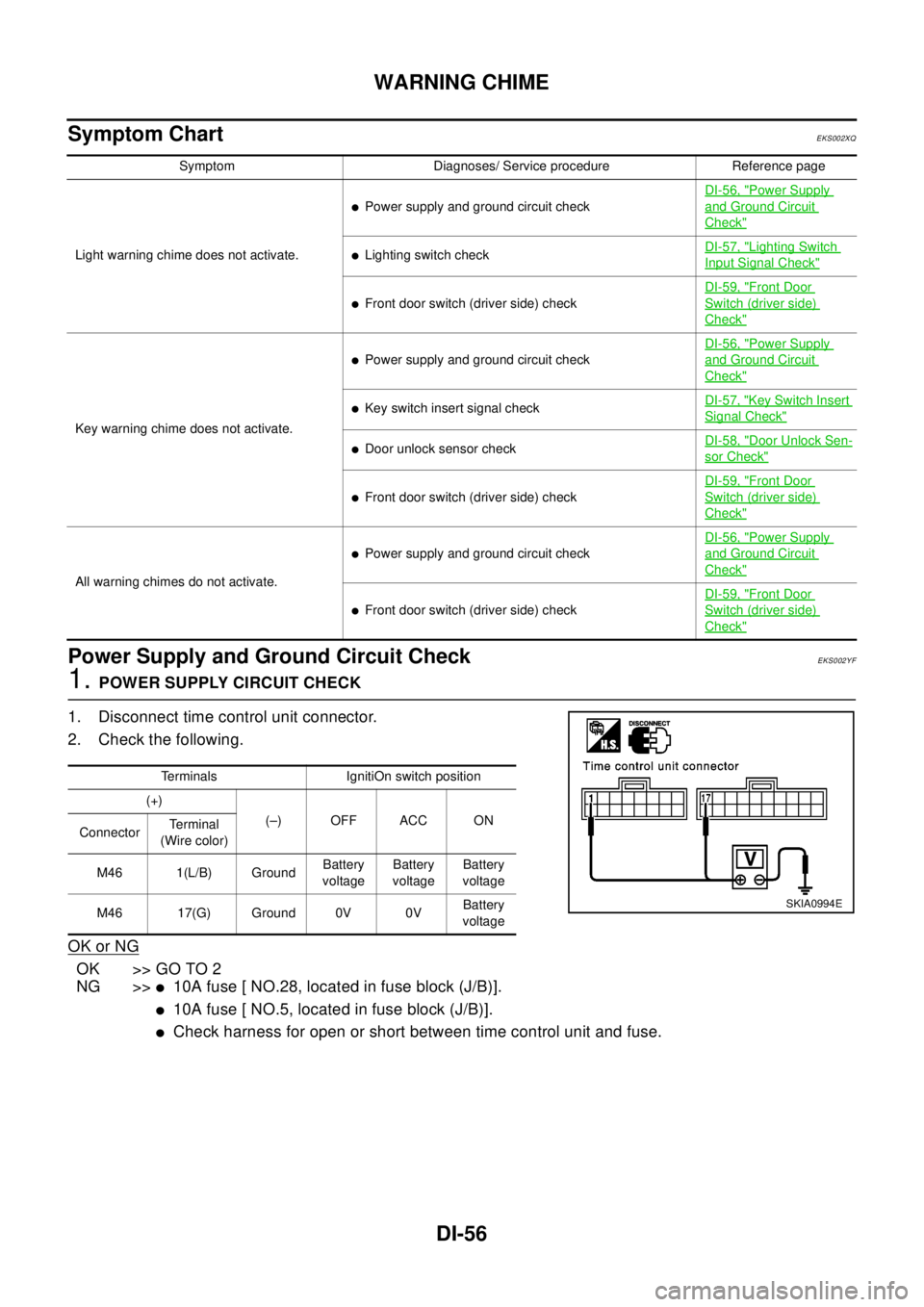
1.POWER SUPPLY CIRCUIT CHECK
1. Disconnect time control unit connector.
2. Check the following.
OK or NG
OK >> GO TO 2
NG >>
l10A fuse [ NO.28, located in fuse block (J/B)].
l10A fuse [ NO.5, located in fuse block (J/B)].
lCheck harness for open or short between time control unit and fuse.
Symptom Diagnoses/ Service procedure Reference page
Light warning chime does not activate.
lPower supply and ground circuit checkDI-56, "
Power Supply
and Ground Circuit
Check"
lLighting switch checkDI-57, "Lighting Switch
Input Signal Check"
lFront door switch (driver side) checkDI-59, "
Front Door
Switch (driver side)
Check"
Key warning chime does not activate.
lPower supply and ground circuit checkDI-56, "
Power Supply
and Ground Circuit
Check"
lKey switch insert signal checkDI-57, "Key Switch Insert
Signal Check"
lDoor unlock sensor checkDI-58, "Door Unlock Sen-
sor Check"
lFront door switch (driver side) checkDI-59, "
Front Door
Switch (driver side)
Check"
All warning chimes do not activate.
lPower supply and ground circuit checkDI-56, "
Power Supply
and Ground Circuit
Check"
lFront door switch (driver side) checkDI-59, "
Front Door
Switch (driver side)
Check"
Terminals IgnitiOn switch position
(+)
(–) OFF ACC ON
ConnectorTe r m i n a l
(Wire color)
M46 1(L/B) GroundBattery
voltageBattery
voltageBattery
voltage
M46 17(G) Ground 0V 0VBattery
voltage
SKIA0994E
Page 1111 of 3066
WARNING CHIME
DI-57
C
D
E
F
G
H
I
J
L
MA
B
DI
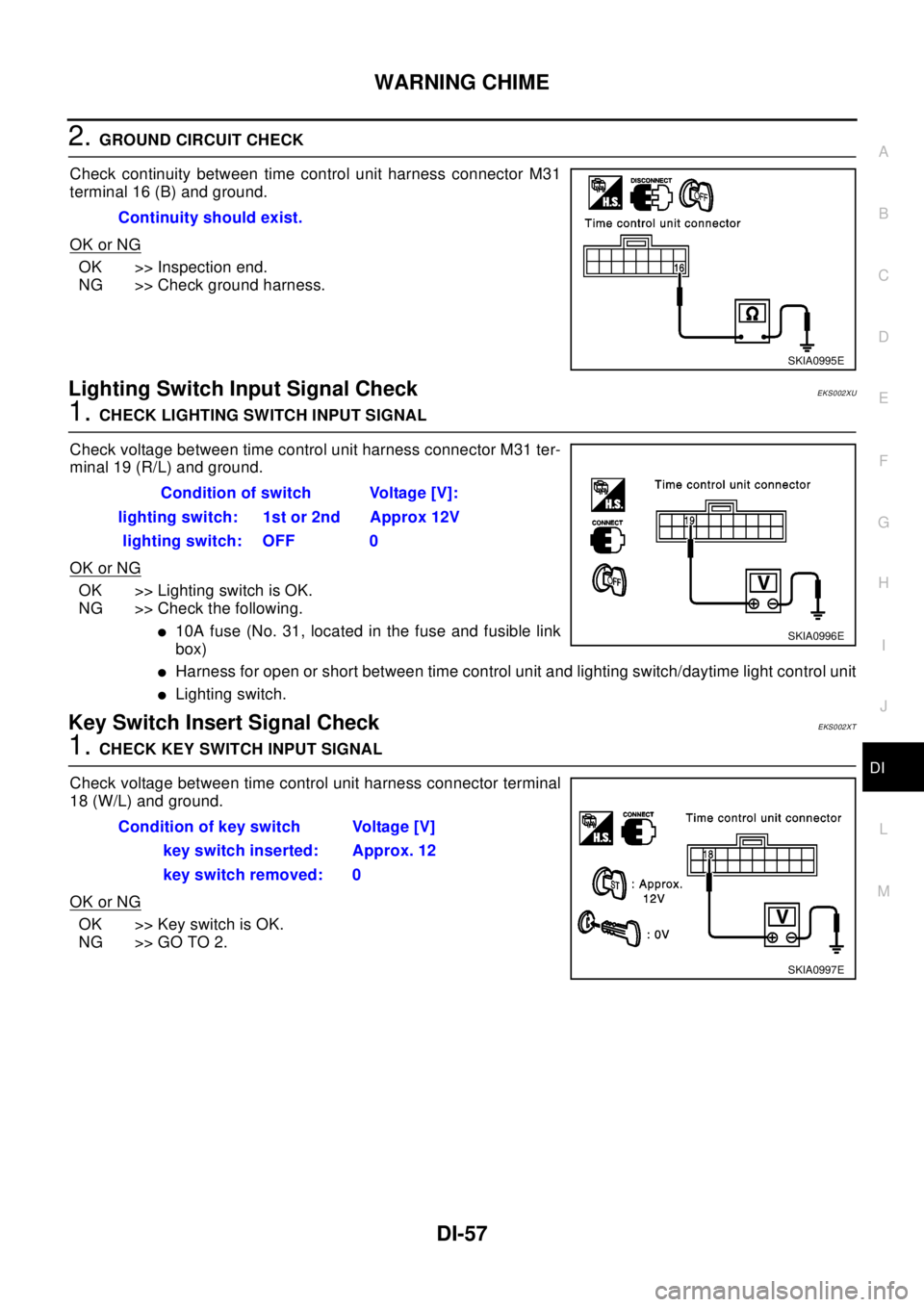
2.GROUND CIRCUIT CHECK
Check continuity between time control unit harness connector M31
terminal 16 (B) and ground.
OK or NG
OK >> Inspection end.
NG >> Check ground harness.
Lighting Switch Input Signal CheckEKS002XU
1.CHECK LIGHTING SWITCH INPUT SIGNAL
Check voltage between time control unit harness connector M31 ter-
minal 19 (R/L) and ground.
OK or NG
OK >> Lighting switch is OK.
NG >> Check the following.
l10A fuse (No. 31, located in the fuse and fusible link
box)
lHarness for open or short between time control unit and lighting switch/daytime light control unit
lLighting switch.
Key Switch Insert Signal CheckEKS002XT
1.CHECK KEY SWITCH INPUT SIGNAL
Check voltage between time control unit harness connector terminal
18 (W/L) and ground.
OK or NG
OK >>KeyswitchisOK.
NG >> GO TO 2.Continuity should exist.
SKIA0995E
Condition of switch Voltage [V]:
lighting switch: 1st or 2nd Approx 12V
lighting switch: OFF 0
SKIA0996E
Condition of key switch Voltage [V]
key switch inserted: Approx. 12
key switch removed: 0
SKIA0997E
Page 1130 of 3066
![NISSAN X-TRAIL 2003 Electronic Manual PDF EC-16
[QR (WITH EURO-OBD)]
PRECAUTIONS
PRECAUTIONS
PFP:00001
Precautions for Supplemental Restraint System (SRS) “AIR BAG” and “SEAT
BELT PRE-TENSIONER”
EBS00B0I
The Supplemental Restraint Sys](/img/5/57402/w960_57402-1129.png "NISSAN X-TRAIL 2003 Electronic Manual PDF EC-16
[QR (WITH EURO-OBD)]
PRECAUTIONS
PRECAUTIONS
PFP:00001
Precautions for Supplemental Restraint System (SRS) “AIR BAG” and “SEAT
BELT PRE-TENSIONER”
EBS00B0I
The Supplemental Restraint Sys")
EC-16
[QR (WITH EURO-OBD)]
PRECAUTIONS
PRECAUTIONS
PFP:00001
Precautions for Supplemental Restraint System (SRS) “AIR BAG” and “SEAT
BELT PRE-TENSIONER”
EBS00B0I
The Supplemental Restraint System such as “AIR BAG” and “SEAT BELT PRE-TENSIONER”, used along
with a front seat belt, helps to reduce the risk or severity of injury to the driver and front passenger for certain
types of collision. Information necessary to service the system safely is included in the SRS and SB section of
this Service Manual.
WAR NIN G:
lTo avoid rendering the SRS inoperative, which could increase the risk of personal injury or death
in the event of a collision which would result in air bag inflation, all maintenance must be per-
formed by an authorized NISSAN/INFINITI dealer.
lImproper maintenance, including incorrect removal and installation of the SRS, can lead to per-
sonal injury caused by unintentional activation of the system. For removal of Spiral Cable and Air
Bag Module, see the SRS section.
lDo not use electrical test equipment on any circuit related to the SRS unless instructed to in this
Service Manual. SRS wiring harnesses can be identified by yellow harness connectors.
On Board Diagnostic (OBD) System of Engine and A/TEBS00B0J
The ECM has an on board diagnostic system. It will light up the malfunction indicator (MI) to warn the driver of
a malfunction causing emission deterioration.
CAUTION:
lBe sure to turn the ignition switch OFF and disconnect the negative battery terminal before any
repair or inspection work. The open/short circuit of related switches, sensors, solenoid valves,
etc. will cause the MI to light up.
lBe sure to connect and lock the connectors securely after work. A loose (unlocked) connector will
cause the MI to light up due to the open circuit. (Be sure the connector is free from water, grease,
dirt, bent terminals, etc.)
lCertain systems and components, especially those related to OBD, may use a new style slide-
locking type harness connector. For description and how to disconnect, refer toPG-70, "
HAR-
NESS CONNECTOR".
lBe sure to route and secure the harnesses properly after work. The interference of the harness
with a bracket, etc. may cause the MI to light up due to the short circuit.
lBe sure to connect rubber tubes properly after work. A misconnected or disconnected rubber tube
may cause the MI to light up due to the malfunction of the fuel injection system, etc.
lBe sure to erase the unnecessary malfunction information (repairs completed) from the ECM and
TCM (Transmission control module) before returning the vehicle to the customer.
PrecautionEBS00B0K
lAlways use a 12 volt battery as power source.
lDo not attempt to disconnect battery cables while engine is
running.
lBefore connecting or disconnecting the ECM harness con-
nector, turn ignition switch OFF and disconnect negative
battery terminal. Failure to do so may damage the ECM
because battery voltage is applied to ECM even if ignition
switch is turned off.
lBefore removing parts, turn ignition switch OFF and then
disconnect battery ground cable.
SEF289H
Page 1131 of 3066
![NISSAN X-TRAIL 2003 Electronic Manual PDF PRECAUTIONS
EC-17
[QR (WITH EURO-OBD)]
C
D
E
F
G
H
I
J
K
L
MA
EC
lDo not disassemble ECM.
lIf a battery terminal is disconnected, the memory will return
to the ECM value.
The ECM will now start to sel](/img/5/57402/w960_57402-1130.png "NISSAN X-TRAIL 2003 Electronic Manual PDF PRECAUTIONS
EC-17
[QR (WITH EURO-OBD)]
C
D
E
F
G
H
I
J
K
L
MA
EC
lDo not disassemble ECM.
lIf a battery terminal is disconnected, the memory will return
to the ECM value.
The ECM will now start to sel")
PRECAUTIONS
EC-17
[QR (WITH EURO-OBD)]
C
D
E
F
G
H
I
J
K
L
MA
EC
lDo not disassemble ECM.
lIf a battery terminal is disconnected, the memory will return
to the ECM value.
The ECM will now start to self-control at its initial value.
Engine operation can vary slightly when the terminal is dis-
connected. However, this is not an indication of a problem.
Do not replace parts because of a slight variation.
lWhen connecting ECM harness connector, fasten it
securely with a lever as far as it will go as shown at right.
lWhen connecting or disconnecting pin connectors into or
from ECM, take care not to damage pin terminals (bend or
break).
Make sure that there are not any bends or breaks on ECM
pin terminal, when connecting pin connectors.
lSecurely connect ECM harness connectors.
A poor connection can cause an extremely high (surge)
voltage to develop in coil and condenser, thus resulting in
damage to ICs.
lKeep engine control system harness at least 10 cm (4 in)
away from adjacent harness, to prevent engine control sys-
tem malfunctions due to receiving external noise, degraded
operation of ICs, etc.
lKeep engine control system parts and harness dry.
lBefore replacing ECM, perform “ECM Terminals and Refer-
ence Value” inspection and make sure ECM functions prop-
erly. Refer toEC-79
.
lHandle mass air flow sensor carefully to avoid damage.
lDo not disassemble mass air flow sensor.
lDo not clean mass air flow sensor with any type of deter-
gent.
lDo not disassemble electric throttle control actuator.
lEven a slight leak in the air intake system can cause seri-
ous problems.
lDo not shock or jar the camshaft position sensor (PHASE),
crankshaft position sensor (POS).
SEF707Y
SEF908W
PBIB0090E
MEF040D
Page 1144 of 3066
![NISSAN X-TRAIL 2003 Electronic Manual PDF EC-30
[QR (WITH EURO-OBD)]
BASIC SERVICE PROCEDURE
BASIC SERVICE PROCEDURE
PFP:00018
Idle Speed and Ignition Timing CheckEBS00B0W
IDLE SPEED
lUsing CONSULT-II
Check idle speed in “DATA MONITOR” mo](/img/5/57402/w960_57402-1143.png "NISSAN X-TRAIL 2003 Electronic Manual PDF EC-30
[QR (WITH EURO-OBD)]
BASIC SERVICE PROCEDURE
BASIC SERVICE PROCEDURE
PFP:00018
Idle Speed and Ignition Timing CheckEBS00B0W
IDLE SPEED
lUsing CONSULT-II
Check idle speed in “DATA MONITOR” mo")
EC-30
[QR (WITH EURO-OBD)]
BASIC SERVICE PROCEDURE
BASIC SERVICE PROCEDURE
PFP:00018
Idle Speed and Ignition Timing CheckEBS00B0W
IDLE SPEED
lUsing CONSULT-II
Check idle speed in “DATA MONITOR” mode with CONSULT-II.
IGNITION TIMING
Any of following two methods may be used.
lMethod A
–Attach timing light to loop wire as shown.
–Check ignition timing.
lMethod B
–Remove No. 1 ignition coil.
–Connect No. 1 ignition coil and No. 1 spark plug with suitable
high-tension wire as shown, and attach timing light clamp to this
wire.
SEF058Y
PBIB0515E
PBIB0509E
PBIB0516E
Page 1146 of 3066
![NISSAN X-TRAIL 2003 Electronic Manual PDF EC-32
[QR (WITH EURO-OBD)]
BASIC SERVICE PROCEDURE
PREPARATION
Before performing “Idle Air Volume Learning”, make sure that all of the following conditions are satisfied.
Learning will be cancelle](/img/5/57402/w960_57402-1145.png "NISSAN X-TRAIL 2003 Electronic Manual PDF EC-32
[QR (WITH EURO-OBD)]
BASIC SERVICE PROCEDURE
PREPARATION
Before performing “Idle Air Volume Learning”, make sure that all of the following conditions are satisfied.
Learning will be cancelle")
EC-32
[QR (WITH EURO-OBD)]
BASIC SERVICE PROCEDURE
PREPARATION
Before performing “Idle Air Volume Learning”, make sure that all of the following conditions are satisfied.
Learning will be cancelled if any of the following conditions are missed for even a moment.
lBattery voltage: More than 12.9V (At idle)
lEngine coolant temperature: 70 - 100°C (158 - 212°F)
lPNP switch: ON
lElectric load switch: OFF
(Air conditioner, headlamp, rear window defogger)
On vehicles equipped with daytime light systems, set lighting switch to the 1st position to light
only small lamps.
lSteering wheel: Neutral (Straight-ahead position)
lVehicle speed: Stopped
lTransmission: Warmed-up
For A/T models with CONSULT-II, drive vehicle until “FLUID TEMP SE” in “DATA MONITOR” mode of “A/
T” system indicates less than 0.9V.
For A/T models without CONSULT-II and M/T models, drive vehicle for 10 minutes.
OPERATION PROCEDURE
With CONSULT-II
1. PerformEC-31, "Accelerator Pedal Released Position Learning".
2. PerformEC-31, "
Throttle Valve Closed Position Learning".
3. Start engine and warm it up to normal operating temperature.
4. Check that all items listed under the topic “PRE-CONDITIONING” (previously mentioned) are in good
order.
5. Select “IDLE AIR VOL LEARN” in “WORK SUPPORT” mode.
6. Touch “START” and wait 20 seconds.
SEF452Y
SEF454Y
Page 1150 of 3066
![NISSAN X-TRAIL 2003 Electronic Manual PDF EC-36
[QR (WITH EURO-OBD)]
ON BOARD DIAGNOSTIC (OBD) SYSTEM
ON BOARD DIAGNOSTIC (OBD) SYSTEM
PFP:00028
IntroductionEBS00BM5
The ECM has an on board diagnostic system, which detects malfunctions relate](/img/5/57402/w960_57402-1149.png "NISSAN X-TRAIL 2003 Electronic Manual PDF EC-36
[QR (WITH EURO-OBD)]
ON BOARD DIAGNOSTIC (OBD) SYSTEM
ON BOARD DIAGNOSTIC (OBD) SYSTEM
PFP:00028
IntroductionEBS00BM5
The ECM has an on board diagnostic system, which detects malfunctions relate")
EC-36
[QR (WITH EURO-OBD)]
ON BOARD DIAGNOSTIC (OBD) SYSTEM
ON BOARD DIAGNOSTIC (OBD) SYSTEM
PFP:00028
IntroductionEBS00BM5
The ECM has an on board diagnostic system, which detects malfunctions related to engine sensors or actua-
tors. The ECM also records various emission-related diagnostic information including:
The above information can be checked using procedures listed in the table below.
´: Applicable —: Not applicable
*1: 1st trip DTCs for self-diagnoses concerning SRT items cannot be shown on the GST display.
*2: When DTC and 1st trip DTC simultaneously appear on the display, they cannot be clearly distinguished from each other.
The malfunction indicator (MI) on the instrument panel lights up when the same malfunction is detected in two
consecutive trips (Two trip detection logic), or when the ECM enters fail-safe mode. (Refer toEC-62
.)
Two Trip Detection LogicEBS00BM6
When a malfunction is detected for the first time, 1st trip DTC and 1st trip Freeze Frame data are stored in the
ECM memory. The MI will not light up at this stage. <1st trip>
If the same malfunction is detected again during the next drive, the DTC and Freeze Frame data are stored in
the ECM memory, and the MI lights up. The MI lights up at the same time when the DTC is stored. <2nd trip>
The “trip” in the “Two Trip Detection Logic” means a driving mode in which self-diagnosis is performed during
vehicle operation. Specific on board diagnostic items will cause the ECM to light up or blink the MI, and store
DTC and Freeze Frame data, even in the 1st trip, as shown below.
´: Applicable —: Not applicable
*1: Except “ECM”Emission-related diagnostic information ISO Standard
Diagnostic Trouble Code (DTC) Mode 3 of ISO 15031-5
Freeze Frame data Mode 2 of ISO 15031-5
System Readiness Test (SRT) code Mode 1 of ISO 15031-5
1st Trip Diagnostic Trouble Code (1st Trip DTC) Mode 7 of ISO 15031-5
1st Trip Freeze Frame data
Test values and Test limits Mode 6 of ISO 15031-5
Calibration ID Mode 9 of ISO 15031-5
DTC 1st trip DTCFreeze Frame
data1st trip Freeze
Frame dataSRT code Test value
CONSULT-II´´ ´ ´ ´—
GST´´*1´—´´
ECM´´*2 — — — —
ItemsMI DTC 1st trip DTC
1st trip 2nd trip
1st trip
displaying2nd trip
displaying1st trip
displaying2nd trip
display-
ing BlinkingLighting
upBlinkingLighting
up
Misfire (Possible three way cata-
lyst damage) — DTC: P0300 -
P0304 is being detected´———— —´—
Misfire (Possible three way cata-
lyst damage) — DTC: P0300 -
P0304 is being detected——´——´——
Fail-safe items (Refer toEC-62
.) —´——´*1 —´*1 —
Except above — — —´—´´—
Page 1152 of 3066
![NISSAN X-TRAIL 2003 Electronic Manual PDF EC-38
[QR (WITH EURO-OBD)]
ON BOARD DIAGNOSTIC (OBD) SYSTEM
*1: 1st trip DTC No. is the same as DTC No.
*2: These numbers are prescribed by ISO 15031-5.
*3: In Diagnostic Test Mode II (Self-diagnostic](/img/5/57402/w960_57402-1151.png "NISSAN X-TRAIL 2003 Electronic Manual PDF EC-38
[QR (WITH EURO-OBD)]
ON BOARD DIAGNOSTIC (OBD) SYSTEM
*1: 1st trip DTC No. is the same as DTC No.
*2: These numbers are prescribed by ISO 15031-5.
*3: In Diagnostic Test Mode II (Self-diagnostic")
EC-38
[QR (WITH EURO-OBD)]
ON BOARD DIAGNOSTIC (OBD) SYSTEM
*1: 1st trip DTC No. is the same as DTC No.
*2: These numbers are prescribed by ISO 15031-5.
*3: In Diagnostic Test Mode II (Self-diagnostic results), these numbers are controlled by NISSAN.
*4: These are not displayed with GST.
*5: When the fail-safe operation occurs, the MI illuminates.
*6: The trouble shooting for this DTC needs CONSULT-II.
*7: Except for M/T models without ESP/TCS/ABS system.
*8: For M/T models with ESP/TCS/ABS system.
*9: When the fail-safe operations for both self-diagnoses occur at the same time, the MI illuminates.
DTC AND 1ST TRIP DTC
The 1st trip DTC (whose number is the same as the DTC number) is displayed for the latest self-diagnostic
result obtained. If the ECM memory was cleared previously, and the 1st trip DTC did not reoccur, the 1st trip
DTC will not be displayed.
If a malfunction is detected during the 1st trip, the 1st trip DTC is stored in the ECM memory. The MI will not
light up (two trip detection logic). If the same malfunction is not detected in the 2nd trip (meeting the required
driving pattern), the 1st trip DTC is cleared from the ECM memory. If the same malfunction is detected in the
2nd trip, both the 1st trip DTC and DTC are stored in the ECM memory and the MI lights up. In other words,
the DTC is stored in the ECM memory and the MI lights up when the same malfunction occurs in two consec-
P0705 0705 PNP SW/CIRC — —´AT- 1 3 0
P0710 0710 ATF TEMP SEN/CIRC — —´AT- 1 3 6
P0720 0720 VEH SPD SEN/CIR AT*9 — —´AT- 1 4 2
P0731 0731 A/T 1ST GR FNCTN — —´AT- 1 5 1
P0732 0732 A/T 2ND GR FNCTN — —´AT- 1 5 8
P0733 0733 A/T 3RD GR FNCTN — —´AT- 1 6 5
P0734 0734 A/T 4TH GR FNCTN — —´AT- 1 7 2
P0740 0740 TCC SOLENOID/CIRC — —´AT- 1 8 1
P0745 0745 L/PRESS SOL/CIRC — —´AT- 1 8 6
P0750 0750 SFT SOL A/CIRC*5 — —´AT- 1 9 3
P0755 0755 SFT SOL B/CIRC*5 — —´AT- 1 9 8
P1065 1065 ECM BACK UP/CIRC — —´EC-256
P1102 1102 MAF SENSOR — —´EC-260
P 1111 1111 I N T / V T IM V / C I R - B 1 — —´EC-266
P1121 1121 ETC ACTR — —´EC-271
P1122 1122 ETC FUNCTION/CIRC — —´EC-273
P1123 1123 ETC MOT RLY/CIRC — —´EC-279
P1143 1143 HO2S1 (B1) — —´*4EC-284
P1144 1144 HO2S1 (B1) — —´*4EC-290
P1146 1146 HO2S2 (B1) — —´*4EC-296
P1147 1147 HO2S2 (B1) — —´*4EC-303
P1212 1212 TCS/CIRC*8 — —´EC-310
P1217 1217 ENG OVER TEMP — —´EC-311
P1610 - P1615 1610 - 1615 NATS MALFUNCTION — —´EC-48
P1705 1705 TP SEN/CIRC A/T*5 — —´AT- 2 0 3
P1706 1706 P-N POS SW/CIRCUIT — —´EC-325
P1760 1760 O/R CLTCH SOL/CIRC — —´AT- 2 0 8
P1805 1805 BRAKE SW/CIRCUIT — —´EC-329
DTC*1
Items
(CONSULT-II screen terms)SRT codeTe s t v a l u e /
Test limit
(GST only)1st trip
DTC*1Reference page
CONSULT-II
GST*2ECM*3
Page 1153 of 3066
![NISSAN X-TRAIL 2003 Electronic Manual PDF ON BOARD DIAGNOSTIC (OBD) SYSTEM
EC-39
[QR (WITH EURO-OBD)]
C
D
E
F
G
H
I
J
K
L
MA
EC
utive trips. If a 1st trip DTC is stored and a non-diagnostic operation is performed between the 1st and 2nd
trips](/img/5/57402/w960_57402-1152.png "NISSAN X-TRAIL 2003 Electronic Manual PDF ON BOARD DIAGNOSTIC (OBD) SYSTEM
EC-39
[QR (WITH EURO-OBD)]
C
D
E
F
G
H
I
J
K
L
MA
EC
utive trips. If a 1st trip DTC is stored and a non-diagnostic operation is performed between the 1st and 2nd
trips")
ON BOARD DIAGNOSTIC (OBD) SYSTEM
EC-39
[QR (WITH EURO-OBD)]
C
D
E
F
G
H
I
J
K
L
MA
EC
utive trips. If a 1st trip DTC is stored and a non-diagnostic operation is performed between the 1st and 2nd
trips, only the 1st trip DTC will continue to be stored. For malfunctions that blink or light up the MI during the
1st trip, the DTC and 1st trip DTC are stored in the ECM memory.
Procedures for clearing the DTC and the 1st trip DTC from the ECM memory are described inEC-46, "
HOW
TO ERASE EMISSION-RELATED DIAGNOSTIC INFORMATION".
For malfunctions in which 1st trip DTCs are displayed, refer toEC-37
. These items are required by legal reg-
ulations to continuously monitor the system/component. In addition, the items monitored non-continuously are
also displayed on CONSULT-II.
1st trip DTC is specified in Mode 7 of ISO 15031-5. 1st trip DTC detection occurs without lighting up the MI
and therefore does not warn the driver of a problem. However, 1st trip DTC detection will not prevent the vehi-
cle from being tested, for example during Inspection/Maintenance (I/M) tests.
When a 1st trip DTC is detected, check, print out or write down and erase (1st trip) DTC and Freeze Frame
data as specified in “Work Flow” procedure Step II, refer toEC-58
. Then perform “DTC Confirmation Proce-
dure” or “Overall Function Check” to try to duplicate the problem. If the malfunction is duplicated, the item
requires repair.
How to Read DTC and 1st Trip DTC
DTC and 1st trip DTC can be read by the following methods.
With CONSULT-II
With GST
CONSULT-II or GST (Generic Scan Tool) Examples: P0340, P0705, P0750, etc.
These DTCs are prescribed by ISO 15031-5.
(CONSULT-II also displays the malfunctioning component or system.)
No Tools
The number of blinks of the MI in the Diagnostic Test Mode II (Self-Diagnostic Results) indicates the DTC.
Example: 0102, 0340 etc.
These DTCs are controlled by NISSAN.
l1st trip DTC No. is the same as DTC No.
lOutput of a DTC indicates a malfunction. However, GST or the Diagnostic Test Mode II do not indi-
cate whether the malfunction is still occurring or has occurred in the past and has returned to nor-
mal. CONSULT-II can identify malfunction status as shown below. Therefore, using CONSULT-II (if
available) is recommended.
A sample of CONSULT-II display for DTC and 1st trip DTC is shown below. DTC or 1st trip DTC of a malfunc-
tion is displayed in SELF-DIAGNOSTIC RESULTS mode of CONSULT-II. Time data indicates how many times
the vehicle was driven after the last detection of a DTC.
If the DTC is being detected currently, the time data will be “0”.
Ifa1sttripDTCisstoredintheECM,thetimedatawillbe“[1t]”.
FREEZE FRMADE DATA AND 1ST TRIP FREEZE FRAME DATA
The ECM records the driving conditions such as fuel system status, calculated load value, engine coolant tem-
perature, short term fuel trim, long term fuel trim, engine speed, vehicle speed, base fuel schedule and intake
air temperature at the moment a malfunction is detected.
Data which are stored in the ECM memory, along with the 1st trip DTC, are called 1st trip freeze frame data.
The data, stored together with the DTC data, are called freeze frame data and displayed on CONSULT-II or
GST. The 1st trip freeze frame data can only be displayed on the CONSULT-II screen, not on the GST. For
details, seeEC-89
.
Only one set of freeze frame data (either 1st trip freeze frame data or freeze frame data) can be stored in the
ECM. 1st trip freeze frame data is stored in the ECM memory along with the 1st trip DTC. There is no priority
for 1st trip freeze frame data and it is updated each time a different 1st trip DTC is detected. However, once
SEF745C
Page 1162 of 3066
![NISSAN X-TRAIL 2003 Electronic Manual PDF EC-48
[QR (WITH EURO-OBD)]
ON BOARD DIAGNOSTIC (OBD) SYSTEM
5. System readiness test (SRT) codes
6. Test values
7. Others
Actual work procedures are explained using a DTC as an example. Be careful so](/img/5/57402/w960_57402-1161.png "NISSAN X-TRAIL 2003 Electronic Manual PDF EC-48
[QR (WITH EURO-OBD)]
ON BOARD DIAGNOSTIC (OBD) SYSTEM
5. System readiness test (SRT) codes
6. Test values
7. Others
Actual work procedures are explained using a DTC as an example. Be careful so")
EC-48
[QR (WITH EURO-OBD)]
ON BOARD DIAGNOSTIC (OBD) SYSTEM
5. System readiness test (SRT) codes
6. Test values
7. Others
Actual work procedures are explained using a DTC as an example. Be careful so that not only the DTC, but all
of the data listed above, are cleared from the ECM memory during work procedures.
NATS (Nissan Anti-theft System)EBS00BM8
lIf the security indicator lights up with the ignition switch in
the “ON” position or “NATS MALFUNCTION” is displayed
on “SELF-DIAG RESULTS” screen, perform self-diagnostic
results mode with CONSULT-II using NATS program card.
Refer toBL-70, "
NATS (NISSAN ANTI-THEFT SYSTEM)".
lConfirm no self-diagnostic results of NATS is displayed
before touching “ERASE” in “SELF-DIAG RESULTS” mode
with CONSULT-II.
lWhen replacing ECM, initialization of NATS system and reg-
istration of all NATS ignition key IDs must be carried out
with CONSULT-II using NATS program card.
Therefore, be sure to receive all keys from vehicle owner.
Regarding the procedures of NATS initialization and NATS ignition key ID registration, refer to
CONSULT-II operation manual, NATS.
Malfunction Indicator (MI)EBS00BM9
DESCRIPTION
The MI is located on the instrument panel.
1. The MI will light up when the ignition switch is turned ON without
the engine running. This is a bulb check.
lIf the MI does not light up, refer toDI-39, "WARNING LAMPS",
or seeEC-252
.
2. When the engine is started, the MI should go off.
If the MI remains on, the on board diagnostic system has
detected an engine system malfunction.
ON BOARD DIAGNOSTIC SYSTEM FUNCTION
The on board diagnostic system has the following four functions.
SEF515Y
SAT652J
Diagnostic Test
ModeKEY and ENG.
Statu sFunction Explanation of Function
Mode I Ignition switch in
“ON” position
Engine stoppedBULB CHECK This function checks the MI bulb for damage (blown, open
circuit, etc.).
If the MI does not come on, check MI circuit.
Engine running MALFUNCTION
WARNINGThis is a usual driving condition. When a malfunction is
detected twice in two consecutive driving cycles (two trip
detection logic), the MI will light up to inform the driver that
a malfunction has been detected.
The following malfunctions will light up or blink the MI in
the 1st trip.
l“Misfire (Possible three way catalyst damage)”
lFail-safe mode