sensor NISSAN X-TRAIL 2003 Electronic Repair Manual
[x] Cancel search | Manufacturer: NISSAN, Model Year: 2003, Model line: X-TRAIL, Model: NISSAN X-TRAIL 2003Pages: 3066, PDF Size: 51.47 MB
Page 2224 of 3066
![NISSAN X-TRAIL 2003 Electronic Repair Manual FUEL TANK
FL-9
[QR20DE]
C
D
E
F
G
H
I
J
K
L
MA
FL
FUEL TANKPFP:17202
Removal and InstallationEBS00BKT
REMOVAL
WA RN ING:
Be sure to read “General Precautions” when working on fuel system. Refer to](/img/5/57402/w960_57402-2223.png "NISSAN X-TRAIL 2003 Electronic Repair Manual FUEL TANK
FL-9
[QR20DE]
C
D
E
F
G
H
I
J
K
L
MA
FL
FUEL TANKPFP:17202
Removal and InstallationEBS00BKT
REMOVAL
WA RN ING:
Be sure to read “General Precautions” when working on fuel system. Refer to")
FUEL TANK
FL-9
[QR20DE]
C
D
E
F
G
H
I
J
K
L
MA
FL
FUEL TANKPFP:17202
Removal and InstallationEBS00BKT
REMOVAL
WA RN ING:
Be sure to read “General Precautions” when working on fuel system. Refer toFL-3, "
General Precau-
tions".
1. Release fuel pressure from fuel line, Refer toEC-34, "
FUEL
PRESSURE RELEASE",EC-399, "FUEL PRESSURE
RELEASE".
2. Open the fuel filler cap and release the pressure inside the fuel
tank.
3. Remove rear seat bottom.
4. Remove inspection hole cover, harness connector and fuel feed
hose.
5. Drain fuel from fuel tank if necessary. For the draining proce-
dure, refer to Step 4 in removal ofFL-4, "
FUEL LEVEL SENSOR
UNIT, FUEL FILTER AND FUEL PUMP ASSEMBLY".
CAUTION:
For the safety work and to maintain fuel tank gravity at center, drain fuel to the level where fuel
tank weight at left and right becomes equal.
6. Remove the quick connector.
lPut mating marks on hoses for correct installation.
7. Remove exhaust center tube and insulator.
PBIC0246E
1 Fuel filler cap 2 Grommet 3 Fuel filler tube
4 Vent hose 5 Vent tube 6 Fuel tank
7 Fuel filler hose 8 Fuel tank band 9 Fuel tank protector
KBIA0280E
Page 2225 of 3066
![NISSAN X-TRAIL 2003 Electronic Repair Manual FL-10
[QR20DE]
FUEL TANK
8. Remove propeller shaft. Refer toPR-3, "Removal and Installation".
9. Using a transmission jack, support the bottom of the rear final
drive.
10. Remove the mounting nuts on](/img/5/57402/w960_57402-2224.png "NISSAN X-TRAIL 2003 Electronic Repair Manual FL-10
[QR20DE]
FUEL TANK
8. Remove propeller shaft. Refer toPR-3, \"Removal and Installation\".
9. Using a transmission jack, support the bottom of the rear final
drive.
10. Remove the mounting nuts on")
FL-10
[QR20DE]
FUEL TANK
8. Remove propeller shaft. Refer toPR-3, "Removal and Installation".
9. Using a transmission jack, support the bottom of the rear final
drive.
10. Remove the mounting nuts on the rear suspension member, and
lower the transmission jack carefully until just before the rear
suspension member is removed from the stud bolts on the vehi-
cle.
11. Disconnect fuel filler hose, EVAP hose and vent hose at fuel
tank side.
12. For disconnection procedure of the quick connector on the
evaporator hose, Refer toFL-4, "
FUEL LEVEL SENSOR UNIT,
FUEL FILTER AND FUEL PUMP ASSEMBLY".
13. Remove fuel tank protector.
14. Remove fuel tank band mounting bolts while supporting fuel
tank.
15. Remove fuel tank.
INSTALLATION
Install in the reverse order of removal paying attention to the following.
lSurely clamp fuel hoses and insert hose to the length below.
lBe sure hose clamp is not placed on swelled area of fuel tube.
lTighten fuel hose clamp so that the distance between its lugs becomes to the following.
lPush the mounting band pin to the vehicle side securely.
lBefore fixing the fuel tank, temporarily install the filler tube.
CAUTION:
Use genuine fuel filler tube mounting bolts or equivalent. Make sure to tighten them to the speci-
fied torque.
lTo connect the quick connector, refer toFL-4, "FUEL LEVEL SENSOR UNIT, FUEL FILTER AND FUEL
PUMP ASSEMBLY".
KBIA0285E
KBIA0286E
KBIA0290E
Fuel filler hose : 35mm (1.38 in)
The other hoses : 25mm (0.98 in)
Fuel tank side : 5 - 9 mm (0.20 - 0.35 in)
Fuel filler tube side : 7 - 11 mm (0.28 - 0.43 in)
Page 2232 of 3066
![NISSAN X-TRAIL 2003 Electronic Repair Manual FUEL LEVEL SENSOR UNIT
FL-17
[YD22DDTi]
C
D
E
F
G
H
I
J
K
L
MA
FL
FUEL LEVEL SENSOR UNITPFP:17042
Removal and InstallationEBS00BLD
REMOVAL
WA RN ING:
Be sure to read “General Precautions” When wor](/img/5/57402/w960_57402-2231.png "NISSAN X-TRAIL 2003 Electronic Repair Manual FUEL LEVEL SENSOR UNIT
FL-17
[YD22DDTi]
C
D
E
F
G
H
I
J
K
L
MA
FL
FUEL LEVEL SENSOR UNITPFP:17042
Removal and InstallationEBS00BLD
REMOVAL
WA RN ING:
Be sure to read “General Precautions” When wor")
FUEL LEVEL SENSOR UNIT
FL-17
[YD22DDTi]
C
D
E
F
G
H
I
J
K
L
MA
FL
FUEL LEVEL SENSOR UNITPFP:17042
Removal and InstallationEBS00BLD
REMOVAL
WA RN ING:
Be sure to read “General Precautions” When working on fuel system. Refer toFL-3, "
General Precau-
tions"
1. Disconnect battery ground cable.
2. Open fuel filer lid.
3. Open the filler cap and release the pressure inside the fuel tank.
4. Check fuel level on level place. If gauge indicates more than the
level shown in figure (full or almost full), drain fuel from fuel tank
until gauge indicates level shown in figure or below.
In case of fuel pump does not operate, take following procedure.
a. Insert fuel tube of less than 25 mm (0.98 in) in diameter into fuel
filler tube through fuel filler opening to draw fuel from fuel filler
tube.
b. Disconnect fuel filler hose from fuel filler tube.
c. Insert fuel tube into fuel tank through fuel filler hose to draw fuel
from fuel tank.
lAs a guide, fuel level becomes the position shown in figure or
below when approximately 15 liter (13-1/4 lmp qt) of fuel are drained from fuel position.
NOTE:
Adjusting fuel level is to prevent fuel from spilling, when fuel level sensor unit is removed.
SBIA0139E
1. Lock ring 2. Main fuel level sensor unit 3.Jet pump, fuel hose and jet pump inlet
assembly
4. Chamber 5. Seal packing 6. Sub fuel level sensor unit
SBIA0140E
FEL0403D
Page 2233 of 3066
![NISSAN X-TRAIL 2003 Electronic Repair Manual FL-18
[YD22DDTi]
FUEL LEVEL SENSOR UNIT
5. Remove rear seat bottom.
6. Peel off floor carpet, then remove inspection hole cover.
7. Disconnect the harness connector, fuel feed tube and fuel return
tub](/img/5/57402/w960_57402-2232.png "NISSAN X-TRAIL 2003 Electronic Repair Manual FL-18
[YD22DDTi]
FUEL LEVEL SENSOR UNIT
5. Remove rear seat bottom.
6. Peel off floor carpet, then remove inspection hole cover.
7. Disconnect the harness connector, fuel feed tube and fuel return
tub")
FL-18
[YD22DDTi]
FUEL LEVEL SENSOR UNIT
5. Remove rear seat bottom.
6. Peel off floor carpet, then remove inspection hole cover.
7. Disconnect the harness connector, fuel feed tube and fuel return
tube.
lRemove the quick connector of the fuel tube as follows.
NOTE:
lHold the sides of the connector, push in tubs and pull out the
tube.
lIf the connector and the tube are stuck together, push and pull
several times until they start to move. Then disconnect them by
pulling.
CAUTION:
lThe tube can be removed when the tabs are completely
depressed. Do not twist it more than necessary.
lDo not use any tools to remove the quick connector.
lKeep the resin tube away from heat. Be especially careful
when welding near the tube.
lPrevent acid liquid such as battery electrolyte etc. from get-
ting on the resin tube.
lDo not bend or twist the tube during installation and
removal.
lDo not remove the remaining retainer on tube or fuel level
sensor unit.
lWhen the tube or fuel level sensor unit is replaced, also
replace the retainer with a new one.
SBIA0141E
SFE562A
Retainer color : Green (Feed hose side)
: Gley (Return hose side)
PBIC0199E
Page 2234 of 3066
![NISSAN X-TRAIL 2003 Electronic Repair Manual FUEL LEVEL SENSOR UNIT
FL-19
[YD22DDTi]
C
D
E
F
G
H
I
J
K
L
MA
FL
lTo keep clean the connecting portion and to avoid damage
and foreign materials, cover them completely with plastic
bags or something](/img/5/57402/w960_57402-2233.png "NISSAN X-TRAIL 2003 Electronic Repair Manual FUEL LEVEL SENSOR UNIT
FL-19
[YD22DDTi]
C
D
E
F
G
H
I
J
K
L
MA
FL
lTo keep clean the connecting portion and to avoid damage
and foreign materials, cover them completely with plastic
bags or something")
FUEL LEVEL SENSOR UNIT
FL-19
[YD22DDTi]
C
D
E
F
G
H
I
J
K
L
MA
FL
lTo keep clean the connecting portion and to avoid damage
and foreign materials, cover them completely with plastic
bags or something similar.
8. Using a lock ring wrench, remove the lock ring.
9. Remove main fuel level sensor unit and sub fuel level sensor
unit.
CAUTION:
lDo not bend the float arm during removal.
lAvoid impacts such as falling when handling components.
Removal of main fuel level sensor unit:
lRaise the fuel level sensor unit, and remove the jet pump.
lLeave the jet pump on the fuel tank with the fuel hose.
lIf necessary, remove the chamber from the bottom of the fuel
tank.
lRemove the chamber by sliding toward the rear of the vehicle.
Removal of sub fuel level sensor unit:
lRaise and release the sub fuel level sensor unit to remove.
lIf necessary, remove the jet pump inlet from the bottom of the fuel tank.
To remove it, pinch the tabs (2 places).
INSPECTION AFTER REMOVAL
Make sure the fuel pump strainer is free from foreign materials, If any are found, remove them.
INSTALLATION
Install in the reverse order of removal paying attention to the follow-
ing.
lWhen installing the chamber and jet pump, insert them fully until
a click sound of full stopper engagement is heard (for jet pump
inlet).
lConnect the quick connector as follows.
1. Check the connection for damage and foreign materials.
2. Align the connector with the tube, then insert the connector
straight into the tube until a click is heard.
3. After connecting, make sure that the connection is secure by fol-
lowing the steps below.
PBIC0163E
PBIC0240E
SBIA0142E
SBIA0143E
Page 2235 of 3066
![NISSAN X-TRAIL 2003 Electronic Repair Manual FL-20
[YD22DDTi]
FUEL LEVEL SENSOR UNIT
lVisually confirm that the two retainer tabs are connected to the connector.
lPull the tube and the connector to make sure they are securely connected.
lInstall](/img/5/57402/w960_57402-2234.png "NISSAN X-TRAIL 2003 Electronic Repair Manual FL-20
[YD22DDTi]
FUEL LEVEL SENSOR UNIT
lVisually confirm that the two retainer tabs are connected to the connector.
lPull the tube and the connector to make sure they are securely connected.
lInstall")
FL-20
[YD22DDTi]
FUEL LEVEL SENSOR UNIT
lVisually confirm that the two retainer tabs are connected to the connector.
lPull the tube and the connector to make sure they are securely connected.
lInstall fuel level sensor unit with mating mark (triangular protrusion) facing between two carved lines on
fuel tank. (Figure shows left side of fuel tank.)
NOTE:
On right side of fuel tank, there are three carved lines on fuel tank. Set mating mark between two outer
carved lines.
lInstall the inspection hole cover with the front mark (arrow) fac-
ing front of the vehicle (Both for RH and LH).
INSPECTION AFTER INSTALLATION
lStart the engine and rev it up, and make sure there is no fuel leakage at connections.
SBIA0144E
Page 2237 of 3066
![NISSAN X-TRAIL 2003 Electronic Repair Manual FL-22
[YD22DDTi]
FUEL TANK
10. Using a transmission jack, support the bottom of the rear final
drive.
11. Remove the mounting nuts on the rear suspension member, and
lower the transmission jack carefu](/img/5/57402/w960_57402-2236.png "NISSAN X-TRAIL 2003 Electronic Repair Manual FL-22
[YD22DDTi]
FUEL TANK
10. Using a transmission jack, support the bottom of the rear final
drive.
11. Remove the mounting nuts on the rear suspension member, and
lower the transmission jack carefu")
FL-22
[YD22DDTi]
FUEL TANK
10. Using a transmission jack, support the bottom of the rear final
drive.
11. Remove the mounting nuts on the rear suspension member, and
lower the transmission jack carefully until just before the rear
suspension member is removed from the stud bolts on the vehi-
cle.
12. Disconnect fuel filler hose, EVAP hose and vent hose at fuel
tank side.
For disconnection procedure of the quick connector. Refer to
FL-17, "
FUEL LEVEL SENSOR UNIT".
13. Remove fuel tank protector.
14. Remove fuel tank band mounting bolts while supporting fuel
tank.
15. Remove fuel tank.
INSTALLATION
lInstall in the reverse order of removal paying attention to the following.
lSurely clamp fuel hoses and insert hose to the length below.
lBe sure hose clamp is not positioned on swelled area of fuel tube.
lTighten fuel hose clamp so that the distance between its lugs becomes to the following.
lPush the mounting band pin to the vehicle side securely.
lBefore fixing the fuel tank, temporarily install the fuel filler tube.
CAUTION:
Use genuine fuel filler tube mounting bolts or equivalent. Make sure to tighten them to the speci-
fied torque.
lTo connect the quick connector. Refer toFL-17, "FUEL LEVEL SENSOR UNIT".
Inspection After InstallationEBS00BL4
Run engine and check for fuel leaks at connections.
KBIA0285E
KBIA0286E
KBIA0290E
Fuel filler hose : 35 mm (1.38 in)
The other hose : 25 mm (0.98 in)
Fuel tank side : 5 - 9 mm (0.20 - 0.35 in)
Fuel filler tube side : 7 - 11 mm (0.28 - 0.43 in)
Page 2247 of 3066
FSU-8
COIL SPRING AND SHOCK ABSORBER
COIL SPRING AND SHOCK ABSORBER
PFP:54302
Removal and InstallationEES00074
REMOVAL
1. Remove tires. Remove brake caliper and hung it aside.
CAUTION:
Avoid depressing brake pedal with brake caliper removed.
2. Remove electrical wires of ABS wheel speed sensor from strut.
3. Remove brake hose lock plate.
4. Remove mounting bolts and nuts securing steering knuckle to strut.
5. Remove mounting nuts on top of strut and remove upper mounting plate and strut from vehicle.
INSTALLATION
lRefer toFSU-5, "Components"in “Front Suspension Assembly” for tightening torque. Tighten in the
reverse order of removal.
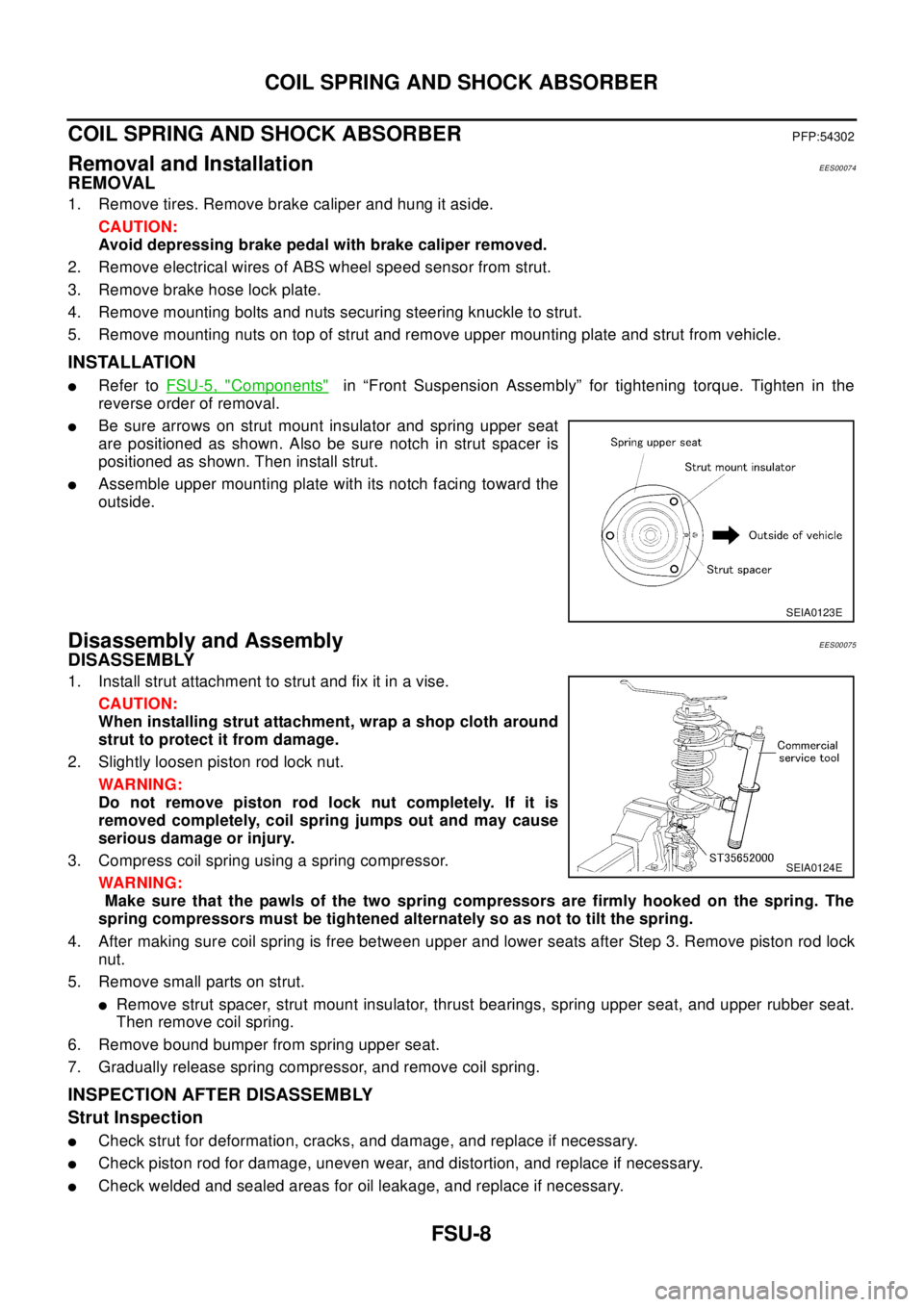
lBe sure arrows on strut mount insulator and spring upper seat
are positioned as shown. Also be sure notch in strut spacer is
positioned as shown. Then install strut.
lAssemble upper mounting plate with its notch facing toward the
outside.
Disassembly and AssemblyEES00075
DISASSEMBLY
1. Install strut attachment to strut and fix it in a vise.
CAUTION:
When installing strut attachment, wrap a shop cloth around
strut to protect it from damage.
2. Slightly loosen piston rod lock nut.
WAR NIN G:
Do not remove piston rod lock nut completely. If it is
removed completely, coil spring jumps out and may cause
serious damage or injury.
3. Compress coil spring using a spring compressor.
WAR NIN G:
Make sure that the pawls of the two spring compressors are firmly hooked on the spring. The
spring compressors must be tightened alternately so as not to tilt the spring.
4. After making sure coil spring is free between upper and lower seats after Step 3. Remove piston rod lock
nut.
5. Remove small parts on strut.
lRemove strut spacer, strut mount insulator, thrust bearings, spring upper seat, and upper rubber seat.
Then remove coil spring.
6. Remove bound bumper from spring upper seat.
7. Gradually release spring compressor, and remove coil spring.
INSPECTION AFTER DISASSEMBLY
Strut Inspection
lCheck strut for deformation, cracks, and damage, and replace if necessary.
lCheck piston rod for damage, uneven wear, and distortion, and replace if necessary.
lCheck welded and sealed areas for oil leakage, and replace if necessary.
SEIA0123E
SEIA0124E
Page 2259 of 3066
GI-6
PRECAUTIONS
Precautions for Multiport Fuel Injection System or Engine Control System
EAS000FT
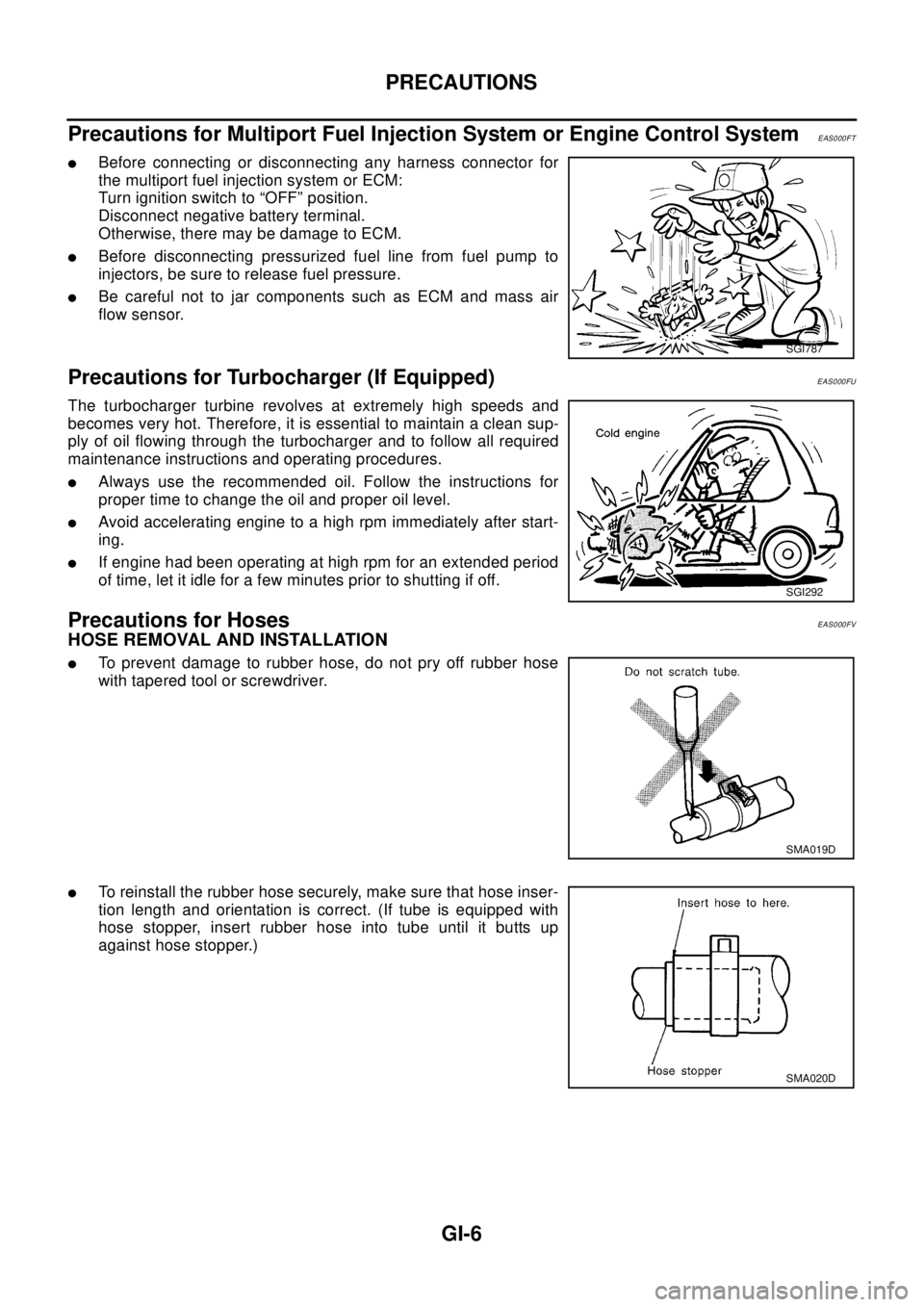
lBefore connecting or disconnecting any harness connector for
the multiport fuel injection system or ECM:
Turn ignition switch to “OFF” position.
Disconnect negative battery terminal.
Otherwise, there may be damage to ECM.
lBefore disconnecting pressurized fuel line from fuel pump to
injectors, be sure to release fuel pressure.
lBe careful not to jar components such as ECM and mass air
flow sensor.
Precautions for Turbocharger (If Equipped)EAS000FU
The turbocharger turbine revolves at extremely high speeds and
becomes very hot. Therefore, it is essential to maintain a clean sup-
ply of oil flowing through the turbocharger and to follow all required
maintenance instructions and operating procedures.
lAlways use the recommended oil. Follow the instructions for
proper time to change the oil and proper oil level.
lAvoid accelerating engine to a high rpm immediately after start-
ing.
lIf engine had been operating at high rpm for an extended period
of time, let it idle for a few minutes prior to shutting if off.
Precautions for HosesEAS000FV
HOSE REMOVAL AND INSTALLATION
lTo prevent damage to rubber hose, do not pry off rubber hose
with tapered tool or screwdriver.
lTo reinstall the rubber hose securely, make sure that hose inser-
tion length and orientation is correct. (If tube is equipped with
hose stopper, insert rubber hose into tube until it butts up
against hose stopper.)
SGI787
SGI292
SMA019D
SMA020D
Page 2278 of 3066
SERVICE INFORMATION FOR ELECTRICAL INCIDENT
GI-25
lVehicle vibration
lHeat sensitive
lFreezing
lWater intrusion
lElectrical load
lCold or hot start up
Get a thorough description of the incident from the customer. It is important for simulating the conditions of the
problem.
Vehicle Vibratio n
The problem may occur or become worse while driving on a rough road or when engine is vibrating (idle with
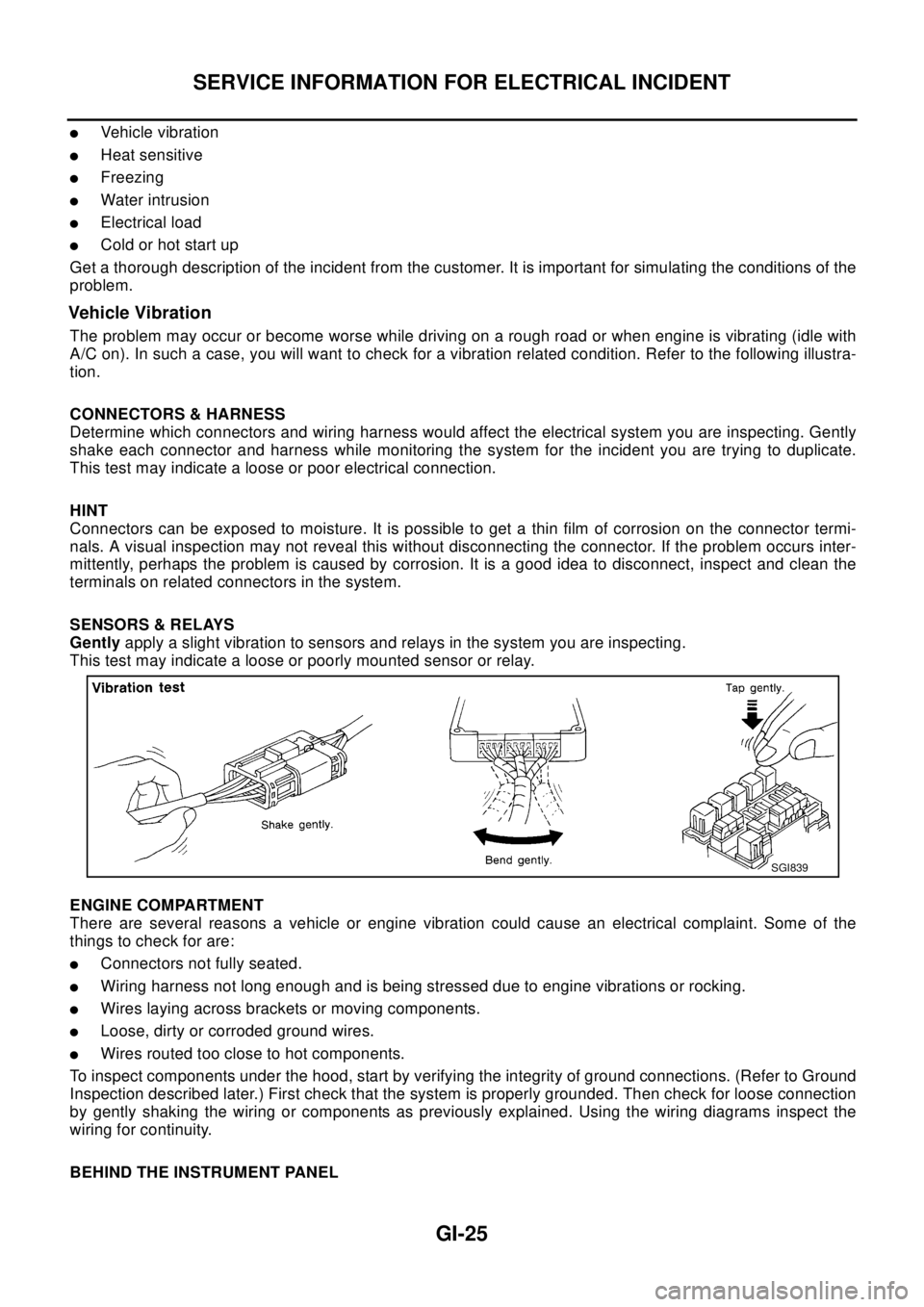
A/C on). In such a case, you will want to check for a vibration related condition. Refer to the following illustra-
tion.
CONNECTORS & HARNESS
Determine which connectors and wiring harness would affect the electrical system you are inspecting. Gently
shake each connector and harness while monitoring the system for the incident you are trying to duplicate.
This test may indicate a loose or poor electrical connection.
HINT
Connectors can be exposed to moisture. It is possible to get a thin film of corrosion on the connector termi-
nals. A visual inspection may not reveal this without disconnecting the connector. If the problem occurs inter-
mittently, perhaps the problem is caused by corrosion. It is a good idea to disconnect, inspect and clean the
terminals on related connectors in the system.
SENSORS & RELAYS
Gentlyapply a slight vibration to sensors and relays in the system you are inspecting.
This test may indicate a loose or poorly mounted sensor or relay.
ENGINE COMPARTMENT
There are several reasons a vehicle or engine vibration could cause an electrical complaint. Some of the
things to check for are:
lConnectors not fully seated.
lWiring harness not long enough and is being stressed due to engine vibrations or rocking.
lWires laying across brackets or moving components.
lLoose, dirty or corroded ground wires.
lWires routed too close to hot components.
To inspect components under the hood, start by verifying the integrity of ground connections. (Refer to Ground
Inspection described later.) First check that the system is properly grounded. Then check for loose connection
by gently shaking the wiring or components as previously explained. Using the wiring diagrams inspect the
wiring for continuity.
BEHIND THE INSTRUMENT PANEL
SGI839