clock NISSAN X-TRAIL 2003 Electronic Repair Manual
[x] Cancel search | Manufacturer: NISSAN, Model Year: 2003, Model line: X-TRAIL, Model: NISSAN X-TRAIL 2003Pages: 3066, PDF Size: 51.47 MB
Page 28 of 3066
AT-22
OVERALL SYSTEM
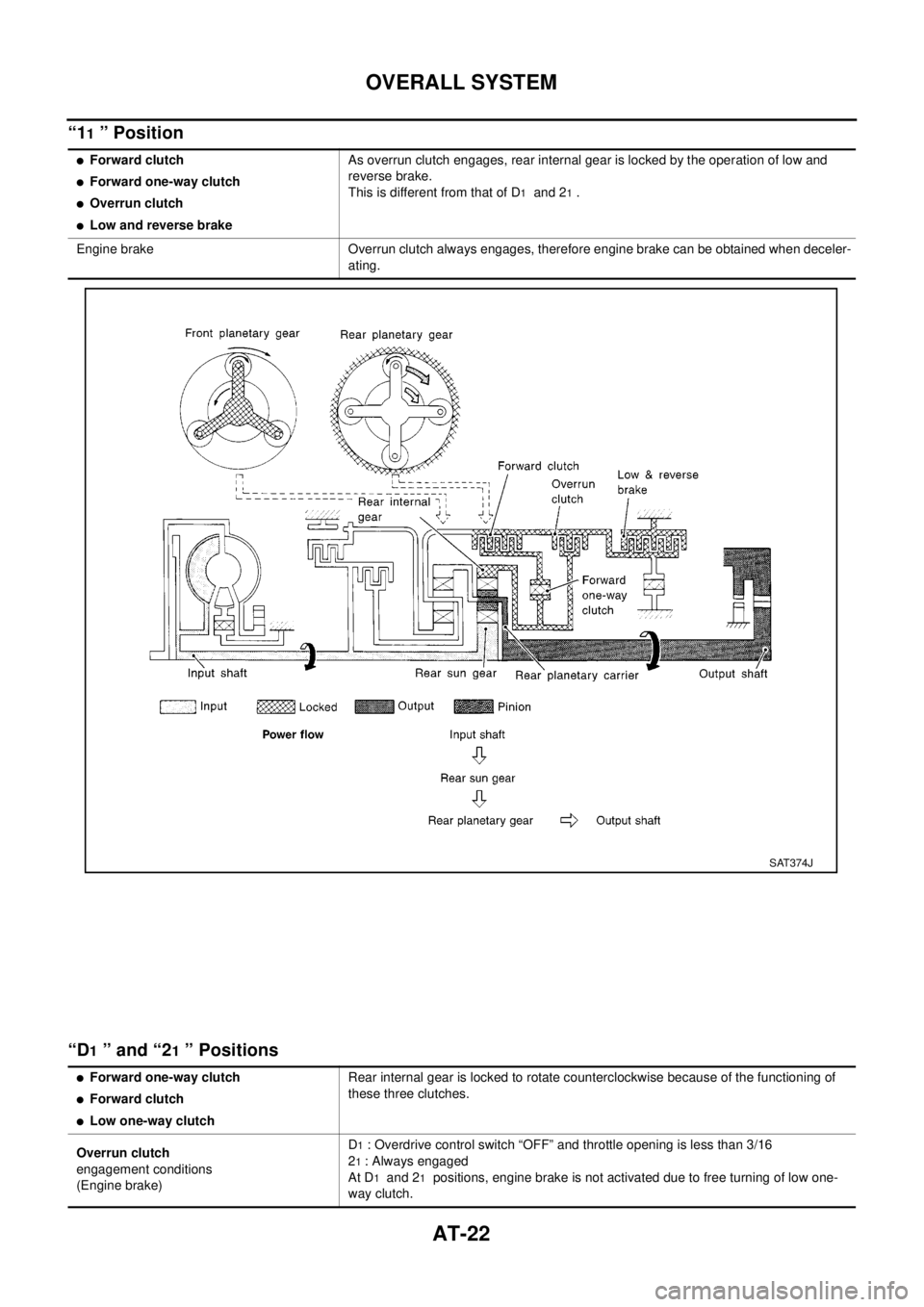
“11”Position
“D
1”and“21” Positions
lForward clutch
lForward one-way clutch
lOverrun clutch
lLow and reverse brakeAs overrun clutch engages, rear internal gear is locked by the operation of low and
reverse brake.
This is different from that of D
1and 21.
Engine brake Overrun clutch always engages, therefore engine brake can be obtained when deceler-
ating.
SAT374J
lForward one-way clutch
lForward clutch
lLow one-way clutchRear internal gear is locked to rotate counterclockwise because of the functioning of
these three clutches.
Overrun clutch
engagement conditions
(Engine brake)D
1: Overdrive control switch “OFF” and throttle opening is less than 3/16
2
1: Always engaged
At D
1and 21positions, engine brake is not activated due to free turning of low one-
way clutch.
Page 472 of 3066
![NISSAN X-TRAIL 2003 Electronic Repair Manual AT-466
[ALL]
DISASSEMBLY
DISASSEMBLY
PFP:31020
DisassemblyECS004LZ
1. Drain ATF through drain plug.
2. Remove torque converter.
3. Check torque converter one-way clutch using check tool as
shown at le](/img/5/57402/w960_57402-471.png "NISSAN X-TRAIL 2003 Electronic Repair Manual AT-466
[ALL]
DISASSEMBLY
DISASSEMBLY
PFP:31020
DisassemblyECS004LZ
1. Drain ATF through drain plug.
2. Remove torque converter.
3. Check torque converter one-way clutch using check tool as
shown at le")
AT-466
[ALL]
DISASSEMBLY
DISASSEMBLY
PFP:31020
DisassemblyECS004LZ
1. Drain ATF through drain plug.
2. Remove torque converter.
3. Check torque converter one-way clutch using check tool as
shown at left.
a. Insert check tool into the groove of bearing support built into
one-way clutch outer race.
b. When fixing bearing support with check tool, rotate one- way
clutch spline using screwdriver.
c. Check that inner race rotates clockwise only. If not, replace
torque converter assembly.
4. Remove A/T fluid charging pipe and fluid cooler tube.
SAT008D
SAT009D
SAT768J
Page 587 of 3066
PRECAUTIONS
ATC-9
C
D
E
F
G
H
I
K
L
MA
B
AT C
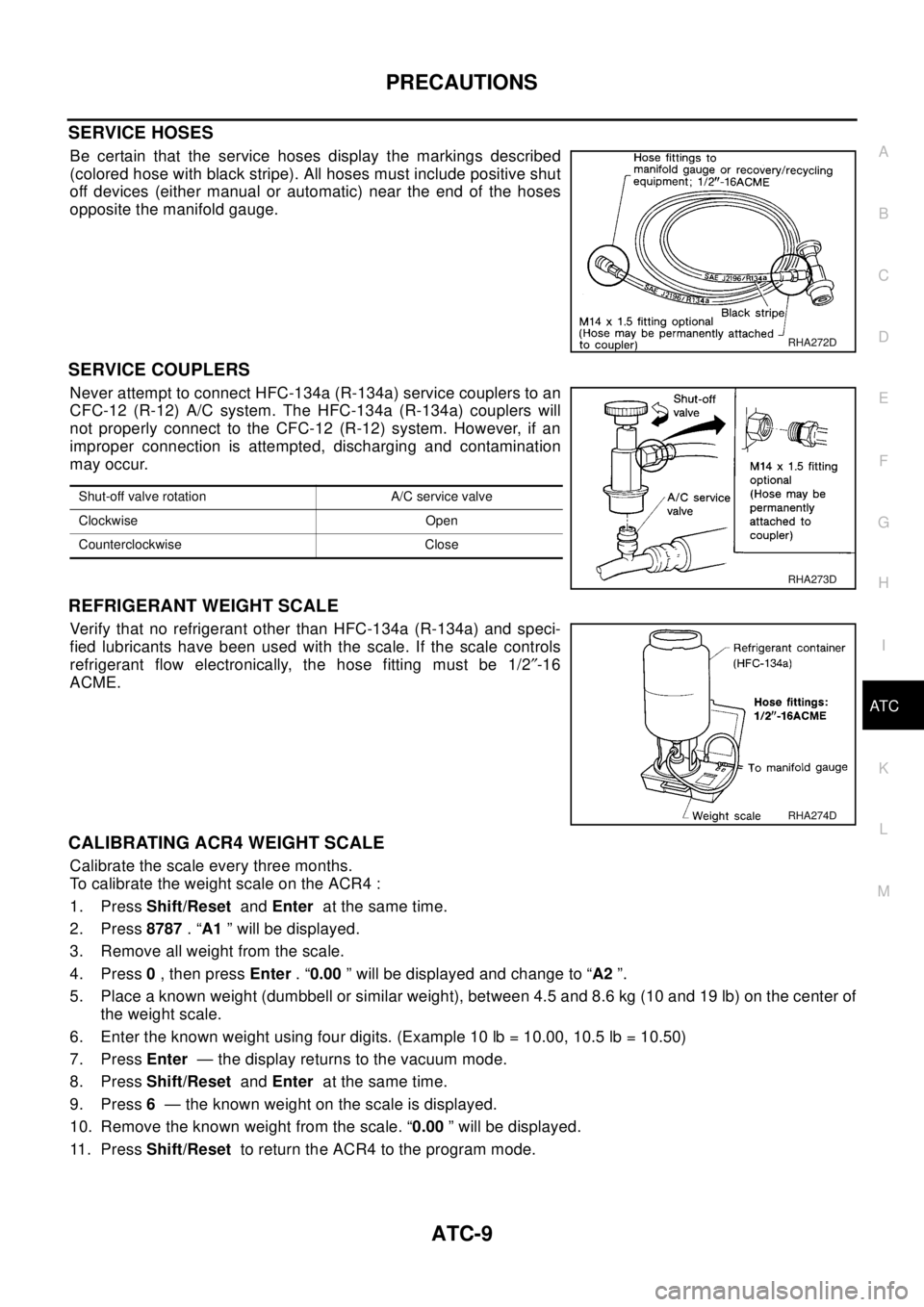
SERVICE HOSES
Be certain that the service hoses display the markings described
(colored hose with black stripe). All hoses must include positive shut
off devices (either manual or automatic) near the end of the hoses
opposite the manifold gauge.
SERVICE COUPLERS
Never attempt to connect HFC-134a (R-134a) service couplers to an
CFC-12 (R-12) A/C system. The HFC-134a (R-134a) couplers will
not properly connect to the CFC-12 (R-12) system. However, if an
improper connection is attempted, discharging and contamination
may occur.
REFRIGERANT WEIGHT SCALE
Verify that no refrigerant other than HFC-134a (R-134a) and speci-
fied lubricants have been used with the scale. If the scale controls
refrigerant flow electronically, the hose fitting must be 1/2²-16
ACME.
CALIBRATING ACR4 WEIGHT SCALE
Calibrate the scale every three months.
To calibrate the weight scale on the ACR4 :
1. PressShift/ResetandEnterat the same time.
2. Press8787.“A1” will be displayed.
3. Remove all weight from the scale.
4. Press0,thenpressEnter.“0.00” will be displayed and change to “A2”.
5. Place a known weight (dumbbell or similar weight), between 4.5 and 8.6 kg (10 and 19 lb) on the center of
the weight scale.
6. Enter the known weight using four digits. (Example 10 lb = 10.00, 10.5 lb = 10.50)
7. PressEnter— the display returns to the vacuum mode.
8. PressShift/ResetandEnterat the same time.
9. Press6— the known weight on the scale is displayed.
10. Remove the known weight from the scale. “0.00” will be displayed.
11 . P r e s sShift/Resetto return the ACR4 to the program mode.
RHA272D
Shut-off valve rotation A/C service valve
Clockwise Open
Counterclockwise Close
RHA273D
RHA274D
Page 622 of 3066
ATC-44
TROUBLE DIAGNOSIS
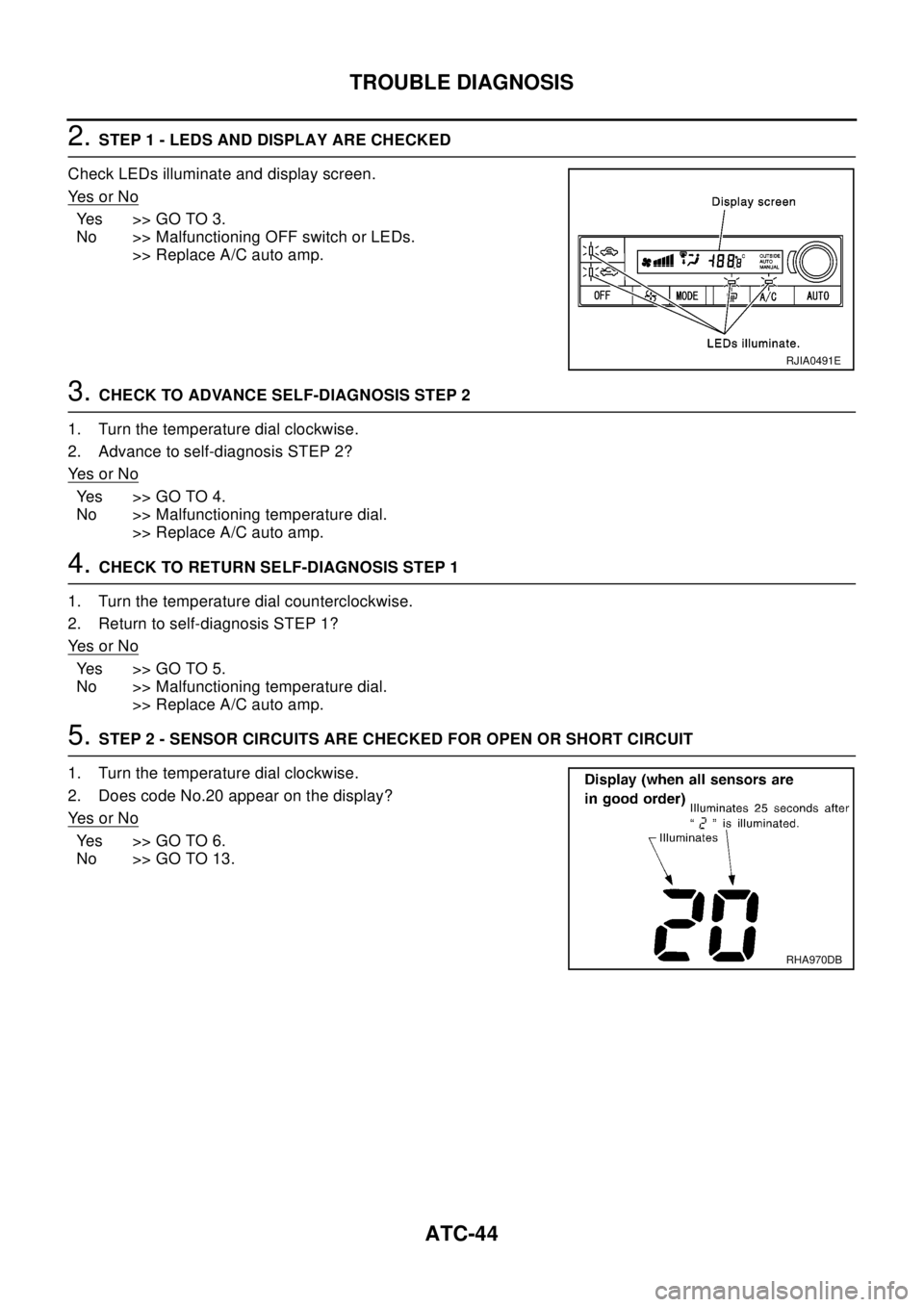
2.STEP 1 - LEDS AND DISPLAY ARE CHECKED
Check LEDs illuminate and display screen.
Ye s o r N o
Yes >>GOTO3.
No >> Malfunctioning OFF switch or LEDs.
>> Replace A/C auto amp.
3.CHECK TO ADVANCE SELF-DIAGNOSIS STEP 2
1. Turn the temperature dial clockwise.
2. Advance to self-diagnosis STEP 2?
Ye s o r N o
Yes >>GOTO4.
No >> Malfunctioning temperature dial.
>> Replace A/C auto amp.
4.CHECK TO RETURN SELF-DIAGNOSIS STEP 1
1. Turn the temperature dial counterclockwise.
2. Return to self-diagnosis STEP 1?
Ye s o r N o
Yes >>GOTO5.
No >> Malfunctioning temperature dial.
>> Replace A/C auto amp.
5.STEP 2 - SENSOR CIRCUITS ARE CHECKED FOR OPEN OR SHORT CIRCUIT
1. Turn the temperature dial clockwise.
2. Does code No.20 appear on the display?
Ye s o r N o
Yes >>GOTO6.
No >> GO TO 13.
RJIA0491E
RHA970DB
Page 623 of 3066
TROUBLE DIAGNOSIS
ATC-45
C
D
E
F
G
H
I
K
L
MA
B
AT C
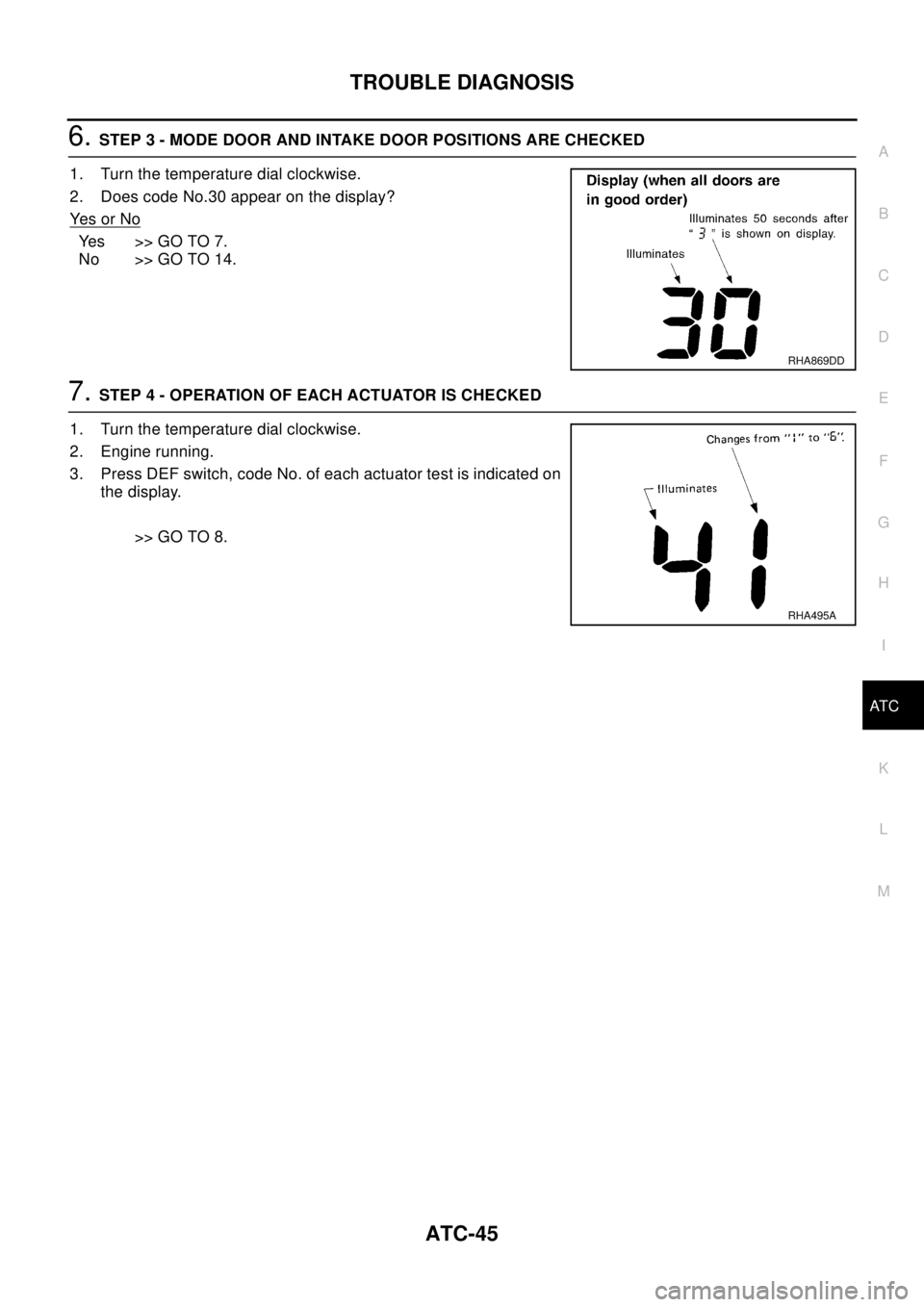
6.STEP 3 - MODE DOOR AND INTAKE DOOR POSITIONS ARE CHECKED
1. Turn the temperature dial clockwise.
2. Does code No.30 appear on the display?
Ye s o r N o
Yes >>GOTO7.
No >> GO TO 14.
7.STEP 4 - OPERATION OF EACH ACTUATOR IS CHECKED
1. Turn the temperature dial clockwise.
2. Engine running.
3. Press DEF switch, code No. of each actuator test is indicated on
the display.
>> GO TO 8.
RHA869DD
RHA495A
Page 624 of 3066
ATC-46
TROUBLE DIAGNOSIS
8.CHECK ACTUATORS
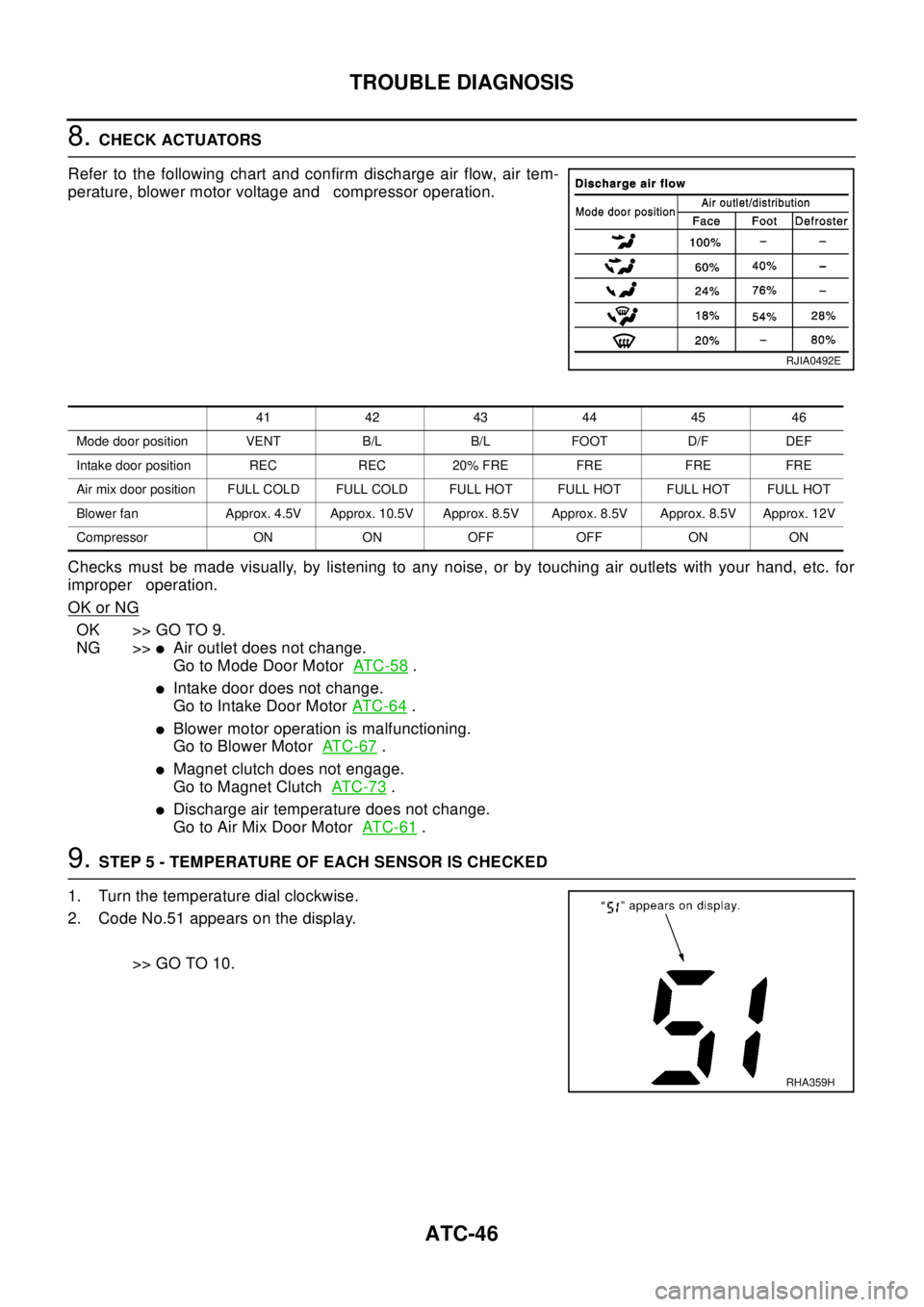
Refer to the following chart and confirm discharge air flow, air tem-
perature, blower motor voltage and compressor operation.
Checks must be made visually, by listening to any noise, or by touching air outlets with your hand, etc. for
improper operation.
OK or NG
OK >> GO TO 9.
NG >>
lAir outlet does not change.
Go to Mode Door MotorAT C - 5 8
.
lIntake door does not change.
Go to Intake Door MotorAT C - 6 4
.
lBlower motor operation is malfunctioning.
Go to Blower MotorAT C - 6 7
.
lMagnet clutch does not engage.
Go to Magnet ClutchAT C - 7 3
.
lDischarge air temperature does not change.
Go to Air Mix Door MotorAT C - 6 1
.
9.STEP 5 - TEMPERATURE OF EACH SENSOR IS CHECKED
1. Turn the temperature dial clockwise.
2. Code No.51 appears on the display.
>> GO TO 10.
RJIA0492E
41 42 43 44 45 46
Mode door position VENT B/L B/L FOOT D/F DEF
Intake door position REC REC 20% FRE FRE FRE FRE
Air mix door position FULL COLD FULL COLD FULL HOT FULL HOT FULL HOT FULL HOT
Blower fan Approx. 4.5V Approx. 10.5V Approx. 8.5V Approx. 8.5V Approx. 8.5V Approx. 12V
Compressor ON ON OFF OFF ON ON
RHA359H
Page 709 of 3066
REFRIGERANT LINES
ATC-131
C
D
E
F
G
H
I
K
L
MA
B
AT C
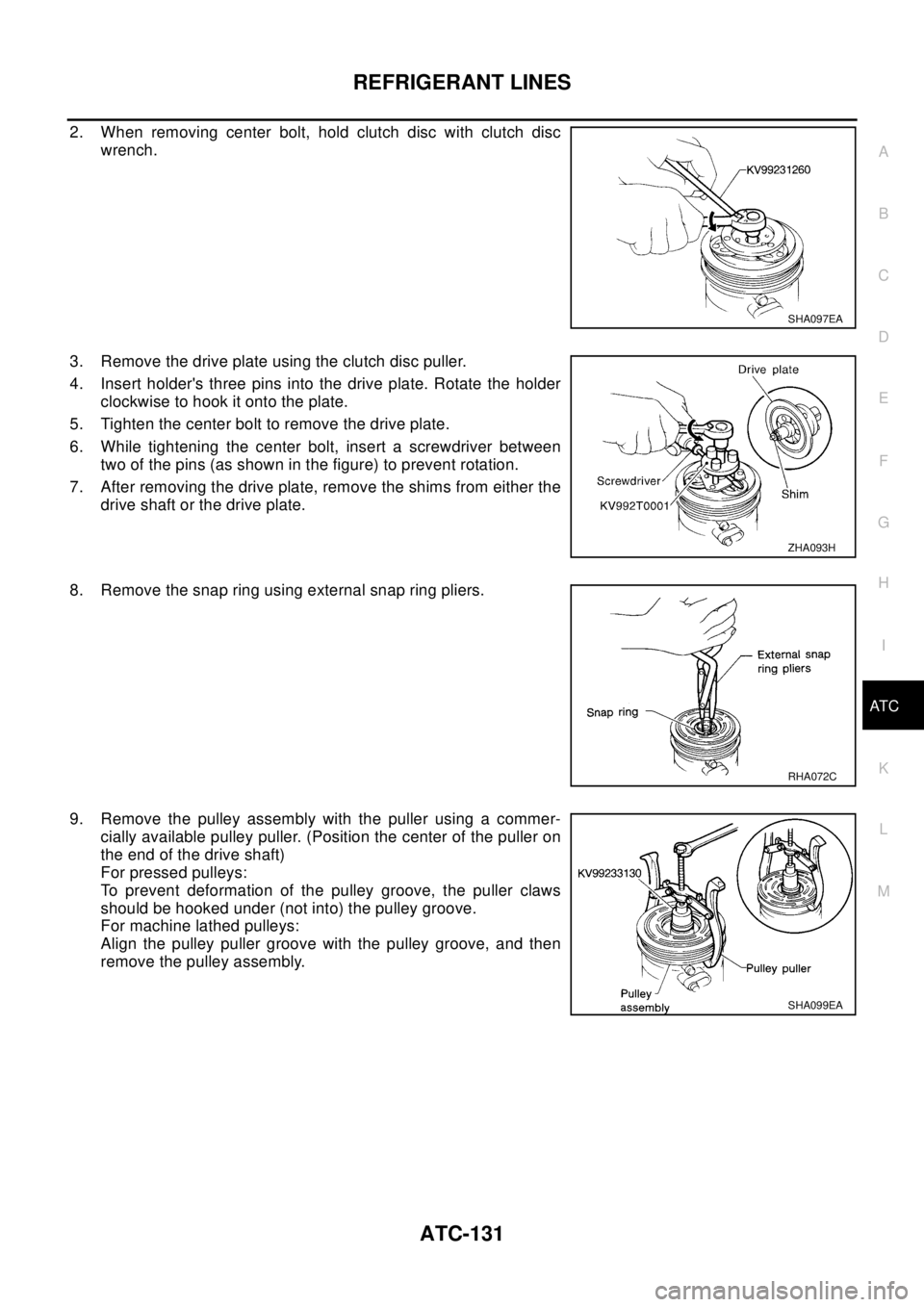
2. When removing center bolt, hold clutch disc with clutch disc
wrench.
3. Remove the drive plate using the clutch disc puller.
4. Insert holder's three pins into the drive plate. Rotate the holder
clockwise to hook it onto the plate.
5. Tighten the center bolt to remove the drive plate.
6. While tightening the center bolt, insert a screwdriver between
two of the pins (as shown in the figure) to prevent rotation.
7. After removing the drive plate, remove the shims from either the
drive shaft or the drive plate.
8. Remove the snap ring using external snap ring pliers.
9. Remove the pulley assembly with the puller using a commer-
cially available pulley puller. (Position the center of the puller on
the end of the drive shaft)
For pressed pulleys:
To prevent deformation of the pulley groove, the puller claws
should be hooked under (not into) the pulley groove.
For machine lathed pulleys:
Align the pulley puller groove with the pulley groove, and then
remove the pulley assembly.
SHA097EA
ZHA093H
RHA072C
SHA099EA
Page 722 of 3066

ATC-144
REFRIGERANT LINES
LUBRICANT
REFRIGERANT
ENGINE IDLING SPEED
Refer toATC-144, "ENGINE IDLING SPEED".
BELT TENSION
Refer to,EM-13, "Tension Adjustment"QR engine;EM-110, "Tension Adjustment"YD engine.
Displacement
cm3 (cu. in)/revMax. 184 (11.228)
110 (6.71)
Min. 14.5 (0.885)
Cylinder bore´stroke
mm (in)37 (1.46)´[2.3 - 28.6 (0.091 - 1.126)] -
Direction of rotation Clockwise (viewed from drive end)
Drive beltPoly V
ModelWith gasoline engine With diesel engine
CALSONIC KANSEI make V-6 ZEXEL VALEO make DKV-11G
Name Nissan A/C System Oil Type S Nissan A/C System Oil Type R
Part number KLH00-PAGS0 KLH00-PAGR0
Capacity
ml (lmp fl oz)Total in system 180 (6.3)
Compressor (Service part) charging
amount180 (6.3)
Ty p eHFC-134a (R-134a)
Capacity
kg (lb)0.50 (1.10)
Page 841 of 3066
BRAKE PEDAL
BR-7
C
D
E
G
H
I
J
K
L
MA
B
BR
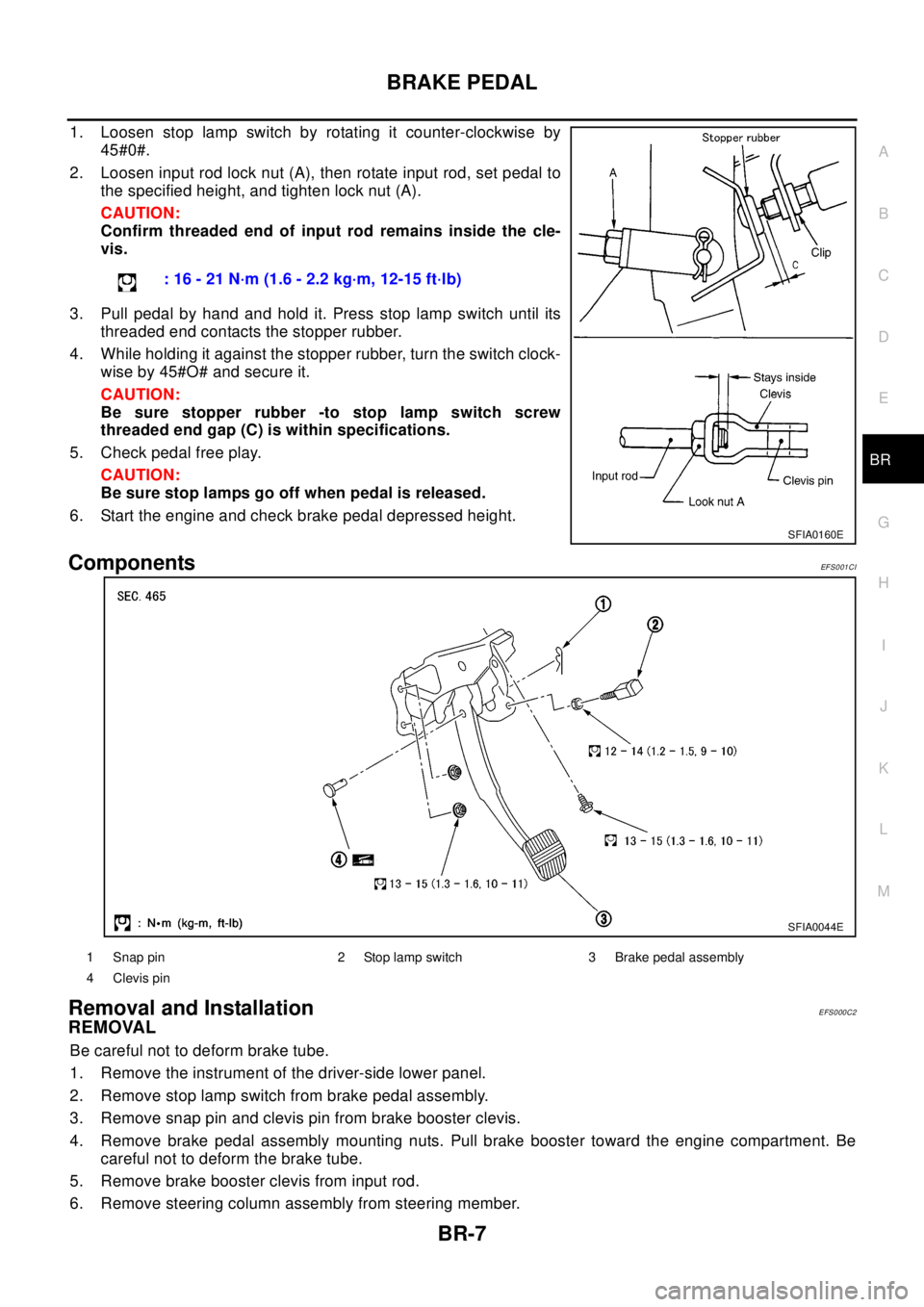
1. Loosen stop lamp switch by rotating it counter-clockwise by
45#0#.
2. Loosen input rod lock nut (A), then rotate input rod, set pedal to
the specified height, and tighten lock nut (A).
CAUTION:
Confirm threaded end of input rod remains inside the cle-
vis.
3. Pull pedal by hand and hold it. Press stop lamp switch until its
threaded end contacts the stopper rubber.
4. While holding it against the stopper rubber, turn the switch clock-
wise by 45#O# and secure it.
CAUTION:
Be sure stopper rubber -to stop lamp switch screw
threaded end gap (C) is within specifications.
5. Check pedal free play.
CAUTION:
Be sure stop lamps go off when pedal is released.
6. Start the engine and check brake pedal depressed height.
ComponentsEF S0 01 CI
Removal and InstallationEFS000C2
REMOVAL
Be careful not to deform brake tube.
1. Remove the instrument of the driver-side lower panel.
2. Remove stop lamp switch from brake pedal assembly.
3. Remove snap pin and clevis pin from brake booster clevis.
4. Remove brake pedal assembly mounting nuts. Pull brake booster toward the engine compartment. Be
careful not to deform the brake tube.
5. Remove brake booster clevis from input rod.
6. Remove steering column assembly from steering member.: 16 - 21 N·m (1.6 - 2.2 kg·m, 12-15 ft·lb)
SFIA0160E
SFIA0044E
1 Snap pin 2 Stop lamp switch 3 Brake pedal assembly
4 Clevis pin
Page 924 of 3066
![NISSAN X-TRAIL 2003 Electronic Repair Manual BRC-56
[ESP/TCS/ABS]
GENERAL INFORMATION
GENERAL INFORMATION
PFP:00000
Fail-SafeEFS0019S
ABS SYSTEM
If a malfunction occurs in the electrical system, the ABS warning lamp, ESP OFF indicator lamp, and](/img/5/57402/w960_57402-923.png "NISSAN X-TRAIL 2003 Electronic Repair Manual BRC-56
[ESP/TCS/ABS]
GENERAL INFORMATION
GENERAL INFORMATION
PFP:00000
Fail-SafeEFS0019S
ABS SYSTEM
If a malfunction occurs in the electrical system, the ABS warning lamp, ESP OFF indicator lamp, and")
BRC-56
[ESP/TCS/ABS]
GENERAL INFORMATION
GENERAL INFORMATION
PFP:00000
Fail-SafeEFS0019S
ABS SYSTEM
If a malfunction occurs in the electrical system, the ABS warning lamp, ESP OFF indicator lamp, and SLIP
indicator lamp in the meter will turn ON. In this condition, the ESP/TCS/ABS and EBD become one of the fol-
lowing conditions by the fail-safe function.
1. Only EBD operates. The same condition as that of models without ESP/TCS/ABS
2. ESP/TCS/ABS and EBD do not operate. Only normal brake operates on 4 wheels.
NOTE:
In the step 1 shown above, the self-diagnosis is carried out at the ignition switch is turned ON and when the
vehicle initial starts. ABS self-diagnosis noise may be heard as usual.
ESP/TCS SYSTEM
If a malfunction occurs in the electrical system, the ESP OFF indicator lamp and SLIP indicator lamp in the
meter turn on. In this condition, ESP/TCS will be deactivated and it becomes equal to that of models without
ESP/TCS. However, ABS is controlled normally.
If a malfunction occurs in the throttle control system, ESP/TCS control does not operate. Only ABS control
operates normally.
CAUTION:
If the fail-safe function operates, carry out the self-diagnosis for ESP/TCS/ABS control system.
Hydraulic CircuitEFS0019T
CAUTION:
lWhen installing, check for twist and fracture.
lMake sure that there is no interference with other parts when turning the steering clockwise or
counter clockwise.
lThe brake piping is an important safety part. If a brake fluid leak is detected, always disassemble
and replace with a new one, if necessary.
ABS FunctionsEFS0019U
1. In cases of braking suddenly or braking on slippery road (ice road), ABS functions prevent wheels from
lock, improve the stability in sudden braking, and make efficient avoidance of obstacles with steering
manipulation by detecting 4-wheel speed and controlling 4-wheel brake fluid pressure.
2. EBD is integrated in ESP/TCS/ABS system.
CAUTION:
lDuring ABS operation, the brake pedal lightly vibrates and its mechanical noise may be heard.
This is a normal condition.
SFIA0346E