page 48 Oldsmobile Alero 2003 s Workshop Manual
[x] Cancel search | Manufacturer: OLDSMOBILE, Model Year: 2003, Model line: Alero, Model: Oldsmobile Alero 2003Pages: 354, PDF Size: 16.74 MB
Page 205 of 354
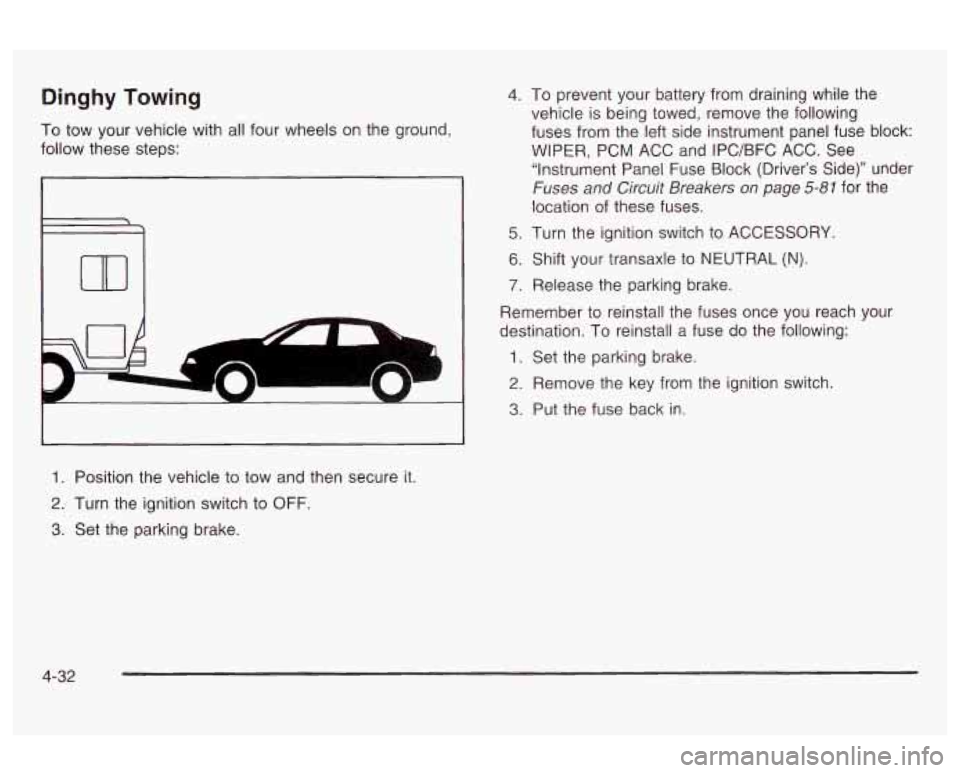
Dinghy Towing
To tow your vehicle with all four wheels on the ground,
follow these steps:
I
L
m
1. Position the vehicle to tow and then secure it.
2. Turn the ignition switch to OFF.
3. Set the parking brake
4. To prevent your battery from draining while the
vehicle is being towed, remove the following
fuses from the left side instrument panel fuse block:
WIPER, PCM ACC and IPC/BFC ACC. See
“Instrument Panel Fuse Block (Driver’s Side)” under
Fuses and Circuit Breakers on page 5-81 for the
location
of these fuses.
5. Turn the ignition switch to ACCESSORY.
6. Shift your transaxle to NEUTRAL (N).
7. Release the parking brake.
Remember to reinstall the fuses once you reach your
destination. To reinstall a fuse do the following:
1. Set the parking brake.
2. Remove the key from the ignition switch.
3. Put the fuse back in
4-32
Page 211 of 354
Weight of the Trailer Tongue
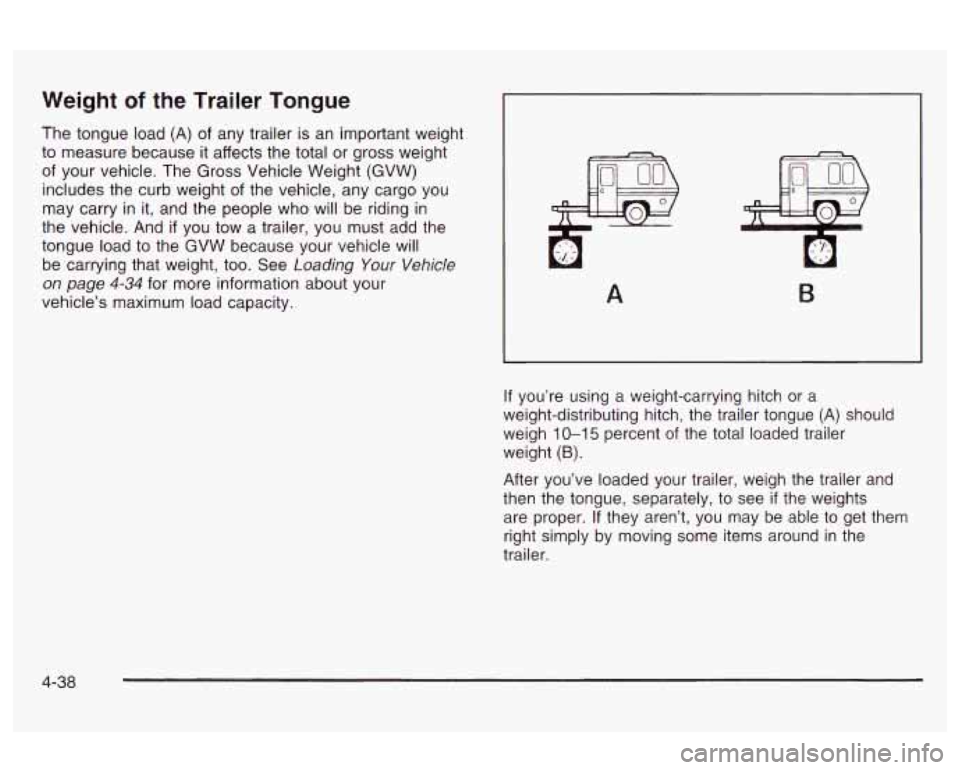
The tongue load (A) of any trailer is an important weight
to measure because it affects the total or gross weight
of your vehicle. The Gross Vehicle Weight (GVW)
includes the curb weight of the vehicle, any cargo you
may carry
in it, and the people who will be riding in
the vehicle. And
if you tow a trailer, you must add the
tongue load to the GVW because your vehicle will
be carrying that weight, too. See
Loading Your Vehicle
on page
4-34 for more information about your
vehicle’s maximum load capacity. A B
If you’re using a weight-carrying hitch or a
weight-distributing hitch, the trailer tongue
(A) should
weigh
10-1 5 percent of the total loaded trailer
weight
(B).
After you’ve loaded your trailer, weigh the trailer and
then the tongue, separately, to see
if the weights
are proper. If they aren’t, you may be able to get them
right simply by moving some items around in the
trailer.
4-38
Page 212 of 354
Total Weight on Your Vehicle’s Tires
Be sure your vehicle’s tires are inflated to the upper limit
for cold tires. You’ll find these numbers on the Tire
Loading Information label at the rear edge of the driver’s
door or see
Loading Your Vehicle on page 4-34. Then
be sure you don’t go over the
GVW limit for your vehicle,
including the weight of the trailer tongue.
Hitches
It’s important to have the correct hitch equipment.
Crosswinds, large trucks going by and rough roads are
a few reasons why you’ll need the right hitch. Here
are some rules to follow:
The rear bumper on your vehicle is not intended for
hitches. Do not attach rental hitches or other
bumper-type hitches to it. Use only a
frame-mounted hitch that does not attach to the
bumper.
Will yo11 have to make any holes in the body nf
your vehicle when you install a trailer hitch? If
you do, then be sure to seal the holes later when
you remove the hitch. If you don’t seal them, deadly
carbon monoxide (CO) from your exhaust can get
into your vehicle. See
Engine Exhaust on
page
2-30. Dirt ana water can, too.
Safety Chains
You should always attach chains between your vehicle
and your trailer. Cross the safety chains under the
tongue of the trailer
so that the tongue will not drop to
the road
if it becomes separated from the hitch.
Instructions about safety chains may be provided by the
hitch manufacturer or by the trailer manufacturer.
Follow the manufacturer’s recommendation for attaching
safety chains and do not attach them to the bumper.
Always leave just enough slack
so you can turn
with your rig. And, never allow safety chains to drag on
the ground.
Trailer Brakes
Does your trailer have its own brakes?
Be sure to read and
follow the instructions for the trailer
brakes
so you’ll be able to install, adjust and maintain
them properly. And because you may have anti-lock
brakes, do not try to tap into your vehicle’s brake
system.
If you do, both systems won’t work well,
e!- 2! 2!!.
4-39
Page 215 of 354
When You Are Ready to Leave After
Parking on a Hill
1. Apply your regular brakes and hold the pedal down
while you:
start your engine,
shift into a gear, and
release the parking brake.
2. Let up on the brake pedal.
3. Drive slowly until the trailer is clear of the chocks.
4. Stop and have someone pick up and store the
chocks.
Maintenance When Trailer Towing
Your vehicle will need service more often when you’re
pulling a trailer. See the Maintenance Schedule for more
on this. Things that are especially important in trailer
operation are automatic transaxle fluid (don’t overfill),
engine oil, drive belt, cooling system and brake system.
Each of these is covered in this manual, and the
Index will help you find them quickly. If you’re trailering,
it’s a good idea to review this information before you
start your trip.
Check periodically to see that all hitch nuts and bolts
are tight.
Engine Cooling When Trailer Towing
Your cooling system may temporarily overheat during
severe operating conditions. See
Engine Overheating on
page
5-26.
4-42
Page 219 of 354
Doing Your Own Service Work
If you want to do some of your own service work, you’ll
want to use the proper service manual. It tells you
much more about how to service your vehicle than this
manual can. To order the proper service manual,
see
Service Publications Ordering Information on
page
7- 10.
Your vehicle has an air bag system. Before attempting
to do your own service work, see
Servicing Your Air
Bag-Equipped Vehicle on page 1-59.
You should keep a record with all parts receipts and list
the mileage and the date of any service work you
perform. See
Part E: Maintenance Record on page 6- 16.
You can be injured and your vehicle could be
damaged if you try to do service work on a
vehicle without knowing enough about
it.
Be sure you have sufficient knowledge,
experience, the proper replacement parts and tools before you attempt any vehicle
maintenance task.
Be sure to use the proper nuts, bolts and
other fasteners. “English” and “metric”
fasteners can be easily confused.
If you
use the wrong fasteners, parts can later
break
or fall off. You could be hurt.
Adding Equipment to the Outside of
Your Vehicle
Things you might add to the outside of your vehicle can
affect the airflow around it. This may cause wind
noise and affect windshield washer performance. Check
with your dealer before adding equipment to the
outside
of your vehicle.
5-4
Page 221 of 354
California Fuel
If your vehicle is certified to meet California Emission
Standards (see the underhood emission control label), it
is designed to operate on fuels that meet California
specifications.
If this fuel is not available in states
adopting California emissions standards, your vehicle
will operate satisfactorily on fuels meeting federal
specifications, but emission control system performance
may be affected. The malfunction indicator lamp may
turn on (see
Malfunction indicator Lamp on page 3-31 )
and your vehicle may fail a smog-check test. If this
occurs, return to your authorized GM dealer for
diagnosis. If it is determined that the condition is caused
by the type of fuel used, repairs may not be covered
by your warranty.
Additives
To provide cleaner air, all gasolines in the United States
are now required to contain additives that will help
prevent engine and fuel system deposits from forming,
allowing your emission control system to work
properly. You should not have to add anything to your
fuel. Gasolines containing oxygenates, such as
ethers and ethanol, and reformulated gasolines may be
available in your area to contribute to clean air.
General Motors recommends that you use these
gasolines, particularly
if they comply with the
specifications described earlier.
Notices Your vehicle was not designed for fuel that
contains methanol. Don’t use fuel containing
methanol. It can corrode metal parts in your fuel
system and also damage the plastic and rubber
parts. That damage wouldn’t be covered under your
warranty.
Some gasolines that are not reformulated for low
emissions may contain an octane-enhancing additive
called methylcyclopentadienyl manganese tricarbonyl
(MMT); ask the attendant where you buy gasoline
whether the fuel contains MMT. General Motors does
not recommend the use of such gasolines. Fuels
containing MMT can reduce the life of spark plugs and
the performance of the emission control system may
be affected. The malfunction indicator lamp may turn on.
If this occurs, return to your authorized GM dealer for
service.
Fuels in Foreign Countries
If you plan on driving in another country outside the
United States or Canada, the proper fuel may be hard
to find. Never use leaded gasoline or any other fuel
not recommended in the previous text on fuel. Costly
repairs caused by use of improper fuel wouldn’t be
covered by your warranty.
To check the fuel availability, ask an auto club, or
contact a major oil company that does business in the
country where you’ll be driving.
5-6
Page 223 of 354
If you get fuel on yourself and then somett --g
ignites it, you could be badly burned. Fuel can
spray out on you if you open the fuel cap too
quickly. This spray can happen
if your tank is
nearly full, and
is more likely in hot weather.
Open the fuel cap slowly and wait for any “hiss” noise to stop. Then unscrew the cap all the way.
Be careful not to spill fuel. Clean fuel from painted
surfaces as soon as possible. See
Cleaning the Outside
of Your Vehicle on page 5-75.
When you put the fuel cap back on, turn it to the right
(clockwise) until you hear a clicking sound. Make
sure you fully install the cap. The diagnostic system can
determine
if the fuel cap has been left off or improperly
installed. This would allow fuel to evaporate into the
atmosphere. See
Malfunction lndicator Lamp on
page
3-31.
Notice: If you need a new fuel cap, be sure to get
the
right type. Your dealer can get one for you. If you
get the wrong type,
it may not fit properly. This may
cause your malfunction indicator lamp to light and
may damage your fuel tank and emissions system.
See “Malfunction lndicator Lamp”
in the Index.
Filling a Portable Fuel Container
m-=
Never fill a portable fuel container while it is in
your vehicle. Static electricity discharge from
the container can ignite the gasoline vapor.
You can be badly burned and your vehicle
damaged if this occurs. To help avoid injury to
you and others:
Dispense gasoline only into approved
containers.
Do not fill a container while it is inside a
vehicle, in a vehicle’s trunk, pickup bed or
on any surface other than the ground.
Bring the fill nozzle in contact with the
inside of the fill opening before operating
the nozzle. Contact should be maintained until the filling is complete.
Don’t smoke while pumping gasoline.
5-8
Page 230 of 354
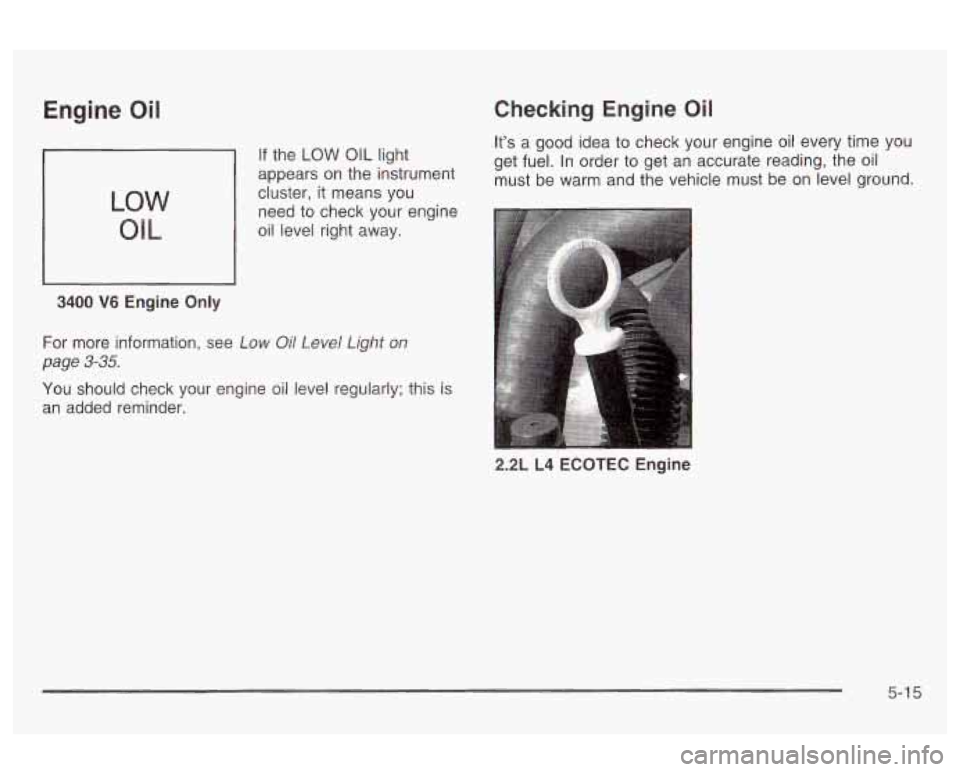
Engine Oil
LOW
OIL I
If the LOW OIL light
appears on the instrument
cluster, it means you
need to check your engine
oil level right away.
L
3400 V6 Engine Only
For more information, see
Low Oil Level Light on
page 3-35.
YOU should check your engine oil level regularly; this is
an added reminder.
Checking Engine Oil
It’s a good idea to check your engine oil every time you
get fuel. In order to get an accurate reading, the
oil
must be warm and the vehicle must be on level ground.
2.2L L4
ECOTEC Engine
5-1 5
Page 231 of 354
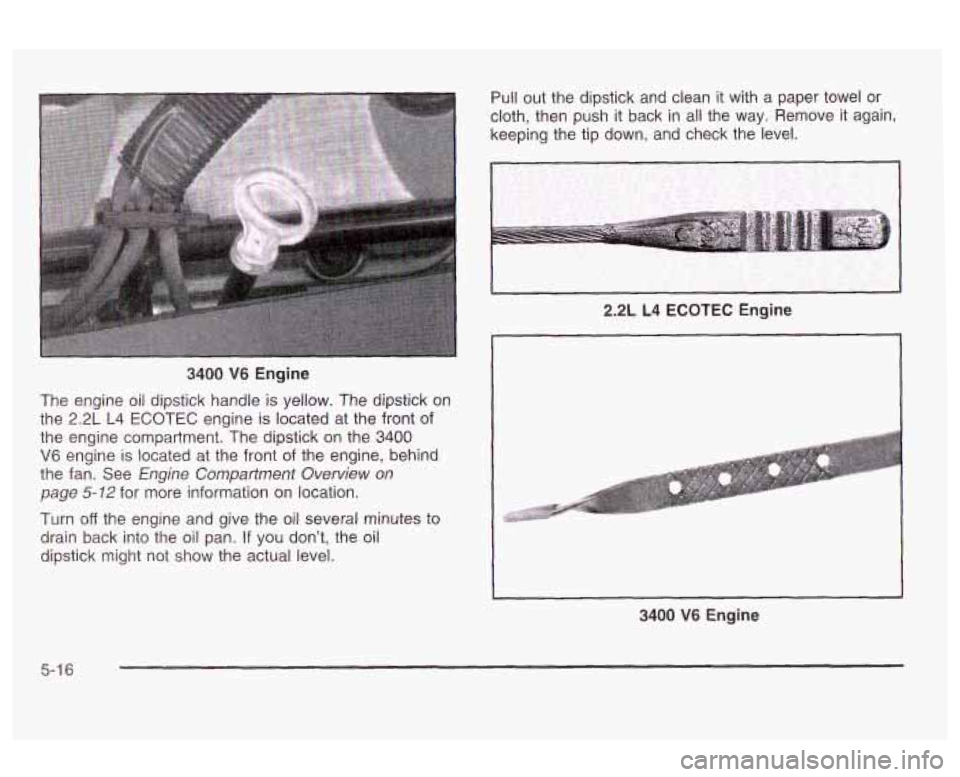
Pull out the dipstick and clean it with a paper towel or
cloth, then push it back in all the way. Remove it again,
keeping the tip down, and check the level.
3400 V6 Engine
The engine
oil dipstick handle is yellow. The dipstick on
the
2.2L L4 ECOTEC engine is located at the front of
the engine compartment. The dipstick on the
3400
V6 engine is located at the front of the engine, behind
the fan. See
Engine Compartment Overview on
page
5-12 for more information on location.
Turn
off the engine and give the oil several minutes to
drain back into the oil pan.
If you don’t, the oil
dipstick might not show the actual level.
I
3400 V6 Engine
5-1 6
Page 232 of 354
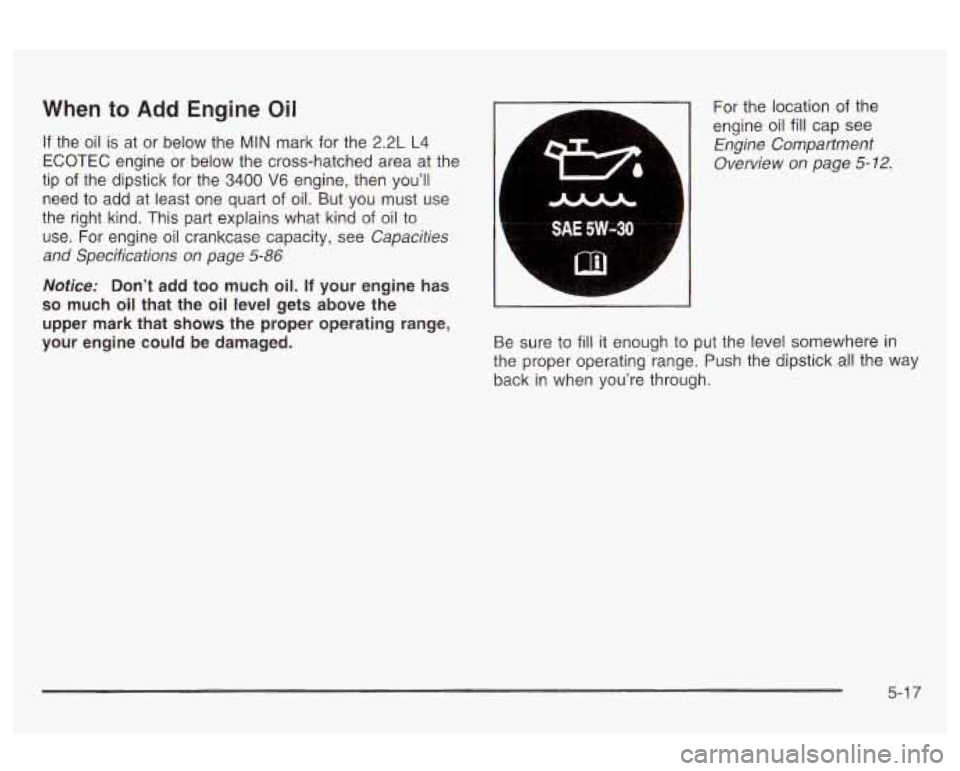
When to Add Engine Oil
If the oil is at or below the MIN mark for the 2.2L L4
ECOTEC engine or below the cross-hatched area at the
tip
of the dipstick for the 3400 V6 engine, then you’ll
need to add at least one quart of oil. But you must use
the right kind. This part explains what kind
of oil to
use. For engine oil crankcase capacity, see
Capacities
and Specifications
on page 5-86
Notice: Don’t add too much oil. If your engine has
so much oil that the oil level gets above the
upper mark that shows the proper operating range,
your engine could be damaged.
I
For the location of the
engine oil
fill cap see
IA
SAE 5W-30
El
Be sure to fill it enough to put the level somewhere in
the proper operating range. Push the dipstick all the way
back in when you’re through.
5-1 7