page 48 Oldsmobile Alero 2003 s Manual Online
[x] Cancel search | Manufacturer: OLDSMOBILE, Model Year: 2003, Model line: Alero, Model: Oldsmobile Alero 2003Pages: 354, PDF Size: 16.74 MB
Page 285 of 354
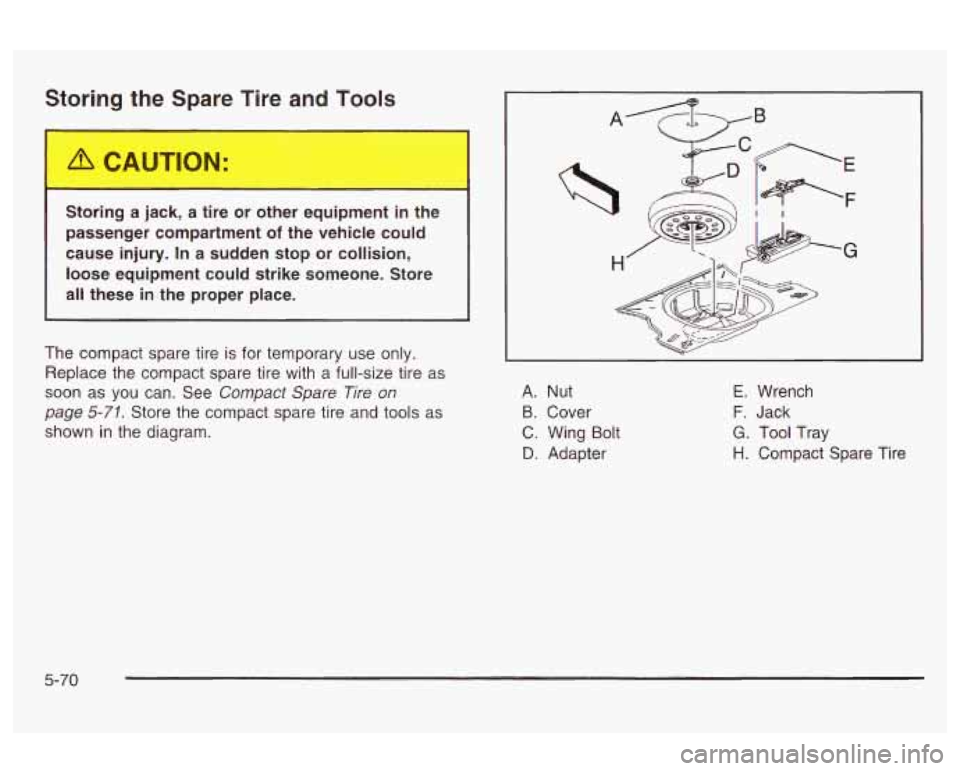
Storing the Spare Tire and Tools
StG..ng a jack, a tire or other equipment in the
passenger compartment
of the vehicle could
cause injury. In a sudden stop or collision,
loose equipment could strike someone. Store
all these in the proper place.
The compact spare tire is for temporary use
only.
Replace the compact spare tire with a full-size tire as
soon as
you can. See Compact Spare Tire on
page 5-71. Store the compact spare tire and tools as
shown in the diagram. A.
Nut
B. Cover
C. Wing Bolt
D. Adapter
E. Wrench
F. Jack
G. Tool Tray
H. Compact Spare Tire
5-70
Page 288 of 354
FabricKarpet
Your dealer has cleaners for the cleaning of fabric
and carpet. They will clean normal spots and stains
very well.
You can get GM
- approved cleaning products from
your dealer. See
GM Vehicle Care/Appearance
Materials
on page 5-78.
Here are some cleaning tips:
a
a
-.
Always read the instructions on the cleaner label.
Clean up stains as soon as you can
- before
they set.
Carefully scrape
off any excess stain.
Use
a dean cioth or sponge, and change io a cieari
area often. A soft brush may be used if stains are
stubborn.
If a ring forms on fabric after spot cleaning, clean
the entire area immediately or it will set.
Using Cleaner on Fabric
1. Vacuum and brush the area to remove any
loose dirt.
2. Always clean a whole trim panel or section. Mask
surrounding trim along stitch or welt lines.
3. Follow the directions on the container label.
4. Apply cleaner with a clean sponge. Don’t saturate
the material and don’t rub it roughly.
5. As soon as you’ve cleaned the section, use a
6. Wipe cleaned area with a clean, water-dampened
7. Wipe with a clean cloth and let dry.
sponge
to remove any excess
cleaner.
towel or cloth.
Special Fabric Cleaning Problems
Stains caused by such things as catsup, coffee (black),
egg, fruit, fruit juice, milk, soft drinks, vomit, urine
and blood can be removed as follows:
1. Carefully scrape off excess stain, then sponge the
2. If a stain remains, follow the cleaner instructions
soiled
area with cool water.
described earlier.
3. If an odor lingers after cleaning vomit or urine, treat
the area with a watedbaking soda solution:
1 teaspoon (5 ml) of baking soda to 1 cup (250 ml)
of lukewarm water.
4. Let dry.
Stains caused by candy, ice cream, mayonnaise, chili
sauce and unknown stains can be removed as follows:
1. Carefully scrape off excess stain.
2. Clean with cool water and allow to dry completely.
3. If a stain remains, follow the cleaner instructions
described earlier.
5-73
Page 289 of 354
Vinyl
Use warm water and a clean cloth.
0 Rub with a clean, damp cloth to remove dirt. You
may have to do this more than once.
Things like tar, asphalt and shoe polish will stain if
you don’t get them off quickly. Use a clean cloth
and vinyl/leather cleaner. See your dealer for
this product.
Leather
Use a soft cloth with lukewarm water and a mild soap or
saddle soap and wipe dry with a soft cloth. Then, let
the leather dry naturally.
Do not use heat to dry.
For stubborn stains, use a leather cleaner. See your
dealer for this product.
Never use oils, varnishes, solvent-based or abrasive
cleaners, furniture polish or shoe polish on leather.
Soiled or stained leather should be cleaned
immediately. If dirt is allowed
to work into the finish,
it can harm the leather.
Top of the Instrument Panel
Use only mild soap and water to clean the top surfaces
of the instrument panel. Sprays containing silicones
or waxes may cause annoying reflections in the
windshield and even make it difficult to see through the
windshield under certain conditions.
Interior Plastic Components
Use only a mild soap and water solution on a soft cloth
or sponge. Commercial cleaners may affect the
surface finish.
Glass Surfaces
Glass should be cleaned often. GM Glass Cleaner or a
liquid household glass cleaner will remove normal
tobacco smoke and dust films on interior glass. See
GM
Vehicle Care/Appearance Materials on page
5-78.
Notice: Don’t use abrasive cleaners on glass,
because they may cause scratches. Avoid placing
decals on the inside rear window, since they
may have to be scraped
off later. If abrasive cleaners
are used on the inside
of the rear window, an
electric defogger element may be damaged. Any
temporary license should not be attached across the
defogger grid.
5-74
Page 290 of 354

Care of Safety Belts
Keep P+s clean and dry.
Do noi ,,,,ch or dye safety belts. If you do, it
may severely weaken them. In a crash, they
might not be able to provide adequate
protection. Clean safety belts only with mild
soap and lukewarm water.
Weatherstrips
Silicone grease on weatherstrips will make them last
longer, seal better, and not stick or squeak. Apply
silicone grease with a clean cloth at least every six
months. During very cold, damp weather more frequent
Fluids and Lubricants on page 6-15.
s.4~y,,”u..“. Qnnli,-Q+inn I I ml
I ,-J UY ha rqgIrpc!- spp Psfl !-J: .Rqc_nmrnended
Cleaning the Outside of
Your Vehicle
The paint finish on your vehicle provides beauty, depth
of color, gloss retention and durability.
Washing Your Vehicle
The best way to preserve your vehicle’s finish is to keep
it clean by washing it often with lukewarm or cold
water.
Don’t wash your vehicle in the direct rays
of the sun.
Use a car washing soap. Don’t use strong soaps
or chemical detergents. Be sure to rinse the vehicle
well, removing all soap residue completely.
You can get
GM-approved cleaning products from your dealer.
See
GM Vehicle Care/Appearance Materials on
page 5-78. Don’t use cleaning agents that are petroleum
based, or that contain acid or abrasives. All cleaning
agents should be flushed promptly and not allowed
to dry on the surface, or they could stain. Dry the finish
with a soft, clean chamois or an all-cotton towel to
avoid surface scratches and water spotting.
High pressure car washes may cause water to enter
your vehicle.
5-75
Page 291 of 354
Cleaning Exterior Lamps/Lenses
Use only lukewarm or cold water, a soft cloth and a car
washing soap to clean exterior lamps and lenses.
Follow instructions under “Washing Your Vehicle.”
Finish Care
Occasional waxing or mild polishing of your vehicle by
hand may be necessary to remove residue from the
paint finish. You can get GM-approved cleaning products
from your dealer. See
GM Vehicle Care/Appearance
Materials
on page 5-78.
Your vehicle has a “basecoatklearcoat” paint finish. The
clearcoat gives more depth and gloss to the colored
basecoat. Always use waxes and polishes that are
non-abrasive and made for a basecoatklearcoat paint
finish.
Notice: Machine compounding or aggressive
polishing on a basecoatklearcoat paint finish may
dull the finish or leave swirl marks.
Foreign materials such as calcium chloride and other
salts, ice melting agents, road oil and tar, tree sap, bird
droppings, chemicals from industrial chimneys, etc.,
can damage your vehicle’s finish
if they remain
on painted surfaces. Wash the vehicle
as soon as
possible.
If necessary, use non-abrasive cleaners that
are marked safe for painted surfaces to remove
foreign matter. Exterior painted
surfaces are subject to aging, weather
and chemical fallout that can take their toll over a
period of years. You can help to keep the paint finish
looking new by keeping your vehicle garaged or covered
whenever possible.
Windshield and Wiper Blades
If the windshield is not clear after using the windshield
washer, or
if the wiper blade chatters when running,
wax, sap or other material may be on the blade or
windshield.
Clean the outside of the windshield with a full-strength
glass cleaning liquid. The windshield is clean if beads do
not form when you rinse it with water.
Grime from the windshield will stick to the wiper blades
and affect their performance. Clean the blade by
wiping vigorously with a cloth soaked in full-strength
windshield washer solvent. Then rinse the blade
with water.
Check the wiper blades and clean them as necessary;
replace blades that look worn.
5-76
Page 294 of 354
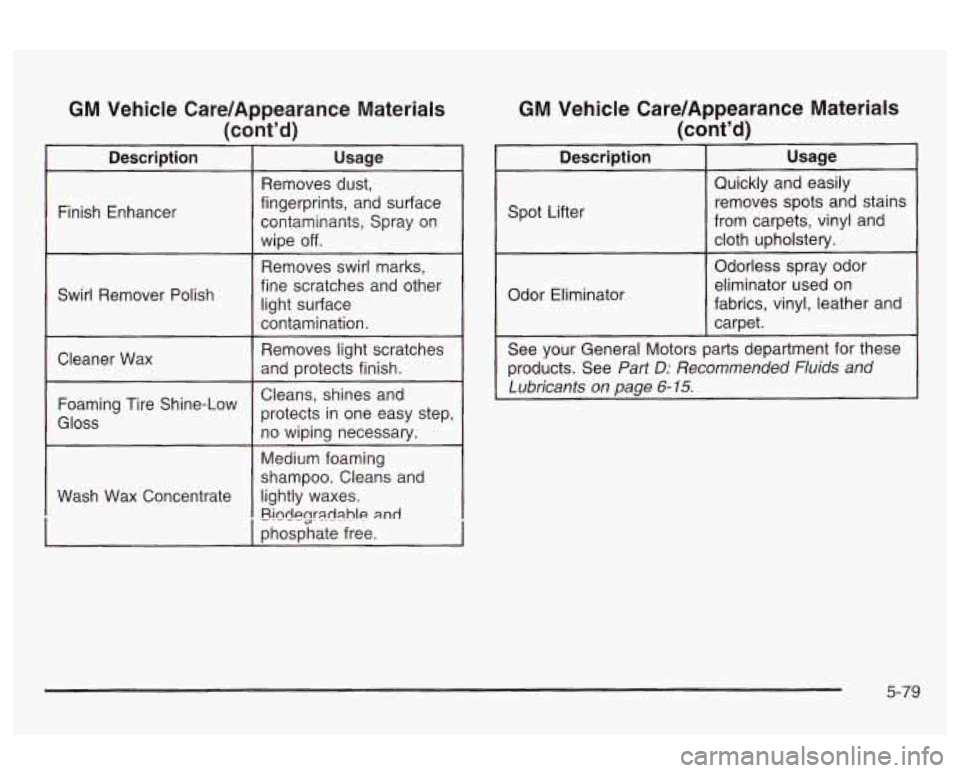
GM Vehicle Care/Appearance Materials
(cont’d) GM
Vehicle Care/Appearance Materials
kont’d)
Description Usage
Finish Enhancer Removes dust,
fingerprints, and surface
contaminants, Spray on
wipe
off.
Removes swirl marks,
fine scratches and other
light surface
contamination.
Swirl Remover Polish
Cleaner Wax
I
Removes light scratches
and protects finish.
Medium foaming
shampoo. Cleans and
~i~cjmr~rJ~hle and
Wash Wax Concentrate lightly waxes.
I phosphate free. Description
Usage
Quickly and easily
removes spots and stains
from carpets, vinyl and
cloth upholstery.
Odorless spray odor
Spot
Lifter
Odor Eliminator eliminator
used on
fabrics, vinyl, leather and
carDet.
See your General Motors parts department for these
products. See
Part D: Recommended fluids and
Lubricants on page 6- 15.
5-79
Page 296 of 354
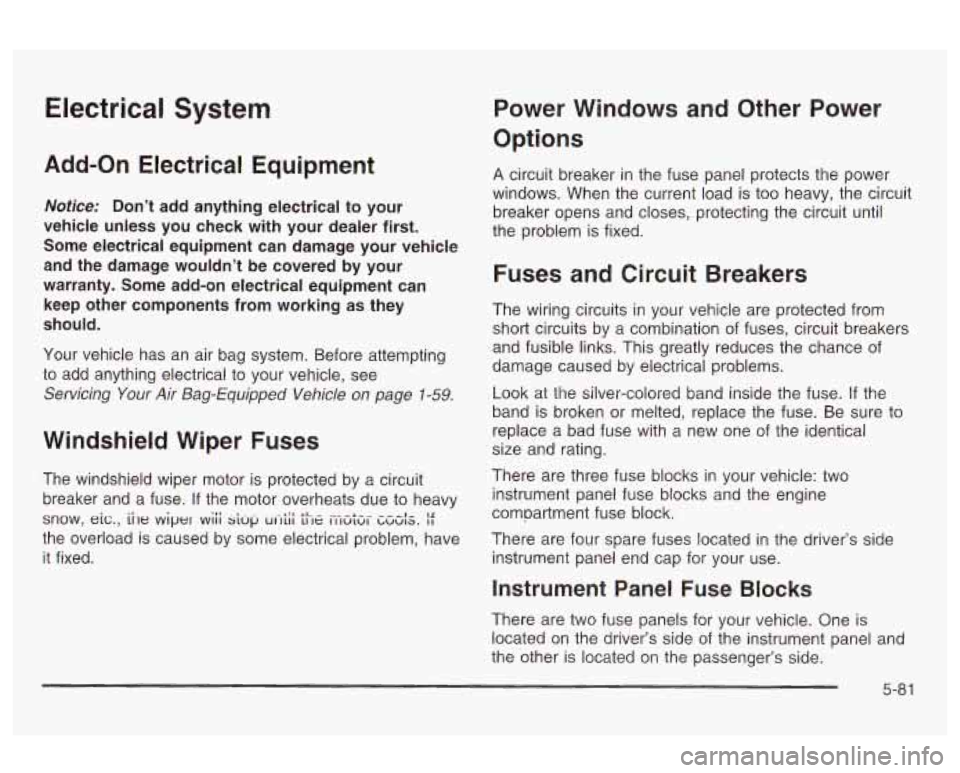
Electrical System
Add-On Electrical Equipment
Notice: Don’t add anything electrical to your
vehicle unless you check with your dealer first.
Some electrical equipment can damage your vehicle
and the damage wouldn’t be covered by your
warranty. Some add-on electrical equipment can
keep other components from working as they
should.
Your vehicle has an air bag system. Before attempting
to add anything electrical to your vehicle, see
Servicing Your Air Bag-Equipped Vehicle on page 1-59.
Windshield Wiper Fuses
The windshield wiper motor is protected by a circuit
breaker and a fuse. If the motor overheats due to heavy
the overload is caused by some electrical problem, have
it fixed. snow,
eic., iile wiper wiii siup ui-liii ti-le i-hstci- GS~S. If
Power Windows and Other Power
Options
A circuit breaker in the fuse panel protects the power
windows. When the current load is too heavy, the circuit
breaker opens and closes, protecting the circuit until
the problem is fixed.
Fuses and Circuit Breakers
The wiring circuits in your vehicle are protected from
short circuits by a combination
of fuses, circuit breakers
and fusible links. This greatly reduces the chance of
damage caused by electrical problems.
There are three fuse blocks in your vehicle: two
instrument panel fuse blocks and the engine
compartment fuse block.
There are four spare fuses located in the driver’s side
instrument panel end cap for your use.
Instrument Panel Fuse Blocks
There are two fuse panels for your vehicle. One is
located on the driver’s side of the instrument panel and
the other is located on the passenger’s side.
5-81
Page 302 of 354
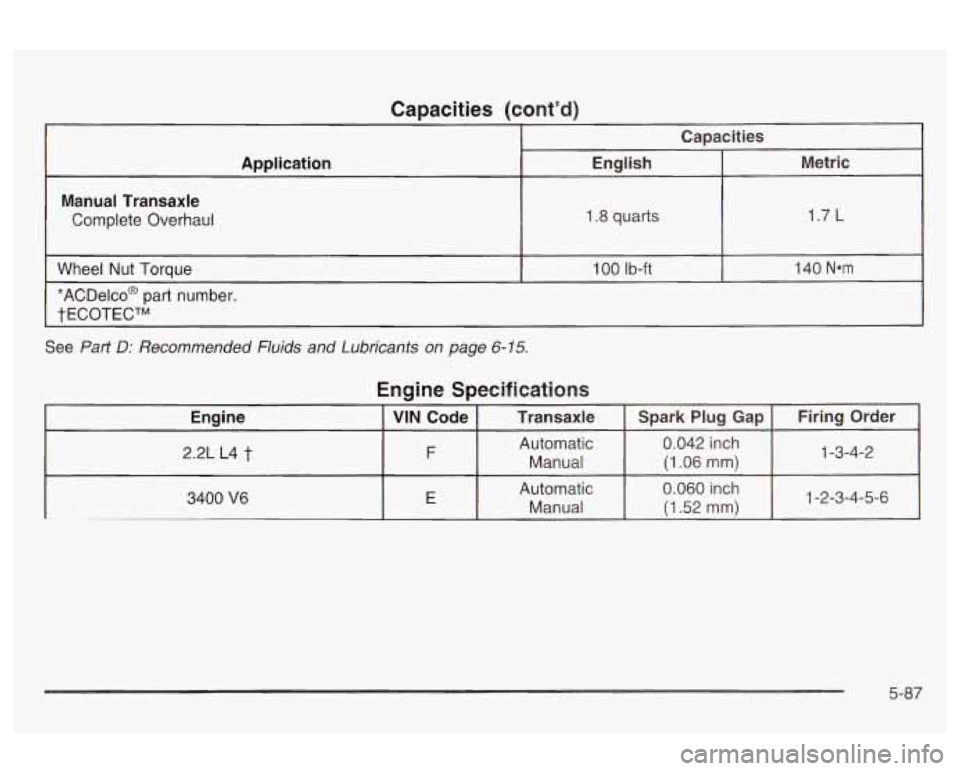
Capacities (cont’d)
Manual Transaxle Complete Overhaul 1.8
quarts 1.7
L
I
Wheel Nut Torque
*ACDelco@ part number. 1
00 Ib-ft
tECOTECTM I 140 Nom
See Part D: Recommended Fluids and Lubricants on page 6-15.
Engine Specidicatians
I
3400 V6 E Automatic 0.060 inch
Manual
(1.52 mm) 1-2-3-4-5-6
5-87
Page 306 of 354
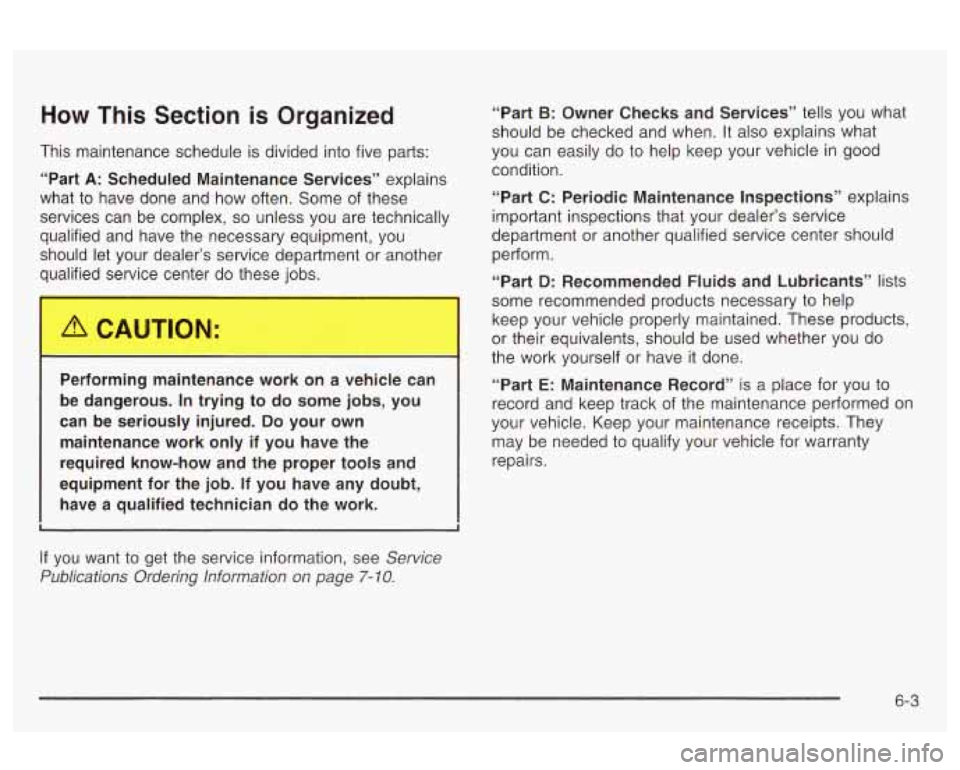
How This Section is Organized
This maintenance schedule is divided into five parts: “Part
B: Owner Checks and Services”
tells you what
should be checked and when. It also explains what
you can easily do to help keep your vehicle
in good
“Part
A: Scheduled Maintenance Services” explains
what to have done and how often. Some of these “Part C: Periodic Maintenance Inspections” explains
services can be complex,
so unless you are technically important inspections that your dealer’s service
qualified and have the necessary equipment, you department or another qualified service center should
should let your dealer’s service department or another perform.
qualified service center do these jobs. condition.
“Part
D: Recommended Fluids and Lubricants” lists
some recommended products necessary to help
keep your vehicle properly maintained. These products,
or their equivalents, should be used whether you do
I the work yourself or have it done. I
Per- _-‘ming mainten_---ce work on a vehicle can
be dangerous.
In trying to do some jobs, you
can be seriously injured. Do your own
maintenance work only
if you have the
required know-how and the proper tools and
equipment for the job.
If you have any doubt,
have a qualified technician
do the work. “Part
E: Maintenance Record”
is a place for you to
record and keep track of the maintenance performed on
your vehicle. Keep your maintenance receipts. They
may be needed to qualify your vehicle for warranty
repairs.
If you want to get the service information, see Service
Publications Ordering information
on page 7- 10.
6-3
Page 307 of 354
Part A: Scheduled Maintenance
Services
This part contains engine oil scheduled maintenance
which explains the engine oil life system and how
it indicates when to change the engine
oil and filter.
Also, listed are scheduled maintenance services which
are
to be performed at the mileage intervals specified.
Using Your Maintenance Schedule
We at General Motors want to keep your vehicle in good
working condition. But we don’t know exactly how
you’ll drive it. You may drive short distances only a few
times
a week. Or you may drive long distances all
the time in very hot, dusty weather. You may use your
vehicle in making deliveries. Or you may drive it to
work, to
do errands or in many other ways.
Because of the different ways people use their vehicles,
maintenance needs may vary. You may need more
frequent checks and replacements.
So please read the
following and note how you drive.
If you have
questions on how to keep your vehicle in good condition,
see your dealer. This part tells
you the maintenance services you should
have done and when you should schedule them.
When you go to your dealer for your service needs,
you’ll know that GM-trained and supported service
people will perform the work using genuine GM parts.
The proper fluids and lubricants to use are listed in
Part
D. Make sure whoever services your vehicle uses
these.
All parts should be replaced and all necessary
repairs done before you or anyone else drives the
vehicle.
This schedule is for vehicles that:
carry passengers and cargo within recommended
limits. You will find these on your vehicle’s
Tire-Loading Information label. See
Loading Your
Vehicle on page 4-34.
are driven on reasonable road surfaces within legal
driving limits.
use the recommended fuel. See Gasoline Octane
on page 5-5.
6-4