warning OPEL ANTARA 2009 Owners Manual
[x] Cancel search | Manufacturer: OPEL, Model Year: 2009, Model line: ANTARA, Model: OPEL ANTARA 2009Pages: 234, PDF Size: 3.01 MB
Page 187 of 234
Self-help, vehicle care187
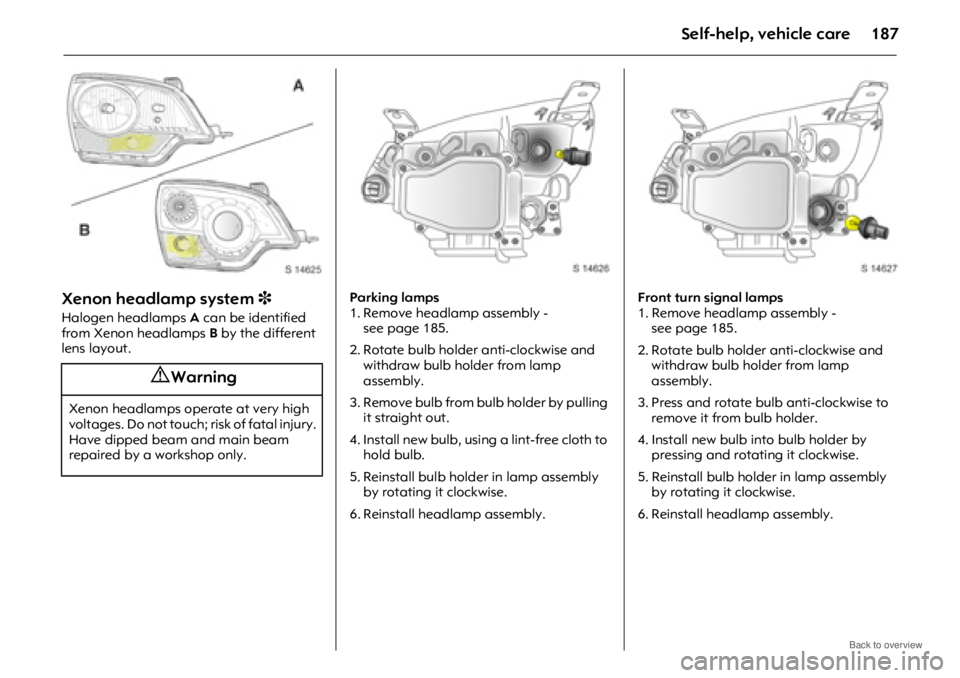
Xenon headlamp system 3
Halogen headlamps A can be identified
from Xenon headlamps B by the different
lens layout. Parking lamps
1. Remove headlamp assembly -
seepage185.
2. Rotate bulb holder anti-clockwise and withdraw bulb holder from lamp
assembly.
3. Remove bulb from bulb holder by pulling it straight out.
4. Install new bulb, using a lint-free cloth to hold bulb.
5. Reinstall bulb holder in lamp assembly by rotating it clockwise.
6. Reinstall headlamp assembly. Front turn signal lamps
1. Remove headlamp assembly -
see page 185.
2. Rotate bulb holder anti-clockwise and withdraw bulb holder from lamp
assembly.
3. Press and rotate bulb anti-clockwise to remove it from bulb holder.
4. Install new bulb into bulb holder by pressing and rotating it clockwise.
5. Reinstall bulb holder in lamp assembly
by rotating it clockwise.
6. Reinstall headlamp assembly.
9 Warning
Xenon headlamps operate at very high
voltages. Do not touch; risk of fatal injury.
Have dipped beam and main beam
repaired by a workshop only.
Page 191 of 234

Self-help, vehicle care191
Centre high-mounted stop lamp,
instrument panel and glove compartment
illumination
We recommend having bulb replacements
carried out by a workshop.
Opel genuine parts and
accessories
We recommend the use of “Opel genuine
parts and accessories” and conversion
parts released expressly for your vehicle
type. These parts have undergone special
tests to establish their reliability, safety and
specific suitability for your vehicle. Despite
continuous market monitoring, we cannot
assess or guarantee these attributes for
other products, even if they have been
granted approval by the relevant
authorities or in some other form.
“Opel genuine parts and accessories” and
conversion parts approved by Opel can be
obtained from your Op el Partner, who can
provide comprehensive advice about
permitted technical changes and ensure
that the part is installed correctly.
A note on safety
To avoid the possibility of injury, only carry
out engine compartment checks (e.g.
checking the brake fluid level or the engine
oil level) when the igni tion is switched off. Never carry out any re
pairs or adjustment
and maintenance work on the vehicle
yourself. This especially applies to the
engine, chassis and safety parts. You may,
out of ignorance, infringe the provisions of
the law and, by not performing the work
properly, you may endanger yourself and
other road users.
Checking and topping up fluids
To aid identification, the engine oil filler
cap, the coolant filler cap, the lid of the
fluid container for the windscreen washer
system and the handle of the engine oil
gauge (dipstick) may be coloured yellow.
9 Warning
The cooling fan may be operated by a
thermoswitch and can therefore start to
operate unexpectedly, even when the
ignition is switched off; risk of injury.
Electronic ignition systems generate very
high voltages. Do not touch the ignition
system; high voltage can be fatal.
Page 192 of 234

Self-help, vehicle care192
Engine oil
Information on engine oils - see page 213.
Engine oil level and consumption
It is normal for every engine to consume
some oil, and it is sometimes necessary to
check and top up the engine oil level
between oil changes.
For this reason, the engine oil level should
be checked every 500 km (300 miles) or
before starting a long trip. The illustrations show checking and
replenishing the engine oil in the Z 24, Z 32
petrol engines and the
Z 20 diesel engines
respectively.
To check the level, remove dipstick from
the dipstick tube, wipe it clean and re-insert
it as far as it will go. After pulling the
dipstick out again, check the oil level,
ensuring it is between the lower and upper
(or MIN and MAX) marks. Engine oil level check and topping up
The engine oil level must be checked with
the vehicle horizontal and with the engine
(which must be at operating temperature)
switched off. Wait a few minutes before
checking the level to allow the normal oil
accumulation in the engine to drain back
into the oil pan.
9 Warning
Do not allow the engine oil level to drop
below the minimum level.
Page 194 of 234
Self-help, vehicle care194
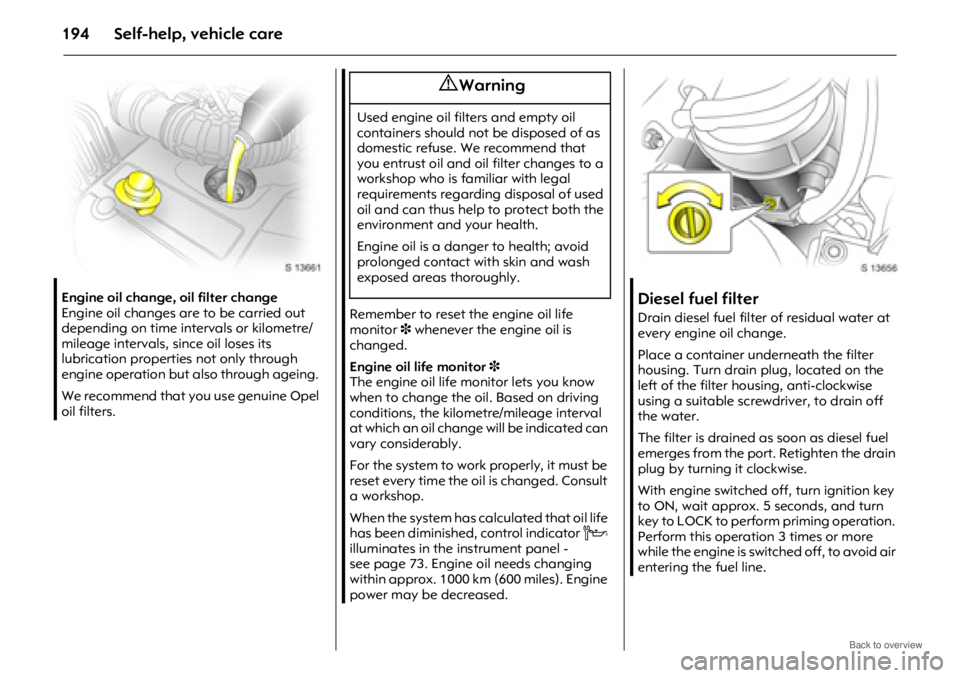
Engine oil change, oil filter change
Engine oil changes are to be carried out
depending on time intervals or kilometre/
mileage intervals, since oil loses its
lubrication properties not only through
engine operation but also through ageing.
We recommend that you use genuine Opel
oil filters.
Remember to reset the engine oil life
monitor 3 whenever the engine oil is
changed.
Engine oil life monitor 3
The engine oil life monitor lets you know
when to change the oil. Based on driving
conditions, the kilometre/mileage interval
at which an oil change will be indicated can
vary considerably.
For the system to work properly, it must be
reset every time the oil is changed. Consult
a workshop.
When the system has calculated that oil life
has been diminished, control indicator C
illuminates in the instrument panel -
see page 73. Engine oil needs changing
within approx. 1000 km (600 miles). Engine
power may be decreased.Diesel fuel filter
Drain diesel fuel filter of residual water at
every engine oil change.
Place a container underneath the filter
housing. Turn drain plug, located on the
left of the filter housing, anti-clockwise
using a suitable screwdriver, to drain off
the water.
The filter is drained as soon as diesel fuel
emerges from the port. Retighten the drain
plug by turning it clockwise.
With engine switched off, turn ignition key
to ON, wait approx. 5 seconds, and turn
key to LOCK to perform priming operation.
Perform this operation 3 times or more
while the engine is switched off, to avoid air
entering the fuel line.
9 Warning
Used engine oil filters and empty oil
containers should not be disposed of as
domestic refuse. We recommend that
you entrust oil and oil filter changes to a
workshop who is familiar with legal
requirements regarding disposal of used
oil and can thus help to protect both the
environment and your health.
Engine oil is a danger to health; avoid
prolonged contact with skin and wash
exposed areas thoroughly.
Page 195 of 234

Self-help, vehicle care195
Check diesel fuel filter at shorter intervals if
the vehicle is subjected to extreme
operating conditions such as high humidity
(primarily in coastal areas), extremely high
or low outside temperatures and
substantially varying daytime and night-
time temperatures.
If there is water in the diesel fuel filter,
control indicator
N illuminates in the
instrument panel - see page 73. Drain the
water immediately.
Coolant
During operation, the system is
pressurized. The temperature may
therefore rise to over 100 °C.
The antifreeze provides excellent corrosion
protection for the cooling and heating
system, as well as freeze protection down
to -28 °C.
Certain types of antifreeze can lead to
engine damage. We therefore strongly
recommend the use of antifreeze that has
been approved by Opel.
Antifreeze and corrosion protection
Before the start of the cold weather season,
have the coolant checked for correct
concentration by a workshop. The amount
of antifreeze must provide protection down
to approx. –28 °C. If the antifreeze
concentration is too low, this reduces
protection from fr eezing and corrosion.
Top up antifreeze if necessary.
If coolant loss is topped up with
demineralised water, have antifreeze
concentration checked and more
antifreeze added as necessary. Coolant level
Hardly any losses occur since the cooling
system is sealed and it is thus rarely
necessary to top up the coolant.
The coolant level in the expansion tank
should be between the
MIN and MAX
marks when the system is cold.
9 Warning
Antifreeze is a danger to health: it must
therefore be kept in the original container
and out of the reach of children.
Page 196 of 234

Self-help, vehicle care196
When the engine is at operating
temperature, coolant level rises. It falls
again when the system cools. If it falls
below the MIN mark when the system is
cold, the coolant must be replenished.
Top up antifreeze. If no antifreeze is
available, top up with clean tap water.
If tap water is unavailable, distilled water
can be used.
When you top up with tap water or distilled
water, add concentrated antifreeze and
possibly mix in antifreeze as well. Have the
cause of the coolant loss eliminated by a
workshop.
Too low a coolant level can cause engine
damage.
When closing, tighten coolant filler cap as
far as it will go. Coolant temperature
Control indicator
W illuminates when
coolant temperature is too high. Check
coolant level:
z Coolant level low:
Top up coolant. Pay attention to the
instructions given under "Antifreeze and
corrosion protecti on" and "Coolant
level". Have the cause of the coolant loss
remedied by a workshop.
z Coolant level OK:
Have the cause of increased coolant
temperature remedied by a workshop.
Brake fluid
Brake fluid level
9 Warning
Allow engine to cool down before
removing coolant filler cap. If steam is
visible, move away from the vehicle until
the engine is cool.
Remove coolant filler cap carefully so
that pressure can escape slowly,
otherwise there is a risk of scalding.
9 Warning
Caution - brake fluid is poisonous and
corrosive. Do not allow it to contact eyes,
skin, fabrics or painted surfaces; direct
contact may cause injuries and damage.
Page 197 of 234
Self-help, vehicle care197
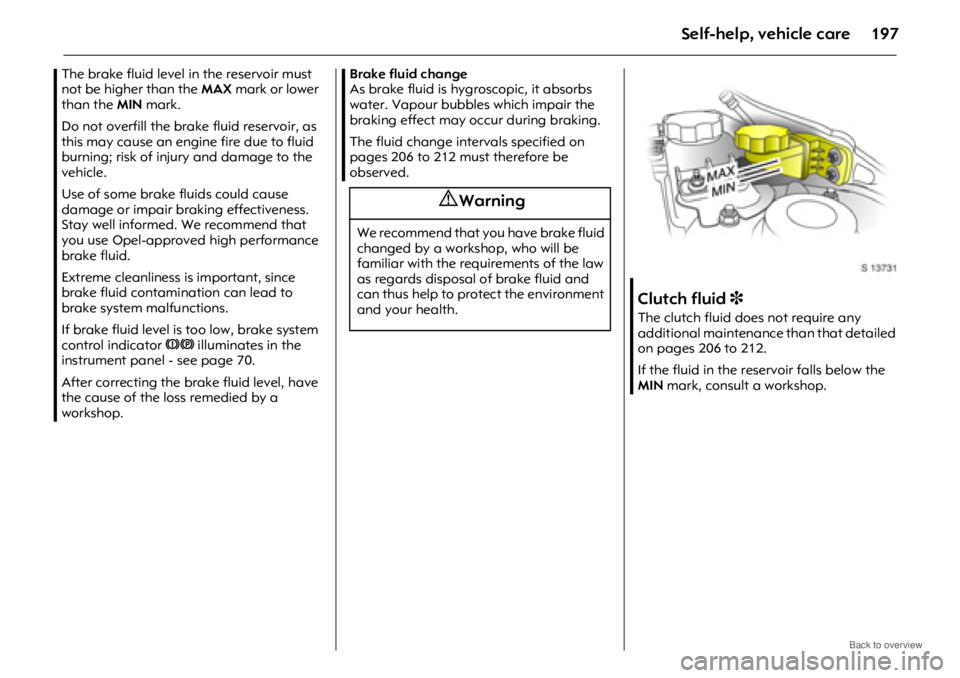
The brake fluid level in the reservoir must
not be higher than the MAX mark or lower
than the MIN mark.
Do not overfill the brak e fluid reservoir, as
this may cause an engine fire due to fluid
burning; risk of injury and damage to the
vehicle.
Use of some brake fluids could cause
damage or impair br aking effectiveness.
Stay well informed. We recommend that
you use Opel-approve d high performance
brake fluid.
Extreme cleanliness is important, since
brake fluid contamination can lead to
brake system malfunctions.
If brake fluid level is too low, brake system
control indicator 4 illuminates in the
instrument panel - see page 70.
After correcting the brake fluid level, have
the cause of the loss remedied by a
workshop. Brake fluid change
As brake fluid is hygroscopic, it absorbs
water. Vapour bubbles which impair the
braking effect may occur during braking.
The fluid change intervals specified on
pages 206 to 212 must therefore be
observed.
Clutch fluid
3
The clutch fluid does not require any
additional maintenanc e than that detailed
on pages 206 to 212.
If the fluid in the reservoir falls below the
MIN mark, consult a workshop.
9 Warning
We recommend that you have brake fluid
changed by a workshop, who will be
familiar with the requ irements of the law
as regards disposal of brake fluid and
can thus help to protect the environment
and your health.
Page 200 of 234
Self-help, vehicle care200
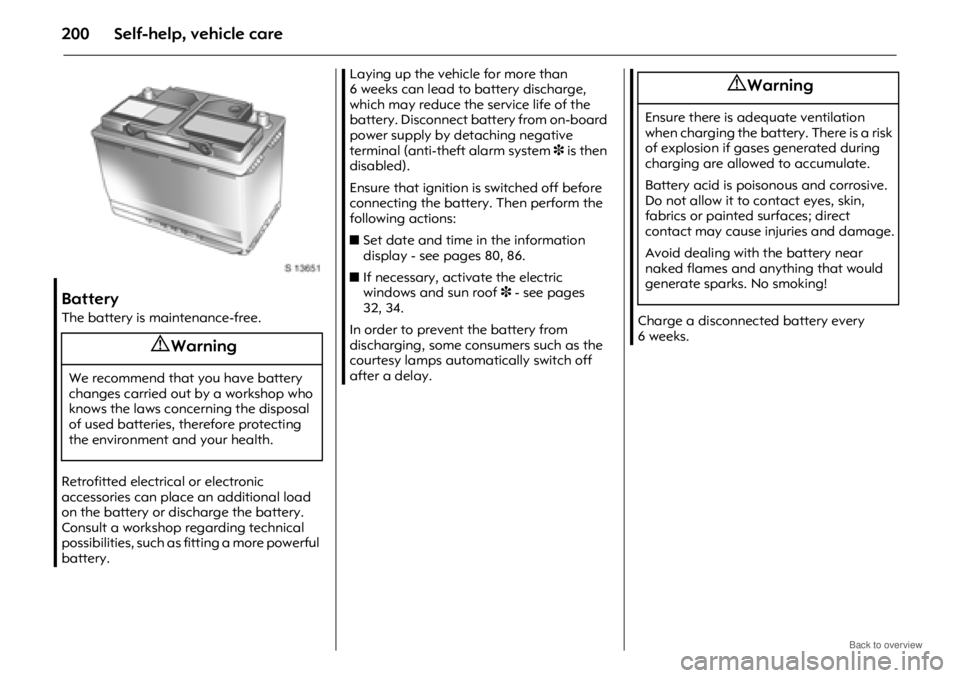
Battery
The battery is maintenance-free.
Retrofitted electrical or electronic
accessories can place an additional load
on the battery or discharge the battery.
Consult a workshop regarding technical
possibilities, such as fitting a more powerful
battery.Laying up the vehicle for more than
6 weeks can lead to battery discharge,
which may reduce the service life of the
battery. Disconnect battery from on-board
power supply by detaching negative
terminal (anti-theft alarm system
3 is then
disabled).
Ensure that ignition is switched off before
connecting the battery. Then perform the
following actions:
z Set date and time in the information
display - see pages 80, 86.
z If necessary, activate the electric
windows and sun roof 3 - see pages
32, 34.
In order to prevent the battery from
discharging, some consumers such as the
courtesy lamps automatically switch off
after a delay. Charge a disconnected battery every
6 weeks.
9 Warning
We recommend that you have battery
changes carried out by a workshop who
knows the laws concerning the disposal
of used batteries, therefore protecting
the environment and your health.
9 Warning
Ensure there is adequate ventilation
when charging the batt
ery. There is a risk
of explosion if gases generated during
charging are allowed to accumulate.
Battery acid is poisonous and corrosive.
Do not allow it to contact eyes, skin,
fabrics or painted surfaces; direct
contact may cause injuries and damage.
Avoid dealing with the battery near
naked flames and anything that would
generate sparks. No smoking!
Page 201 of 234
Self-help, vehicle care201
Protection of electronic
components
In order to avoid the breakdown of
electronic components within the electrical
system, never disconnect the battery with
the engine running. Never start the engine
while the battery is disconnected (e.g.
when using jump leads).
To avoid damaging the vehicle, do not
make any modifications to the electrical
system, e.g. connecting additional
consumers or tampering with electronic
control units (chip tuning). Disconnecting/connecting the battery
from/to the electrical system
Disconnect the battery from the vehicle
electrical system before charging:
first detach the negative and then the
positive lead.
Do not reverse the polarity of the battery,
i.e. do not confuse the terminals for the
positive and negative leads. When
connecting, start with the positive lead and
then connect the negative lead.
Vehicle storage
If your vehicle is to be stored for long
periods without use, we recommend you
consult a workshop for advice.
Vehicle care
In caring for your vehicle, observe all
national environmental regulations,
particularly when washing your vehicle.
Regular, thorough care contributes to
improving the appearance of your vehicle
and maintaining its va
lue. It is also a
prerequisite for clai ms made under the
warranty, in the event of paint or corrosion
damage. In the following pages, we give
you tips for vehicle care which, with correct
use, will help to ward off unavoidable and
harmful environmental influences.
9 Warning
Electronic ignition systems generate very
high voltages. Do not touch the ignition
system; high voltage can be fatal.
Page 213 of 234

Service, maintenance213
Additional servicing
Additional operations ⊕
Additional work is work that is not required
every service but can be performed in
conjunction with a regular service.
Time allowances for such work are not
included in the scope of regular services
and will be charged for additionally. It is
more economic if these operations are
performed as part of a scheduled service
than having them performed separately.
Severe operating conditions o
Operating conditions are classified as
severe when one or more of the following
occurs frequently:
z cold starts,
z stop and go,
z trailer/caravan towing,
z gradients and/or high altitudes,
z poor road surfaces,
z sand and dust,
z extreme temperature fluctuations.
Police vehicles, taxis and driving school
vehicles are also cla ssified as operating
under severe conditions.
Under severe operating conditions, it may
be necessary to have certain scheduled
service work done more frequently than the
scheduled intervals.
For example, if fuel is used that does not
comply with required standards, the fuel
filter may need more frequent draining or
replacement and it may also be necessary
to change other components more often
(e.g. spark plugs). It is recommended to seek technical advice
on the servicing requirements dependent
on the specific operating conditions of your
vehicle.
Recommended fluids and
lubricants
Only use products that have been tested
and approved. Damage resulting from the
use of non-approved materials will not be
covered by the warranty.
Checking and topping up fluids
see page 191.
Engine oil
Engine oil is identified by its quality and
also its viscosity. Quality is more important
than viscosity when selecting which engine
oil to use.
Engine oil quality
European specifications
Opel engine oil m
eets classifications
GM-LL-A-025 and GM-LL-B-025 and is
therefore suitable for both petrol and
diesel engines.
International specifications
The above specification is valid only if the
service interval is reduced to that shown for
the international service schedule -
see pages 209 to 212.
Topping up engine oil
Oils of different manufacturers and brands
can be mixed as long as you comply with
the specified engine oil criteria (quality and
viscosity).
9 Warning
Operating materials are hazardous and
must be handled with the appropriate
level of care. If consumed, seek medical
attention immediatel y. Do not inhale
fumes and avoid skin contact. Keep out
of reach of children. Do not allow
operating materials to contaminate the
sewage system, surface water, ground
water or soil. Dispose of empty containers
properly. Always bear in mind that
operating materials are hazardous to
your health.
GM-LL-A-025: Petrol engines
GM-LL-B-025: Diesel engines without DPF
ACEA-C3 Diesel engines with DPF
GM General Motors Europe
LL Longlife
A or B Engine oil quality specification
025 Validity index
ACEA-A3: Petrol engines
ACEA-B4: Diesel engines without DPF
ACEA-C3: Diesel engines with DPF