warning OPEL ANTARA 2009 Repair Manual
[x] Cancel search | Manufacturer: OPEL, Model Year: 2009, Model line: ANTARA, Model: OPEL ANTARA 2009Pages: 234, PDF Size: 3.01 MB
Page 122 of 234

Driving and operation122
Always exercise caution when in slippery
conditions (caused by sand, gravel, water,
snow or ice on the road), in order to
maintain vehicle control.
Use the accelerator to control the vehicle -
keep brake pedal use to a minimum.
zDo not slip the clutch.
z Do not spin the wheels.
z Do not make exaggerated or jerky
steering movements.
Driving a vehicle in snow and ice should be
undertaken with extreme caution:
z Select a gear suitable for the conditions.
z Start the vehicle moving with minimal
engine revs, low gear and combined
clutch and accelerator control.
z Change to a higher gear as quickly as
possible, to keep the engine revs low.
z With automatic transmission 3, select
drive range D and press button n, to
activate the Winter program. Off-road driving
During off-road drivin
g, you will encounter
a variety of driving conditions and
circumstances too numerous to list here.
Always use good judgement and common
sense. If you feel uncomfortable about
tackling a given situation, do not attempt
it.
Avoid protruding objects (such as rocks or
tree stumps) that may damage the
underbody and tyres of your vehicle.
Test the brakes after operating in mud, to
clear excess mud from the braking
surfaces.
Gripping the steering wheel
Terrain conditions can cause rapid and
unexpected movement in the steering,
especially rough terrain. Preparation
The duration, distance and conditions of
the off-road activity determine the extent
of the preparation th
at is required. The
following are given as guidelines.
Know the area where you will be driving,
either by inspection or from terrain maps.
Decide your route in advance and ensure
that it is a vehicular right of way
1).
Make a thorough check of the vehicle.
Check the following:
z Oil, water, fuel, brake and clutch fluid
levels,
z Drive belts,
z Windscreen wipers and washer system,
z Lamps.
Maintenance - see pages 126, 206.
9 Warning
Be ready to deal with these movements
by having a firm grip on the outer rim of
the steering wheel with the thumbs
outside the spokes, to guard against
injury from kickback.
1)Observe national regulations.
Page 124 of 234

Driving and operation124
The ground clearance, ramp angle, angle
of approach and departure and wading
depth need to be considered, especially in
hilly conditions and when wading, to
prevent the vehicle becoming stuck and
possibly damaged.
Technical data - see page 215. Driving through water
Do not exceed th
e maximum wading
depth.
Check the depth of water: choose the
lowest entry and departure angles before
entering.
Maintain a steady engine speed, to help
prevent water from entering the exhaust
system, but do not exceed 5 km/h (3 mph),
to avoid splashing the water.
Drive with the flow wherever possible, not
against it. If you have to drive against the
flow, try to drive at an angle to it, so that
the leading corner of the vehicle will help
deflect water from the engine
compartment.
Avoid splashing the water - if the ignition
system becomes wet, the engine may stall. Avoid water entering the air intake system.
Test the brakes after leaving the water -
wet brakes are less effective than dry ones.
Perform the service operations for wading,
involving checks for water contamination,
at the earliest opportunity.
Service checks after wading -
see page 126.
9 Warning
If water enters the air intake system,
engine seizure with severe costly damage
may result.
Page 125 of 234

Driving and operation125
Self-help
Recovery and towing
When recovering or towing a vehicle
off-road, observe the following:
zA greater force is required to move a
vehicle from or through mud than when
on a hard surfaced road.
z Attach a tow rope to the towing eye of
the vehicle, not to the axle -
see pages 164, 174.
z Where possible, drive both vehicles
forward to affect a recovery, using an
appropriate gear to avoid wheelspin.
z Avoid the use of reverse gear because of
possible resultant wheelspin.
z Stay clear of the tow rope.
Wheel changing
Place a board or plate beneath the jack, to
prevent it from sinking into soft ground.
Further information - see page 178. Cleaning
Clean the vehicle thoroughly and as soon
as possible after driving off-road.
Do not let mud remain dry on any part of
the vehicle as it becomes abrasive and can
damage paint, glass, seals, bearings and
brake components.
If left to build up, mud can seriously affect
the air flow through and over mechanical
components and cause localised
overheating and failure of parts, especially
in the engine compartment.
Ensure the radiator core and the area
between the radiator and intercooler/oil
cooler (where installed) is cleaned, to
maintain proper cooling air flow.
Check the radiator and cooler cores for
blockage (sand, silt etc.).
Check the tyre treads.
Clean and check the mechanical parts of
the vehicle, particularly the following
areas:
z
Driveshafts, including sealing bellows,
z Front brake calipers, pads and discs,
z Front suspension,
z Clutch fork sealing bellows,
z Rear brake calipers, pads and discs,
z Rear suspension,
z Fuel tank and underguard,
z Breathers, axles and fuel tank,
z Load sensing valve,
z Transfer box and underguard,
z Engine oil pan and underguard.
Observe the following:
z Do not spray high-pressure water
directly at the vehicle seals.
z The wheels must be removed to clean all
mud and stones from the brake calipers
and to check brake pad wear.
z The areas on the upper side of the
underguards must be cleared of stones,
to prevent damage to the engine oil pan
and the fuel tank.
9 Warning
Breaking ropes can cause serious injury.
Page 132 of 234
Driving and operation132
Fuel filler cap
If replacing the fuel filler cap, be sure to use
the original fuel filler cap for your model, to
ensure full functionality.
Refuelling
Ensure suitable fuel is available before
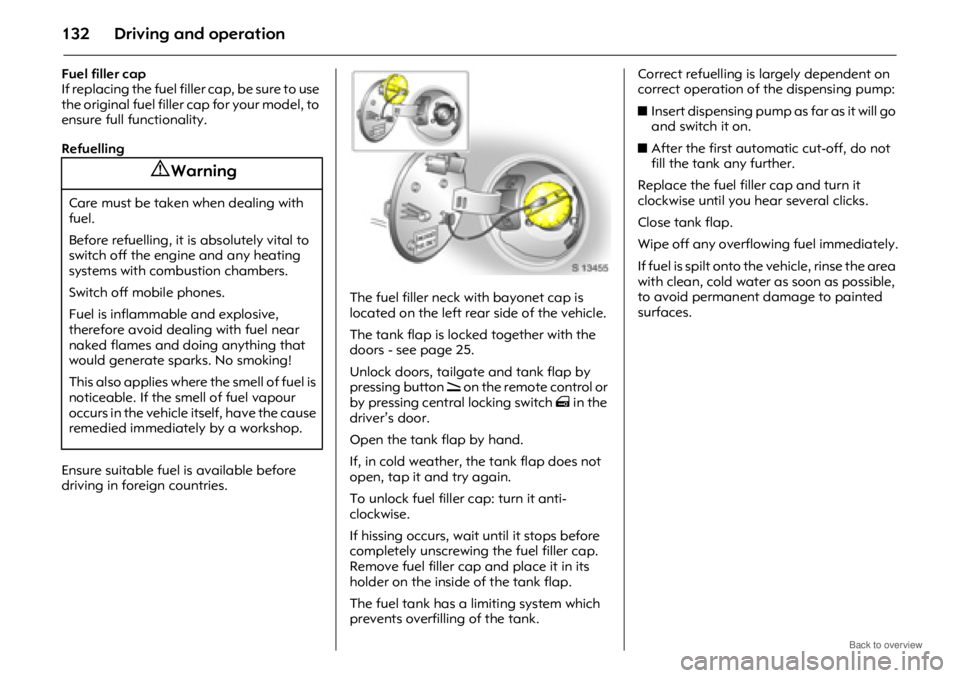
driving in foreign countries. The fuel filler neck with bayonet cap is
located on the left rear side of the vehicle.
The tank flap is locked together with the
doors - see page 25.
Unlock doors, tailgate and tank flap by
pressing button q
on the remote control or
by pressing central locking switch m in the
driver’s door.
Open the tank flap by hand.
If, in cold weather, the tank flap does not
open, tap it and try again.
To unlock fuel filler cap: turn it anti-
clockwise.
If hissing occurs, wait until it stops before
completely unscrewing the fuel filler cap.
Remove fuel filler cap and place it in its
holder on the inside of the tank flap.
The fuel tank has a limiting system which
prevents overfilling of the tank. Correct refuelling is largely dependent on
correct operation of the dispensing pump:
z
Insert dispensing pump as far as it will go
and switch it on.
z After the first automatic cut-off, do not
fill the tank any further.
Replace the fuel filler cap and turn it
clockwise until you hear several clicks.
Close tank flap.
Wipe off any overflowing fuel immediately.
If fuel is spilt onto the vehicle, rinse the area
with clean, cold water as soon as possible,
to avoid permanent damage to painted
surfaces.
9 Warning
Care must be taken when dealing with
fuel.
Before refuelling, it is absolutely vital to
switch off the engi ne and any heating
systems with combustion chambers.
Switch off mobile phones.
Fuel is inflammable and explosive,
therefore avoid dealing with fuel near
naked flames and doing anything that
would generate sparks. No smoking!
This also applies where the smell of fuel is
noticeable. If the smell of fuel vapour
occurs in the vehicle itself, have the cause
remedied immediately by a workshop.
Page 135 of 234

Driving and operation135
Exhaust gases
Do not run engine in enclosed spaces, e.g.
in a garage, or sit in a parked vehicle for an
extended period with the engine running.
Do not drive with tailgate open. If driving
with the tailgate open is necessary, set fan
to highest speed, close windows and
ensure air recirculation mode is off, to allow
entry of outside air.
If the underbody or rear of vehicle is
damaged or corroded, you notice a
change in the sound of the exhaust system,
or whenever you suspect exhaust gases are
penetrating the vehicle interior, consult a
workshop immediately.
When the vehicle is driven for the first time,
wax and oil on the exhaust system may
evaporate, producing smoke-like emissions
which should not be inhaled. Allow wax
and oil to evaporate while the vehicle is in
the open air. Diesel particle filter (DPF) 3
The diesel particle filter removes polluting
soot particles out of the exhaust.
The system contains a self-cleaning
function at certain intervals. The filter is
cleaned by burning the soot particles at
high temperature. This procedure runs
automatically under certain vehicle
conditions and can take up to 15 minutes,
during which time fuel consumption may
increase. The smell and the noise that
occur are normal.
The system cannot automatically clean
itself under certain vehicle conditions, such
as driving short distances.
If control indicator
I illuminates, you
should continue driving, and as soon as the
road and traffic situation permits it,
increase speed to more than 50 km/h
(30 mph) and diesel particle filter cleaning
will start.
Cleaning is quicker at faster speeds and
under load. The engine speed should not
drop below 2000 rpm. The control indicator
extinguishes as soon as cleaning is
complete.
We recommend that you do not turn the
ignition off during cleaning. Maintenance
Have all maintenance work carried out at
the intervals specified by Opel. We
recommend that you entrust this work to
your Opel Partner, who has proper
equipment and trained personnel
available. Electronic testing of systems
permits rapid diagnosis and remedy of
faults. This way, you can be certain that all
components of the vehicle’s electrical,
injection and ignition systems operate
correctly, that your ve
hicle has a low level
of pollutant emission and that the catalytic
converter system will have a long service
life.
You are thereby making an important
contribution towards keeping the air clean
and compliance with emissions legislation.
Checking and adjustment of the fuel-
injection and ignition systems is part of the
scope of a Service. For this reason, you
should have all maintenance work carried
out at the intervals specified in the chapter
"Service, Maintanance" on page 206.
9 Warning
Engine exhaust gases contain poisonous
carbon monoxide, which has no colour or
odour and can be lethal if inhaled.
If exhaust fumes penetrate the vehicle
interior, open the windows and consult a
workshop immediately.
Page 136 of 234
Driving and operation136
Drive control systems
Electronic Stability Control (ESC)
The Electronic Stability Control improves
driving stability when necessary,
independently of the type of road surface
and the tyre grip. It also prevents the drive
wheels from spinning.
The system monitors vehicle movements.
As soon as the vehicle starts to swerve
(understeers/oversteers), engine output is
reduced (the sound of the engine changes)
and individual wheels are specifically
braked. This considerably improves the
driving stability of the vehicle on snow and
ice and on wet or slippery road surfaces.
ESC is ready for operation after the ignition
is switched on and the ESC control
indicators
7, A and J illuminate then
extinguish after approx. 4 seconds. When the ESC comes into action, control
indicator
7 flashes in the instrument panel.
Some noise or vibration may be apparent.
The vehicle is now in a critical situation;
the ESC helps you to keep control of the
vehicle and reminds you to match your
speed to the road conditions.
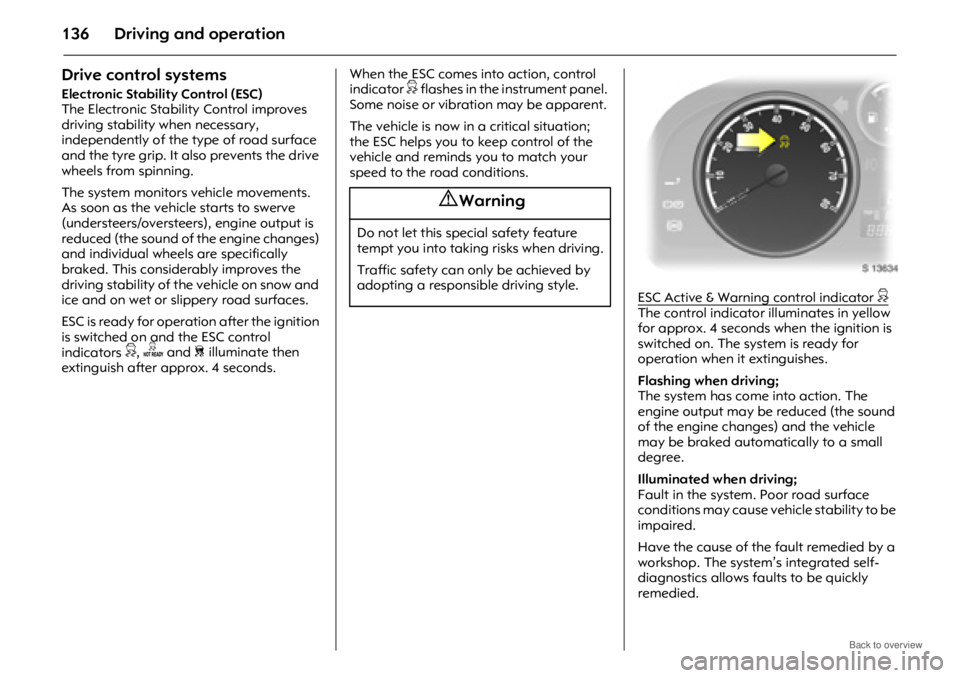
ESC A
ctive & Warning control indicator 7The control indicator illuminates in yellow
for approx. 4 seconds when the ignition is
switched on. The system is ready for
operation when it extinguishes.
Flashing when driving;
The system has come into action. The
engine output may be reduced (the sound
of the engine changes) and the vehicle
may be braked automatically to a small
degree.
Illuminated when driving;
Fault in the system. Poor road surface
conditions may cause vehicle stability to be
impaired.
Have the cause of the fault remedied by a
workshop. The system’s integrated self-
diagnostics allows faults to be quickly
remedied.
9 Warning
Do not let this special safety feature
tempt you into taking risks when driving.
Traffic safety can only be achieved by
adopting a responsible driving style.
Page 140 of 234
Driving and operation140
Cruise control 3
Cruise control can store and maintain
speeds over approx. 30 km/h (20 mph).
Deviation from the stored speed may occur
when driving uphill or downhill.
For safety reasons, cruise control cannot
be activated until the foot brake has been
depressed once.
Cruise control is operated with buttons
d, c and e on the turn signal lever. Do not use cruise control if it is not
advisable to maintain a constant speed
(e.g. in situations presenting a danger to
yourself and other road users, in heavy
traffic or on winding, slippery or greasy
roads).
With automatic transmission, only use
cruise control while in
D.
When cruise control is active, reaction
times may be increased, due to the
different position of the feet.
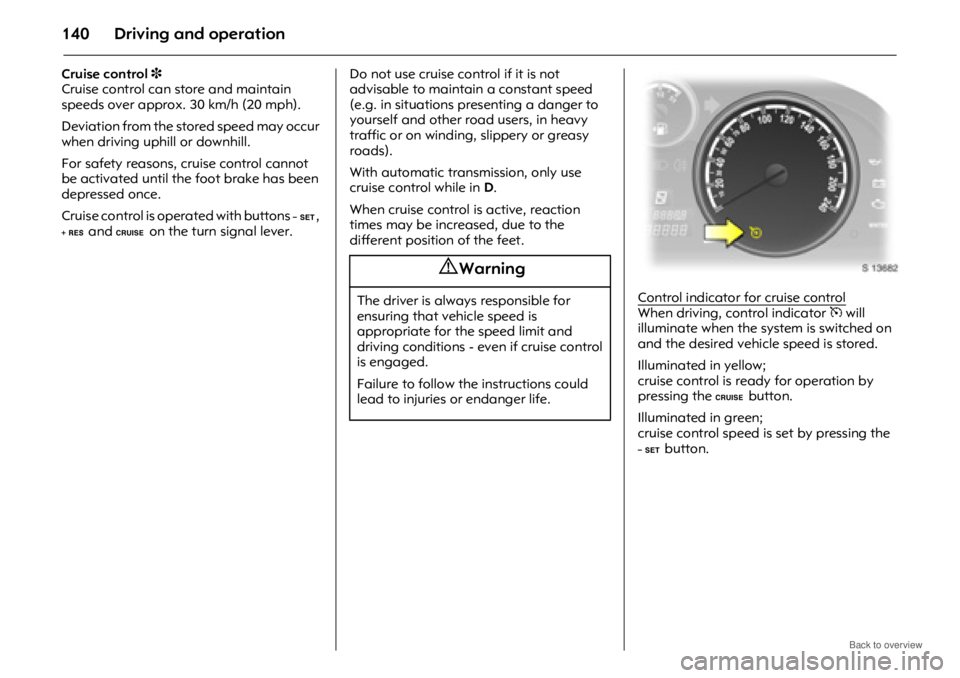
Control indicator for cruise control
When driving, control indicator m will
illuminate when the syst em is switched on
and the desired vehicle speed is stored.
Illuminated in yellow;
cruise control is ready for operation by
pressing the
ebutton.
Illuminated in green;
cruise control speed is set by pressing the
d button.
9 Warning
The driver is always responsible for
ensuring that vehicle speed is
appropriate for the speed limit and
driving conditions - even if cruise control
is engaged.
Failure to follow the instructions could
lead to injuries or endanger life.
Page 142 of 234

Driving and operation142
Park pilot 3
The park pilot makes parking easier by
measuring the distance between the
vehicle and any obstacles to the front and
rear and giving an acoustic signal in the
passenger compartment.
The system records the distance using four
sensors in both the front and rear bumpers.
To activate
The park pilot activates automatically
when the ignition is switched on and a
forward gear or reverse gear is engaged
and the hand brake is released. The acoustic signal may differ depending
on the type of object detected.
If the vehicle approaches an obstacle when
in a forward gear or while reversing, a
series of signals can be heard in the vehicle
interior. The interval between the signals
becomes shorter as the distance is
reduced. If the distance is less than 30 cm,
the signal will be continuous.
To deactivate
The system deactivates automatically
when in neutral (aut omatic transmission 3
in N or P) with the hand brake applied.
When the vehicle speed is greater than
8 km/h (5 mph), the system also
deactivates.
To deactivate the system manually, press
button
b on the instrument panel.
The control indicator in the button will
illuminate.
If the button is pressed again, the control
indicator in the button will extinguish and
the system will be reactivated as soon as a
forward gear or reverse gear is engaged
and the hand brake is released.
9 Warning
Under certain circumstances, various
reflective surfaces on objects or clothing
as well as external noise sources may
cause the system to fail to detect
obstacles.
The park pilot may not recognise sharp
objects, thick clothes or sponge-like
materials which absorb the frequency.
If the sensors are damaged or covered
with snow, dirt or ice, the park pilot may
not activate.
For these reasons, care must be taken
when reversing, even if the park pilot is
operational. This is of particular
importance when in the vicinity of
pedestrians.
Page 144 of 234
Driving and operation144
Tyre pressure monitoring system3
The tyre pressure monitoring system
continually checks the pressure of all four
wheels while driving.
A pressure sensor is integrated in each
wheel. Once a minute, the pressure of each
tyre is sent to a control unit, where it is
compared. If the system detects one or
more pressure differences, a message
appears on the information display.
Current tyre pressures can be shown in the
information display.
For the system to be operational, all wheels
must be equipped with pressure sensors
and all tyres must be filled to the
prescribed pressure. The tyre pressure
monitoring system automatically detects if
the vehicle is being driven with a load of up
to 3 persons or a full load.
Once the ignition is switched on, the system
is operational and will continuously
monitor the tyre pressures at speeds of
approx. 40 km/h (25 mph) and above. Tyre pressure – see pages 224.
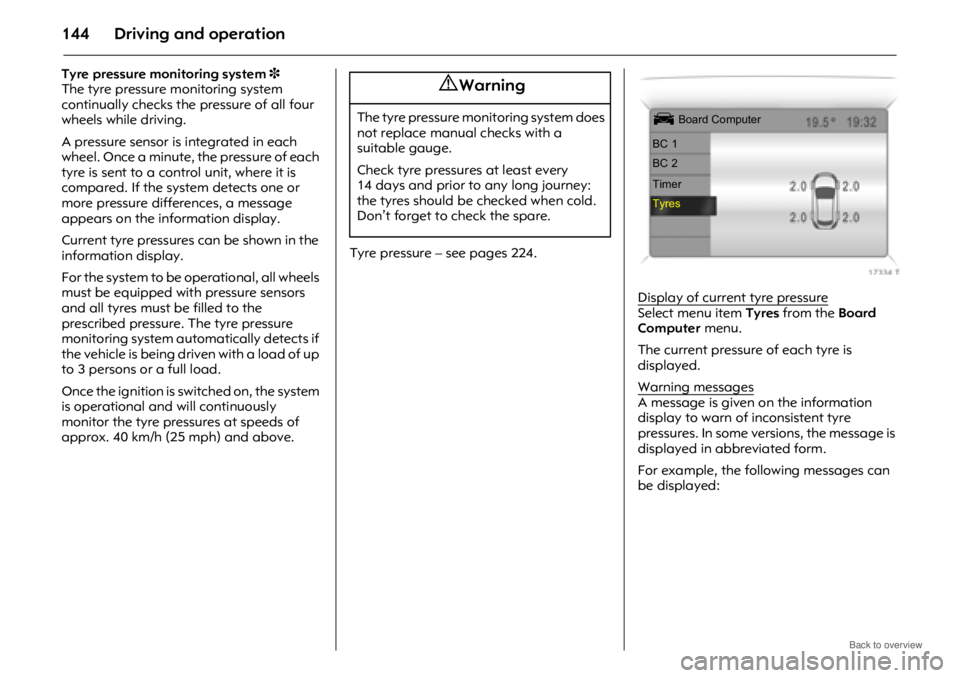
Display of current tyre pressure
Select menu item Tyres from the Board
Computer menu.
The current pressure of each tyre is
displayed.
Warning messages
A message is given on the information
display to warn of inconsistent tyre
pressures. In some versions, the message is
displayed in abbreviated form.
For example, the following messages can
be displayed:
9 Warning
The tyre pressure monitoring system does
not replace manual checks with a
suitable gauge.
Check tyre pressures at least every
14 days and prior to any long journey:
the tyres should be checked when cold.
Don’t forget to check the spare. Ü Board Computer
BC 1
BC 2
Timer
Tyres
Page 145 of 234
Driving and operation145
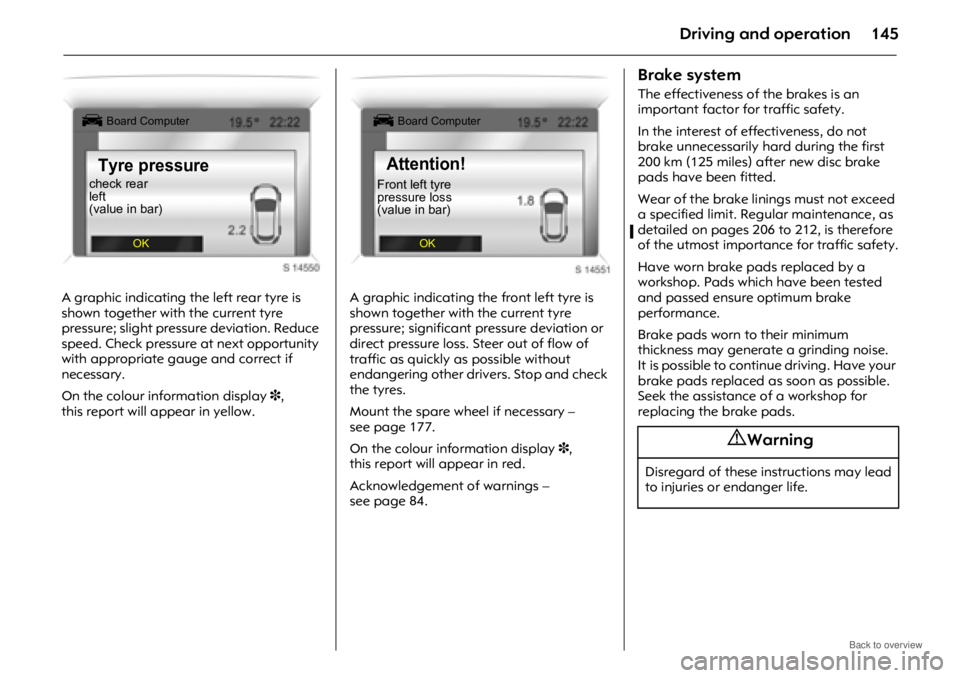
A graphic indicating the left rear tyre is
shown together with the current tyre
pressure; slight pressure deviation. Reduce
speed. Check pressure at next opportunity
with appropriate gauge and correct if
necessary.
On the colour information display 3,
this report will appear in yellow. A graphic indicating the front left tyre is
shown together with the current tyre
pressure; significant pressure deviation or
direct pressure loss. Steer out of flow of
traffic as quickly as possible without
endangering other drivers. Stop and check
the tyres.
Mount the spare wheel if necessary –
see page 177.
On the colour information display
3,
this report will appear in red.
Acknowledgement of warnings –
see page 84.
Brake system
The effectiveness of the brakes is an
important factor for traffic safety.
In the interest of effectiveness, do not
brake unnecessarily hard during the first
200 km (125 miles) after new disc brake
pads have been fitted.
Wear of the brake linings must not exceed
a specified limit. Regular maintenance, as
detailed on pages 206 to 212, is therefore
of the utmost importance for traffic safety.
Have worn brake pads replaced by a
workshop. Pads which have been tested
and passed ensure optimum brake
performance.
Brake pads worn to their minimum
thickness may generate a grinding noise.
It is possible to continue driving. Have your
brake pads replaced as soon as possible.
Seek the assistance of a workshop for
replacing the brake pads.
Ü Board Computer
Tyre pressure
OK
check rear
left
(value in bar)
Ü Board Computer
Attention!
OK
Front left tyre
pressure loss
(value in bar)
9 Warning
Disregard of these instructions may lead
to injuries or endanger life.