warning OPEL ANTARA 2009 Manual PDF
[x] Cancel search | Manufacturer: OPEL, Model Year: 2009, Model line: ANTARA, Model: OPEL ANTARA 2009Pages: 234, PDF Size: 3.01 MB
Page 147 of 234
Driving and operation147
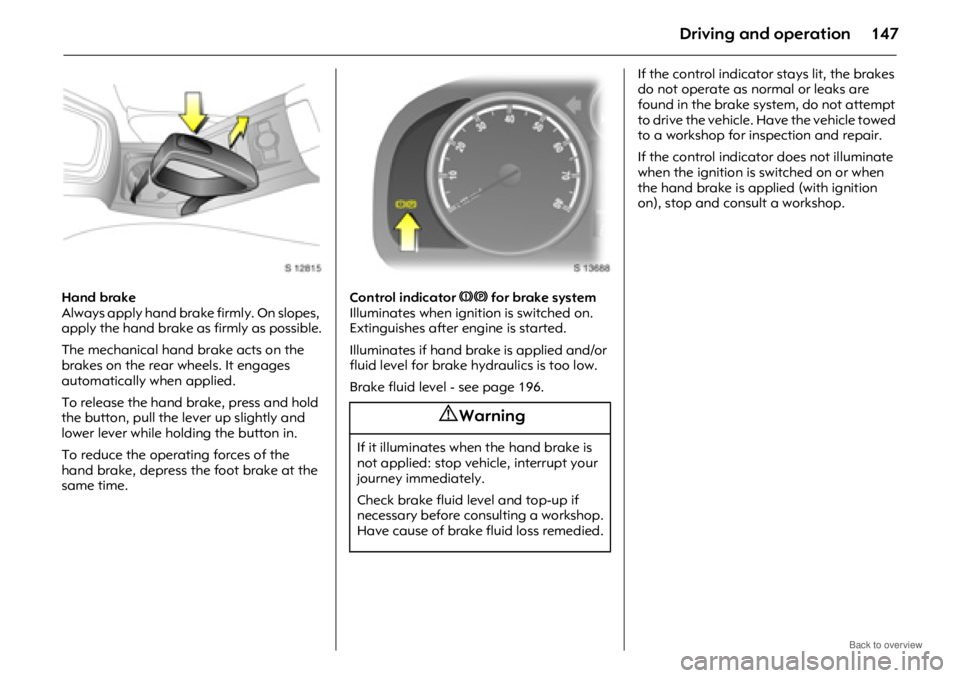
Hand brake
Always apply hand brake firmly. On slopes,
apply the hand brake as firmly as possible.
The mechanical hand brake acts on the
brakes on the rear wheels. It engages
automatically when applied.
To release the hand brake, press and hold
the button, pull the lever up slightly and
lower lever while holding the button in.
To reduce the operating forces of the
hand brake, depress the foot brake at the
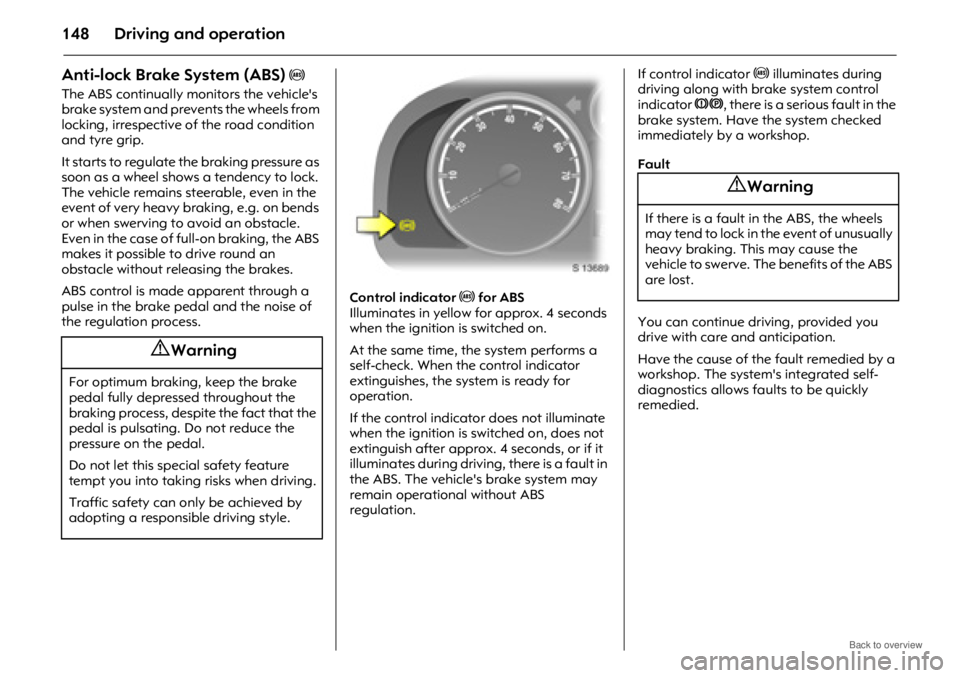
same time. Control indicator
4 for brake system
Illuminates when ignition is switched on.
Extinguishes after engine is started.
Illuminates if hand brake is applied and/or
fluid level for brake hydraulics is too low.
Brake fluid level - see page 196. If the control indicator stays lit, the brakes
do not operate as normal or leaks are
found in the brake system, do not attempt
to drive the vehicle. Have the vehicle towed
to a workshop for inspection and repair.
If the control indicator does not illuminate
when the ignition is switched on or when
the hand brake is applied (with ignition
on), stop and consult a workshop.
9 Warning
If it illuminates when the hand brake is
not applied: stop vehi
cle, interrupt your
journey immediately.
Check brake fluid level and top-up if
necessary before consulting a workshop.
Have cause of brake fluid loss remedied.
Page 148 of 234
Driving and operation148
Anti-lock Brake System (ABS)
u
The ABS continually monitors the vehicle's
brake system and prevents the wheels from
locking, irrespective of the road condition
and tyre grip.
It starts to regulate the braking pressure as
soon as a wheel shows a tendency to lock.
The vehicle remains steerable, even in the
event of very heavy braking, e.g. on bends
or when swerving to avoid an obstacle.
Even in the case of full-on braking, the ABS
makes it possible to drive round an
obstacle without releasing the brakes.
ABS control is made apparent through a
pulse in the brake pedal and the noise of
the regulation process. Control indicator
u for ABS
Illuminates in yellow for approx. 4 seconds
when the ignition is switched on.
At the same time, the system performs a
self-check. When the control indicator
extinguishes, the system is ready for
operation.
If the control indicato r does not illuminate
when the ignition is switched on, does not
extinguish after approx. 4 seconds, or if it
illuminates during driving, there is a fault in
the ABS. The vehicle's brake system may
remain operational without ABS
regulation. If control indicator
u illuminates during
driving along with brake system control
indicator 4, there is a serious fault in the
brake system. Have the system checked
immediately by a workshop.
Fault
You can continue driving, provided you
drive with care and anticipation.
Have the cause of the fault remedied by a
workshop. The system's integrated self-
diagnostics allows faults to be quickly
remedied.
9 Warning
For optimum braking, keep the brake
pedal fully depresse d throughout the
braking process, despite the fact that the
pedal is pulsating. Do not reduce the
pressure on the pedal.
Do not let this special safety feature
tempt you into taking risks when driving.
Traffic safety can only be achieved by
adopting a responsible driving style.
9 Warning
If there is a fault in the ABS, the wheels
may tend to lock in the event of unusually
heavy braking. This may cause the
vehicle to swerve. The benefits of the ABS
are lost.
Page 149 of 234

Driving and operation149
Wheels, tyres
See page 223 for suitable tyres and
restrictions.
Factory-fitted tyres are matched to the
chassis and offer optimum driving comfort
and safety.
Changing tyre/wheel type
Note the necessary modifications before
switching to different tyres or wheels.
If wheel rims of a different type are to be
installed, the wheel nuts may also need to
be changed. We recommend you consult
an Opel Partner.
If tyres of a different size to those fitted at
the factory are used (this includes winter
tyres), the electron ic speedometer may
possibly need to be reprogrammed, to
ensure that the speed displayed is correct. Vehicles with tyre pressure monitoring
system
3
When using winter tyres, or when switching
to different tyre sizes, sensors for the tyre
pressure monitoring syst em can be fitted at
a later date by a workshop, upon request.
Otherwise, the system would not indicate
tyre pressure deviations.
Tyre pressure monitoring system -
see page 144.
Fitting new tyres
New tyres should be fitted in pairs, or, for
preference, in sets. Make sure that both
tyres on an axle are:
z the same size,
z the same design,
z the same make,
z and have the same tread pattern.
Fit directional tyres such that they roll in the
direction of travel. The rolling direction is
indicated by a symbol (e.g. an arrow) on
the sidewall.
Tyres fitted opposing the rolling direction
(e.g. when a tyre is changed) should be
refitted as soon as possible. This is the only
way to obtain full benefit from the design
properties of the tyre.
Observe legal requirements when
disposing of tyres. Some brands of tyres have a beaded edge
for alloy wheels, to protect against
damage. If wheel trims are used on steel
wheels with beaded-edge tyres, the
following procedure must be followed:
z
Wheel trims and tyres that are approved
by Opel for the respective vehicle and
comply with all of the relevant wheel and
tyre combination requ irements must be
used.
z If the wheel trims and tyres used are not
Opel-approved, the tyres must not have
a beaded edge.
9 Warning
Use of unsuitable tyres or wheels may
lead to accidents and render the vehicle
unroadworthy.
9 Warning
Use of unsuitable tyres or wheel trims
could lead to sudden pressure loss and
thereby accidents.
Page 150 of 234
Driving and operation150
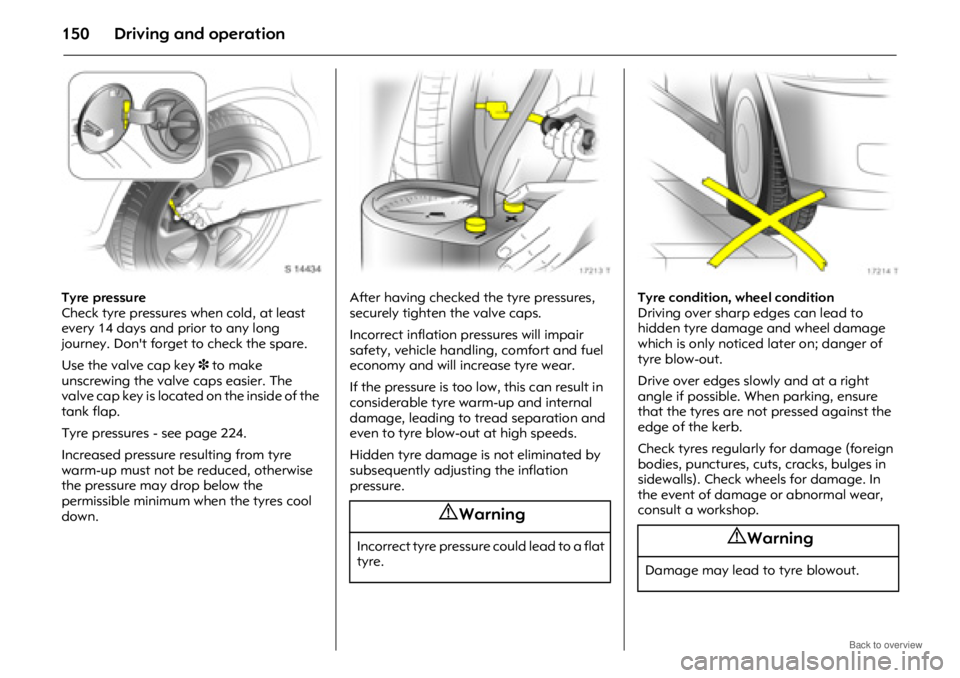
Tyre pressure
Check tyre pressures when cold, at least
every 14 days and prior to any long
journey. Don't forget to check the spare.
Use the valve cap key 3 to make
unscrewing the valve caps easier. The
valve cap key is located on the inside of the
tank flap.
Tyre pressures - see page 224.
Increased pressure resulting from tyre
warm-up must not be reduced, otherwise
the pressure may drop below the
permissible minimum when the tyres cool
down. After having checked the tyre pressures,
securely tighten the valve caps.
Incorrect inflation pressures will impair
safety, vehicle handling, comfort and fuel
economy and will increase tyre wear.
If the pressure is too low, this can result in
considerable tyre warm-up and internal
damage, leading to tread separation and
even to tyre blow-out at high speeds.
Hidden tyre damage is not eliminated by
subsequently adjusting the inflation
pressure.
Tyre condition, wheel condition
Driving over sharp edges can lead to
hidden tyre damage and wheel damage
which is only noticed later on; danger of
tyre blow-out.
Drive over edges slowly and at a right
angle if possible. When parking, ensure
that the tyres are not pressed against the
edge of the kerb.
Check tyres regularly for damage (foreign
bodies, punctures, cuts, cracks, bulges in
sidewalls). Check wheels for damage. In
the event of damage
or abnormal wear,
consult a workshop.
9 Warning
Incorrect tyre pressure could lead to a flat
tyre.9 Warning
Damage may lead to tyre blowout.
Page 153 of 234

Driving and operation153
Always use fine-linked chains that add no
more than 15 mm to the tyre tread and the
inboard sides (including chain lock).
Tyre chains may only be used at speeds of
up to 50 km/h (30 mph)
1) or up to the tyre
chain manufacturer’s recommended
maximum speed, whichever is lower.
When travelling on road s that are free of
snow, they may only be used for brief
periods since they are subject to rapid wear
on a hard road and may snap.
Avoid sharp turns, bumps and holes and
do not lock the wheels when braking, to
avoid damaging the tyre chains.
Retighten the chains after driving for
approx. 1 km (0.6 miles). If, at any time,
you hear or suspect that the chains are
contacting the vehicle, stop and retighten
the chains.
Always read the instructions supplied with
the tyre chains. Temporary spare wheel
The temporary spare wheel is designed for
use on your vehicle only.
Do not attempt to use the spare tyre on a
different wheel, or use a different tyre on
the spare wheel, as they will not fit.
For notes on the temporary spare wheel -
see page 178.
Ensure the temporary spare wheel is
inflated to the correct tyre pressure -
see page 224.
Wheel changing - see page 178.
Roof racks 3
For reasons of safety and to avoid
damaging the roof, we recommend that
you use the Opel roof rack system
approved for your vehicle.
Fasten the roof rack to the roof rails
following the instructions that accompany
the system, ensuring that the roof load is
evenly distributed over the side or cross
rails. Loads must not be placed on the roof
surface.
To prevent damage or loss, check
frequently that roof loads are securely
fastened.
Driving with a roof load affects the
vehicle’s centre of gravity; drive carefully in
crosswinds and do not drive at high
speeds.
Driving hints - see page 127.
1)Varies from country to country on account of
national regulations.
9 Warning
Disregard of the instructions may lead to
injuries or endanger life. Vehicle
passengers must be informed
accordingly.
Page 154 of 234
Driving and operation154
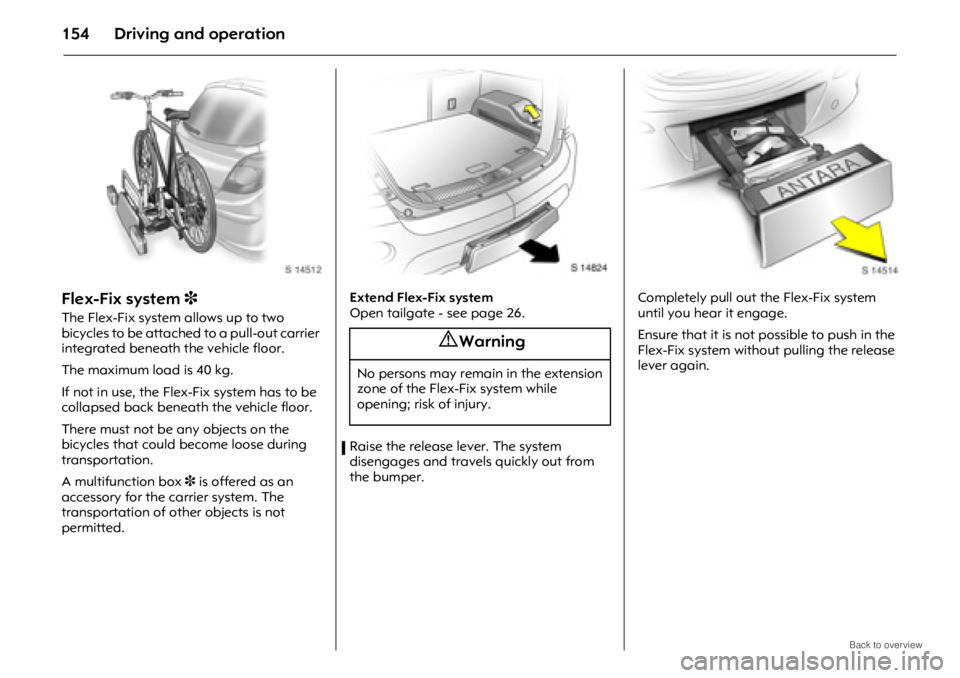
Flex-Fix system 3
The Flex-Fix system allows up to two
bicycles to be attached to a pull-out carrier
integrated beneath the vehicle floor.
The maximum load is 40 kg.
If not in use, the Flex-Fix system has to be
collapsed back beneath the vehicle floor.
There must not be any objects on the
bicycles that could become loose during
transportation.
A multifunction box 3 is offered as an
accessory for the carrier system. The
transportation of other objects is not
permitted. Extend Flex-Fix system
Open tailgate - see page 26.
Raise the release lever. The system
disengages and travels quickly out from
the bumper.
Completely pull out
the Flex-Fix system
until you hear it engage.
Ensure that it is not possible to push in the
Flex-Fix system without pulling the release
lever again.
9 Warning
No persons may remain in the extension
zone of the Flex-Fix system while
opening; risk of injury.
Page 156 of 234
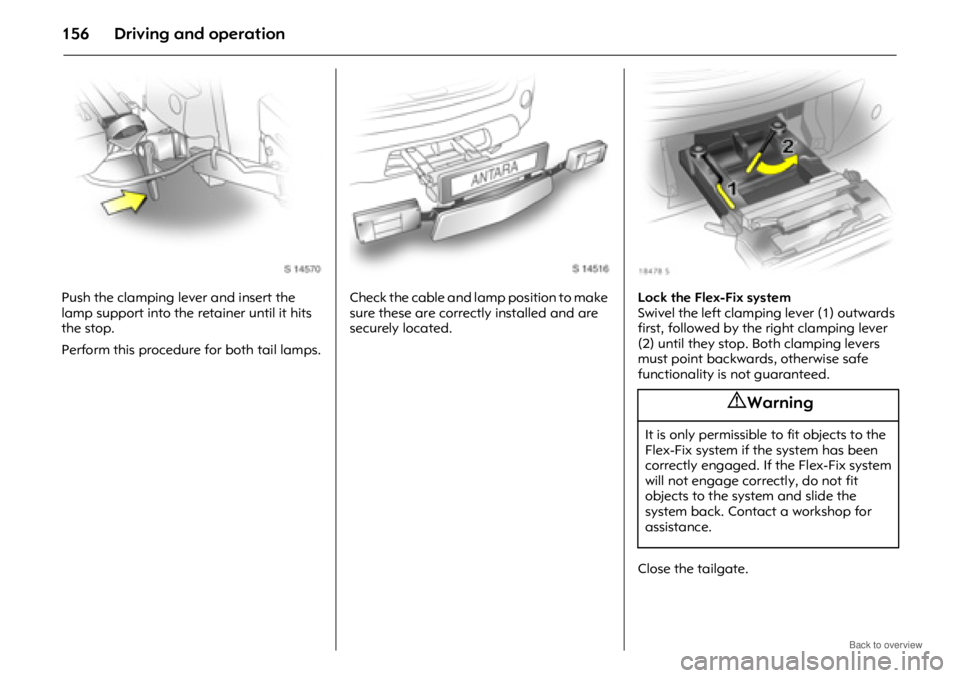
Driving and operation156
Push the clamping lever and insert the
lamp support into the retainer until it hits
the stop.
Perform this procedure for both tail lamps.Check the cable and lamp position to make
sure these are correctly installed and are
securely located.
Lock the Flex-Fix system
Swivel the left clamping lever (1) outwards
first, followed by the right clamping lever
(2) until they stop. Both clamping levers
must point backwards, otherwise safe
functionality is not guaranteed.
Close the tailgate.
9 Warning
It is only permissible to fit objects to the
Flex-Fix system if the system has been
correctly engaged. If the Flex-Fix system
will not engage correctly, do not fit
objects to the system and slide the
system back. Contact a workshop for
assistance.
Page 162 of 234
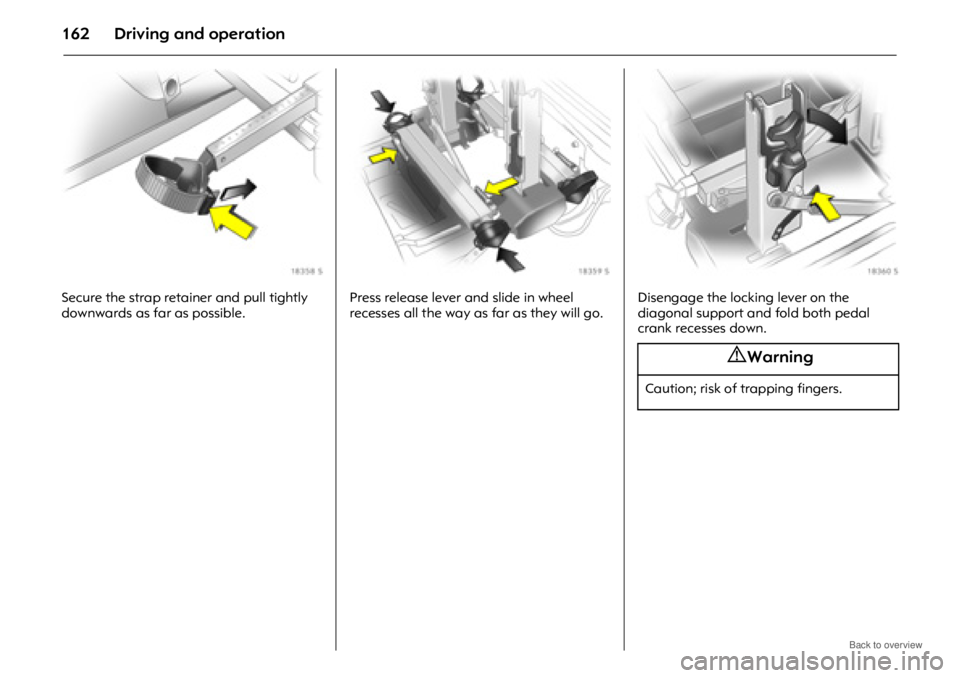
Driving and operation162
Secure the strap retainer and pull tightly
downwards as far as possible.Press release lever and slide in wheel
recesses all the way as far as they will go.Disengage the locking lever on the
diagonal support and fold both pedal
crank recesses down.
9 Warning
Caution; risk of trapping fingers.
Page 164 of 234
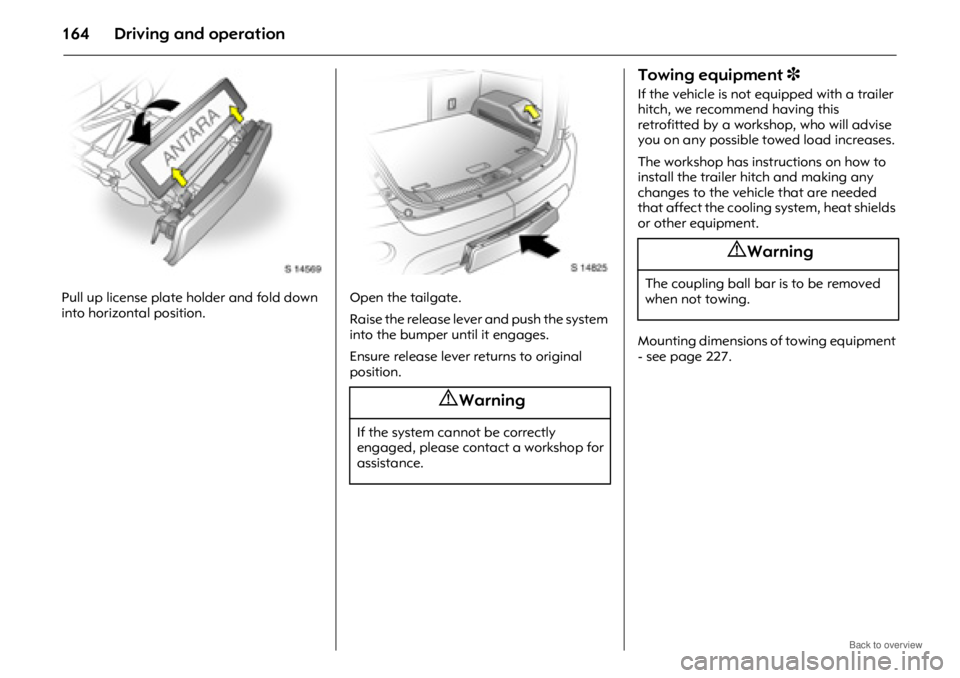
Driving and operation164
Pull up license plate holder and fold down
into horizontal position.Open the tailgate.
Raise the release lever
and push the system
into the bumper until it engages.
Ensure release lever returns to original
position.
Towing equipment 3
If the vehicle is not equipped with a trailer
hitch, we recommend having this
retrofitted by a workshop, who will advise
you on any possible towed load increases.
The workshop has instructions on how to
install the trailer hitch and making any
changes to the vehicle that are needed
that affect the coolin g system, heat shields
or other equipment.
Mounting dimensions of towing equipment
- see page 227.
9 Warning
If the system cannot be correctly
engaged, please contact a workshop for
assistance.
9 Warning
The coupling ball bar is to be removed
when not towing.
Page 166 of 234
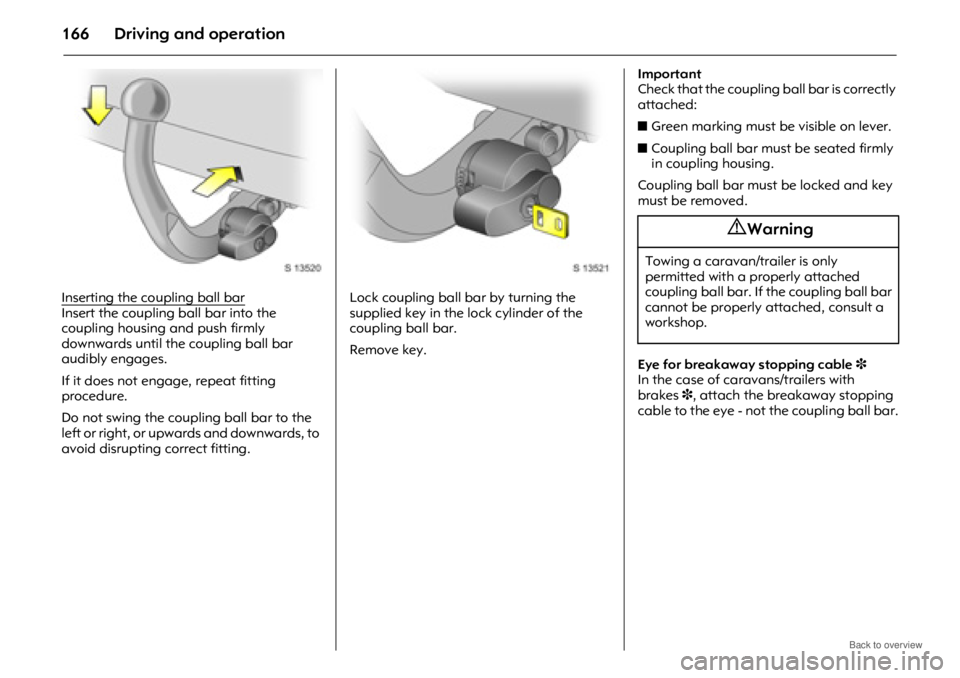
Driving and operation166
Inserting the coupling ball barInsert the coupling ball bar into the
coupling housing and push firmly
downwards until the coupling ball bar
audibly engages.
If it does not engage, repeat fitting
procedure.
Do not swing the coupling ball bar to the
left or right, or upwards and downwards, to
avoid disrupting correct fitting. Lock coupling ball bar by turning the
supplied key in the lock cylinder of the
coupling ball bar.
Remove key.Important
Check that the coupling ball bar is correctly
attached:
z
Green marking must be visible on lever.
z Coupling ball bar must be seated firmly
in coupling housing.
Coupling ball bar must be locked and key
must be removed.
Eye for breakaway stopping cable 3
In the case of caravans/trailers with
brakes 3, attach the breakaway stopping
cable to the eye - not the coupling ball bar.
9 Warning
Towing a caravan/trailer is only
permitted with a properly attached
coupling ball bar. If the coupling ball bar
cannot be properly attached, consult a
workshop.