warning OPEL ANTARA 2009 Manual Online
[x] Cancel search | Manufacturer: OPEL, Model Year: 2009, Model line: ANTARA, Model: OPEL ANTARA 2009Pages: 234, PDF Size: 3.01 MB
Page 170 of 234
Driving and operation170
Block the wheels of both the caravan/trailer
and the vehicle when parking and always
apply the hand brake firmly. If possible, do
not park on slopes. Parking on inclines
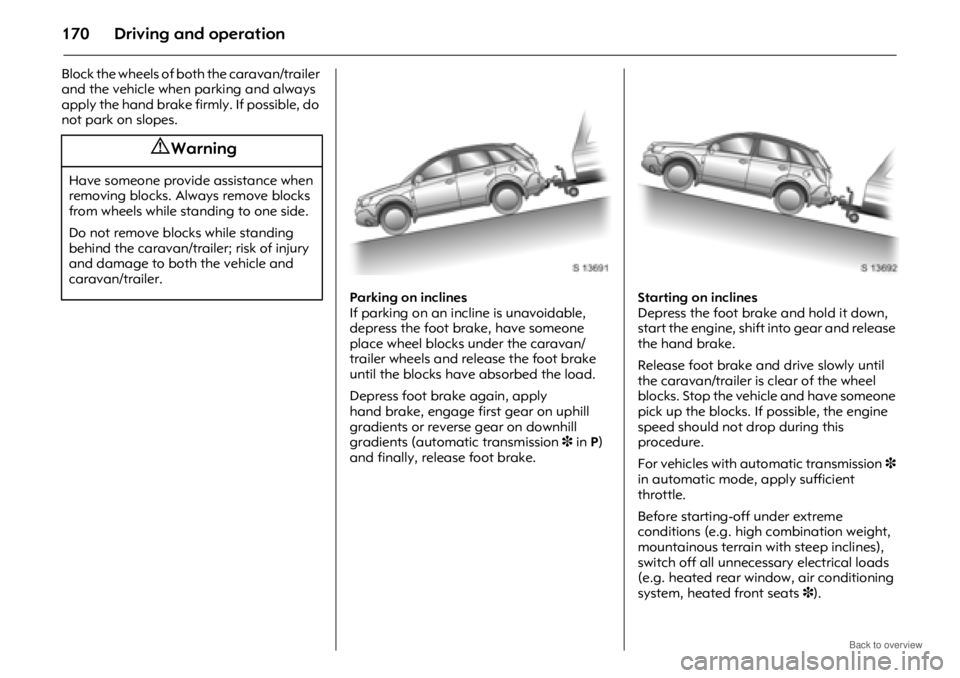
If parking on an incline is unavoidable,
depress the foot brake, have someone
place wheel blocks under the caravan/
trailer wheels and release the foot brake
until the blocks have absorbed the load.
Depress foot brake again, apply
hand brake, engage first gear on uphill
gradients or reverse gear on downhill
gradients (automatic transmission 3 in P)
and finally, release foot brake. Starting on inclines
Depress the foot brake and hold it down,
start the engine, shift into gear and release
the hand brake.
Release foot brake and drive slowly until
the caravan/trailer is clear of the wheel
blocks. Stop the vehicle and have someone
pick up the blocks. If possible, the engine
speed should not drop during this
procedure.
For vehicles with automatic transmission
3
in automatic mode, apply sufficient
throttle.
Before starting-off under extreme
conditions (e.g. high combination weight,
mountainous terrain with steep inclines),
switch off all unnecessary electrical loads
(e.g. heated rear window, air conditioning
system, heated front seats 3).
9 Warning
Have someone provide assistance when
removing blocks. Always remove blocks
from wheels while standing to one side.
Do not remove blocks while standing
behind the caravan/trailer; risk of injury
and damage to both the vehicle and
caravan/trailer.
Page 171 of 234

Self-help, vehicle care171
Self-help, vehicle care
Diesel fuel system, bleeding
Never let the fuel tank run dry. If control
indicator Y illuminates, refuel as soon as
possible.
It is possible to restart the engine if the tank
has been run dry. A delayed start can be
expected. Switch on the ignition three times
for approx. 15 seconds. Then try to start
the engine for no more than 40 seconds. If
the engine will not start, wait at least
10 seconds before trying again. If the
engine will still not start, consult a
workshop.
Bonnet
To open the bonnet, pull release lever /
located on the left-hand side below the
instrument panel.
The bonnet will then be unlocked and will
partially open. Return release lever to its
original position.
Do not pull release lever while the vehicle is
moving.
Diesel fuel system, bleeding .............. 171
Bonnet ................................................. 171
Starting ................................................ 172
Starting the engine with jump leads
3 172
Towing ................................................. 174
Jack and vehicle tools ........................ 176
Warning triangle ¨ 3 ,
First aid kit +3................................ 177
Temporary spare wheel ..................... 177
Wheel changing .................................. 178
Electrical system ................................. 181
Fuses and the most important circuits they protect ...................................... 182
Bulb replacement ............................... 185
Opel genuine parts and accessories . 191
A note on safety ................................. 191
Checking and topping up fluids ........ 191
Windscreen wipers .............................. 198
Windscreen washer system ................ 199
Battery ................................................. 200
Protection of electr onic components 201
Vehicle storage ................................... 201
Vehicle care......................................... 201
9 Warning
Disregard of the instructions may lead to
injuries or endanger life. Vehicle
passengers must be informed
accordingly.
Page 172 of 234

Self-help, vehicle care172
To open completely, locate the safety
catch, found slightly left of centre on the
underside of the bonnet, push the catch
upwards and lift the bonnet gently. The
bonnet is held open automatically.
When the bonnet is opened, leaves, dirt or
snow on the bonnet can slide down and
obstruct the air intake. Remove any leaves,
dirt or snow. Air intake - see page 114.
Never drive with bonnet open.
To close bonnet, lower it gradually,
allowing it to drop from a height of approx.
30 cm.
Check that the bonnet is locked in position
before driving, by pulling at its front edge.
If it is not engaged, repeat closing
procedure.
Starting
Do not start with quick charger
This prevents damage to electronic
components.
Do not start by pushing or towing
Because your vehicle is fitted with a
catalytic converter, it must not be started
by pushing or towing - see page 133.
The vehicle can only be started using jump
leads - see following pages.
Starting the engine with jump
leads 3
A vehicle with a discha rged battery can be
started using jump leads and the battery of
another vehicle.
Start attempts should be made at intervals
of 1 minute and should not last longer than
15 seconds.
9 Warning
If the vehicle battery requires charging
whilst still in the vehicle, ensure there is
adequate ventilation in and around the
battery compartment, to prevent risk of
explosion.
9 Warning
This must be done with extreme care. Any
deviation from the following instructions
could lead to personal injury or damage
resulting from battery explosion, as well
as to damage to the electrical systems in
both vehicles.
Page 174 of 234
Self-help, vehicle care174
zDo not connect leads to negative
terminal of discharged battery.
z The last connection point should be as
far away from the discharged battery as
possible.
z Route leads so they cannot catch on
rotating parts in engine compartment.
z Start the engine of the vehicle providing
the jump start.
z After 5 minutes, start the other engine.
Start attempts shou ld be made at
intervals of 1 minute and should not last
longer than 15 seconds.
z After starting, allow both engines to idle
for approx. 3 minutes with leads
connected.
z In order to avoid excess voltage in the
electrical system, before removing a
lead, switch on an electrical consumer
(e.g. lamps, heated rear window) in the
vehicle receiving the jump start.
z Operate discharged vehicle for approx.
20 minutes to allow for recharging.
z Reverse above sequence exactly when
removing leads.
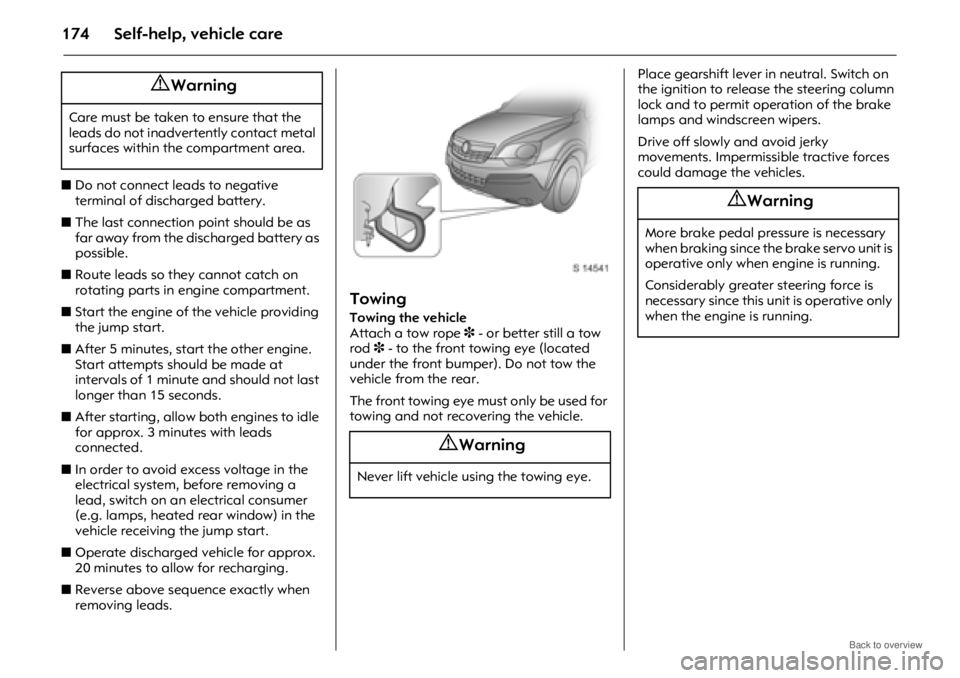
Towing
Towing the vehicle
Attach a tow rope 3 - or better still a tow
rod 3 - to the front towing eye (located
under the front bumper). Do not tow the
vehicle from the rear.
The front towing eye must only be used for
towing and not recovering the vehicle. Place gearshift lever in neutral. Switch on
the ignition to release the steering column
lock and to permit operation of the brake
lamps and windscreen wipers.
Drive off slowly and avoid jerky
movements. Impermissible tractive forces
could damage
the vehicles.
9 Warning
Care must be taken to ensure that the
leads do not inadvertently contact metal
surfaces within the compartment area.
9 Warning
Never lift vehicle using the towing eye.
9 Warning
More brake pedal pressure is necessary
when braking since the brake servo unit is
operative only when engine is running.
Considerably greater steering force is
necessary since this unit is operative only
when the engine is running.
Page 175 of 234
Self-help, vehicle care175
Keep tow rope 3 clear of front bumper,
and ensure it is secure ly fixed to the towing
eye at both ends. Pull on the tow rope 3 to
check.
To prevent entry of exhaust fumes from
towing vehicle, switch on air recirculation
mode (see page 109) and close the
windows.
Never let passengers ride in a vehicle that
is being towed.
Never tow a vehicle with damaged parts
that are not secured to the vehicle or if
wheels, brakes or steering are damaged.
Do not tow the vehicle with a tow rope 3 or
tow rod 3 for extended periods, to avoid
damage to the vehicle. Only tow in this
manner on hard-surfaced roads.
For vehicles with automatic transmission 3:
use flatbed or wheel lift equipment only.
Towing can cause severe damage to the
transmission.
Seek the assistance of a workshop. Towing service
Entrust your vehicle only to the towing
service of your choice and obtain an
estimate on towing costs before employing
any towing service. This will prevent
unnecessary expense and possible
insurance problems during claim
processing.
Use flatbed equipment whenever possible.
If vehicle is to be towed using a wheel lift,
tow with all wheels off the road, using a
towing dolly.
Never use sling-type equipment to tow the
vehicle or tow the vehicle with the front or
rear wheels on the road, to avoid causing
serious damage to the vehicle.
Place the gearshift lever in neutral
(automatic transmission 3
in N), switch on
hazard warning lamps, turn key to ignition
switch position ACC and release the
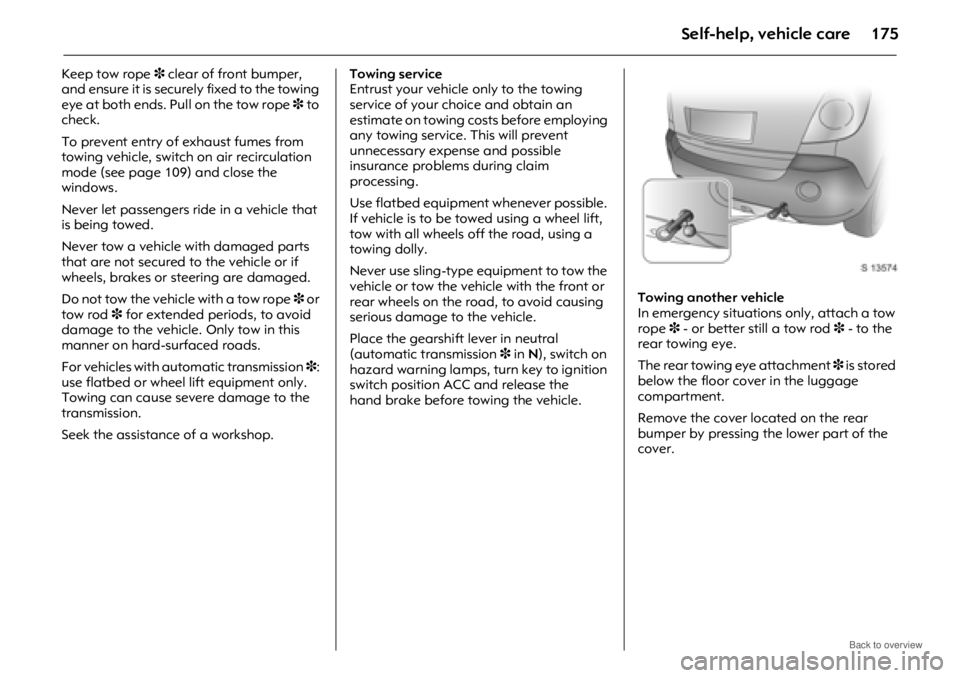
hand brake before towing the vehicle. Towing another vehicle
In emergency situations only, attach a tow
rope
3 - or better still a tow rod 3 - to the
rear towing eye.
The rear towing eye attachment 3 is stored
below the floor cover in the luggage
compartment.
Remove the cover located on the rear
bumper by pressing the lower part of the
cover.
Page 176 of 234
Self-help, vehicle care176
Screw the rear towing eye attachment anti-
clockwise until it is firmly in place.
Drive off slowly and avoid jerky
movements. Impermissible tractive forces
could damage the vehicles.
To prevent damage, do not take up slack
in the tow rope too quickly.
After towing, unscrew the rear towing eye
attachment clockwise to remove, and
reinstall the cover.
Jack and vehicle tools
The jack and vehicle tools have been
specially developed for your vehicle and
must only be used on that vehicle. Only use
jack for changing wheels.
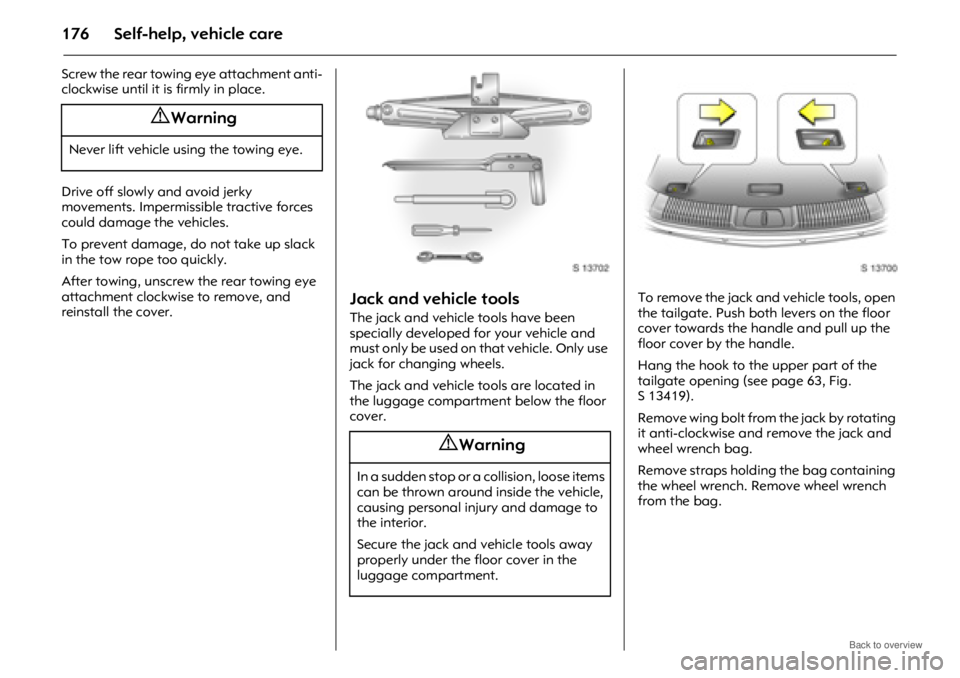
The jack and vehicle tools are located in
the luggage compartment below the floor
cover. To remove the jack and vehicle tools, open
the tailgate. Push both levers on the floor
cover towards the handle and pull up the
floor cover by the handle.
Hang the hook to the upper part of the
tailgate opening (see page 63, Fig.
S 13419).
Remove wing bolt from the jack by rotating
it anti-clockwise and remove the jack and
wheel wrench bag.
Remove straps holding the bag containing
the wheel wrench. Remove wheel wrench
from the bag.
9 Warning
Never lift vehicle using the towing eye.
9 Warning
In a sudden stop or a collision, loose items
can be thrown around inside the vehicle,
causing personal injury and damage to
the interior.
Secure the jack and vehicle tools away
properly under the floor cover in the
luggage compartment.
Page 177 of 234
Self-help, vehicle care177
Warning triangle
¨ 3 ,
First aid kit
+3
Your first aid kit and warning triangle can
be accommodated below the floor cover in
the luggage compartment.
Temporary spare wheel
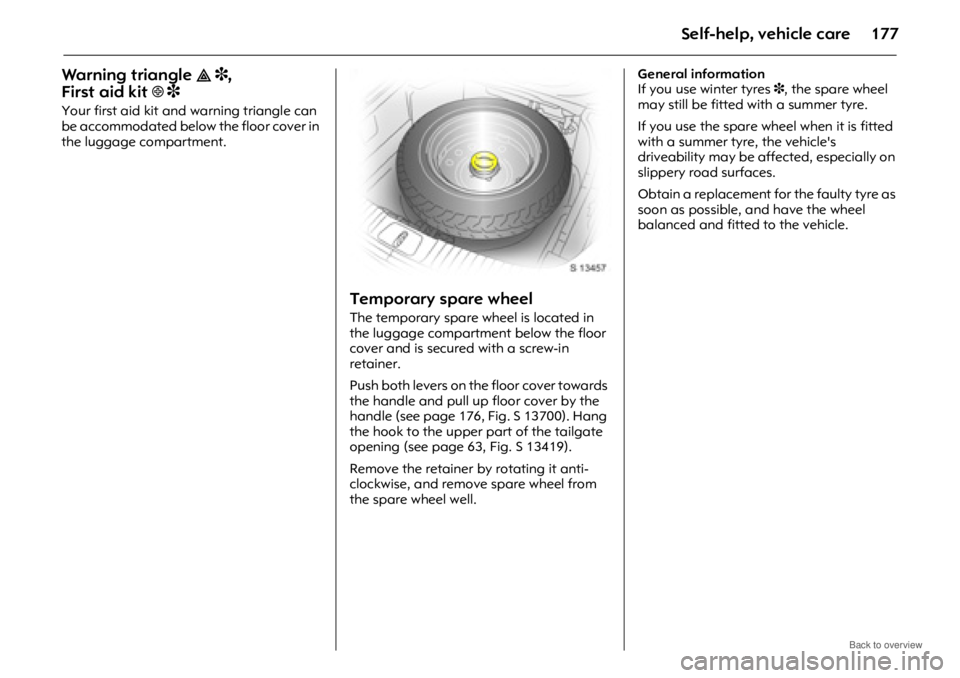
The temporary spare wheel is located in
the luggage compartment below the floor
cover and is secured with a screw-in
retainer.
Push both levers on the floor cover towards
the handle and pull up floor cover by the
handle (see page 176, Fig. S 13700). Hang
the hook to the upper part of the tailgate
opening (see page 63, Fig. S 13419).
Remove the retainer by rotating it anti-
clockwise, and remove spare wheel from
the spare wheel well. General information
If you use winter tyres
3, the spare wheel
may still be fitted with a summer tyre.
If you use the spare wheel when it is fitted
with a summer tyre, the vehicle's
driveability may be affected, especially on
slippery road surfaces.
Obtain a replacement for the faulty tyre as
soon as possible, and have the wheel
balanced and fitted to the vehicle.
Page 178 of 234

Self-help, vehicle care178
Notes on temporary spare wheel
zUsing a temporary spare wheel may
change the driving behaviour of the
vehicle, particularly if using winter
tyres 3. Replace defective tyre as quickly
as possible, balanc e wheel and fit to
vehicle.
z Fit only one temporary spare wheel.
z Do not drive faster than 80 km/h
(50 mph).
z Take curves slowly.
z Do not use the temporary spare wheel
for a lengthy period.
z Replace temporary spare wheel with full
specification wheel without delay.
z When temporary spare wheel is fitted, do
not take the vehicle through an
automatic car wash with guide rails. The
temporary spare wheel may get caught
on the rails, causing damage to the tyre,
wheel and other vehicle parts.
z Tyre chains are not permitted on the
temporary spare wheel.
If tyre chains are necessary after a front
wheel puncture, fit the temporary spare
wheel to the rear and a rear wheel to the
front. Check tyre pressure and adjust if
necessary - see page 224.
z Follow the temporary spare wheel
instructions on pages 153, 181, 223. Notes on directional tyres
3
Tyres with a prescribed rotating direction
can only achieve their maximum
performance if they are fitted in the
prescribed rotating direction.
If a tyre or spare wheel is fitted that is
rotating in the wrong direction due to a
puncture, the following must be noted:
z The handling of the vehicle may be
different. Replace defective tyres as soon
as possible, have wheel balanced and
fitted to the vehicle.
z Do not drive faster than 80 km/h
(50 mph).
z Drive particularly carefully on wet and
snow-covered road surfaces.
z For more information on tyres with a
prescribed rotating direction -
see page 149.Wheel changing
In order to reduce the chance of possible
injuries, make the following preparations
and note the procedure:
zPark on a level, firm and non-slippery
surface.
z Switch on hazard warning lamps and
apply hand brake. Engage 1st gear or
reverse (automatic transmission 3 in P).
z Correctly set up warning triangle 3.
z Ensure all vehicle passengers are out of
the vehicle and clear of the vehicle and
other traffic.
z Take the spare wheel from under the
luggage compartment floor cover -
see page 177.
z Before raising the vehicle, turn front
wheels to straight-ahead position.
Page 181 of 234

Self-help, vehicle care181
Electrical system
Fuses
There are two fuse boxes in the vehicle:
the instrument panel fu se box is located on
the left-hand side of the front passenger’s
footwell, the engine compartment fuse box
is located next to the coolant reservoir.
It is advisable to carry a full set of fuses.
Spare fuses are kept in the engine
compartment fuse box.
7. Change the wheel.
Notes on spare wheel - see page 178.
8. Screw on wheel nuts and tighten slightly by hand until wheel is held
against the hub.
9. Rotate wrench anti-clockwise and lower vehicle to the ground.
10. Tighten wheel nuts in a cross wise sequence, putting the wrench on as far
as possible.
11. Stow replaced wheel in luggage compartment.
12. Stow the jacking equipment and warning triangle 3 - see pages 176,
177.
13. Check the tyre pressure of the newly fitted wheel - see page 224. Adjust as
necessary.
14. Have the new wheel balanced on the vehicle and have the tightening torque
of the wheel nuts checked as soon as
possible, and if necessary, corrected.
Tightening torque - see page 223.
15. Replace defective tyre on the wheel that was removed.
16. Replace temporary spare wheel with a full specification wheel without delay.
9 Warning
Electronic ignition systems generate very
high voltages. Do not touch the ignition
system; high voltage can be fatal.
Page 184 of 234
184 Self-help, vehicle care
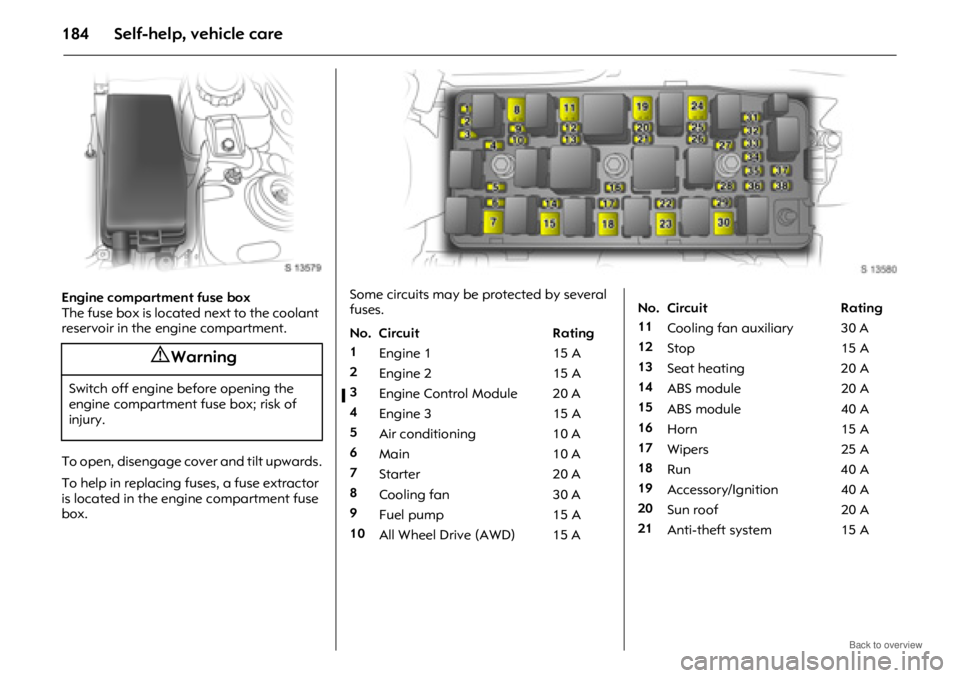
Engine compartment fuse box
The fuse box is located next to the coolant
reservoir in the engine compartment.
To open, disengage cover and tilt upwards.
To help in replacing fuses, a fuse extractor
is located in the engine compartment fuse
box.
9 Warning
Switch off engine before opening the
engine compartment fuse box; risk of
injury.
Some circuits may be protected by several
fuses.
No. Circuit Rating
1 Engine 1 15 A
2 Engine 2 15 A
3 Engine Control Module 20 A
4 Engine 3 15 A
5 Air conditioning 10 A
6 Main 10 A
7 Starter 20 A
8 Cooling fan 30 A
9 Fuel pump 15 A
10 All Wheel Drive (AWD) 15 ANo. Circuit Rating
11 Cooling fan auxiliary 30 A
12 Stop 15 A
13 Seat heating 20 A
14 ABS module 20 A
15 ABS module 40 A
16 Horn 15 A
17 Wipers 25 A
18 Run 40 A
19 Accessory/Ignition 40 A
20 Sun roof 20 A
21 Anti-theft system 15 A