wheel OPEL ANTARA 2009 Workshop Manual
[x] Cancel search | Manufacturer: OPEL, Model Year: 2009, Model line: ANTARA, Model: OPEL ANTARA 2009Pages: 234, PDF Size: 3.01 MB
Page 152 of 234
Driving and operation152
Tyre designations
Meanings:
e.g. 235/60 R 17 102 H
Speed code letters: Winter tyres
3
See page 223 for restrictions.
Winter tyres improve safety at extremely
low outside temperatures and should
therefore be fitted on all wheels.
The design of summer tyres means they
have limited qualities for winter driving.
If the maximum permissible speed for the
winter tyres is less than that of the vehicle,
a notice indicating the maximum
permissible speed for the tyres must be
affixed within the driver's field of vision 3
1).
If you use the spare wheel when it is fitted
with a summer tyre; the vehicle's
driveability may be affected, especially on
slippery road surfaces. Obtain a
replacement for the faulty tyre as soon as
possible, and have the wheel balanced
and fitted to the vehicle.
Ensure that winter tyres are inflated to the
correct pressure specified by the tyre
manufacturer.
If winter tyres are installed that have not
been approved for your vehicle, ESC
performance may be affected. Consult a
workshop regarding availability of
approved winter tyres.
Wheel trims 3
If the wheel trims and tyres used are not
Opel-approved, make sure the tyres do not
have a beaded edge - see page 149. Tyre chains
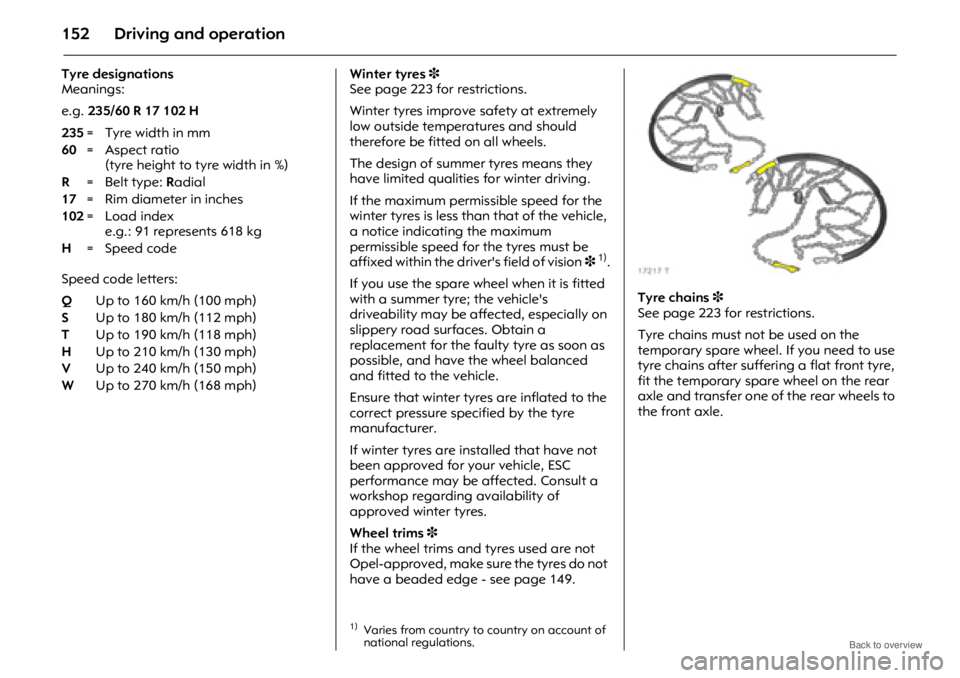
3
See page 223 for restrictions.
Tyre chains must not be used on the
temporary spare wheel. If you need to use
tyre chains after suffering a flat front tyre,
fit the temporary spare wheel on the rear
axle and transfer one of the rear wheels to
the front axle.
235
=Tyre width inmm
60 =Aspect ratio
(tyre height to tyre width in %)
R =Belt type: Radial
17 = Rim diameter in inches
102 =Load index
e.g.: 91 represents 618 kg
H = Speed code
Q Up to 160 km/h (100 mph)
S Up to 180 km/h (112 mph)
T Up to 190 km/h (118 mph)
H Up to 210 km/h (130 mph)
V Up to 240 km/h (150 mph)
W Up to 270 km/h (168 mph)
1)Varies from country to country on account of
national regulations.
Page 153 of 234

Driving and operation153
Always use fine-linked chains that add no
more than 15 mm to the tyre tread and the
inboard sides (including chain lock).
Tyre chains may only be used at speeds of
up to 50 km/h (30 mph)
1) or up to the tyre
chain manufacturer’s recommended
maximum speed, whichever is lower.
When travelling on road s that are free of
snow, they may only be used for brief
periods since they are subject to rapid wear
on a hard road and may snap.
Avoid sharp turns, bumps and holes and
do not lock the wheels when braking, to
avoid damaging the tyre chains.
Retighten the chains after driving for
approx. 1 km (0.6 miles). If, at any time,
you hear or suspect that the chains are
contacting the vehicle, stop and retighten
the chains.
Always read the instructions supplied with
the tyre chains. Temporary spare wheel
The temporary spare wheel is designed for
use on your vehicle only.
Do not attempt to use the spare tyre on a
different wheel, or use a different tyre on
the spare wheel, as they will not fit.
For notes on the temporary spare wheel -
see page 178.
Ensure the temporary spare wheel is
inflated to the correct tyre pressure -
see page 224.
Wheel changing - see page 178.
Roof racks 3
For reasons of safety and to avoid
damaging the roof, we recommend that
you use the Opel roof rack system
approved for your vehicle.
Fasten the roof rack to the roof rails
following the instructions that accompany
the system, ensuring that the roof load is
evenly distributed over the side or cross
rails. Loads must not be placed on the roof
surface.
To prevent damage or loss, check
frequently that roof loads are securely
fastened.
Driving with a roof load affects the
vehicle’s centre of gravity; drive carefully in
crosswinds and do not drive at high
speeds.
Driving hints - see page 127.
1)Varies from country to country on account of
national regulations.
9 Warning
Disregard of the instructions may lead to
injuries or endanger life. Vehicle
passengers must be informed
accordingly.
Page 158 of 234
Driving and operation158
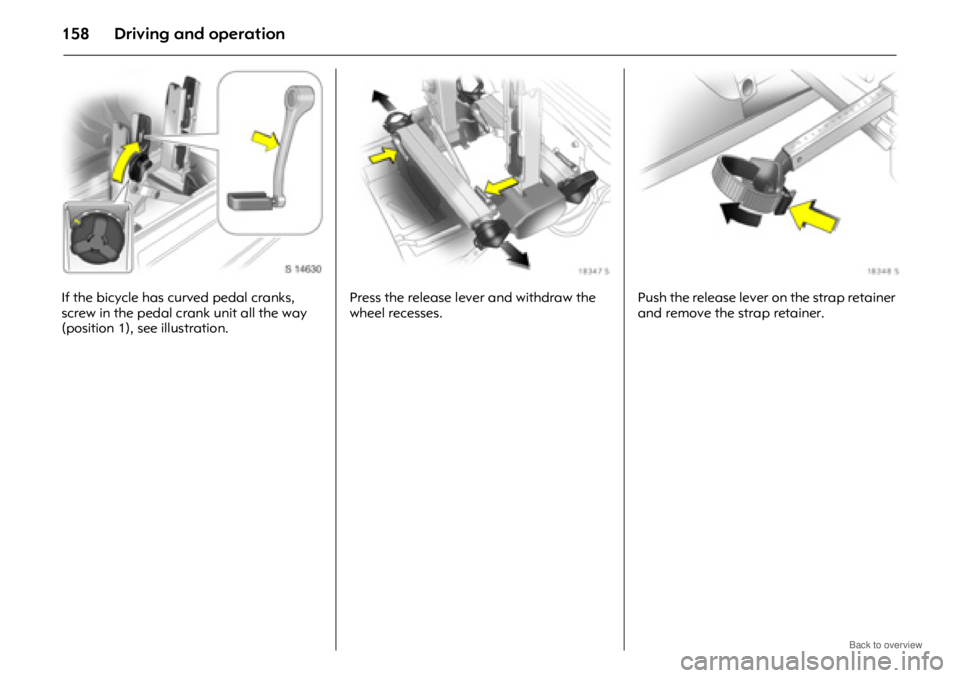
If the bicycle has curved pedal cranks,
screw in the pedal crank unit all the way
(position 1), see illustration.Press the release lever and withdraw the
wheel recesses.
Push the release lever on the strap retainer
and remove the strap retainer.
Page 159 of 234
Driving and operation159
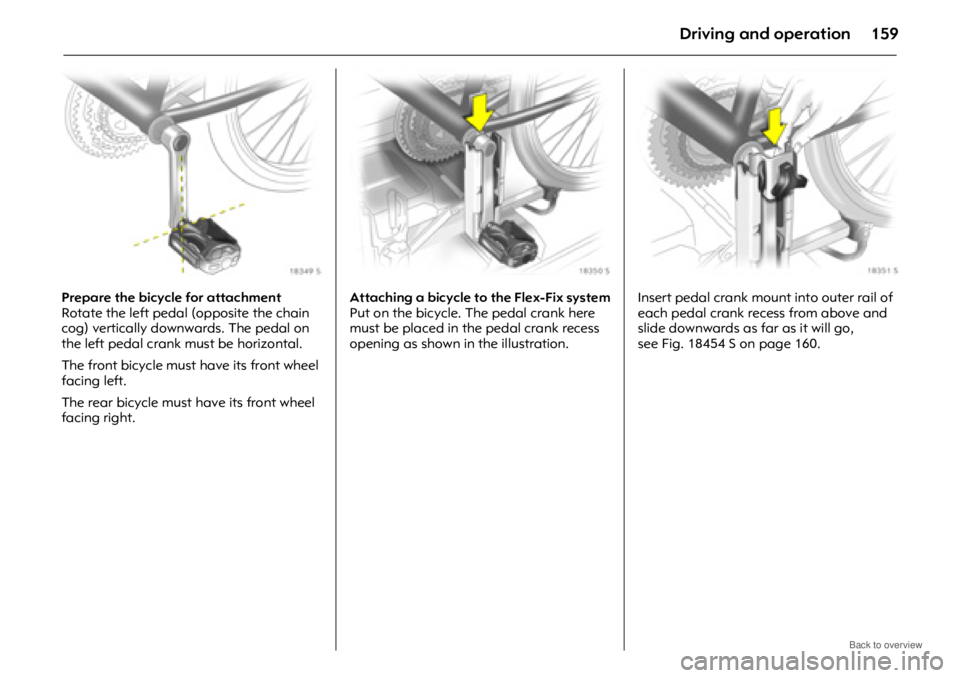
Prepare the bicycle for attachment
Rotate the left pedal (opposite the chain
cog) vertically downwards. The pedal on
the left pedal crank must be horizontal.
The front bicycle must have its front wheel
facing left.
The rear bicycle must have its front wheel
facing right.Attaching a bicycle to the Flex-Fix system
Put on the bicycle. The pedal crank here
must be placed in the pedal crank recess
opening as shown in the illustration.
Insert pedal crank mount
into outer rail of
each pedal crank recess from above and
slide downwards as far as it will go,
see Fig. 18454 S on page 160.
Page 160 of 234
Driving and operation160
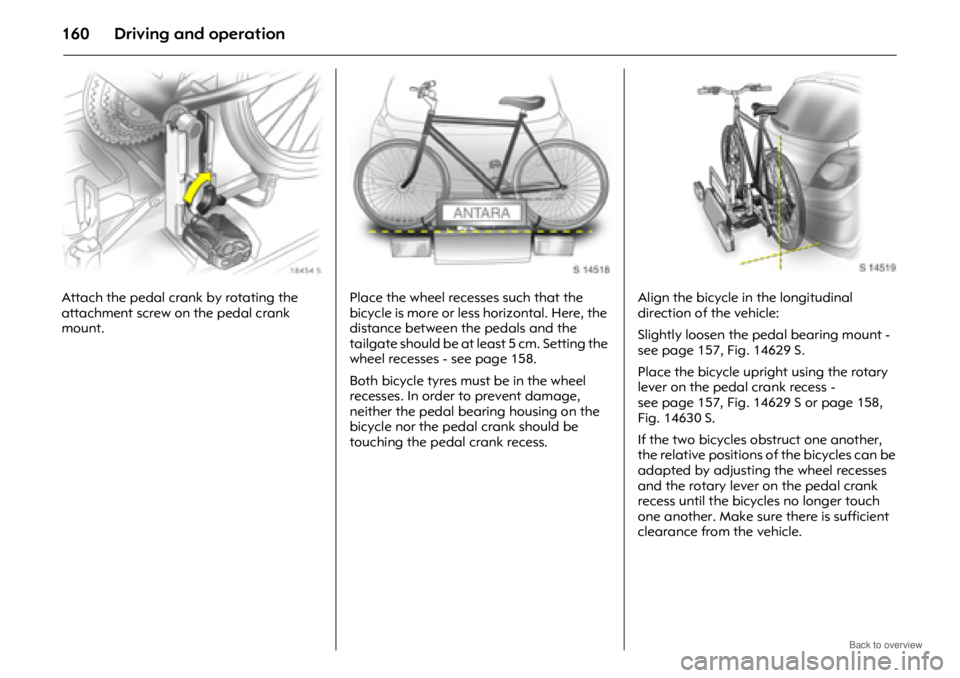
Attach the pedal crank by rotating the
attachment screw on the pedal crank
mount.Place the wheel recesses such that the
bicycle is more or less horizontal. Here, the
distance between the pedals and the
tailgate should be at least 5 cm. Setting the
wheel recesses - see page 158.
Both bicycle tyres must be in the wheel
recesses. In order to prevent damage,
neither the pedal bearing housing on the
bicycle nor the pedal crank should be
touching the pedal crank recess.Align the bicycle in the longitudinal
direction of the vehicle:
Slightly loosen the pedal bearing mount -
see page 157, Fig. 14629 S.
Place the bicycle upright using the rotary
lever on the pedal crank recess -
see page 157, Fig. 14629 S or page 158,
Fig. 14630 S.
If the two bicycles obstruct one another,
the relative positions of the bicycles can be
adapted by adjusting the wheel recesses
and the rotary lever on the pedal crank
recess until the bicycles no longer touch
one another. Make sure there is sufficient
clearance from the vehicle.
Page 161 of 234
Driving and operation161
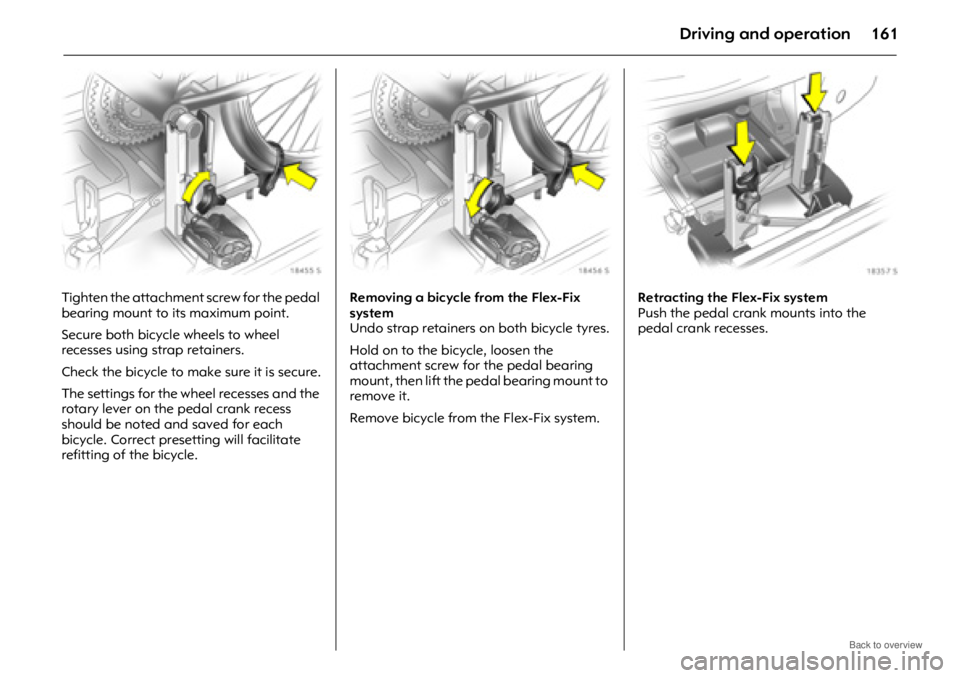
Tighten the attachment screw for the pedal
bearing mount to its maximum point.
Secure both bicycle wheels to wheel
recesses using strap retainers.
Check the bicycle to make sure it is secure.
The settings for the wheel recesses and the
rotary lever on the pedal crank recess
should be noted and saved for each
bicycle. Correct presetting will facilitate
refitting of the bicycle. Removing a bicycle from the Flex-Fix
system
Undo strap retainers on both bicycle tyres.
Hold on to the bicycle, loosen the
attachment screw for the pedal bearing
mount, then lift the pedal bearing mount to
remove it.
Remove bicycle from the Flex-Fix system.
Retracting the Flex-Fix system
Push the pedal crank mounts into the
pedal crank recesses.
Page 162 of 234
Driving and operation162
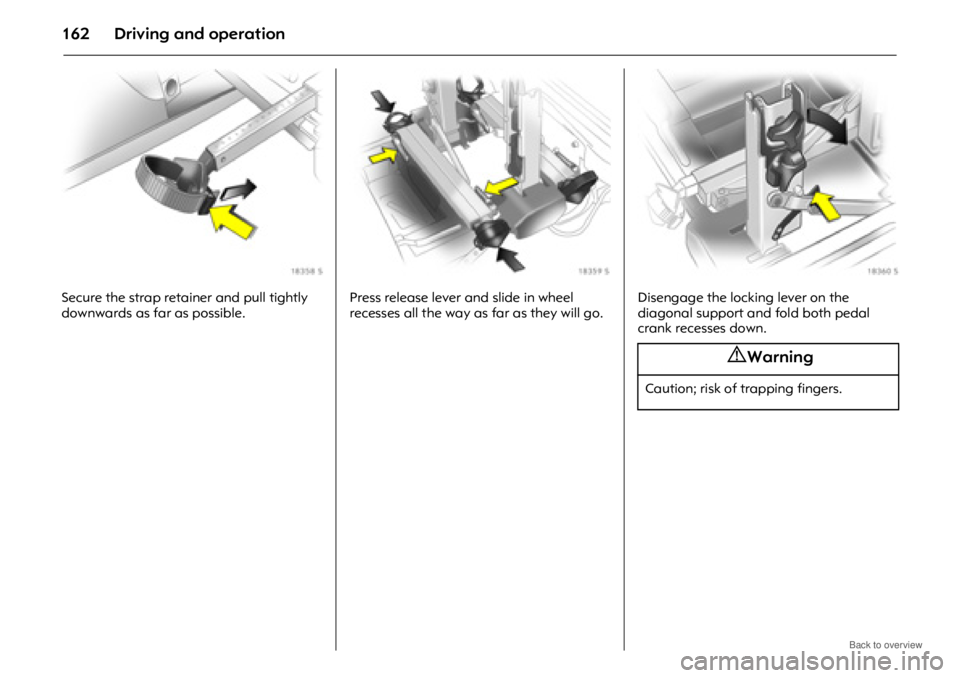
Secure the strap retainer and pull tightly
downwards as far as possible.Press release lever and slide in wheel
recesses all the way as far as they will go.Disengage the locking lever on the
diagonal support and fold both pedal
crank recesses down.
9 Warning
Caution; risk of trapping fingers.
Page 167 of 234

Driving and operation167
Dismounting the coupling ball bar
Unlock coupling ball bar and remove key.
Push lever to the left, towards the coupling
ball bar and turn it downwards. Pull
coupling ball bar out of coupling housing.
Remove any rust or dirt from area around
the coupling housing and coupling ball bar
connection before inserting sealing plug in
the hole.
Place the coupling ball bar in the bag
supplied, fasten it wi th the strap and stow
it below the floor cover in the luggage
compartment.
Do not use steam-jet cleaners or other
high-pressure cleaners to clean the
coupling ball bar.
Towing
Caravan/trailer loads1)
The permissible caravan/trailer loads are
vehicle-dependent and engine-dependent
maximum values which must not be
exceeded.
The actual caravan/trailer load is the
difference between the actual gross weight
of the caravan/trailer and the actual
coupling socket load with the caravan/
trailer coupled.
When the caravan/trailer load is being
checked, therefore, on ly the caravan/trailer
wheels - and not the jockey wheel - must be
standing on the weighing apparatus.
The permissible caravan/trailer loads for
your vehicle are given in the vehicle papers.
Unless otherwise stated , they are valid for
gradients up to max. 12%.
The permissible caravan/trailer load should
be fully utilized only by drivers who are
adequately experienced in towing large
caravans/trailers.
The permitted caravan/trailer load applies
up to the specified incline and up to an
altitude of 1000 metres above sea level. Since engine power decreases as altitude
increases because of the air becoming
thinner, therefore reducing climbing ability,
it may not be possible for permissible trailer
loads to be fully utilized in mountainous
territory.
The permitted towing weight decreases by
10% for every 1000 metres of additional
altitude.
The towing weight does not have to be
reduced when driving on roads with slight
inclines (less than 8%, e.g. on motorways).
The actual caravan/trailer load plus the
actual Gross Vehicle Weight must not
exceed the maximum permitted towing
weight. For example, if the permitted Gross
Vehicle Weight is utilised, the caravan/
trailer load must only
be used until the
maximum permitted towing weight is
reached.
The maximum permitted towing weight is
shown on the vehicle id entification plate -
see page 215.
1)Observe national regulations.
Page 170 of 234
Driving and operation170
Block the wheels of both the caravan/trailer
and the vehicle when parking and always
apply the hand brake firmly. If possible, do
not park on slopes. Parking on inclines
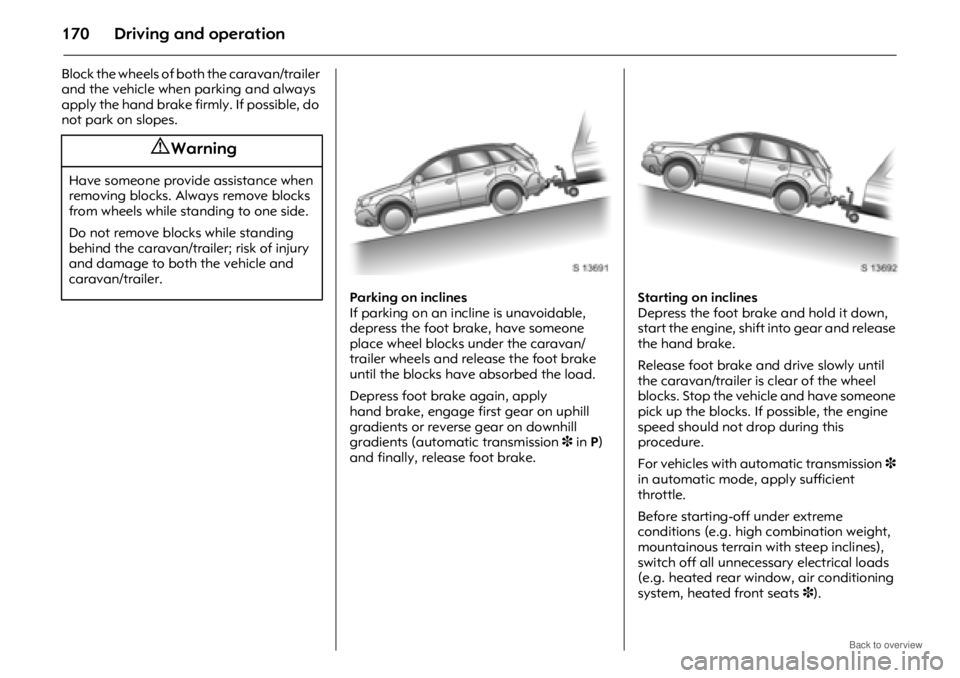
If parking on an incline is unavoidable,
depress the foot brake, have someone
place wheel blocks under the caravan/
trailer wheels and release the foot brake
until the blocks have absorbed the load.
Depress foot brake again, apply
hand brake, engage first gear on uphill
gradients or reverse gear on downhill
gradients (automatic transmission 3 in P)
and finally, release foot brake. Starting on inclines
Depress the foot brake and hold it down,
start the engine, shift into gear and release
the hand brake.
Release foot brake and drive slowly until
the caravan/trailer is clear of the wheel
blocks. Stop the vehicle and have someone
pick up the blocks. If possible, the engine
speed should not drop during this
procedure.
For vehicles with automatic transmission
3
in automatic mode, apply sufficient
throttle.
Before starting-off under extreme
conditions (e.g. high combination weight,
mountainous terrain with steep inclines),
switch off all unnecessary electrical loads
(e.g. heated rear window, air conditioning
system, heated front seats 3).
9 Warning
Have someone provide assistance when
removing blocks. Always remove blocks
from wheels while standing to one side.
Do not remove blocks while standing
behind the caravan/trailer; risk of injury
and damage to both the vehicle and
caravan/trailer.
Page 171 of 234

Self-help, vehicle care171
Self-help, vehicle care
Diesel fuel system, bleeding
Never let the fuel tank run dry. If control
indicator Y illuminates, refuel as soon as
possible.
It is possible to restart the engine if the tank
has been run dry. A delayed start can be
expected. Switch on the ignition three times
for approx. 15 seconds. Then try to start
the engine for no more than 40 seconds. If
the engine will not start, wait at least
10 seconds before trying again. If the
engine will still not start, consult a
workshop.
Bonnet
To open the bonnet, pull release lever /
located on the left-hand side below the
instrument panel.
The bonnet will then be unlocked and will
partially open. Return release lever to its
original position.
Do not pull release lever while the vehicle is
moving.
Diesel fuel system, bleeding .............. 171
Bonnet ................................................. 171
Starting ................................................ 172
Starting the engine with jump leads
3 172
Towing ................................................. 174
Jack and vehicle tools ........................ 176
Warning triangle ¨ 3 ,
First aid kit +3................................ 177
Temporary spare wheel ..................... 177
Wheel changing .................................. 178
Electrical system ................................. 181
Fuses and the most important circuits they protect ...................................... 182
Bulb replacement ............................... 185
Opel genuine parts and accessories . 191
A note on safety ................................. 191
Checking and topping up fluids ........ 191
Windscreen wipers .............................. 198
Windscreen washer system ................ 199
Battery ................................................. 200
Protection of electr onic components 201
Vehicle storage ................................... 201
Vehicle care......................................... 201
9 Warning
Disregard of the instructions may lead to
injuries or endanger life. Vehicle
passengers must be informed
accordingly.