wheel OPEL ANTARA 2009 Repair Manual
[x] Cancel search | Manufacturer: OPEL, Model Year: 2009, Model line: ANTARA, Model: OPEL ANTARA 2009Pages: 234, PDF Size: 3.01 MB
Page 175 of 234
Self-help, vehicle care175
Keep tow rope 3 clear of front bumper,
and ensure it is secure ly fixed to the towing
eye at both ends. Pull on the tow rope 3 to
check.
To prevent entry of exhaust fumes from
towing vehicle, switch on air recirculation
mode (see page 109) and close the
windows.
Never let passengers ride in a vehicle that
is being towed.
Never tow a vehicle with damaged parts
that are not secured to the vehicle or if
wheels, brakes or steering are damaged.
Do not tow the vehicle with a tow rope 3 or
tow rod 3 for extended periods, to avoid
damage to the vehicle. Only tow in this
manner on hard-surfaced roads.
For vehicles with automatic transmission 3:
use flatbed or wheel lift equipment only.
Towing can cause severe damage to the
transmission.
Seek the assistance of a workshop. Towing service
Entrust your vehicle only to the towing
service of your choice and obtain an
estimate on towing costs before employing
any towing service. This will prevent
unnecessary expense and possible
insurance problems during claim
processing.
Use flatbed equipment whenever possible.
If vehicle is to be towed using a wheel lift,
tow with all wheels off the road, using a
towing dolly.
Never use sling-type equipment to tow the
vehicle or tow the vehicle with the front or
rear wheels on the road, to avoid causing
serious damage to the vehicle.
Place the gearshift lever in neutral
(automatic transmission 3
in N), switch on
hazard warning lamps, turn key to ignition
switch position ACC and release the
hand brake before towing the vehicle. Towing another vehicle
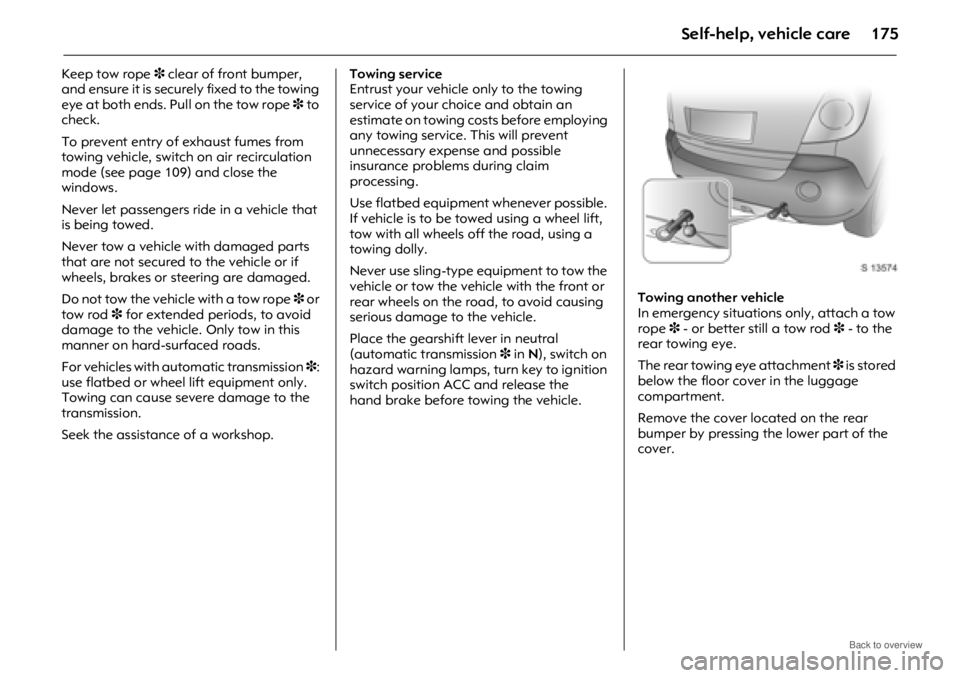
In emergency situations only, attach a tow
rope
3 - or better still a tow rod 3 - to the
rear towing eye.
The rear towing eye attachment 3 is stored
below the floor cover in the luggage
compartment.
Remove the cover located on the rear
bumper by pressing the lower part of the
cover.
Page 176 of 234
Self-help, vehicle care176
Screw the rear towing eye attachment anti-
clockwise until it is firmly in place.
Drive off slowly and avoid jerky
movements. Impermissible tractive forces
could damage the vehicles.
To prevent damage, do not take up slack
in the tow rope too quickly.
After towing, unscrew the rear towing eye
attachment clockwise to remove, and
reinstall the cover.
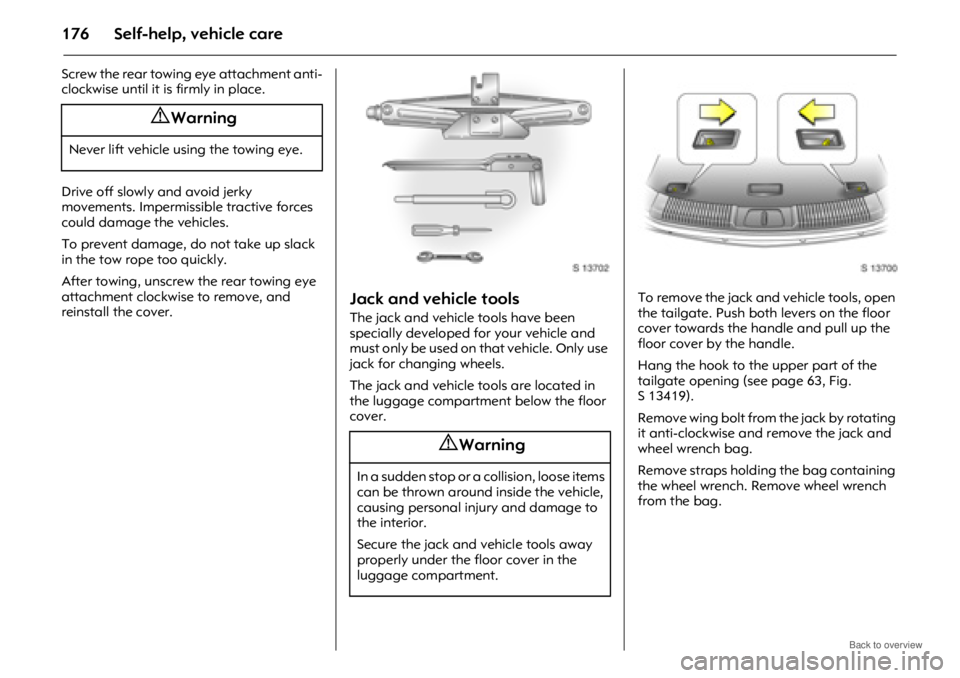
Jack and vehicle tools
The jack and vehicle tools have been
specially developed for your vehicle and
must only be used on that vehicle. Only use
jack for changing wheels.
The jack and vehicle tools are located in
the luggage compartment below the floor
cover. To remove the jack and vehicle tools, open
the tailgate. Push both levers on the floor
cover towards the handle and pull up the
floor cover by the handle.
Hang the hook to the upper part of the
tailgate opening (see page 63, Fig.
S 13419).
Remove wing bolt from the jack by rotating
it anti-clockwise and remove the jack and
wheel wrench bag.
Remove straps holding the bag containing
the wheel wrench. Remove wheel wrench
from the bag.
9 Warning
Never lift vehicle using the towing eye.
9 Warning
In a sudden stop or a collision, loose items
can be thrown around inside the vehicle,
causing personal injury and damage to
the interior.
Secure the jack and vehicle tools away
properly under the floor cover in the
luggage compartment.
Page 177 of 234
Self-help, vehicle care177
Warning triangle
¨ 3 ,
First aid kit
+3
Your first aid kit and warning triangle can
be accommodated below the floor cover in
the luggage compartment.
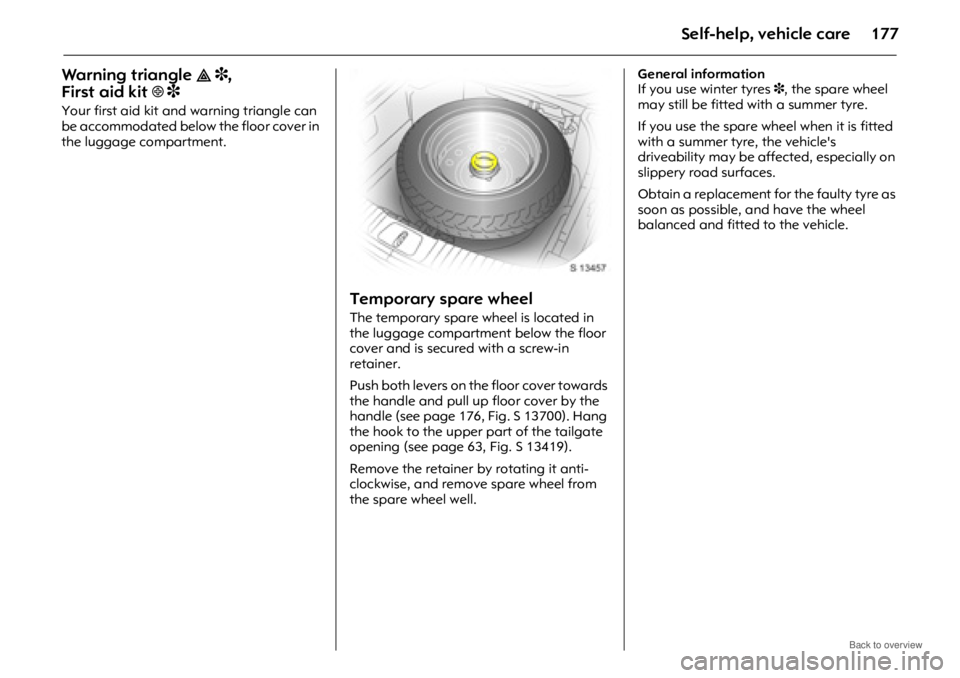
Temporary spare wheel
The temporary spare wheel is located in
the luggage compartment below the floor
cover and is secured with a screw-in
retainer.
Push both levers on the floor cover towards
the handle and pull up floor cover by the
handle (see page 176, Fig. S 13700). Hang
the hook to the upper part of the tailgate
opening (see page 63, Fig. S 13419).
Remove the retainer by rotating it anti-
clockwise, and remove spare wheel from
the spare wheel well. General information
If you use winter tyres
3, the spare wheel
may still be fitted with a summer tyre.
If you use the spare wheel when it is fitted
with a summer tyre, the vehicle's
driveability may be affected, especially on
slippery road surfaces.
Obtain a replacement for the faulty tyre as
soon as possible, and have the wheel
balanced and fitted to the vehicle.
Page 178 of 234

Self-help, vehicle care178
Notes on temporary spare wheel
zUsing a temporary spare wheel may
change the driving behaviour of the
vehicle, particularly if using winter
tyres 3. Replace defective tyre as quickly
as possible, balanc e wheel and fit to
vehicle.
z Fit only one temporary spare wheel.
z Do not drive faster than 80 km/h
(50 mph).
z Take curves slowly.
z Do not use the temporary spare wheel
for a lengthy period.
z Replace temporary spare wheel with full
specification wheel without delay.
z When temporary spare wheel is fitted, do
not take the vehicle through an
automatic car wash with guide rails. The
temporary spare wheel may get caught
on the rails, causing damage to the tyre,
wheel and other vehicle parts.
z Tyre chains are not permitted on the
temporary spare wheel.
If tyre chains are necessary after a front
wheel puncture, fit the temporary spare
wheel to the rear and a rear wheel to the
front. Check tyre pressure and adjust if
necessary - see page 224.
z Follow the temporary spare wheel
instructions on pages 153, 181, 223. Notes on directional tyres
3
Tyres with a prescribed rotating direction
can only achieve their maximum
performance if they are fitted in the
prescribed rotating direction.
If a tyre or spare wheel is fitted that is
rotating in the wrong direction due to a
puncture, the following must be noted:
z The handling of the vehicle may be
different. Replace defective tyres as soon
as possible, have wheel balanced and
fitted to the vehicle.
z Do not drive faster than 80 km/h
(50 mph).
z Drive particularly carefully on wet and
snow-covered road surfaces.
z For more information on tyres with a
prescribed rotating direction -
see page 149.Wheel changing
In order to reduce the chance of possible
injuries, make the following preparations
and note the procedure:
zPark on a level, firm and non-slippery
surface.
z Switch on hazard warning lamps and
apply hand brake. Engage 1st gear or
reverse (automatic transmission 3 in P).
z Correctly set up warning triangle 3.
z Ensure all vehicle passengers are out of
the vehicle and clear of the vehicle and
other traffic.
z Take the spare wheel from under the
luggage compartment floor cover -
see page 177.
z Before raising the vehicle, turn front
wheels to straight-ahead position.
Page 179 of 234
Self-help, vehicle care179
zRemove wheel trim 3.
z Slacken wheel nuts one turn only before
raising the vehicle, but do not totally
unscrew or remove the nuts until the
wheel is off the ground.
z Never change more th an one wheel at a
time.
z Block wheel diagonally opposite the
wheel to be changed, by placing wedge
blocks or equivalent in front and behind
the wheel.
z Do not jack-up the vehicle when traffic is
too close.
z Use jack only when changing wheels.
z Never exceed jack maximum working
load (900 kg).
z If the ground on which the vehicle is
standing is soft, a solid board (max. 1 cm
thick) should be placed under the jack.
Using a thicker board could lead to
damage of the jack and the vehicle. z
Do not raise the vehicle more than is
necessary to change a wheel.
z No people or animals may be in the
vehicle when it is jacked-up.
z Never start or run the engine or crawl
under a jacked-up vehicle.
z Before screwing on the wheel nuts when
changing a wheel, ap ply a light coating
of grease to the cone of each wheel nut.
z Fully tighten the wheel nuts after
lowering the vehicle all the way, ensuring
nuts have been tightened to the correct
torque (see page 223).
z If conditions are not satisfactory to
change a wheel safely, consult a
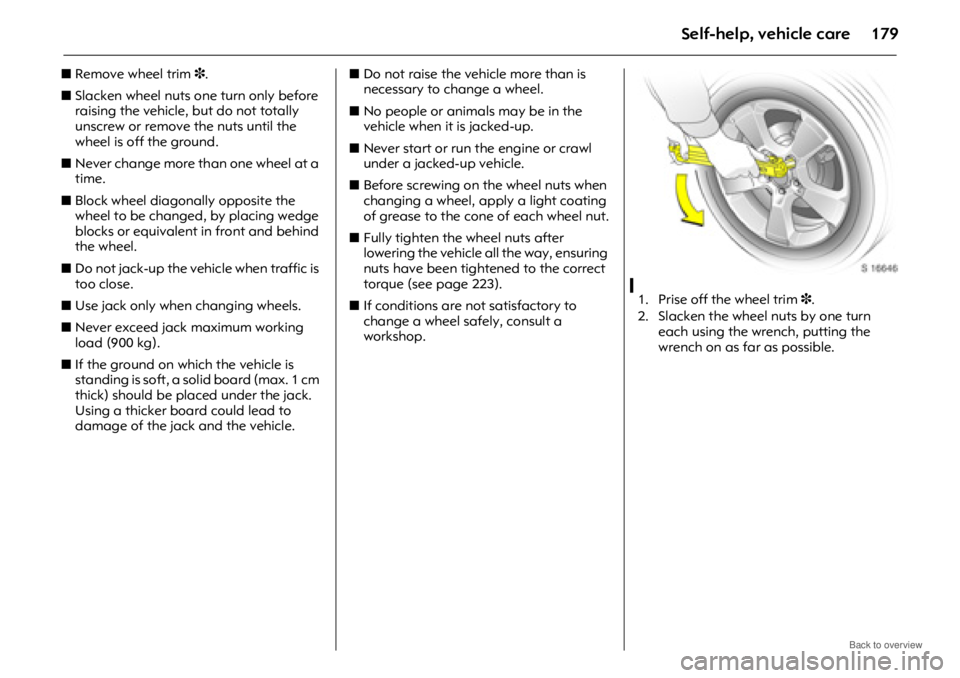
workshop. 1. Prise off the wheel trim 3
.
2. Slacken the wheel nuts by one turn each using the wrench, putting the
wrench on as far as possible.
Page 180 of 234
Self-help, vehicle care180
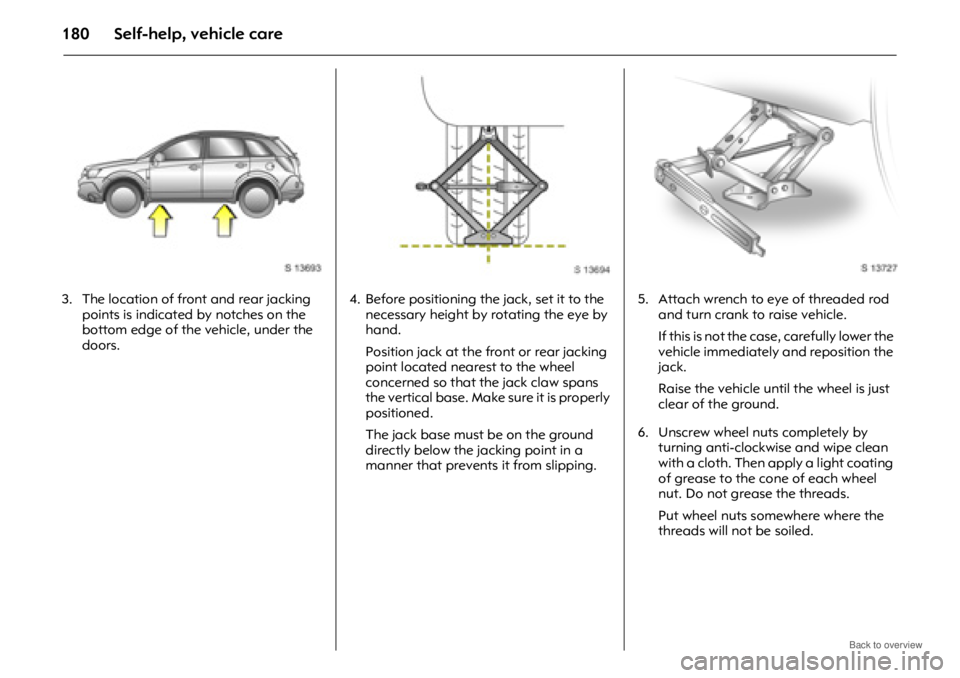
3. The location of front and rear jacking points is indicated by notches on the
bottom edge of the vehicle, under the
doors.4. Before positioning the jack, set it to the necessary height by rotating the eye by
hand.
Position jack at the front or rear jacking
point located nearest to the wheel
concerned so that the jack claw spans
the vertical base. Make sure it is properly
positioned.
The jack base must be on the ground
directly below the jacking point in a
manner that prevents it from slipping.5. Attach wrench to eye of threaded rod and turn crank to raise vehicle.
If this is not the case, carefully lower the
vehicle immediately and reposition the
jack.
Raise the vehicle until the wheel is just
clear of the ground.
6. Unscrew wheel nuts completely by turning anti-clockwise and wipe clean
with a cloth. Then apply a light coating
of grease to the cone of each wheel
nut. Do not grease the threads.
Put wheel nuts somewhere where the
threads will not be soiled.
Page 181 of 234

Self-help, vehicle care181
Electrical system
Fuses
There are two fuse boxes in the vehicle:
the instrument panel fu se box is located on
the left-hand side of the front passenger’s
footwell, the engine compartment fuse box
is located next to the coolant reservoir.
It is advisable to carry a full set of fuses.
Spare fuses are kept in the engine
compartment fuse box.
7. Change the wheel.
Notes on spare wheel - see page 178.
8. Screw on wheel nuts and tighten slightly by hand until wheel is held
against the hub.
9. Rotate wrench anti-clockwise and lower vehicle to the ground.
10. Tighten wheel nuts in a cross wise sequence, putting the wrench on as far
as possible.
11. Stow replaced wheel in luggage compartment.
12. Stow the jacking equipment and warning triangle 3 - see pages 176,
177.
13. Check the tyre pressure of the newly fitted wheel - see page 224. Adjust as
necessary.
14. Have the new wheel balanced on the vehicle and have the tightening torque
of the wheel nuts checked as soon as
possible, and if necessary, corrected.
Tightening torque - see page 223.
15. Replace defective tyre on the wheel that was removed.
16. Replace temporary spare wheel with a full specification wheel without delay.
9 Warning
Electronic ignition systems generate very
high voltages. Do not touch the ignition
system; high voltage can be fatal.
Page 183 of 234
Self-help, vehicle care 183
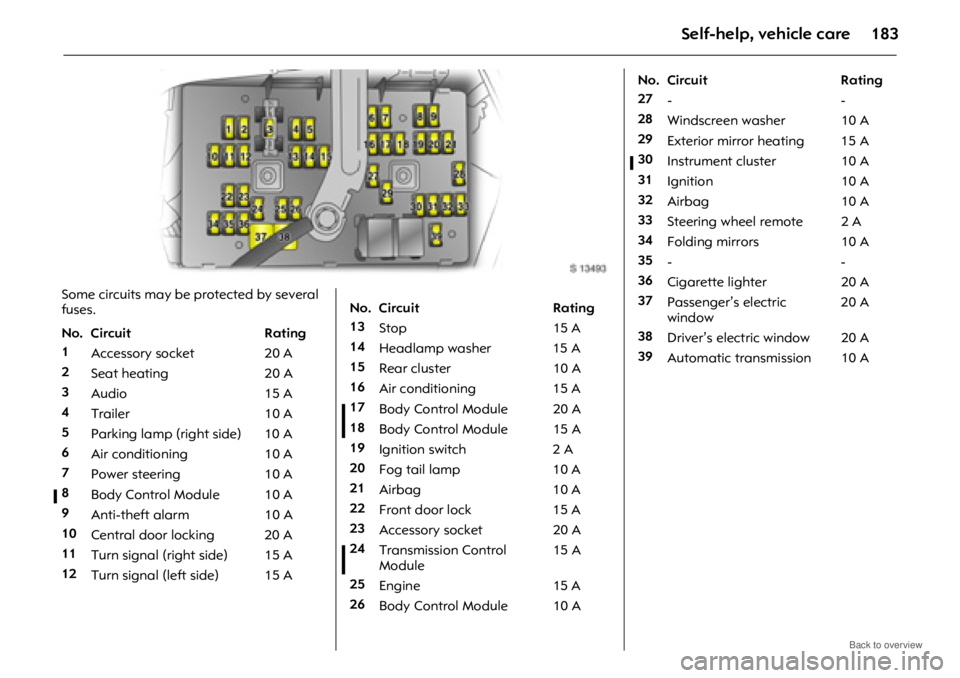
Some circuits may be protected by several
fuses.
No. Circuit Rating
1Accessory socket 20 A
2 Seat heating 20 A
3 Audio 15 A
4 Trailer 10 A
5 Parking lamp (right side) 10 A
6 Air conditioning 10 A
7 Power steering 10 A
8 Body Control Module 10 A
9 Anti-theft alarm 10 A
10 Central door locking 20 A
11 Turn signal (right side) 15 A
12 Turn signal (left side) 15 ANo. Circuit Rating
13 Stop 15 A
14 Headlamp washer 15 A
15 Rear cluster 10 A
16 Air conditioning 15 A
17 Body Control Module 20 A
18 Body Control Module 15 A
19 Ignition switch 2 A
20 Fog tail lamp 10 A
21 Airbag 10 A
22 Front door lock 15 A
23 Accessory socket 20 A
24 Transmission Control
Module 15 A
25 Engine 15 A
26 Body Control Module 10 A
No. Circuit Rating
27 --
28 Windscreen washer 10 A
29 Exterior mirror heating 15 A
30 Instrument cluster 10 A
31 Ignition 10 A
32 Airbag 10 A
33 Steering wheel remote 2 A
34 Folding mirrors 10 A
35 --
36 Cigarette lighter 20 A
37 Passenger’s electric
window 20 A
38 Driver’s electric window 20 A
39 Automatic transmission 10 A
Page 184 of 234
184 Self-help, vehicle care
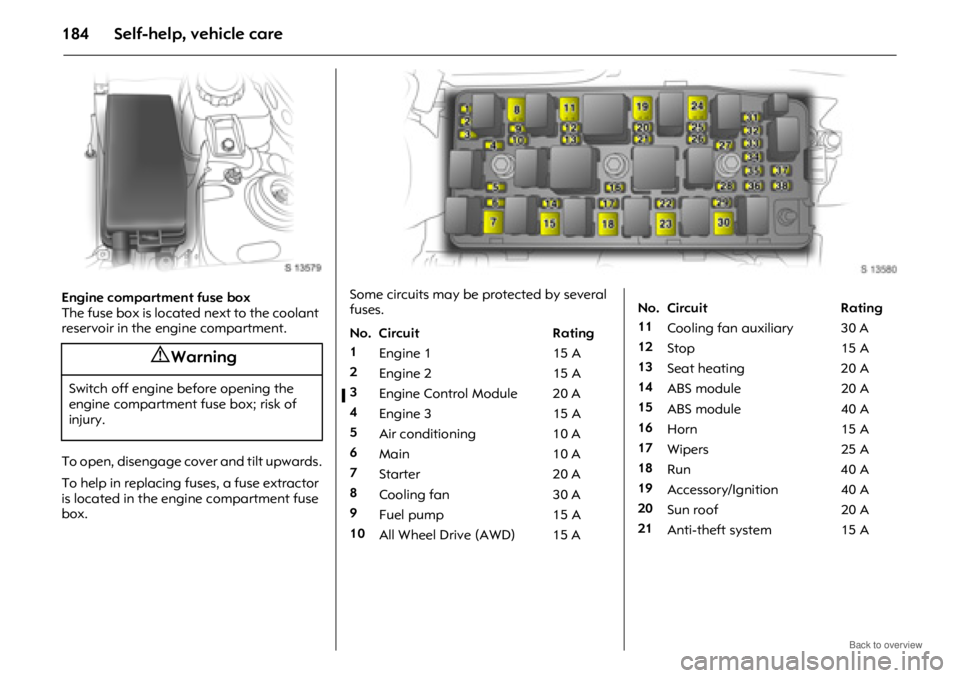
Engine compartment fuse box
The fuse box is located next to the coolant
reservoir in the engine compartment.
To open, disengage cover and tilt upwards.
To help in replacing fuses, a fuse extractor
is located in the engine compartment fuse
box.
9 Warning
Switch off engine before opening the
engine compartment fuse box; risk of
injury.
Some circuits may be protected by several
fuses.
No. Circuit Rating
1 Engine 1 15 A
2 Engine 2 15 A
3 Engine Control Module 20 A
4 Engine 3 15 A
5 Air conditioning 10 A
6 Main 10 A
7 Starter 20 A
8 Cooling fan 30 A
9 Fuel pump 15 A
10 All Wheel Drive (AWD) 15 ANo. Circuit Rating
11 Cooling fan auxiliary 30 A
12 Stop 15 A
13 Seat heating 20 A
14 ABS module 20 A
15 ABS module 40 A
16 Horn 15 A
17 Wipers 25 A
18 Run 40 A
19 Accessory/Ignition 40 A
20 Sun roof 20 A
21 Anti-theft system 15 A
Page 202 of 234

Self-help, vehicle care202
Vehicle care aids 3
Vehicle wash:
z Car Shampoo
z Sponges
z Chamois Leather
z Wheel Cleaners
z Engine Cleaners
z Glass Cleaners
Exterior care:
z Touch-up Applicator
z Spray and Touch-up Paint
z Car Polishes/Colour Restorers
z Car Waxes/Sealers
z Alloy Wheel Cleaner
z Alloy Wheel Preserver
z Metallic Paintwork Wax
z Rust Preventative
z Lubricant Sprays
z Lock Cylinder Grease
z De-icer Sprays
z Tar Removal Spray
z Insect Remover
z Window Cleaning Spray
z Cleaning Solvent and Antifreeze
Interior care:
z Interior/Upholstery Cleaner Washing
The paintwork of your vehicle is exposed to
environmental influences, e.g. continuous
changes in weather conditions, industrial
waste gases and dust or thawing salts, so
wash and wax your vehicle regularly. When
using automatic car washes, select a
program which includes waxing.
Bird droppings, dead insects, resin, pollen
and the like should be cleaned off
immediately, as they contain aggressive
constituents which can cause paint
damage.
If using a car wash, comply with the
pertinent instructions of the car wash
manufacturer. The windscreen wipers and
tailgate wipers must be switched off –
see pages 92, 93. Remove detachable rod
antenna by unscrewing it.
Do not use high-pressure jet cleaners.
If you wash your vehicle by hand, make
sure that the insides of the wings are also
thoroughly rinsed out. Do not use
household dishwashing liquid, to avoid
removing wax from the paintwork.
Clean edges and folds on opened doors
and flaps as well as the areas they cover.
Thoroughly rinse off and leather-off the
vehicle. Rinse leather frequently. Use
separate leathers for paint and window
surfaces; remnants of wax on the windows
will impair vision.
Also wash aluminium trim parts, avoiding
the use of abrasive materials such as
automotive or chrome polish, steam or
caustic soap. Washing with water is
normally sufficient.
Observe national regulations.