wheel OPEL COMBO 2010 Owner's Guide
[x] Cancel search | Manufacturer: OPEL, Model Year: 2010, Model line: COMBO, Model: OPEL COMBO 2010Pages: 212, PDF Size: 2.49 MB
Page 131 of 212
125
Driving and operation
Picture no: 6459u.tif
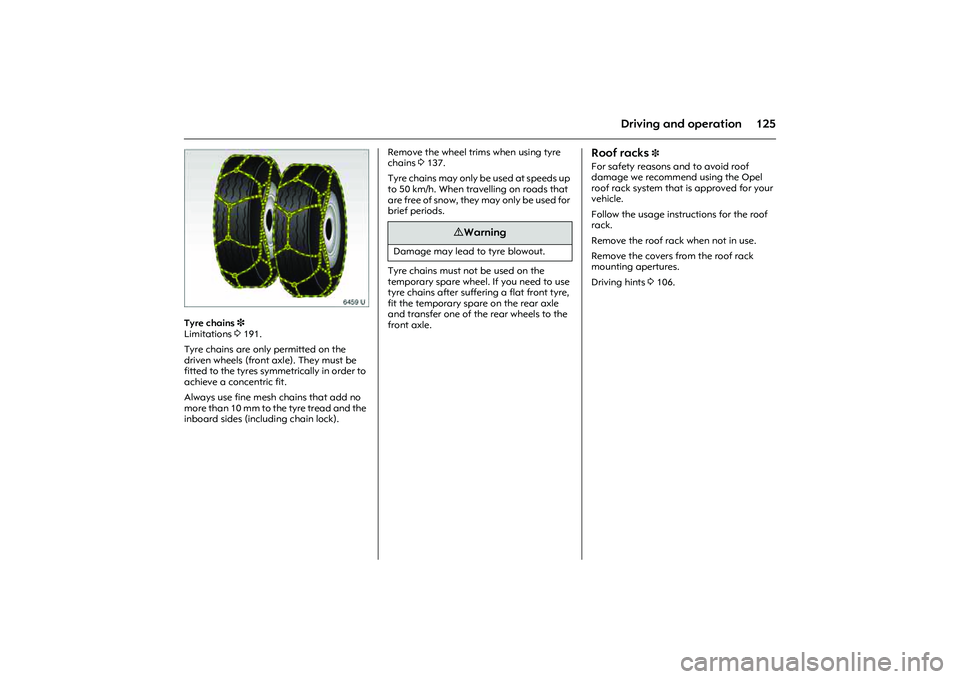
Tyre chains 3
Limitations 3191.
Tyre chains are only permitted on the
driven wheels (front axle). They must be
fitted to the tyres symmetrically in order to
achieve a concentric fit.
Always use fine mesh chains that add no
more than 10 mm to the tyre tread and the
inboard sides (including chain lock). Remove the wheel trims when using tyre
chains 3137.
T y r e c h a i n s m a y o n l y b e u s e d a t s p e e d s u p
to 50 km/h. When travelling on roads that
are free of snow, they may only be used for
brief periods.
Tyre chains must not be used on the
temporary spare wheel. If you need to use
tyre chains after suffering a flat front tyre,
fit the temporary spare on the rear axle
and transfer one of the rear wheels to the
front axle.
Roof racks
3
For safety reasons and to avoid roof
damage we recommend using the Opel
roof rack system that is approved for your
vehicle.
Follow the usage instructions for the roof
rack.
Remove the roof rack when not in use.
Remove the covers from the roof rack
mounting apertures.
Driving hints 3106.
9 Warning
Damage may lead to tyre blowout.
Page 134 of 212
128 Self-help, vehicle careSelf-help, vehicle care
Diesel fuel system, bleeding If the tank is allowed to run dry, the diesel
fuel system must be bled. Turn over the
ignition three times for 15 seconds at a
time. Then start the engine for a maximum
of 40 seconds
1). Repeat this process after
no less than 5 seconds. If the engine fails to
start, seek the assistance of a workshop.
Picture no: 16121s.tif
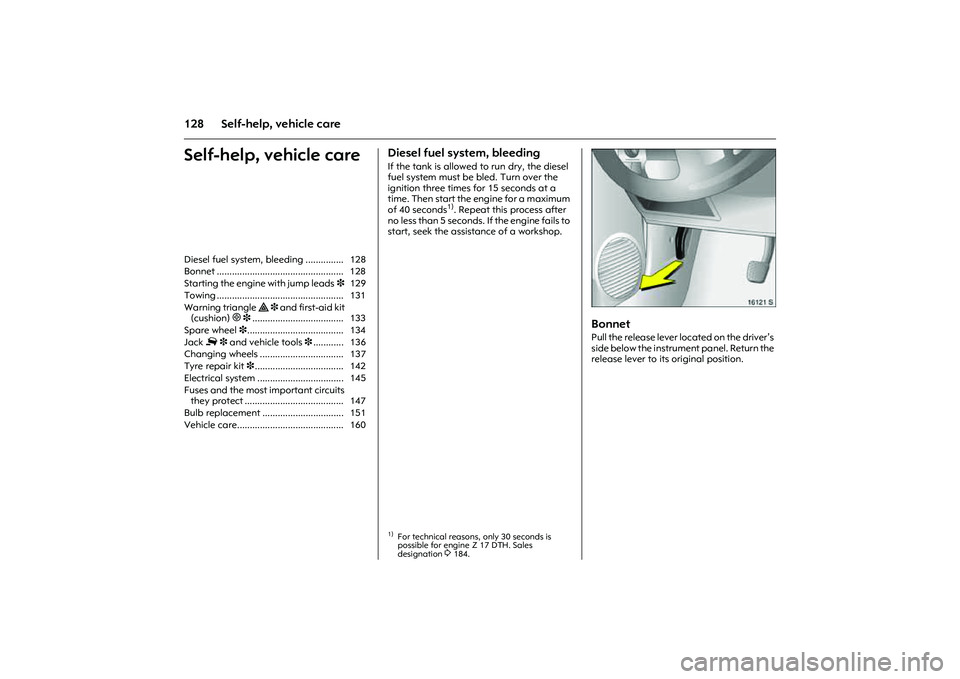
Bonnet Pull the release lever located on the driver’s
side below the instrument panel. Return the
release lever to its original position. Diesel fuel system, bleeding ............... 128
Bonnet .................................................. 128
Starting the engine with jump leads3 129
Towing .................................................. 131
Warning triangle ¨ 3 and first-aid kit
(cushion) + 3.................................... 133
Spare wheel 3...................................... 134
Jack £ 3 and vehicle tools3............ 136
Changing wheels ................................. 137
Tyre repair kit 3................................... 142
Electrical system .................................. 145
Fuses and the most important circuits
they protect ....................................... 147
Bulb replacement ................................ 151
Vehicle care.......................................... 160
1)For technical reasons, only 30 seconds is
possible for engine Z 17 DTH. Sales
designation
3184.
Page 140 of 212
134 Self-help, vehicle care
Picture no: 12462s.tif
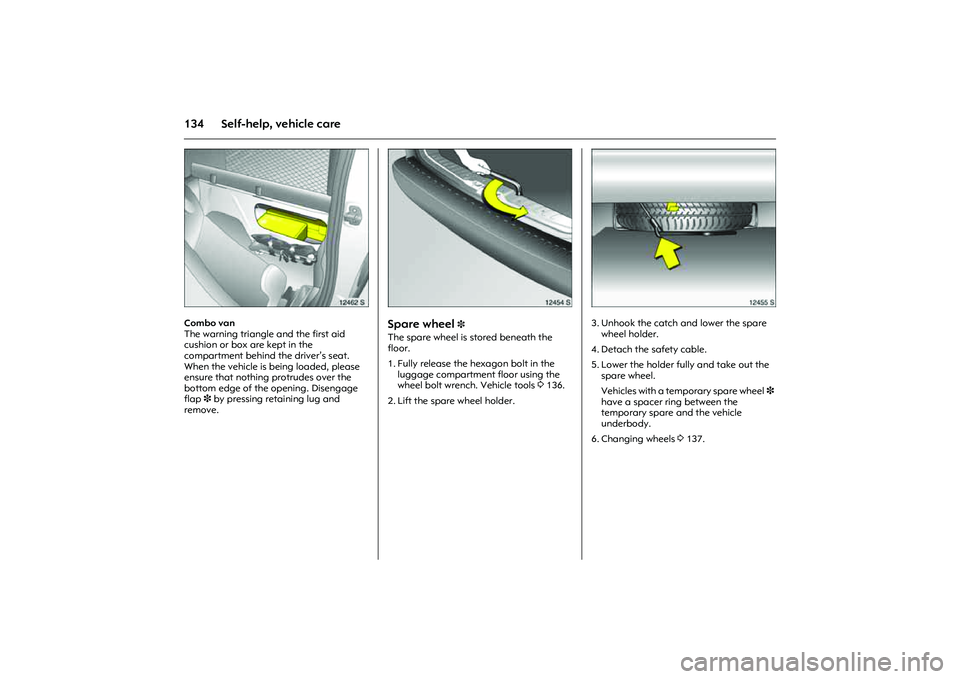
Combo van
The warning triangle and the first aid
cushion or box are kept in the
compartment behind the driver’s seat.
When the vehicle is being loaded, please
ensure that nothing protrudes over the
bottom edge of the opening. Disengage
flap 3 by pressing retaining lug and
remove.
Picture no: 12454s.tif
Spare wheel
3
The spare wheel is stored beneath the
floor.
1. Fully release the hexagon bolt in the
luggage compartment floor using the
wheel bolt wrench. Vehicle tools 3136.
2. Lift the spare wheel holder.
Picture no: 12455s.tif
3. Unhook the catch and lower the spare
wheel holder.
4. Detach the safety cable.
5. Lower the holder fully and take out the
spare wheel.
Vehicles with a temporary spare wheel3
have a spacer ring between the
temporary spare and the vehicle
underbody.
6. Changing wheels 3137.
Page 141 of 212
135
Self-help, vehicle care
Picture no: 16493s.tif
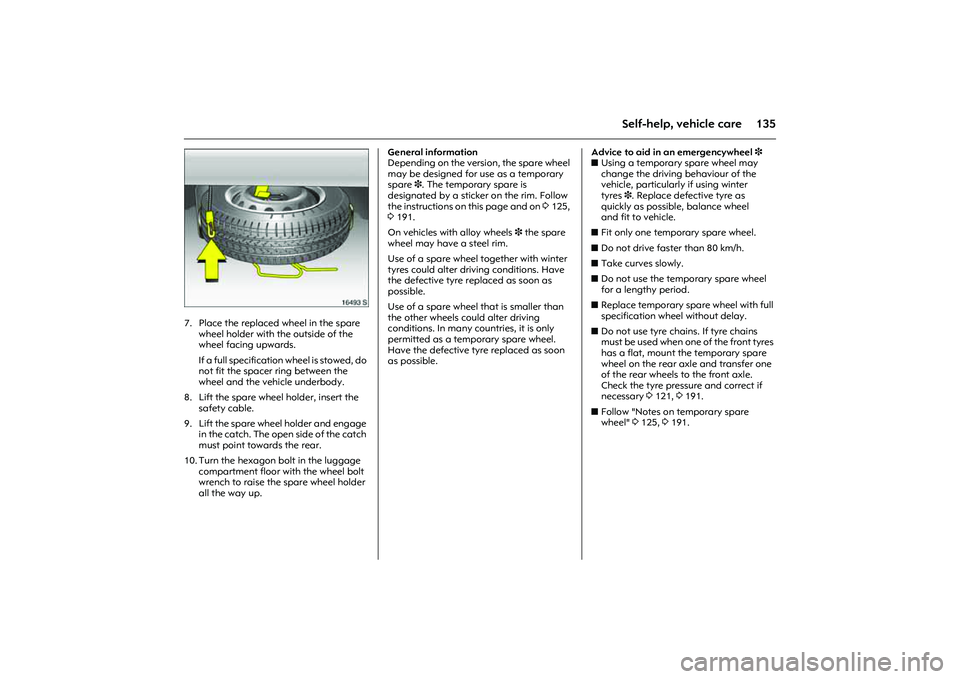
7. Place the replaced wheel in the spare
wheel holder with the outside of the
wheel facing upwards.
If a full specification wheel is stowed, do
not fit the spacer ring between the
wheel and the vehicle underbody.
8. Lift the spare wheel holder, insert the
safety cable.
9. Lift the spare wheel holder and engage
in the catch. The open side of the catch
must point towards the rear.
10. Turn the hexagon bolt in the luggage
compartment floor with the wheel bolt
wrench to raise the spare wheel holder
all the way up. General information
Depending on the version, the spare wheel
may be designed for use as a temporary
spare 3. The temporary spare is
designated by a sticker on the rim. Follow
the instructions on this page and on 3125,
3191.
On vehicles with alloy wheels 3 the spare
wheel may have a steel rim.
Use of a spare wheel together with winter
tyres could alter driving conditions. Have
the defective tyre replaced as soon as
possible.
Use of a spare wheel that is smaller than
the other wheels could alter driving
conditions. In many countries, it is only
permitted as a temporary spare wheel.
Have the defective tyre replaced as soon
as possible. Advice to aid in an emergencywheel 3
zUsing a temporary spare wheel may
change the driving behaviour of the
vehicle, particularly if using winter
tyres3. Replace defective tyre as
quickly as possible, balance wheel
and fit to vehicle.
zFit only one temporary spare wheel.
zDo not drive faster than 80 km/h.
zTake curves slowly.
zDo not use the temporary spare wheel
for a lengthy period.
zReplace temporary spare wheel with full
specification wheel without delay.
zDo not use tyre chains. If tyre chains
must be used when one of the front tyres
has a flat, mount the temporary spare
wheel on the rear axle and transfer one
of the rear wheels to the front axle.
Check the tyre pressure and correct if
necessary 3121, 3191.
zFollow "Notes on temporary spare
wheel" 3125, 3191.
Page 142 of 212
136 Self-help, vehicle careInformation on directional tyres 3
Fit directional tyres such that they roll in the
direction of travel. The rolling direction is
indicated by a symbol (e.g. an arrow) on
the sidewall.
The following applies to tyres fitted
opposing the rolling direction:
zDriving conditions may be altered. Have
the defective tyre replaced as soon as
possible.
zDo not drive faster than 80 km/h.
zDrive especially carefully in wet and
snowy weather.
Further information on directional tyres
3121.
Picture no: 2457s.tif
Jack
£
3 and vehicle tools
3
The jack and the vehicle tools have been
specially developed for your vehicle and
must only be used on that vehicle. Only use
jack for changing wheels.
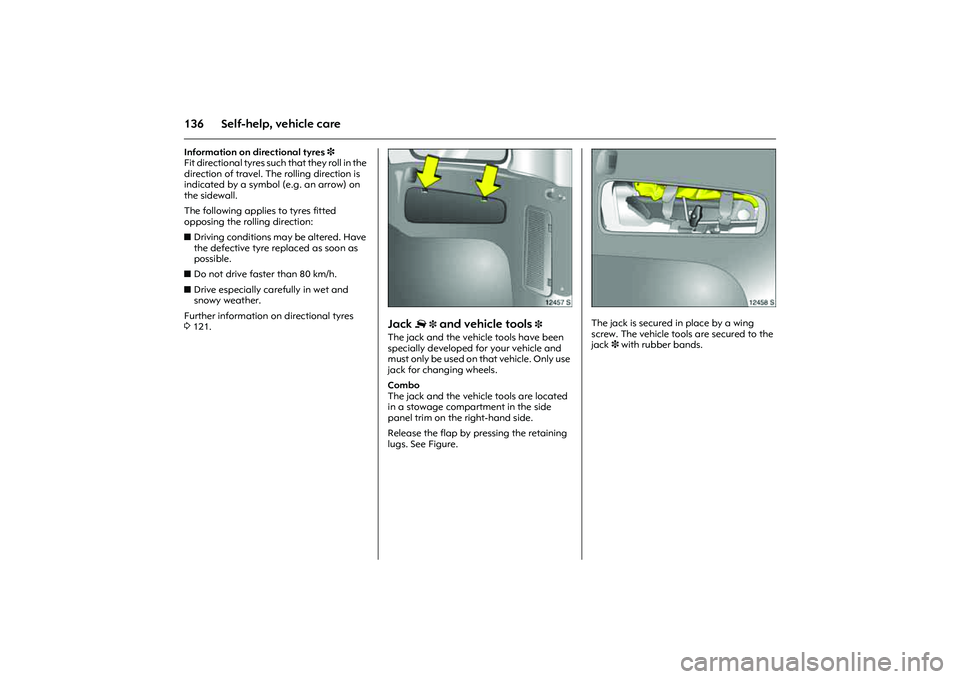
Combo
The jack and the vehicle tools are located
in a stowage compartment in the side
panel trim on the right-hand side.
Release the flap by pressing the retaining
lugs. See Figure.
Picture no: 12458s.tif
The jack is secured in place by a wing
screw. The vehicle tools are secured to the
jack 3 with rubber bands.
Page 143 of 212
137
Self-help, vehicle care
Picture no: 12461s.tif
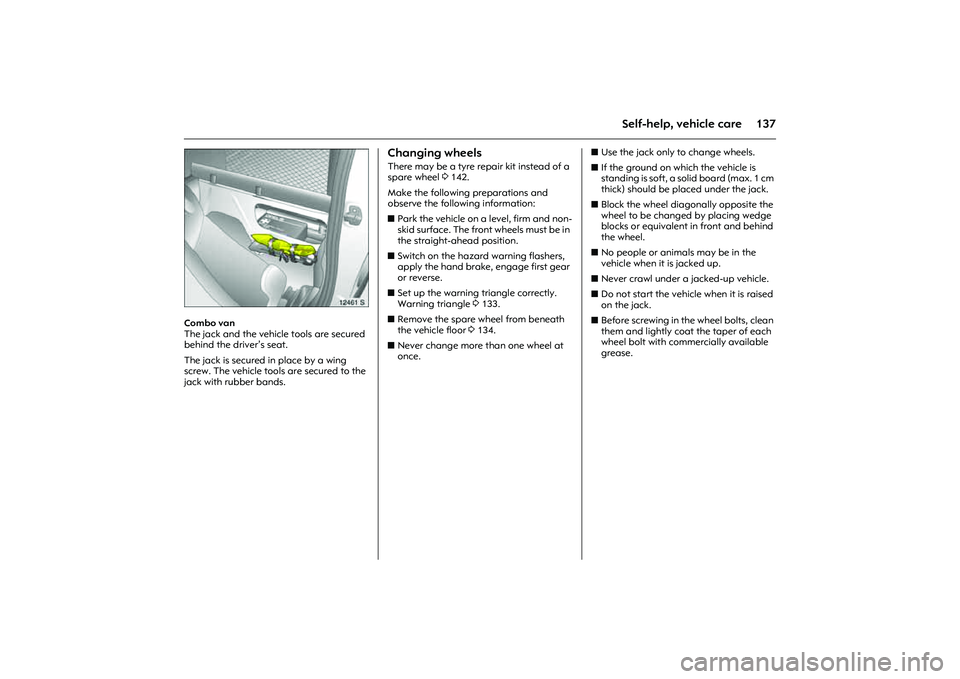
Combo van
The jack and the vehicle tools are secured
behind the driver’s seat.
The jack is secured in place by a wing
screw. The vehicle tools are secured to the
jack with rubber bands.
Changing wheels There may be a tyre repair kit instead of a
spare wheel 3142.
Make the following preparations and
observe the following information:
zPark the vehicle on a level, firm and non-
skid surface. The front wheels must be in
the straight-ahead position.
zSwitch on the hazard warning flashers,
apply the hand brake, engage first gear
or reverse.
zSet up the warning triangle correctly.
Warning triangle 3133.
zRemove the spare wheel from beneath
the vehicle floor 3134.
zNever change more than one wheel at
once. zUse the jack only to change wheels.
zIf the ground on which the vehicle is
standing is soft, a solid board (max. 1 cm
thick) should be placed under the jack.
zBlock the wheel diagonally opposite the
wheel to be changed by placing wedge
blocks or equivalent in front and behind
the wheel.
zNo people or animals may be in the
vehicle when it is jacked up.
zNever crawl under a jacked-up vehicle.
zDo not start the vehicle when it is raised
on the jack.
zBefore screwing in the wheel bolts, clean
them and lightly coat the taper of each
wheel bolt with commercially available
grease.
Page 144 of 212
138 Self-help, vehicle care
Picture no: 12483s.tif
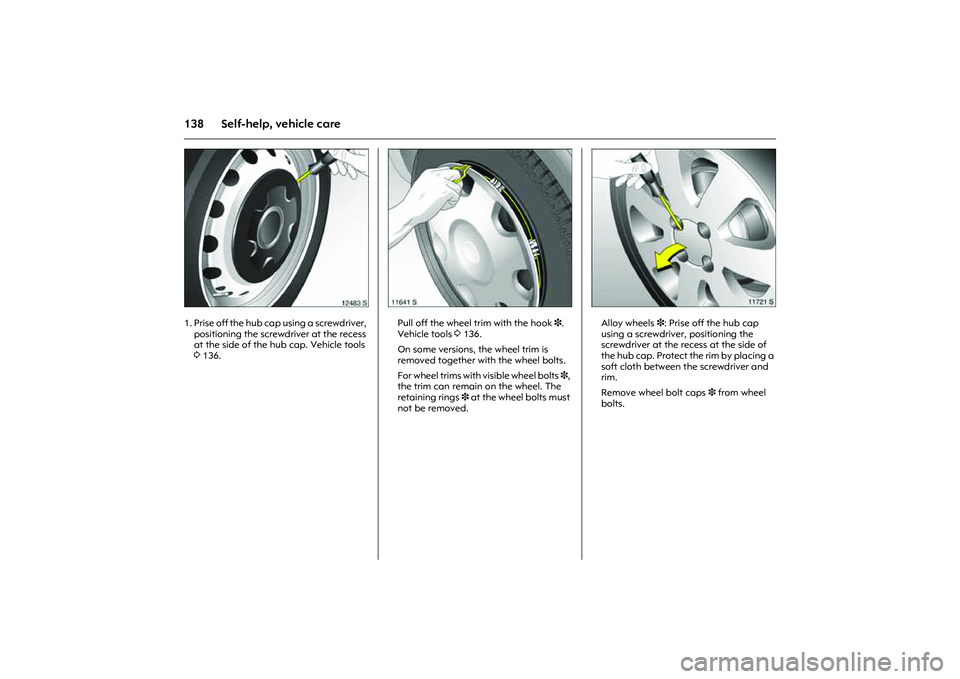
1. Prise off the hub cap using a screwdriver,
positioning the screwdriver at the recess
at the side of the hub cap. Vehicle tools
3136.
Picture no: 11641s.tif
Pull off the wheel trim with the hook 3.
Vehicle tools 3136.
On some versions, the wheel trim is
removed together with the wheel bolts.
For wheel trims with visible wheel bolts 3,
the trim can remain on the wheel. The
retaining rings 3 at the wheel bolts must
not be removed.
Picture no: 11721s.tif
Alloy wheels 3: Prise off the hub cap
using a screwdriver, positioning the
screwdriver at the recess at the side of
the hub cap. Protect the rim by placing a
soft cloth between the screwdriver and
rim.
Remove wheel bolt caps 3 from wheel
bolts.
Page 145 of 212
139
Self-help, vehicle care
Picture no: 11642s.tif
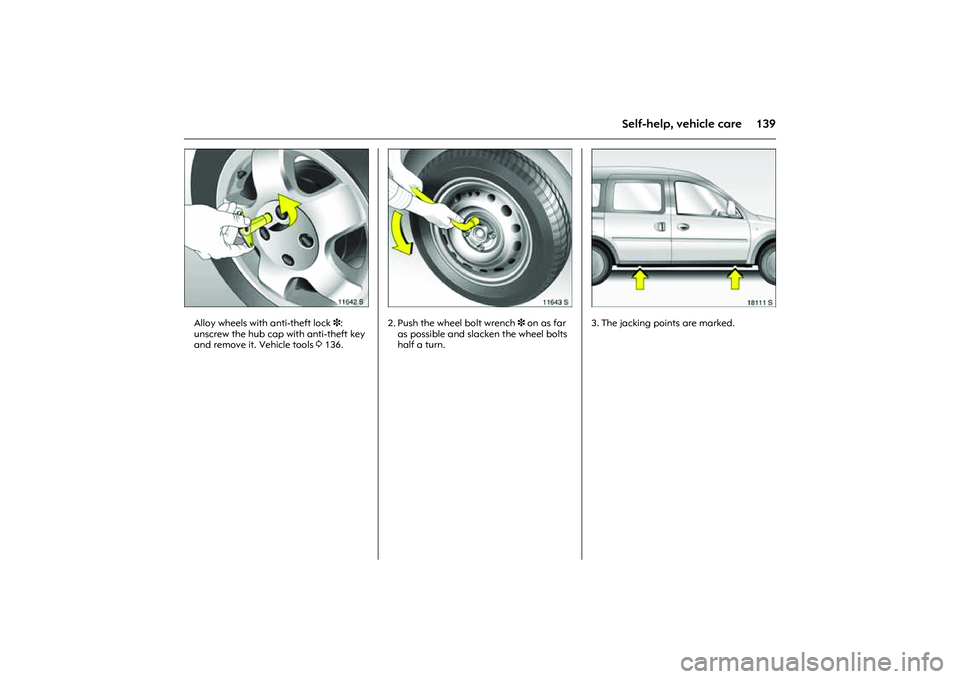
Alloy wheels with anti-theft lock3:
unscrew the hub cap with anti-theft key
and remove it. Vehicle tools 3136.
Picture no: 11643s.tif
2. Push the wheel bolt wrench 3 on as far
as possible and slacken the wheel bolts
half a turn.
Picture no: 18111s.tif
3. The jacking points are marked.
Page 146 of 212
140 Self-help, vehicle care
Picture no: 11645s.tif
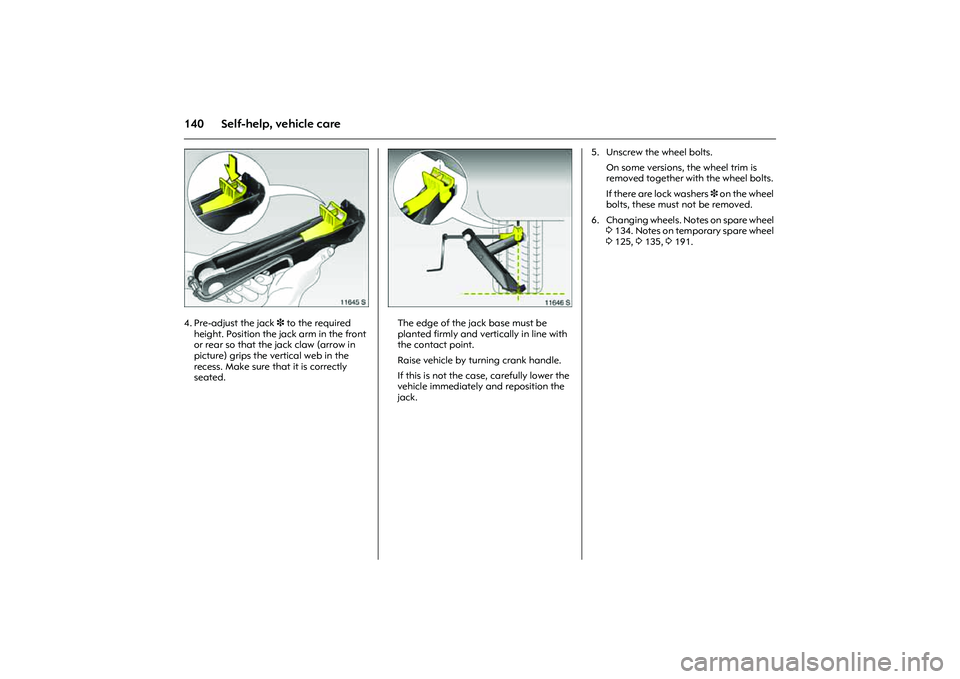
4. Pre-adjust the jack 3 to the required
height. Position the jack arm in the front
or rear so that the jack claw (arrow in
picture) grips the vertical web in the
recess. Make sure that it is correctly
seated.
Picture no: 11646s.tif
The edge of the jack base must be
planted firmly and vertically in line with
the contact point.
Raise vehicle by turning crank handle.
If this is not the case, carefully lower the
vehicle immediately and reposition the
jack.5. Unscrew the wheel bolts.
On some versions, the wheel trim is
removed together with the wheel bolts.
If there are lock washers 3 on the wheel
bolts, these must not be removed.
6. Changing wheels. Notes on spare wheel
3134. Notes on temporary spare wheel
3125, 3135, 3191.
Page 147 of 212
141
Self-help, vehicle care
Picture no: 11647s.tif
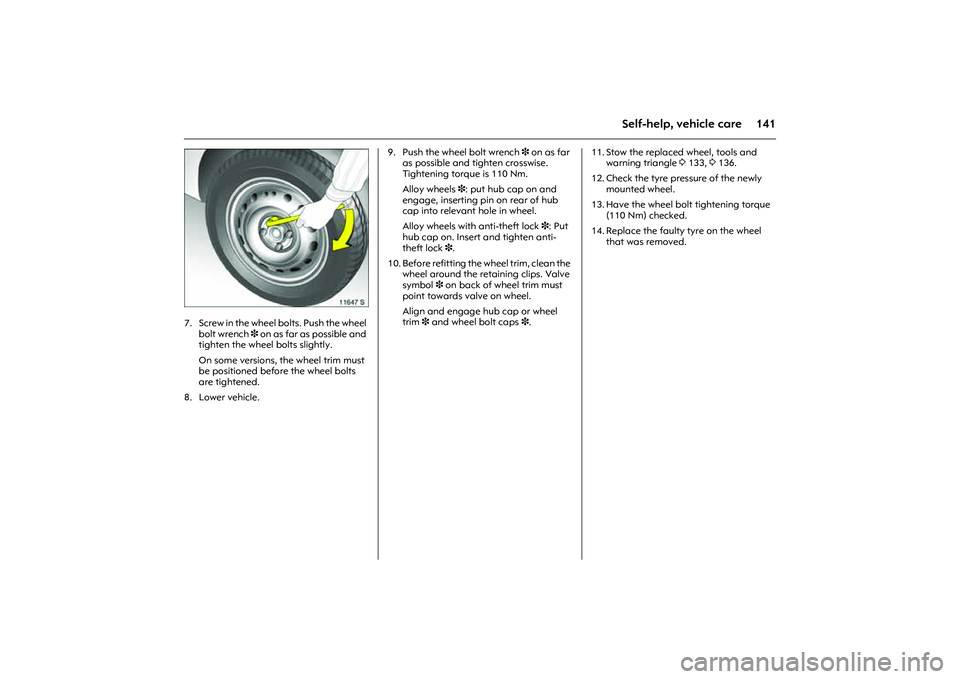
7. Screw in the wheel bolts. Push the wheel
bolt wrench 3 on as far as possible and
tighten the wheel bolts slightly.
On some versions, the wheel trim must
be positioned before the wheel bolts
are tightened.
8. Lower vehicle. 9. Push the wheel bolt wrench 3 on as far
as possible and tighten crosswise.
Tightening torque is 110 Nm.
Alloy wheels 3: put hub cap on and
engage, inserting pin on rear of hub
cap into relevant hole in wheel.
Alloy wheels with anti-theft lock3: Put
hub cap on. Insert and tighten anti-
theft lock3.
10. Before refitting the wheel trim, clean the
wheel around the retaining clips. Valve
symbol 3 on back of wheel trim must
point towards valve on wheel.
Align and engage hub cap or wheel
trim 3 and wheel bolt caps 3.11. Stow the replaced wheel, tools and
warning triangle 3133, 3136.
12. Check the tyre pressure of the newly
mounted wheel.
13. Have the wheel bolt tightening torque
(110 Nm) checked.
14. Replace the faulty tyre on the wheel
that was removed.