oil change OPEL FRONTERA 1998 Manual PDF
[x] Cancel search | Manufacturer: OPEL, Model Year: 1998, Model line: FRONTERA, Model: OPEL FRONTERA 1998Pages: 6000, PDF Size: 97 MB
Page 4717 of 6000

6E–60
ENGINE DRIVEABILITY AND EMISSIONS
Electronic Ignition System Diagnosis
If the engine cranks but will not run or immediately stalls,
the Engine Cranks But Will Not Start chart must be used
to determine if the failure is the ignition system or the fuel
system. If DTC P0341, or P0336 is set, the appropriate
diagnostic trouble code chart must be used for diagnosis.
If a misfire is being experienced with no DTC set, refer to
the
Symptoms section for diagnosis.
Fuel Metering System Check
Some failures of the fuel metering system will result in an
“Engine Cranks But Will Not Run” symptom. If this
condition exists, refer to the
Cranks But Will Not Run
chart. This chart will determine if the problem is caused
by the ignition system, the PCM, or the fuel pump
electrical circuit.
Refer to
Fuel System Electrical Test for the fuel system
wiring schematic.
If there is a fuel delivery problem, refer to
Fuel System
Diagnosis
, which diagnoses the fuel injectors, the fuel
pressure regulator, and the fuel pump. If a malfunction
occurs in the fuel metering system, it usually results in
either a rich HO2S signal or a lean HO2S signal. This
condition is indicated by the HO2S voltage, which causes
the PCM to change the fuel calculation (fuel injector pulse
width) based on the HO2S reading. Changes made to the
fuel calculation will be indicated by a change in the long
term fuel trim values which can be monitored with a Tech
2. Ideal long term fuel trim values are around 0%; for a
lean HO2S signal, the PCM will add fuel, resulting in a fuel
trim value above 0%. Some variations in fuel trim values
are normal because all engines are not exactly the same.
If the fuel trim values are greater than +23%, refer to
DTC
P0131, DTC P0151, DTC P0171, and DTC 1171
f o r i t e m s
which can cause a lean HO2S signal.
Idle Air Control (IAC) Valve
The Tech 2 displays the IAC pintle position in counts. A
count of “0” indicates the PCM is commanding the IAC
pintle to be driven all the way into a fully-seated position.
This is usually caused by a large vacuum leak.
The higher the number of counts, the more air is being
commanded to bypass the throttle blade. Refer to IAC
System Check in order to diagnose the IAC system.
Refer to
Rough, Unstable, or Incorrect Idle, Stalling in
Symptoms for other possible causes of idle problems.
Fuel System Pressure Test
A fuel system pressure test is part of several of the
diagnostic charts and symptom checks. To perform this
test, refer to
Fuel Systems Diagnosis.
Fuel Injector Coil Test Procedure and
Fuel Injector Balance Test Procedure
T32003
Test Description
Number(s) below refer to the step number(s) on the
Diagnostic Chart:
2. Relieve the fuel pressure by connecting the
5-8840-0378-0 Fuel Pressure Gauge to the fuel
pressure connection on the fuel rail.
CAUTION: In order to reduce the risk of fire and
personal injury, wrap a shop towel around the fuel
pressure connection. The towel will absorb any fuel
leakage that occurs during the connection of the fuel
pressure gauge. Place the towel in an approved
container when the connection of the fuel pressure
gauge is complete.
Place the fuel pressure gauge bleed hose in an
approved gasoline container.
With the ignition switch “OFF,” open the valve on the
fuel pressure gauge.
3. Record the lowest voltage displayed by the DVM
after the first second of the test. (During the first
second, voltage displayed by the DVM may be
inaccurate due to the initial current surge.)
Injector Specifications:
Resistance Ohms
Voltage Specification at
10
C-35C (50F-95F)
11.8 – 12.65.7 – 6.6
The voltage displayed by the DVM should be within
the specified range.
The voltage displayed by the DVM may increase
throughout the test as the fuel injector windings
warm and the resistance of the fuel injector windings
changes.
Page 4762 of 6000
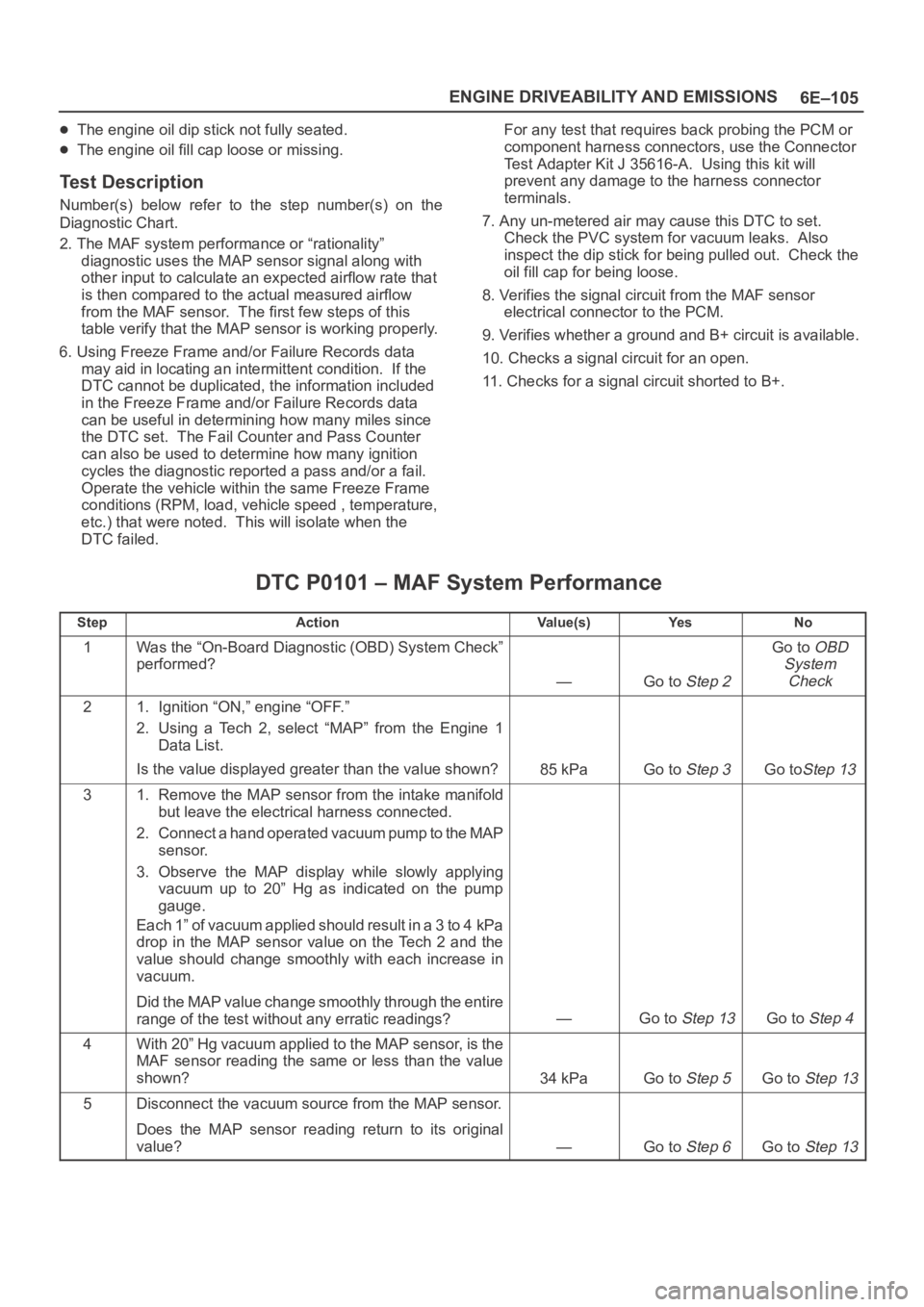
6E–105 ENGINE DRIVEABILITY AND EMISSIONS
The engine oil dip stick not fully seated.
The engine oil fill cap loose or missing.
Test Description
Number(s) below refer to the step number(s) on the
Diagnostic Chart.
2. The MAF system performance or “rationality”
diagnostic uses the MAP sensor signal along with
other input to calculate an expected airflow rate that
is then compared to the actual measured airflow
from the MAF sensor. The first few steps of this
table verify that the MAP sensor is working properly.
6. Using Freeze Frame and/or Failure Records data
may aid in locating an intermittent condition. If the
DTC cannot be duplicated, the information included
in the Freeze Frame and/or Failure Records data
can be useful in determining how many miles since
the DTC set. The Fail Counter and Pass Counter
can also be used to determine how many ignition
cycles the diagnostic reported a pass and/or a fail.
Operate the vehicle within the same Freeze Frame
conditions (RPM, load, vehicle speed , temperature,
etc.) that were noted. This will isolate when the
DTC failed.For any test that requires back probing the PCM or
component harness connectors, use the Connector
Test Adapter Kit J 35616-A. Using this kit will
prevent any damage to the harness connector
terminals.
7. Any un-metered air may cause this DTC to set.
Check the PVC system for vacuum leaks. Also
inspect the dip stick for being pulled out. Check the
oil fill cap for being loose.
8. Verifies the signal circuit from the MAF sensor
electrical connector to the PCM.
9. Verifies whether a ground and B+ circuit is available.
10. Checks a signal circuit for an open.
11. Checks for a signal circuit shorted to B+.
DTC P0101 – MAF System Performance
StepActionVa l u e ( s )Ye sNo
1Was the “On-Board Diagnostic (OBD) System Check”
performed?
—Go to Step 2
Go to OBD
System
Check
21. Ignition “ON,” engine “OFF.”
2. Using a Tech 2, select “MAP” from the Engine 1
Data List.
Is the value displayed greater than the value shown?
85 kPaGo to Step 3Go toStep 13
31. Remove the MAP sensor from the intake manifold
but leave the electrical harness connected.
2. Connect a hand operated vacuum pump to the MAP
sensor.
3. Observe the MAP display while slowly applying
vacuum up to 20” Hg as indicated on the pump
gauge.
Each 1” of vacuum applied should result in a 3 to 4 kPa
drop in the MAP sensor value on the Tech 2 and the
value should change smoothly with each increase in
vacuum.
Did the MAP value change smoothly through the entire
range of the test without any erratic readings?
—Go to Step 13Go to Step 4
4With 20” Hg vacuum applied to the MAP sensor, is the
MAF sensor reading the same or less than the value
shown?
34 kPaGo to Step 5Go to Step 13
5Disconnect the vacuum source from the MAP sensor.
Does the MAP sensor reading return to its original
value?
—Go to Step 6Go to Step 13
Page 4851 of 6000
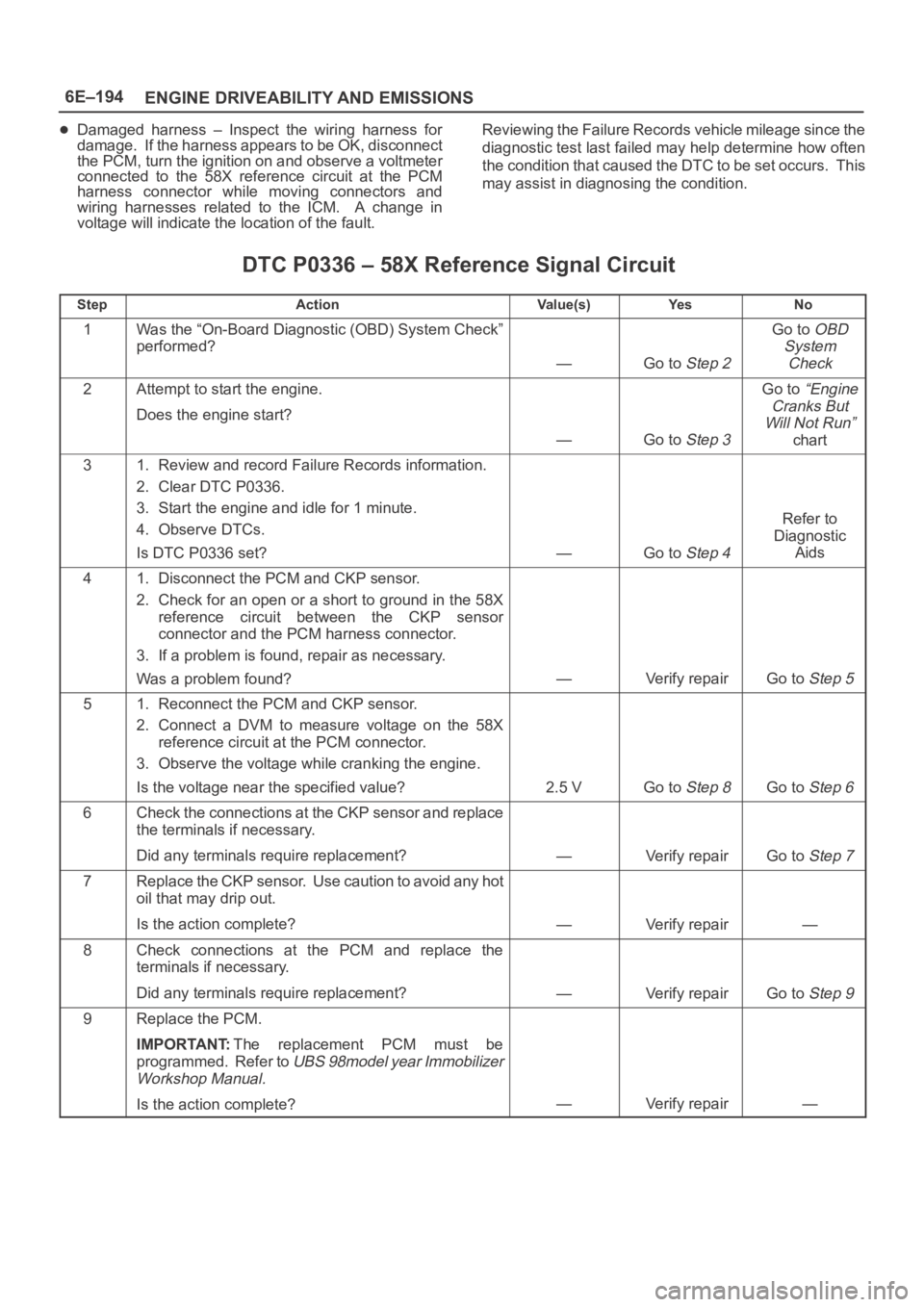
6E–194
ENGINE DRIVEABILITY AND EMISSIONS
Damaged harness – Inspect the wiring harness for
damage. If the harness appears to be OK, disconnect
the PCM, turn the ignition on and observe a voltmeter
connected to the 58X reference circuit at the PCM
harness connector while moving connectors and
wiring harnesses related to the ICM. A change in
voltage will indicate the location of the fault.Reviewing the Failure Records vehicle mileage since the
diagnostic test last failed may help determine how often
the condition that caused the DTC to be set occurs. This
may assist in diagnosing the condition.
DTC P0336 – 58X Reference Signal Circuit
StepActionVa l u e ( s )Ye sNo
1Was the “On-Board Diagnostic (OBD) System Check”
performed?
—Go to Step 2
Go to OBD
System
Check
2Attempt to start the engine.
Does the engine start?
—Go to Step 3
Go to “Engine
Cranks But
Will Not Run”
chart
31. Review and record Failure Records information.
2. Clear DTC P0336.
3. Start the engine and idle for 1 minute.
4. Observe DTCs.
Is DTC P0336 set?
—Go to Step 4
Refer to
Diagnostic
Aids
41. Disconnect the PCM and CKP sensor.
2. Check for an open or a short to ground in the 58X
reference circuit between the CKP sensor
connector and the PCM harness connector.
3. If a problem is found, repair as necessary.
Was a problem found?
—Verify repairGo to Step 5
51. Reconnect the PCM and CKP sensor.
2. Connect a DVM to measure voltage on the 58X
reference circuit at the PCM connector.
3. Observe the voltage while cranking the engine.
Is the voltage near the specified value?
2.5 VGo to Step 8Go to Step 6
6Check the connections at the CKP sensor and replace
the terminals if necessary.
Did any terminals require replacement?
—Verify repairGo to Step 7
7Replace the CKP sensor. Use caution to avoid any hot
oil that may drip out.
Is the action complete?
—Verify repair—
8Check connections at the PCM and replace the
terminals if necessary.
Did any terminals require replacement?
—Verify repairGo to Step 9
9Replace the PCM.
IMPORTANT:The replacement PCM must be
programmed. Refer to
UBS 98model year Immobilizer
Workshop Manual.
Is the action complete?—Verify repair—
Page 4853 of 6000

6E–196
ENGINE DRIVEABILITY AND EMISSIONS
Damaged harness – Inspect the wiring harness for
damage. If the harness appears to be OK, disconnect
the PCM, turn the ignition on and observe a voltmeter
connected to the 58X reference circuit at the PCM
harness connector while moving connectors and
wiring harnesses related to the ICM. A change in
voltage will indicate the location of the fault.Reviewing the Failure Records vehicle mileage since the
diagnostic test last failed may help determine how often
the condition that caused the DTC to be set occurs. This
may assist in diagnosing the condition.
DTC P0337 – CKP Sensor Circuit Low Frequency
StepActionVa l u e ( s )Ye sNo
1Was the “On-Board Diagnostic (OBD) System Check”
performed?
—Go to Step 2
Go to OBD
System
Check
2Attempt to start the engine.
Does the engine start?
—Go to Step 3Go to Chart 3
31. Review and record Failure Records information.
2. Clear DTC P0337.
3. Start the engine and idle for 1 minute.
4. Observe DTCs.
Is DTC P0337 set?
—Go to Step 4
Refer to
Diagnostic
Aid
41. Disconnect the CKP sensor.
2. Ignition “ON.”
3. Using a DVM, verify that 5 V reference and ground
are being supplied at the sensor connector (PCM
side).
Are 4-6 volts and ground available at the sensor?
—Go to Step 7Go to Step 5
51. Ignition “ON.”
2. With a DVM, backprobe the PCM connector 5 V
reference and ground connections.
Are 5 V reference and ground available at the PCM?
—Go to Step 6Go to Step 11
6Check 5 V reference or ground between the CKP
sensor and PCM and repair the open circuit, short to
ground or short to voltage.
Is the action complete?
—Verify repair—
71. Ignition “OFF.”
2. Disconnect the PCM and CKP sensor.
3. Check for an open or a short to ground in the 58X
reference circuit between the CKP sensor
connector and the PCM harness connector.
4. If a problem is found, repair as necessary.
Was a problem found?
—Verify repairGo to Step 8
81. Reconnect the PCM and CKP sensor.
2. Connect a DVM to measure voltage on the 58X
reference circuit at the PCM connector.
3. Observe the voltage while cranking the engine.
Is the voltage near the specified value?
2.5 VGo to Step 11Go to Step 9
9Check the connections at the CKP sensor and replace
the terminals if necessary.
Did any terminals require replacement?
—Verify repairGo to Step 10
10Replace the CKP sensor. Use caution and avoid hot oil
that may drip out.
Is the action complete?
—Verify repair—
Page 4864 of 6000

6E–207 ENGINE DRIVEABILITY AND EMISSIONS
Poor connection at PCM – Inspect the harness
connectors for backed-out terminals, improper mating,
broken locks, improperly formed or damaged
terminals, and poor terminal-to-wire connections.
Damaged harness – Inspect the wiring harness for
damage. If the harness appears to be OK, observe
Tech 2 display related to DTC P0351 while moving theconnector and wiring related to the ignition system. A
change in the display will indicate the location of the
fault.
Reviewing the Failure Records vehicle mileage since the
diagnostic test last failed may help determine how often
the condition that caused the DTC to be set occurs. This
may assist in diagnosing the condition.
DTC P0351 – Ignition 1 Control Circuit
StepActionVa l u e ( s )Ye sNo
1Was the “On-Board Diagnostic (OBD) System Check”
performed?
—Go to Step 2
Go to OBD
System
Check
21. Ignition “ON,” engine “OFF.”
2. Review and record Tech 2 Failure Records data.
3. Operate the vehicle within Failure Record
conditions as noted.
4. Use Tech 2 to monitor the “Specific DTC”
information for DTC P0351 until the DTC P0351 test
runs.
5. Note the test result.
Does Tech 2 indicate DTC P0351 failed this ignition
cycle?
—Go to Step 3
Go to
Diagnostic
Aids
3Check for faulty connection at ignition coil.
Was a problem found?
—Verify repair Go to Step 4
4Check for faulty connection at PCM connector.
Was a problem found?
—Verify repair Go to Step 5
51. Ignition “ON,” engine “OFF.”
2. Back probe the ignition control circuit 1 at the PCM
with a DVM.
Is the voltage near the specified value?
25-55 mVGo to Step 6Go to Step 9
61. Ignition “ON,” engine running.
2. Back probe the ignition control circuit at the PCM for
the cylinder being tested.
Is the voltage in the specified range, rapidly toggling
back and forth to a reading 20-50 mV higher?
100-180 mVGo to Step 7Go to Step 13
71. Ignition “OFF.”
2. Disconnect the 3-pin and 5-pin connectors at the
ignition coil.
3. Check ignition control circuit 1 voltage at the ignition
coil connector while cranking the engine.
Does the voltage measure between the specified
values?
200-1200 mVGo to Step 8Go to Step 11
8Replace the ignition coil.
Is the action complete?
—Verify repair—
91. Ignition “OFF.”
2. Disconnect the PCM and the ignition coil.
3. Check ignition control circuit 1 for short to ground.
Was a problem found?
—Verify repair Go to Step 10
10Check ignition control circuit 1 for short to voltage.
Was a problem found?
—Verify repairGo to Step 13
Page 4867 of 6000

6E–210
ENGINE DRIVEABILITY AND EMISSIONS
Poor connection at PCM – Inspect the harness
connectors for backed-out terminals, improper mating,
broken locks, improperly formed or damaged
terminals, and poor terminal-to-wire connections.
Damaged harness – Inspect the wiring harness for
damage. If the harness appears to be OK, observe the
Tech 2 display related to DTC P0352 while moving theconnector and wiring related to the ignition system. A
change in the display will indicate the location of the
fault.
Reviewing the Failure Records vehicle mileage since the
diagnostic test last failed may help determine how often
the condition that caused the DTC to be set occurs. This
may assist in diagnosing the condition.
DTC P0352 – Ignition 2 Control Circuit
StepActionVa l u e ( s )Ye sNo
1Was the “On-Board Diagnostic (OBD) System Check”
performed?
—Go to Step 2
Go to OBD
System
Check
21. Ignition “ON,” engine “OFF.”
2. Review and record Tech 2 Failure Records data.
3. Operate the vehicle within Failure Record
conditions as noted.
4. Use a Tech 2 to monitor the “Specific DTC”
information for DTC P0352 until the DTC P0352 test
runs.
5. Note the test result.
Does the Tech 2 indicate DTC P0352 failed this ignition
cycle?
—Go to Step 3
Go to
Diagnostic
Aids
3Check for faulty connection at ignition coil.
Was a problem found?
—Verify repairGo to Step 4
4Check for faulty connection at PCM connector.
Was a problem found?
—Verify repairGo to Step 5
51. Ignition “ON,” engine “OFF.”
2. Back probe the ignition control circuit 2 at the PCM
with a DVM .
Is the voltage near the specified value?
25-55 mVGo to Step 6Go to Step 9
61. Ignition “ON,” engine running.
2. Back probe the ignition control circuit at the PCM for
the cylinder being tested.
Is the voltage in the specified range, rapidly toggling
back and forth to a reading 20-50 mV higher?
100-180 mVGo to Step 7Go to Step 13
71. Ignition “OFF.”
2. Disconnect the 3-pin and 5-pin connectors at the
ignition coil.
3. Check ignition control circuit 2 voltage at the ignition
coil connector while cranking the engine connector.
Does the voltage measure between the specified
values?
200-1200 mVGo to Step 8Go to Step 11
8Replace the ignition coil.
Is the action complete?
—Verify repair—
91. Ignition “OFF.”
2. Disconnect the PCM and the ignition coil.
3. Check ignition control circuit 2 for short to ground.
Was a problem found?
—Verify repairGo to Step 10
10Check ignition control circuit 2 for short to voltage.
Was a problem found?
—Verify repairGo to Step 13
Page 4870 of 6000

6E–213 ENGINE DRIVEABILITY AND EMISSIONS
Poor connection at PCM – Inspect the harness
connectors for backed-out terminals, improper mating,
broken locks, improperly formed or damaged
terminals, and poor terminal-to-wire connections.
Damaged harness – Inspect the wiring harness for
damage. If the harness appears to be OK, observe the
Tech 2 display related to DTC P0353 while moving theconnector and wiring related to the ignition system. A
change in the display will indicate the location of the
fault.
Reviewing the Failure Records vehicle mileage since the
diagnostic test last failed may help determine how often
the condition that caused the DTC to be set occurs. This
may assist in diagnosing the condition.
DTC P0353 – Ignition 3 Control Circuit
StepActionVa l u e ( s )Ye sNo
1Was the “On-Board Diagnostic (OBD) System Check”
performed?
—Go to Step 2
Go to OBD
System
Check
21. Ignition “ON,” engine “OFF.”
2. Review and record Tech 2 Failure Records data.
3. Operate the vehicle within Failure Record
conditions as noted.
4. Use a Tech 2 to monitor the “Specific DTC”
information for DTC P0353 until the DTC P0353 test
runs.
5. Note the test result.
Does the Tech 2 indicate DTC P0353 failed this ignition
cycle?
—Go to Step 3
Go to
Diagnostic
Aids
3Check for faulty connection at ignition coil.
Was a problem found?
—Verify repairGo to Step 4
4Check for faulty connection at PCM connector.
Was a problem found?
—Verify repairGo to Step 5
51. Ignition “ON,” engine “OFF.”
2. Back probe the ignition control circuit 3 at the PCM
with a DVM positive lead with the negative lead to
ground.
Is the voltage near the specified value?
25-55 mVGo to Step 6Go to Step 9
61. Ignition “ON,” engine running.
2. Back probe the ignition control circuit at the PCM for
the cylinder being tested.
Is the voltage in the specified range, rapidly toggling
back and forth to a reading 20-50 mV higher?
100-180 mVGo to Step 7Go to Step 13
71. Ignition “OFF.”
2. Disconnect the 3-pin and 5-pin connectors at the
ignition coil.
3. Check ignition control circuit 3 voltage at the ignition
coil connector while cranking the engine.
Does the voltage measure between the specified
values?
200-1200 mVGo to Step 8Go to Step 11
8Replace the ignition coil.
Is the action complete?
—Verify repair—
91. Ignition “OFF.”
2. Disconnect the PCM and the ignition coil.
3. Check ignition control circuit 3 for short to ground.
Was a problem found?
—Verify repairGo to Step 10
10Check ignition control circuit 3 for short to voltage.
Was a problem found?
—Verify repairGo to Step 13
Page 4873 of 6000

6E–216
ENGINE DRIVEABILITY AND EMISSIONS
Poor connection at PCM – Inspect the harness
connectors for backed-out terminals, improper mating,
broken locks, improperly formed or damaged
terminals, and poor terminal-to-wire connections.
Damaged harness – Inspect the wiring harness for
damage. If the harness appears to be OK, observe the
Tech 2 display related to DTC P0354 while moving theconnector and wiring related to the ignition system. A
change in the display will indicate the location of the
fault.
Reviewing the Failure Records vehicle mileage since the
diagnostic test last failed may help determine how often
the condition that caused the DTC to be set occurs. This
may assist in diagnosing the condition.
DTC P0354 – Ignition 4 Control Circuit
StepActionVa l u e ( s )Ye sNo
1Was the “On-Board Diagnostic (OBD) System Check”
performed?
—Go to Step 2
Go to OBD
System
Check
21. Ignition “ON,” engine “OFF.”
2. Review and record Tech 2 Failure Records data.
3. Operate the vehicle within Failure Record
conditions as noted.
4. Use a Tech 2 to monitor the “Specific DTC”
information for DTC P0354 until the DTC P0354 test
runs.
5. Note the test result.
Does the Tech 2 indicate DTC P0354 failed this ignition
cycle?
—Go to Step 3
Go to
Diagnostic
Aids
3Check for faulty connection at ignition coil.
Was a problem found?
—Verify repairGo to Step 4
4Check for faulty connection at PCM connector.
Was a problem found?
—Verify repairGo to Step 5
51. Ignition “ON,” engine “OFF.”
2. Back probe the ignition control circuit 4 at the PCM
with a DVM positive lead with the negative lead to
ground.
Is the voltage near the specified value?
25-55 mVGo to Step 6Go to Step 9
61. Ignition “ON,” engine running.
2. Back probe the ignition control circuit at the PCM for
the cylinder being tested.
Is the voltage in the specified range, rapidly toggling
back and forth to a reading 20-50 mV higher?
100-180 mVGo to Step 7Go to Step 13
71. Ignition “OFF.”
2. Disconnect the 3-pin and 5-pin connectors at the
ignition coil.
3. Check ignition control circuit 4 voltage at the ignition
coil connector while cranking the engine.
Does the voltage measure between the specified
values?
200-1200 mVGo to Step 8Go to Step 11
8Replace the ignition coil.
Is the action complete?
—Verify repair—
91. Ignition “OFF.”
2. Disconnect the PCM and the ignition coil.
3. Check ignition control circuit 4 for short to ground.
Was a problem found?
—Verify repairGo to Step 10
10Check ignition control circuit 4 for short to voltage.
Was a problem found?
—Verify repairGo to Step 13
Page 4876 of 6000

6E–219 ENGINE DRIVEABILITY AND EMISSIONS
Poor connection at PCM – Inspect the harness
connectors for backed-out terminals, improper mating,
broken locks, improperly formed or damaged
terminals, and poor terminal-to-wire connections.
Damaged harness – Inspect the wiring harness for
damage. If the harness appears to be OK, observe the
Tech 2 display related to DTC P0355 while moving theconnector and wiring related to the ignition system. A
change in the display will indicate the location of the
fault.
Reviewing the Failure Records vehicle mileage since the
diagnostic test last failed may help determine how often
the condition that caused the DTC to be set occurs. This
may assist in diagnosing the condition.
DTC P0355 – Ignition 5 Control Circuit
StepActionVa l u e ( s )Ye sNo
1Was the “On-Board Diagnostic (OBD) System Check”
performed?
—Go to Step 2
Go to OBD
System
Check
21. Ignition “ON,” engine “OFF.”
2. Review and record Tech 2 Failure Records data.
3. Operate the vehicle within Failure Record
conditions as noted.
4. Use a Tech 2 to monitor the “Specific DTC”
information for DTC P0355 until the DTC P0355 test
runs.
5. Note the test result.
Does the Tech 2 indicate DTC P0355 failed this ignition
cycle?
—Go to Step 3
Go to
Diagnostic
Aids
3Check for faulty connection at ignition coil.
Was a problem found?
—Verify repairGo to Step 4
4Check for faulty connection at PCM connector.
Was a problem found?
—Verify repairGo to Step 5
51. Ignition “ON,” engine “OFF.”
2. Back probe the ignition control circuit 5 at the PCM
with a DVM positive lead with the negative lead to
ground.
Is the voltage near the specified value?
25-55 mVGo to Step 6Go to Step 9
61. Ignition “ON,” engine running.
2. Back probe the ignition control circuit at the PCM for
the cylinder being tested.
Is the voltage in the specified range, rapidly toggling
back and forth to a reading 20-50 mV higher?
100-180 mVGo to Step 7Go to Step 13
71. Ignition “OFF.”
2. Disconnect the 3-pin and 5-pin connectors at the
ignition coil.
3. Check ignition control circuit 5 voltage at the ignition
coil connector while cranking the engine.
Does the voltage measure between the specified
values?
200-1200 mVGo to Step 8Go to Step 11
8Replace the ignition coil.
Is the action complete?
—Verify repair—
91. Ignition “OFF.”
2. Disconnect the PCM and the ignition coil.
3. Check ignition control circuit 5 for short to ground.
Was a problem found?
—Verify repairGo to Step 10
10Check ignition control circuit 5 for short to voltage.
Was a problem found?
—Verify repairGo to Step 13
Page 4879 of 6000

6E–222
ENGINE DRIVEABILITY AND EMISSIONS
Poor connection at PCM – Inspect the harness
connectors for backed-out terminals, improper mating,
broken locks, improperly formed or damaged
terminals, and poor terminal-to-wire connections.
Damaged harness – Inspect the wiring harness for
damage. If the harness appears to be OK, observe the
Tech 2 display related to DTC P0356 while moving theconnector and wiring related to the ignition system. A
change in the display will indicate the location of the
fault.
Reviewing the Failure Records vehicle mileage since the
diagnostic test last failed may help determine how often
the condition that caused the DTC to be set occurs. This
may assist in diagnosing the condition.
DTC P0356 – Ignition 6 Control Circuit
StepActionVa l u e ( s )Ye sNo
1Was the “On-Board Diagnostic (OBD) System Check”
performed?
—Go to Step 2
Go to OBD
System
Check
21. Ignition “ON,” engine “OFF.”
2. Review and record Tech 2 Failure Records data.
3. Operate the vehicle within Failure Record
conditions as noted.
4. Use a Tech 2 to monitor the “Specific DTC”
information for DTC P0356 until the DTC P0356 test
runs.
5. Note the test result.
Does the Tech 2 indicate DTC P0356 failed this ignition
cycle?
—Go to Step 3
Go to
Diagnostic
Aids
3Check for faulty connection at ignition coil.
Was a problem found?
—Verify repairGo to Step 4
4Check for faulty connection at PCM connector.
Was a problem found?
—Verify repairGo to Step 5
51. Ignition “ON,” engine “OFF.”
2. Back probe the ignition control circuit 6 at the PCM
with a DVM positive lead with the negative lead to
ground.
Is the voltage near the specified value?
25-55 mVGo to Step 6Go to Step 9
61. Ignition “ON,” engine running.
2. Back probe the ignition control circuit at the PCM for
the cylinder being tested.
Is the voltage in the specified range, rapidly toggling
back and forth to a reading 20-50 mV higher?
100-180 mVGo to Step 7Go to Step 13
71. Ignition “OFF.”
2. Disconnect the 3-pin and 5-pin connectors at the
ignition coil.
3. Check ignition control circuit 6 voltage at the ignition
coil connector while cranking the engine.
Does the voltage measure between the specified
values?
200-1200 mVGo to Step 8Go to Step 11
8Replace the ignition coil.
Is the action complete?
—Verify repair—
91. Ignition “OFF.”
2. Disconnect the PCM and the ignition coil.
3. Check ignition control circuit 6 for short to ground.
Was a problem found?
—Verify repairGo to Step 10
10Check ignition control circuit 6 for short to voltage.
Was a problem found?
—Verify repairGo to Step 13