display PEUGEOT 2008 2015 Owner's Manual
[x] Cancel search | Manufacturer: PEUGEOT, Model Year: 2015, Model line: 2008, Model: PEUGEOT 2008 2015Pages: 340, PDF Size: 8.4 MB
Page 70 of 340
68
2008_en_Chap03_confort_ed01-2015
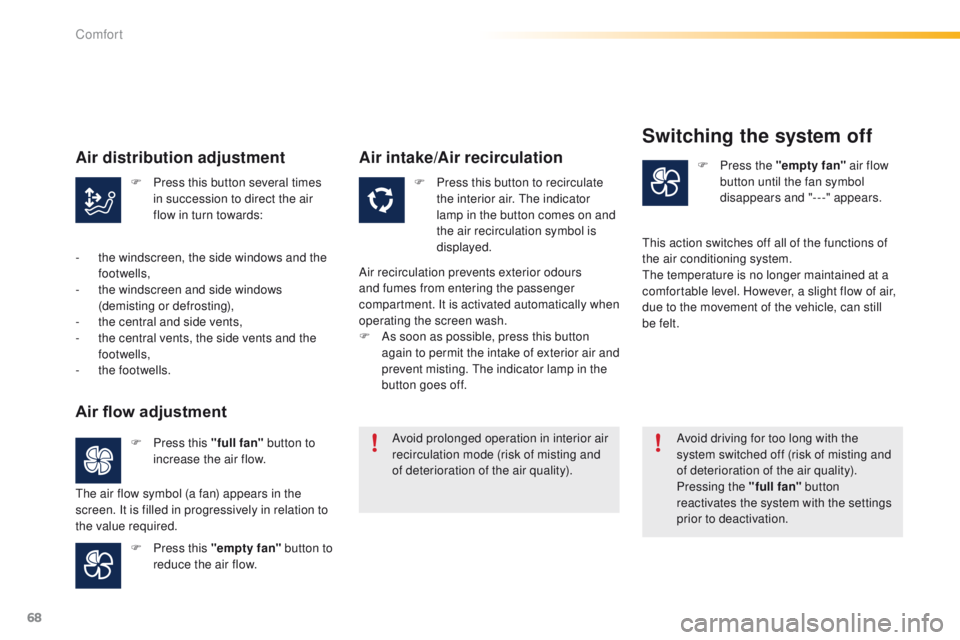
F Press this button several times in succession to direct the air
flow in turn towards: F
P ress this button to recirculate
the interior air. The indicator
lamp in the button comes on and
the air recirculation symbol is
displayed. F
P
ress the "empty fan"
air flow
button until the fan symbol
disappears and "---" appears.
F
P
ress this "full fan" button to
increase the air flow.
F
P
ress this "empty fan" button to
reduce the air flow. Avoid prolonged operation in interior air
recirculation mode (risk of misting and
of deterioration of the air quality).
Avoid driving for too long with the
system switched off (risk of misting and
of deterioration of the air quality).
Pressing the "full fan"
button
reactivates the system with the settings
prior to deactivation.
Air distribution adjustment
- the windscreen, the side windows and the footwells,
-
t
he windscreen and side windows
(demisting or defrosting),
-
t
he central and side vents,
-
t
he central vents, the side vents and the
footwells,
-
t
he footwells.
Air flow adjustment
The air flow symbol (a fan) appears in the
screen. It is filled in progressively in relation to
the value required.
Air intake/Air recirculation
Air recirculation prevents exterior odours
and fumes from entering the passenger
compartment. It is activated automatically when
operating the screen wash.
F
A
s soon as possible, press this button
again to permit the intake of exterior air and
prevent misting. The indicator lamp in the
button goes off.
Switching the system off
This action switches off all of the functions of
the air conditioning system.
The temperature is no longer maintained at a
comfortable level. However, a slight flow of air,
due to the movement of the vehicle, can still
be felt.
Comfort
Page 74 of 340
72
2008_en_Chap04_amenagements_ed01-2015
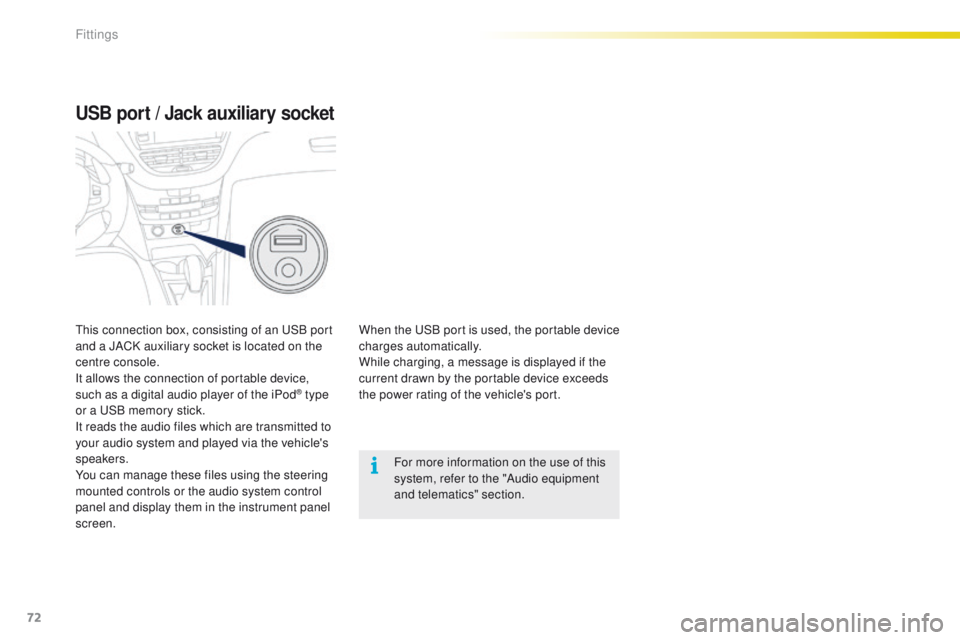
USB port / Jack auxiliary socket
When the USB port is used, the portable device
charges automatically.
While charging, a message is displayed if the
current drawn by the portable device exceeds
the power rating of the vehicle's port.For more information on the use of this
system, refer to the "Audio equipment
and telematics" section.
This connection box, consisting of an USB port
and a JACK auxiliary socket is located on the
centre console.
It allows the connection of portable device,
such as a digital audio player of the iPod
® type
or a USB memory stick.
It reads the audio files which are transmitted to
your audio system and played via the vehicle's
speakers.
You can manage these files using the steering
mounted controls or the audio system control
panel and display them in the instrument panel
screen.
Fittings
Page 82 of 340

80
2008_en_Chap05_conduite_ed01-2015
Key left in the "Ignition on"
position
On opening the driver's door, an alert
message is displayed, accompanied by an
audible signal, to remind you that the key is
still in the ignition switch at position 1 (Stop).
F Immobilise the vehicle.
F
T urn the key fully towards you to position 1
(Stop) .
F
R
emove the key from the ignition switch.
F
T
o lock the steering column, turn the wheel
until the lock engages.
Switching off
If the key has been left in the ignition
switch at position 2 (Ignition on) ,
the ignition will be switched off
automatically after one hour.
To switch the ignition back on, turn the
key to position 1 (Stop) , then back to
position 2 (Ignition on) .
Free-wheeling
For safety reasons, do not free-wheel.
Other wise, some vehicle functions will
no longer be active.
Switching off the engine leads to a loss
of braking assistance.
To facilitate unlocking of the steering
wheel, it is recommended that you
place the wheels in the straight ahead
position before switching off the engine.
Driving
Page 86 of 340
84
2008_en_Chap05_conduite_ed01-2015
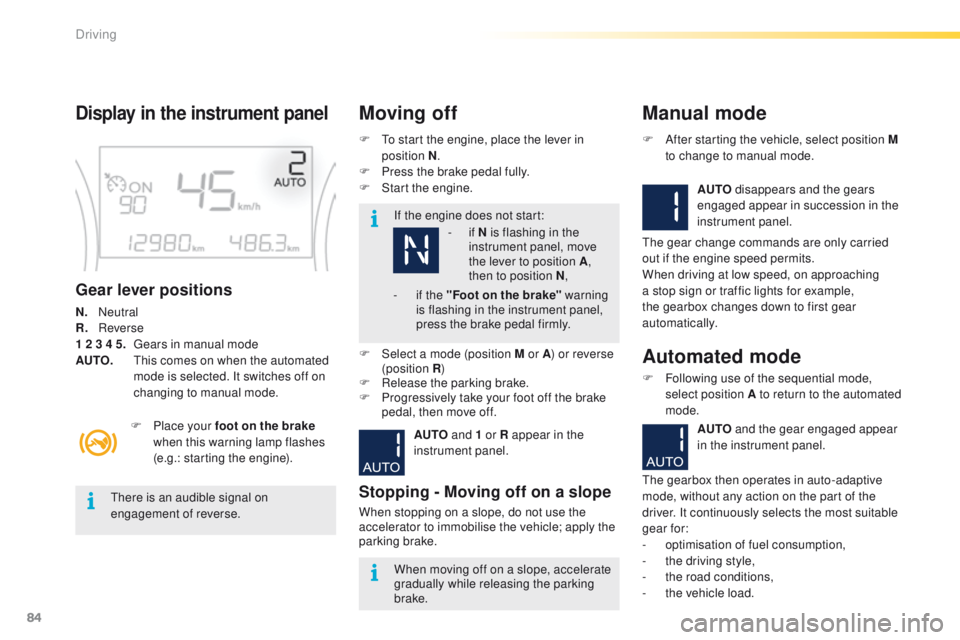
Display in the instrument panel
Gear lever positions
N. Neutral
R.
R everse
1 2 3 4 5.
G
ears in manual mode
AUTO.
T
his comes on when the automated
mode is selected. It switches off on
changing to manual mode. F
T
o start the engine, place the lever in
position N .
F
P
ress the brake pedal fully.
F
S
tart the engine.
Moving off
If the engine does not start:
F
P
lace your foot on the brake
when this warning lamp flashes
(e.g.: starting the engine).
There is an audible signal on
engagement of reverse.
When moving off on a slope, accelerate
gradually while releasing the parking
brake.
F
Sel
ect a mode (position M or A ) or reverse
(position R )
F
R
elease the parking brake.
F
P
rogressively take your foot off the brake
pedal, then move off.
AUTO and 1 or R appear in the
instrument panel.
Stopping - Moving off on a slope
When stopping on a slope, do not use the
accelerator to immobilise the vehicle; apply the
parking brake.
Manual mode
AUTO disappears and the gears
engaged appear in succession in the
instrument panel.
F
A
fter starting the vehicle, select position M
to change to manual mode.
The gear change commands are only carried
out if the engine speed permits.
When driving at low speed, on approaching
a stop sign or traffic lights for example,
the gearbox changes down to first gear
automatically.
Automated mode
F Following use of the sequential mode, select position A to return to the automated
mode.
AUTO and the gear engaged appear
in the instrument panel.
The gearbox then operates in auto-adaptive
mode, without any action on the part of the
driver. It continuously selects the most suitable
gear for:
-
o
ptimisation of fuel consumption,
-
t
he driving style,
-
t
he road conditions,
-
t
he vehicle load.
-
i
f N is flashing in the
instrument panel, move
the lever to position A ,
then to position N ,
-
i
f the "Foot on the brake" warning
is flashing in the instrument panel,
press the brake pedal firmly.
Driving
Page 87 of 340
85
2008_en_Chap05_conduite_ed01-2015
You must press the brake pedal firmly
while starting the engine.
Never select neutral N while the vehicle
is moving.
Only engage reverse gear R when the
vehicle is immobilised, with your foot on
the brake pedal.
In all cases, you must apply the parking
brake to immobilise the vehicle.
"Auto sequential" mode
In the automated mode, you can resume
control temporarily at any time using the
steering mounted control paddles.
The use of these paddles permits manual
selection of the gears in situations which
require a more rapid change-down than in
the automated mode (arrival at a roundabout,
leaving a car park with a steep gradient,
over taking...).
The gearbox engages the required gear if
the engine speed permits. AUTO remains
displayed on the instrument panel.
After a few moments, the gearbox resumes
automatic control of the gears.
Stopping the vehicle
Before switching off the engine, you can
change to position N to be in neutral.
In this case, you must apply the parking
brake to immobilise the vehicle.
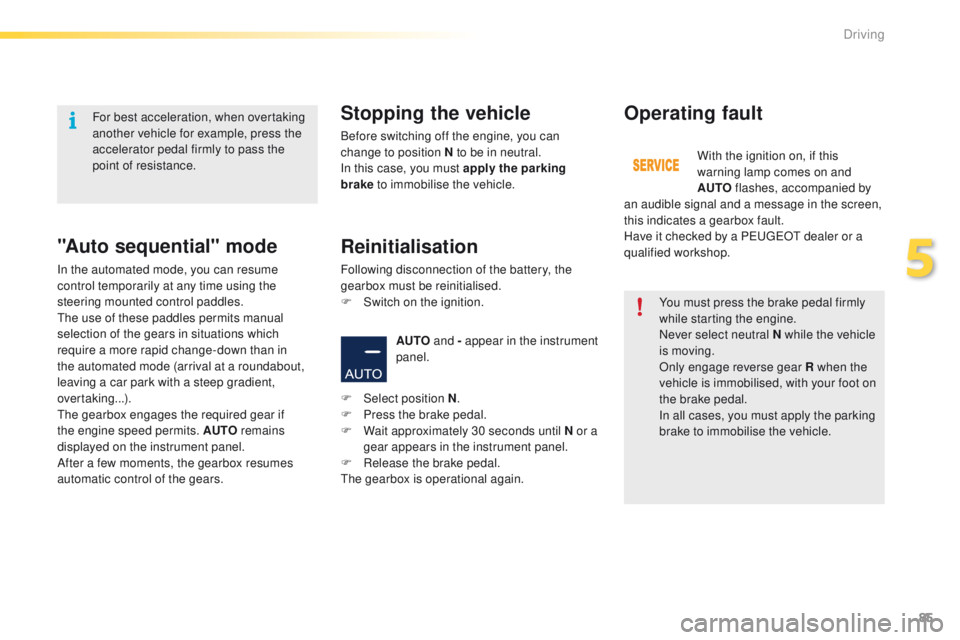
AUTO and - appear in the instrument
panel.
Operating fault
With the ignition on, if this
warning lamp comes on and
AUTO flashes, accompanied by
an audible signal and a message in the screen,
this indicates a gearbox fault.
Have it checked by a PEUGEOT dealer or a
qualified workshop.
For best acceleration, when overtaking
another vehicle for example, press the
accelerator pedal firmly to pass the
point of resistance.
F
Sel
ect position N .
F
P
ress the brake pedal.
F
W
ait approximately 30 seconds until N or a
gear appears in the instrument panel.
F
R
elease the brake pedal.
The gearbox is operational again.
Reinitialisation
Following disconnection of the battery, the
gearbox must be reinitialised.
F
S
witch on the ignition.
5
Driving
Page 89 of 340
87
2008_en_Chap05_conduite_ed01-2015
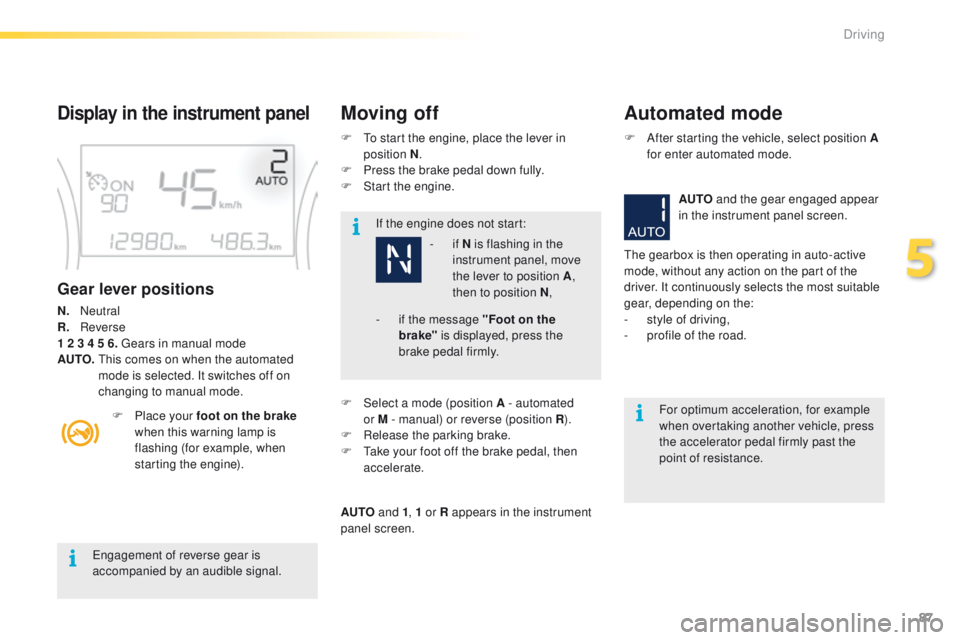
Engagement of reverse gear is
accompanied by an audible signal.If the engine does not start:
For optimum acceleration, for example
when overtaking another vehicle, press
the accelerator pedal firmly past the
point of resistance.
Display in the instrument panelMoving offAutomated mode
Gear lever positions
N. Neutral
R. R everse
1 2 3 4 5 6. Gears in manual mode
AUTO.
T
his comes on when the automated
mode is selected. It switches off on
changing to manual mode.
F
P
lace your foot on the brake
when this warning lamp is
flashing (for example, when
starting the engine). F
T
o start the engine, place the lever in
position N .
F
P
ress the brake pedal down fully.
F
S
tart the engine.
- if
N is flashing in the
instrument panel, move
the lever to position A ,
then to position N ,
F
Sel
ect a mode (position A - automated
or M - manual) or reverse (position R ).
F
R
elease the parking brake.
F
T
ake your foot off the brake pedal, then
accelerate.
AUTO and 1, 1 or R appears in the instrument
panel screen. F
A
fter starting the vehicle, select position A
for enter automated mode.
AUTO and the gear engaged appear
in the instrument panel screen.
The gearbox is then operating in auto-active
mode, without any action on the part of the
driver. It continuously selects the most suitable
gear, depending on the:
- s tyle of driving,
-
p
rofile of the road.
-
i f the message "Foot on the
brake" is displayed, press the
brake pedal firmly.
5
Driving
Page 90 of 340
88
2008_en_Chap05_conduite_ed01-2015
At very low speed, if reverse gear
is requested, this will only be taken
into account when the vehicle is
immobilised. A warning lamp appears in
the instrument panel screen.
Manual gear
changingManual mode
On sharp acceleration, the gearbox will
not change up unless the driver acts on
the gear lever or the steering mounted
paddles.
Never select neutral N while the vehicle
is moving.
Only engage reverse gear R when the
vehicle is immobilised with the brake
pedal pressed.
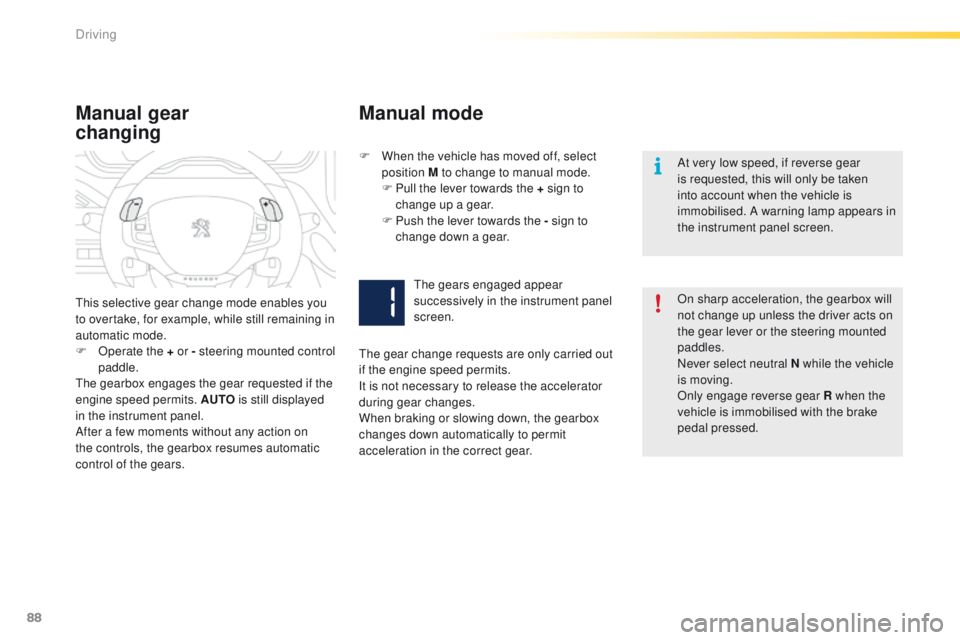
This selective gear change mode enables you
to overtake, for example, while still remaining in
automatic mode.
F
O
perate the + or - steering mounted control
paddle.
The gearbox engages the gear requested if the
engine speed permits. AUTO is still displayed
in the instrument panel.
After a few moments without any action on
the controls, the gearbox resumes automatic
control of the gears. F
W
hen the vehicle has moved off, select
position M to change to manual mode.
F
P
ull the lever towards the +
sign to
change up a gear.
F
P
ush the lever towards the - sign to
change down a gear.
The gears engaged appear
successively in the instrument panel
screen.
The gear change requests are only carried out
if the engine speed permits.
It is not necessary to release the accelerator
during gear changes.
When braking or slowing down, the gearbox
changes down automatically to permit
acceleration in the correct gear.
Driving
Page 92 of 340
90
2008_en_Chap05_conduite_ed01-2015
Four-speed automatic gearbox which offers a
choice between the comfort of fully automatic
operation, enhanced by sport and snow
programmes, or manual gear changing.
There are therefore four driving modes:
-
a
utomatic operation for electronic
management of the gears by the gearbox,
-
sp
ort programme for a more dynamic style
of driving,
-
s
now programme to improve driving when
traction is poor,
-
s
equential operation for manual changing
of the gears by the driver.
Automatic gearbox
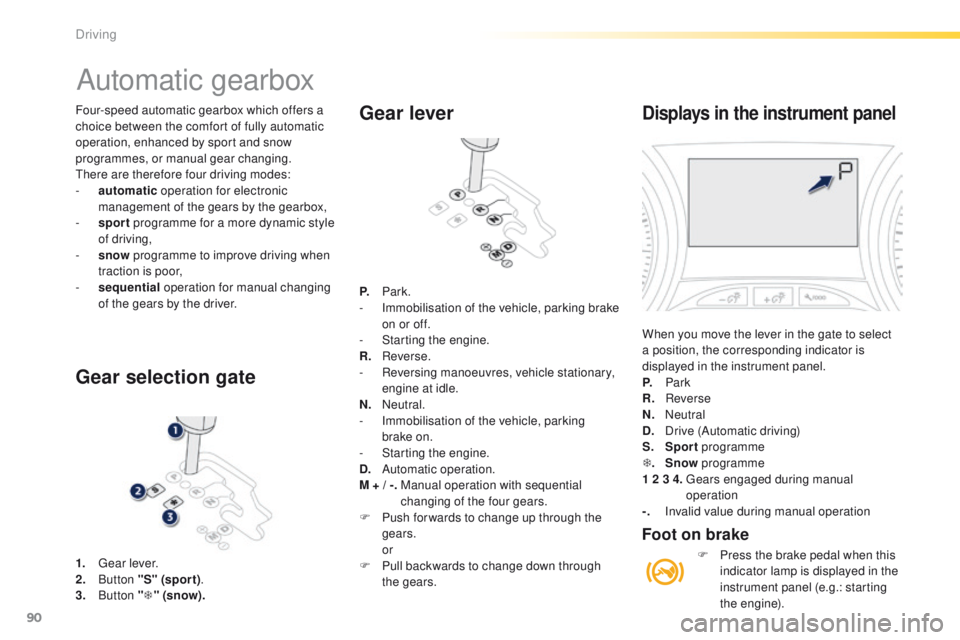
1. Gear lever.
2. B utton "S" (spor t) .
3.
Button "T " (snow).
Gear selection gate Gear lever
P.
Park.
- I mmobilisation of the vehicle, parking brake
on or off.
-
S
tarting the engine.
R.
R
everse.
-
R
eversing manoeuvres, vehicle stationary,
engine at idle.
N.
N
eutral.
-
I
mmobilisation of the vehicle, parking
brake on.
-
S
tarting the engine.
D.
A
utomatic operation.
M + / -.
M
anual operation with sequential
changing of the four gears.
F
P
ush for wards to change up through the
gears.
or
F
P
ull backwards to change down through
the gears.
Displays in the instrument panel
When you move the lever in the gate to select
a position, the corresponding indicator is
displayed in the instrument panel.
P.
Park
R.
Reverse
N.
N
eutral
D.
D
rive (Automatic driving)
S.
Sport programme
T .
Snow programme
1 2 3 4.
G
ears engaged during manual
operation
-.
I
nvalid value during manual operation
Foot on brake
F Press the brake pedal when this indicator lamp is displayed in the
instrument panel (e.g.: starting
the engine).
Driving
Page 93 of 340
91
2008_en_Chap05_conduite_ed01-2015
F Apply the parking brake.
F Sel ect position P or N .
F
S
tart the engine.
If this procedure is not followed, there is an
audible signal, accompanied by the display of
an warning message.
F
W
ith the engine running, press the brake
pedal.
F
R
elease the parking brake.
F
Sel
ect position R , D or M.
F
G
radually release the brake pedal.
The vehicle moves off immediately.
Moving off
When the engine is running at idle, with
the brakes released, if position R , D
or M is selected, the vehicle moves
even without the accelerator being
pressed.
When the engine is running, never
leave children in the vehicle without
supervision.
When carrying out maintenance with
the engine running, apply the parking
brake and select position P .
If position N is selected inadvertently
while driving, allow the engine to
return to idle then select position D to
accelerate.
If the ambient temperature is
below
-23°C, the engine should be left
at idle for four minutes, to ensure the
correct operation and life of the engine
and gearbox. Never select position N while the
vehicle is moving.
Never select positions P or R unless the
vehicle is completely stationary.
Automatic operation
F Select position D for automatic
changing
of the four gears.
The gearbox then operates in auto-adaptive
mode, without any intervention on the part
of the driver. It continuously selects the most
suitable gear according to the style of driving,
the profile of the road and the load in the
vehicle.
For maximum acceleration without touching the
gear lever, press the accelerator pedal down
fully (kick down). The gearbox changes down
automatically or maintains the gear selected
until the maximum engine speed is reached.
On braking, the gearbox changes down
automatically to provide efficient engine
braking.
If you release the accelerator sharply, the
gearbox will not change to a higher gear for
safety reasons.
5
Driving
Page 94 of 340
92
2008_en_Chap05_conduite_ed01-2015
Sport and snow programmes
Sport programme "S"
F Press button "S", after starting the engine.
The gearbox automatically favours a dynamic
style of driving.
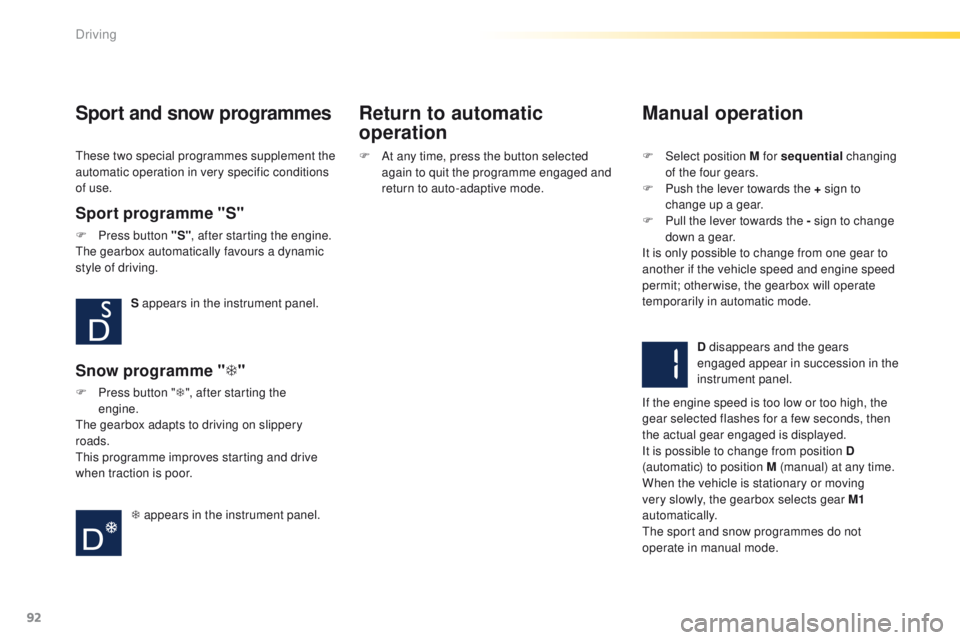
S appears in the instrument panel.
Snow programme " T"
F Press button " T", after starting the
engine.
The gearbox adapts to driving on slippery
roads.
This programme improves starting and drive
when traction is poor.
T appears in the instrument panel.
These two special programmes supplement the
automatic operation in very specific conditions
of use.
Return to automatic
operation
Manual operation
F Select position M for sequential
changing
of the four gears.
F
P
ush the lever towards the + sign to
change up a gear.
F
P
ull the lever towards the - sign to change
down a gear.
It is only possible to change from one gear to
another if the vehicle speed and engine speed
permit; otherwise, the gearbox will operate
temporarily in automatic mode.
D disappears and the gears
engaged appear in succession in the
instrument panel.
If the engine speed is too low or too high, the
gear selected flashes for a few seconds, then
the actual gear engaged is displayed.
It is possible to change from position D
(automatic) to position M (manual) at any time.
When the vehicle is stationary or moving
very slowly, the gearbox selects gear M1
automatically.
The sport and snow programmes do not
operate in manual mode.
F
A
t any time, press the button selected
again to quit the programme engaged and
return to auto-adaptive mode.
Driving