instrument panel PEUGEOT 2008 2016 User Guide
[x] Cancel search | Manufacturer: PEUGEOT, Model Year: 2016, Model line: 2008, Model: PEUGEOT 2008 2016Pages: 450, PDF Size: 14.16 MB
Page 44 of 450
42
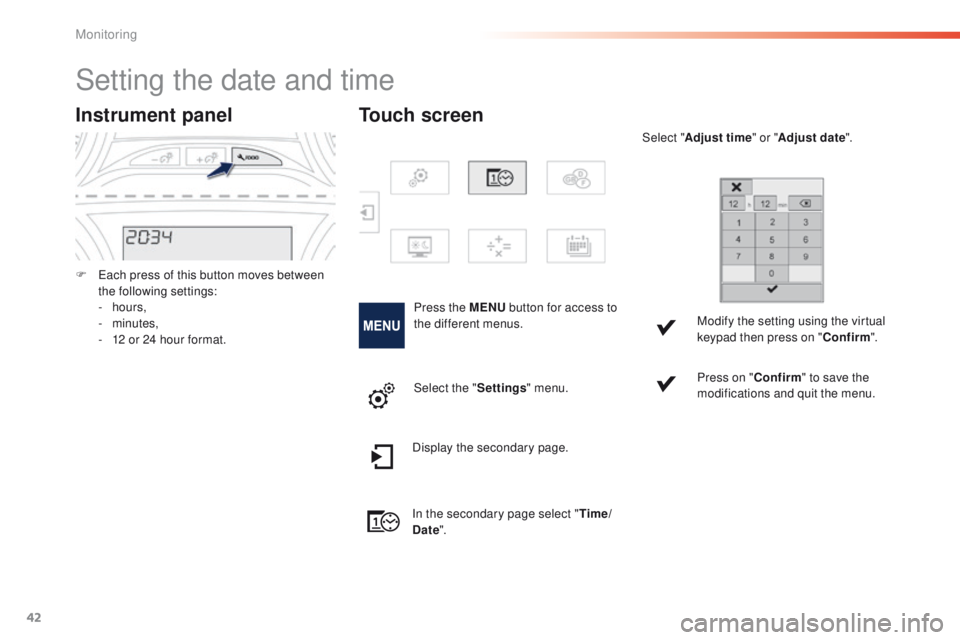
Instrument panel
F Each press of this button moves between the following settings:
-
hours,
-
minutes,
-
1
2 or 24 hour format.
Setting the date and time
Press the MENU button for access to
the different menus. Select "
Adjust time " or "Adjust date".
Modify the setting using the virtual
keypad then press on " Confirm".
Touch screen
Select the " Settings" menu. Press on "
Confirm" to save the
modifications and quit the menu.
Display the secondary page.
In the secondary page select " Time/
Date ".
Monitoring
Page 48 of 450
46
2008_en_Chap02_ouvertures_ed01-2016
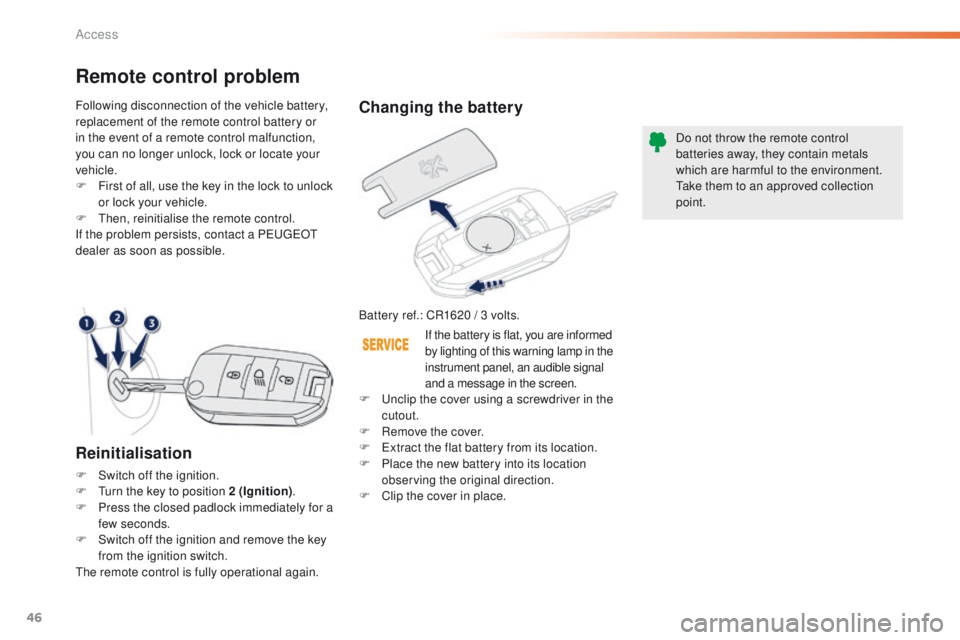
Changing the battery
Battery ref.: CR1620 / 3 volts.Do not throw the remote control
batteries away, they contain metals
which are harmful to the environment.
Take them to an approved collection
point.
Remote control problem
Reinitialisation
F Switch off the ignition.
F
T urn the key to position 2 (Ignition) .
F
P
ress the closed padlock immediately for a
few seconds.
F
S
witch off the ignition and remove the key
from the ignition switch.
The remote control is fully operational again. Following disconnection of the vehicle battery,
replacement of the remote control battery or
in the event of a remote control malfunction,
you can no longer unlock, lock or locate your
vehicle.
F
F
irst of all, use the key in the lock to unlock
or lock your vehicle.
F
T
hen, reinitialise the remote control.
If the problem persists, contact a PEUGEOT
dealer as soon as possible.
If the battery is flat, you are informed
by lighting of this warning lamp in the
instrument panel, an audible signal
and a message in the screen.
F
U
nclip the cover using a screwdriver in the
cutout.
F
R
emove the cover.
F
E
xtract the flat battery from its location.
F P lace the new battery into its location
observing the original direction.
F
C
lip the cover in place.
Access
Page 61 of 450
59
2008_en_Chap03_confort_ed01-2016
Steering wheel adjustment
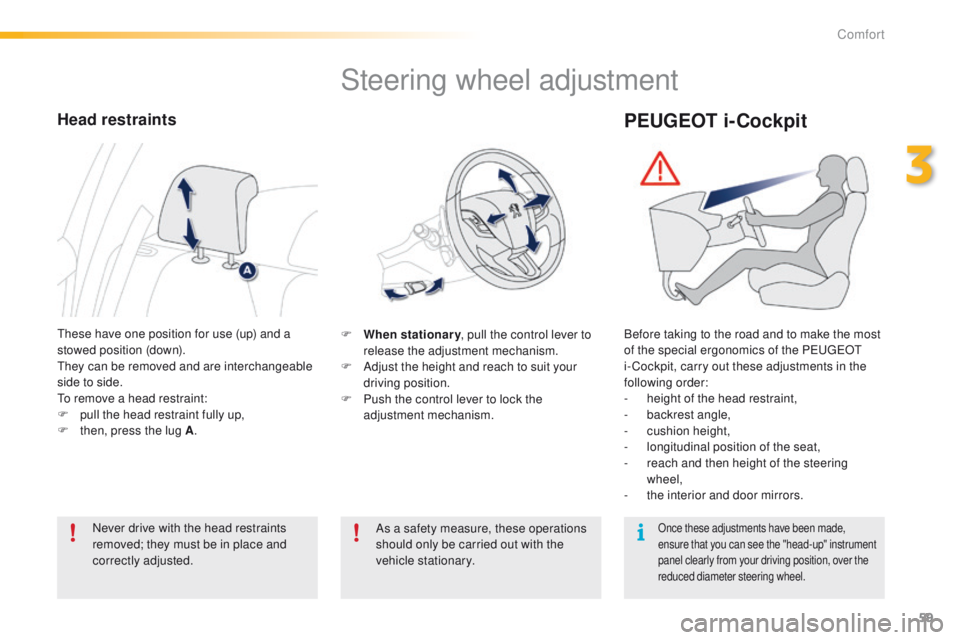
F When stationary, pull the control lever to
release the adjustment mechanism.
F
A
djust the height and reach to suit your
driving position.
F
P
ush the control lever to lock the
adjustment mechanism.
As a safety measure, these operations
should only be carried out with the
vehicle stationary.
Never drive with the head restraints
removed; they must be in place and
correctly adjusted.
These have one position for use (up) and a
stowed position (down).
They can be removed and are interchangeable
side to side.
To remove a head restraint:
F
p
ull the head restraint fully up,
F
t
hen, press the lug A .
Head restraintsPEUGEOT i-Cockpit
Before taking to the road and to make the most
of the special ergonomics of the PEUGEOT
i- Cockpit, carry out these adjustments in the
following order:
-
h
eight of the head restraint,
-
b
ackrest angle,
-
c
ushion height,
-
l
ongitudinal position of the seat,
-
r
each and then height of the steering
wheel,
-
t
he interior and door mirrors.
Once these adjustments have been made,
ensure that you can see the "head-up" instrument
panel clearly from your driving position, over the
reduced diameter steering wheel.
3
Comfort
Page 75 of 450
73
2008_en_Chap04_amenagements_ed01-2016
USB port / Jack auxiliary socket
When the USB port is used, the portable device
charges automatically.
While charging, a message is displayed if the
current drawn by the portable device exceeds
the power rating of the vehicle's port.For more information on the use of this
system, refer to the "Audio equipment
and telematics" section.
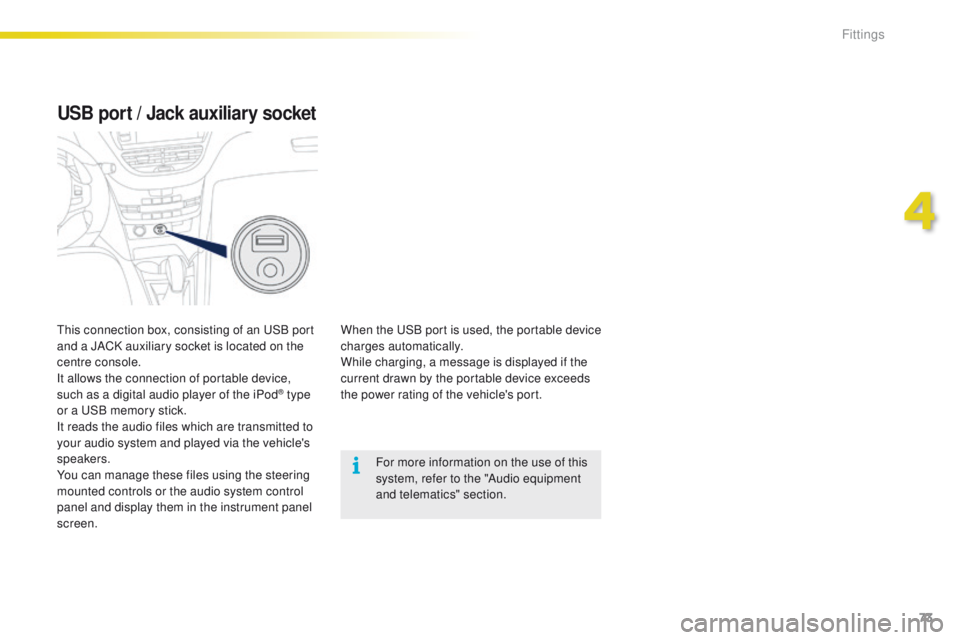
This connection box, consisting of an USB port
and a JACK auxiliary socket is located on the
centre console.
It allows the connection of portable device,
such as a digital audio player of the iPod
® type
or a USB memory stick.
It reads the audio files which are transmitted to
your audio system and played via the vehicle's
speakers.
You can manage these files using the steering
mounted controls or the audio system control
panel and display them in the instrument panel
screen.
4
Fittings
Page 87 of 450
85
2008_en_Chap05_conduite_ed01-2016
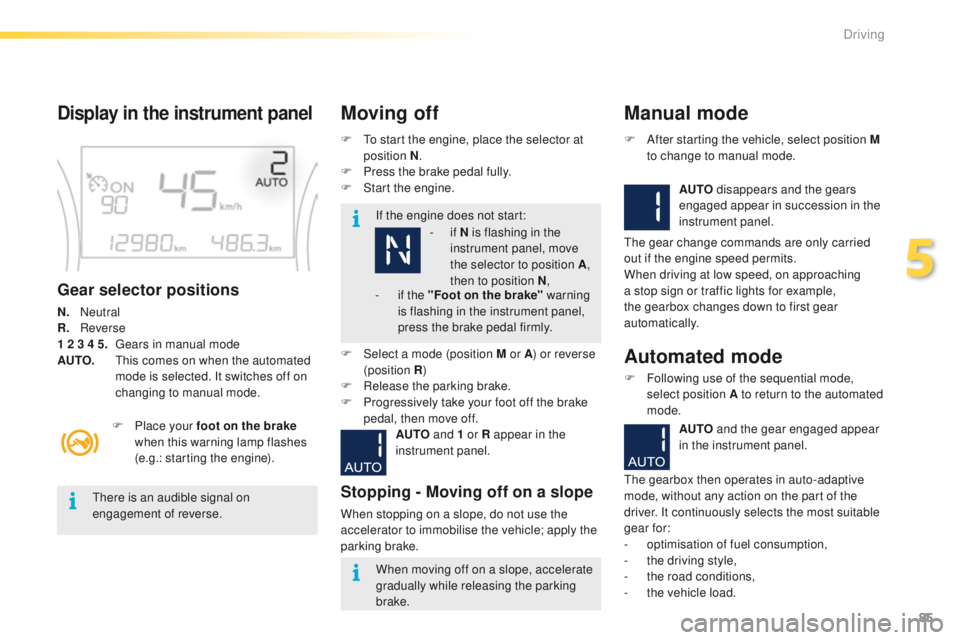
Display in the instrument panel
Gear selector positions
N. Neutral
R . Reverse
1 2 3 4 5.
G
ears in manual mode
AUTO.
T
his comes on when the automated
mode is selected. It switches off on
changing to manual mode. F
T
o start the engine, place the selector at
position N .
F
P
ress the brake pedal fully.
F
S
tart the engine.
Moving off
If the engine does not start:
F
P
lace your foot on the brake
when this warning lamp flashes
(e.g.: starting the engine).
There is an audible signal on
engagement of reverse.
When moving off on a slope, accelerate
gradually while releasing the parking
brake.
F
Sel
ect a mode (position M or A ) or reverse
(position R )
F
R
elease the parking brake.
F
P
rogressively take your foot off the brake
pedal, then move off.
AUTO and 1 or R appear in the
instrument panel.
Stopping - Moving off on a slope
When stopping on a slope, do not use the
accelerator to immobilise the vehicle; apply the
parking brake.
Manual mode
AUTO disappears and the gears
engaged appear in succession in the
instrument panel.
F
A
fter starting the vehicle, select position M
to change to manual mode.
The gear change commands are only carried
out if the engine speed permits.
When driving at low speed, on approaching
a stop sign or traffic lights for example,
the gearbox changes down to first gear
automatically.
Automated mode
F Following use of the sequential mode, select position A to return to the automated
mode.
-
i
f
N is flashing in the
instrument panel, move
the selector to position A ,
then to position N ,
-
i
f the "Foot on the brake" warning
is flashing in the instrument panel,
press the brake pedal firmly.
AUTO and the gear engaged appear
in the instrument panel.
The gearbox then operates in auto-adaptive
mode, without any action on the part of the
driver. It continuously selects the most suitable
gear for:
-
o
ptimisation of fuel consumption,
-
t
he driving style,
-
t
he road conditions,
-
t
he vehicle load.
5
Driving
Page 88 of 450
86
2008_en_Chap05_conduite_ed01-2016
You must press the brake pedal firmly
while starting the engine.
Never select neutral N while the vehicle
is moving.
Only engage reverse gear R when the
vehicle is immobilised, with your foot on
the brake pedal.
In all cases, you must apply the parking
brake to immobilise the vehicle.
For best acceleration, when overtaking
another vehicle for example, press the
accelerator pedal firmly to pass the
point of resistance.
"Auto sequential" mode
In the automated mode, you can resume
control temporarily at any time using the
steering mounted control paddles.
The use of these paddles permits manual
selection of the gears in situations which
require a more rapid change-down than in
the automated mode (arrival at a roundabout,
leaving a car park with a steep gradient,
over taking...).
The gearbox engages the required gear if
the engine speed permits. AUTO
remains
displayed on the instrument panel.
After a few moments, the gearbox resumes
automatic control of the gears.
Stopping the vehicle
Before switching off the engine, you can
change to position N to be in neutral.
In this case, you must apply the parking
brake to immobilise the vehicle.
Reinitialisation
Following disconnection of the battery, the
gearbox must be reinitialised.
F
S
witch on the ignition.
AUTO and - appear in the instrument
panel.
F
Sel
ect position N .
F
P
ress the brake pedal.
F
W
ait approximately 30 seconds until N or a
gear appears in the instrument panel.
F
R
elease the brake pedal.
The gearbox is operational again.
Operating fault
With the ignition on, if this
warning lamp comes on and
AUTO flashes, accompanied by
an audible signal and a message in the screen,
this indicates a gearbox fault.
Have it checked by a PEUGEOT dealer or a
qualified workshop.
Driving
Page 90 of 450
88
2008_en_Chap05_conduite_ed01-2016
Engagement of reverse gear is
accompanied by an audible signal.If the engine does not start:
For optimum acceleration, for example
when overtaking another vehicle, press
the accelerator pedal firmly past the
point of resistance.
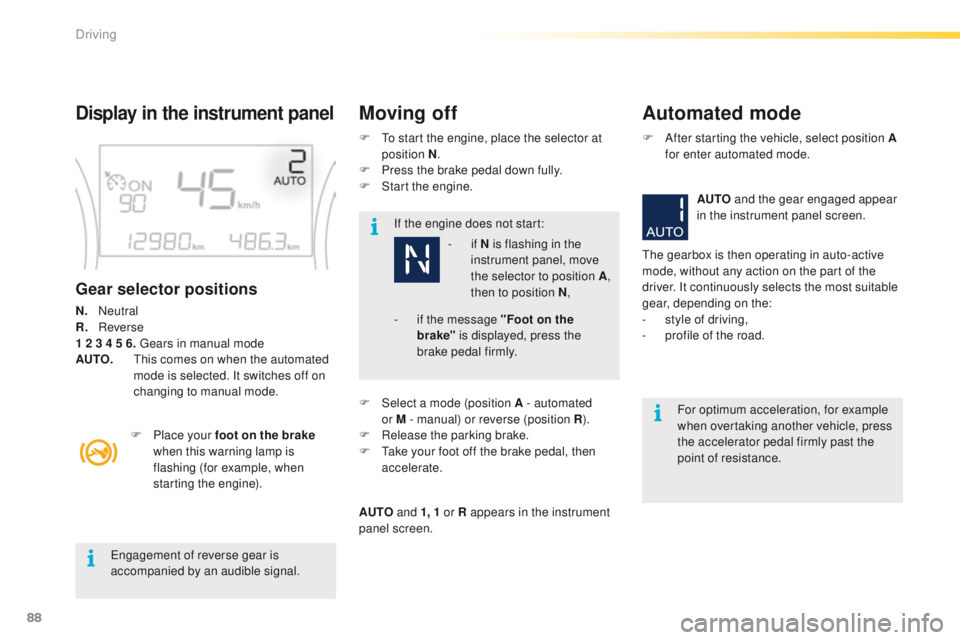
Display in the instrument panelMoving offAutomated mode
Gear selector positions
N. Neutral
R. R everse
1 2 3 4 5 6. Gears in manual mode
AUTO.
T
his comes on when the automated
mode is selected. It switches off on
changing to manual mode.
F
P
lace your foot on the brake
when this warning lamp is
flashing (for example, when
starting the engine). F
T
o start the engine, place the selector at
position N .
F
P
ress the brake pedal down fully.
F
S
tart the engine.
- if
N is flashing in the
instrument panel, move
the selector to position A ,
then to position N ,
F
Sel
ect a mode (position A - automated
or
M - manual) or reverse (position R).
F
R
elease the parking brake.
F
T
ake your foot off the brake pedal, then
accelerate.
AUTO and 1, 1 or R appears in the instrument
panel screen. F
A
fter starting the vehicle, select position A
for enter automated mode.
AUTO and the gear engaged appear
in the instrument panel screen.
The gearbox is then operating in auto-active
mode, without any action on the part of the
driver. It continuously selects the most suitable
gear, depending on the:
- s tyle of driving,
-
p
rofile of the road.
-
i f the message "Foot on the
brake" is displayed, press the
brake pedal firmly.
Driving
Page 91 of 450
89
2008_en_Chap05_conduite_ed01-2016
At very low speed, if reverse gear
is requested, this will only be taken
into account when the vehicle is
immobilised. A warning lamp appears in
the instrument panel screen.
Manual gear changingManual mode
On sharp acceleration, the gearbox will
not change up unless the driver acts on
the gear lever or the steering mounted
paddles.
Never select neutral N while the vehicle
is moving.
Only engage reverse gear R when the
vehicle is immobilised with the brake
pedal pressed.
This selective gear change mode enables you
to overtake, for example, while still remaining in
automatic mode.
F
O
perate the + or - steering mounted control
paddle.
The gearbox engages the gear requested if the
engine speed permits. AUTO is still displayed
in the instrument panel.
After a few moments without any action on
the controls, the gearbox resumes automatic
control of the gears. F
W
hen the vehicle has moved off, select
position M to change to manual mode.
F
P
ull the selector towards the +
sign to
change up a gear.
F
P
ush the selector towards the - sign to
change down a gear.
The gears engaged appear
successively in the instrument panel
screen.
The gear change requests are only carried out
if the engine speed permits.
It is not necessary to release the accelerator
during gear changes.
When braking or slowing down, the gearbox
changes down automatically to permit
acceleration in the correct gear.
5
Driving
Page 92 of 450
90
2008_en_Chap05_conduite_ed01-2016
Operating fault
When immobilising the vehicle, with
the engine running, you must place the
gear selector at neutral N.
Before carrying out any work in the
engine compartment, check that the
gear selector is at neutral N and that the
parking brake is applied. With the ignition on, the flashing
of this warning lamp and the
flashing of AUTO
, accompanied
by an audible signal and a message in
the instrument panel screen, indicates a
malfunction of the gearbox.
Have it checked by PEUGEOT or a qualified
workshop.
You must press the brake pedal firmly
when starting the engine.
Whatever the circumstances, you must
manually apply the parking brake to
immobilise the vehicle.
Stopping the vehicle
Before switching off the engine, you can
choose to:
-
m
ove to position N to engage neutral,
-
l
eave the gear engaged; in this case, it will
not be possible to move the vehicle.
In both cases, you must apply the parking
brake to immobilise the vehicle.
Driving
Page 93 of 450
91
2008_en_Chap05_conduite_ed01-2016
4-speed automatic gearbox which offers a
choice between the ease of fully automatic
operation, enhanced by sport and snow
programmes, or manual gear changing.
Two driving modes are available:
-
a
utomatic operation with electronic
management of the gears by the gearbox,
with a sport programme for a more
dynamic style of driving and a snow
programme to make driving easier when
grip is poor.
-
m
anual operation for sequential changing
of the gears by the driver.
Automatic gearbox
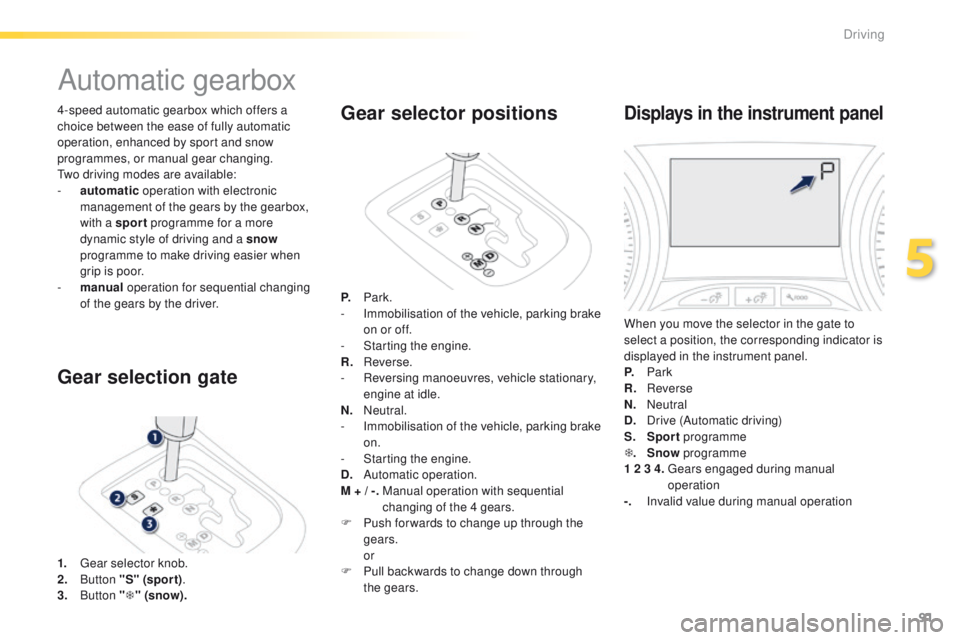
1. Gear selector knob.
2. B utton "S" (spor t) .
3.
Button "T " (snow).
Gear selection gate Gear selector positions
P.
Park.
- I mmobilisation of the vehicle, parking brake
on or off.
-
S
tarting the engine.
R.
R
everse.
-
R
eversing manoeuvres, vehicle stationary,
engine at idle.
N.
N
eutral.
-
I
mmobilisation of the vehicle, parking brake
on.
-
S
tarting the engine.
D.
A
utomatic operation.
M + / -.
M
anual operation with sequential
changing of the 4 gears.
F
P
ush for wards to change up through the
gears.
or
F
P
ull backwards to change down through
the gears.
Displays in the instrument panel
When you move the selector in the gate to
select a position, the corresponding indicator is
displayed in the instrument panel.
P.
Park
R.
Reverse
N.
N
eutral
D.
D
rive (Automatic driving)
S.
Sport programme
T .
Snow programme
1 2 3 4.
G
ears engaged during manual
operation
-.
I
nvalid value during manual operation
5
Driving