wheel PEUGEOT 2008 2016 Owners Manual
[x] Cancel search | Manufacturer: PEUGEOT, Model Year: 2016, Model line: 2008, Model: PEUGEOT 2008 2016Pages: 450, PDF Size: 14.16 MB
Page 4 of 450
.
.
2008_en_Chap00a_sommaire_ed01-2016
Instrument panels 14
Library of indicator and warning lamps 1 6
Gauges and indicators
2
8
Touch screen
3
4
Trip computer
3
8
Distance recorders
4
1
Setting the date and time
4
2
MonitoringOver view
Remote control key 4
3
Doors 48
Boot
50
Locking / unlocking from the inside
5
1
Alarm
52
Electric windows
5
4Interior fittings
7 1
Boot fittings 7 5
AccessFittings
Front seats 56
Rear seats 5 8
Steering wheel adjustment
5
9
Mirrors
60
Ventilation
62
Heating
6
5
Manual air conditioning
6
5
Dual-zone digital air conditioning
6
7
Front demist - defrost
7
0
Rear screen demist - defrost
70
Comfort
Driving recommendations 7 9
Starting - Switching off the engine 8 0
Manual parking brake
8
2
5-speed manual gearbox
8
3
6-speed manual gearbox
8
3
5-speed electronic gearbox
8
4
6 -speed electronic gearbox
87
A
utomatic gearbox
9
1
Automatic gearbox (EAT6)
9
5
Gear shift indicator
9
9
Stop & Start
1
00
Hill start assist
1
03
Speed limiter
1
04
Cruise control
1
06
Memorising speeds
1
08
Parking sensors
1
10
Reversing camera
1
12
Park Assist
1
13
Driving
Eco-driving
Contents
Page 5 of 450
.
2008_en_Chap00a_sommaire_ed01-2016
General safety recommendations 134
Direction indicators
1
35
Hazard warning lamps
1
35
H or n
13
6
Emergency or assistance call
1
36
Under-inflation detection
1
37
ESC system
1
40
Grip control
1
43
Active City Brake
1
45
Front seat belts
1
49
Airbags
152
Safety
Fuel tank 1 70
Misfuel prevention (Diesel) 1 72
Running out of fuel (Diesel)
1
74
AdBlue
® and SCR system
(BlueHDi Diesel) 1 75
Temporary puncture repair kit
1
83
Changing a wheel
1
94
Snow chains
2
01
Changing a bulb
2
02
Changing a fuse
2
08
12 V battery
2
14
Changing a wiper blade
2
20
To w i n g
2 2 1
Towing a trailer
2
23
Towbar with quickly detachable towball
2
25
Fitting roof bars
2
30
Advice on care and maintenance
2
30
Accessories
2
31
Practical information
Bonnet 234
Petrol engines 2 35
Diesel engines
2
36
Checking levels
2
37
Checks
240
Checks
General information 2 42
Petrol engines 2 43
Petrol weights
2
45
Diesel engines
2
47
Diesel weights
2
49
Dimensions
252
Identification markings
2
53
Technical data
Emergency call 254
Assistance call 2 55
7-inch touch screen
2
57
Audio system / Bluetooth
3
27
Audio system
3
47
Audio equipment and telematics
Alphabetical index
Carrying children 1 56
Deactivating the passenger's front airbag 1 58
ISOFIX child seats
1
65
Child lock
1
69
Child safety
Lighting 1 17
Headlamp adjustment 1 24
Cornering lighting
1
25
Wiper controls
1
26
Lighting dimmer
1
30
Courtesy lamps
1
31
Interior mood lighting
1
32
Panoramic glazed sunroof
1
33
Visibility
Contents
Page 6 of 450
4
2008_en_Chap00b_vue-ensemble_ed01-2016
Exterior
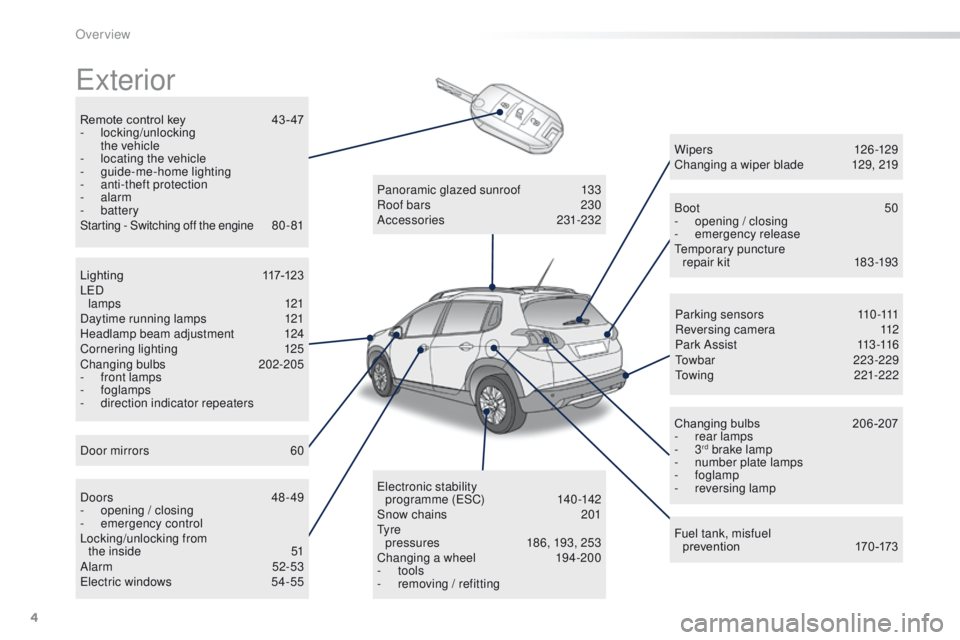
Remote control key 43 - 47
- locking/unlocking
the vehicle
-
l
ocating the vehicle
-
gu
ide-me-home lighting
-
a
nti-theft protection
-
alarm
-
battery
Starting - Switching off the engine
8
0 - 81 Boot
50
-
ope
ning / closing
-
em
ergency release
Temporary puncture repair kit
1
83-193
W iper s
126 -129
Changing a wiper blade
1
29, 219
Changing bulbs
2
06-207
-
r
ear lamps
-
3
rd brake lamp
-
n
umber plate lamps
-
foglamp
-
r
eversing lamp
Fuel tank, misfuel p r eve nt i o n
17
0 -173
Panoramic glazed sunroof
1
33
Roof bars
2
30
Accessories
231-232
Electronic stability programme (ESC)
1
40 -142
Snow chains
2
01
Ty r e pressures
1
86, 193, 253
Changing a wheel
1
94-200
-
tools
-
r
emoving / refitting
Lighting
1
17-123
LED lamps
121
Daytime running lamps
1
21
Headlamp beam adjustment
1
24
Cornering lighting
1
25
Changing bulbs
2
02-205
-
f
ront lamps
-
foglamps
-
d
irection indicator repeaters
Door mirrors
6
0
Doors
48 - 49
-
ope
ning / closing
-
em
ergency control
Locking/unlocking from the inside
5
1
Alarm
52-53
Electric windows
5
4-55 P a r k i n g s e n s o r s
11
0 -111
Reversing camera
1
12
P a r k A s s i s t
11
3 -11 6
Towbar
223-229
Towing
221-222
Over view
Page 9 of 450
7
2008_en_Chap00b_vue-ensemble_ed01-2016
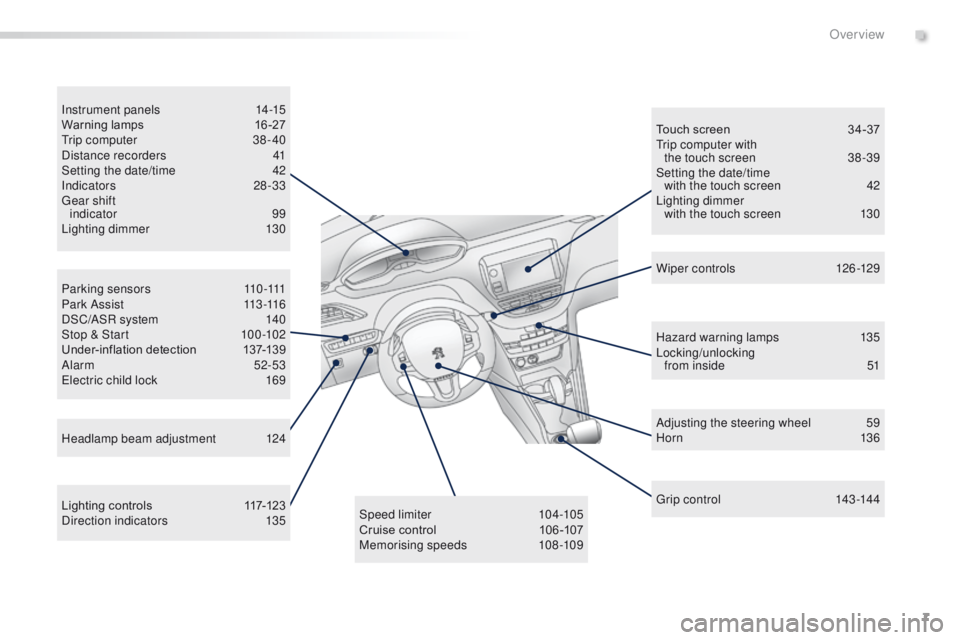
P a r k i n g s e n s o r s 110 -111
P a r k A s s i s t 11 3 -11 6
DSC/ASR system
1
40
Stop & Start
1
00 -102
Under-inflation detection
1
37-139
Alarm
52-53
Electric child lock
1
69
Instrument panels
1
4-15
Warning lamps
1
6-27
Trip computer
3
8 - 40
Distance recorders
4
1
Setting the date/time
4
2
Indicators
28-33
Gear shift indicator 99
Lighting dimmer
1
30
Lighting controls
1
17-123
Direction indicators
1
35Speed limiter
1
04-105
Cruise control
1
06 -107
Memorising speeds
1
08-109Touch screen
3
4-37
Trip computer with the touch screen
3
8 -39
Setting the date/time with the touch screen
4
2
Lighting dimmer with the touch screen
1
30
Headlamp beam adjustment
1
24 Wiper controls
1
26-129
Hazard warning lamps
1
35
Locking/unlocking from inside
5
1
Adjusting the steering wheel
5
9
H or n
13 6
Gr ip c ontrol
14
3 -14 4
.
Over view
Page 11 of 450
9
2008_en_Chap00b_vue-ensemble_ed01-2016
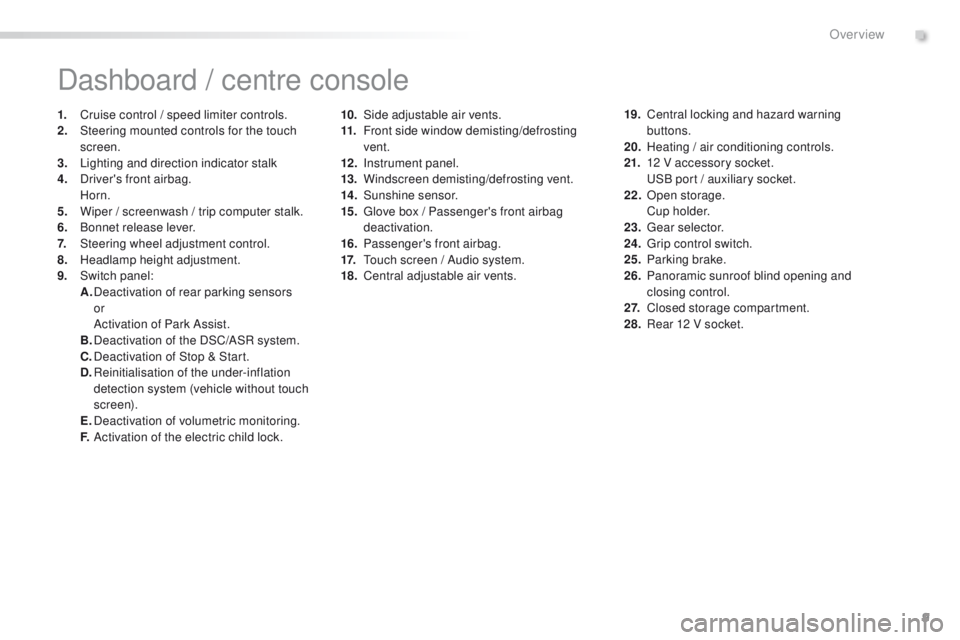
10. Side adjustable air vents.
11. Front side window demisting/defrosting
vent.
12 .
I
nstrument panel.
13.
W
indscreen demisting/defrosting vent.
14 .
S
unshine sensor.
15.
G
love box / Passenger's front airbag
deactivation.
16.
P
assenger's front airbag.
17.
T
ouch screen / Audio system.
18.
C
entral adjustable air vents.
Dashboard / centre console
1. Cruise control / speed limiter controls.
2. Steering mounted controls for the touch
screen.
3.
L
ighting and direction indicator stalk
4.
D
river's front airbag.
Horn.
5.
W
iper / screenwash / trip computer stalk.
6.
B
onnet release lever.
7.
S
teering wheel adjustment control.
8.
H
eadlamp height adjustment.
9.
S
witch panel:
A.
D
eactivation of rear parking sensors
or
A
ctivation of Park Assist.
B.
D
eactivation of the DSC/ASR system.
C.
D
eactivation of Stop & Start.
D.
R
einitialisation of the under-inflation
detection system (vehicle without touch
screen).
E.
D
eactivation of volumetric monitoring.
F.
A
ctivation of the electric child lock. 19. C
entral locking and hazard warning
buttons.
20.
H
eating / air conditioning controls.
21.
1
2 V accessory socket.
U
SB port / auxiliary socket.
22.
O
pen storage.
C
u p h o l d e r.
23.
G
ear selector.
24.
G
rip control switch.
25.
P
arking brake.
26.
P
anoramic sunroof blind opening and
closing control.
2 7.
C
losed storage compartment.
28.
R
ear 12 V socket.
.
Over view
Page 15 of 450
13
2008_en_Chap00c_eco-conduite_ed01-2016
Limit the causes of excess consumption
Spread loads throughout the vehicle; place the heaviest items in the
bottom of the boot, as close as possible to the rear seats.
Limit the loads carried in the vehicle and reduce wind resistance (roof
bars, roof rack, bicycle carrier, trailer...). Use a roof box in preference.
Remove roof bars and roof racks after use.
At the end of winter, remove snow tyres and refit your summer tyres.
Observe the recommendations on
maintenance
Check the tyre pressures regularly, when cold, referring to the label in
the door aperture, driver's side.
Carry out this check in particular:
-
b
efore a long journey,
-
a
t each change of season,
-
a
fter a long period out of use.
Don't forget the spare wheel and the tyres on any trailer or caravan.
Have your vehicle serviced regularly (engine oil, oil filter, air filter,
passenger compartment filter...) and observe the schedule of
operations recommended in the manufacturer's service schedule.
With a BlueHDi Diesel engine, if the SCR system is faulty your vehicle
becomes polluting; go to a PEUGEOT dealer or a qualified workshop
without delay to have the emissions of nitrous oxides brought back to
the legal level.
When refuelling, do not continue after the third cut-off of the nozzle to
avoid any over flow.
At the wheel of your new vehicle, it is only after the first 1 800 miles
(3 000 kilometres) that you will see the fuel consumption settle down to
a consistent average.
.
Eco-driving
Page 28 of 450
26
Warning / indicator lampStateCause Action / Observations
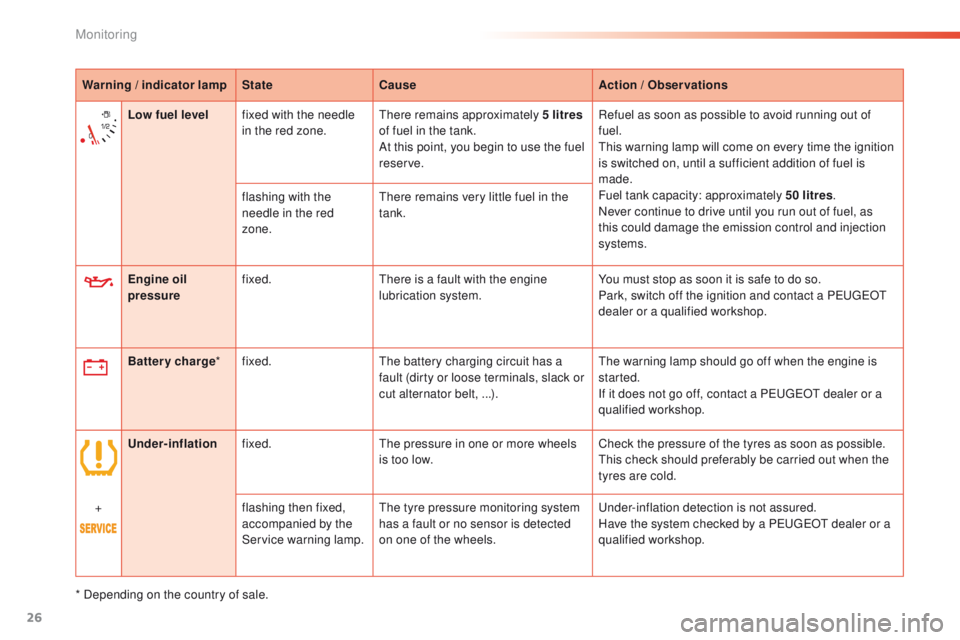
Engine oil
pressure fixed.
There is a fault with the engine
lubrication system. You must stop as soon it is safe to do so.
Park, switch off the ignition and contact a PEUGEOT
dealer or a qualified workshop.
Battery charge *fixed. The battery charging circuit has a
fault (dirty or loose terminals, slack or
cut alternator belt, ...). The warning lamp should go off when the engine is
started.
If it does not go off, contact a PEUGEOT dealer or a
qualified workshop.
Low fuel level
fixed with the needle
in the red zone. There remains approximately 5 litres
of fuel in the tank.
At this point, you begin to use the fuel
reserve. Refuel as soon as possible to avoid running out of
fuel.
This warning lamp will come on every time the ignition
is switched on, until a sufficient addition of fuel is
made.
Fuel tank capacity: approximately 50 litres
.
Never continue to drive until you run out of fuel, as
this could damage the emission control and injection
systems.
flashing with the
needle in the red
zone.
There remains very little fuel in the
tank.
Under-inflation fixed. The pressure in one or more wheels
is too low. Check the pressure of the tyres as soon as possible.
This check should preferably be carried out when the
tyres are cold.
+ flashing then fixed,
accompanied by the
Service warning lamp.The tyre pressure monitoring system
has a fault or no sensor is detected
on one of the wheels. Under-inflation detection is not assured.
Have the system checked by a PEUGEOT dealer or a
qualified workshop.
* Depending on the country of sale.
Monitoring
Page 40 of 450
38
System that gives you information on the current journey (range, fuel consumption…).
Tr i p c o m p u t e r
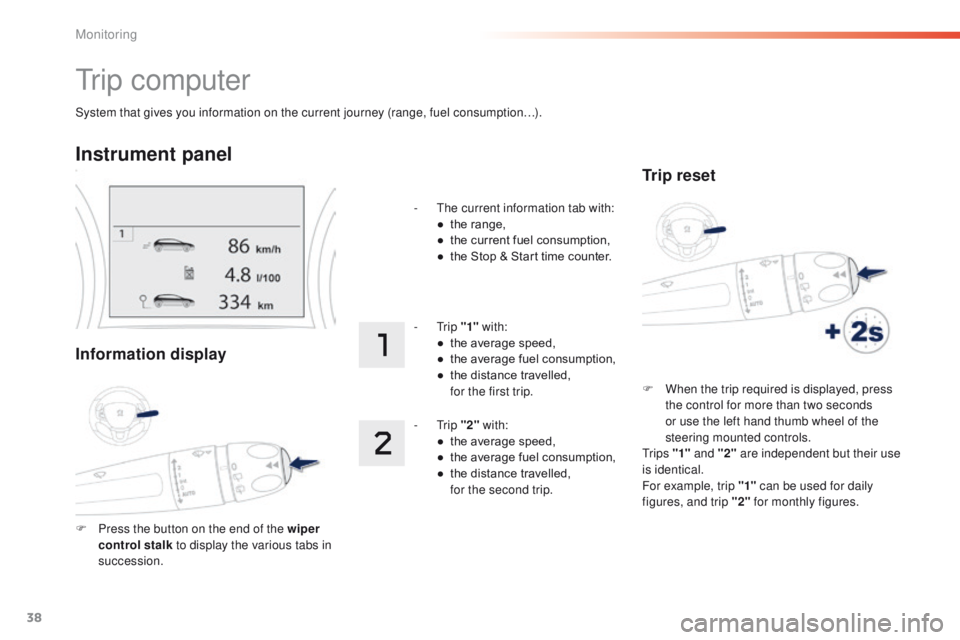
Instrument panel
Information display
F Press the button on the end of the wiper control stalk to display the various tabs in
succession. -
T
he current information tab with:
●
t
he range,
●
t
he current fuel consumption,
●
t
he Stop & Start time counter.
- Trip
"1" with:
●
t
he average speed,
●
t
he average fuel consumption,
●
t
he distance travelled,
f
or the first trip.
- Trip
"2" with:
●
t
he average speed,
●
t
he average fuel consumption,
●
t
he distance travelled,
f
or the second trip.
Trip reset
F When the trip required is displayed, press
the control for more than two seconds
or use the left hand thumb wheel of the
steering mounted controls.
Tr i p s "1" and "2" are independent but their use
is identical.
For example, trip "1" can be used for daily
figures, and trip "2" for monthly figures.
Monitoring
Page 61 of 450
59
2008_en_Chap03_confort_ed01-2016
Steering wheel adjustment
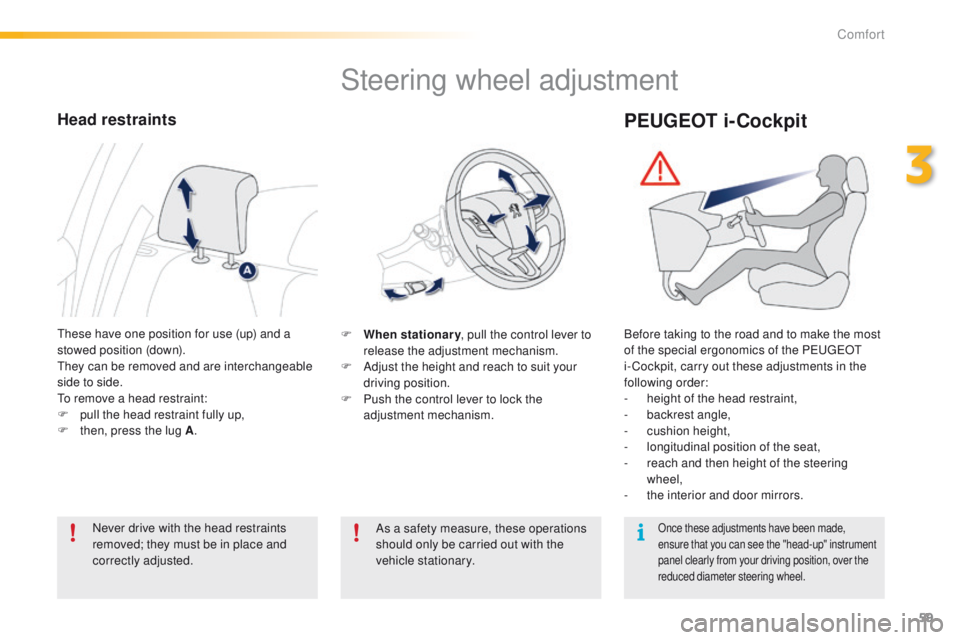
F When stationary, pull the control lever to
release the adjustment mechanism.
F
A
djust the height and reach to suit your
driving position.
F
P
ush the control lever to lock the
adjustment mechanism.
As a safety measure, these operations
should only be carried out with the
vehicle stationary.
Never drive with the head restraints
removed; they must be in place and
correctly adjusted.
These have one position for use (up) and a
stowed position (down).
They can be removed and are interchangeable
side to side.
To remove a head restraint:
F
p
ull the head restraint fully up,
F
t
hen, press the lug A .
Head restraintsPEUGEOT i-Cockpit
Before taking to the road and to make the most
of the special ergonomics of the PEUGEOT
i- Cockpit, carry out these adjustments in the
following order:
-
h
eight of the head restraint,
-
b
ackrest angle,
-
c
ushion height,
-
l
ongitudinal position of the seat,
-
r
each and then height of the steering
wheel,
-
t
he interior and door mirrors.
Once these adjustments have been made,
ensure that you can see the "head-up" instrument
panel clearly from your driving position, over the
reduced diameter steering wheel.
3
Comfort
Page 81 of 450
79
2008_en_Chap05_conduite_ed01-2016
Driving recommendations
Observe the driving regulations and remain
vigilant whatever the traffic conditions.
Pay close attention to the traffic and keep your
hands on the wheel so that you are ready to
react at any time to any eventuality.
On a long journey, a break every two hours is
strongly recommended.
In difficult weather, drive smoothly, anticipate
the need to brake and increase the distance
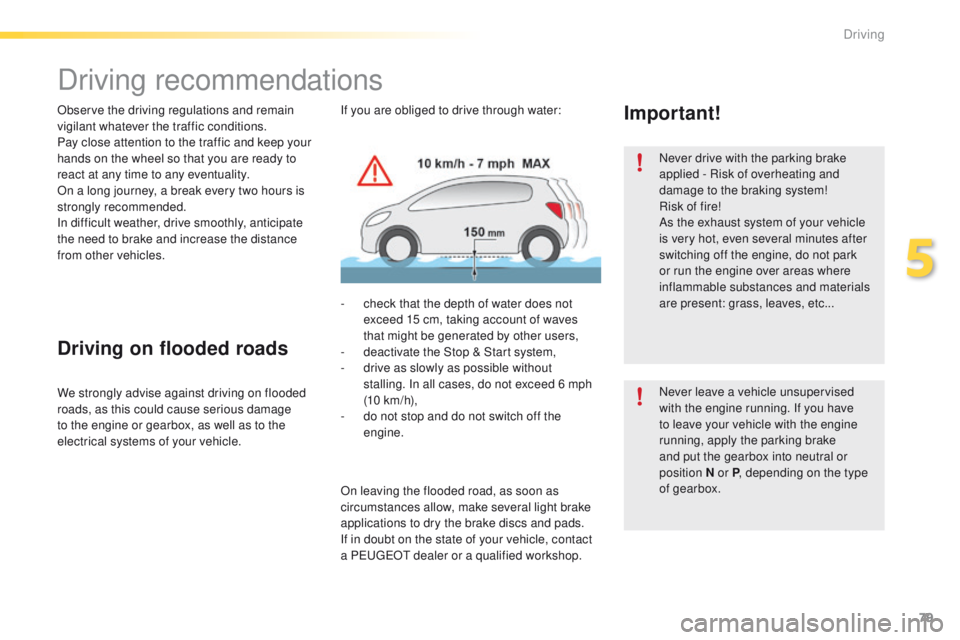
from other vehicles.If you are obliged to drive through water:Important!
Driving on flooded roads
- check that the depth of water does not exceed 15 cm, taking account of waves
that might be generated by other users,
-
d
eactivate the Stop & Start system,
-
d
rive as slowly as possible without
stalling. In all cases, do not exceed 6 mph
(10
km/h),
-
d
o not stop and do not switch off the
engine.
We strongly advise against driving on flooded
roads, as this could cause serious damage
to the engine or gearbox, as well as to the
electrical systems of your vehicle.
On leaving the flooded road, as soon as
circumstances allow, make several light brake
applications to dry the brake discs and pads.
If in doubt on the state of your vehicle, contact
a PEUGEOT dealer or a qualified workshop. Never drive with the parking brake
applied - Risk of overheating and
damage to the braking system!
Risk of fire!
As the exhaust system of your vehicle
is very hot, even several minutes after
switching off the engine, do not park
or run the engine over areas where
inflammable substances and materials
are present: grass, leaves, etc...
Never leave a vehicle unsupervised
with the engine running. If you have
to leave your vehicle with the engine
running, apply the parking brake
and put the gearbox into neutral or
position
N or P, depending on the type
of gearbox.
5
Driving