brake PEUGEOT 206 2002 User Guide
[x] Cancel search | Manufacturer: PEUGEOT, Model Year: 2002, Model line: 206, Model: PEUGEOT 206 2002Pages: 160, PDF Size: 2.03 MB
Page 29 of 160

INSTRUMENTS AND CONTROLS
30
Handbrake, low brake fluid and ElectronicBrake Force Distributionsystem fault warninglight
Linked to the central (STOP) warninglight. This indicates one of the following:
Ð that the handbrake is applied or not fully released,
Ð an excessive drop in brake fluid level (if the warning light remains on even when the handbrake isreleased).
Ð a fault in the Electronic Brake Force Distribution system, if lit at
the same time as the ABS warninglight.
You must stop.
Consult a PEUGEOT dealer.
INSTRUMENTS AND CONTROLS
A permanently lit warning light or one flashing, with the engine run-ning, indicates an operating faultof the unit concerned. The illumi-nation of certain warning lightsmay be accompanied by anaudible signal and a message on
the multi-function display. Do notignore this warning: consult aPEUGEOT dealer as soon as pos-sible.
If the central (STOP) warning light comes on when you are driving,
stop your vehicle immediately,where it is safe to do so.
Anti-lock Braking System (ABS) warninglight
If this warning light is permanentlyon, it indicates a malfunction of theABS.
However, the vehicle retains conventional servo-assisted bra-king.
Consult a PEUGEOT dealer.
Coolant temperature and low coolant level warninglight
Linked to the central (STOP) warninglight.You must stop.
Wait for the engine to cool before top-ping up the level. The cooling circuit is pressurised.In the event of breakdown and to prevent any risk of burns , unscrew
the cap by two turns to allow thepressure to drop. When the pressure has dropped, remove the cap and top up the level.
Consult a PEUGEOT dealer.
Central (STOP) warning light Linked to the "engine
oil pressure", "coolant temperature and low coolant level", "handbrake","low brake fluid level" and "electronicbrake force distribution system fault"warning lights.You must stop if the light flasheswith the engine running.
Consult a PEUGEOT dealer.
Engine oil pressure and temperaturewarning light
Linked to the central (STOP) warninglight.
You must stop.
This warning light indicates one ofthe following:
Ð insufficient oil pressure,
Ð a lack of oil in the lubrication cir- cuit. Top up the level.
Ð an oil temperature which is too high. The warning light is acompa-
nied by an audible signal. To lowerthe oil temperature, reduce yourspeed.
Consult a PEUGEOT dealer.
17-06-2002
Page 111 of 160
YOUR 206 IN DETAIL
104
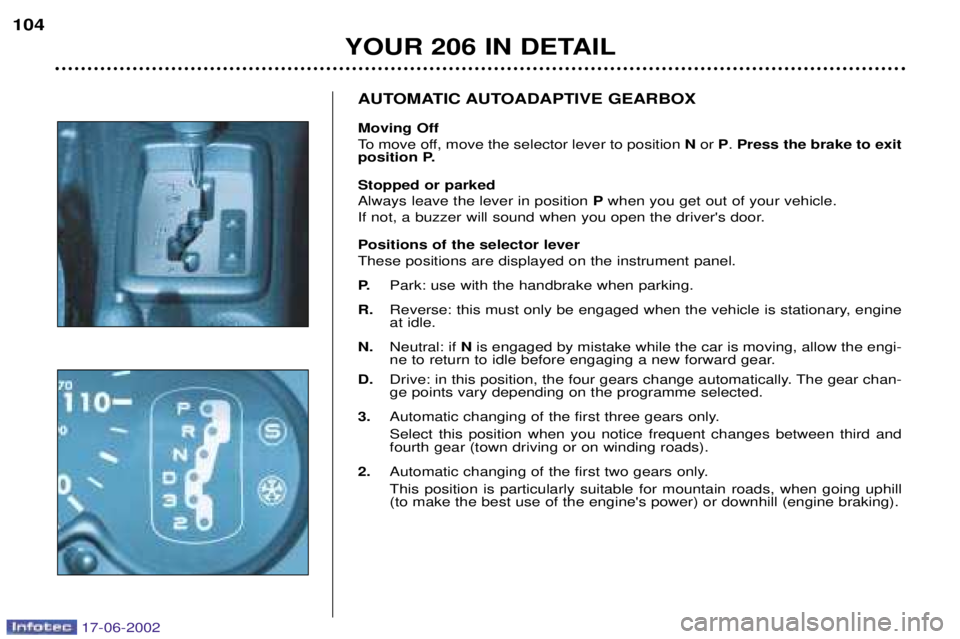
AUTOMATIC AUTOADAPTIVE GEARBOX Moving Off
To move off, move the selector lever to position
Nor P. Press the brake to exit
position P. Stopped or parked Always leave the lever in position Pwhen you get out of your vehicle.
If not, a buzzer will sound when you open the driver's door. Positions of the selector lever These positions are displayed on the instrument panel. P. Park: use with the handbrake when parking.
R. Reverse: this must only be engaged when the vehicle is stationary, engine at idle.
N. Neutral: if Nis engaged by mistake while the car is moving, allow the engi-
ne to return to idle before engaging a new forward gear.
D. Drive: in this position, the four gears change automatically. The gear chan-ge points vary depending on the programme selected.
3. Automatic changing of the first three gears only. Select this position when you notice frequent changes between third and fourth gear (town driving or on winding roads).
2. Automatic changing of the first two gears only. This position is particularly suitable for mountain roads, when going uphill (to make the best use of the engine's power) or downhill (engine braking).
17-06-2002
Page 112 of 160

YOUR 206 IN DETAIL105
Operating programmes
You have a choice of three operating programmes:
Ð Autoadaptive (normal)
Ð Sport
Ð SnowOne press on button Aor Bwill
select Sport or Snow respectively. The selection is displayed on theinstrument panel. Pressing the but-ton a second time will return to theautoadaptive (normal) programme. Autoadaptive programme (normal)
Gear changes are carried out on the basis of various parameters, suchas:
Ð driving style,
Ð road characteristics,
Ð vehicle load.The gearbox selects the most sui- table programme from those in thememory for the current drivingconditions. Sport programme The Sport programme automatically favours more dynamic driving. Snow Programme In position
D, the Snow programme
provides smooth driving suited to slippery roads in order to improve
traction and stability. Starting is in2nd gear and changing down is at
low engine speeds. Special operating features
Ð During prolonged braking, the gearbox changes down automati-
cally, so as to provide efficientengine braking.
Ð If you take your foot off the acce- lerator suddenly (when you aretaken by surprise, for example),the gearbox will not change up, so
as to improve safety.
Ð When the engine is cold, the gear- box automatically selects a spe-cial programme that enables theengine to reach its ideal tempera-ture more quickly in order todecrease pollution.
Kickdown For immediate maximum accelera-
tion without touching the gear lever,press the accelerator pedal down as
far as it will go. The gearbox willchange down automatically or stayin the gear selected, up to maximumengine speed.
Any disruption of the sys- tem is signalled by thesimultaneous flashing ofthe Sport and Snow
lights on the instrument panel. Insuch a case, the gearbox will ope-
rate in downgrade mode. You mayfeel a substantial knock whenreverse is selected from Pto Ror
N to R(without any risk of damage
to the gearbox). Do not exceed 60 mph (100km/h).Contact a PEUGEOT dealer
without delay. When the engine is idling with the
car in gear, the car will move evenwithout you accelerating. Do not accelerate while a gear is being selected, when the vehicle is
stationary.
When stationary, have your foot on the brake pedal when selecting a
gear. Do not accelerate in gear with the brakes on. If work needs to be done with the engine running, apply the hand-brake and select position P.
Do not change down to brake onslippery roads. Never select position Nwhen the
vehicle is moving.Never engage Por Runless the
vehicle is stationary.Do not leave children inside the vehicle unsupervised when theengine is running.
17-06-2002
Page 113 of 160
YOUR 206 IN DETAIL
106
The normal operation of the ABS may make itself felt by slightvibrations of the brake pedal. In emergency braking, press very firmly without releasingthe pressure.
THE ABS ANTI-LOCK BRAKING SYSTEM
When used with approved tyres in good condition, in the event of sharp
braking, the ABS optimises the sta-bility and manoeuvrability of yourvehicle, particularly on poor or slip-pery road surfaces. The anti-lock braking system comes into operation automatically whenthere is a risk of wheel lock.
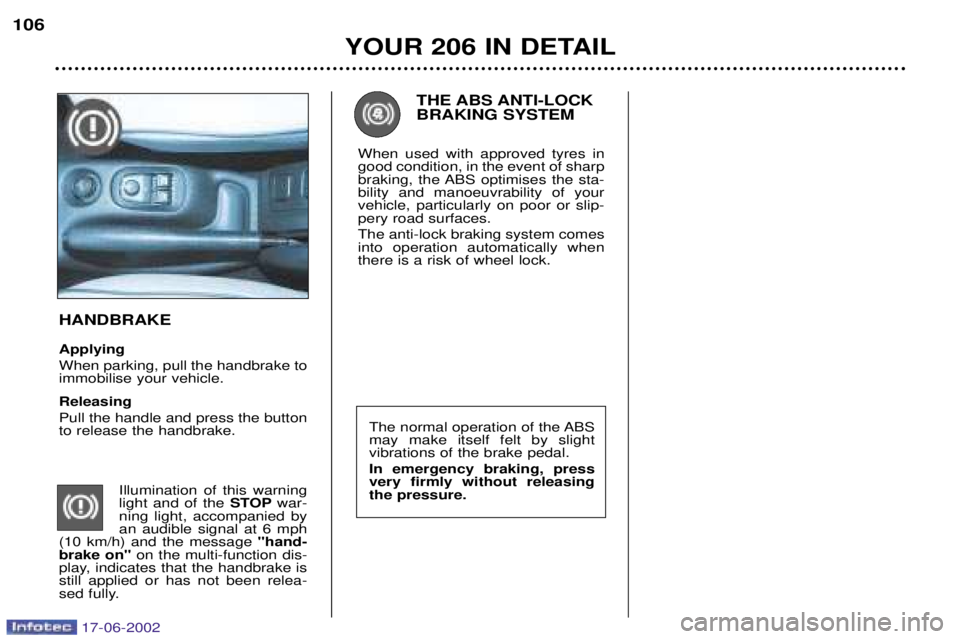
HANDBRAKE Applying When parking, pull the handbrake to immobilise your vehicle. Releasing Pull the handle and press the button to release the handbrake.
Illumination of this warninglight and of the STOPwar-
ning light, accompanied byan audible signal at 6 mph
(10 km/h) and the message "hand-
brake on" on the multi-function dis-
play, indicates that the handbrake isstill applied or has not been relea-
sed fully.
17-06-2002
Page 119 of 160
PRACTICAL INFORMATION
110
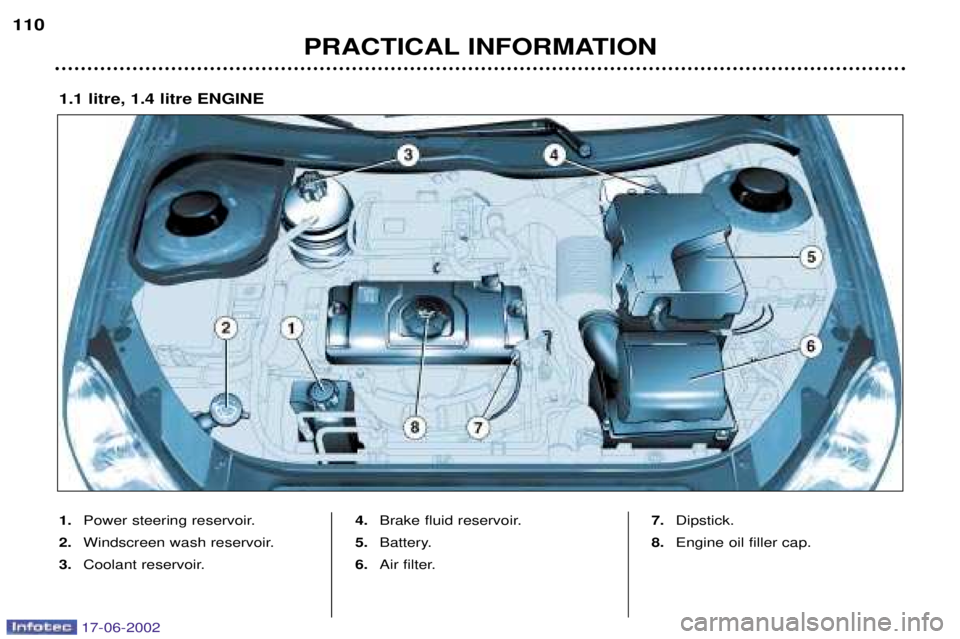
1.
Power steering reservoir.
2. Windscreen wash reservoir.
3. Coolant reservoir. 4.
Brake fluid reservoir.
5. Battery.
6. Air filter. 7.
Dipstick.
8. Engine oil filler cap.
1.1 litre, 1.4 litre ENGINE
17-06-2002
Page 120 of 160
PRACTICAL INFORMATION111
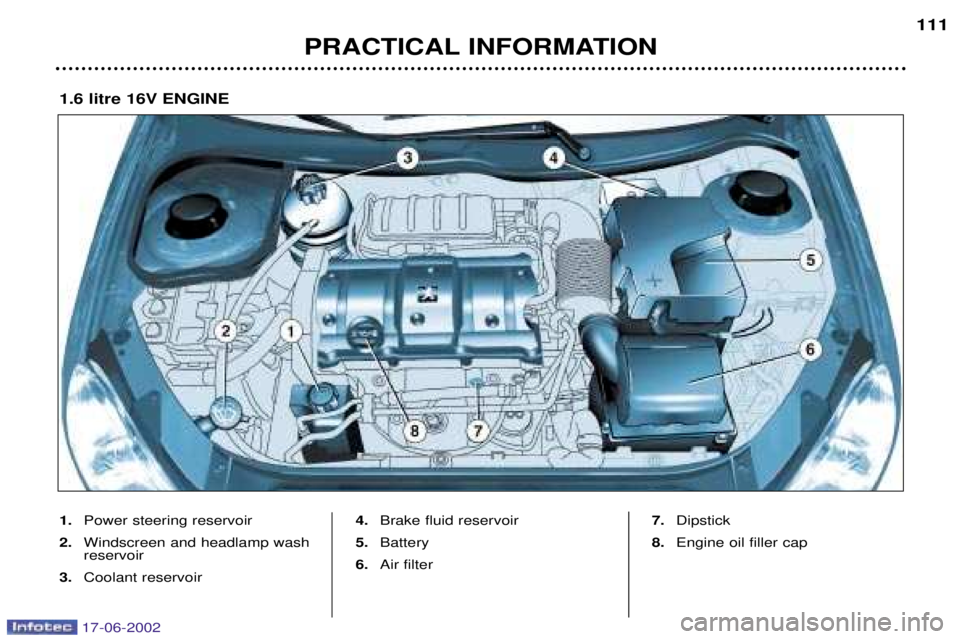
1.
Power steering reservoir
2. Windscreen and headlamp wash reservoir
3. Coolant reservoir 4.
Brake fluid reservoir
5. Battery
6. Air filter 7.
Dipstick
8. Engine oil filler cap
1.6 litre 16V ENGINE
17-06-2002
Page 121 of 160
PRACTICAL INFORMATION
112
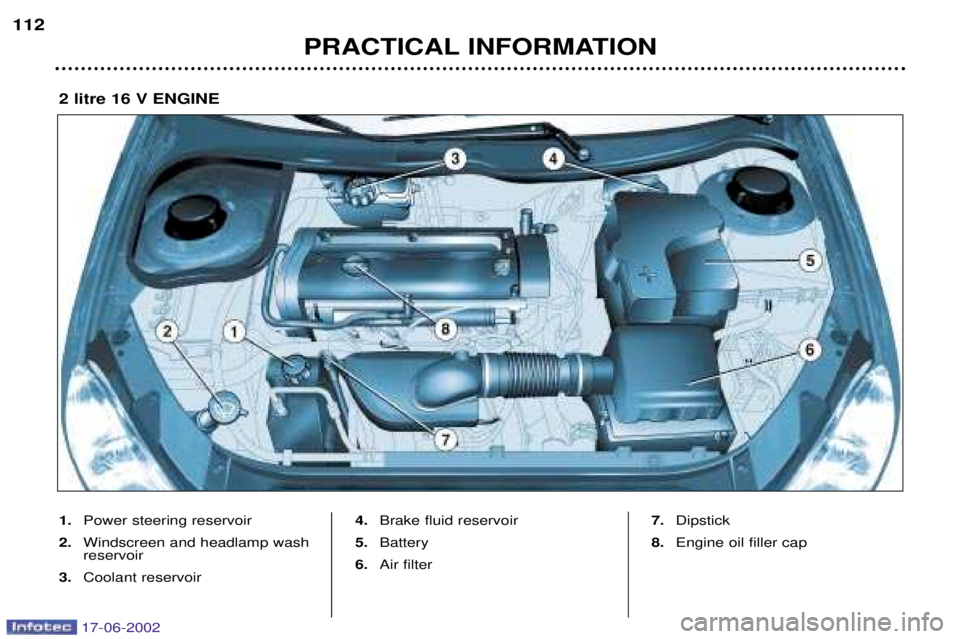
1.
Power steering reservoir
2. Windscreen and headlamp wash reservoir
3. Coolant reservoir 4.
Brake fluid reservoir
5. Battery
6. Air filter 7.
Dipstick
8. Engine oil filler cap
2 litre 16 V ENGINE
17-06-2002
Page 122 of 160
PRACTICAL INFORMATION113
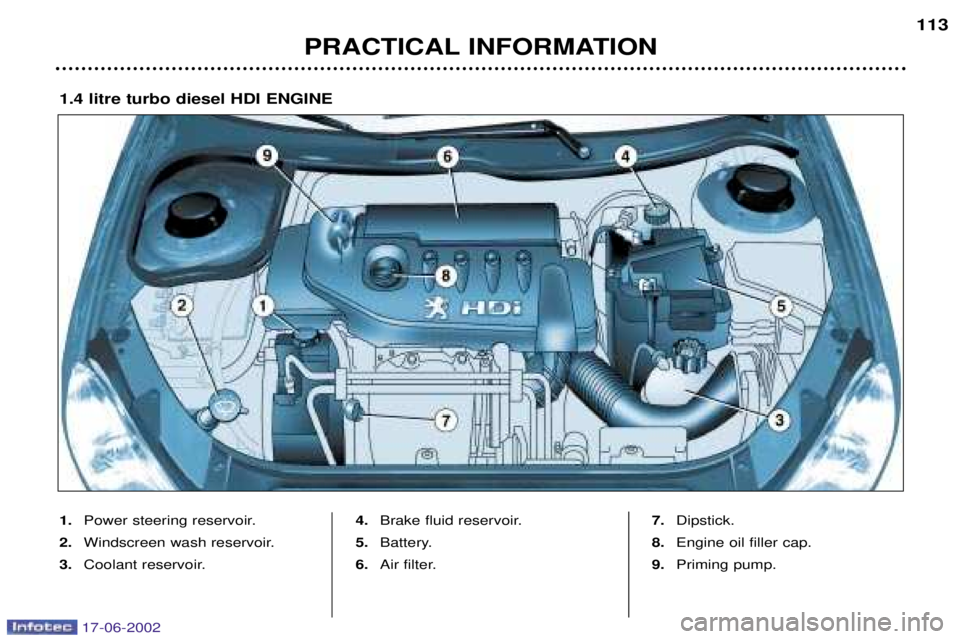
1.
Power steering reservoir.
2. Windscreen wash reservoir.
3. Coolant reservoir. 4.
Brake fluid reservoir.
5. Battery.
6. Air filter. 7.
Dipstick.
8. Engine oil filler cap.
9. Priming pump.
1.4 litre turbo diesel HDI ENGINE
17-06-2002
Page 123 of 160
PRACTICAL INFORMATION
114
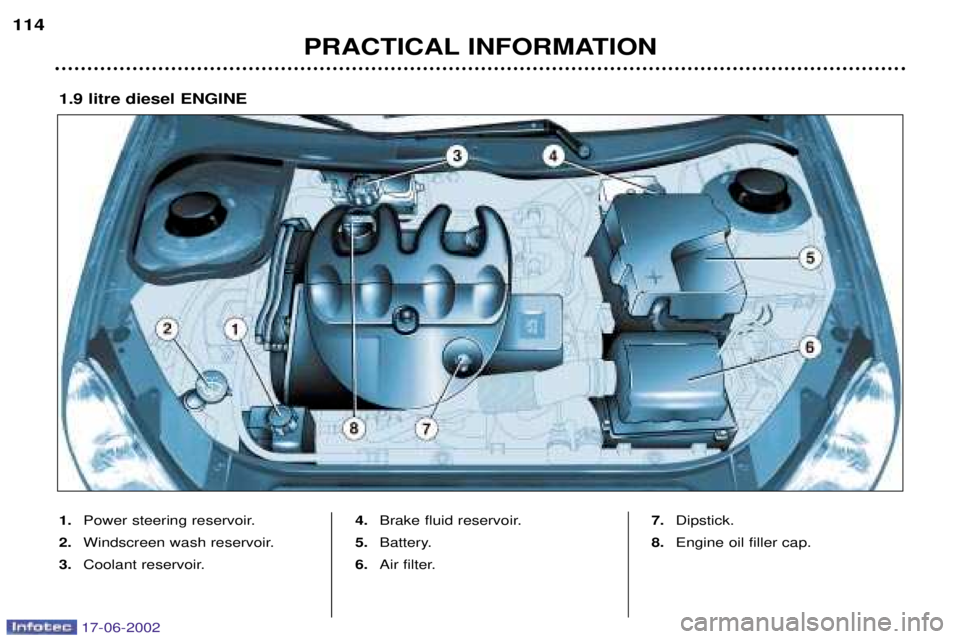
1.
Power steering reservoir.
2. Windscreen wash reservoir.
3. Coolant reservoir. 4.
Brake fluid reservoir.
5. Battery.
6. Air filter. 7.
Dipstick.
8. Engine oil filler cap.
1.9 litre diesel ENGINE
17-06-2002
Page 124 of 160
PRACTICAL INFORMATION115
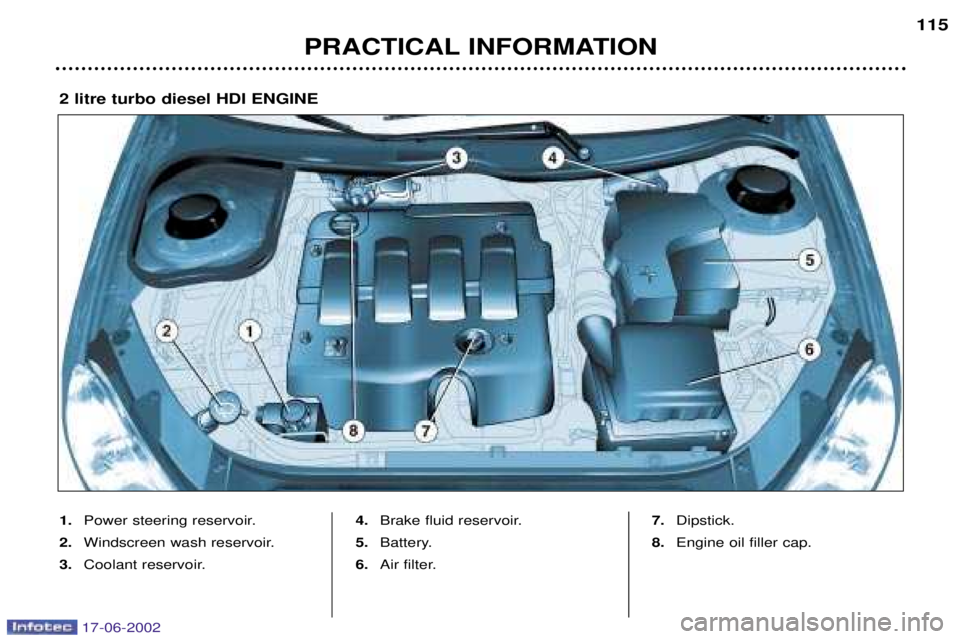
1.
Power steering reservoir.
2. Windscreen wash reservoir.
3. Coolant reservoir. 4.
Brake fluid reservoir.
5. Battery.
6. Air filter. 7.
Dipstick.
8. Engine oil filler cap.
2 litre turbo diesel HDI ENGINE
17-06-2002