engine Peugeot 206 CC 2003 User Guide
[x] Cancel search | Manufacturer: PEUGEOT, Model Year: 2003, Model line: 206 CC, Model: Peugeot 206 CC 2003Pages: 135, PDF Size: 2.11 MB
Page 24 of 135
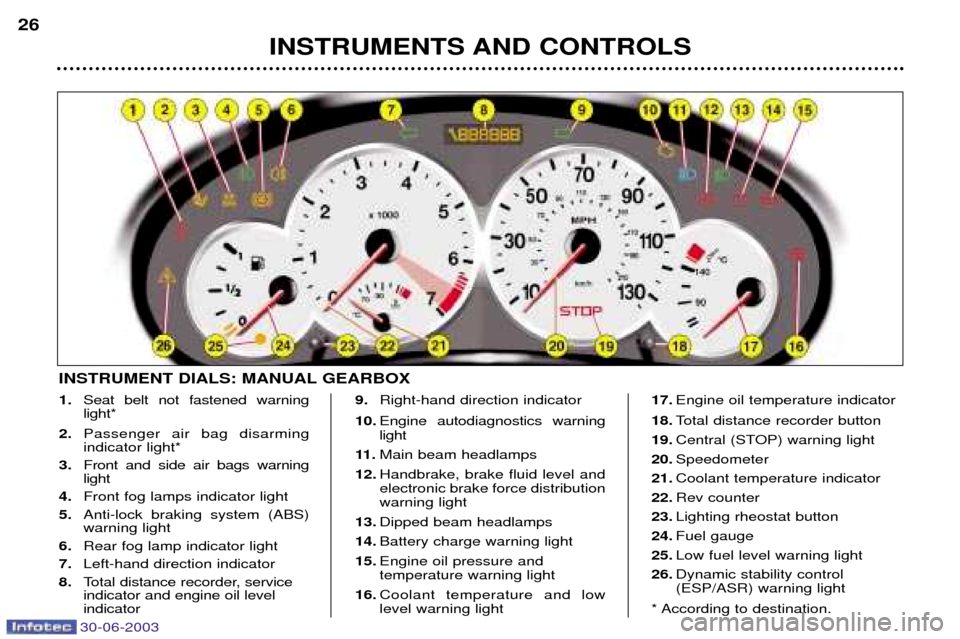
30-06-2003
1.Seat belt not fastened warning light*
2. Passenger air bag disarmingindicator light*
3. Front and side air bags warninglight
4. Front fog lamps indicator light
5. Anti-lock braking system (ABS)warning light
6. Rear fog lamp indicator light
7. Left-hand direction indicator
8. Total distance recorder, serviceindicator and engine oil level indicator 9.
Right-hand direction indicator
10. Engine autodiagnostics warning light
11 . Main beam headlamps
12. Handbrake, brake fluid level and electronic brake force distributionwarning light
13. Dipped beam headlamps
14. Battery charge warning light
15. Engine oil pressure and temperature warning light
16. Coolant temperature and lowlevel warning light 17.
Engine oil temperature indicator
18. Total distance recorder button
19. Central (STOP) warning light
20. Speedometer
21. Coolant temperature indicator
22. Rev counter
23. Lighting rheostat button
24. Fuel gauge
25. Low fuel level warning light
26. Dynamic stability control (ESP/ASR) warning light
* According to destination.
INSTRUMENTS AND CONTROLS
26
INSTRUMENT DIALS: MANUAL GEARBOX
Page 25 of 135
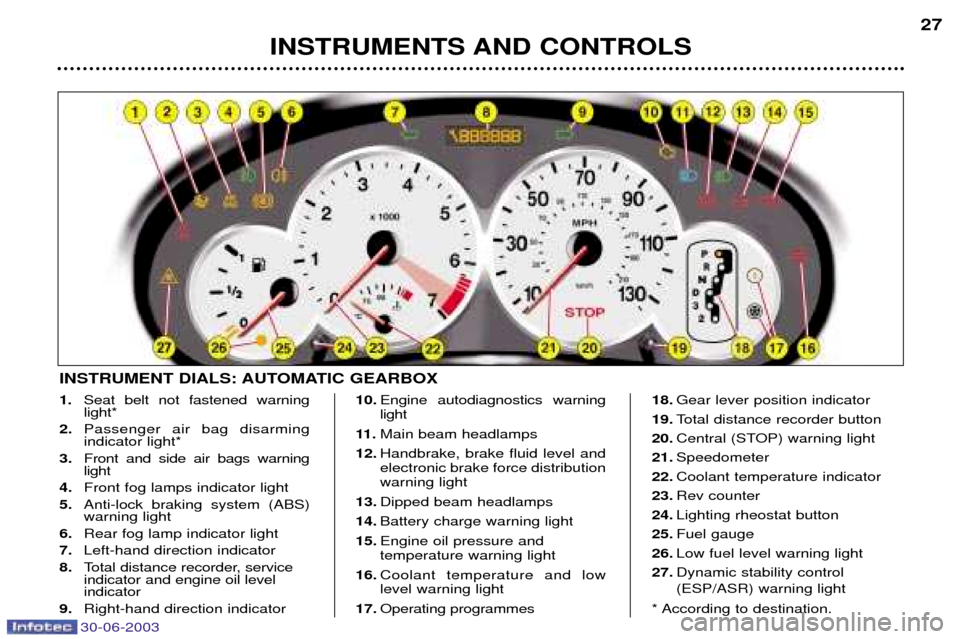
30-06-2003
INSTRUMENTS AND CONTROLS27
1. Seat belt not fastened warning light*
2. Passenger air bag disarmingindicator light*
3. Front and side air bags warninglight
4. Front fog lamps indicator light
5. Anti-lock braking system (ABS)warning light
6. Rear fog lamp indicator light
7. Left-hand direction indicator
8. Total distance recorder, serviceindicator and engine oil level indicator
9. Right-hand direction indicator 10.
Engine autodiagnostics warning light
11 . Main beam headlamps
12. Handbrake, brake fluid level andelectronic brake force distributionwarning light
13. Dipped beam headlamps
14. Battery charge warning light
15. Engine oil pressure and temperature warning light
16. Coolant temperature and lowlevel warning light
17. Operating programmes 18.
Gear lever position indicator
19. Total distance recorder button
20. Central (STOP) warning light
21. Speedometer
22. Coolant temperature indicator
23. Rev counter
24. Lighting rheostat button
25. Fuel gauge
26. Low fuel level warning light
27. Dynamic stability control (ESP/ASR) warning light
* According to destination.
INSTRUMENT DIALS: AUTOMATIC GEARBOX
Page 26 of 135
30-06-2003
INSTRUMENTS AND CONTROLS
28
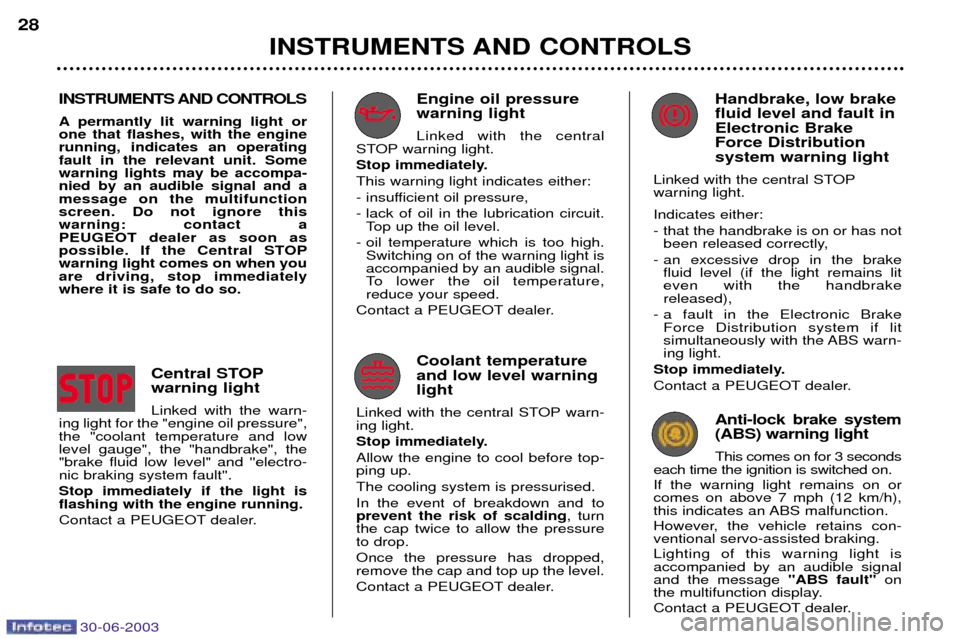
Handbrake, low brake fluid level and fault inElectronic BrakeForce Distributionsystem warning light
Linked with the central STOP warning light. Indicates either:
- that the handbrake is on or has not been released correctly,
- an excessive drop in the brake fluid level (if the light remains lit even with the handbrakereleased),
- a fault in the Electronic Brake Force Distribution system if lit
simultaneously with the ABS warn-ing light.
Stop immediately.
Contact a PEUGEOT dealer.
INSTRUMENTS AND CONTROLS
A permantly lit warning light or one that flashes, with the enginerunning, indicates an operatingfault in the relevant unit. Somewarning lights may be accompa-nied by an audible signal and amessage on the multifunctionscreen. Do not ignore this warning: contact a PEUGEOT dealer as soon as
possible. If the Central STOPwarning light comes on when youare driving, stop immediatelywhere it is safe to do so.
Anti-lock brake system (ABS) warning light This comes on for 3 seconds
each time the ignition is switched on. If the warning light remains on or comes on above 7 mph (12 km/h),
this indicates an ABS malfunction.
However, the vehicle retains con- ventional servo-assisted braking. Lighting of this warning light is accompanied by an audible signaland the message "ABS fault"on
the multifunction display.
Contact a PEUGEOT dealer.
Engine oil pressure warning light Linked with the central
STOP warning light.
Stop immediately.This warning light indicates either:
- insufficient oil pressure,
- lack of oil in the lubrication circuit. Top up the oil level.
- oil temperature which is too high. Switching on of the warning light is accompanied by an audible signal.
To lower the oil temperature,reduce your speed.
Contact a PEUGEOT dealer.
Coolant temperature and low level warninglight
Linked with the central STOP warn- ing light.
Stop immediately.Allow the engine to cool before top- ping up. The cooling system is pressurised.In the event of breakdown and to prevent the risk of scalding , turn
the cap twice to allow the pressureto drop. Once the pressure has dropped, remove the cap and top up the level.
Contact a PEUGEOT dealer.
Central STOP warning light Linked with the warn-
ing light for the "engine oil pressure", the "coolant temperature and lowlevel gauge", the "handbrake", the"brake fluid low level" and ''electro-nic braking system fault''. Stop immediately if the light is flashing with the engine running.
Contact a PEUGEOT dealer.
Page 27 of 135
30-06-2003
INSTRUMENTS AND CONTROLS29
Front and side air bags warning light The warning light comes on
for a few seconds when the ignition is switched on. Switching on of this warning light, with the engine running, is accom-panied by an audible signal and amessage on the multifunction dis-play indicating a fault in the air bags.
Contact a PEUGEOT dealer.
Seat belt not fastened warning light*
When the ignition is switched on,the warning light comes on when
the driver has not fastened his seat belt.
Engine autodiagnos- tics warning light This comes on each time
the ignition is switched on. If it comes on when the engine isrunning, it indicates a malfunction inthe injection, ignition or emission
control system. There is a risk of
damage to your catalytic converter.
Contact a PEUGEOT dealer rapidly.
Low fuel level warning light
When the warning light first
comes on, you have enough fuel to drive at least 30 miles (50 km) (the tank capacity is
approximately 47 litres (10.3 gallons)).
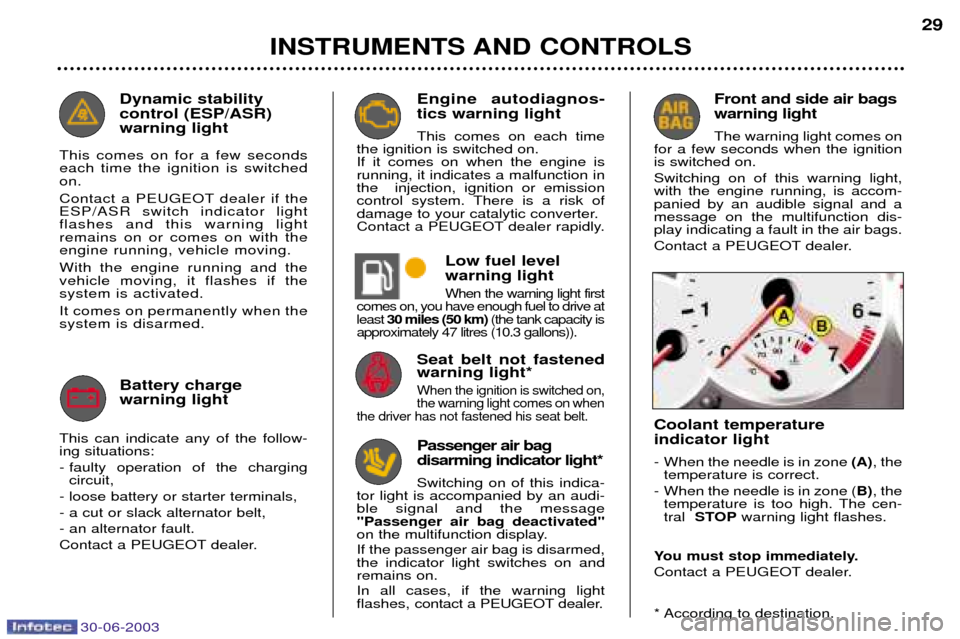
Coolant temperature indicator light
- When the needle is in zone (A), the
temperature is correct.
- When the needle is in zone ( B), the
temperature is too high. The cen- tral STOP warning light flashes.
You must stop immediately.
Contact a PEUGEOT dealer.
* According to destination.
Dynamic stability control (ESP/ASR)warning light
This comes on for a few seconds each time the ignition is switchedon.
Contact a PEUGEOT dealer if the ESP/ASR switch indicator lightflashes and this warning lightremains on or comes on with theengine running, vehicle moving. With the engine running and the vehicle moving, it flashes if thesystem is activated. It comes on permanently when the system is disarmed.
Passenger air bag disarming indicator light* Switching on of this indica-
tor light is accompanied by an audi- ble signal and the message''Passenger air bag deactivated''
on the multifunction display. If the passenger air bag is disarmed, the indicator light switches on andremains on. In all cases, if the warning light flashes, contact a PEUGEOT dealer.
Battery charge warning light
This can indicate any of the follow- ing situations:
- faulty operation of the charging circuit,
- loose battery or starter terminals,- a cut or slack alternator belt,- an alternator fault.
Contact a PEUGEOT dealer.
Page 28 of 135
30-06-2003
INSTRUMENTS AND CONTROLS29
Front and side air bags warning light The warning light comes on
for a few seconds when the ignition is switched on. Switching on of this warning light, with the engine running, is accom-panied by an audible signal and amessage on the multifunction dis-play indicating a fault in the air bags.
Contact a PEUGEOT dealer.
Seat belt not fastened warning light*
When the ignition is switched on,the warning light comes on when
the driver has not fastened his seat belt.
Engine autodiagnos- tics warning light This comes on each time
the ignition is switched on. If it comes on when the engine isrunning, it indicates a malfunction inthe injection, ignition or emission
control system. There is a risk of
damage to your catalytic converter.
Contact a PEUGEOT dealer rapidly.
Low fuel level warning light
When the warning light first
comes on, you have enough fuel to drive at least 30 miles (50 km) (the tank capacity is
approximately 47 litres (10.3 gallons)).
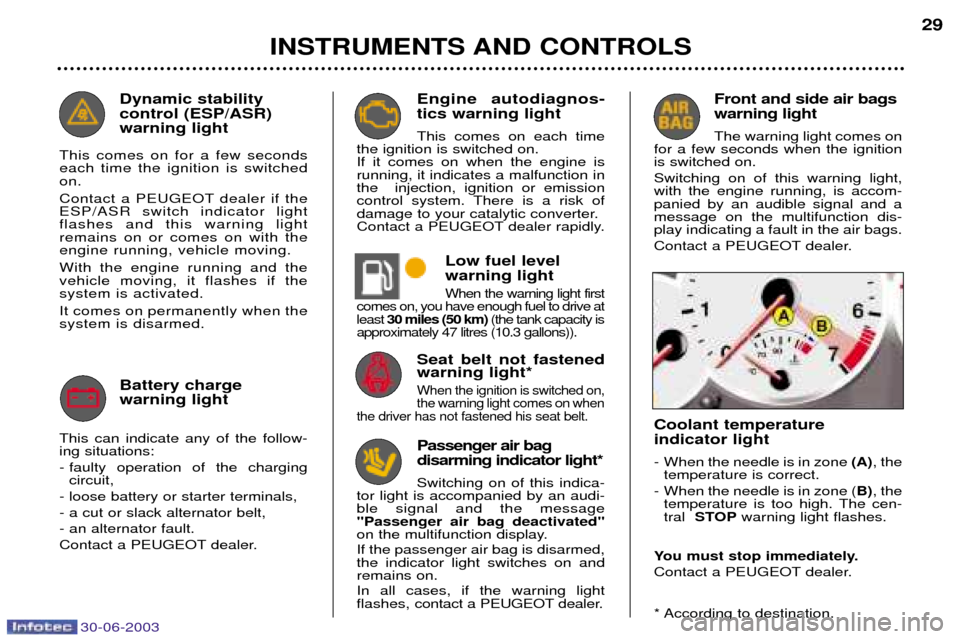
Coolant temperature indicator light
- When the needle is in zone (A), the
temperature is correct.
- When the needle is in zone ( B), the
temperature is too high. The cen- tral STOP warning light flashes.
You must stop immediately.
Contact a PEUGEOT dealer.
* According to destination.
Dynamic stability control (ESP/ASR)warning light
This comes on for a few seconds each time the ignition is switchedon.
Contact a PEUGEOT dealer if the ESP/ASR switch indicator lightflashes and this warning lightremains on or comes on with theengine running, vehicle moving. With the engine running and the vehicle moving, it flashes if thesystem is activated. It comes on permanently when the system is disarmed.
Passenger air bag disarming indicator light* Switching on of this indica-
tor light is accompanied by an audi- ble signal and the message''Passenger air bag deactivated''
on the multifunction display. If the passenger air bag is disarmed, the indicator light switches on andremains on. In all cases, if the warning light flashes, contact a PEUGEOT dealer.
Battery charge warning light
This can indicate any of the follow- ing situations:
- faulty operation of the charging circuit,
- loose battery or starter terminals,- a cut or slack alternator belt,- an alternator fault.
Contact a PEUGEOT dealer.
Page 29 of 135

30-06-2003
INSTRUMENTS AND CONTROLS
30
Instrument panel display After switching on the ignition, three functions are shown in succession:- service indicator (see corresponding section),
- engine oil level indicator,- total distance recorder (total or trip distances).Note:
the total or trip distances are displayed for 30 seconds when the ignition
is switched off, on opening the driver's door, as well as on locking and unlocking the vehicle. Engine oil level When the ignition is switched on, the engine oil level is indicated for approximate- ly 10 seconds, after the servicing information.
Maximum oil level If the flashing of the six squares is confirmed by checking using the dipstick, a surplus of oilcan cause damage to the engine.
Consult a PEUGEOT dealer without delay. Lack of oil Flashing of the six segments and "min" on the display indicate a lack of oil which can causedamage to the engine. If the lack of oil is confirmed by checking using the dipstick, it is essential to top up the level. Oil level gauge fault Flashing of the six segments indicates a fault in the oil level gauge. There is a risk the engine will be damaged.
Consult a PEUGEOT dealer.
Engine oil temperature indicator light When the engine is running, it indi- cates the oil temperature:
- When the needle is in zone
(C),
the temperature is correct,
- When the needle is in zone (D),
the temperature is too high. To lower the oil temperature, reduceyour speed.
The level indicated when checking using the dipstick is only correct ifthe vehicle has been on level ground, with the engine stopped, for morethan 10 minutes.
Page 30 of 135
30-06-2003
INSTRUMENTS AND CONTROLS
30
Instrument panel display After switching on the ignition, three functions are shown in succession:- service indicator (see corresponding section),
- engine oil level indicator,- total distance recorder (total or trip distances).Note:
the total or trip distances are displayed for 30 seconds when the ignition
is switched off, on opening the driver's door, as well as on locking and unlocking the vehicle. Engine oil level When the ignition is switched on, the engine oil level is indicated for approximate- ly 10 seconds, after the servicing information.
Maximum oil level If the flashing of the six squares is confirmed by checking using the dipstick, a surplus of oilcan cause damage to the engine.
Consult a PEUGEOT dealer without delay. Lack of oil Flashing of the six segments and "min" on the display indicate a lack of oil which can causedamage to the engine. If the lack of oil is confirmed by checking using the dipstick, it is essential to top up the level. Oil level gauge fault Flashing of the six segments indicates a fault in the oil level gauge. There is a risk the engine will be damaged.
Consult a PEUGEOT dealer.
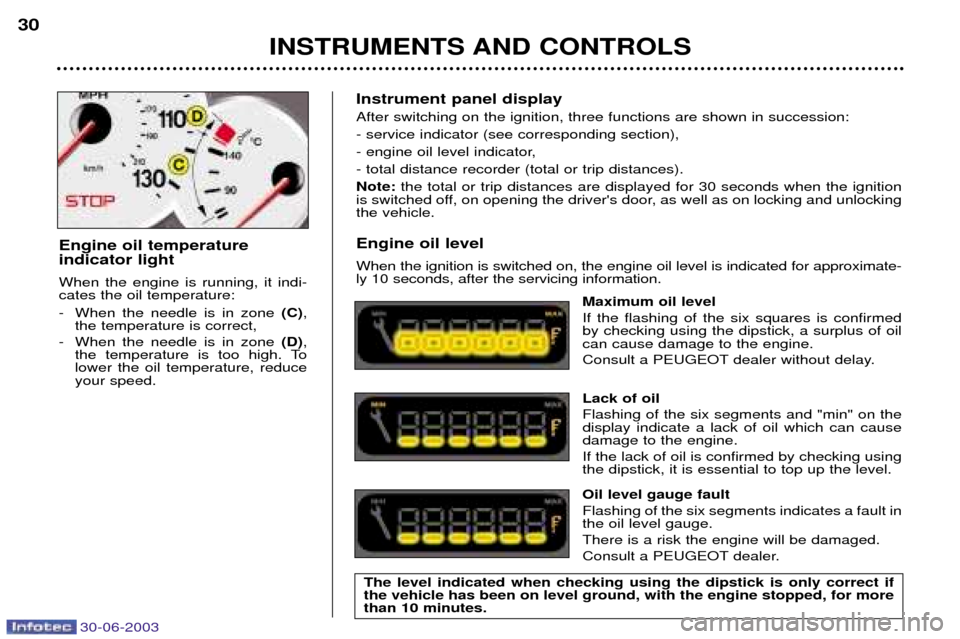
Engine oil temperature indicator light When the engine is running, it indi- cates the oil temperature:
- When the needle is in zone
(C),
the temperature is correct,
- When the needle is in zone (D),
the temperature is too high. To lower the oil temperature, reduceyour speed.
The level indicated when checking using the dipstick is only correct ifthe vehicle has been on level ground, with the engine stopped, for morethan 10 minutes.
Page 59 of 135
30-06-2003
YOUR 206 CC IN DETAIL59
Windscreen ,side windows
and footwells. Footwells.
These settings are recommended for cold climates. Centre and side vents.
This setting is recommended for hotclimates.
3. Air flow adjustment Turn the control from posi- tion 1to position 4to give
a sufficient air flow for com-fort. 4. Air intake control
Outside air intake.
This is the position for normal use.
Recirculation of interior air.
This position prevents the entry ofunpleasant odours and fumes fromthe outside and increases the speedof heating.
As soon as possible, place the con-trol in the outside air position, other-wise there is a risk of the windowsmisting up.
5. De-icing the rear screen and the mirrors
With the engine running, pressing the button de-icesthe rear screen and the mir-rors.
It switches off automatically afterapproximately twelve minutes. Pressing the button again starts it again for twelve minutes.
It is possible to stop the de-icingoperation by pressing the buttonbefore the twelve minutes haveelapsed.
Note: this function is disarmed when
the roof is stored in the boot.
Page 61 of 135

30-06-2003
YOUR 206 CC IN DETAIL61
Important precaution Operate the air conditioning system for 5 to 10 minutes, once or twice amonth, to keep it in perfect working
order. If the system does not produce cold
air, do not use it and contact your
PEUGEOT dealer.
3. Air distribution adjustment Windscreen and side win- dows (demisting/de-icing).
To quickly de-ice or demist the wind-screen and the side windows:
- place the temperature and air flow controls to maximum,
- close the central vents,
- place the outside air intake control to the left, in the 'Outside air' posi- tion,
- operate the air conditioning.
Windscreen, side windowsand footwells. Footwells.
These settings are recommended for cold climates.
Central and side vents.
This setting is recommended for hotclimates.
5. Air intake control
Outside air intake.
This is the normal operating posi-tion.
Recirculation of interior air.
This position prevents the entry ofunpleasant odours or fumes fromthe outside. Used simultaneously with the air conditioning enables both the heat-ing and cooling performance to beimproved. Used without air conditioning, recirculation may result in mistingthe windows. As soon as possible, place the control in the outside air position. 6. De-misting the rear screen
and the mirrors
With the engine running,pressing the button de-miststhe rear screen and the mirrors.
It switches off automatically afterapproximately twelve minutes. Press again to resume de-misting for twelve minutes. It is possible to stop the de-misting operation by pressing the buttonagain before the end of the twelveminutes. Note: this function is disarmed when
the roof is stored in the boot.
4. Air flow adjustment
From position 1to position
4 . Turn the knob to obtain a
sufficient flow of air to ensure your comfort.
Page 72 of 135
30-06-2003
YOUR 206 CC IN DETAIL73
Make a careful note of the number on each key. The key number is
coded on the label attached to the key. If the keys are lost, your PEUGEOT dealer can rapidly supply you with new keys.
The high frequency remote control is a sensitive system; do not operate itwhile it is in your pocket as there is a possibility that it may unlock your vehicle,without you being aware of it. The remote control does not operate when the key is in the ignition, even when the ignition is switched off, except for reprogramming. Driving with the doors locked may make access to the passenger compart-
ment by the emergency services more difficult in an emergency. As a safety precaution (with children on board), remove the ignition key when you leave the vehicle, even for a short time. Do not repeatedly press the button of your remote control out of range of your vehicle.
You run the risk of stopping it from working and the remote control would have to be reprogrammed. When purchasing a second-hand vehicle:
- ensure that you are given the confidential card;
- have the key codes memorised by a PEUGEOT dealer, to ensure that the keys in your possession are the only ones which can start the vehicle.
Do not make any modifications to the electronic engine immobiliser system.
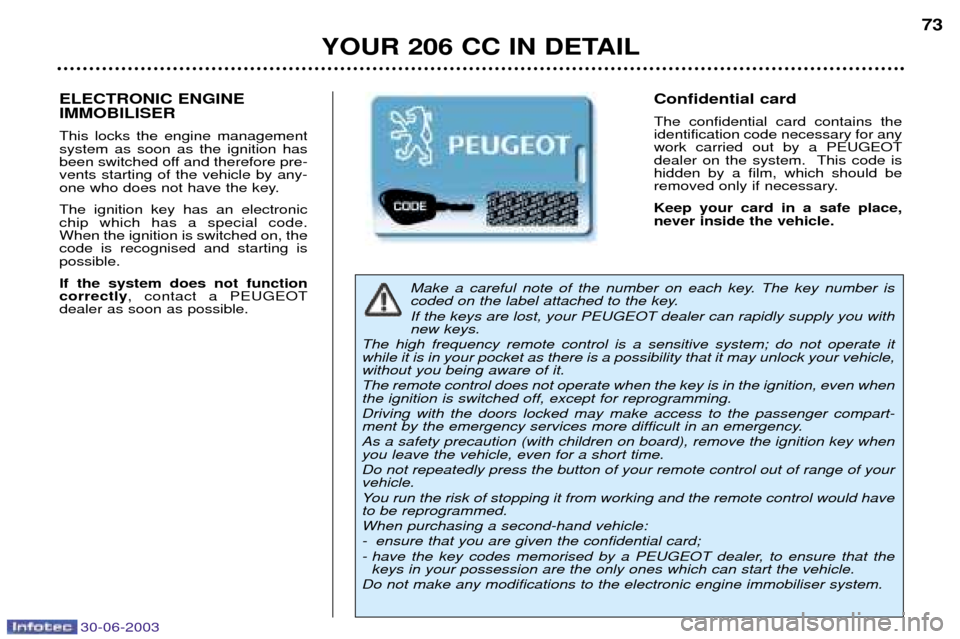
Confidential card The confidential card contains the identification code necessary for anywork carried out by a PEUGEOT
dealer on the system. This code ishidden by a film, which should be
removed only if necessary. Keep your card in a safe place, never inside the vehicle.ELECTRONIC ENGINE IMMOBILISER This locks the engine management system as soon as the ignition has
been switched off and therefore pre-vents starting of the vehicle by any-
one who does not have the key. The ignition key has an electronic chip which has a special code.When the ignition is switched on, thecode is recognised and starting ispossible. If the system does not function correctly , contact a PEUGEOT
dealer as soon as possible.