four wheel drive Peugeot 208 2015 Owner's Manual - RHD (UK, Australia)
[x] Cancel search | Manufacturer: PEUGEOT, Model Year: 2015, Model line: 208, Model: Peugeot 208 2015Pages: 341, PDF Size: 38.75 MB
Page 169 of 341
167
208_en_Chap07_ Amenagements_ed01-2015
To w i n g
Access to the tools
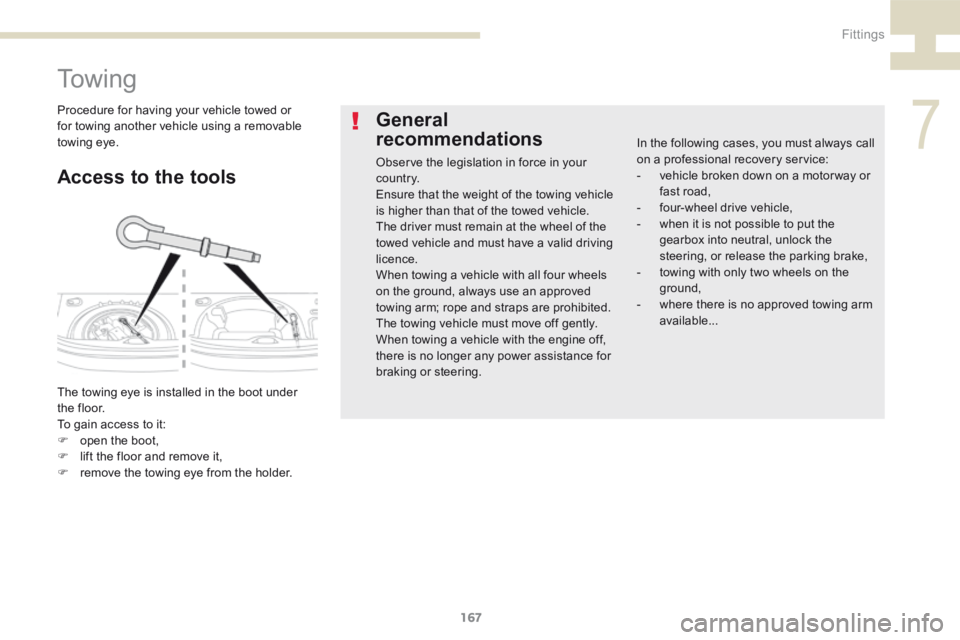
The towing eye is installed in the boot under
t h e f l o o r.
To gain access to it:
F open the boot,
F lift the floor and remove it,
F remove the towing eye from the holder.
General
recommendations
Observe the legislation in force in your
c o unt r y.
Ensure that the weight of the towing vehicle
is higher than that of the towed vehicle.
The driver must remain at the wheel of the
towed vehicle and must have a valid driving
licence.
When towing a vehicle with all four wheels
on the ground, always use an approved
towing arm; rope and straps are prohibited.
The towing vehicle must move off gently.
When towing a vehicle with the engine off,
there is no longer any power assistance for
braking or steering. In the following cases, you must always call
on a professional recovery service:
-
vehicle broken down on a motor way or
fast road,
- four-wheel drive vehicle,
- when it is not possible to put the
gearbox into neutral, unlock the
steering, or release the parking brake,
- towing with only two wheels on the
ground,
- where there is no approved towing arm
available...
Procedure for having your vehicle towed or
for towing another vehicle using a removable
towing eye.
7
Fittings
Page 202 of 341
200
208_en_Chap08_Informations-pratiques_ed01-2015
Under-inflation
The under-inflation detection system
does not replace the need for vigilance
on the part of the driver.
This system does not avoid the need to
check the tyre pressures (including the
spare wheel) every month as well as
before a long journey.
Driving with under-inflated tyres impairs
road holding, extends braking distances
and causes premature tyre wear,
particularly under arduous condition
(high loading, high speed, long journey).The inflation pressures defined for
your vehicle can be found on the tyre
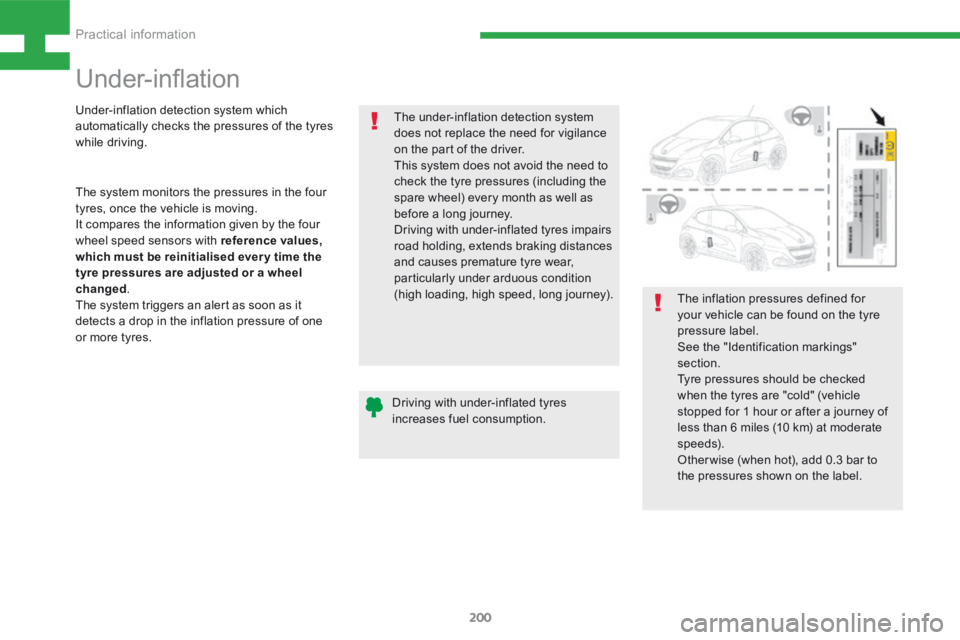
pressure label.
See the "Identification markings"
section.
Tyre pressures should be checked
when the tyres are "cold" (vehicle
stopped for 1 hour or after a journey of
less than 6 miles (10 km) at moderate
speeds).
Other wise (when hot), add 0.3 bar to
the pressures shown on the label.
Driving with under-inflated tyres
increases fuel consumption.
Under-inflation detection system which
automatically checks the pressures of the tyres
while driving.
The system monitors the pressures in the four
tyres, once the vehicle is moving.
It compares the information given by the four
wheel speed sensors with reference values,
which must be reinitialised ever y time the
tyre pressures are adjusted or a wheel
changed
.
The system triggers an alert as soon as it
detects a drop in the inflation pressure of one
or more tyres.
Practical information
Page 203 of 341
201
208_en_Chap08_Informations-pratiques_ed01-2015
Under-inflation alert
The loss of pressure detected does not
always cause visible bulging of the tyre.
Do not satisfy yourself with just a visual
check.This is given by fixed illumination of
this warning lamp, accompanied by
an audible signal and, depending on
equipment, the display of a message.
F Reduce speed immediately, avoid
excessive steering movements and sudden
braking
F Stop the vehicle as soon as it is safe
to do so. F
In the event of a puncture, use the
temporary puncture repair kit or the spare
wheel (depending on equipment),
or
F if you have a compressor, such as the one
in the temporary puncture repair kit, check
the pressures of the four tyres when cold,
or
F if it is not possible to make this check
immediately, drive carefully at reduced
speed. The alert is maintained until the system
is reinitialised.
The under-inflation alert is only
dependable if the system has been
reinitialised with all four tyres inflated to
the correct pressures.
Snow chains
The system does not have to be
reinitialised after fitting or removing
snow chains.
8
Practical information
Page 204 of 341
202
208_en_Chap08_Informations-pratiques_ed01-2015
Reinitialising
It is necessary to reinitialise the system every
time one or more tyre pressure is adjusted, and
after changing one or more wheels.
A label attached to the middle pillar, driver's
side, gives a reminder of this.Before reinitialising the system, ensure
that the pressures of the four tyres are
correct for the use of the vehicle and in
line with the recommendations on the
tyre pressure label.
The under-inflation detection system
does not give a warning if a pressure is
incorrect at the time of reinitialisation. F
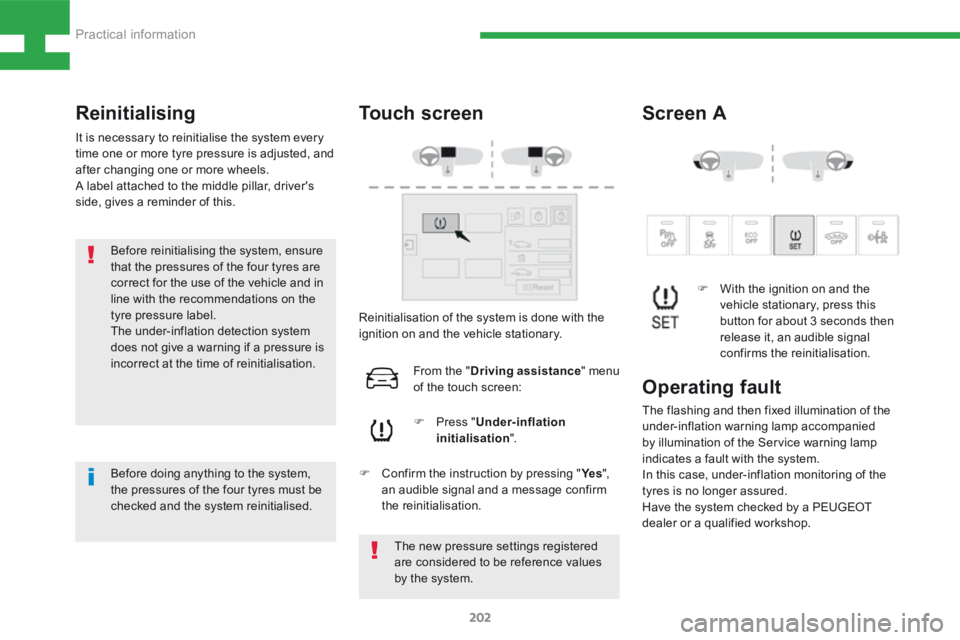
With the ignition on and the
vehicle stationary, press this
button for about 3 seconds then
release it, an audible signal
confirms the reinitialisation.
The new pressure settings registered
are considered to be reference values
by the system.
Reinitialisation of the system is done with the
ignition on and the vehicle stationary.
F Press " Under-inflation
initialisation ".
From the "
Driving assistance " menu
of the touch screen:
F Confirm the instruction by pressing " Ye s",
an audible signal and a message confirm
the reinitialisation.
Operating fault
The flashing and then fixed illumination of the
under-inflation warning lamp accompanied
by illumination of the Service warning lamp
indicates a fault with the system.
In this case, under-inflation monitoring of the
tyres is no longer assured.
Have the system checked by a PEUGEOT
dealer or a qualified workshop.
Touch screen Screen A
Before doing anything to the system,
the pressures of the four tyres must be
checked and the system reinitialised.
Practical information