heating Peugeot 208 2015 Owner's Manual - RHD (UK, Australia)
[x] Cancel search | Manufacturer: PEUGEOT, Model Year: 2015, Model line: 208, Model: Peugeot 208 2015Pages: 341, PDF Size: 38.75 MB
Page 4 of 341
2
208_en_Chap00a_sommaire_ed01-2015
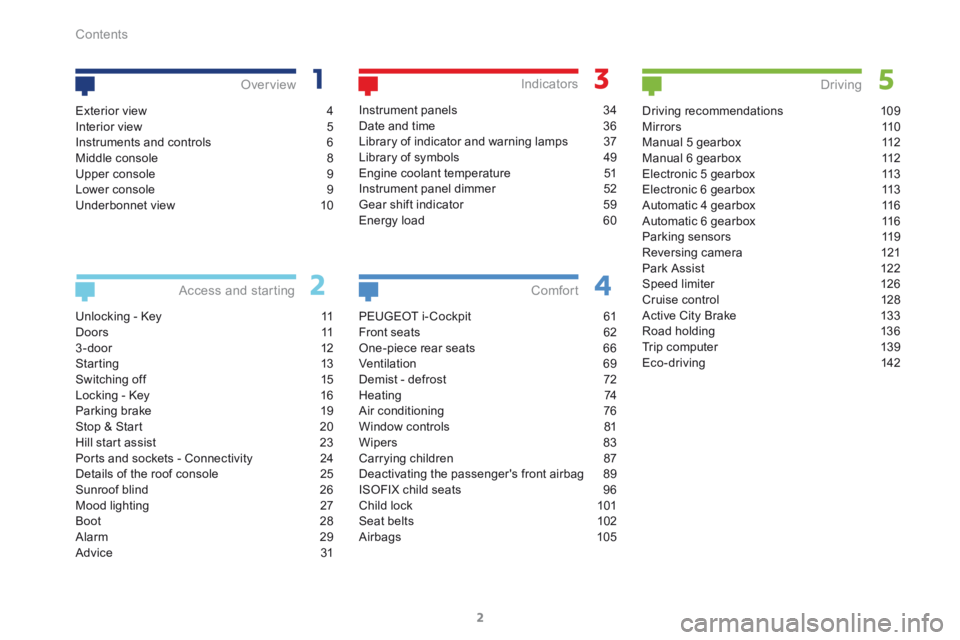
Unlocking - Key 11
D o o r s 11
3 - door 12
Starting 13
Switching off 15
Locking - Key 16
Parking brake 19
Stop & Start 20
Hill start assist 23
Ports and sockets - Connectivity 24
Details of the roof console 25
Sunroof blind 26
Mood lighting 27
Boot 28
Alarm 29
Advice 31
Access and starting Over view
Instrument panels
34
Date and time 36
Library of indicator and warning lamps 37
Library of symbols 49
Engine coolant temperature 51
Instrument panel dimmer 52
Gear shift indicator 59
Energy load 60
Indicators
PEUGEOT i- Cockpit 61
Front seats 62
One-piece rear seats 66
Ventilation 69
Demist - defrost 72
Heating 74
Air conditioning 76
Window controls 81
Wipers 83
Carrying children 87
Deactivating the passenger's front airbag 89
ISOFIX child seats 96
Child lock 101
Seat belts 102
Airbags 105
Comfort
Driving recommendations 109
M i r r o r s 11 0
Manual 5 gearbox 112
Manual 6 gearbox 112
Electronic 5 gearbox 113
Electronic 6 gearbox 113
Automatic 4 gearbox 116
Automatic 6 gearbox 116
Parking sensors 119
Reversing camera 121
Park Assist 122
Speed limiter 126
Cruise control 128
Active City Brake 133
Road holding 136
Trip computer 139
Eco-driving 142
Driving
Exterior view 4
Interior view 5
Instruments and controls 6
Middle console 8
Upper console 9
Lower console 9
Underbonnet view 10
Contents
Page 10 of 341

8
208_en_Chap01_vue-ensemble_ed01-2015
Touch screen.Heating / Ventilation.
Hazard warning lamps. Bluetooth audio system.
Audio system.
Middle console
Central locking.
Automatic dual-zone
air conditioning.
Centre console
223-285 2 87- 3 0 5
3 07- 318 74 -75
76 -77
78- 80
14 4 18
Manual air
conditioning.
Over view
Page 40 of 341
38
208_en_Chap03_Indicateurs_ed01-2015
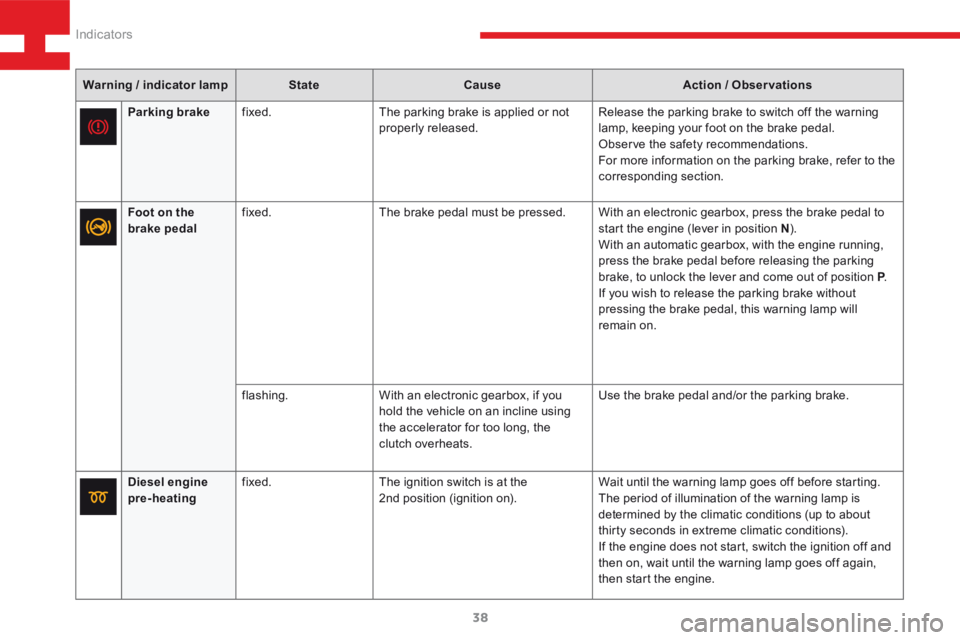
Warning / indicator lampStateCause Action / Observations
Diesel engine
pre-heating fixed.
The ignition switch is at the
2nd position (ignition on). Wait until the warning lamp goes off before starting.
The period of illumination of the warning lamp is
determined by the climatic conditions (up to about
thirty seconds in extreme climatic conditions).
If the engine does not start, switch the ignition off and
then on, wait until the warning lamp goes off again,
then start the engine.
Parking brake
fixed. The parking brake is applied or not
properly released. Release the parking brake to switch off the warning
lamp, keeping your foot on the brake pedal.
Observe the safety recommendations.
For more information on the parking brake, refer to the
corresponding section.
Foot on the
brake pedal fixed.
The brake pedal must be pressed. With an electronic gearbox, press the brake pedal to
start the engine (lever in position N).
With an automatic gearbox, with the engine running,
press the brake pedal before releasing the parking
brake, to unlock the lever and come out of position P .
If you wish to release the parking brake without
pressing the brake pedal, this warning lamp will
remain on.
flashing. With an electronic gearbox, if you
hold the vehicle on an incline using
the accelerator for too long, the
clutch overheats. Use the brake pedal and/or the parking brake.
Indicators
Page 67 of 341

65
208_en_Chap04_confort_ed01-2015
Heated seats
With the engine running, the front seats can be
heated separately.
Armrest
Comfort and storage system for the driver and
front passenger.
Cover with opening lever
F Lift the lever to raise the lid. Storage space in the console
F
Pull the armrest fully up.
Additional adjustments
F Use the adjustment wheel, select the level
of heating required:
0 : Of f.
1 : Low.
2 : Medium.
3 : High.
4
Comfort
Page 71 of 341

69
208_en_Chap04_confort_ed01-2015
Ventilation
Air intake
The air circulating in the passenger
compartment is filtered and originates either
from the outside via the grille located at the
base of the windscreen or from the inside in air
recirculation mode.
Air intake flow
The incoming air follows various paths
depending on the controls selected by the
driver:
- direct arrival in the passenger
compartment (air intake),
- passage through a heating circuit (heating),
- passage through a cooling circuit (air
conditioning).
Control panel
The controls of this system are grouped
together on the control panel on the centre
console.
General points
Air distribution
The incoming air is distributed via various
outlets:
- windscreen demisting-defrosting vents,
- front side window demisting-defrosting
vents,
- side adjustable air vents,
- central adjustable air vents,
- air outlets to the front footwells,
- air outlets to the rear footwells.
4
Comfort
Page 72 of 341
70
208_en_Chap04_confort_ed01-2015
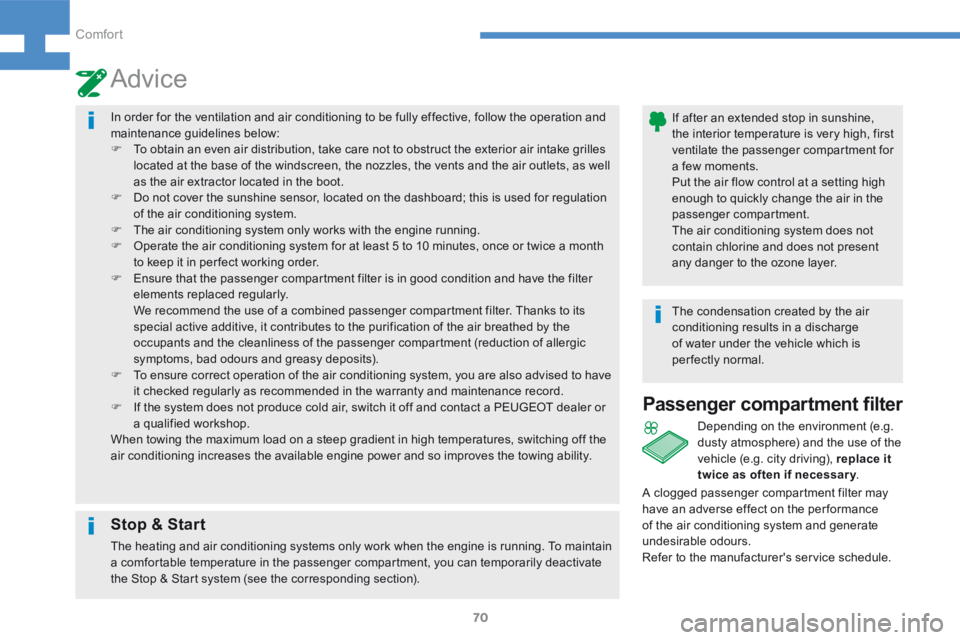
In order for the ventilation and air conditioning to be fully effective, follow the operation and
maintenance guidelines below:
F To obtain an even air distribution, take care not to obstruct the exterior air intake grilles
located at the base of the windscreen, the nozzles, the vents and the air outlets, as well
as the air extractor located in the boot.
F Do not cover the sunshine sensor, located on the dashboard; this is used for regulation
of the air conditioning system.
F The air conditioning system only works with the engine running.
F Operate the air conditioning system for at least 5 to 10 minutes, once or twice a month
to keep it in per fect working order.
F Ensure that the passenger compartment filter is in good condition and have the filter
elements replaced regularly.
We recommend the use of a combined passenger compartment filter. Thanks to its
special active additive, it contributes to the purification of the air breathed by the
occupants and the cleanliness of the passenger compartment (reduction of allergic
symptoms, bad odours and greasy deposits).
F To ensure correct operation of the air conditioning system, you are also advised to have
it checked regularly as recommended in the warranty and maintenance record.
F If the system does not produce cold air, switch it off and contact a PEUGEOT dealer or
a qualified workshop.
When towing the maximum load on a steep gradient in high temperatures, switching off the
air conditioning increases the available engine power and so improves the towing ability.
Advice
If after an extended stop in sunshine,
the interior temperature is very high, first
ventilate the passenger compartment for
a few moments.
Put the air flow control at a setting high
enough to quickly change the air in the
passenger compartment.
The air conditioning system does not
contain chlorine and does not present
any danger to the ozone layer.
The condensation created by the air
conditioning results in a discharge
of water under the vehicle which is
perfectly normal.
Stop & Start
The heating and air conditioning systems only work when the engine is running. To maintain
a comfortable temperature in the passenger compartment, you can temporarily deactivate
the Stop & Start system (see the corresponding section).
Passenger compartment filter
Depending on the environment (e.g.
dusty atmosphere) and the use of the
vehicle (e.g. city driving), replace it
twice as often if necessar y .
A clogged passenger compartment filter may
have an adverse effect on the per formance
of the air conditioning system and generate
undesirable odours.
Refer to the manufacturer's service schedule.
Comfort
Page 73 of 341

71
208_en_Chap04_confort_ed01-2015
Advice
Digital air conditioning: use the automatic mode in preference by pressing the "AUTO" button.
I require...
Heating or Manual air conditioning
Air distribution Air flowRecirculation of interior air /
Intake of exterior air Temperature
Manual AC
HOT
COLD
DEMISTING
DEFROSTING
Interior settings
4
Comfort
Page 76 of 341

74
208_en_Chap04_confort_ed01-2015
Temperature
F Turn the knob from blue
(cold) to red (hot) to adjust the
temperature to your wishes.
Air flow
F Turn the knob from position 1 to
position 6 , to obtain the desired
air f low. If you place the air flow control at
position 0 (off), the temperature in the
vehicle will no longer be maintained.
However, a slight flow of air can still be
felt due to the movement of the vehicle.
Heating / Ventilation
Manual mode
Comfort
Page 81 of 341

79
208_en_Chap04_confort_ed01-2015
On entering the vehicle, if the interior
temperature is much colder or warmer
than the comfort value, there is no need
to alter the value displayed in order to
obtain the required level of comfort.
The system corrects the temperature
difference automatically and as quickly
as possible.
Auto - Visibility programme
Switching onF Press the "visibility" button for
faster demisting or defrosting
of the windscreen and side
windows.
Switching off The air conditioning is designed to
operate efficiently in all seasons, with
the windows closed.
Air conditioning
It allows you:
-
in summer, to lower the temperature,
- in winter, above 3 °C, to improve demisting.
Switching on
F Press the " A/C" button, the associated
indicator lamp comes on.
The air conditioning cannot operate when the
air flow is set to off.
Switching off
F Press the "A /C " button again; the
associated indicator lamp goes off.
Switching off may cause some problems
(humidity, misting).
F
Press the "visibility" button
again or the "AUTO" button, the
indicator lamp in the button goes
off and the indicator lamp in the
"AUTO" button comes on.
The system reverts to the previous settings
used. F
Press the "AUTO" button again
to return to the automatic comfort
programme.
The system automatically manages the air
conditioning, and the air intake, flow and
distribution to the windscreen and side
windows to the best effect. For maximum cooling or heating of
the passenger compartment, you can
exceed the minimum value of 14 or the
maximum value of 28.
F Push the button down
until "LO" is displayed or
up until "HI" is displayed.
4
Comfort
Page 111 of 341

109
208_en_Chap05_conduite_ed01-2015
Never drive with the parking brake
applied - Risk of overheating and
damage to the braking system!
Do not park or run the engine when
stationary in areas where inflammable
substances and materials (dry grass,
dead leaves...) might come into contact
with the hot exhaust system - Risk of
fire!
Never leave a vehicle unsupervised
with the engine running. If you have
to leave your vehicle with the engine
running, apply the parking brake
and put the gearbox into neutral or
position N or P, depending on the type
of gearbox.
Driving recommendations
Observe the driving regulations and remain
vigilant whatever the traffic conditions.
Pay close attention to the traffic and keep your
hands on the wheel so that you are ready to
react at any time to any eventuality.
On a long journey, a break every two hours is
strongly recommended.
In difficult weather, drive smoothly, anticipate
the need to brake and increase the distance
from other vehicles. If you are obliged to drive through water:Important!
Driving on flooded
roads
- check that the depth of water does not
exceed 15 cm, taking account of waves
that might be generated by other users,
- deactivate the Stop & Start system,
- drive as slowly as possible without
stalling. In all cases, do not exceed 6 mph
(10 km/h),
- do not stop and do not switch off the
engine.
We strongly advise against driving on flooded
roads, as this could cause serious damage
to the engine or gearbox, as well as to the
electrical systems of your vehicle.
On leaving the flooded road, as soon as
circumstances allow, make several light brake
applications to dry the brake discs and pads.
If in doubt on the state of your vehicle, contact
a PEUGEOT dealer or a qualified workshop.
5
Driving