weight Peugeot 208 2015 Owner's Manual - RHD (UK, Australia)
[x] Cancel search | Manufacturer: PEUGEOT, Model Year: 2015, Model line: 208, Model: Peugeot 208 2015Pages: 341, PDF Size: 38.75 MB
Page 12 of 341
10
208_en_Chap01_vue-ensemble_ed01-2015
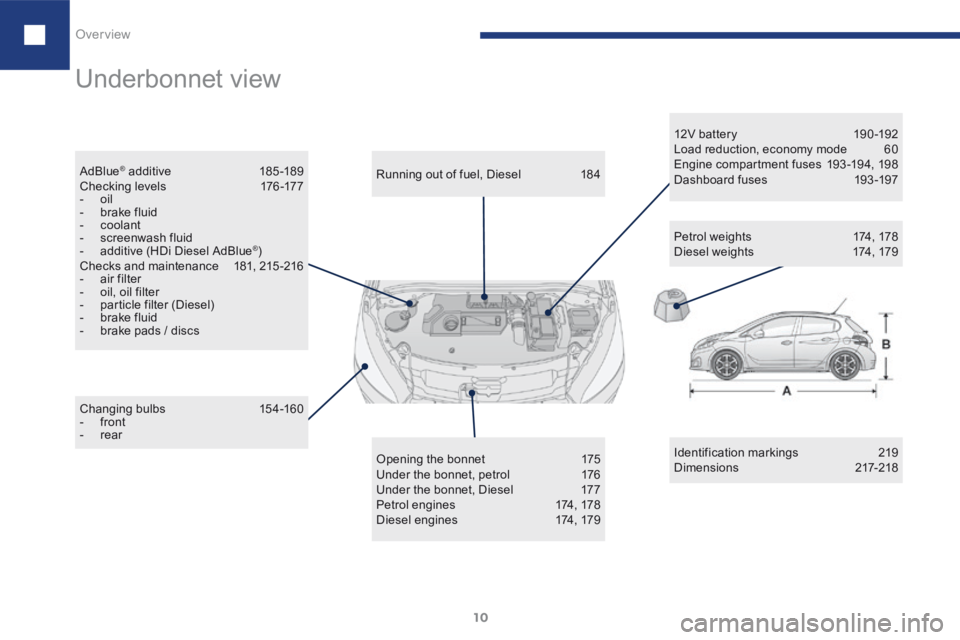
Underbonnet view
Identification markings 219
Dimensions 217-218
Changing bulbs
154-160
- front
- rear Running out of fuel, Diesel
184
Opening the bonnet 175
Under the bonnet, petrol 176
Under the bonnet, Diesel 177
Petrol engines 174, 178
Diesel engines 174, 17912V bat ter y
19 0 -192
Load reduction, economy mode 60
Engine compartment fuses 193-194, 198
Dashboard fuses 193-197
Petrol weights 174, 178
Diesel weights 174, 179
AdBlue
® additive
185 -189
C h e c k i n g l eve l s 176 -17 7
- oil
- brake fluid
- coolant
- screenwash fluid
- additive (HDi Diesel AdBlue
®)
Checks and maintenance 181, 215-216
- air filter
- oil, oil filter
- particle filter (Diesel)
- brake fluid
- brake pads / discs
Over view
Page 58 of 341
56
208_en_Chap03_Indicateurs_ed01-2015
Retrieving the service
information
You can access the service information at any
time.
F Press the trip distance recorder zero reset
button.
The service information is displayed for a
few seconds, then disappears.
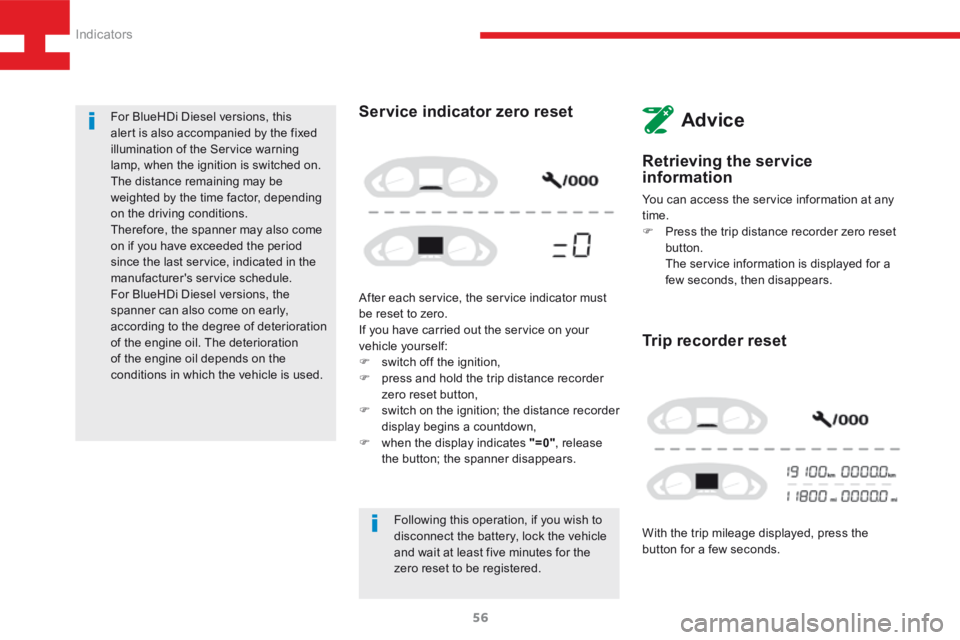
With the trip mileage displayed, press the
button for a few seconds.
Trip recorder reset
Following this operation, if you wish to
disconnect the battery, lock the vehicle
and wait at least five minutes for the
zero reset to be registered.
Service indicator zero reset
After each service, the service indicator must
be reset to zero.
If you have carried out the service on your
vehicle yourself:
F switch off the ignition,
F press and hold the trip distance recorder
zero reset button,
F switch on the ignition; the distance recorder
display begins a countdown,
F when the display indicates "=0" , release
the button; the spanner disappears.
For BlueHDi Diesel versions, this
alert is also accompanied by the fixed
illumination of the Service warning
lamp, when the ignition is switched on.
The distance remaining may be
weighted by the time factor, depending
on the driving conditions.
Therefore, the spanner may also come
on if you have exceeded the period
since the last service, indicated in the
manufacturer's service schedule.
For BlueHDi Diesel versions, the
spanner can also come on early,
according to the degree of deterioration
of the engine oil. The deterioration
of the engine oil depends on the
conditions in which the vehicle is used.
Advice
Indicators
Page 89 of 341
87
208_en_Chap04_confort_ed01-2015
General points
For maximum safety, please observe the
following recommendations:
- in accordance with European regulations,
all children under the age of 12 or less
than one and a half metres tall must
travel in approved child seats suited to
their weight , on seats fitted with a seat
belt or ISOFIX mountings*,
- statistically, the safest seats in your
vehicle for carr ying children are the
rear seats,
- a child weighing less than 9 kg must
travel in the rear ward facing position
both in the front and in the rear. PEUGEOT recommends
that children
should travel in the outer rear seats of
your vehicle:
- rearward facing up to the age of 3,
- forward facing over the age of 3.
Although one of PEUGEOT main criteria when
designing your vehicle, the safety of your
children also depends on you.
* The regulations on carrying children are
specific to each country. Refer to the
legislation in force in your country.
Carrying children
4
Comfort
Page 96 of 341
94
208_en_Chap04_confort_ed01-2015
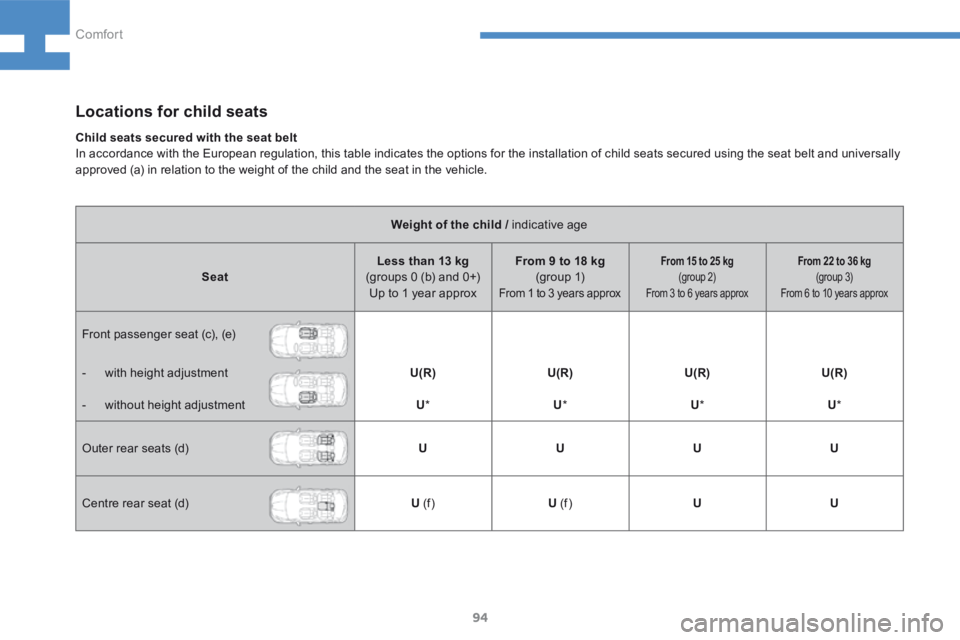
Locations for child seats
Weight of the child / indicative age
Seat Less than 13 kg
(groups 0 (b) and 0+) Up to 1 year approx From 9 to 18 kg
(g r o u p 1)
From 1 to 3 years approx
From 15 to 25 kg
(group 2)
From 3 to 6 years approx From 22 to 36 kg
(group 3)
From 6 to 10 years approx
Front passenger seat (c), (e)
- with height adjustment U(R) U(R) U(R)U(R)
- without height adjustment U* U* U* U*
Outer rear seats (d) UUUU
Centre rear seat (d) U (f )U (f ) UU
Child seats secured with the seat belt
In accordance with the European regulation, this table indicates the options for the installation of child seats secured using the seat belt and universally
approved (a) in relation to the weight of the child and the seat in the vehicle.
Comfort
Page 101 of 341
99
208_en_Chap04_confort_ed01-2015
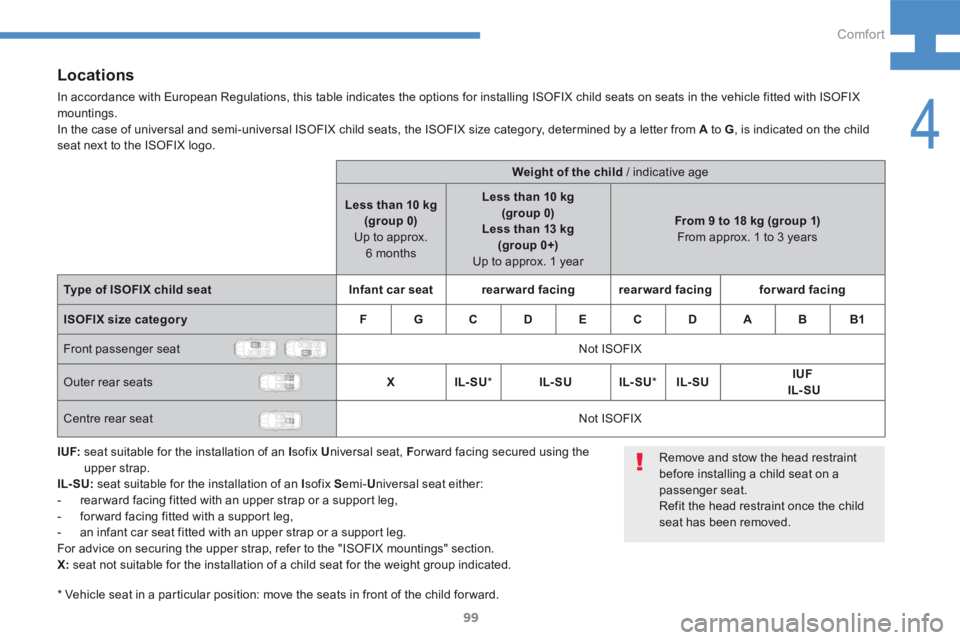
Locations
In accordance with European Regulations, this table indicates the options for installing ISOFIX child seats on seats in the vehicle fitted with ISOFIX
mountings.
In the case of universal and semi-universal ISOFIX child seats, the ISOFIX size category, determined by a letter from A to G, is indicated on the child
seat next to the ISOFIX logo.
Weight of the child / indicative age
Less than 10 kg (group 0)
Up to approx. 6 months Less than 10 kg
(group 0)
Less than 13 kg (group 0+)
Up to approx. 1 year From 9 to 18 kg (group 1)
From approx. 1 to 3 years
Type of ISOFIX child seat Infant car seatrearward facing rearward facing forward facing
ISOFIX size categor y FG CD EC DABB1
Front passenger seat Not ISOFIX
Outer rear seats XIL- SU* IL- SU IL- SU*IL- SU IUF
IL- SU
Centre rear seat Not ISOFIX
I UF: seat suitable for the installation of an I sofix Universal seat, F or ward facing secured using the
upper strap.
IL- SU: seat suitable for the installation of an I sofix Semi-Universal seat either:
- rear ward facing fitted with an upper strap or a support leg,
- for ward facing fitted with a support leg,
- an infant car seat fitted with an upper strap or a support leg.
For advice on securing the upper strap, refer to the "ISOFIX mountings" section.
X: seat not suitable for the installation of a child seat for the weight group indicated.
* Vehicle seat in a particular position: move the seats in front of the child for ward. Remove and stow the head restraint
before installing a child seat on a
passenger seat.
Refit the head restraint once the child
seat has been removed.
4
Comfort
Page 168 of 341
166
208_en_Chap07_ Amenagements_ed01-2015
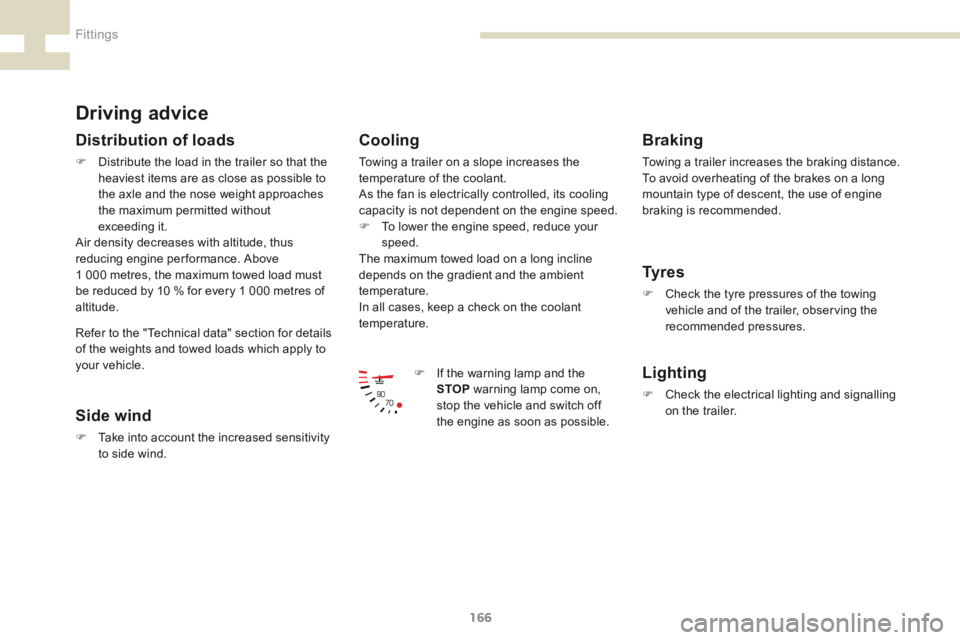
Driving advice
Distribution of loads
F Distribute the load in the trailer so that the
heaviest items are as close as possible to
the axle and the nose weight approaches
the maximum permitted without
exceeding it.
Air density decreases with altitude, thus
reducing engine performance. Above
1 000 metres, the maximum towed load must
be reduced by 10 % for every 1 000 metres of
altitude.
Side wind
F Take into account the increased sensitivity
to side wind.
Cooling
Towing a trailer on a slope increases the
temperature of the coolant.
As the fan is electrically controlled, its cooling
capacity is not dependent on the engine speed.
F To lower the engine speed, reduce your
speed.
The maximum towed load on a long incline
depends on the gradient and the ambient
temperature.
In all cases, keep a check on the coolant
temperature.
F If the warning lamp and the
STOP warning lamp come on,
stop the vehicle and switch off
the engine as soon as possible.
Braking
Towing a trailer increases the braking distance.
To avoid overheating of the brakes on a long
mountain type of descent, the use of engine
braking is recommended.
Ty r e s
F Check the tyre pressures of the towing
vehicle and of the trailer, observing the
recommended pressures.
Lighting
F Check the electrical lighting and signalling
on the trailer.
Refer to the "Technical data" section for details
of the weights and towed loads which apply to
your vehicle.
Fittings
Page 169 of 341
167
208_en_Chap07_ Amenagements_ed01-2015
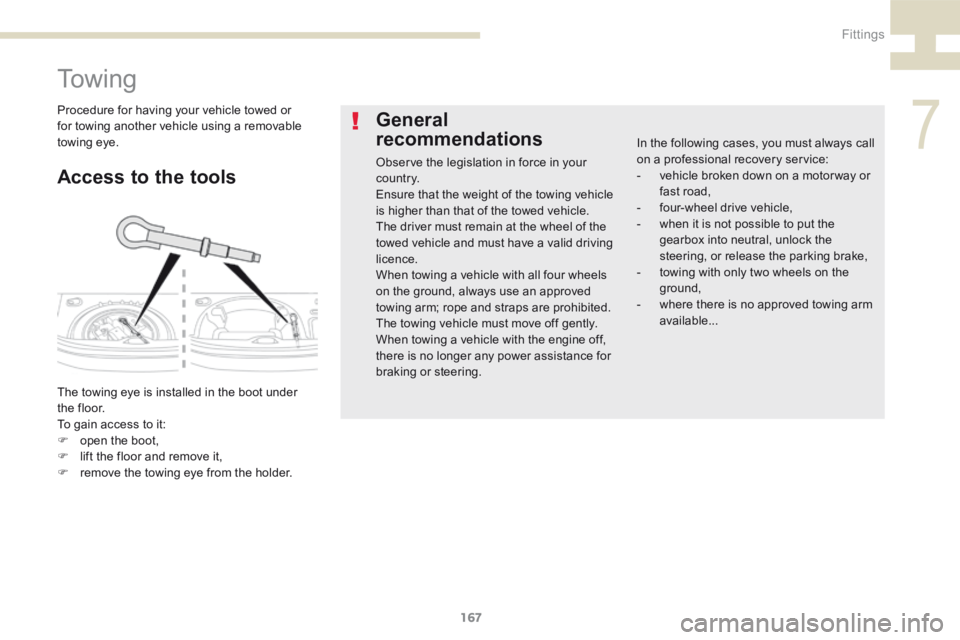
To w i n g
Access to the tools
The towing eye is installed in the boot under
t h e f l o o r.
To gain access to it:
F open the boot,
F lift the floor and remove it,
F remove the towing eye from the holder.
General
recommendations
Observe the legislation in force in your
c o unt r y.
Ensure that the weight of the towing vehicle
is higher than that of the towed vehicle.
The driver must remain at the wheel of the
towed vehicle and must have a valid driving
licence.
When towing a vehicle with all four wheels
on the ground, always use an approved
towing arm; rope and straps are prohibited.
The towing vehicle must move off gently.
When towing a vehicle with the engine off,
there is no longer any power assistance for
braking or steering. In the following cases, you must always call
on a professional recovery service:
-
vehicle broken down on a motor way or
fast road,
- four-wheel drive vehicle,
- when it is not possible to put the
gearbox into neutral, unlock the
steering, or release the parking brake,
- towing with only two wheels on the
ground,
- where there is no approved towing arm
available...
Procedure for having your vehicle towed or
for towing another vehicle using a removable
towing eye.
7
Fittings
Page 176 of 341
174
208_en_Chap08_Informations-pratiques_ed01-2015
General information
Engine characteristicsWeights and towed loads
The kerb weight is equal to the unladen
weight + driver (75 kg).
The gross train weight and towed load values
indicated apply up to a maximum altitude of
1 000 metres; the towed load mentioned must
be reduced by 10 % for every additional
1 000 metres.
The weight of the braked trailer can be
increased, within the GTW limit, on condition
that the GV W of the towing vehicle is reduced
by the same amount.
The recommended nose weight is the vertical
load on the towbar ball (removable with or
without tools). High ambient temperatures may result
in a reduction in the per formance of
the vehicle to protect the engine; when
the ambient temperature is higher than
37 °C, limit the towed weight.
Towing with a lightly loaded vehicle can
adversely affect roadholding.
Braking distances are increased when
towing a trailer.
Never exceed 60 mph (100 km/h) when
towing (comply with the legislation in
force in your country).
GV W:
gross vehicle weight, the maximum authorised vehicle weight.
GT W: gross train weight, the maximum authorised weight of vehicle
plus trailer.
The engine characteristics (capacity,
maximum power, maximum power speed, fuel,
CO
2 emissions...) for your vehicle are given in
the registration document, as well as in sales
brochures.
These characteristics correspond to the
values type-approved on a test bed, under
conditions defined in European legislation
(Directive 1999/99/EC).
For more information, contact a PEUGEOT
dealer or a qualified workshop. The maximum weights and towed loads for your
vehicle are given are given in the registration
document, as well as in sales brochures.
These values are also present on the
manufacturer's plate or label.
See the "Identification markings" section.
For more information, contact a PEUGEOT
dealer or a qualified workshop.
Practical information
Page 180 of 341
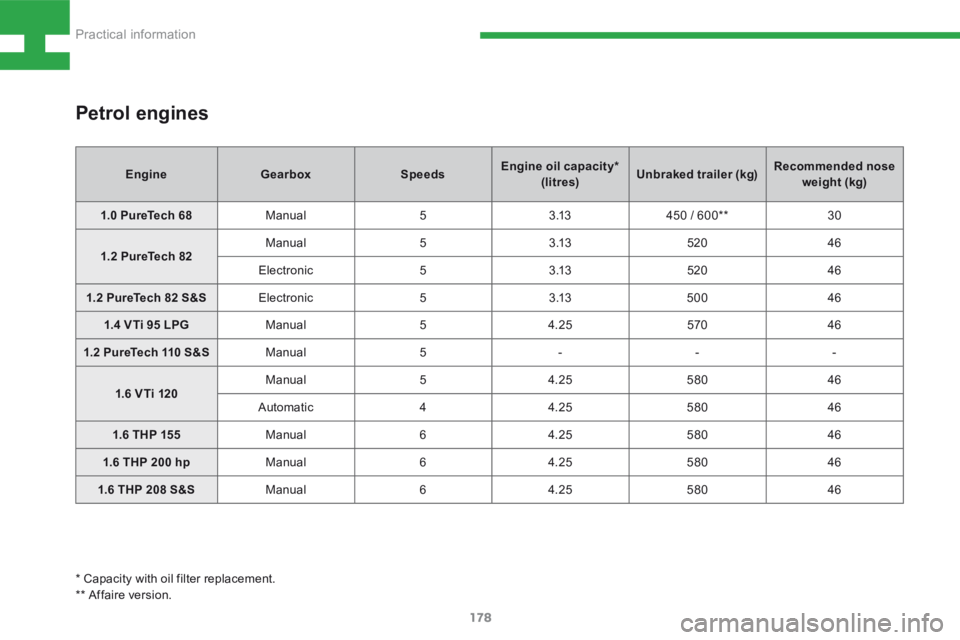
178
208_en_Chap08_Informations-pratiques_ed01-2015
EngineGearbox SpeedsEngine oil capacity*
(litres) Unbraked trailer (kg) Recommended nose
weight (kg)
1.0 PureTech 68 Manual53 .13450 / 600** 30
1.2 PureTech 82 Manual
53 .13 520 46
Electronic 53 .13 520 46
1.2 PureTech 82 S&S Electronic53 .13 500 46
1.4 VTi 95 LPG Manual54.25 570 46
1.2 PureTech 110 S&S Manual5---
1.6 VTi 120 Manual
54.25 580 46
Automatic 44.25 580 46
1.6 THP 155 Manual 64.25 580 46
1.6 THP 200 hp Manual64.25 580 46
1.6 THP 208 S&S Manual64.25 580 46
* Capacity with oil filter replacement.
** Affaire version.
Petrol engines
Practical information
Page 181 of 341
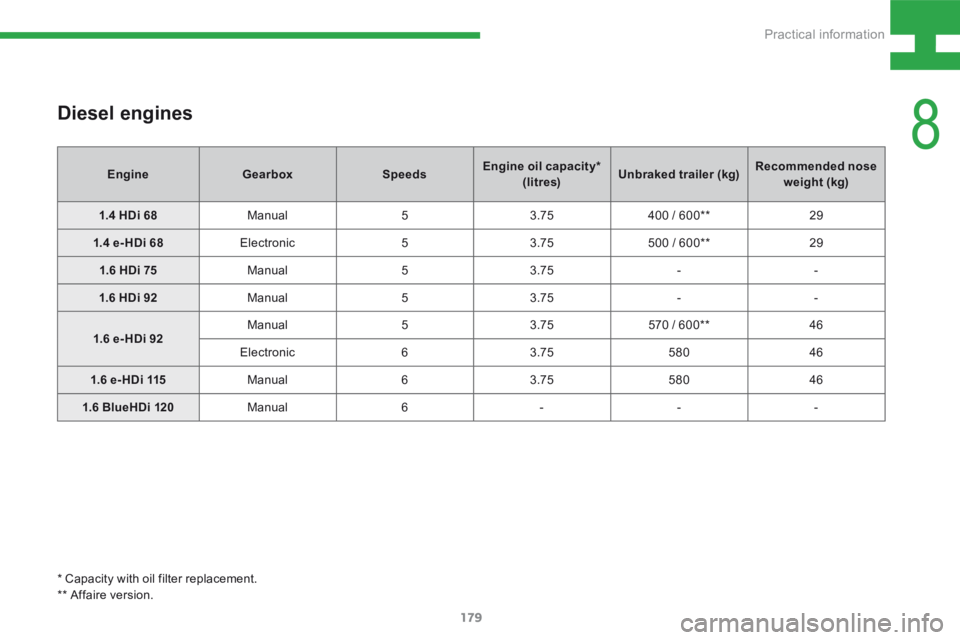
179
208_en_Chap08_Informations-pratiques_ed01-2015
* Capacity with oil filter replacement.
** Affaire version.
Diesel engines
EngineGearbox SpeedsEngine oil capacity*
(litres) Unbraked trailer (kg) Recommended nose
weight (kg)
1.4 HDi 68 Manual 53.75400 / 600** 29
1.4 e- HDi 68 Electronic 53.75500 / 600** 29
1.6 HDi 75 Manual 53.75 --
1.6 HDi 92 Manual 53.75 --
1.6 e- HDi 92 Manual
53.75570 / 600** 46
Electronic 63.75 580 46
1.6 e- HDi 115 Manual63.75 580 46
1.6 BlueHDi 120 Manual6---
8
Practical information