ignition PEUGEOT 3008 2009.5. Workshop Manual
[x] Cancel search | Manufacturer: PEUGEOT, Model Year: 2009.5., Model line: 3008, Model: PEUGEOT 3008 2009.5.Pages: 290, PDF Size: 20.67 MB
Page 136 of 290
132
Particular situations
In certain situations (e.g. star-
ting the engine), the parking brake
can automatically alter its force. This
is normal operation.
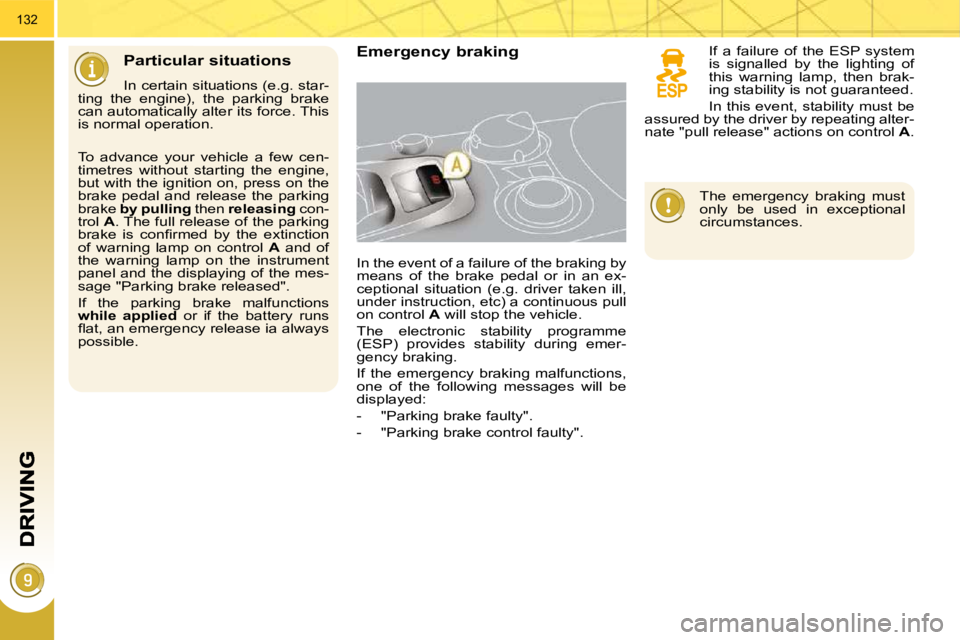
Emergency braking
In the event of a failure of the braking by
means of the brake pedal or in an ex-
ceptional situation (e.g. driver taken ill,
under instruction, etc) a continuous pull
on control A will stop the vehicle.
The electronic stability programme
(ESP) provides stability during emer-
gency braking.
If the emergency braking malfunctions,
one of the following messages will be
displayed:
- "Parking brake faulty".
- "Parking brake control faulty".
To advance your vehicle a few cen-
timetres without starting the engine,
but with the ignition on, press on the
brake pedal and release the parking
brake
by pulling then releasing con-
trol A . The full release of the parking
brake is confi rmed by the extinction
of warning lamp on control A and of
the warning lamp on the instrument
panel and the displaying of the mes-
sage "Parking brake released".
If the parking brake malfunctions
while applied or if the battery runs
fl at, an emergency release ia always
possible. If a failure of the ESP system
is signalled by the lighting of
this warning lamp, then brak-
ing stability is not guaranteed.
In this event, stability must be
assured by the driver by repeating alter-
nate "pull release" actions on control A .
The emergency braking must
only be used in exceptional
circumstances.
Page 137 of 290
133
Emergency unlocking
For safety reasons, after this
manoeuvre it is essential to
contact a PEUGEOT dealer
urgently.
Following an emergency unlocking,
immobilisation of the vehicle is no
longer guaranteed once the manual
emergency unlocking has been de-
ployed and the manual control does
not allow the re-application of your
parking brake.
Take no action, either on control A , or
stopping starting the engine while the
unlocking device is engaged.
Take care not to allow moisture or
dust in the proximity of the plug.
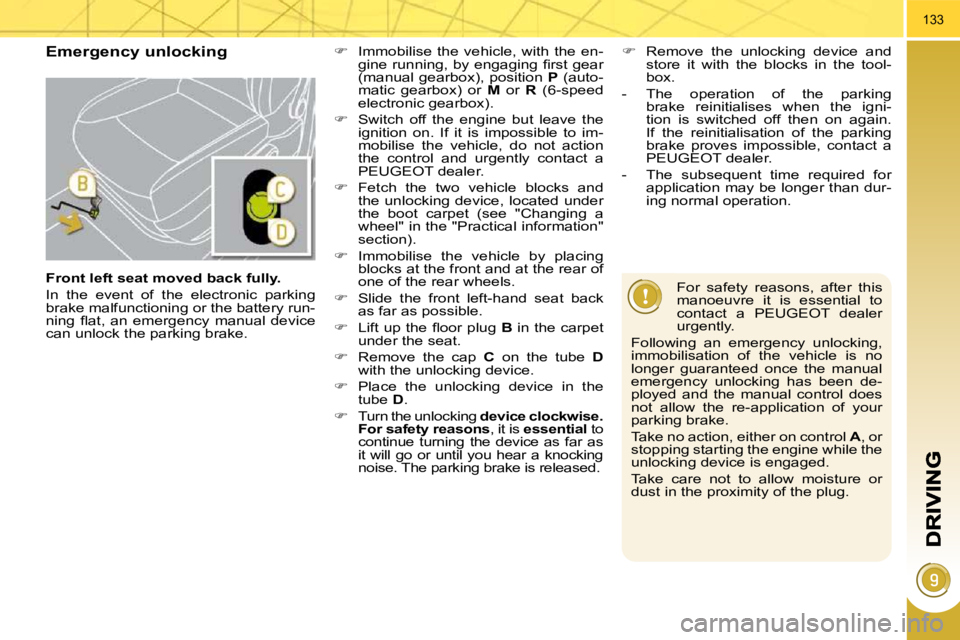
Immobilise the vehicle, with the en-
gine running, by engaging fi rst gear
(manual gearbox), position P (auto-
matic gearbox) or M or R (6-speed
electronic gearbox).
Switch off the engine but leave the
ignition on. If it is impossible to im-
mobilise the vehicle, do not action
the control and urgently contact a
PEUGEOT dealer.
Fetch the two vehicle blocks and
the unlocking device, located under
the boot carpet (see "Changing a
wheel" in the "Practical information"
section).
Immobilise the vehicle by placing
blocks at the front and at the rear of
one of the rear wheels.
Slide the front left-hand seat back
as far as possible.
Lift up the fl oor plug B in the carpet
under the seat.
Remove the cap C on the tube D
with the unlocking device.
Place the unlocking device in the
tube D .
Turn the unlocking device clockwise.
For safety reasons , it is essential to
continue turning the device as far as
it will go or until you hear a knocking
noise. The parking brake is released.
Remove the unlocking device and
store it with the blocks in the tool-
box.
- The operation of the parking brake reinitialises when the igni-
tion is switched off then on again.
If the reinitialisation of the parking
brake proves impossible, contact a
PEUGEOT dealer.
- The subsequent time required for application may be longer than dur-
ing normal operation.
Front left seat moved back fully.
In the event of the electronic parking
brake malfunctioning or the battery run-
ning fl at, an emergency manual device
can unlock the parking brake.
Page 139 of 290
137
System which projects various informa-
tion onto a transparent strip in the fi eld
of vision of the driver so that he does
not have to take his eyes off the road.
This system operates when the engine
is running and the settings are stored
when the ignition is switched off.
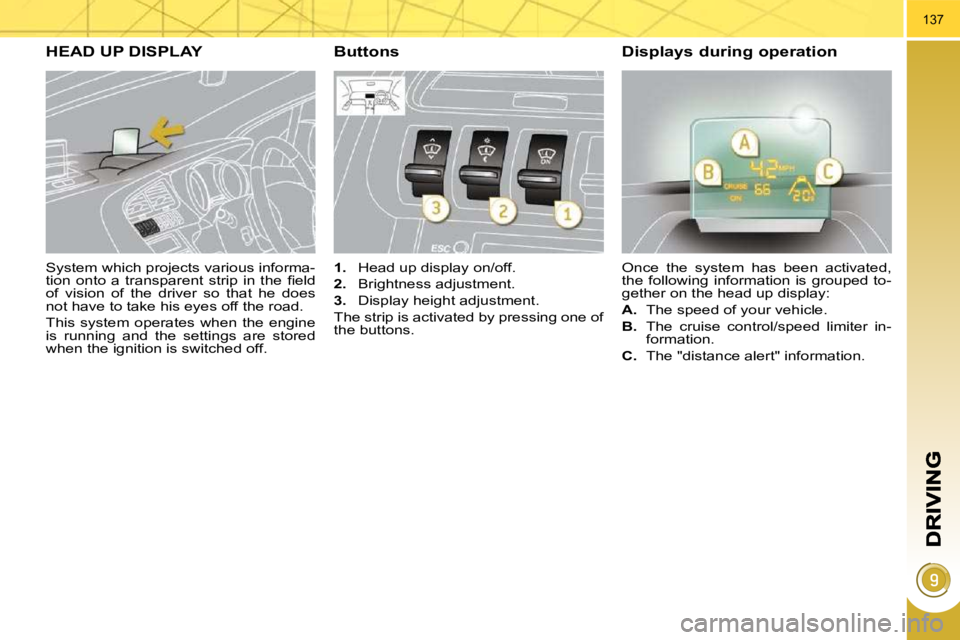
HEAD UP DISPLAY
1. Head up display on/off.
2. Brightness adjustment.
3. Display height adjustment.
The strip is activated by pressing one of
the buttons. Once the system has been activated,
the following information is grouped to-
gether on the head up display:
A. The speed of your vehicle.
B. The cruise control/speed limiter in-
formation.
C. The "distance alert" information.
Buttons Displays during operation
Page 141 of 290
139
"DISTANCE ALERT"
For the safety time to be observed, re-
fer to the current legislation or highway
code recommendations in your country.
The system operates when the speed
of your vehicle is higher than 45 mph
(70 km/h) and below 90 mph (150 km/h).
It has a programmable visual alert
which remains in the memory when the
ignition is switched off.
This system is a driving aid and cannot,
in any circumstances, take the place of
the vigilance and responsibility of the
driver.
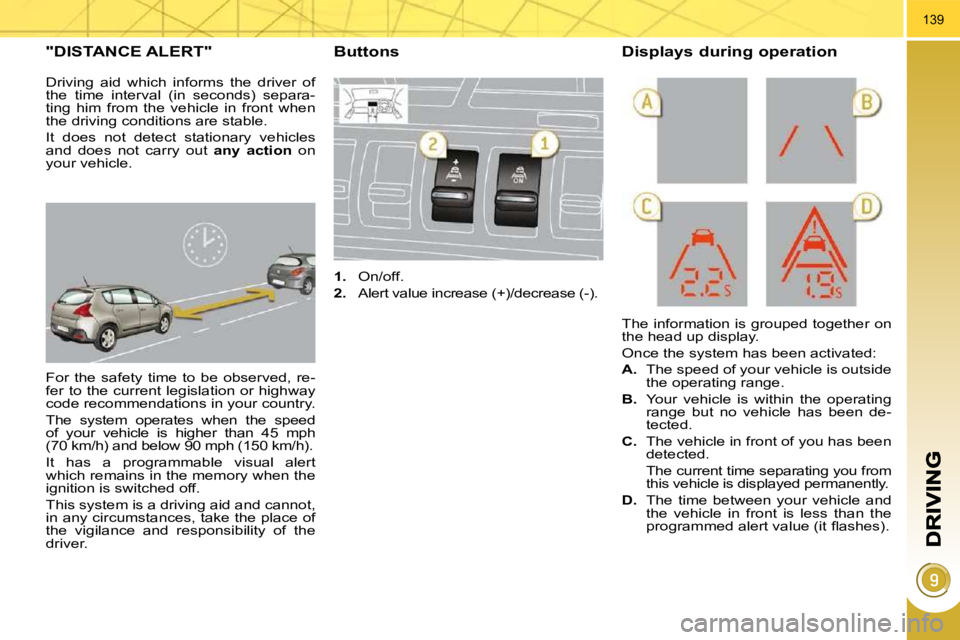
1. On/off.
2. Alert value increase (+)/decrease (-).
The information is grouped together on
the head up display.
Once the system has been activated:
A. The speed of your vehicle is outside
the operating range.
B. Your vehicle is within the operating
range but no vehicle has been de-
tected.
C. The vehicle in front of you has been
detected.
The current time separating you from this vehicle is displayed permanently.
D. The time between your vehicle and
the vehicle in front is less than the
programmed alert value (it fl ashes).
Buttons Displays during operation
Driving aid which informs the driver of
the time interval (in seconds) separa-
ting him from the vehicle in front when
the driving conditions are stable.
It does not detect stationary vehicles
and does not carry out any action on
your vehicle.
Page 143 of 290
141
SPEED LIMITER
System which prevents the vehicle from
exceeding the speed programmed by
the driver.
When the programmed speed limit is
reached, pressing the accelerator pedal
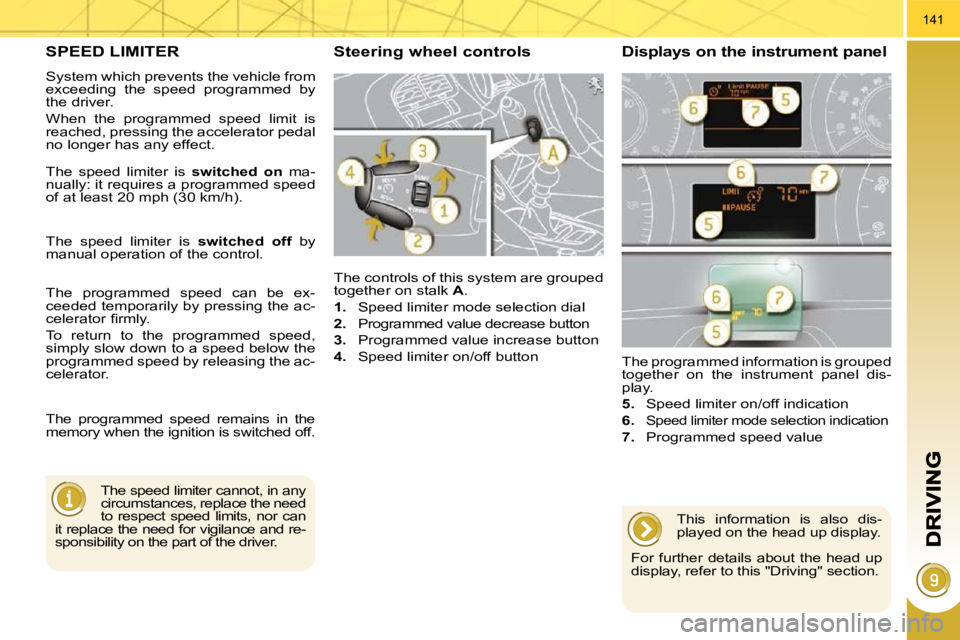
no longer has any effect. The controls of this system are grouped
together on stalk A .
1. Speed limiter mode selection dial
2. Programmed value decrease button
3. Programmed value increase button
4. Speed limiter on/off button
The programmed information is grouped
together on the instrument panel dis-
play.
5. Speed limiter on/off indication
6.
Speed limiter mode selection indication
7. Programmed speed value
Steering wheel controls Displays on the instrument panel
The speed limiter cannot, in any
circumstances, replace the need
to respect speed limits, nor can
it replace the need for vigilance and re-
sponsibility on the part of the driver.
The speed limiter is
switched on ma-
nually: it requires a programmed speed
of at least 20 mph (30 km/h).
The speed limiter is switched off by
manual operation of the control.
The programmed speed can be ex-
ceeded temporarily by pressing the ac-
celerator fi rmly.
To return to the programmed speed,
simply slow down to a speed below the
programmed speed by releasing the ac-
celerator.
The programmed speed remains in the
memory when the ignition is switched off.
This information is also dis-
played on the head up display.
For further details about the head up
display, refer to this "Driving" section.
Page 145 of 290
143
CRUISE CONTROL
System which automatically maintains
the speed of the vehicle at the value
programmed by the driver, without any
action on the accelerator pedal.
The cruise control is switched on
manually: it requires a minimum vehicle
speed of 25 mph (40 km/h) and the en-
gaging:
- of fourth gear on the manual gear- box,
- of second gear on the piloted manual gearbox or automatic gearbox, in se-
quential driving mode,
- of position A on the piloted manual
gearbox or D on the automatic gear-
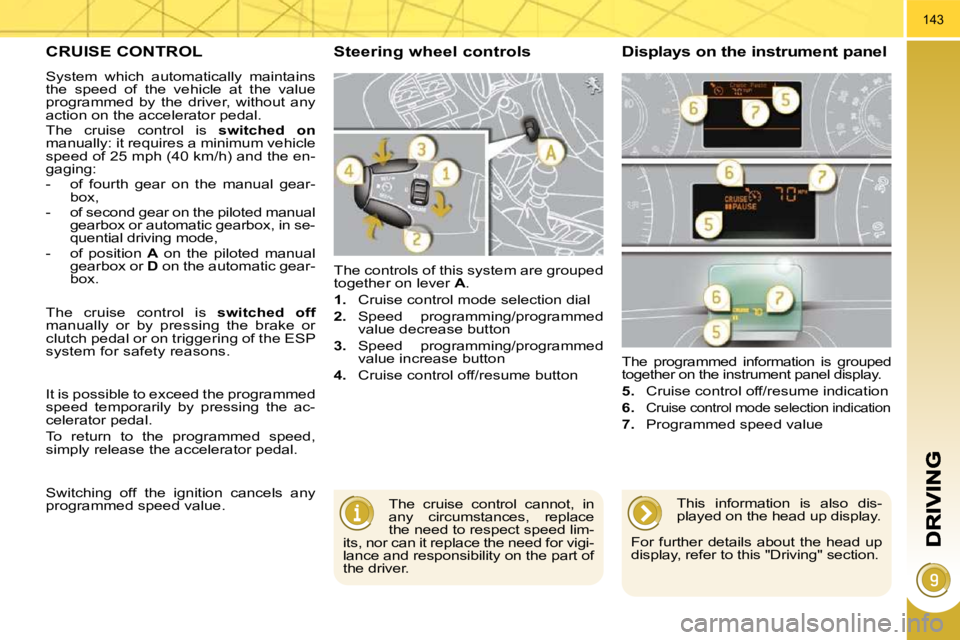
box. The controls of this system are grouped
together on lever
A .
1. Cruise control mode selection dial
2. Speed programming/programmed
value decrease button
3. Speed programming/programmed
value increase button
4. Cruise control off/resume button The programmed information is grouped
together on the instrument panel display.
5. Cruise control off/resume indication
6.
Cruise control mode selection indication
7. Programmed speed value
Steering wheel controls Displays on the instrument panel
The cruise control cannot, in
any circumstances, replace
the need to respect speed lim-
its, nor can it replace the need for vigi-
lance and responsibility on the part of
the driver.
The cruise control is
switched off
manually or by pressing the brake or
clutch pedal or on triggering of the ESP
system for safety reasons.
It is possible to exceed the programmed
speed temporarily by pressing the ac-
celerator pedal.
To return to the programmed speed,
simply release the accelerator pedal.
Switching off the ignition cancels any
programmed speed value. This information is also dis-
played on the head up display.
For further details about the head up
display, refer to this "Driving" section.
Page 151 of 290
149
Stopping the vehicle Operating fault
With the ignition on, if this
warning light comes on and
AUTO fl ashes, accompanied
by an audible signal and a
message on the multifunction
display, this indicates a malfunction of
the gearbox.
Have it checked by a PEUGEOT dealer.
It is essential to press the
brake pedal when starting the
engine.
When parking, is it essential to apply
the handbrake to immobilise the ve-
hicle, whatever the circumstances.
When immobilising the vehi-
cle, with the engine running, it
is essential to place the gear
lever in neutral N .
Before carrying out any work in the
engine compartment, check that the
gear lever is in neutral N and that
the handbrake is applied.
Sport function
Following selection of the sequential
mode or automatic mode, press but-
ton S to activate the Sport function
which offers you a more dynamic
style of driving.
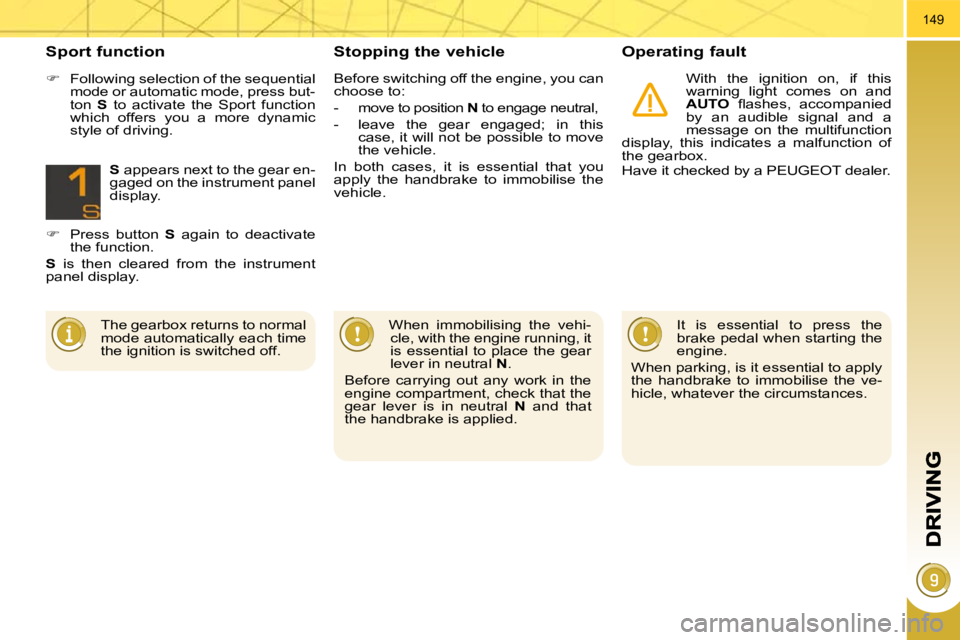
S appears next to the gear en-
gaged on the instrument panel
display.
Press button S again to deactivate
the function.
S is then cleared from the instrument
panel display.
The gearbox returns to normal
mode automatically each time
the ignition is switched off. Before switching off the engine, you can
choose to:
- move to position
N to engage neutral,
- leave the gear engaged; in this case, it will not be possible to move
the vehicle.
In both cases, it is essential that you
apply the handbrake to immobilise the
vehicle.
Page 154 of 290
152
Stopping the vehicle
Before switching off the engine, you
can engage position P or N to place the
gearbox in neutral.
In both cases, apply the handbrake to
immobilise the vehicle, unless it is pro-
grammed to automatic mode.
Operating fault
When the ignition is on, the
lighting of this warning light,
accompanied by an audible
signal and a message on the
multifunction display, indicates
a gearbox malfunction.
In this case, the gearbox switches to
emergency mode and is locked in 3rd
gear. You may feel a substantial knock
when changing from P to R and from N
to R . This will not cause any damage to
the gearbox.
Do not exceed 60 mph (100 km/h), local
speed restrictions permitting.
Have it checked by a PEUGEOT dealer.
This warning light may also come on if a
door is opened.
If the battery is fl at and the le-
ver is in position P , it will not
be possible to change to an-
other position.
Above all, do not force the lever as
this could damage the gearbox.
Never press the brake and accelera-
tor pedals at the same time. Brake or
accelerate using the right foot only.
Pressing both pedals simultaneously
could damage the gearbox.
Manual operation
Select position M for sequential
changing of the six gears.
Push the lever towards the + sign to
change up a gear.
Pull the lever towards the - sign to
change down a gear.
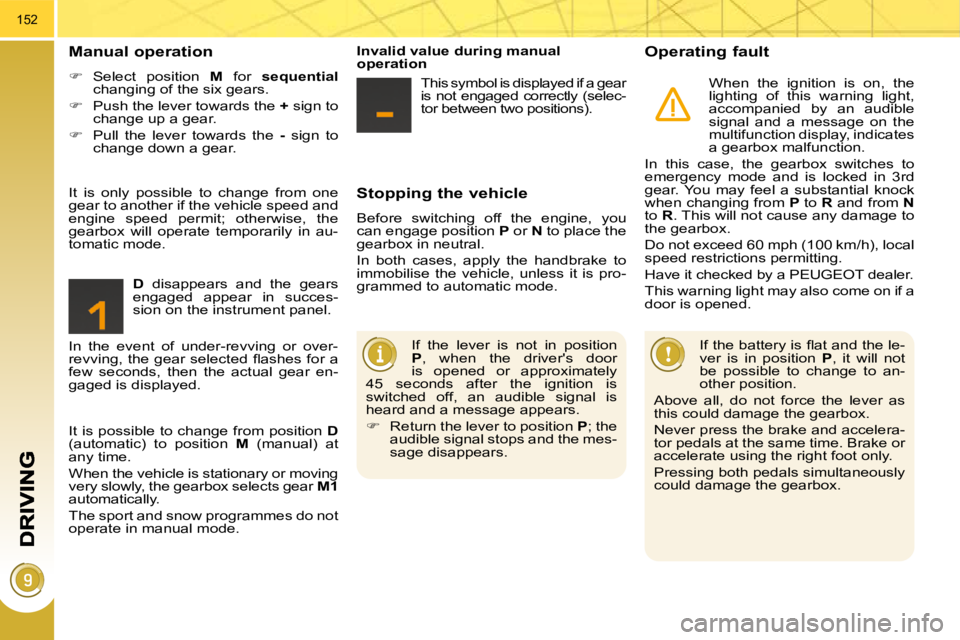
D disappears and the gears
engaged appear in succes-
sion on the instrument panel.
If the lever is not in position
P , when the driver's door
is opened or approximately
45 seconds after the ignition is
switched off, an audible signal is
heard and a message appears.
Return the lever to position P ; the
audible signal stops and the mes-
sage disappears.
It is only possible to change from one
gear to another if the vehicle speed and
engine speed permit; otherwise, the
gearbox will operate temporarily in au-
tomatic mode.
Invalid value during manual
operation
This symbol is displayed if a gear
is not engaged correctly (selec-
tor between two positions).
It is possible to change from position D
(automatic) to position M (manual) at
any time.
When the vehicle is stationary or moving
very slowly, the gearbox selects gear M1
automatically.
The sport and snow programmes do not
operate in manual mode.
In the event of under-revving or over-
revving, the gear selected fl ashes for a
few seconds, then the actual gear en-
gaged is displayed.
Page 161 of 290
CHECKS
160
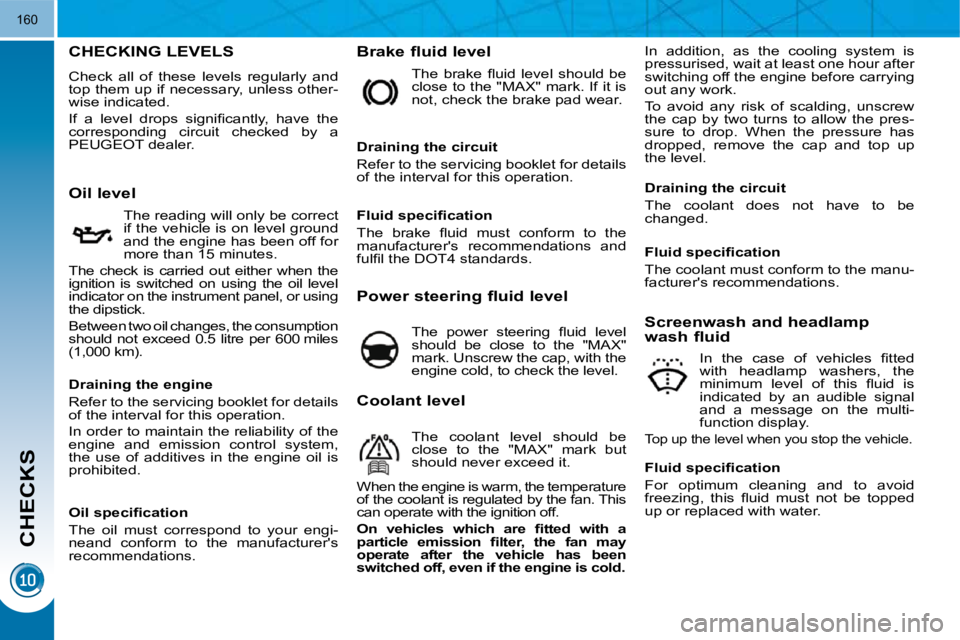
CHECKING LEVELS
Check all of these levels regularly and
top them up if necessary, unless other-
wise indicated.
If a level drops signifi cantly, have the
corresponding circuit checked by a
PEUGEOT dealer. Brake fluid level
In addition, as the cooling system is
pressurised, wait at least one hour after
switching off the engine before carrying
out any work.
To avoid any risk of scalding, unscrew
the cap by two turns to allow the pres-
sure to drop. When the pressure has
dropped, remove the cap and top up
the level.
Oil level The reading will only be correct
if the vehicle is on level ground
and the engine has been off for
more than 15 minutes.
The check is carried out either when the
ignition is switched on using the oil level
indicator on the instrument panel, or using
the dipstick.
Between two oil changes, the consumption
should not exceed 0.5 litre per 600 miles
(1,000 km). The brake fl uid level should be
close to the "MAX" mark. If it is
not, check the brake pad wear.
Draining the circuit
Refer to the servicing booklet for details
of the interval for this operation.
Power steering fluid level The power steering fl uid level
should be close to the "MAX"
mark. Unscrew the cap, with the
engine cold, to check the level. Screenwash and headlamp
wash fluid
In the case of vehicles fi tted
with headlamp washers, the
minimum level of this fl uid is
indicated by an audible signal
and a message on the multi-
function display.
Top up the level when you stop the vehicle.
Draining the engine
Refer to the servicing booklet for details
of the interval for this operation.
In order to maintain the reliability of the
engine and emission control system,
the use of additives in the engine oil is
prohibited.
Oil specifi cation
The oil must correspond to your engi-
neand conform to the manufacturer's
recommendations. Fluid specifi cation
The brake fl uid must conform to the
manufacturer's recommendations and
fulfi l the DOT4 standards.
Draining the circuit
The coolant does not have to be
changed.
Fluid specifi cation
For optimum cleaning and to avoid
freezing, this fl uid must not be topped
up or replaced with water.
Coolant level
The coolant level should be
close to the "MAX" mark but
should never exceed it.
When the engine is warm, the temperature
of the coolant is regulated by the fan. This
can operate with the ignition off.
On vehicles which are fi tted with a
particle emission fi lter, the fan may
operate after the vehicle has been
switched off, even if the engine is cold. Fluid specifi cation
The coolant must conform to the manu-
facturer's recommendations.
Page 166 of 290
PRACTICAL INFORMATION
164
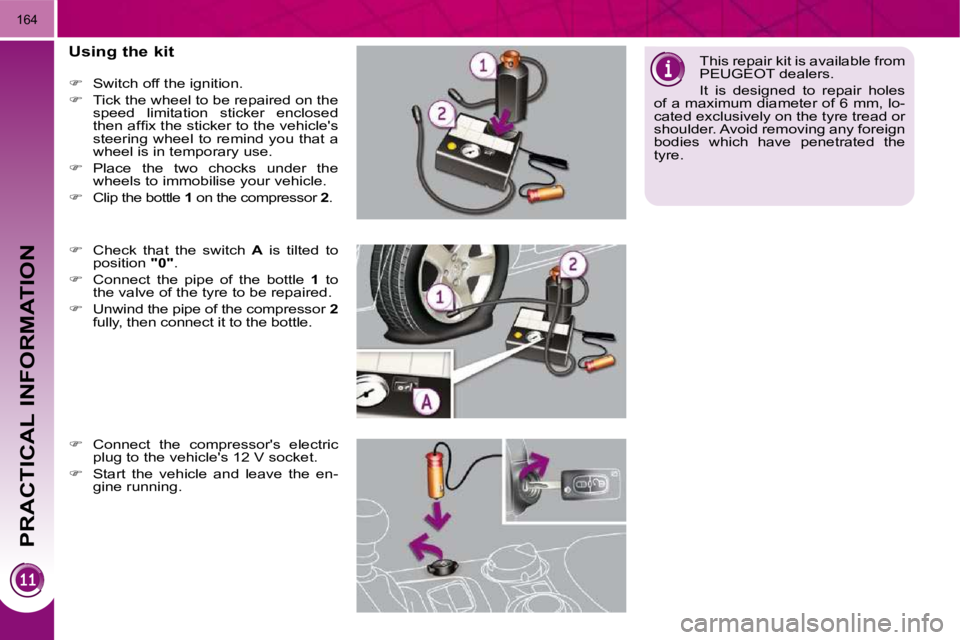
Using the kit
Switch off the ignition.
Tick the wheel to be repaired on the
speed limitation sticker enclosed
then affi x the sticker to the vehicle's
steering wheel to remind you that a
wheel is in temporary use.
Place the two chocks under the
wheels to immobilise your vehicle.
Clip the bottle 1 on the compressor 2 .
Check that the switch A is tilted to
position "0" .
Connect the pipe of the bottle 1 to
the valve of the tyre to be repaired.
Unwind the pipe of the compressor 2
fully, then connect it to the bottle.
Connect the compressor's electric
plug to the vehicle's 12 V socket.
Start the vehicle and leave the en-
gine running. This repair kit is available from
PEUGEOT dealers.
It is designed to repair holes
of a maximum diameter of 6 mm, lo-
cated exclusively on the tyre tread or
shoulder. Avoid removing any foreign
bodies which have penetrated the
tyre.