ECO mode PEUGEOT 3008 2013 Owner's Manual
[x] Cancel search | Manufacturer: PEUGEOT, Model Year: 2013, Model line: 3008, Model: PEUGEOT 3008 2013Pages: 352, PDF Size: 15.64 MB
Page 100 of 352
98
VIS
Different lighting times are
available:
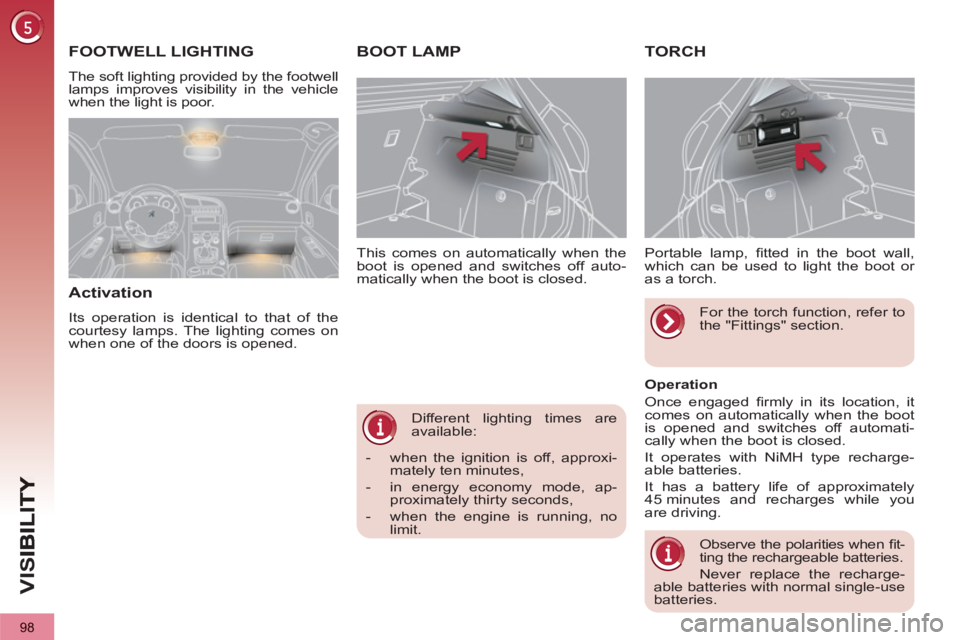
This comes on automatically when the
boot is opened and switches off auto-
matically when the boot is closed.
BOOT LAMP TORCH
Portable lamp, fi tted in the boot wall,
which can be used to light the boot or
as a torch.
Operation
Once engaged fi rmly in its location, it
comes on automatically when the boot
is opened and switches off automati-
cally when the boot is closed.
It operates with NiMH type recharge-
able batteries.
It has a battery life of approximately
45 minutes and recharges while you
are driving.
Observe the polarities when fi t-
ting the rechargeable batteries.
Never replace the recharge-
able batteries with normal single-use
batteries.
For the torch function, refer to
the "Fittings" section.
FOOTWELL LIGHTING
The soft lighting provided by the footwell
lamps improves visibility in the vehicle
when the light is poor.
Activation
Its operation is identical to that of the
courtesy lamps. The lighting comes on
when one of the doors is opened.
- when the ignition is off, approxi-
mately ten minutes,
- in energy economy mode, ap-
proximately thirty seconds,
- when the engine is running, no
limit.
Page 126 of 352
124
SA
F
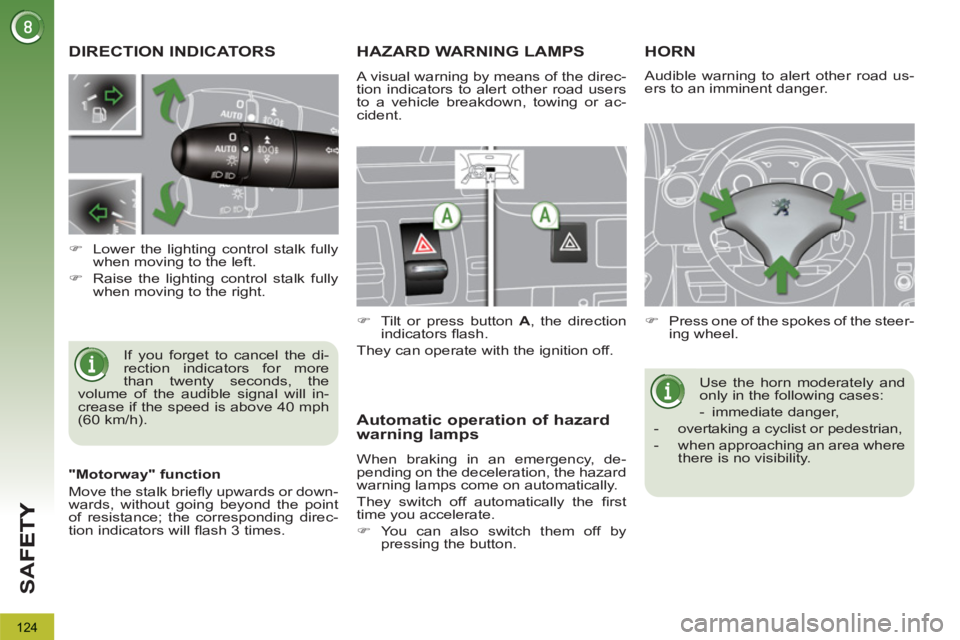
DIRECTION INDICATORS
If you forget to cancel the di-
rection indicators for more
than twenty seconds, the
volume of the audible signal will in-
crease if the speed is above 40 mph
(60 km/h).
)
Lower the lighting control stalk fully
when moving to the left.
)
Raise the lighting control stalk fully
when moving to the right.
HAZARD WARNING LAMPS
A visual warning by means of the direc-
tion indicators to alert other road users
to a vehicle breakdown, towing or ac-
cident.
)
Tilt or press button A
, the direction
indicators fl ash.
They can operate with the ignition off.
Automatic operation of hazard
warning lamps
When braking in an emergency, de-
pending on the deceleration, the hazard
warning lamps come on automatically.
They switch off automatically the fi rst
time you accelerate.
)
You can also switch them off by
pressing the button.
HORN
)
Press one of the spokes of the steer-
ing wheel.
Use the horn moderately and
only in the following cases:
- immediate danger,
- overtaking a cyclist or pedestrian,
- when approaching an area where
there is no visibility.
Audible warning to alert other road us-
ers to an imminent danger.
"Motorway" function
Move the stalk briefl y upwards or down-
wards, without going beyond the point
of resistance; the corresponding direc-
tion indicators will fl ash 3 times.
Page 131 of 352
129
SA
F
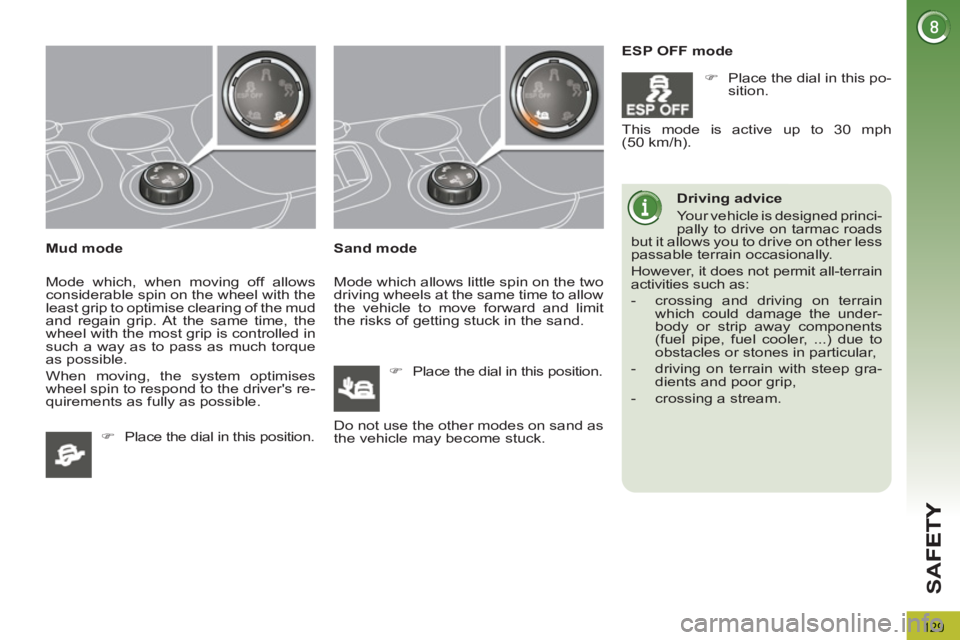
Mud mode
Mode which, when moving off allows
considerable spin on the wheel with the
least grip to optimise clearing of the mud
and regain grip. At the same time, the
wheel with the most grip is controlled in
such a way as to pass as much torque
as possible.
When moving, the system optimises
wheel spin to respond to the driver's re-
quirements as fully as possible.
Sand mode
Mode which allows little spin on the two
driving wheels at the same time to allow
the vehicle to move forward and limit
the risks of getting stuck in the sand.
Driving advice
Your vehicle is designed princi-
pally to drive on tarmac roads
but it allows you to drive on other less
passable terrain occasionally.
However, it does not permit all-terrain
activities such as:
- crossing and driving on terrain
which could damage the under-
body or strip away components
(fuel pipe, fuel cooler, ...) due to
obstacles or stones in particular,
- driving on terrain with steep gra-
dients and poor grip,
- crossing a stream.
)
Place the dial in this position.
)
Place the dial in this position.
ESP OFF mode
)
Place the dial in this po-
sition.
Do not use the other modes on sand as
the vehicle may become stuck. This mode is active up to 30 mph
(50 km/h).
Page 139 of 352
137
D
R
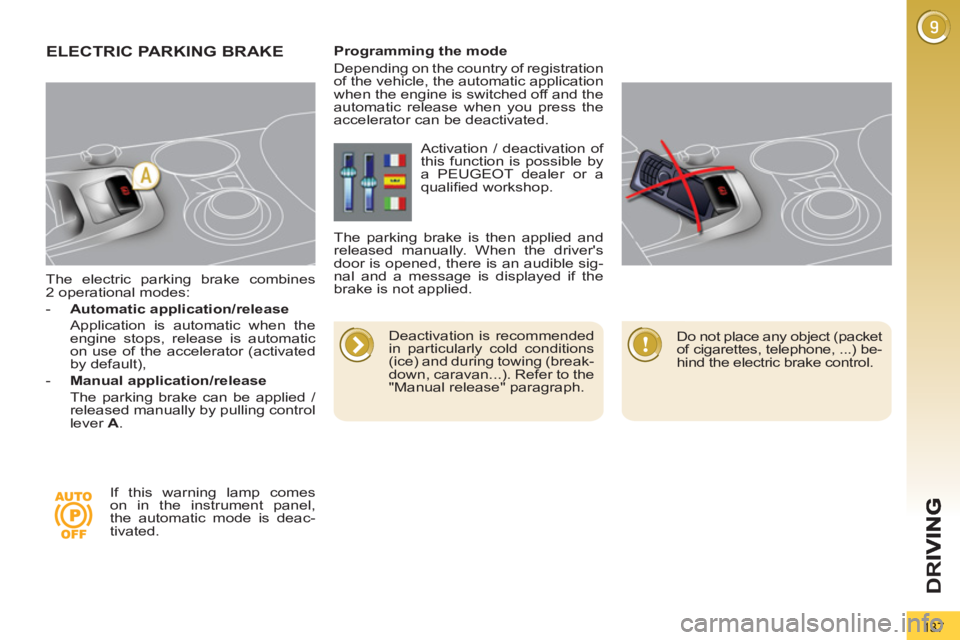
The electric parking brake combines
2 operational modes:
- Automatic application/release
Application is automatic when the
engine stops, release is automatic
on use of the accelerator (activated
by default),
- Manual application/release
The parking brake can be applied /
released manually by pulling control
lever A
.
ELECTRIC PARKING BRAKE
Deactivation is recommended
in particularly cold conditions
(ice) and during towing (break-
down, caravan...). Refer to the
"Manual release" paragraph.
Programming the mode
Depending on the country of registration
of the vehicle, the automatic application
when the engine is switched off and the
automatic release when you press the
accelerator can be deactivated.
If this warning lamp comes
on in the instrument panel,
the automatic mode is deac-
tivated. Activation / deactivation of
this function is possible by
a PEUGEOT dealer or a
qualifi ed workshop.
The parking brake is then applied and
released manually. When the driver's
door is opened, there is an audible sig-
nal and a message is displayed if the
brake is not applied.
Do not place any object (packet
of cigarettes, telephone, ...) be-
hind the electric brake control.
Page 152 of 352
150
D
R
I
On a steep descent or in the
event of sharp acceleration,
the speed limiter will not be
able to prevent the vehicle from ex-
ceeding the programmed speed.
To avoid any risk of jamming of the
pedals:
- ensure that the mat is positioned
correctly,
- do not fi t one mat on top of an-
other.
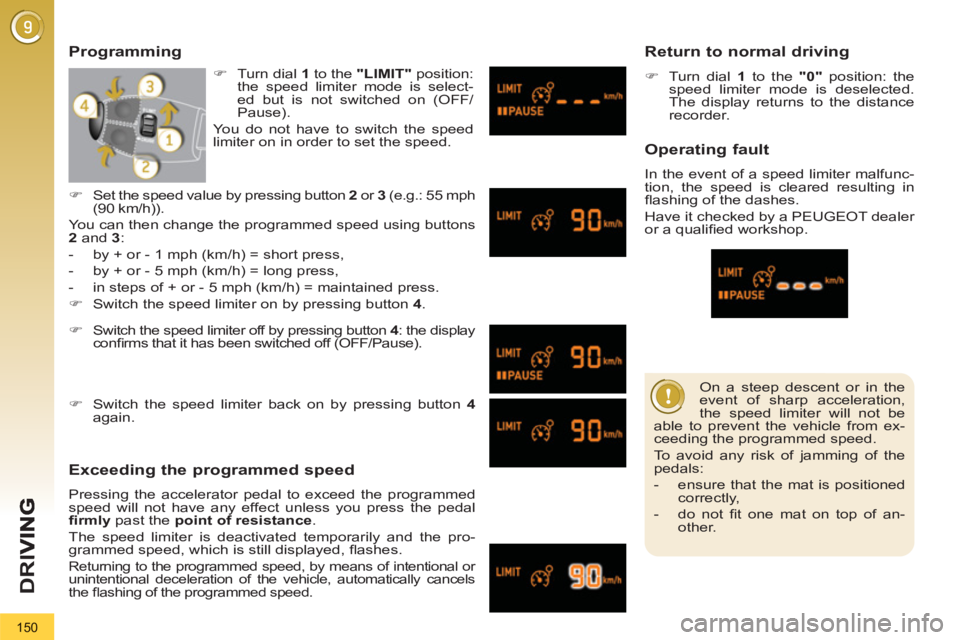
Programming
Exceeding the programmed speed
Pressing the accelerator pedal to exceed the programmed
speed will not have any effect unless you press the pedal
fi rmly
past the point of resistance
.
The speed limiter is deactivated temporarily and the pro-
grammed speed, which is still displayed, fl ashes.
Returning to the programmed speed, by means of intentional or
unintentional deceleration of the vehicle, automatically cancels
the fl ashing of the programmed speed.
Return to normal driving
)
Turn dial 1
to the "0"
position: the
speed limiter mode is deselected.
The display returns to the distance
recorder.
Operating fault
In the event of a speed limiter malfunc-
tion, the speed is cleared resulting in
fl ashing of the dashes.
Have it checked by a PEUGEOT dealer
or a qualifi ed workshop.
)
Switch the speed limiter off by pressing button 4
: the display
confi rms that it has been switched off (OFF/Pause).
)
Switch the speed limiter back on by pressing button 4
again.
)
Set the speed value by pressing button 2
or 3
(e.g.: 55 mph
(90 km/h)).
You can then change the programmed speed using buttons
2
and 3
:
- by + or - 1 mph (km/h) = short press,
- by + or - 5 mph (km/h) = long press,
- in steps of + or - 5 mph (km/h) = maintained press.
)
Switch the speed limiter on by pressing button 4
.
)
Turn dial 1
to the "LIMIT"
position:
the speed limiter mode is select-
ed but is not switched on (OFF/
Pause).
You do not have to switch the speed
limiter on in order to set the speed.
Page 153 of 352
151
D
R
CRUISE CONTROL
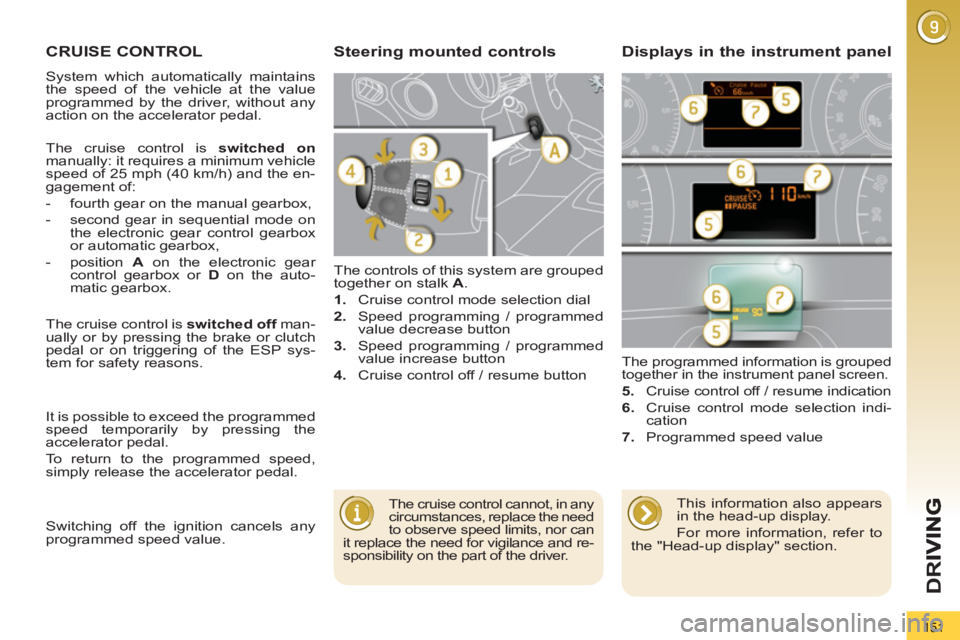
The controls of this system are grouped
together on stalk A
.
1.
Cruise control mode selection dial
2.
Speed programming / programmed
value decrease button
3.
Speed programming / programmed
value increase button
4.
Cruise control off / resume button The programmed information is grouped
together in the instrument panel screen.
5.
Cruise control off / resume indication
6.
Cruise control mode selection indi-
cation
7.
Programmed speed value
Steering mounted controls Displays in the instrument panel
The cruise control cannot, in any
circumstances, replace the need
to observe speed limits, nor can
it replace the need for vigilance and re-
sponsibility on the part of the driver.
The cruise control is switched on
manually: it requires a minimum vehicle
speed of 25 mph (40 km/h) and the en-
gagement of:
- fourth gear on the manual gearbox,
- second gear in sequential mode on
the electronic gear control gearbox
or automatic gearbox,
- position A
on the electronic gear
control gearbox or D
on the auto-
matic gearbox.
The cruise control is switched off
man-
ually or by pressing the brake or clutch
pedal or on triggering of the ESP sys-
tem for safety reasons.
It is possible to exceed the programmed
speed temporarily by pressing the
accelerator pedal.
To return to the programmed speed,
simply release the accelerator pedal.
This information also appears
in the head-up display.
For more information, refer to
the "Head-up display" section.
System which automatically maintains
the speed of the vehicle at the value
programmed by the driver, without any
action on the accelerator pedal.
Switching off the ignition cancels any
programmed speed value.
Page 154 of 352
152
D
R
I
When the cruise control is
switched on, be careful if you
maintain the pressure on one
of the programmed speed changing
buttons: this may result in a very rapid
change in the speed of your vehicle.
Do not use the cruise control on slip-
pery roads or in heavy traffi c.
On a steep descent, the cruise con-
trol will not be able to prevent the
vehicle from exceeding the pro-
grammed speed.
To avoid any risk of jamming of the
pedals:
- ensure that the mat is positioned
correctly,
- never fi t one mat on top of another.
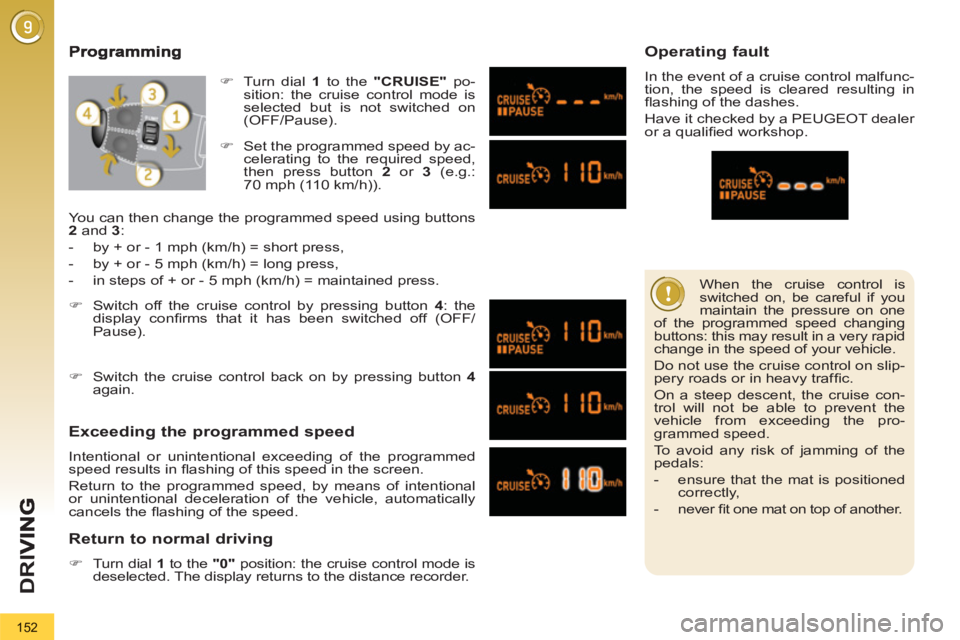
Exceeding the programmed speed
Intentional or unintentional exceeding of the programmed
speed results in fl ashing of this speed in the screen.
Return to the programmed speed, by means of intentional
or unintentional deceleration of the vehicle, automatically
cancels the fl ashing of the speed.
Return to normal driving
)
Turn dial 1
to the "0"
position: the cruise control mode is
deselected. The display returns to the distance recorder.
Operating fault
In the event of a cruise control malfunc-
tion, the speed is cleared resulting in
fl ashing of the dashes.
Have it checked by a PEUGEOT dealer
or a qualifi ed workshop.
)
Set the programmed speed by ac-
celerating to the required speed,
then press button 2
or 3
(e.g.:
70 mph (110 km/h)).
)
Switch off the cruise control by pressing button 4
: the
display confi rms that it has been switched off (OFF/
Pause).
)
Switch the cruise control back on by pressing button 4
again.
You can then change the programmed speed using buttons
2
and 3
:
- by + or - 1 mph (km/h) = short press,
- by + or - 5 mph (km/h) = long press,
- in steps of + or - 5 mph (km/h) = maintained press.
)
Turn dial 1
to the "CRUISE"
po-
sition: the cruise control mode is
selected but is not switched on
(OFF/Pause).
Page 155 of 352
153
D
R
6-SPEED MANUAL GEARBOX
As a safety precaution and to
facilitate starting of the engine: Only engage reverse gear
when the vehicle is stationary
with the engine at idle.
Engaging 5 thor 6 thgear
)
Move the lever fully to the right to
engage 5 th or 6 th
gear.
GEAR SHIFT INDICATOR *
O
peration
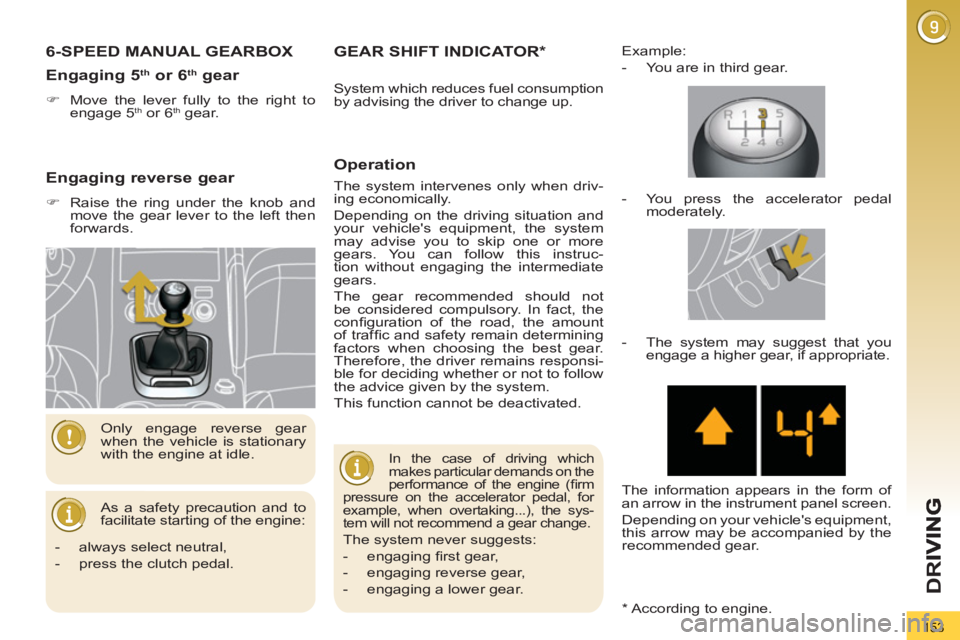
Example:
- You are in third gear.
In the case of driving which
makes particular demands on the
performance of the engine (fi rm
pressure on the accelerator pedal, for
example, when overtaking...), the sys-
tem will not recommend a gear change.
The system never suggests:
- engaging fi rst gear,
- engaging reverse gear,
- engaging a lower gear.
- You press the accelerator pedal
moderately.
- The system may suggest that you
engage a higher gear, if appropriate.
The information appears in the form of
an arrow in the instrument panel screen.
Depending on your vehicle's equipment,
this arrow may be accompanied by the
recommended gear.
- always select neutral,
- press the clutch pedal.
Engaging reverse gear
)
Raise the ring under the knob and
move the gear lever to the left then
forwards.
System which reduces fuel consumption
by advising the driver to change up.
* According to engine.
The system intervenes only when driv-
ing economically.
Depending on the driving situation and
your vehicle's equipment, the system
may advise you to skip one or more
gears. You can follow this instruc-
tion without engaging the intermediate
gears.
The gear recommended should not
be considered compulsory. In fact, the
confi guration of the road, the amount
of traffi c and safety remain determining
factors when choosing the best gear.
Therefore, the driver remains responsi-
ble for deciding whether or not to follow
the advice given by the system.
This function cannot be deactivated.
Page 162 of 352
160
D
R
I
Stopping the vehicle
Before switching off the engine, you
can engage position P
or N
to place the
gearbox in neutral.
In both cases, apply the parking brake
to immobilise the vehicle, unless it is
programmed to automatic mode.
Operating fault
When the ignition is on, the
lighting of this warning lamp,
accompanied by an audible
signal and a message in the
multifunction screen, indicates
a gearbox malfunction.
In this case, the gearbox switches to
back-up mode and is locked in 3rd gear.
You may feel a substantial knock when
changing from P
to R
and from N
to R
.
This will not cause any damage to the
gearbox.
Do not exceed 60 mph (100 km/h), local
speed restrictions permitting.
Have it checked by a PEUGEOT dealer
or a qualifi ed workshop.
This warning lamp may also come on if
a door is opened.
You risk damaging the gearbox:
Manual operation
)
Select position M
for sequential
changing of the six gears.
)
Push the lever towards the +
sign to
change up a gear.
)
Pull the lever towards the -
sign to
change down a gear.
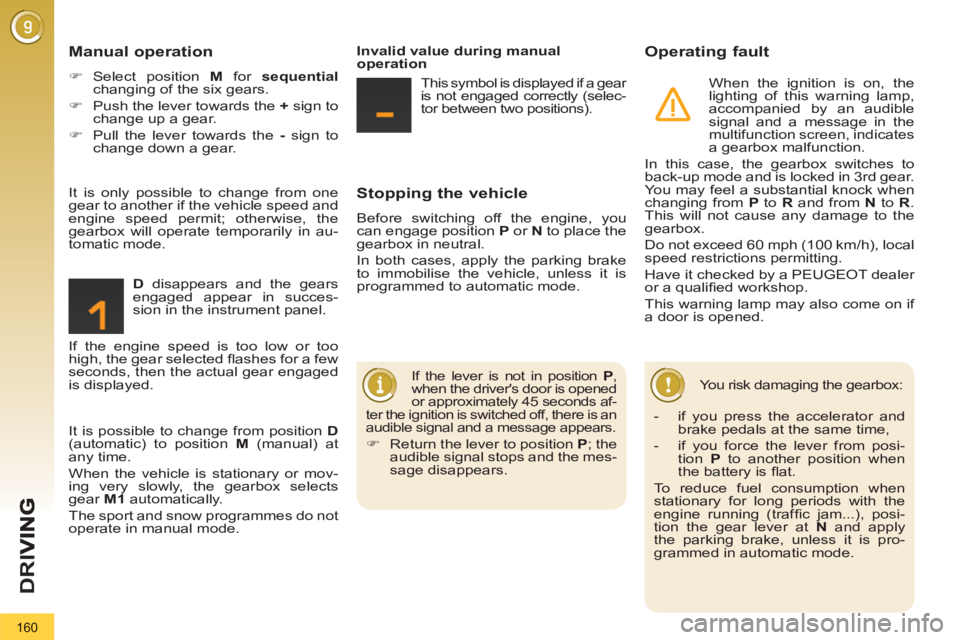
D
disappears and the gears
engaged appear in succes-
sion in the instrument panel.
If the lever is not in position P
,
when the driver's door is opened
or approximately 45 seconds af-
ter the ignition is switched off, there is an
audible signal and a message appears.
)
Return the lever to position P
; the
audible signal stops and the mes-
sage disappears.
It is only possible to change from one
gear to another if the vehicle speed and
engine speed permit; otherwise, the
gearbox will operate temporarily in au-
tomatic mode.
Invalid value during manual
operation
This symbol is displayed if a gear
is not engaged correctly (selec-
tor between two positions).
It is possible to change from position D
(automatic) to position M
(manual) at
any time.
When the vehicle is stationary or mov-
ing very slowly, the gearbox selects
gear M1
automatically.
The sport and snow programmes do not
operate in manual mode. If the engine speed is too low or too
high, the gear selected fl ashes for a few
seconds, then the actual gear engaged
is displayed.
- if you press the accelerator and
brake pedals at the same time,
- if you force the lever from posi-
tion P
to another position when
the battery is fl at.
To reduce fuel consumption when
stationary for long periods with the
engine running (traffi c jam...), posi-
tion the gear lever at N
and apply
the parking brake, unless it is pro-
grammed in automatic mode.
Page 163 of 352
161
D
R
STOP & START
The Stop & Start system puts the engine
temporarily into standby - STOP mode -
during stops in the traffi c (red lights, traf-
fi c jams, or other...). The engine restarts
automatically - START mode - as soon as
you want to move off. The restart takes
place instantly, quickly and silently.
Perfect for urban use, the Stop & Start
system reduces fuel consumption and
exhaust emissions as well as the noise
level when stationary.
Operation
Going into engine STOP mode
The "ECO"
warning lamp comes
on in the instrument panel and
the engine goes into standby:
- with the electronic gearbox sys-
tem
, at speeds below 4 mph (6 km/h),
press the brake pedal or put the gear
lever in position N
.
If your vehicle is fi tted with the system,
a time counter calculates the sum of the
periods in STOP mode during a journey.
It rests itself to zero every time the igni-
tion is switched on with the key.
For your comfort, during park-
ing maoeuvres, STOP mode is
not available for a few seconds
after coming out of reverse gear.
STOP mode does not affect the func-
tionality of the vehicle, such as for
example, braking, power steering...
Never refuel with the engine in
STOP mode; you must switch
off the ignition with the key.
Special cases: STOP mode not
available
STOP mode is not invoked when:
- the driver's door is open,
- the driver's seat belt is not fastened,
- the vehicle has not exceeded 6 mph
(10 km/h) since the last engine start
using the key,
- the electric parking brake is applied
or being applied,
- the engine is needed to maintain a
comfortable temperature in the pas-
senger compartment,
- demisting is active,
- some special conditions (battery
charge, engine temperature, brak-
ing assistance, ambient tempera-
ture...) where the engine is needed
to assure control of a system.
In this case, the "ECO"
warning
lamp fl ashes for a few seconds
then goes off.
This operation is perfectly normal.