warning light Peugeot 306 Break 2002 User Guide
[x] Cancel search | Manufacturer: PEUGEOT, Model Year: 2002, Model line: 306 Break, Model: Peugeot 306 Break 2002Pages: 131, PDF Size: 2.25 MB
Page 73 of 131

SPECIAL FEATURES
126
ALARM SYSTEM* Setting and disarming the alarm Switching off the siren The alarm completes the security equipment of your vehicle. It com-prises two types of protection: -exterior protection: when this is
set, the alarm sounds if a door,
the bonnet, the boot or the tail- gate are opened.
- interior sensor protection: when
it is set, the alarm sounds if thesensors detect a variation in the
air movement inside the vehicle(breaking of a window) or amovement inside the vehicle.
It is also equipped with an anti-
tamper function. If an attempt is made to neutralise the leads to the siren, the centralcontrol or the battery:
- the alarm is triggered,- the siren sounds, the headlights come on*. To set the alarm (exterior and interior protection) The ignition must be switched off.
You must be outside the vehiclePress the locking button of the remote control key (if your vehiclehas deadlocking, you then need topress this button again). The doors will lock.The direction indicators come on continuously for two seconds. The red lamp on the switch flashes once a second. Five seconds afterwards : the exteri- or protection is set. Fifty seconds afterwards : the interi- or protection is set. Note :
when the alarm is triggered,
the siren sounds for thirty seconds. It then stops, but the alarm remains set.
Warning
If, on setting the alarm, a door, the boot, tailgate or the bonnet are notproperly closed, the siren will be trig-
gered briefly. If the vehicle is proper-ly closed within forty five secondsafter this, the alarm is set, the direc-tion indicators come on continuouslyfor two seconds. In all cases the alarm is set forty five seconds afterwards. To disarm the alarm (exteriorand interior protection) Press the unlocking button on the remote control. The doors unlock.The direction indicators flash for two seconds. The red lamp on the switch goes out.Note :
if the lamp continues to flash
after disarming the alarm, it is
because it has been triggered. Thisflashing will stop on switching on theignition.
* According to specification.
Page 84 of 131
YOUR 306 IN DETAIL
102
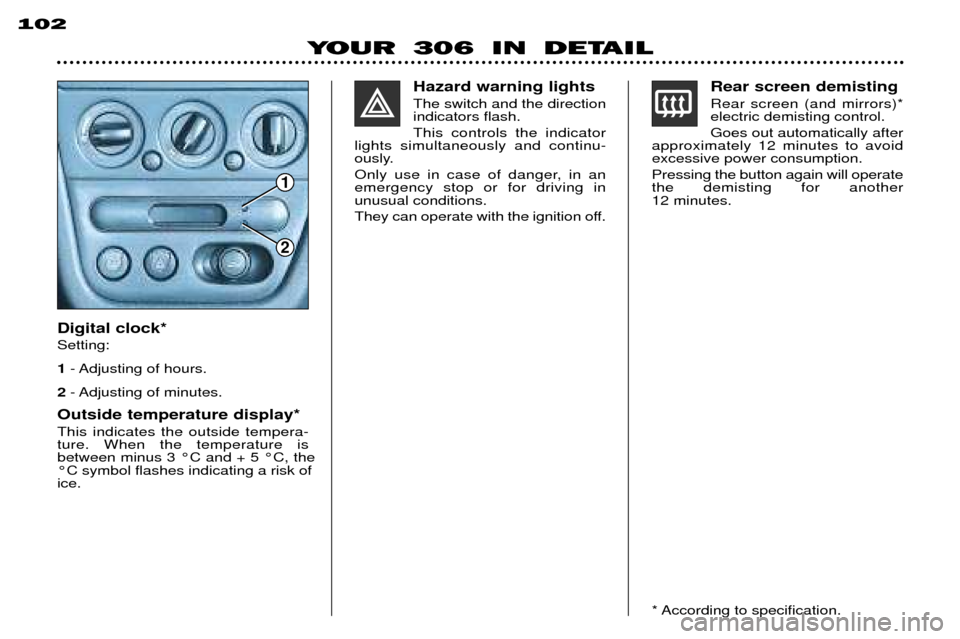
Rear screen demisting Rear screen (and mirrors)* electric demisting control. Goes out automatically after
approximately 12 minutes to avoid excessive power consumption. Pressing the button again will operate the demisting for another 12 minutes.
* According to specification.
Digital clock* Setting: 1
- Adjusting of hours.
2 - Adjusting of minutes.
Outside temperature display* This indicates the outside tempera- ture. When the temperature isbetween minus 3 ¡C and + 5 ¡C, the¡C symbol flashes indicating a risk ofice.Hazard warning lights The switch and the direction indicators flash. This controls the indicator
lights simultaneously and continu-
ously.
Only use in case of danger, in an emergency stop or for driving inunusual conditions.
They can operate with the ignition off.
1
2
Page 89 of 131
108
DRIVING YOUR 306
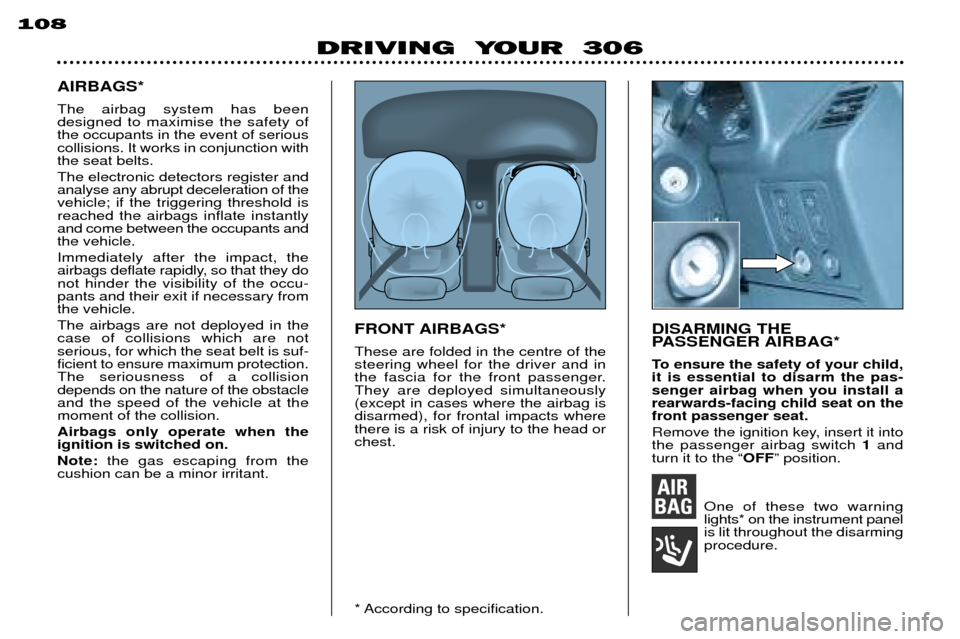
AIRBAGS* The airbag system has been designed to maximise the safety ofthe occupants in the event of seriouscollisions. It works in conjunction withthe seat belts. The electronic detectors register and analyse any abrupt deceleration of thevehicle; if the triggering threshold isreached the airbags inflate instantlyand come between the occupants andthe vehicle. Immediately after the impact, the
airbags deflate rapidly, so that they donot hinder the visibility of the occu-pants and their exit if necessary fromthe vehicle. The airbags are not deployed in the case of collisions which are notserious, for which the seat belt is suf-ficient to ensure maximum protection.The seriousness of a collisiondepends on the nature of the obstacleand the speed of the vehicle at themoment of the collision. Airbags only operate when the ignition is switched on. Note:the gas escaping from the
cushion can be a minor irritant. FRONT AIRBAGS* These are folded in the centre of the steering wheel for the driver and in
the fascia for the front passenger.They are deployed simultaneously(except in cases where the airbag isdisarmed), for frontal impacts wherethere is a risk of injury to the head orchest.
DISARMING THE
PASSENGER AIRBAG*
To ensure the safety of your child, it is essential to disarm the pas-senger airbag when you install arearwards-facing child seat on thefront passenger seat.
Remove the ignition key, insert it into the passenger airbag switch
1and
turn it to the Ò OFFÓ position.
One of these two warninglights* on the instrument panel
is lit throughout the disarmingprocedure.
* According to specification.
Page 90 of 131
109
DRIVING YOUR 306
In the ÒOFFÓ position, the passenger
airbag will not be triggered in the event of an impact. As soon as you remove the rear- wards-facing child seat from the frontpassenger seat, turn the airbag switchto the Ò ONÓ position, to arm the airbag
and thus ensure the safety of yourpassenger in an impact. Passenger airbag precautions
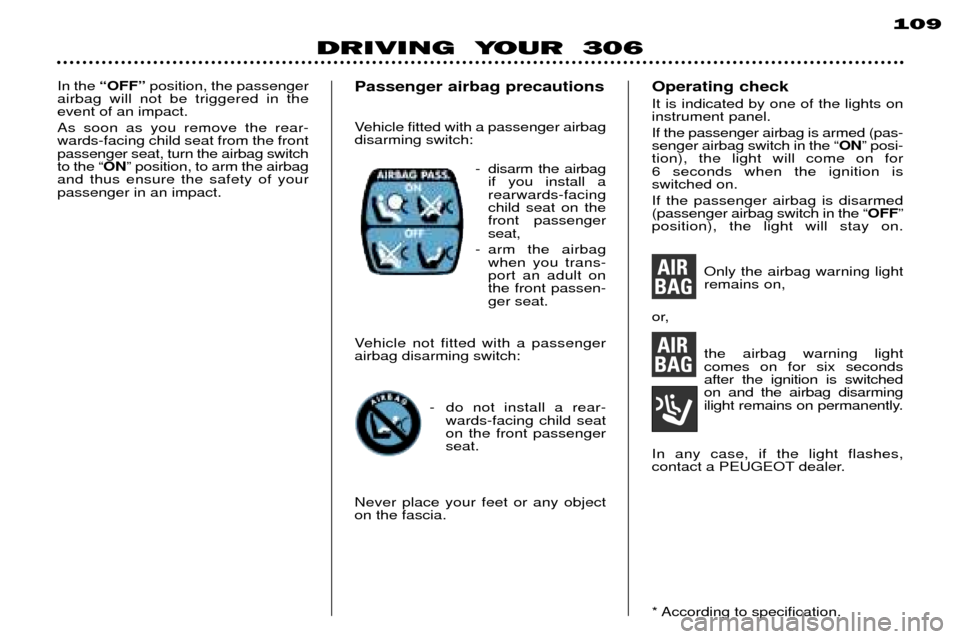
Vehicle fitted with a passenger airbag disarming switch:
- disarm the airbagif you install arearwards-facingchild seat on thefront passengerseat,
- arm the airbag when you trans-port an adult onthe front passen-ger seat.
Vehicle not fitted with a passengerairbag disarming switch:
- do not install a rear-wards-facing child seaton the front passengerseat.
Never place your feet or any object on the fascia. Operating check It is indicated by one of the lights on instrument panel. If the passenger airbag is armed (pas- senger airbag switch in the Ò
ONÓ posi-
tion), the light will come on for 6 seconds when the ignition isswitched on. If the passenger airbag is disarmed (passenger airbag switch in the Ò OFFÓ
position), the light will stay on.
Only the airbag warning lightremains on,
or,
the airbag warning lightcomes on for six secondsafter the ignition is switched
on and the airbag disarming
ilight remains on permanently.
In any case, if the light flashes,
contact a PEUGEOT dealer.
* According to specification.
Page 105 of 131
MAINTENANCE OF YOUR 30635
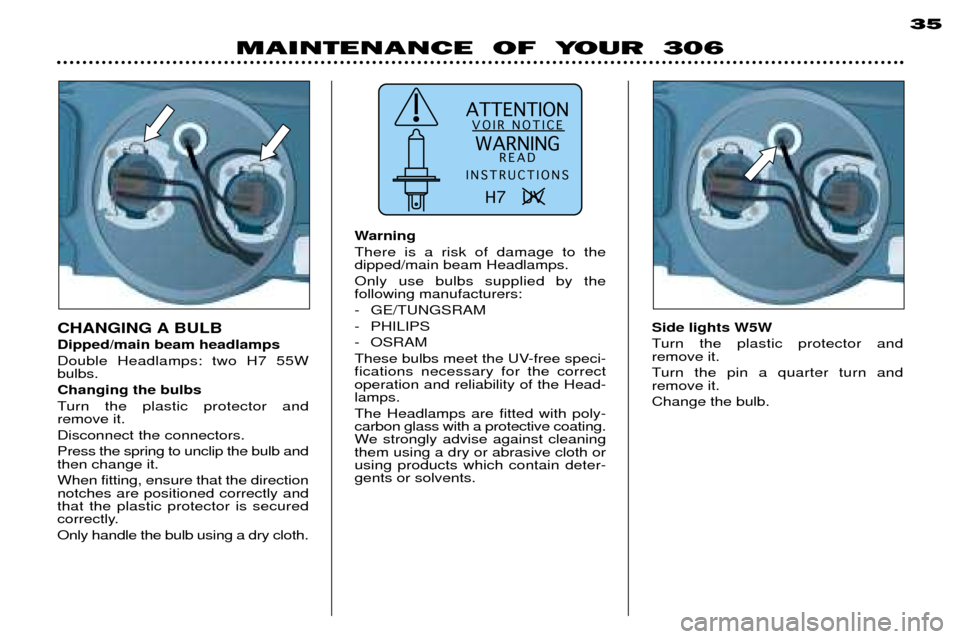
Side lights W5W
Turn the plastic protector and remove it.
Turn the pin a quarter turn and remove it. Change the bulb.
Dipped/main beam headlamps Double Headlamps: two H7 55W bulbs. Changing the bulbs
Turn the plastic protector and remove it. Disconnect the connectors.Press the spring to unclip the bulb and then change it. When fitting, ensure that the direction notches are positioned correctly andthat the plastic protector is secured
correctly. Only handle the bulb using a dry cloth. WarningThere is a risk of damage to the dipped/main beam Headlamps. Only use bulbs supplied by the following manufacturers:
- GE/TUNGSRAM
- PHILIPS
- OSRAM
These bulbs meet the UV-free speci- fications necessary for the correctoperation and reliability of the Head-lamps. The Headlamps are fitted with poly- carbon glass with a protective coating.
We strongly advise against cleaningthem using a dry or abrasive cloth orusing products which contain deter-gents or solvents.
ATTENTION
VOIR NOTICE
WARNING READ
INSTRUCTIONS
H7 UV
CHANGING A BULB
Page 109 of 131
MAINTENANCE OF YOUR 306
38
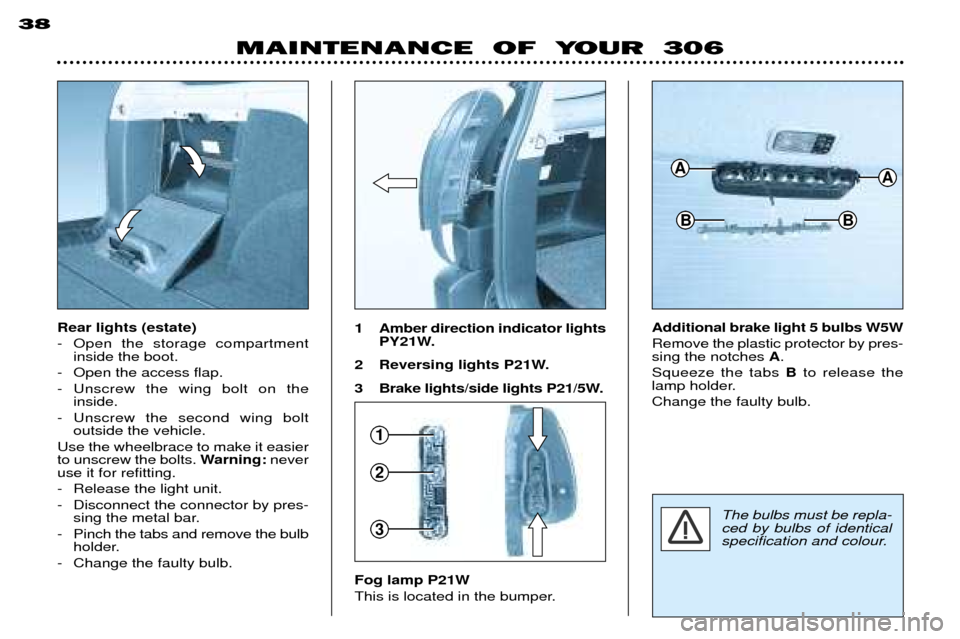
Rear lights (estate)
- Open the storage compartment
inside the boot.
- Open the access flap.
- Unscrew the wing bolt on the inside.
- Unscrew the second wing bolt outside the vehicle.
Use the wheelbrace to make it easier to unscrew the bolts. Warning:never
use it for refitting.
- Release the light unit.
- Disconnect the connector by pres- sing the metal bar.
- Pinch the tabs and remove the bulb holder.
- Change the faulty bulb.
Fog lamp P21W
This is located in the bumper.Additional brake light 5 bulbs W5WRemove the plastic protector by pres- sing the notches
A.
Squeeze the tabs Bto release the
lamp holder. Change the faulty bulb.
1 Amber direction indicator lights
PY21W.
2 Reversing lights P21W.
3 Brake lights/side lights P21/5W.
AA
BB
1
2
3The bulbs must be repla- ced by bulbs of identical
specification and colour.
Page 114 of 131
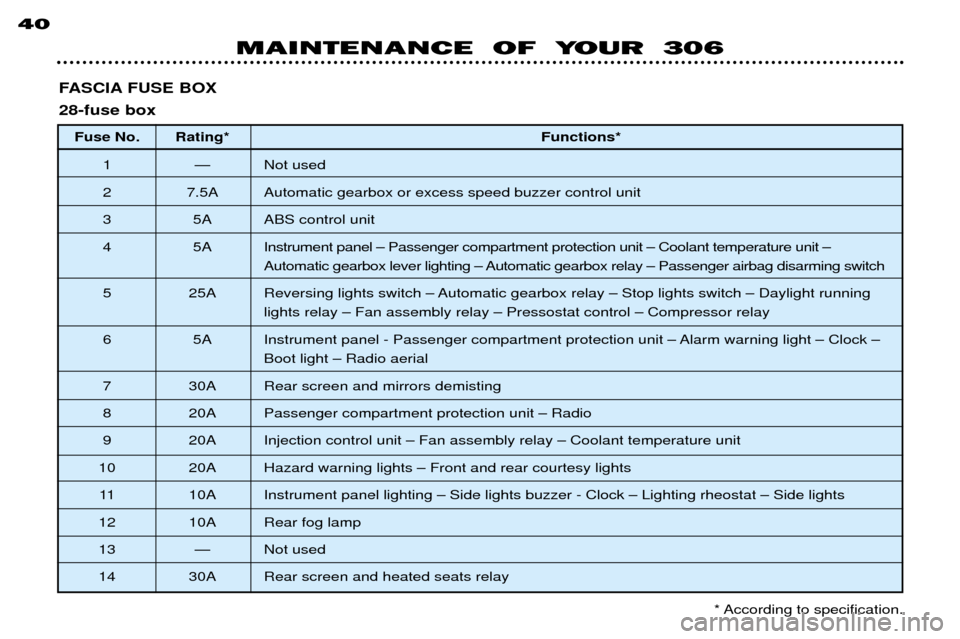
FASCIA FUSE BOX 28-fuse boxFuse No. Rating* Functions*
1 Ñ Not used
2 7.5A Automatic gearbox or excess speed buzzer control unit
3 5A ABS control unit
4 5A Instrument panel Ð Passenger compartment protection unit Ð Coolant temperature unit Ð Automatic gearbox lever lighting Ð Automatic gearbox relay Ð Passenger airbag disarming switch
5 25A Reversing lights switch Ð Automatic gearbox relay Ð Stop lights switch Ð Daylight running lights relay Ð Fan assembly relay Ð Pressostat control Ð Compressor relay
6 5A Instrument panel - Passenger compartment protection unit Ð Alarm warning light Ð Clock Ð Boot light Ð Radio aerial
7 30A Rear screen and mirrors demisting
8 20A Passenger compartment protection unit Ð Radio
9 20A Injection control unit Ð Fan assembly relay Ð Coolant temperature unit
10 20A Hazard warning lights Ð Front and rear courtesy lights
11 10A Instrument panel lighting Ð Side lights buzzer - Clock Ð Lighting rheostat Ð Side lights
12 10A Rear fog lamp
13 Ñ Not used
14 30A Rear screen and heated seats relay
MAINTENANCE OF YOUR 306
40
* According to specification.
Page 119 of 131

MAINTENANCE OF YOUR 30647
Driving advice Distribution of loads: distribute the load in the trailer so that the heaviestloads are as close as possible to theaxle and the nose weight is close tothe maximum authorised without,
however, exceeding it. Cooling:
towing a trailer on a slope
increases the coolant temperature. As the fan is electrically controlled, itscooling capacity is not dependent onthe engine speed.
On the contrary, use a high gear to lower the engine speed, and reduceyour speed. The maximum towing load on a long slope depends on the gradient andthe outside temperature. In all cases, pay attention to the coolant temperature. If the warning light comes on, stop the
vehicle and switch off the engine assoon as possible.
TOWING A TRAILER,
CARAVAN, BOAT ETC.
Only use original PEUGEOT towbars which have been tested and approvedfrom the design stage of your vehicle. The towbar must be fitted by a
PEUGEOT dealer.
Your vehicle is mainly designed for transporting people and luggage but it
may also be used to tow a trailer. Driving with a trailer subjects the towing vehicle to more significantforces and requires particular atten-
tion on the part of the driver. Air density decreases with altitude, thus also reducing engine perfor-
mance. Above 1000 metres, reducethe maximum towing load by 10 %and so on for each additional 1000 metres.
For use in arduous conditions(towed load at the limit of the Permis-
sible Gross Train Weight, in Summeron a long hill)
certain engines (1.9 l
Diesel) must be equipped with a
more resistant cooling system.
Consult a PEUGEOT dealer who, depending on your vehicle and what it
is used for, will be able to advise youabout suitable equipment. Pay attention to the coolant tempera- ture at all times. If the alarm warning light comes on,
stop the vehicle and switch off theengine as soon as possible.
Tyres: check the tyre pressures of the
towing vehicle and the trailer, obser- ving the recommended pressures. Brakes: towing increases the braking
distance. Drive at a moderate speed,
change down early, brake graduallyand avoid jerky braking. Lighting: adjust your headlamps so
as not to dazzle other road users. Check the electrical signalling on the
trailer. Side wind: sensitivity to side wind is
increased. Drive smoothly and at a moderate speed.